Guest Post by Michael Kile
 The IPCC’s latest serve of climate catastrophism, released just before the UN General Assembly met in New York last month, ironically contained some good news; but not even “inadequate” models, “limited” observations, poor understanding, dodgy “projections” and revelations about “deep uncertainty” could rein in the hyperbole.
The Intergovernmental Panel on Climate Change (IPCC) is the UN agency that “assesses” the status of climate-change science and produces reports on it. It also prepares a Summary for Policymakers (SPM). This document is crafted to be digestible by climate bureaucrats, national leaders and the media, most of whom have been drip-fed alarmist rhetoric for years, if not decades.
The IPCC is an odd outfit. Created in 1988 by the United Nations Environment Programme (UN Environment) and the World Meteorological Organization (WMO), it is no surprise to learn its Secretariat is located in the latter’s Geneva building. Except for the Secretary Abdalah Mokssit, a Moroccan applied mathematician and meteorologist, most of its 18 staff seem to be “communications and media specialists” or administrators. The current chair is Hoesung Lee, a South Korean economist. He was elected in late 2015, after the resignation of Rajendra Pachauri.
The assessment reports are described as “neutral, policy relevant but not policy prescriptive”. Translation: we are not telling you what to do, but encourage you to do what we are telling you. They are “drafted and reviewed in several stages”. This byzantine process with its own jargon – “a calibrated language for the communication of confidence” – apparently ensures “objectivity and transparency”. The IPCC does not conduct its own research.
As the reports “are a key input into the international negotiations to tackle climate change”, some critics suggest there is a conflict of interest here. Could a carefully selected group of scientists come up with a document contrary to the wishes of its founders or the UN itself, especially on an issue that has morphed into a global secular religion?
After all, a cynic might say any organisation that deliberately encourages eco-anxiety, radicalising juveniles “to meaningfully engage with decision-makers on the defining issue of our time” – as at the United Nations Youth Climate Summit 2019 – is capable of anything, even being economical with the truth.
More on that later. On 20 – 23 September the IPCC met in Monaco to consider its latest offering, a 173-page Special Report on the Ocean and Cryosphere in a Changing Climate (SROCC). Approved on 24 September, it was launched the next day at Monaco’s Oceanographic Museum.
The Final Draft, we are told, was prepared by 104 authors – 31 women and 73 men – from 36 countries, 19 (53%) of which were developing countries or countries with economies in transition.
Can truth be determined by the number of references, however broad, scrutinised for a research effort, or how many comments are made during an assessment?
If so, the SROCC is impressive, with 6,981 publications listed as references. As for comments, there were 31,176 from expert reviewers and governments in 80 countries (First Order Draft: 12,002; Second Order Draft: 16,137; Final Draft: 3037. None of them seem to be in the public domain.)
The SROCC’s key findings were then recast as a 42-page Summary for Policymakers (SPM) by 49 “drafting authors”, under the joint scientific leadership of IPCC Working Groups I and II.
The word “cryosphere”, is from the Greek kryos, meaning cold or ice. How many comments were exchanged trying to decide whether such a word, one that hardly slips off the tongue in six languages – Arabic, Chinese, English, French, Russian and Spanish – should be used in a report designed to hype the “existential crisis” of a Hothouse Earth? Climate alarmism is not a dish that is best served cold.
In the IPCC context, it “describes the frozen components of the Earth system, including snow, glaciers, ice-sheets and ice shelves, ice bergs and sea ice, ice on lakes and rivers as well as permafrost and seasonally frozen ground.”
A global media chorus of concern followed the report’s release before one could say How Dare You! Most agencies, however, seem to have read only the IPCC’s Press Release or the SPM. How dare they!
The Australian Broadcasting Commission (ABC) was one of them. On 26 September, two posts appeared on The World Today under the heading: “Climate change threat from the sea”:
- IPCC warns sea level rise could have catastrophic effects (4mins 46secs)
- Oceans may already be at warming tipping point, expert warns (5 mins 11 secs)
“The latest IPCC warning about the ‘catastrophic’ impact of climate change,” the ABC website declared, “concentrates on oceans and coastlines — and one expert says it may already be too late.”
One expert, of course, is sufficient when the end-game is alarmism. On this occasion it was Professor Matthew England, Deputy Director of the UNSW Climate Change Research Centre, and a contributing author on two earlier IPCC Assessment Reports.
“As we’ve been hearing, the IPCC report finds that the world’s oceans have been absorbing 90 per cent of the excess heat in our climate system and that’s been keeping atmospheric temperatures down.” If more wasn’t done “to tackle the problem, the implications for countries like Australia could be enormous.”
Professor England, “one of the world’s top oceanographers and climate scientists, warns we may be reaching a tipping point on that now,” said Eleanor Hall, the program host. “He says the IPCC warning of ‘catastrophic’ sea level rise is very unusual for a conservative organisation, and must be taken seriously.” It was a “very confronting finding”.
Professor England shared the IPCC’s concern. He baulked, however, at the tipping point suggestion like a wary horse in a steeplechase. It was a hurdle too far on the day: “We don’t know how close we are to these tipping points,” he replied. They apparently can be “discovered” only when we have passed them. In other words, they are unpredictable. Oops.
Could it be, dear reader, that tipping points are more at home at the races than in climate modeller nightmares?
Eleanor Hall: This report focuses on the oceans and the ice caps. It’s predicting more rapid sea level rises and faster melting of the ice caps compared to just five years ago. Some people accuse scientists of exaggerating the threat. Does this [new report] suggest scientists have been over-cautious in their predictions? (1.50min.)
Professor England: Part of what’s happening is a lot of these signals we previously saw creeping along at a certain rate, these have picked up in the last five years because we’re basically pumping more and more greenhouse gases into the atmosphere. They energise the system. They warm the oceans. They melt the polar ice caps. This acceleration is expected, but the fact it’s gone as high as we’ve seen has been surprising. (2.09min.)
Eleanor Hall: One scientist calls the Arctic sea ice decline unprecedented in at least a 1,000 years. Are we getting closer to some of the feared tipping points for climate change at the Earth’s poles?
Professor England: Yes, potentially. We don’t know how close we are to these tipping points. Unfortunately, they are only discovered once we’ve passed them. The Arctic’s a great example. Once the ice melts there, that system absorbs heat much more rapidly that a reflective ice surface. And that warming at the Arctic is so rapid that the Greenland Ice Sheet sitting right next to it is exposed to much warmer temperatures.
Unfortunately, there’s so much ice locked up there we’re talking a five metre sea level rise by 2300. (3.07mim.) All the world’s cities will have to be thinking about sea walls at massive costs or abandoning massive infrastructure.
When you have tipping points, you get such a rapid rate of change to the system that actually adapting becomes probably impossible.
Eleanor Hall: So you’re saying that even scientists are often not aware of when we’re approaching a tipping point?
Professor England: Yes. Tipping points come about due to the non-linearity of the [climate] system. What I mean by that is you get a small change triggering a larger impact. You can get breaking up of an ice sheet and a rate of sea-level rise that we are [initially] comfortable to adapt to. At the moment, we have had only 15 cm of sea-level rise over the last 30 to 40 years. That has already caused a lot of damage to the coast. But 15cm is a very tiny fraction of the five metres being forecast by 2300. (3.55min.)
I should say 2300 does sound like a long, long time away but it’s only six or seven generations. That’s why we’re seeing all these protests from students today. They’re recognising the fact that we’re leaving them with a huge debt.
Yes, he said it. Scientists are never – or seldom ever – aware of an “approaching” tipping point precisely because tipping points are unpredictable. Assertions to the contrary are somewhere between speculation and fear-mongering, given the “non-linearity of the [climate] system”.
Paradoxically, the global climate itself is what the IPCC used to call “a coupled non-linear chaotic system”, hence “long-term prediction of future climate states is not possible.” (IPCC 3rd Assessment Report; Section 14.2.2.2, p. 774, 2001).
The real mystery here, however, is not the climate. It is why so many researchers choose to remain silent about the veracity of modeller “forecasts”, especially decades or centuries ahead, even when the consequence is climate hysteria.
One can hardly blame the ABC. It merely quoted from the IPCC’s emphatic Monaco Press Release the previous day:
Sea level will continue to rise for centuries. It could reach around 30-60cm by 2100, even if greenhouse gas emissions are sharply reduced and global warming limited to well below 2C, but around 60-110cm if greenhouse gas emissions continue to increase strongly.
According to Valérie Masson-Delmotte, Co-Chair of IPCC Working Group I, the rate of sea level rise has accelerated in recent decades, “due to growing water inputs from ice sheets in Greenland and Antarctica, in addition to the contribution of melt water from glaciers and the expansion of warmer sea waters.”
One “feared tipping point” not discussed in the ABC interview was Antarctica, the world’s fifth largest continent. Ms Masson-Delmotte certainly mentioned it.
This new assessment also has revised upwards the projected contribution of the Antarctic ice sheet to sea level rise by 2100 in the case of high emissions of greenhouse gases,” she said. “The wider range of sea level projections for 2100 and beyond is related to how ice sheets will react to warming, especially in Antarctica, with major uncertainties still remaining. (IPCC Monaco Press Release, 25 September, 2019)
A phrase of just five words – with major uncertainties still remaining – but one with momentous implications. How can the IPCC justify revising upwards Antarctica’s projected contribution to global sea level given this admission?
The answer lies buried in an icy world of deep uncertainty, one where the planet’s coldest ever temperature was recorded on 21 July, 1983 – minus 128.56 degrees Fahrenheit (minus 89.2 degrees Celsius). Far too cold, surely, for melting of such a huge ice sheet to be a serious threat.
Ninety per cent of the world’s ice (29 million cubic kilometres) and approximately 80 per cent of its fresh water, is locked up in the Antarctic ice sheet. If all the ice were to melt, the level of the world’s oceans would rise by nearly 60 m. However, the response of the ice sheet to global warming is the largest unknown in projecting future sea level over the next 100–1000 years. Australian Antarctic Division
Furthermore, key SROCC “high confidence” alarmist statements are often contradicted or compromised by a “low confidence” statement, or by words like “potential”, “may be”, “within a few centuries”. For example:
3.3 Acceleration of ice flow and retreat in Antarctica, which has the potential to lead to sea-level rise of several metres within a few centuries, is observed in the Amundsen Sea Embayment of West Antarctica and in Wilkes Land, East Antarctica (very high confidence). These changes may be the onset of an irreversible ice sheet instability. Uncertainty related to the onset of ice sheet instability arises from limited observations, inadequate model representation of ice sheet processes, and limited understanding of the complex interactions between the atmosphere, ocean and the ice sheet. {3.3.1, Cross-Chapter Box 8 in Chapter 3, 4.2.3} (SROCC, 24 September, 2019)
It gets worse. From Chapter 1 of the SROCC Final Draft (pages 41 to 48):
In some cases, deep uncertainty (Cross-Chapter Box 5 in Chapter 1) may exist in current scientific assessments of the processes, rate, timing, magnitude, and consequences of future ocean and cryosphere changes. This includes physically plausible high-impact changes, such as high-end sea level rise scenarios.
Existing guidelines to ensure consistent treatment of uncertainties by IPCC author teams (Mastrandrea et al., 2010; Section 1.9.2) may not be sufficient to ensure the desired consistency or guide robust findings when conditions of deep uncertainty are present (Adler and HirschHadorn, 2014). The IPCC, and earlier assessments, encountered deep uncertainty when evaluating numerous aspects of the climate change problem.
Deep Uncertainty – Case B —Antarctic ice sheet and sea level rise: Dynamical ice loss from Antarctica (Cross-Chapter Box 8 in Chapter 3) provides an example of lack of knowledge about processes, and disagreement about appropriate models and probability distributions for representing uncertainty However, the magnitude of additional rise beyond 2100, and the probability of greater sea level rise than that included in the likely range before 2100, are characterised by deep uncertainty (Section 4.2.3).
What can be learned, the authors ask, from addressing the SROCC cases of deep uncertainty? In Case B above, the lack of “adequate” models produced “divergent views on the probability of ice loss and led to deep uncertainty”, but clearly not for the authors of the IPCC media release.
As in any good horror movie, the SROCC’s coup de grâce does not appear until the final pages, at least in Chapter 3. Note the “critical priorities for future initiatives” below and prepare for yet more model mania.
Overturning circulation in the Southern Ocean is a key factor that controls heat and carbon exchanges with the atmosphere, and hence global climate, however there are no direct measures of this and only sparse indirect indicators of how it may be changing. This is a critical weakness in sustained observations of the global ocean. (SROCC, Final draft, chapter 3, section 3.7, Key Knowledge Gaps and Uncertainties, 2019)
Snow depth on sea ice is essentially unmeasured, limiting mass balance estimates and ice thickness retrievals. Improved mechanistic understanding of the observed changes and trends in Antarctic sea ice is required, notably the decadal increase and very recent rapid retreat. This has consequences for climate, ecosystems and fisheries; however, lack of understanding and poor model performance translates to very limited predictive skill.
There is a need to better understand the evolution of polar glaciers and ice sheets, and their influences on global sea level. Longer and improved quantifications of their changes are required, especially where mass losses are greatest, and (relatedly) better attribution of natural versus anthropogenic drivers. Better understanding of the sensitivity of Antarctica to marine ice sheet instability is required, and whether recent changes in West Antarctica represent the onset of irreversible change.
So be vigilant when perusing an IPCC climate report. Read between the lines, especially the Press Release and Summary for Policymakers. For the Devil – or uncertainty monster – is indeed in the detail.
Who would have thought there are (page 173): “critical gaps in knowledge concerning interactions between the atmosphere and specific elements of the polar ocean and cryosphere”?
For me, one comment – the last in the SPM – reveals the UN’s real purpose here: co-opt the IPCC to develop a “scientific” argument validating its 17 Agenda 2030 Sustainable Development Goals (SDGs), while trumpeting the need for urgent “transformative change”.
This assessment of the ocean and cryosphere in a changing climate reveals the benefits of ambitious mitigation and effective adaptation for sustainable development and, conversely, the escalating costs and risks of delayed action. The potential to chart Climate Resilient Development Pathways varies within and among ocean, high mountain and polar land regions. Realising this potential depends on transformative change. This highlights the urgency of prioritising timely, ambitious, coordinated and enduring action. (very high confidence) {1.1, 1.8, Cross-Chapter Box 1, 2.3, 2.4, 3.5, 4.2.1, 4.2.2, 4.3.4, 4.4, Table 4.9, 5.5, 6.9, Cross-Chapter Box 9, Figure SPM.5 (SPM C4.7, page 42)
How dare you!
Michael Kile
1 October 2019
This article was first published in Australia at Quadrant Online
In 2016, at one of Hillary’s rallies, Bill Clinton had to step step in for sick Hillary, Bill said to the small crowd, “In a post truth era, facts no longer matter.’
That statement about sums it all up for those who have adopted the ambitious, arrogant, unscrupulous ideology of environmentalism and refuse to entertain reality, as in real world observational data on climate.
An atmospheric warming trend of +0.13 degrees C per decade since December 1978 (UAH satellite temp. data) does not represent a global warming crisis or a climate emergency. And those declaring climate change is an an existential threat are engaging in gross deception.
97% of U.N. member nations say that freedom and democracy are the cause of all human suffering, urge immediate action to mitigate freedom with a large dose of communism or totalirian reform! Snarc/
I know it’s only about 90% of the U.N. that is fascist, totalitarian or communist; but it’s the thought that counts!
Churchill’s original concept was a group of nations which followed liberal democratic policies but he was overruled by Roosevelt who seemed to have a serious bromance for Stalin. Too bad there was no one awake in the U.S. government as the communists went about undermining our schools and institutions. But I’m sure the kill counts are exaggerated and this time the intelligentsia will get it right. NOT!!
Tell me how air ( gas) can heat ocean ( water) …heat capacity?
quote :
“more greenhouse gases into the atmosphere. They energise the system. They warm the oceans. They melt the polar ice caps. ”
.
I must be missing some intermediate reaction. At most, I might accept slower cooling or slower warming aka isolation.
“Tell me how air ( gas) can heat ocean ( water) …heat capacity?”
Good question
The data are just as skeptical as you are
Pls see
https://tambonthongchai.com/2019/09/28/sea-ice-extent-area-1979-2018/
Simple answer is; It can’t!
Remember the League of Nations?–it failed miserably. The United Nations was set up to replace it, with the primary mandate to…prevent war.
I think we’d all agree that the worst offender to The Environment is war–remember the image of the oil wells burning when Saddam Hussein made an international statement simply about losing one?–no way I can make even my Cummins tailpipe do that. Can we list the major wars that the UN has not prevented?–in my lifetime, Korean war, Vietnam war, Yugoslav wars, Gulf Wars, Syrian war….
Just who is the UN, in any of it’s many factions, to lecture anyone else on this planet about a failure to prevent environmental damage? The UN, if honest, would just dismiss itself and everyone in it and go home in shame, not form an IPCC and tell everyone ‘Look Over Here!!’
This has never been about climate change or environment; it is about socio-economic change with marketers having figured out the psychology of how to stampede the buffalo over a cliff. There is indeed, however, a ‘tipping point’ that threatens–once the conversion to totalitarian governments has gone far enough in replacing democracies there will be no stopping the flood, there’s no turning back once we’ve lost the right to be heard. Even Peter Ridd has not won the right to be heard–despite being right. He is to be made an example of for others. The ‘tipping point’ is analogous to the cliff edge for the buffalo at Head Smashed In Buffalo Jump in Alberta.
History has shown that the only way to turn that clock back is with blood, and lots of it, for many years; dictators don’t give back control willingly, especially with lots of money behind them. Freedom is a lot harder to win back than it is to preserve–and look how effortlessly, even willingly the Gretadmirers are letting it go and stampeding toward the cliff.
The prevention of war may have been the UN’s purpose long ago, but it became clear early on that it was essentially useless in that regard. If I did some digging, I could probably find some statistics that cite the UN’s role in alleviating hunger, disease, and so forth, but ultimately it all comes down to money. Feeding hungry people involves first growing food, then transporting it, and finally distributing it. Money makes that happen.
In every instance where the UN helped people, it would have been better if the people had been able to help themselves, if they had never needed assistance in the first place. The UN is the greedy middleman, the world’s slum lord, a global welfare pimp. The UN perpetuates the world’s problems in order to maintain its own relevance.
The problem is not an unequal distribution of wealth, food, or housing. The problem is an unequal distribution of morality, decency, and rule of law. Does anyone believe that the world would not be a better place if good, decent people were in charge of things?
But that’s not how things are. Good, decent people are not in charge of things in most countries around the world, and the UN is a reflection of that reality. A giant step forward in progress of the human condition would be to accept that fact and abolish the UN. Repurpose the UN building as low-cost housing for the poor. Recall and repurpose all the diplomats and ancillary UN personnel to doing something useful in their home countries.
A critical evaluation of the IPCC/WMO case for the demise of sea ice by AGW
https://tambonthongchai.com/2019/09/28/sea-ice-extent-area-1979-2018/
“Tipping points, tipping points, tipping points ….”.
Your typical ABC audience would be blissfully ignorant of even the rudimentary geological knowledge of the Planet and would never bother to find out; Professor England knows that and is tailoring his remarks as if to frighten children because that is, in effect, what they are.
Is it two or four “tipping points” that bring you back to where you started?
Instead of declaring climate emergencies governments should be defunding the U.N. it has outlived its usefulness. Worse still it has become a detriment to those wishing to live in a free democratic society. The US should lead the way by throwing it off of our property. We could establish an alternate talk shop of nations meeting basic criteria for liberty. That would cut membership in half.
Bingo!
Troe speaketh the truth
https://tambonthongchai.com/2019/05/13/greta2/
Bearing in mind that for decades we have been told that ‘The Science is Settled’, it is strange to see how many arcane (but apparently vital) issues, urgently need armies of well paid boffins to investigate.
Send more cash. Now.
Meanwhile, I remember just in December 2018, at the UN CoP 24 Bunfight in Katowice, Poland, there were 406 delegates from Guinea, 237 from Democratic Republic of Congo and 208 from Ivory Coast.
I don’t want to disparage our chums from Africa, but even a glance at the statistics of literacy, health, human development, economy, deforestation, nutrition, corruption and so on (not to mention wars) suggests to me that maybe there are bigger problems than Climate Change in these countries (and in the rest of Africa.)
This is another facet of how the UN and their sock-puppet IPCC operates.
Who do you imagine picks up the tab for all this?
Go on, just guess.
How Dare They?
Meanwhile, at https://www.cia.gov/library/publications/the-world-factbook/fields/251.html#EK
we learn that, in 2017, there were 11 Million people in Guinea with no access to electricity. Another 10 Million in Ivory Coast and no less than 69 Million in DR Congo.
Clearly, none of the 851 ‘delegates’ from these Countries (who flew to CoP 24 in Poland) will be chosen from these 90 Million literally benighted people, who will likely also have only the ‘biomass’ they can gather to cook meals. They will be the extended families of the kleptocrats who ‘govern’ these Countries.
I’m sure there are millions of the 90 Million who are at least as bright as “Professor Shroudwaver” England. (Or “Dr. Fraudpants” Mann, for that matter.)
I’m certain that there are hundreds of Millions who are more honest than to consign Africa’s poor to grinding poverty, the outrageous levels of child slave labour, pitiful life expectancy just in order to advance their careers and line their pockets.
Even the DR Congo’s new Chinese Colonists, who buy the majority of Congo’s Cobalt for Electric Vehicles & for the kit to attempt to stabilise electrical grids with large components of Ruinable Energy, should feel a pang of conscience?
HOW DARE THEY?
A certain psycho troll is at it again and needs to be once again deleted and blocked.
That’s exactly backward.
Prof. England seems only to have heard of the effect of albedo on the absorption of solar radiation. But that’s not the most important effect. He’s apparently forgotten that radiation goes both directions.
Half of the time, sea ice coverage doesn’t affect absorption of sunlight at all, because there’s no sunlight to absorb, because it’s nighttime. But, 100% of the time, sea ice coverage reduces heat loss through radiation, convection and, most importantly, evaporation.
A layer of floating ice and snow insulates the water, generally keeping it warmer, rather than making it colder. Reducing that ice coverage has the opposite effect.
It’s an important negative feedback mechanism, which helps regulate water temperatures:
warmer water temp → less sea ice coverage → more heat loss, esp. thru evaporation → cooler water temp
In fact, the Arctic is a net exporter of radiant energy, nearly always. (There’s only a very brief period, just a few weeks long, near the summer solstice, in which absorbed solar energy barely exceeds radiated energy.) Here’s a paper:
L’Ecuyer, T. et al, 2015 (or here). The observed state of the energy budget in the early twenty-first century. J. Climate, 28, 8319-8346.
http://dx.doi.org/10.1175/JCLI-D-14-00556.1
Here are Figures 7 & 8 from that paper, with graphs showing the radiative energy budget at TOA, for various regions:
https://www.sealevel.info/2015_lecuyer_eeb_jcli_fig7-8.html
Look at the graph for the Arctic. Note that for almost the entire year the Arctic is a net exporter of radiation. (The difference is made up by air and water currents, which carry heat from lower latitudes.) Here’s that graph, enlarged:
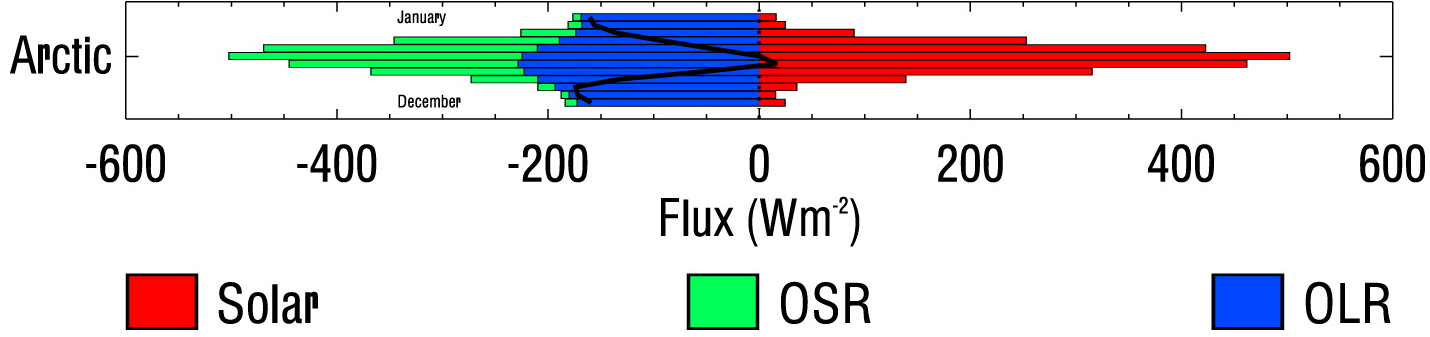
The black line is the net radiative balance.
So when you insulate the Arctic Ocean with a layer of ice & snow, for most of the year it helps keep the water warmer, and the air ends up staying colder.
Thus, when that ice melts, the water loses heat and moisture much more rapidly, which cools the water (rather than warms it!), which warms and moistens the air.
It’s a very large effect. Based on Nimbus-5 observations, Zwally, et al. 1983 reported that, “…the release of heat to the atmosphere from the open water is up to 100 times greater than the heat conducted through the ice.”
When the ice opens up next to Greenland, it does warm the air, but it doesn’t cause ice loss. Just the opposite, in fact: the most important effect is Lake/Ocean-Effect Snowfall (LOES), on the Greenland Ice Sheet. That snowfall represents water removed from the oceans, and accumulating on the Ice Sheet, adding to ice mass, and reducing sea-level.
Dave Burton. Thank you for the reference to the paper, L’Ecuyer, T. et al, 2015.
Your last paragraph from the report says:”… in a changing climate reveals…”.
So they have already determined the put come.
“Professor England: Part of what’s happening is a lot of these signals we previously saw creeping along at a certain rate, these have picked up in the last five years because we’re basically pumping more and more greenhouse gases into the atmosphere. They energise the system. They warm the oceans. They melt the polar ice caps. This acceleration is expected, but the fact it’s gone as high as we’ve seen has been surprising.”
It is amazing to me how a so-called “Professor” could be wrong on so many things in so few sentences.
First, a “lot of these signals” to which the Professor alludes obviously don’t include the following two key ones:
> Global lower atmospheric temperature, which is increasing at a CONSTANT rate of +0.13 C per decade since January 1979, based on UAH global measurements from satellites (UAH database Version 6.0 up to August 2019). That is, the best curve fit through those 40 years of data is LINEAR with absolutely no evidence of acceleration in the last 5 years (three of those five years showed declines).
> Global sea-level rise, which is increasing at a CONSTANT rate of 2.9 +/- 0.4 mm per year since 1992, based on the NOAA compilation of radar altimetry measurements from the TOPEX/Poseidon, Jason 1, Jason 2, and Jason 3 satellites. That is, the best curve fit through those 27 years of data is LINEAR with absolutely no evidence of acceleration in the last 5 years.
Lastly, it appears the Professor did not consider that a great many things in nature can reach an asymptotic or “saturation” limit. The most simple example is that when you first add salt to pure water, the water does become more salty with the increasing amount added; however, after adding a certain amount, the amount of salt the water can hold in solution is reached, and after that point adding more salt only increasing the amount of undissolved salt at the bottom of the water container. Given this, it is rather absurd to make a prediction that “pumping more and more greenhouses gases into the atmosphere” will cause any climate effect to “accelerate” (or, alternatively, to decelerate). The simple fact is the Earth has never experienced a runaway greenhouse effect despite having atmospheric CO2 levels more than ten times the present level of ~410 ppm.
“I should say 2300 does sound like a long, long time away but it’s only six or seven generations. That’s why we’re seeing all these protests from students today. They’re recognizing the fact that we’re leaving them with a huge debt.”
Looking back in time, that “six or seven” generations goes back to 1738–281 years. I seriously doubt students today have any grasp of what will likely be accomplished in that amount of time going forward. In 1738 the steam engine had only been invented 26 years earlier and King George III was still in a crib sucking his thumb.