Public Release: 19-Jan-2019
Scientists turn carbon emissions into usable energy
Ulsan National Institute of Science and Technology(UNIST)

IMAGE: This is a schematic illustration of Hybrid Na-CO2 System and its reaction mechanism. view more
Credit: UNIST
A recent study, affiliated with UNIST has developed a system that produces electricity and hydrogen (H2) while eliminating carbon dioxide (CO2), which is the main contributor of global warming.
Published This breakthrough has been led by Professor Guntae Kim in the School of Energy and Chemical Engineering at UNIST in collaboration with Professor Jaephil Cho in the Department of Energy Engineering and Professor Meilin Liu in the School of Materials Science and Engineering at Georgia Institute of Technology.
In this work, the research team presented Hybrid Na-CO2 system that can continuously produce electrical energy and hydrogen through efficient CO2 conversion with stable operation for over 1,000 hr from spontaneous CO2 dissolution in aqueous solution.
“Carbon capture, utilization, and sequestration (CCUS) technologies have recently received a great deal of attention for providing a pathway in dealing with global climate change,” says Professor Kim. “The key to that technology is the easy conversion of chemically stable CO2 molecules to other materials.” He adds, “Our new system has solved this problem with CO2 dissolution mechanism.”
Much of human CO2 emissions are absorbed by the ocean and turned into acidity. The researchers focused on this phenomenon and came up with the idea of melting CO2 into water to induce an electrochemical reaction. If acidity increases, the number of protons increases, which in turn increases the power to attract electrons. If a battery system is created based on this phenomenon, electricity can be produced by removing CO2.
Their Hybrid Na-CO2 System, just like a fuel cell, consists of a cathode (sodium metal), separator (NASICON), and anode (catalyst). Unlike other batteries, catalysts are contained in water and are connected by a lead wire to a cathode. When CO2 is injected into the water, the entire reaction gets started, eliminating CO2 and creating electricity and H2. At this time, the conversion efficiency of CO2 is high at 50%.
“This hybrid Na-CO2 cell, which adopts efficient CCUS technologies, not only utilizes CO2 as the resource for generating electrical energy but also produces the clean energy source, hydrogen,” says Jeongwon Kim in the Combined M.S/Ph.D. in Energy Engineering at UNIST, the co-first author for the research.
In particular, this system has shown stability to the point of operating for more than 1,000 hours without damage to electrodes. The system can be applied to remove CO2 by inducing voluntary chemical reactions.
“This research will lead to more derived research and will be able to produce H2 and electricity more effectively when electrolytes, separator, system design, and electrocatalysts are improved,” said Professor Kim.###
Journal Reference
Changmin Kim et. al., “Efficient CO2 Utilization via a Hybrid Na-CO2 System Based on CO2 Dissolution,” iScience, (2018).
From EurekAlert!
HT/David B
The ALP in Australia, on the cusp of federal election success, is promoting H2 ‘manufacture’.
The chief scientist is supposed to be working on this.
We have abundant LNG and coal.
Compressed hydrogen is such a dangerous product, as is liquid hydrogen.
Industrial scale liquid sodium would go up with a bang if anything went wrong.
Now a politician is trying to pick industries, a bad sign.
He needs to listen to Bob Hawke and Bill Gates and go down the nuclear road, but as a retail politician
and powerless against the Greens he wants us to go the H2 track.
Whither Australia?
https://www.smh.com.au/politics/federal/labor-predicts-next-resource-boom-with-1-billion-hydrogen-pledge-20190122-p50swe.html
When I got to the end of the first paragraph, after reading, “…while eliminating carbon dioxide (CO2), which is the main contributor of global warming.”, it quickly became clear spending further time reviewing this garbage would be a colossal waste.
And for every ton of coal burnt you get 7 tons of sodium bicarbonate. So for every unit train of coal delivered you need 7 unit trains to haul away the waste.
Being a railfan I like trains and like to watch them so I consider this a brilliant idea.
We just need some place to unload it.
Did anyone ask the ocean algae community about this? They have rights too!
This paper is embarrassing in its stupidity. As other commenters above have observed, apparently the authors seem unacquainted with the Law of Conservation of Energy
I find the paper Introduction amusing for some reason that I can’t quite put my finger on.
“Many RESEARCHERS BELIEVE that Global Warming and Climate Change are the result of carbon dioxide generated by HUMAN ACTIVITIES OVER THE CENTURIES (Jenkinson, et. al., 1991, OBAMA, 2017)
B. Obama, The Irreversible Momentum of Clean Energy, SCIENCE, 355 (2017) pp. 126-129
I also can’t quite figure out how this differs from bubbling the carbon dioxide into water, the dumping in some Na, collecting the H2 produced, and letting the water evaporate from the sodium bicarbonate solution. Since the pioneering work of the Nobel Prize winner, obama, stimulated this research, it must be good.
It never hurts to keep mentioning that a gallon of gasoline/diesel contains ~4 times the energy of a gallon of liquid H2. A gallon of LNG is about 3 times the energy density of H2. I have to say that engineering, which I thought was hard to make ‘lite’ like they have done in the arts to accommodate the ‘rights of all to a university education’ flood that engulfed universities. These people dont think like engineers.
To those who are concerned that this process is a voracious user of energy, all you need are lots of lovely windmills to power it! Just think of all of those contracts for research and building these things, loads of money…. /sarc
Any system that is designed primarily to prevent CO2 from entering the atmosphere is without merit.
The statement near the end of the abstract caught my attention (emphasis on “voluntary”): “The system can be applied to remove CO2 by inducing voluntary chemical reactions. I went back to the illustration and asked what is NASICON? From omniscient WIKI https://en.wikipedia.org/wiki/NASICON is a material that can be a film or a glass membrane. Back to the statement. Metallic sodium? Check. Water? Check? Fragile membrane separating the two? Check. So what we have is a potential involuntary chemical reaction.
We already have billions of free machines that turn carbon dioxide into glucose.
We call them trees.
Funny that ,I too thought that plants find the CO2 very useful.
And do an amazing job of storing energy ,all without any help from government funded experts.
I guess one needs an modern university education to know for sure that this ain’t so.
I’m surprised that as Chemical Engineers that they have forgotten the Laws of Thermodynamics. They’ve also incorrectly drawn their energy and mass balances around the system (as many have already alluded to so far). Perhaps if they’d gone the THE Ohio State University instead of GIT they’d know this. The best they can hope to achieve is a more efficient system; it’s impossible to get more energy out of the process than is input as that is akin to a perpetual motion machine. Since they are academics, they do not need to worry about the economics and industrial scale-up. But as long as there is free grant money from the EPA/DOE, what do they care?
Notice they don’t mention the dissolution rate of that chunk of sodium. Another researcher who either failed thermodynamics and energy balances, or is woefully under-educated for the current position. Rule number one is you can’t get something for nothing. Rule number two is that entropy makes it so you can’t even break even.
At the end of the paper, in the Limitations section, they state that they cannot rule out this step is very slow due to the ceramic electrolyte.
Which makes no sense.
The membrane I think is the ceramic, and the electrolyte is organic.
Everything about this setup is incredibly expensive and resource intensive…from the platinum electrodes, sodium metal anodes, sodium hydroxide in the reaction medium, and that electrolyte and membrane.
Their big breakthrough appears to be that they have devised a way to keep the platinum from getting clogged up…and this appears maybe by using the sodium hydroxide in the aqueous solution.
They state the process does not consume the anode, but to reconstitute it requires somehow putting it in seawater with it exploding and running electricity through it to pull sodium from the water.
They say nothing about how to do this except that it is “easy”.
…without it exploding…
As pointed out already, this title is totally untrue. CO2 can not be turned into ‘usable energy’. What they do, is store CO2 as Na2CO3 using manufactured metallic sodium. That process in totality consumes energy, it does not produce energy. Any claims of net energy would be a frawd, as it would contain perpetual motion.
That they get the title so wrong means they don’t know elementary chemistry.
Full Paper here:
https://www.cell.com/iscience/pdf/S2589-0042(18)30186-X.pdf
Supplement here:
https://ars.els-cdn.com/content/image/1-s2.0-S258900421830186X-mmc1.pdf
Reportedly, Na is not consumed.
In summary, we have devised hybrid Na-CO2 cell utilizing CO2 as a useful resource. This new system has
three distinctive advantages. First, it uses a kinetically fast HER as a discharge reaction thanks to a spontaneous CO2 dissolution, enabling the provision of high current compared with the present aprotic system.
Second, unlike conventional aprotic CO2 batteries, wherein solid products are clogged on the electrodes,
this system can continuously produce gas-phase hydrogen during discharge without damaging the electrode. This ability enabled highly stable performance to be achieved over 1,000 hr. Third, the proposed system has the unprecedented great advantage of not regenerating CO2 while recycling Na metal through
charging process. Therefore, this hybrid Na-CO2 cell truly fulfills the purpose of a real CCUS technology,
as it consumes CO2 efficiently throughout the process. This novel system could potentially serve as a
new CO2 utilization technology and a stepping stone for the future utilization of renewable energy
technologies
It also says Then, the electrochemical net equation is simply given as the oxidation of Na metal and the spontaneous evolution of hydrogen (Equation 5). And it says that it produces baking soda, which seems to imply Na is gradually used up.
Energetics of “recycling Na through charging process” seems not to be discussed. If I missed it, please let me know.
As others have commented, this seems much more costly than planting trees and shrubs, and growing crops.
I was just reading it more carefully and noticing their description in the text does not match the diagram at all.
Yes, the key details seems to be “regenerated by charging”!
But then what happens to the bicarbonate in solution?
It sounds like they run it one way, in an insanely expensive battery, then run it backwards by recharging?
This would imply that the CO2 is then regenerated.
They say the sodium is the cathode in the text, but the anode is the source of electrons in a battery, and is very definitely consumed, unless the battery is recharged in which case the entire reaction is reversed.
If you pull the sodium ions back out by recharging, the HCO3+ is not just gonna stay there by itself…every part of the reaction has to go the other way.
I see now.
First, they do “mechanically recharge the battery by replacing the sodium anode”.
The “recharging” process is done by “recycling” the removed anode, placing it in seawater, and applying electricity.
So there goes the free electricity they got in the discharge phase.
So they are left with sodium bicarbonate solution and acidified seawater!
Unless maybe they get chorine gas somehow.
Oh, BTW…that cathode appears to be ultrapure platinum.
And the initial aqueous solution is not water, but a mixture of brine, distilled water, and sodium hydroxide.
And pure CO2 is injected…it does not spontaneously draw CO2 from air as the article seems to imply.
IOW…this is a non-scalable and incredibly expensive process, requiring multiple costly inputs, and leaving two solutions that must be dealt with.
Sodium bicarbonate powder has value, but going from a solution of it to a powder takes energy.
And then they create acidified brine to reconstitute the sodium anode.
I am sure it takes a lot more power to recharge the plate than was gained.
And how exactly do they put a sodium anode in salt water without it exploding?
They do not say…they just state that since sodium is abundant in seawater, the sodium anode can be easily recycled
Minicholas, thanks for getting into the details more than I did.
This paper epitomizes the disdain that the AGW community has for the public. They really think that people are stupid enough to believe in their perpetual motion machine.
I wouldn’t write off this process too quickly. Even if it has minimal use as an energy producer and as CO2 reduction it is interesting and may have other applications. I would not be averse to funding a little further research. At least until the process is fully understood. And it may slightly placate the CO2 is evil club.
CO2 is definitely an advantage to plant growth and food production. It is possible it has some slight effect on atmospheric temperatures which may be detrimental or beneficial. It is also possible that rising CO2 will have some other previously undiscovered affect. Perhaps beneficial, perhaps not.
Research is healthy if it can be divorced from the confirmation bias evident in almost all results reported in the popular press regarding climate.
The process is fully understood. They corrode sodium to generate electricity and convert CO2 to bicarbonate ion. They just “forget” to include the fact that we don’t have any sodium trees around here. More energy goes into refining the sodium than they can get out. Otherwise, they are violating the first and second laws of thermodynamics.
Hmmm…
“Their Hybrid Na-CO2 System, just like a fuel cell, consists of a cathode (sodium metal), separator (NASICON), and anode (catalyst). Unlike other batteries, catalysts are contained in water and are connected by a lead wire to a cathode.”
The setup shown has the sodium metal as the anode, and is not a catalyst. A catalyst is not consumed in a reaction. But the anode in a battery is.
The description I quoted here is either a typo, or they do not know what they are talking about, which seems unlikely but cannot be ruled out, given that they think making sodium metal and using it to make a battery for turning CO2 in baking soda solution.
They state that CO2 must be injected into the water, and after 1000 hours it is “50% efficient”.
Does this mean that after 1000 hours they managed to react half of the CO2 injected?
In terms of money and energy, this setup is incredibly expensive, which most people associate with inefficiency.
Apparently organic electrolytes are very expensive as well, and making nonflammable and stable ones has been a major impediment to making more efficient lithium ion batteries.
While I know I shouldn’t,I really find the idea of Gang Green playing with large amounts of sodium metal to be a quite charming idea.
Just add water.
I think there is a TV show just for this kind of thing.
“The science of stupid?”
The activists hysterically concerned with stopping the use of fossil fuels will never embrace carbon capture, utilization, and sequestration (CCUS) technologies. The only energy sources they support are expensive and experimental “renewables.” We could make our electric grid completely non-coal generated* by building modern nuclear reactors.
These activists don’t want to find ways to make greenhouse gas emissions less disruptive**. They reject any discussions regarding the cost of stopping fossil fuel use vs the cost of correcting any damage from fossil fuel use. They have one and only one solution in mind. They are dogmatic zealots and fanatics and tolerate no dissent.
* The fracking revolution made the costs of natural-gas power generation competitive with coal with far fewer emissions. But the activists also want to ban fracking, despite the fact fracking is much more environmentally sound than coal mining.
** In my opinion, carbon-based greenhouse gas emissions, especially CO2, are generally harmless. The climate is not that sensitive to modest increases in the atmospheric CO2 levels.
As a GT alum, this is embarrassing to read. The first thing they teach there is TANSTAAFL.
I have invented a novel process of producing unicorn energy. It’s still a work in progress but here’s what I’ve got so far:
Step 1) Invent unicorns
Sorry, that’s as far as I’ve gotten. More funding needed.
“…carbon dioxide (CO2), which is the main contributor of global warming.”
Assertion presented as fact.
Assertion which is contrary to observation.
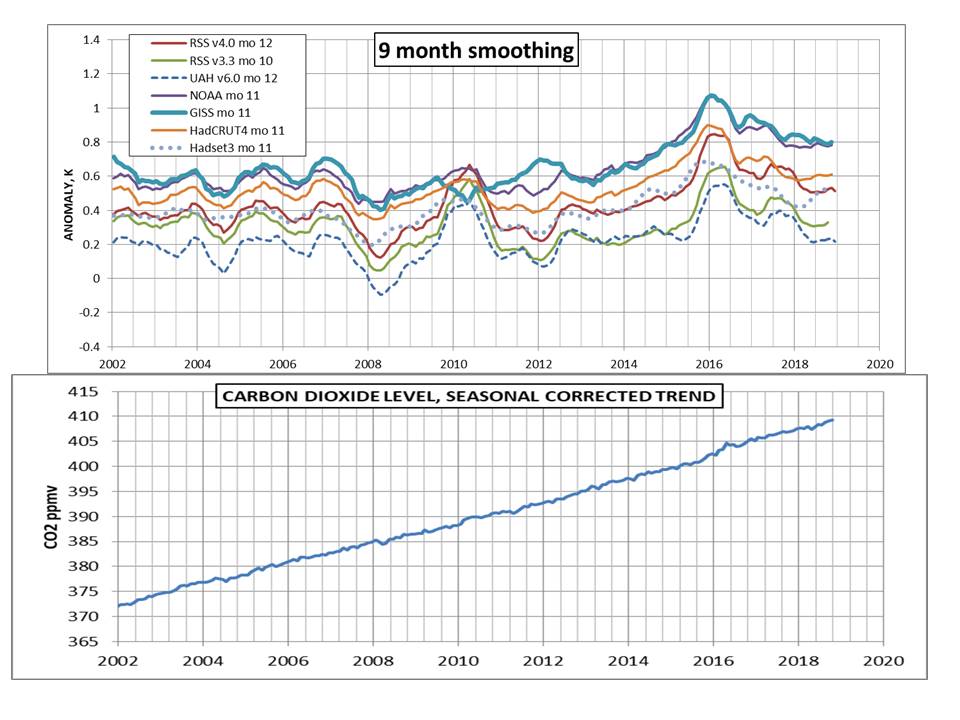
Is this back in time to alchemy???
No, the science and chemistry behind it are real. it’s just that it is an incredibly inefficient method to generate electricity.
If Climate Change were not the current rage, these guys wouldn’t have even gotten any money to study such a wasteful process.
Critical thinkers have a saying, “Just because you can doesn’t mean that you should.”
Metallic sodium is produced by the electrolysis of molten sodium chloride. This product is expensive (about $ 150 per kilogram) and dangerous: we will not allow contact with water and air. Only an absolutely ignorant person in engineering and economics could suggest using metallic sodium in a device for trapping CO2 from the air. Needless to say, the idea of capturing CO2 itself is absurd.