By Mike Bastasch
Scientists at the Scripps Institution of Oceanography recorded the warmest sea surface temperature taken in 102 years off the school’s pier in Southern California.

Scripps researchers recorded a high of 78.6 degrees Fahrenheit on Wednesday after a string of daily sea surface temperature records off the pier.
The researchers were quick to claim, “This is how global warming will play out,” according to a press release.

Wednesday’s sea surface temperature reading beat the previous record set on July 30, 1931, but only by 0.2 degrees Fahrenheit.
“It surpassed the previous record of 78.4°F (25.8°C) set on July 30, 1931, during an unusually warm period that year,” reads the Scripps release touting the new record temperature reading.
“Records related to heat and intense weather will become easier to break having been given a boost from anthropogenic climate change that has added about [one degree Celsius] to ocean temperatures over the past century,” scientists said, according to the release.
But while Scripps is trying to tie the record-high ocean reading to the broader wave of media coverage on global heat waves, there are a few caveats to note about what the scientists found.
First, these measurements are taken from a pier that’s near the shoreline, which would not necessarily make it representative of the entire Pacific Ocean, and therefore easily influenced by local weather events.
The “anomalously warm temperatures for the past week” that Scripps researchers observed at their pier somewhat mirror the temperature pattern in 1931, and indeed, the daily records broken in the past week have been very close to readings from 87 years ago.
There is an upward trend in temperature readings from Scripps’ pier, but the trend seems to also broadly coincide with the flipping of a natural ocean cycle, the Pacific Decadal Oscillation, to its warm phase. That flip occurred around 1976.

Source: Scripps Institution of Oceanography at the University of California San Diego
Also, the scientists themselves admit there’s lingering heat from the incredibly strong El Nino that peaked in 2016. Pacific Ocean temperatures don’t seem to have returned to normal in El Nino’s wake — in fact, forecasters say there’s a 65 percent of an El Nino forming this fall.
“It looks like we took a step up during 2014-2016 from which we have not completely recovered,” Scripps oceanographer Reinhard Flick said in a statement.
Scripps has been measuring sea surface temperatures and salinity off its pier since August 1916, and the school began gathering seafloor data in 1925.
Scripps still takes temperature measurements off its pier by hand, but in that time the technology used to log readings has changed dramatically.
Read more at Daily Caller
So
Like I said.
GB cycle is 87 years.
2018 -87 = ???
Bob Tisdale has a post on the 1976 climate shift
LINK
a 1995 published paper:
THE 1976-77 CLIMATE SHIFT OF THE PACIFIC OCEAN
By Arthur J. Miller, Daniel R. Cayan, Tim P. Barnett,
Nicholas E. Graham and Josef M. Oberhuber
OCEANOGRAPHY Vol. 7, No. 1, 1994
Recording essentially the same temperature as 87 years ago is just so scary. NOT!
What is not said is the oceans had been warming for 300 years prior to 1931 when man could have very little influence. It is much more likely that naturally warming oceans are the reason for a warmer atmosphere and not the other way around.
78.6 F? I don’t go in the Gulf unless it’s at least 80F.
The error margin between the methods and instruments used then and now will be far greater than 0.2F, even greater still if they’ve faffed with the data to supposedly make it compatible!
And it’s not as if this year’s concerted propaganda campaign hasn’t produced similar laughable claims, a few days ago in July by a similar margin – old record was 41.0C
“Japan heatwave: Temperature hits new historic record 41.1C, says Japanese weather agency.”
Let’s see if they can find another meaningless, isolated, and of questionable method temperature to report.
0.2 degrees Fahrenheit…..in 102 years
well, obviously the heat is not hiding there
Do surface temps really matter? Lake Michigan is chewing up and spitting out a lot of tourists these days because the surface temps are in the upper 60’s, but 18 inches down water is cold enough to cause hypothermia in 6-7 minutes.
‘This Is How Global Warming Will Play Out:’
Conditions that are practically indistinguishable from those observed 87 years ago?
I wish there was a description of the techniques used, in the past and currently.
There has been good discussion on water temp measurements here that show much affect the water temp readings.
Let me guess: There was a boat docked and idling its engines right next to the sea surface temperature sensor at the Scripps pier?
Yet, I don’t think any scientist can explain how CO2 can warm the ocean. If they can, then perhaps they will accurately project changes in ENSO, the AMO, and NAO. If you cannot forecast changes in ENSO, you cannot project changes in our climate
Climate folks seem to like to distinguish (sometimes) between local conditions and global indicators. Out of curiosity I got the data from three Southern CA pier stations (Scripps Pier, Newport Pier, and Stearns Wharf, which roughly span San Diego, LA, and Santa Barbara) at
http://sccoos.org/data/autoss/
Then I calculated the mean of the three stations’ reported temperatures every 2 hours and the standard deviations. I hope the plot shows up, here is and attempt to paste it, for what its worth.
First try did not work. Here is a maybe working link
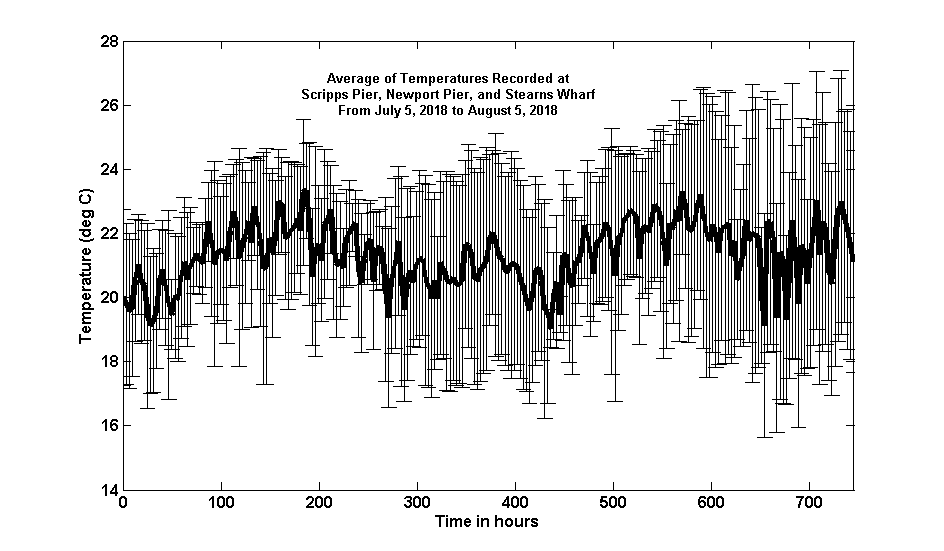
“It surpassed the previous record of 78.4°F (25.8°C) set on July 30, 1931″…?
I didn’t know they had Digital Thermometers with that accuracy in 1931 !
The Scripps Pier is also the location of a NOAA tide station. The most recent sea level measurements there are still lower than the peak measurements from the 1990s; approximately 6 inches lower than the peak El Nino year of 1998. The indicated long term sea level rise for this very credible tide station is only 2.17 mm per year, or 8.5 inches per 100 years.
Documented sea level decline since 1998. Guess this is how Global Warming will play out.
LAT’s – lead story in Sunday’s print edition, in the leading paragraph, quoted the Scripps Pier reading as 78.8 degrees (not 78.6), and failed to mention that it broke the 87 year-old record set in 1931 by only 0.20 F; proclaiming that this is proof of ‘man-made’ global warming.
LAT’s (print edition): “Record heat in California is no fluke, experts warn — Rising temperatures have fueled wildfire conditions and blunt talk from scientists about climate change” Here: http://www.latimes.com/local/lanow/la-me-california-july-hot-20180805-story.html
They shrill that “downtown L.A. recorded its hottest Thanksgiving Day on record at 92 degrees;”but fail to mention that the record high – still standing – for the month of November is 100 degrees, set on Nov 1, 1966 (would have been no to little AGW that far back).
In all of their shrill fear-mongering coverage this past month (and, it’s been every day) they decided not to share these still standing record heat waves for Los Angeles:
July 24, 1891 – 103
July 25, 1891 – 109 – Still standing as the all time record high for the month of July.
July 26, 1891 – 102
And, for Aug gets here, this one is still on the books:
Aug 17, 1885 – 104
Aug 18, 1885 – 102
Aug 19, 1885 – 106 – Still standing as the all time record high for the month of Aug.
All with no UHI effect.
“anthropogenic climate change that has added about [one degree Celsius] to ocean temperatures over the past century,”
I’m confused. If global warming has added about one degree Celsius to ocean temperatures over the past century then why was the record only broken by 0.2 degrees C?
The temperature on the day 04.08.2018.

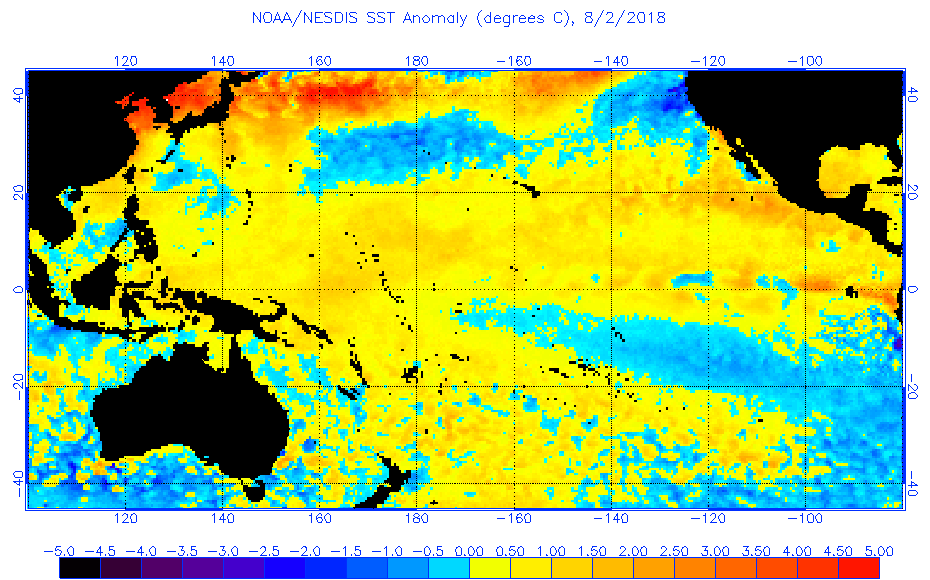
The troubling part of this release is ““Records related to heat and intense weather will become easier to break having been given a boost from anthropogenic climate change that has added about [one degree Celsius] to ocean temperatures over the past century,” scientists said, according to the release.”
I don’t think there is any valid data to support this statement. The very implication that ocean temperatures have changed more than atmospheric temps is not possible and that some ocean temps in certain areas have changed due to AGW is a stretch.
How do these things get by the reviewers or even the editors that print them?
the sky is falling….
the oceans are rising…
man when the 2 hit gonna make for an interesting day..
There the Climate Liars go again, confusing and conflating natural warming which is real, with “anthropogenic warming”, which may or may not exist, but if it does, is too small to measure. For the kabillionth time, yes, we know there has been some warming since the LIA, and damn good thing too. No, it doesn’t mean the warming will necessarily continue.
Of course, there is global warming – after the “Little ice age” ended some 140 years ago – by natural variability. I wonder, do the alarmists regret that the Little ice age no longer prevails?
A measurement of 78.6 implies a measurement accuracy of + or – .05 degrees. Is this even possible for these type measurements? I’m skeptical.
These are meaningless ocean temperature claims.
There were very few Southern Hemisphere
sea surface measurements
before 1940, and still not enough today.
The measurement methodology
has changed many times,
not to mention
changes in the locations
of the measurments:
– Wood buckets
– Canvas buckets
– Insulated canvas buckets
– Ship engine cooling water intake
– Disposable Bathythermograph
Sondes, and:
– ARGO Floating Buoys
As far as I know, there has never been a test
of all these six different measurement methodologies
in the same location, at the same time
to find out whether they all
provided the same temperature
measurement (of course they would not be the same,
and that’s why there will never be a test !)
I doubt if historical sea surface temperature
measurements margins of error could be
less than +/- 1 degree C., so a new record
by 0.2 degrees C. is meaningless.
It took 87 years to break the 1931 record
by 0.2 degrees C. ?
And is that supposed to scare people?
A “good” climate change article HAS to scare people,
or it is a waste of bandwidth — Leftists Rule 14b.
For example, and I am being serious here,
although I have not yet seen such an article yet,
I expect a future climate change article
to claim global warming is causing
man’s ‘favorite organ’ to shrink, at an
unprecedented rate
(the word unprecedented is mandatory
— Leftist Rule 16a).
My climate change blog:
http://www.elOnionBloggle.Blogspot.com
My pool in southern Arizona is running above 90 F now for 2 weeks. warmest Late July early August pool temp I’ve had in the 5 years I’ve owned my house here.
But July wasn’t particularly above normal. Hot as usual, with afternoon highs around 105-107 F, but I think the way the night time cloud cover has played-out has kept the usual radiative cooling suppressed. An analysis of night time lows would confirm or refute this possibility. But it’s not that important to me. I like the warm pool becasue it still feels great at night for swims.