
Guest essay by Eric Worrall
If we don’t immediately shut down global CO2 emissions, by the end of the century some Penguins might have to move to different islands – otherwise they’ll die!
As climate change worsens, king penguins will need to move — or they’ll die
‘I’m worried about the future of the species.’
If we don’t cut greenhouse gas emissions to address climate change, then by the end of the century, 70 percent of king penguins could face a tough decision: either find a new home or die, according to new research.
King penguins live on islands scattered throughout the Southern Ocean, the waters surrounding Antarctica. The birds can swim as far as 310 miles (500 kilometers) to feed on lanternfish, squids, and krill in a food belt circling the continent. But climate models show that this food belt will move closer and closer to the South Pole, forcing the penguins to swim farther to catch their meals. By 2100, the penguins are expected to migrate to other islands or as many as 70 percent of them could disappear, according to a study published today in Nature Climate Change.
“Wow,” says Michelle LaRue, a research ecologist at the University of Minnesota, who was not involved in the study. “That’s not something I would have expected.” Unlike their closest relatives, the emperor penguin, king penguins don’t live on sea ice. In fact, they only live on ice-free islands. So in a warming world, you’d expect penguins that don’t need ice to breed to fare just fine, LaRue tells The Verge. But today’s study shows that the cascading effects of climate change are incredibly complex and can affect species in a variety of ways.
…
The abstract of the study;
Climate-driven range shifts of the king penguin in a fragmented ecosystem
Robin Cristofari, Xiaoming Liu, Francesco Bonadonna, Yves Cherel, Pierre Pistorius, Yvon Le Maho, Virginie Raybaud, Nils Christian Stenseth, Céline Le Bohec & Emiliano Trucchi
Range shift is the primary short-term species response to rapid climate change, but it is often hampered by natural or anthropogenic habitat fragmentation. Different critical areas of a species’ niche may be exposed to heterogeneous environmental changes and modelling species response under such complex spatial and ecological scenarios presents well-known challenges. Here, we use a biophysical ecological niche model validated through population genomics and palaeodemography to reconstruct past range shifts and identify future vulnerable areas and potential refugia of the king penguin in the Southern Ocean. Integrating genomic and demographic data at the whole-species level with specific biophysical constraints, we present a refined framework for predicting the effect of climate change on species relying on spatially and ecologically distinct areas to complete their life cycle (for example, migratory animals, marine pelagic organisms and central-place foragers) and, in general, on species living in fragmented ecosystems.
Read more: https://www.nature.com/articles/s41558-018-0084-2
Penguins swim hundreds, even thousands of miles throughout their lives. Even if global warming occurs as rapidly as alarmists fear, I somehow doubt a gradual migration which occurs over a period of 80 years would be a major stress factor.
King penguins are about the least threatened of any penguin species. They are very numerous (>2 million pairs), they have a large distribution with numerous colonies on many different islands and they are apparently not very dependent on any specific prey species. They have increased strongly in recent decades. Recently they have even started breeding on the chilean part of Tierra del Fuego, which seems a somewhat odd move if they are under pressure from increasing heat: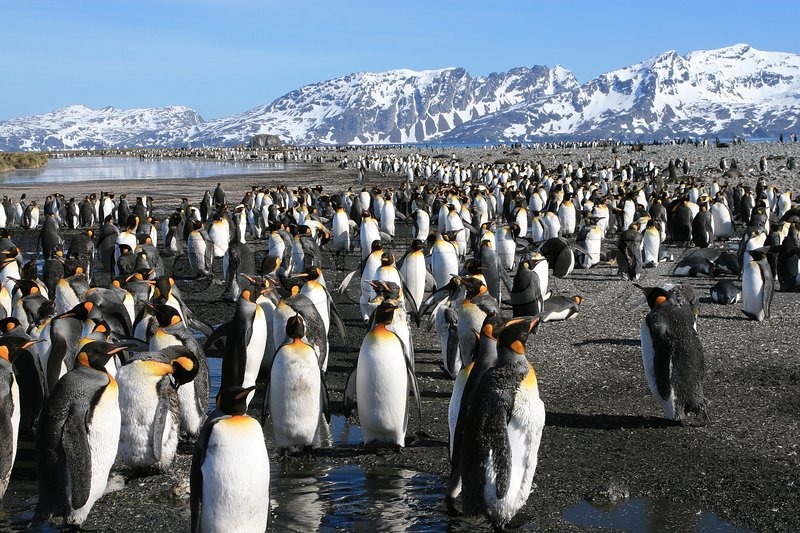
http://songoftheroad.com/wp-content/uploads/2015/06/ChileTierraDelFuego_33_KingPenguinsWideShot.jpg
This is really amazing habitat for king penguins. Usually it looks more like this (Salisbury plains South Georgia):
BBC radio in full-on hysteria mode this morning more like the headless chickens their reporters are than the much more intelligent penguins they are worried about.
I recall that the King penguins are the last surviving land species from Antarctica before it drifted over the southern pole and evolved to deal with their changing conditions?
But now they are suddenly all going to give up and die to support more twerpy alarmist/BBC extinction drivel.
Apparently more nonsense about the Great Barrier Reef is planned by the increasingly uninformed BBC this afternoon in some idiot programme entitled “Costing the Earth”. Tells you all you need to know.
The paper admits that king penguins wen through a severe reduction 20,000 years ago when it got colder, and the BBC admits that king penguin populations are increasing. They say they are “rebounding ” from hunting but that ended some time ago.
So populations fall when it is colder, populations now are increasing, but the model that assumes a bunch of changes will happen and that those changes will be bad for populations, shows it will be bad.
Who hunted penguins? For what purpose, food, feathers, webbed feet? (collectors for zoos and aquatic theme parks?) Are they including natural predation from orca and leopard seal “hunters”?
The accounts from Shackleton’s stranded expeditions record that penguins, while edible, are not very tasty. But, I suppose one could acquire a taste for almost anything if pressed hard enough.
C’mon, Rocket!
“Who hunted penguins? For what purpose, food, feathers, webbed feet? (collectors for zoos and aquatic theme parks?) Are they including natural predation from orca and leopard seal “hunters”?”
We all know it was the polar bears!
As it got warmer, they migrated to the Arctic. And the penguins thrived.
Gums…
“But today’s study shows that the cascading effects of climate change are incredibly complex and can affect species in a variety of ways.”
Gee, as a layman I don’t see this theory as “incredibly complex”. I must be missing something.
so one trace gas controls this “incredibly complex” theory ??? I take it “incredibly complex” in this case means “we tortured the model until it gave us the answer we wanted” …
Did you read the Nature paper? I couldn’t get past the paywall. If not, maybe you are missing something.
Wasn’t it a couple/few years ago it was too warm in their antarctic breeding grounds but too cold in their Southern tip of Africa to breed?
“It depends which kind of Earth you want to live on in the future: empty or full of nice species around us.”
Heh. I think these people inhabit a completely different sort of place; one where the sun never shines.
There is no real evidence that CO2 has any effect on climate and plenty of scientific reasoning to support the idea that the climate sensifity of CO2 is zero. Appaently the Penguins made it throuth the previous intergalcial period, the Eemian, which was warmer then the current intergalcial period with more ice cap melting and higher sea levels. They made it through the cool down to the last ice age, the ice age itself and the warm up to the Holocene maximum which was warmer than today. Today’s climate change seems trivial when compared to the past. The climate change is happening so slowly that the species has plenty of time to adapt.
“But today’s study shows that the cascading effects of climate change are incredibly complex and can affect species in a variety of ways.”
This hasn’t happened yet. Don’t these obtundent clones know that, so far, nothing has happened. They talk about it as if it was all around us and it is only electron sprites sporting and gamboling in a virtual fantasy world. The study shows nothing. It speculates. I came across a King Penguin moulting in a cave near sea level on the the southern coast of New Zealand near Balclutha/Papatowai. When the estuary was flooded by high tide, my late father-in-law and I used to go flounder spearing wearing waders and carrying a lantern and a burlap bag over our shoulders for the fish. The esturary was full of fish large and small and I’m sure my moulting penguin was doing fine re the vittles. I’m a Manitoba prairie boy so this was quite exotic to me, also digging cockles and pippis (shell fish) in the sand after tide went out. We would put the live shellfish into pails with some groats (sand-like cut oats) so the critters would evolve out the sand and take on the oats to remove grit from the feast.
Oh, but Gary, there are things happening. You won’t believe it, so of course things won’t make sense to you. The world will make less and less sense, the people will seem to lie more and more, and you will become ever more confused, paranoid and angry by the world around you.
The feed fish populations have dropped dramatically in the Pacific off the West Coast, and they suspect it’s due to the “warm blob” that’s sitting there (or was, I don’t know if it still is). Maybe climate change maybe not, but these are the kinds of things are predicted, and it’s not ridiculous to anticipate changes in the south.
Have you read the paper?
I haven’t, but I’m sure it goes far beyond what’s on verve or verge or whatever