Guest Essay by Kip Hansen (with help from Steve Case)
 Prologue: I have been writing recently about Sea Level Rise, both as particular local examples ( Guam, Canton, Miami, New York, and NY/NJ ) and in the series SEA LEVEL: Rise and Fall, of which this is the fourth installment.
# # # # #
How does one get a rise out of nothing?
Let’s see just how R. Steven Nerem, of the CU Sea Level Research Group, manages to pull that trick out of a hat. According to a report at Nature.com:
He [Steve Nerem] presented the as-yet-unpublished analysis on 13 July in New York City at a conference sponsored by the World Climate Research Programme and the International Oceanographic Commission. …. Nerem’s team calculated that the rate of sea-level rise increased from around 1.8 millimetres per year in 1993 to roughly 3.9 millimetres per year today as a result of global warming.
Hmmmm….let’s see what NOAA says on the matter, as of yesterday:

Now, that’s odd. NOAA NESDIS-Star [National Environmental Satellite, Data, and Information Service; Center for Satellite Applications and Research] doesn’t show anything like a sudden acceleration from 1993 data (right on NOAA’s 3.0 ± 0.4 mm/yr) to present — same exact trend line, the same figure given in the image title.
So, first things first — who is R. Steven Nerem?
Steve Nerem is a Sea Level Rise Alarm Evangelist — there is no other appropriate description. I have no doubt that he truly believes in his Cause, after all, he has traveled the world for the last year delivering the same presentation — exact same abstract — in San Francisco (Dec 2016), Bologna (Feb 2017), New York (July 2017), Miami (Oct 2017), and New Orleans (Dec 2017). Nerem is one of the co-authors of the infamous, three-years-late 2007 Comment in the journal Global and Planetary Change attempting to refute Nils-Axel Mörner’s 2004 paper (two links there) in the same journal. I covered the Mörner/Nerem/ Mörner exchange in SEA LEVEL: Rise and Fall – Part 3.
Steve Nerem was also co-author of the blatantly alarmist Washington Post article in May 2016, “10 things you should know about sea level rise and how bad it could be”, in which it is stated “Scientists estimate that if it warms by about 4 to 5 degrees Celsius (7.2 to 9 degrees Fahrenheit), which is projected to happen by the end of the century if we don’t act on climate change, then all the ice will eventually melt. That’s 230 feet of sea level rise.”
Dr. Nerem’s travelling show is described in a July 2017 Nature.com article titled “Satellite snafu masked true sea-level rise for decades”. The article relates details from Nerem’s oft-repeated presentation saying:
“As the Greenland ice sheet thaws, it is helping to raise the world’s sea levels.
The numbers didn’t add up. Even as Earth grew warmer and glaciers and ice sheets thawed, decades of satellite data seemed to show that the rate of sea-level rise was holding steady — or even declining.”
“Now, after puzzling over this discrepancy for years, scientists have identified its source: a problem with the calibration of a sensor on the first of several satellites launched to measure the height of the sea surface using radar. Adjusting the data to remove that error suggests that sea levels are indeed rising at faster rates each year.”
“Nerem’s team calculated that the rate of sea-level rise increased from around 1.8 millimetres per year in 1993 to roughly 3.9 millimetres per year today as a result of global warming. In addition to the satellite calibration error, his analysis also takes into account other factors that have influenced sea-level rise in the last several decades, such as the eruption of Mount Pinatubo in the Philippines in 1991 and the recent El Niño weather pattern.”
“If sea-level rise continues to accelerate at the current rate, Nerem says, the world’s oceans could rise by about 75 centimetres [ 29.5 inches] over the next century. That is in line with projections made by the Intergovernmental Panel on Climate Change in 2013.”
If this sounds to you a lot like what Nils-Axel Mörner has been saying all along, that SLR alarm has its origins in the ad hoc– after measurement — adjustments and ‘corrections’, you may have something.
Here’s the graph from Nerem’s CIRES faculty page:

In the text of the page, it states “We must also carefully assess the measurement errors and the influence of decadal variability on a relatively short 25-year record. While we are still completing this research, it appears that long-term sea level rise has accelerated from roughly 2 mm/year in the mid-1990s to 4 mm/year today (2017).” Of course, that statement is a little loosely worded — making it seem that the trend of the early part of this graph is around 2 mm/yr. In reality he is referring to the long-term, 20th century tide-gauge-based trend of 1.8-2.0 mm/yr in the first instance and to his “roughly 3.9 mm/yr” from his unpublished re-analysis. Notice that the trend line, instead of the usually seen straight line from 1993 to present is here represented as a curved acceleration trend.
The generally accepted view of these two figures is shown in this image:

Just last year, Nerem co-authored a paper titled “Is the detection of accelerated sea level rise imminent?” ( published in Aug 2016, just four months before Dr. Nerem hits the lecture trail ). The abstract concludes with “…a detectable acceleration is likely to emerge from the noise of internal climate variability in the coming decade.” and goes on to say “Over the 23-year time series, it shows that GMSL has been rising at a rate of 3.3 ± 0.4 mm/yr, but with notable inter-decadal variability. Our current best estimate of the rates during the first (1993–2002) and second (2003–2012) decades of the altimeter era are 3.5 and 2.7 mm/yr. There are several theories to explain this variability, but here we present an additional explanation, with important implications for anticipated near-future acceleration.”
They got real busy, and according to the Nature.com report found that elusive acceleration by December 2016.
How did they do it?
Easy, apparently. You see, the modern portion of the satellite sea level record is too widely shared to make any major changes — it is difficult to change it or adjust it — it has already exceeded its adjustment-budget, any more adjustment and it will go broke — so they [no laughing now ] again adjusted the past.
I will use NOAAs images and data to show how this was done:

This blinking image shows the usually viewed NOAA-NESDIS-STAR satellite SLR record graph, up to the end of 2017, colored for the four satellite missions that gathered the data. The second image, overlaid, shows the latest data from NASA JPL that includes the “updates” that Nerem is discussing. What we see here is that through a series of adjustments, they have raised the left end of the graph, the TOPEX Altimeter A data, by approximately 3-to-5 mm and made some very slight changes in the Altimeter B data. Raising the left end of the graph — 1993-1999 — then allows them to change the trend line from a slope of 3.0 to 3.18 mm/yr.
Nerem has one-upped that and used the same adjusted data to draw a curving acceleration trend which he claims shows 3.9 mm/yr.
Five (5) millimeters, the maximum change to any data point in the update, is a tad more than thickness of 3 US dimes stacked atop one another or, in Europe, the thickness of two 1 Euro coins stacked. In inches, 2/10ths of an inch. The dreadful, to-be-feared acceleration of Sea Level Rise is built out of the dubious corrections to TOPEX Altimeter A data alone — a full five mms, of six years of “bad data” from 1993 – 1999. Data which, if poor, should have been thrown out instead of adjusted to match a predetermined narrative.
Nothing whatever changes in the more dependable data from 1999 to Jan 2018. According to NOAA that 19 year record has not been changed at all and still shows exactly the same trend that it has always shown — approximate 3.0 ± 0.4 mm/yr. And nothing changes the fact that the latest altimeter data from new, improved Jason-3 show virtually zero SLR for over 2 years now — ZERO. We’ll have to wait and see what the enthusiasts do to make that match their narrative.
They have created an acceleration out of nothing.
# # # # #
PS: I think I’ll stick with this, the latest from NOAA:

# # # # #
WTWT:
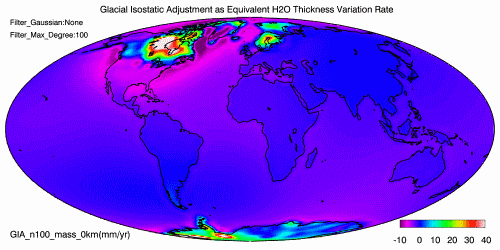
I am sorry to have to inform you, though, that it is worse than we thought. You see, the data used in determining satellite-based SLR in the above data and graphs, is not really sea level rise. That is, it does not represent (and never has) an actual increase in the level of the sea surface above the geoid (or, easier to imagine, increasing distance from the center of the Earth). Real sea level rise is reflected in a rise in Global Mean Sea Surface Height. But Global Mean SLR, as calculated by Colorado’s Sea Level Group, NOAA, and other SLR groups is a concept — not a measurement. I once used the phrase “imaginary number” to describe this type of non-physical metric — a number said to represent something in the real world, but in actuality, being something different altogether. I discuss in general how this comes about in an essay “What Are They Really Counting”. SLR satellite data includes things such as the “GIA Adjustment” — which is the amount of SLR that there would have been if the ocean basin hadn’t increased in volume and other additions and adjustments that cannot actually be found manifested in any change to the physical Sea Surface Height. But that’s a torrid tale for another time.
# # # # #
Series Take Home Messages:
- Overall, the seas have been rising, slowly and inexorably, since the end of the last Ice Age, with some blips and bumps along the way. In general, they will continue to do so for the foreseeable future — at somewhere between 4-12 inches [10-30cm] per century. This rate is an imminent threat to populated areas built nominally at today’s existing sea level.
- It does not seem that sea levels are rising dangerously or rapidly, nor is the rise accelerating, on a global scale — though our ability to measure global changes at these very small (millimetric) magnitudes is highly questionable.
- If Morner (and his 101 colleagues of the INQUA Commission) are correct, there has not been much actual sea level rise at all over the last 25 years (the satellite altimetry era).
- All of the above could mean that the constant drumbeat of doom regarding rising sea levels is based on the same sort of Computational Hubris that has brought us “average global temperature anomaly” in place of average global surface temperature.
- The touted “acceleration” in SLR is an alarmist talking point created from the disconnect between (mostly) tide-gauge data unadjusted for Vertical Land Movement at the tide-gauge site (vertical movement of the tide gauge itself) and the satellite altimetry data — a data set almost hopelessly confounded by measurement and physical elements orders of magnitude greater than the signal being sought.
# # # # #
Author’s Comment Policy:
I am always happy to read your comments and to try and answer your on-topic questions.
Sea Level Rise is an ongoing Scientific Controversy. This means that great care must be taken in reading and interpreting the past data, new studies and especially media coverage of the topic [including this series!] — bias and advocacy are rampant, opposing forces are firing repeated salvos at one another in the journals and in the press [this essay is about the latest salvo from Steve Nerem] and the consensus may well simply be “an accurate measure of the prevailing bias in the field.” (h/t John Ioannidis)
Sea Level Rise is being blatantly used as a scare tactic by advocates of Catastrophic Anthropogenic Global Warming/Climate Change. Sea level Rise — by now well-known to the general public as less than a foot per century — has been supplanted by Dangerous Sea Level Rise Acceleration as a talking point.
Steve Case brought the latest adjustments to my attention and supplied links and graphs — many thanks, Steve.
If you are speaking directly to me in your comment, begin it with “Kip…” so I am sure to see it.
# # # # #
For some reason the link to the one title above didn’t show:
https://www.aviso.altimetry.fr/fileadmin/documents/OSTST/2011/oral/02_Thursday/Splinter%203%20SCI/04%20Nerem%20ostst_2011_nerem.pdf
Here is a recent headline from live science.
The Bottom of the Ocean Is Sinking
https://goo.gl/pgCh96
And this is pasted directly from the article.
“As a result, satellite assessments of sea-level change — which don’t account for a sinking ocean bottom — could be underestimating the amount that seas are rising by 8 percent, according to the study.”
If warming can cause cooling then I guess it could be logical that sinking could cause rising or vice-versa.
rckkrgrd ==> Yes — nutty huh? The claim is we should be more worried because the sea isn’t rising as much as it might have if the ocean bottom didn’t sink….
“I guess it could be logical that sinking could cause rising or vice-versa.”
It does. This is a phenomenon that has been understood for a long time. Rising sea-levels will cause oceans and continental margins to sink and the rest of the continents to rise. Isostasy isn’t exactly cutting-edge. Here is a nice explanation of it…. from 1911:
https://www.jstor.org/stable/983933?seq=2#page_scan_tab_contents
Modern climate science is very largely rehashing well known facts with a bunch of unprecedenteds thrown in.
Yes isostasy is real but the study merely used a formula to estimate how much the ocean crust has been isostatically subsided from additional water volume. The entire ocean and continental crust doesn’t merely subside or uplift evenly, and that excerpt from 1911 is only correct in its assessment that oceanic and continental crust have different densities.
The downward force applied by a few millimeters of water in the ocean basins is completely negligible to the upward forces derived from the mantle. Even the isostatic adjustment from the melting of the Laurentide Ice Sheets and true global sea level rise of over 100 m can be completely dwarfed by tectonic subsidence and compression.
The vertical movement in crust from one major earthquake can measure meters (up to 10s of meters in some cases and perhaps more), whereas isostatic adjustment is on the order of mm/year.
People apparently thrive only when they are worried about something. To be worried that ice melts causing sea levels to rise during the peak of an interstadial period is the same thing as being worried that it is cold in winter and warm in summer.
Idiots.
Pamela ==> Having recently retired from a life at sea in the Caribbean to our crooked old home in the Central Hudson Valley of New York state — I am worried about the cold in Winter — don’t like it! My nose runs….my achy bones ache. Gads!
I hear you. But that is winter for you. Funny thing, back when the founding fathers endured summertime sweltering humid heat, they sent their families away to more comfortable climates. And more than a few handbills beckoned pioneers westward touting the milder winters. So that is my answer to snowflakes worried about what is just weather. Move.
https://tidesandcurrents.noaa.gov/sltrends/sltrends.html
Open this link and a map will appear with numerous multi colored arrows. Click on an arrow and the data for that location will appear, e.g. Miami. In the pop up window select “linear trend”.
2.39 mm/y, that’s 0.094” 3/32 of an INCH each year!!!! OOOOHHHHH SCARY!!!!
Which is NOT actually measured but computer MODELLED!!!!
0.78 ft over 100 YEARS or a WHOPPING 9 inches!!!!
Alarmists pushing the dangers of sea level rise are nothing but a pack of lying weasels!!!
nickreality65 ==> The SLTrends map shows only the very important, but irrelevant to Global issues, Relative Sea Levels and their rising and falling. The people of Miami need to know what the sea level is doing there..part of their city already lies below High High Water….almost all of their underground infrastructure is below existing sea level…they are a disaster waiting for nature to pull the trigger.
The Alarmists are not “lying” — surely exaggerating — they are just misguided, fooling themselves, and trying to “Save The World”.
But where sea level is concerned, there are no “Global issues” to worry about. All impact of sea level rise that affect humans will happen at the coast, and tide gauges will show us if there’s a local adaptation needed. Whether that local rise is a result of global SLR or not matters not at all.
In the case of Miami, the local mean sea level rise is (like pretty much everywhere else) extremely tiny and in itself extremely easy to adapt to. Miami, like many other coastal cities, is extremely vulnerable to much larger swings in much smaller periods, and that’s true whether the average sea level is going up or not. Protecting against that concern can also provide protection against many decades of SLR for very little additional cost. Mitigation measures that actually succeeded in eliminating SLR, if such a thing were possible, would protect against that concern not at all.
Surely you cannot talk about sea level rise without mentioning isostatic rebound?
Jules ==> Read the earlier essay in this series: SEA LEVEL: Rise and Fall- Part 2 – Tide Gauges
And more importantly than isostatic rebound is the general tectonic movement along active margins and sedimentation along passive margins.
http://www.danintranet.org/storymedia/13641.jpg
When eustasy is not changing fast enough to overwhelm regional changes, you don’t have global sea level rise, you have a global sea level stand still. This has been the case for at least 10,000 years.
“…a tad more than thickness of 3 US dimes stacked atop one another or, in Europe, the thickness of two 1 Euro coins stacked”
In real money that works out at three stacked 5 pence pieces.
Hart ==> You folks still use “5 pence pieces”…..? Where’s that? and can you supply an analog for the Aussies and Kiwis?
The internet is your friend…
But you didn’t answer the question as to why NOAA has failed to update their data since August 10, 2017.
Don’t you think that it is odd that 4 months of data has not been posted/added to this graphic? Any insight on why that might be?????
https://climate.nasa.gov/vital-signs/sea-level/
dscott ==> I didn’t know the question had been asked. The correct target for the question is Randal Jackson at the Earth Science Communications Team at NASA’s Jet Propulsion Laboratory | California Institute of Technology, the web site manager.
More generally, NASA is not NOAA — NOAA often is not even just NOAA. These are HUGE government bureaucracies — more bureaucracy than science often — and honestly, web site maintenance is usually a part-time assignment to some employee. Further, SLR is NOT A MEASUREMENT — it is a calculation, a conceptual construct created out of a lot of other data and opinions. They have a formula, method, and it takes time to arrive at a specific single number and make sure everyone agrees with it before it is published.
Even a careless glance at all the NOAA, NASA, JPL, EPA graphs of SLR show interesting differences, they are not the same graph made from the same data (it is not really data, but each groups “opinion”) — they are, for the most part, only similar.
Kip, any comments on the earth’s rotation rate changes?
Hart ==> Probably a little better understood than Dark Matter and Dark Energy?
A good, if old, explanation here.
Axel Morner wrote a paper on rotation rate and sea level rise about 25 years ago. The abstract is at https://www.jstor.org/stable/4298049 His conclusion seems to be 11cm or less SLR for the 100 years prior to his study. I didn’t look for anything more modern
CAVEAT – Morner pretty consistently has the lowest estimates of SLR among the serious experts. Doesn’t mean he’s wrong, but if he is, he’s probably more likely be too low than too high.
Don K == Morner 2013 takes that estimate from “:our best estimate of possible future sea level changes is + 10 ± 10 cm in a century [or 4 inches per century (10cm) with possibilities down to zero or up to 8 inches] or, maybe, even +5 ± 15 cm [2 to 8 inches] [2 inches per century with the possibility of minus 4 inches to plus 8 inches].”
Its the serious suggestion of the possibility of MINUS 10 cm/century that upsets some people. 🙂
Michael,
If you follow my series of articles on climate change at Climate.Etc I’m talking about the relationship between rotation rate and climate in my next article that should be up later this month. It is very interesting stuff.
Thanks, Javier, I’ll keep an eye open for it. My question to Kip was based on whether recent LoD changes supported the idea of mass loss at the poles (which is assumed to also affect sea level changes). My understanding was that it was another piece of evidence that did not support the alarmist cause, but I’m interested to hear the latest news and opinions on the matter.
Even still . . . “Nerem’s team calculated that the rate of sea-level rise increased from around 1.8 millimetres per year in 1993 to roughly 3.9 millimetres per year today as a result of global warming.”
Whether they are correct, or not, did they mean to say, ‘because of some additional GW, AGW, or, are they suggesting that all GW is man-made?
Put another way – was the ‘1.8 mm/yr’ rate of SLR prior to 1993 not because of GW? Or, was it less then because there was no human footprint on GW yet?
Just what did they intend to blame it on. Can’t any of these “scientists” even manage to use the correct terms?
garyh845 ==> You are not wrong, but the fault is probably that of the journalist.
That section of the report compares the old tide-gauge-based century average rate with the new satellite-based rate — there has not yet been a good explanation for the disconnect — but read this entire series for some insight.
Hey Kip – this is a super series which you’ve put together.
My point was only about them – and for that matter, all of us – using the correct terms when speaking of what’s expected to be naturally occurring, and about the view that some additional GW, AGW, is predicted to result in some changes (catastrophic, but of course) in CC, ACC or CACC.
Yes – the media is the worst of it, but the literature from the scientific community, and especially the groups like the IPCC and the National Climate Assessment, and the academies and associations, in making their dire predictions generally only use language like this, and it under the banner of either simply, “global warming,” or “climate change:”
Sea levels are rising.
Glaciers are melting.
The oceans are warming.
Corals are dying.
The broad public is only seeing that all these things are because of AGHG emissions, and if we address that then all of these events will magically cease.
I’m suggesting that the we, the skeptical community, always keep the “A,” in GW and CC.
Let’s simply look at the headlines on Marc’s home page:
CLAIM: ‘Climate Change May Have Helped Spark Iran’s Protests’
Study claims: Earth will become a DESERT by 2050 if global warming isn’t stopped
CLAIM: Scientists Can Now Blame Individual Natural Disasters on Climate Change
WaPo: ‘Climate change is turning 99% of these baby sea turtles female’
Washington Gov Claims ‘Just 59 Days’ To Save Children From Global Warming
But then, even Bastardi doesn’t use the correct term . .
‘Insanity…It’s Witchcraft’ – Meteorologist Joe Bastardi on claims that cold & snow caused by ‘global warming’
I suspect that most of us believe that much to most of the GW since even 1950 is naturally occurring, with many allowing that there probably is some additional warming caused by man, AGW. Bastardi should be saying, ” , , caused by man-made global warming.’
My goal is to get our skeptical politicians to always use the correct terms when being interviewed, etc. For example:
Wolfe Blitzer: “So Senator, do you believe in climate change?”
Senator: “Would you be more specific Wolfe?”
Then, the audience will be tweaked – perhaps even start thinking a little bit more critically. Actually, I believe that a few journalists out there, will actually come back and be more accurate like, “I mean, do you believe that AGW will result in some forms of unnatural climate change?” If they don’t then the Senator can state their view based on that criteria.
Wolfe: But sea levels are rising Senator, putting our cities at grave risk.
Senator: Wolfe, SL’s were rising before the consensus view of when a human footprint in GW potentially became observable (1950’s – 1970’s)
Just a few weeks ago someone published a completely theoretical based study that concluded that the rising sea level has depressed the entire ocean crust down by 0.04 inches. Newsweek then came to the conclusion that this was making sea level rise even worse. We’re dealing with a special kind of person when debating climastrology, I can’t wait for the red team v blue team.
There will be no catastrophe due to sea level rise.
What a disappointment.
Another setback for the misanthrope doomers.
Myself. I know that with our climate and sea-level and ozone hole and world population boom, etcetera, is just as it should be The Earth is fine.
There is another easy way to prove that the satellite rate given inherent m asurement uncertainty AND Nerem are wrong. Global SLR must approximately equal thermosteric rise (estimable using ARGO) plus ice sheet mass loss (estimable from GRACE with diff GPS measurements of Antarctica GiA). The answer is 2.2-2.3,not 3.9. Detailed in my guest post here some time ago on SLR, acceleration, and closure.
ristvan ==> if you were in one of the Sea Level groups, you would be asked to modify your findings to more closely match the findings of others.
Personally, I think the correct answer is: “Not So Much, more or less a bit.”
Any discussions about fake catastrophic sea level rise should include the lack of acceleration in the decrease in the speed of the earth’s rotation which is easy to measure and not detected.
Kip, as always, a sober, quiet, logical assessment – the kind that wins over a reader looking for answers, and also a good model for some of us more excitable types outraged and jaded by the politicization and deconstruction of science, scholarly pursuit in general and civil discourse. Thank you (I’m trying harder!).
You touched on a good point that I remember remarking on when the adjustment was made to SLR by adding on the ocean basin volumetric increases due to glacial rebound effects. It was small, but just another annoying change that augmented the alarmist trend. At the time I remarked that now we have an adjustment that raises sea level above the water level making it a truly imaginary metric. You made the same observation but I think the impact of this foolishness would be greater on the reader right up at the front of the article. Essentially, temperature measurement has the same quality. We have a temperature record that nowhere seems to touch on the curve measured by actual thermometers.
It is argued by BEST and all the others they
had to make chages because of time of day readings, station moves …which I wouldn’t have a lot of trouble with. But then they put in an algorithm to handle inter-annual shifts in T that they reasoned needed to be removed by shifting an entire length of the record to match without any ‘discontinuity and they got to choose which segment had to be shifted which way – and the effect was to increase the trend significantly, I cry foul.
My main argument against SLR and T manipulations is the need to keep purpose in mind. If the worry is about 1-3m of SLR by 2100 (early Hansen) we needn’t be rushing down to the sea with a micrometer. A yardstick or even an axhandle would be a suitable instrument, or even eyeballing the status of peril for the inundation of the West Side Hwy. Global warming progress- a half dozen thermometers in the arctic; average them and divide by 3 for the globe.
Gary ==> Thank you – as for science, we truly live in interesting times.
Kip,
We had an earlier exchange during your last installment on sea level rise
https://wattsupwiththat.com/2017/12/19/sea-level-rise-and-fall-part-3-computational-hubris/#comment-2697291
Nothing in your latest article removes the suspicion that Dr. Nerem is in career preservation mode and is diddling the science to fit the narrative. Membership in the “science club” not only allows Nerem job, salary and benefits it also allows him to expense account trips to meetings in San Francisco (Dec 2016), Bologna (Feb 2017), New York (July 2017), Miami (Oct 2017), and New Orleans (Dec 2017) on the same abstract. He probably isn’t flying coach-class either. Furthermore, as you show in this new post the science adjustments always seem to go in the same direction – that of supporting the consensus narrative. So I’ll ask again, do you still believe him to not be misleading the rather large sea level group at CU?
nvw ==> Nerem is a popular co-author on Sea Level issues, not only with his local colleagues, but in the international sea level cadre. He certainly is an “enthusiast” — and, by my reckoning, as SLR Alarm Evangelist. What influence he may have over the science of others is unknown to me — but in the SLR crowd, his views are common as dirt — he is not an outlier.
Kip,
I seem to be missing something here. In your “blinking image,” The trend line appears to have decreased in slope rather than increased! What’s wrong with this picture?
Clyde ==> I have to depend on the text included on each graph. The graph with the NOAA/NESDIS/STAR logo says “3.0 ± 0.4 mm/yr” up near the logo, and the one from the NOAA/JPL update site is clearly marked (by them) “linear rate = 3.18 ± 0.4 mm/yr”.
Visually, I must agree with you, it appears to be a decreased slope.
To be blunt, as the author of this article, you need to sort that and find the error, from wherever it may be. You can’t cite slope values which are *seen to be* wrong — because your article loses its veracity.
Specifically, the vertical scales are not the same for the blinking and steady components.
I’m guessing they’ve “adjusted” it in the interim — to increase sea level volumetric rise, presumably — some nonsense like the sea floor is widening due to the sea level increase, whatever it takes to paint a more alarmist picture. What you’ve done to best display the trend change, is overlay them to a chi-square minimum. That’s the right technique, all you need do is state that the vertical axes are different from each other to make this problem go away. Unfortunately, you’d probably also need to summarize (in a footnote or caption) why the axis changed — I suggest in the caption, in parentheses, so as not to distract from the article topic. OK, I’m outta here.
NZ Willy ==> Just to make it plain — I only show their data and their graphs — laying one atop the other — I Ieave their titles and other text as is (I move some of it so it doesn’t overlap) — thus preventing any claims that I have altered their results. I give links in the text to the original images on their sites of origin — trying to as fair and disinterested as possible, despite my own clearly expressed opinions.
I am as careful as I know how to be — I am a science journalist — a science essayist — trying to give a clear picture of a scientific point, as best I can.
I do appreciate your thoughtful input.
NZ Willy ==> I am afraid you are mistaken. The 1999 to present traces align [almost] exactly and the only change is shown in the TOPEX ALt A data (which agrees with the textual description of the update).
The numerical y-axis is different as they center the zero at different times.
The only remaining question is the method of determining the “linear rate” used in the update — they simply don’t say. It is not really an important question — as each and every SLR group has their own version of a similar (but not identical) graph with their own determinations of long-term trend.
Part of gthe reason for this lies in the idea that SLR from satellite data is a concept, not a measurement, and each group has a slightly varying idea of what should be added, subtracted, and adjusted to their own model, thus different time series and different slopes.
Much of this will be resolved when Nerem and his group actually publish their update findings so we can take a look under the hood.
Kip, nah, the numerical y-axes are not different just at the zero point (else I wouldn’t have mentioned it), but in their scales. The blinking graph goes from approx -40 to +50 (thus a range of 90), the steady graph from approx -20 to +60 (a range of 80). So the blinking graph’s vertical scale is compressed about 12% compared with the steady graph, and that’s why the blinking slope looks flatter than the steady one even though its numeric value is in fact larger.
NZ Willy ==> Let me repeat myself. The different grloups (in this case NOAA -NESDIS_STAR and NASA/JPL) all do their won calculations and present differing numerical values for SLR,
Thus their graphs are different. They don’t agree numerically — only way to compare them to to align the majority of the data features — if 80% of the traces align atop one another, then we must accept that we have done the best we can. We ar4e only trying to determine the differences — the changes — and this we do visually.
You can go to the link and see the actual numerical output for the update graph (NASA/JPL).
Using the JPL provided text file numerical values for the 2017 update vs 2018 update, we see this:
That is the change that has been made.
I wanted to show it against the more familiar NOAA graph, and made the blinker.
Jason 3 will be dealt to for heresy, even if they have to announce it’s been hit by a meteoroid which threw its sensor off but don’t worry we’ll adjust its output to compensate.
I have some real issues with the alarm bells being rung over a rise of a few millimeters in water levels, so bear with me.
1 – There is plenty of geological evidence to show that sea levels everywhere have risen and fallen, long before humans entered the picture. It’s all over this planet, it has been going on for millions of years, and that includes the shark nesting grounds in the Chesapeake/Delaware area. There are fossil shark teeth embedded all over the place out there.
2 – Where I live now is part of what a geologist termed the Lake Michigan scoop. I spent 30 years living in Chicago one block off Clark Street. The slope from Clark Street covers many blocks, and I’d politely put the real distance of that slope at about 2.5 miles, with adjustments for the vagaries of the lake shore itself. The landscape from the lake shore to several miles west of me is composed of hills and valleys, which is more obvious over at the Indiana Dunes State Park area. You can find the same gigantic sand ripples or ridges wherever Lake Michigan used to cover this area, until it retreated some thousands of years ago. You can easily see how far inland the edge of the “scoop” went by looking at the western shore of Green Bay and following that line south. This entire area consists of ancient, ancient beach.
Now someone is complaining that Lake Michigan’s “rise” is going to destroy the “wetlands” around here,as if there is no recourse for wildlife and they will all die off. This is baloney. The lake expands and retreats on a whim. All the Great Lakes do that. I’m more concerned about the sieches that occur on an irregular basis, especially since the lake levels rise and fall because that is the nature of the Great Lakes.
3 – I’m not sure what this dude’s issue really is, other than a need for other people’s cash and some attention. But if he doesn’t understand that a rise of 2 to 3 millimeters is less than the thickness of the soles of his shoes, he’s not much of an observer, in my view. He presents himself as someone who would panic a the sight of high surf (which surfers love) at the beaches of Hawaii, even though those massive swells are the result of storm activity far away.
4 – If anything, ocean levels will retreat, because they fluctuate anyway. I’m not referring to tidal fluctuations, but rather to the ocean levels themselves.
So please tell me what IS the real issue here? I only ask, because the constant hollering “WOLF!” by these people, when there’s a Yorkie loose instead, is grasping at straws.
This is what makes people like me skeptical of the validity of their claims.
Sara ==> What is really going on here is that there are some people that really think that AGW is going to raise sea levels appreciably — more than the 8-12 inches we have dependably seen over the last century or so.
When they issue “warnings” nobody listens because it isn’t a very stirring story. In order to be heard, they instinctively up the volume and the urgency — they exaggerate — they pontificate — they propagandize — soon, like Nerem, he is saying, without blinking it seems, that there might be 230 feet of Sea Level Rise. He must know that is absurd — it will take a millennium to reach those levels even if surface temperature does the physically impossible thing and becomes “run-away”. To Nature.com, he only said 30 inches — by 2100 — which is at least double any reasonable expectation.
You are quite right when you point out that such behavior makes people skeptical of their claims — CAGW propagandists are their own worst enemies if their intention is to convince people of AGW. They have made the whole field either an Article of Faith (for believers) or a laughingstock to everyone else.
I have a longer response in the holding pen, but I think it’s legit to ask if this Nerem has ever seen the tidal bore and the ripsnorting tides at the Bay of Fundy? I think that would drive him nuts!
I get the impression that some of these people seldom stray outside enclosed buildings, unless they are forced to by hunger and a need for sleep.
Sara ==> He does get out quite regularly for conferences — every couple of months anyway — doesn’t even bother to make a new presentation — just gives the same old one repeatedly for the last year.
Sara
In 1986 I was involved in obtaining a $6 million state appropriations to mitigate high water levels in Lake Michigan. The water levels subsequently receded. Just a few years ago everyone here was blaming low water levels on AGW. A colleague who had worked in Great Lakes Shoreline Programs since the 1950s explained to me at the time of the appropriations that the water levels were guided by a natural cycle. He was correct. The alarmists are wrong.
Cerescokid ==> I do remember the overflowing Lake Michigan, I have relatives in Michigan and Wisconsin.
Can you find and post some links to information about the story for our readers here? Thanks.
Kip Hansen and Cerescokid:
Natural cycles. That is exactly what I’m talking about! These are natural cycles and nothing else. I’ve seen Lake Michigan so low you wondered if it would ever recover and at other times, with such a high volume that the waves hitting some of the lighthouses are 40 feet high. Spectacular they are, in freezing weather, too.
If Lake Michigan has receded 2++ miles from its original shore line over the last 18,000 years, i don’t doubt for a moment that it could refill to the height of North Clark Street at Wilson and Clark.
Same thing with the oceans: they rise and fall over epochs. What was once forested land in Florida is now under water, and has been for many millenia. I’m sure that at one some time long ago, the entire east coast of Texas all the way over to Pensacola was high and dry and forested, and at some other time was flooded and full of mangroves and fish.
Should we tell them about the fossils of the Mazon Creek (I have some, including a shrimp I found at Braidwood) and how large parts of this continent were flooded by seawater something like 300 million years ago? They’ve never heard of the Tully monster, have they? If I search hard enough I can find crinoid (sea lily) fossils on the lake shore. I’ve got some great beach rocks!
What IS the big deal? Is it that the CAGWers and Warmians and those other Yahoos are afraid of change, and of loss of control of something, which they never had anyway? I’m just asking, because this is all beginning to resemble a serious mental disorder. I just don’t know which one.
On a related note, an interesting article appeared recently in the University of Colorado Alumni Magazine, https://www.colorado.edu/coloradan/2017/12/01/whered-my-14er-go
Evidently there is a major project through NOAA’s National Geodetic Survey group implement a new project for elevation measurement called GRAV-D with a 2022 target implementation. Seems the “earth isn’t a perfect ellipsoid. It looks more like a lumpy potato.”
GRAV-D will “use the data to create a model of the Earth’s geoid – a mathematically approximation of global mean sea level”.
“Once it’s [GRAV-D] is infect, a NOAA team with continually monitor agents of geologic change – such as volcanic eruptions, earthquakes and movement of tectonic places, – all of which influence Earth’s dynamic shape. As the shape changes, so will the global mean sea level and the elevations of landforms.”
Sounds like a moving baseline to me.
Joe ==> Ah, “the geoid” — No one has thought the Earth was a “perfect ellipsoid” for a very long time — not since satellites started whizzing about, anyway. The US National Geodetic Survey hasThe NGS Geoid Page for that — a whole section actually — there is more to know about the geoid that we might ever want to think about — and it relates to SLR because the actual measurement made by calculation from satellite data is “Sea Surface Height above the geoid” (at that point).
I once watched a video from the NGS explaining the geoid and its changes and how it is determined — one and a half hours…..if you really don’t need to know — don’t watch it. If you must know, email me and I’ll get you a link — I have it somewhere. (my first name at the domain i4 decimal net )
Thanks Kip No problem with the shape of the earth or using satellite data. The way the article was written, it sounded like mean sea level would change.
I guess that is fine if the baseline is the geoid. In that case we would have a better measurement of mean sea level and that it does change. That seem to take us back to the question did the sea level rise or did the earth subside at a specific point.
Joe ==> When the official reference geoid changes from one NGS official geoids, then all the altitude numbers can change — but the geoid changes very little, so the height of Mt Everest doesn’t change, but SLR, as mms, might a bit.
The geoid is NOT REAL — not physical — it is a conceptual construct.
If the planet stayed the same temperature and land movement stopped there would still be an increase in sea levels.
Why?
Despite the GIA nonsense based on a model that can’t be verified. Volcanoes erupting especially around the ring of fire are creating new islands and filling ocean emptiness with igneous rocks.
This reduces the volume of oceans not increases them. This is ignored of course because adjustments would have to lower the sea level rise and we can’t have science involved because who could we blame?
Omighod! Miami and New York soon to be high and dry! Ocean drying up!
This site is reporting on the very low perihelion King Tides last week in Ecuador. If the sea level keeps falling at this rate, soon we will have no oceans left.
https://watchers.news/2018/01/07/very-low-tide-along-the-coast-of-ecuador-during-earth-s-perihelion/
I think that the sea level rise is hiding in the deep oceans, just like the heat.
dscott
wattsupwiththat.com/2018/01/09/sea-level-rise-and-fall-part-4-getting-a-rise-out-of-nothing/comment-page-1/#comment-2713676
delayed update to sea level since August is a signal that “adjustments” are afoot (pun intended). The last time I asked that very question a few years ago, they came up with glacial rebound increasing the volume of the ocean basins so they slapped on a 0.3 mm penalty to actual SLR so that now SLR is actually above water level. It was during a temporary drop in sea level that they had to repair!
Watch for “accelerated” SLR being foist on us. Several articles on acceleration have been heard and the zealots will deliver.
The dreaded “Pause” which sceptics made much of and which terminated the careers of numerous climate scientists who were taken down by the so-called Climate Blues, a deep depression that engulfed them with growing doubts about the global warming theory after half a lifetime or more of study and research possibly wasted. The pernicious “Pause” had to go, so Karl adjusted it out of existence as a last sacrificial act in 2015 on the eve of taking his pension. I coined the term “Karlization
of temperatures” at the time.
The fact that sea level rise stubbornly has stuck to a long term modest linear increase, hasn’t made sense in a “rapidly” warming world to the warming proponents. This is exactly the state of affairs that gave rise to Karlization. I’ll be waiting with a new term. “Neremization” possibly? How old is he?
Gary ==> R. Steven Nerem got his BS in 1982 — so guess-timate birth year 1960, so 57/58 years old approx.
Kip. If the real sea level rise is as you state “at somewhere between 4-12 inches [10-30cm] per century”
Surely surely places like California & the middle East , should be desalinating to replenish their aquifers & combat this threat for coastal areas. Bit cheaper and more sensible than concrete sea walls for every coastline on the planet.
I wonder how much sewer water is pumped into the ocean globally per year, the stupidity being, rainfall mixing (going into the same underground pipes) with human waste rather than being used for food cultivation, and fresh clean desalinated water used for drinking water perhaps
neiallswheel ==> The Middle East does desalinate sea water — Santa Barbara, California has a fully functional, but not in use, desal plant. Recycling ocean water won’t make a difference for SLR — most of the ground water pumping is done for agricultural use, guess-timated at 70%.