Guest Post by Willis Eschenbach
I see that there’s another neo-Malthusian trying to convince us that global starvation and food riots are just around the corner. This time it’s David Archibald right here on WUWT. Anthony had posted a graph showing gains in various human indicators, viz:

But David disagrees, showing various looks at wheat production.
Now, back in 2010, I wrote a post called “I Am So Tired of Malthus” … and I am. For those not born before 1800, a bit of history is in order. Thomas Robert Malthus was an English cleric who made a famous claim in 1798. His claim was that population increases geometrically, doubling every 25 years. But the food supply only increases arithmetically. If you are a fan of original documents as I am, you can find his claim here. In it he says;
Population, when unchecked, increases in a geometrical ratio. Subsistence increases only in an arithmetical ratio. A slight acquaintance with numbers will shew the immensity of the first power in comparison of the second.
To him, this meant inevitable starvation was provably true … hey, it’s mathematics. However, in the event the population disagreed and kept growing … and we didn’t all die from lack of food. Go figure.
But this colossal failure did not kill Malthus’s idea, oh, no. In the 1960s the cudgel was taken up by the failed serial doomcaster, Paul R. Ehrlich. In 1968 he wrote “The Population Bomb”, which starts as follows:
“The battle to feed all of humanity is over. In the 1970s hundreds of millions of people will starve to death in spite of any crash programs embarked upon now. At this late date nothing can prevent a substantial increase in the world death rate …”
His solution?
“We must have population control at home, hopefully through a system of incentives and penalties, but by compulsion if voluntary methods fail. We must use our political power to push other countries into programs which combine agricultural development and population control.”
Charming fellow, compulsory population control in the US … of course, he’s a tenured Professor at Stanford so he must be right.
Riight … but once the 1970s were over and he had been proven just as wrong as Malthus, did he change his tune? Oh, no … in 1990 he wrote another book called “The Population Explosion” in which he claimed that there would be widespread food riots by the turn of the century.
Riight … but once the 1990s were over and Ehrlich had been proven just as wrong as Malthus for a second time, did he change his tune? Oh, no. He now says he was 100% correct, but he just got the timing wrong. It’s all gonna happen any day now, he says.
And David Archibald agrees with him.
The Limits To Growth isn’t discredited, just a couple of generations too early.
Riight … so I decided to take another look, as I did seven years ago, at how much food the world actually has. Per capita food consumption is the best indicator for this. A man can own a thousand automobiles on a given day … but he cannot eat a thousand breakfasts on a given day. So there is no distortion of average food consumption by a few rich people as there would be of average car ownership. Here are the latest figures from the FAO, the UN Food and Agriculture Association. I’ve shown the poorest groups of countries, along with the EU countries and the world average for comparison. First, total food consumption in calories per person:

As you can see, people are eating better than ever. The poorest of the poor, the Least Developed Countries (“LDCs”, including the Solomon Islands where I’m writing this) get more food now than the global average in 1961, the first year for which we have data. And in turn, the world average is nearly up to where the EU countries were in 1961 … “widespread starvation”? Hardly …
Note also that the EU countries have leveled off. They are now eating as much as they want.
Nor is this just “empty calories”. Here is the corresponding graph, this time for protein consumption:

Again, we see the same pattern. The LDCs are up to the 1961 world average; the world is approaching the 1961 EU average; and the EU protein consumption has levelled out.
So while Malthus, Paul Ehrlich, and David Archibald all assure us that global starvation and food collapse is just around the corner … well, not this corner but the next corner … well, no, I didn’t mean that corner, I meant the corner after that … meanwhile, the people of the world pay no attention to failed doomcasters and grow more food per capita year after year after year.
Now, the increase in food is usually attributed to the “green revolution” of Norman Borlaug. And while this had a huge effect starting in the 1940s and increasing in the 1960s, Borlaug got the Nobel Prize in 1970 for his work. However, a corollary of that is that by 1995 the further gains from the Green Revolution would have been minimal. Paul Ehrlich specifically said that the Green Revolution is what screwed up his predictions, but with the Green Revolution behind us, he reiterated that we’re all doomed to starvation … not.
Are there still problems regarding food? Assuredly, although these days they are more problems of distribution and storage, not problems of production.
Are people working to solve those problems? Again, assuredly, it’s important work.
But while no one knows what tomorrow may bring, me, I’m not going to concern myself with people feeding themselves. Seems like we’re doing rather well on that score, with no sign of an impending disaster.
Best to all from the warm climes, join me over on my blog for my further adventures in a Least Developed but Most Interesting Country, the Solomon Islands.
w.
What was the reason for the large drop of food consumption in the Small Islands from the mid 80s to early 90s?
What are the next large scale projects we can do to improve the world food supply:
1. Eliminate the Tse-Tse Fly
2. Introduce modern GMO strains in Africa, over EU objections
3. Make more CO2 so plants benefit
Working on bringing clean water to the many who don’t have access to the same would be of great benefit to many.
Tooo easy, we can let the EU do that.
How about simpler projects first, like improving food storage and transportation in the third world.
I’d love to compare government and NGO investment in solar and wind versus better compressors to improve food (protein) distribution. Link it to cold beer and the demand will be incredible.
What is it about the 3rd world that they can’t improve their own food storage and transportation?
What are you, racist?
Mike,
I hope that was sarcastic. My only motivation is to help people regardless of their ethnicity. I don’t even recognize different human “races”, only regional and ethnic differences which I don’t deem as relevant in decision making. I totally believe in the notion of judging people by the content of their character. So the “racist” card does not work on me; it is juvenile name calling at best.
Paul, yes it was entirely tongue-in-cheek. I guess you didn’t see the twinkle in my eye and my wry smile. Maybe I need to remove the strip of tape that covers my computer’s camera…
Of course I would never cavalierly accuse people I don’t even know, although I have no qualms about mocking popular “culture” in which the glib “racist” term is deployed to the point of meaninglessness.
I do apologize for my offense, sometimes (read that “frequently”) my attempts at humor and satirizing the zeitgeist backfire, especially when rendered to the dead text on a computer screen. Yet I don’t learn…
Again, I intended no offense, and I apologize for my clumsy attempt at humor.
Mike,
No problem. At first I was going to rip into you, and then it occurred to me that you were being sarcastic. You need to remember to add the /sarc tag when you do that, or maybe a 😉 emoticon.
Food riots or food fights?
Thanks Willis.
David A. or someone spent a lot of time on those many charts. On another post I mentioned they likely have no meaning out about 5 years. Thus, I’m not responding to him, but to one of your charts.
Regarding the “Protein Consumption” chart
that flat-lined from about 2000 to 2010 …
I learned just this past week about “rabbit starvation**” or “protein poisoning.” The concept being that too much rabbit – lean meat – in one’s diet can kill you. If you get >45 percent of your calories from protein, symptoms that include nausea, weakness and diarrhea will result. Then you will wink out. These symptoms abate when the protein content of your diet is reduced by increasing the amount of fats and carbohydrates.
So, “let them eat cake” and ice cream is a good motto. Suits me.
[**Upon first seeing the phrase I thought of rabbits needing to engage in cecotrophy. That’s a different story.]
From what I understand, the problem is that protein only contains 4 calories per gram … and we need about 1800 calories of food per day. It’s not the protein that is the problem, it’s the lack of calories. But what do I know, I was born yesterday …
w.
Carbohydrates are also 4 calories per gram, fat is 9 calories per gram.
Lean meat is a poor source of calories because digesting protein and converting some of it into glucose consumes energy and liberates little. This causes people to eat more of the meat if that is all that is available in a vain attempt to satisfy their hunger. Meat toxicity follows.
This is from the winter issue of Natural History.
Article by Jonathan Silvertown: “Cooking and Evolution”
An excerpt from his new book: Dinner with Darwin . . .
I should add that my original comment was about the flat lining of protein consumption.
There seems no need to go higher, and likely would be harmful.
I agree with Willis..
Since 1960, world-wide crop yields have almost tripled from advancements in: farm machine technology, GMOs, irrigation infrastructure, wide availability of cheap pertro-chemical fertilizers/weed killers/insecticides, and increases in CO2 fertilization (ironically, from fossil fuel consumption):
https://data.worldbank.org/indicator/AG.YLD.CREL.KG
Especially with advances in GMO technology, crop yields will continue to out-pace population.
Most industrialized and developing countries with relatively free-markets and individual freedom rights, have birthrates below well below 2.1 kids/family, which is the minimum rate required for population maintenance.
Almost all countries with excessive birthrates (more than 3 kids per family) that lack free-markets and individual private property rights i.e almost ALL of Africa:
https://en.wikipedia.org/wiki/List_of_sovereign_states_and_dependencies_by_total_fertility_rate
Africa needs to follow the Mauritius economic model, which is one of the freest countries in Africa, and has seen its birthrate fall from 6.0 in 1960 to the current rate of just 1.2…
It’s not “food” shortage problem, but rather and a lack of economic and individual property right freedom shortage… If Marxist/Theocratic Africa would switch their socio-economic model to free-market capitalism, the world’s birthrate average would fall to under 3…
How that can happen is anyones’ guess… I certainly don’t have the answers, but I do know with certainly it isn’t from brought about by “poor” people in rich countries giving free food/money to rich dictators/despots in poor countries…
I’ve read approximately one third of food be comes waste before it ‘make it to a fork, globally. I can’t seem to find comparing this across countries at various levels of development. It would seem that reducing spoilage rates could offer some dramatic improvements regardless of increasing production.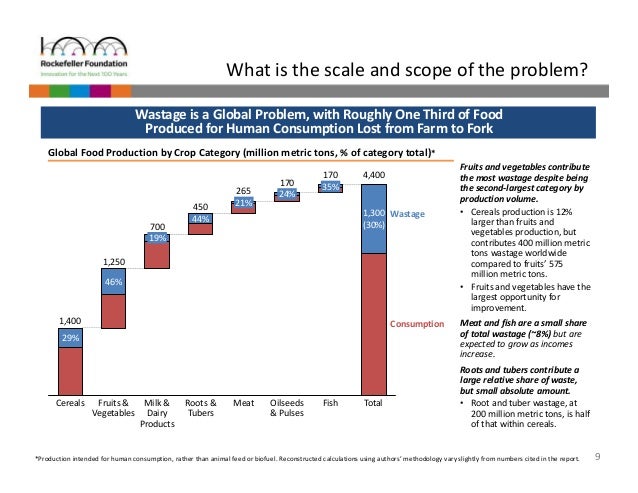 ?cb=1410920460
Yes, Randy-san. Industrialized countries throw away HUGE amounts of perfectly edible food.
I’m in the Japanese food industry and supermarket chains have a terrible policy of throwing away perfectly good food that has less than 50% of its Best Before Date remaining… For example, canned goods which usually have a 3 year shelf-life are tossed in the dumpster when there is 1.5 years remaining on the BBD…
Another problem is excessively-high cosmetic food standards.. It’s estimated that 50% of fresh produce is destroyed due to slight imperfections of shape, color and size… Most of this “below cosmetic standard” produce is either fed the livestock or just plowed back in the earth as fertilizer…
In 3rd world countries, it’s estimated that 20% of all food is eaten by rats… This is primarily due to poor infrastructure, lack of serviceable roads, decrepit warehousing facilities, etc. In the 3rd world, obviously much less food is wasted for reasons of cosmetic/BBD/slightly-spoiled food standards.
The overall total global food loss is estimated to be around 33%.
SAMURAI
One of our national retailers in the UK, has just decided to sell goods past their ‘sell by’ date at 10p per item rather than dumping it. I believe fresh food such as meat is excluded, but cans and packet goods are all included.
The best correlate to birthrates is the level of female education in a society.
Educate the women-folk, and they stop being baby factories, it seems to be universally true.
Ever wonder why some countries are dead set against letting girls and woman get an education?
There is one major world religion that makes no secret of their intention to conquer the world by migration and reproduction.
I think the obvious answer is that they don’t *want* to improve their lives. At least not as a group. How could a population who really wanted to accomplish something fail so spectacularly for so long?
Until they demonstrate through concrete action that they actually want to improve their situation, we’re doing them a disservice by ameliorating the consequences of their indolence.
They should overthrow a few dictators, rid themselves of warlords, establish functioning institutions and infrastructure, and develop some industry. What do you mean they can’t? Why not?
Europeans started from nothing in America and succeeded.
Transported convicts achieved similar success in Australia.
The Japanese, living on barren islands with virtually zero natural resources, succeeded spectacularly.
In a land such as Africa, overflowing with natural resources and arable land, well, there’s an entire industry built around making excuses for their failure and thereby prolonging their misery.
“Helping” them, in the long run, is harming them and is simply postponing the day of reckoning that they will have to face, sooner or later. And in the process it’s condemning millions, if not billions, to short lives of misery.
The food shortages start when the glaciation resumes. Once we start losing crop land and harvests to cold it will start. By then we should be eating local greenhouse food so we’ll skip the starvation in the wealthy countries. In Japan they turned an old semiconductor plant into a vertical salad farm. 10,000 heads of lettuce a day.
Now if only we hadn’t pissed away all that money on abatement of CO2 we could afford some great greenhouses …. never mind 🙁
TRM
One of my enduring irritations of AGW; that we are squandering vast resources on combating a phantom, which could be better spent taking advantage of the agricultural opportunities available from a greening planet.
We should be fixing the roof while the sun’s shining, but what politician ever did that?
Trump perhaps?
I guess this isn’t a history blog. Humanity increased to 7.5 billion because of a natural warming trend out of the LIA and the massive utilization of fossil fuels which has perhaps caused a half degree of human warming, although impossible to prove now. All beneficial to growing a lot of food. Knowledge has increased exponentially, as has our ability to harness the good Earth to feed ourselves with ample to spare, politics notwithstanding.
I am constantly amazed that really smart people can actually think that a catastrophe looms in 50-100 years due to a few more degrees warming, or is actually causing current harm as the world continues to grow in population and wealth, all due to a warmer world. Or that this warming would be detrimental to growing more food over the next century, with more CO2 and all. The alarmists should pick a new word, since catastrophe indicates a sudden misfortune. If substantial AGW is correct and is a negative experience, then it is going to be C in real slow motion.
But to think that a real catastrophe cannot or will not happen, like a major cooling event that freezes/kills a substantial crop in the northern hemisphere in the span of a few years right when everything seems to be going the best, is to defy history. If it is the one thing we do learn from history, is that everything is fine, until it isn’t. But I sure hope you are right Willis.
Earthling2 December 10, 2017 at 9:32 pm Edit
I have no idea what that means.
Yes. I have not seen anyone deny that.
Yes, given our experience of warming out of the little ice age, which was almost entirely beneficial, I find the fear of another slight warming to be way overblown.
Say what? As a far as I know, you’re the only one talking about “a real catastrophe can or will not happen”. I have no idea who you’re talking about, but it sure isn’t me. This blog doesn’t need a “history lesson”, everyone I know of is aware that the unexpected is possible. No one denies that a meteorite might strike the earth, it’s happened before.
So … I guess this is a history blog, but you are projecting the idea that we’re all pollyannas who think the world will always turn out well …
w.
I think you do know what I mean Willis, by my little snark that this isn’t a history blog. A lot of civilizations over time have gone the way of the dodo bird, because of some catastrophic event, either self imposed due to mismanagement of resources, politics/warfare or some unforeseen natural catastrophe out of left field that no one saw coming 4-5 years earlier. And who could, especially if it was a combination of all 3.
But we now in the 21st century have the unique advantage of being able to see with hindsight, almost 20-20 what went wrong, or rather, what happened, over the last 12-13,000 years since the end of the ice age. That should bode well for us, in that we should know what could go wrong with anything and everything, but I feel now we have a collective hubris about us that we can do no wrong, probably because many of our generation in the West have not known suffering like they did in the dark ages, when sulphuric rains were falling on Europe became of vulcanism in Iceland from two eruptions back to back—in 536 and 540 which may have been the tipping point plunging Europe into the dark ages for centuries. Or a 1/3 of Europe perishing indirectly in the years following the eruption of Tambora in 1815. I even recall my own Grandfather, who was born in 1892, telling me stories as a kid that his father and grandfather told him about many numerous farms all failing for 4-5 years after the Krakatoa eruption in 1883, and the reason why they indeed had to move and emigrate.
My point being, in our short time span with exponential growth in everything the last 150 years, how would humanity fare now if some of the normal things that happen regularly, not an asteroid, but just regular things like stratovolcanoes blowing off happening like they did back then? That’s why I like to tell my alarmist critics that any warming we can muster is good, because the alternative is very bleak.
But after reading your blog and day dreaming about the South Pacific, I just bought a ticket to a SE Asia tropical island(s), because I am tired of the cold. I am hoping I can shake this cold ‘attitude’ which I am accused of, by sitting on a warm beach and honing my diving and sailing skills. Bon voyage to all!
Earthling2 December 10, 2017 at 10:53 pm Edit
Oh, good, I’m faced with another mind reader who can tell me what I know and don’t know … Earthling, when someone says “I don’t know what you mean”, it’s a polite way of asking for an explanation. Call me crazy, but if I had known what you meant, I wouldn’t have asked.
True dat’ …
Mmmm … a third of Europe died (indirectly) in the years following Tambora … citation please. And while stories from your grandfather about things that occurred before his birth are indeed interesting, they call that “anectdotal” … and the plural of “anecdote” is not “fact”, it is “rumor”.
While I agree that warming is generally good, and an ice age would be a show-stopper, I don’t share your pessimism. Humans are infinitely resilient, we’ve made it through stratovolcanoes and
Dawg! Great news, let us know of your adventures. Best wishes for your voyage,
w.
Willis,
It’s obvious that the Malthusian predictions have failed. But, with something as controversial and important as this, I think it deserves a detailed examination rather than ridicule about how wrong they were, It is more important to understand WHY the predictions failed, than to take the opportunity to gloat.
Note that Malthus said, “Population, WHEN UNCHECKED, increases in a geometrical ratio.” I think that provides some insight on the intricacies of the issue.
Since about 1960, inexpensive and unprecedentedly effective birth control has been available in the countries producing the majority of the world’s food. Thus, the growth in the industrialized countries has flattened while the poorer countries still approximate geometric growth. At the same time, the character of farming has changed from small farms to large corporate complexes that essentially convert fossil fuels into food. That is, large farm machinery has replaced individuals, especially for grain crops. Cheap fertilizers are produced from the fossil fuels. Trucks and ocean-going ships transport and distribute grains more effectively. Production of food in industrialized countries is now akin to the way that cars are produced by robots. Except that the robots essentially eat fossil fuels instead of human food. Everything is different from what it was 60 years ago. I don’t think that Ehrlich was in tune with how things were changing.
Your graphs show an approximate linear growth in per capita food consumption. That could be explained by either a linear growth in population, or people getting fewer calories per capita. What is the explanation?
I hope that you are right and that Malthus was fundamentally wrong in his assumptions. However, I’d be more inclined to believe you if you explained exactly what went wrong with his predictions.
Clyde Spencer December 10, 2017 at 9:33 pm
I don’t know what that means. Is there a typo in there?
w.
Wllis,
My mistake! It was late at night and I was erroneously interpreting your second figure as total calorie consumption rather than per capita consumption.
It should be obvious. Malthus’ premise was simply wrong, logical but fundamentally wrong: he supposed that any increase in food production would be linear (so would fail to keep up with “exponential” population growth). Malthus’ “logic” continues to befuddle linear thinkers, apparently.
“Your graphs show an approximate linear growth in per capita food consumption. That could be explained by either a linear growth in population, or people getting fewer calories per capita. What is the explanation?”
Clyde Spencer, since the graph shows “per capita food consumption” it would be nearly impossible for them to be getting fewer calories unless the are eating less fat (protein = 4 cal/gram, carbs = 4 cal/gram, fat = 9 cal/gram) or we are including “oat chaff and wheat hulls” in the calculation (i.e. “Raw Bits”, inedible non-food in the food).
Furthermore, in the world overall population growth is not linear, though the rate is slowing.
Thus, the explanation is, we are growing more food. Even with the immense wastage, whether by Western snobbishness (see comments re: cosmetic discards) or lack of preservation (refrigeration/canning which could be solved by expanding electricity using petro-fuels and developing poverty stricken areas) we have more food to consume. I hope this helps.
PWT,
I have already copped to my mea culpa, above.
Clyde,
The problem with the “when unchecked” part is that what Malthus meant was “unchecked by government”. He could not conceive of other forces which would limit population growth. His problem was lack of quality, long term population data. Perhaps if he’d had the data we have today he would have recognized that population growth is a complex curve driven by many forces, not all of which are apparent until after the fact. History is littered with failed predictions of population trends. The same is true for food production trends.
Paul,
I’m not directly familiar with the writings of Malthus. Therefore, I can’t say with certainty your claim that Malthus was referring to “government” is wrong. However, the concept of the “Four Horseman of the Apocalypse” comes from the bible, and as a cleric, I’m certain that Malthus would have been familiar with the idea.
I beg to differ. The “positive checks” on population growth posited by Malthus were starvation, disease, etc, which raise the death rate, while “preventive checks”, such as postponement of marriage, etc., kept the birthrate down, both of which types of check entail “misery and vice”. Not sure where he saw governments involved, except perhaps in war, which often accompanies famine and pestilence.
His original 1798 essay is quite short.
I agree with you, Willis. In addition, Ehrlich and his junior patron saint Holdren should be wiped from the USA. Obama was the idiot who supported Holdren and Erhlich. Just motha phuckin amazing. Seriously.
MRW December 10, 2017 at 9:47 pm
Dang … bloodthirsty much? I don’t worry about that stuff. I once heard karma defined as hitting a golf ball in a tiled bathroom … so I leave their fate in their hands.
w.
Bloodthirsty.
Hunh?
MRW December 11, 2017 at 10:30 am
So … on your planet saying that two people should be “wiped from the USA” is not bloodthirsty?
w.
Let me give my experience in Ethiopia on food: I travelled all around Ethiopia by a van carrying diesel at the back. I saw the bumper crop yields in some parts [Sudan border] and no crop in some areas [along the Red Sea]. I saw the poor quality mud-stone roads. At the same time fighting with rebels. The later two made the transportation of food grains from rich to poor zones. — just few days before the end of war, I left the job and returned to India.
Dr. S. Jeevananda Reddy
Thanks, Dr. Reddy, good to hear from you. As you observed, the problem is not lack of arable land. It is all the other things—transportation, communication, storage, post-harvest loss, and above all war. War is the reason that the breadbasket of the Sudan is not producing, they’ve had a civil war there off and on for years.
w.
I’ve been shooting this stuff down for along time, mainly associated with mineral resources running out. The Club of Rome were adding up what mining companies called reserves, not understanding that companies drill and establish reserves generally to see their way 20yrs or more ahead – a sort of inventory. It costs money to develop reserves so they don’t overdo this. This is why copper reserves today are more abundant than ever before.
http://www.icsg.org/index.php/the-world-of-copper/71-uncategorised/114-long-term-availability-of-copper
The rest of the metals and minerals are similarly abundant. Moreover, we have been recycling these valuable commodities for over a millennium and, with miniaturization and substitution reducing unit demand, mining is evolving into a ‘topping up’ activity.
Countering the Malthusian stuff made me a natural sceptic of all forms of disaster prognoses like end days of this old planet because of CO2.
My critique of Archibald was that he was worse than Malthus because he had much more data than his predecessor. Malthus was a thinker and probably would’ve been pleased to learn he had been wrong.
I was disappointed in Archibald because he used the exact same kind of evidence in the same linear way that Club of Rome did. These prophets all fail to acknowledge that the underlying ‘resource’ is human ingenuity. Would it be unkind to think that it’s because they lack it themselves.
It is not so that food is distributed over the world buy any function controlled by graphs.
It’s inevitable, unfortunately. When electricity supply fails, society collapses within a week and all of your graphed lines plummet. The problem is nobody remembers how to do things without electricity. The best remedy is to have long-term outages in restricted geographic places. Maybe South Australia can do us all a big service by losing their electricity entirely for a few months and see how quickly it becomes a ghost province.
“…a week…”
Jeez, that is skating on thin ice.
That’s one of the main excuses of failed prognosticators.
Everyone, especially experts, should be familiar with Tetlock. Expert predictions are junk. Everyone should know that … especially the experts. There should be accountability for failed predictors.
CB,
I don’t think that anyone is good at long-term forecasts. Those that appear to be are probably just lucky. However, the importance of gad flies that promote future catastrophes is that they get people to think about things that are beyond the typical 3-days of future concern. That is, they raise the level of consciousness to where people question whether ‘Business as Usual’ is a realistic model for the future, or if some course corrections should be considered.
Malthus was right … for foxes and rabbits. link
Humans don’t conform to a whole bunch of paradigms.
Except all the biological ones like, mmm, habitat for example.
Humans create their own habitat.
Tony,
You overlook cultural evolution, of which humans are capable. If we colonized the oceans with floating cities, earth could support tens of billions of people. Not that that is liable to happen. Our population will stabilize around ten billion. Eleven, tops. Then probably decline.
Commie, the difference between foxes/rabbits and humans is the huge ingenuity factor. This is the real resource underlying the availability of physical resources.
It is precisely why predictions of disaster are only made by those lacking ingenuity. All they have to guide them is ideology and linear bean counting analysis. Their apriori reasoning (the kind a clever teenager is forced to use in arguing with his parents because he lacks experience) usually begins by making the mistake that resources are finite. I best get rid of this central illusion forthwith, before I make my big prediction for the future.
Here are the resource stretchers.
1) All the stuff we have mined, for example, is still here on the face of the earth. Metals have been recycled over more than a millennium because of their value.
2) Ingenuity has permitted lesser and lesser per unit demand. The amount of copper used, say, in communications has much more than halved (miniaturization) per unit since the last doubling of population.
3) Ingenuity has permitted substitution of cheaper, more abundant resources for less abundant. We don’t demand zinc for steel culverts, barn rooves… We demand waterproofing, and conduits for water to pass under roadways – plastic etc will do just fine.
4) We have greater reserves and resources today for copper, for example, than at any time in the past.
My big prediction, we will, not long after 2050, have reached peak population – we’re 80%there. The greening of the planet and food and resource abundance will usher in a Garden of Eden earth with widespread prosperity which will put the final nail in the coffin of all these Malthusian and other dystopian ideological nonsense mongers.
Forgot link re copper – it applies of course to all resources
http://www.icsg.org/index.php/the-world-of-copper/71-uncategorised/114-long-term-availability-of-copper
Gary,
You of all people should appreciate that what makes a mine, instead of an interesting outcrop, is the grade and tonnage of the ore. As the unbelievably rich massive blocks of pure copper from the Keweenaw Peninsula have been exhausted, technology has allowed us to mine low-grade porphyry-copper deposits, at the expense of much greater energy requirements. The key to the availability of mineral resources is cheap energy. With sufficiently abundant energy, the oceans could potentially supply us with every element we need. Until such time, the decision on whether to invest in the infrastructure to develop a mine will depend on the grade, tonnage, transportation costs, and energy cost to extract the metal from the ore.
It is primarily the precious metals that have been recycled over millennia. Iron has largely rusted away and been dispersed to a grade much lower than the ore from which it was mined. The industrial metals, like lead, tin, zinc, magnesium, cadmium, germanium, gallium, etc., largely end up dispersed in landfills, and whether they will ever be recycled is problematic.
Substitutions have their cost. Often the substitutes are cheap(er) but may not perform as well. How often have those of us who are older lamented about the “cheap quality” of new products, especially those coming from China? Esthetics are an important consideration for many people. I much prefer a fine walnut rifle stock to a plastic stock.
Gary,
For an update on the status of recycling, see the following:
https://www.yahoo.com/news/electronic-waste-high-squandering-gold-other-metals-study-150333804–sector.html
“What is as interesting is why there is such a desire to be scared.” (Tom Halla)
No idea; it’s hard-wired I think, maybe something about actually being scared, all those hundreds of thousands of years in the dark, telling ghost stories. Fear is a perfectly good response for survival. Run and hide. Sometimes it’s irrational and dysfunctional, sometimes it’s not. It’s the logic that needs work.
As a pensioner I have to keep tabs on my money supply. One big problem is food cost. Why is food cost going up and portion sizes getting smaller? It is happening in small easy stages so you don’t notice at first.
Politics causes food shortages.
A given country, according to the graphs, produces and consumes more food. The result is the world wide obesity problem. Yet we have areas with starvation, although fortunately those areas are shrinking.
Politics will however block food supplies getting through. Bad examples include Zimbabwe, and Venezuela, both former net exporters. An example in my country (Australia), is energy poverty. We export huge amounts of energy, very cheap energy, however due to a mish mash of very poor policy, there is a big and growing problem with energy poverty. Politicians are deliberately making energy too expensive for the poor. The same is happening with food in Australia but it’s happening a lot slower, political policy is making food more expensive.
I believe this was also Barack Obama’s desire: “Under my plan of a cap and trade system, electricity rates would necessarily skyrocket.” (from his speech in January, 2008). To his great chagrin (and the people of the USA’s delight), he never got this plan fully enacted when he was President of the USA.
“Why . . . portion sizes getting smaller?”
Blame this on ‘Cookbook’ publishers.
Old ones assumed a can of something weighed 1 pound.
Not so now. You need a new cookbook.
The fastest way to ensure an inadequate global food supply is the dogma driven and artificially fast push for the wrong types of ‘renewable’ energy (chiefly wind/solar). It is only fossil fuels that do, and can continue to, provide the leverage for adequate food production.
Economists have long understood the basics of how Malthus’ prediction went wrong: that technological progress kept moving the production function upwards (increasing marginal productivity) faster than population growth moved us out along the production function (decreasing marginal productivity), hence marginal productivity (which in a competitive economy is equal to wages), kept going up, so that instead of starving, people have become ever more prosperous.
It was the great but relatively unknown economist Julian Simon who added the key relationship, where technological progress is a function fundamentally of population. Other things matter too–education, for instance–but even amongst the least educated, people are still inventive and population always and everywhere produces net gains in productivity, a proposition that Simon documented with several hundred pages of data and examples in his magnum opus The Ultimate Resource.
So now all real economists understand: it is no accident that population increase always coincides with increase in prosperity, the opposite of what Malthus and the neo-Malthusians always predict. As I have said many times, the climate alarm scientists are not climate scientists at all. What they are actually doing is just really really bad economics.
Our friend David Archibald is no dogmatist. A few days with the late Dr. Simon’s great book will quickly convince him what is actually going on. Neo-Malthusianism is one of those things, like climate alarmism, where those who haven’t looked into the issue for themselves have only ever heard one side of it: the wrong side.
Everyone who figures out how the world actually works has to go through a variety of such awakenings because the idiots control almost all of our information industries. That’s just the way it is. The duped need to be corrected (thank you Willis), but I never think ill of anyone for being a dupee. As long as they don’t become a duper.
It is worth pointing out that averaged over age the daily caloric requirement is only around 2000 calories per day and protein needs are 0.8 g/kg lean weight or 40 – 50 g/day for females and 50 – 60 g/day for males. Over consumption of protein and calories, as simple carbohydrates from cereals and sugar, is responsible for the rapid increase in metabolic disorders (obesity, diabetes II, cancers, heart disease, dementia, Alzheimer’s, etc) since the US Government issued their false Nutritional Guidelines in the 1970’s to promote sales of grains and oilseeds produced by US farmers and which has now been copied around the Globe with disastrous results. On this basis it will be these disorders that will reduce World population with only the poor and 30% of other populations that are not overweight or obese surviving.
And yet in spite of all of these supposedly unsurvivable maladies, we are living longer and longer.
Many of these illnesses are increasing in frequency because we are living longer.
We cannot cause immortality by curing every illness one by one.
And a lot of these trends are likely because of entire industries devoted to tracking such things, as well as being attributable to greater care and thus becoming more likely to being diagnosed, instead of just dropping dead one day without ever seeing a doctor, like people used to do.
Menicholas,
A slight quibble. The maximum longevity seems to stubbornly persist at about 100 years. Those of us who reach old age aren’t living much longer than our ancestors who reached our age. The difference, which is often misunderstood, is that because we have done a good job of reducing childhood deaths, a larger percentage of people are reaching old age. Thus, while the average life expectancy at birth has increased significantly, we aren’t really living longer. The idea that people of yore died soon after reaching the age of 25 is wrong.
I agree, Clyde, and I see that what I wrote is actually somewhat self-contradictory.
On average, lifespans are still increasing, and better yet, more people are staying fit and active and sharp for more of the limited years we have been gifted.
Very true that childhood mortality was a big part of especially the early gains in life expectancy, as was proper sanitation, more access to proper nutrition and an increased understanding of what proper nutrition even is (although we seem to still struggle with that aspect), more awareness of the need for physical fitness, and more and better understanding of physiology as well as more and better medicines and treatments for not only preventing illness but curing those who do become ill.
I happen to live in a place where large numbers of people move when they get older and when they choose to retire, Florida USA. I see and meet people who are well up in years and are amazingly fit and active and sharp.
Of course there are still unfortunate cases of people dying way too young from what were entirely avoidable causes, such as heart attacks and strokes due to untreated hypertension, lack of physical activity and all the harms that ensue from that, and the tragedies of accidents, violence, drug abuse, etc.
But progress in all of these areas seems to be ongoing: We are getting new drugs for specific illnesses, new treatments for those that do occur, better and more effective diagnostic techniques and devices, safer cars, increased attention to personal protective equipment, more people willing to engage in physical fitness activities for their own sake, and even such things as making drug overdose treatments readily available.
But as you correctly point out, there is a point at which our bodies seem to just wear out, or where cumulative deterioration makes survival increasingly unlikely.
Everyone is not going to live to see 100, at least not anytime soon. But more and more are doing just that…and those that are 100 today were born before most of the advances in medicines and nutrition and other factors were present. So, what will become of those of us who were born in the post WWII years, and have never been starved for a day, never had any serious childhood diseases…and which may have shortened end of life years?
We know that an occasional person has lived decades beyond the century mark, and those that have were born in the 1800’s.
So, will those born today and have the advantages of all of these improvements in understanding and ability for their entire lifespan, will they have a chance to mostly all live to be 100-120 years old and remain fit and active?
Perhaps…if they do not kill themselves with drugs, or neglect their own care, or suffer an unfortunate accident.
Peter – your assertion that “only the poor” will survive these maladies is fallacious.
The high-calorie, low-nutrient foods tend to be cheaper and more easily distributed, so “the poor” have proportionally greater access to the very foods you are asserting will reduce the world population.
Note also that the foods you’re blaming have relatively little protein, so I’m not sure where that overconsumption is coming from in your hypothesis.
kb
I was referring to the graph showing the daily level of protein intake per head which is way too high unless your are an elite athlete of lumberjack. Excess protein stimulates the mTOR path that accelerates the growth of tumour cells, as does the insulin resistance caused by excess intake of simple carbohydrates. On the comment made by Meniicholas that we are living longer, that has yet to be proven as the current statistics are based on persons born 80+ years ago before the new damaging nutritional standards came into being but the indications are that we now instead of a binomial distribution for longevity it is splitting into one with two peaks with the major part of the population having lower longevity and the minor part living longer such that the average of the two is relatively static. .
What is established is that a poor lifestyle of of inflammatory diet, lack of physical activity and adverse environmental factors cut around seven years off lifespan if modestly obese and up to 14 years if very obese. It is also a fact that Dementia and Alzheimer’s are on the increase – this is a disorder of aging cells that cannot be explained by person living longer because the average longevity has not changed much – it is a response to inflammation caused by insulin resistance and especially the adverse high ratio of omega-6 to omega-3 fatty acids in this kind of diet that promote free radicals (ROS) and limit the cell repair mechanisms leading to premature loss in telomere length. The fact that Menicholas sees plenty of fit people in Florida is a matter of looking for light under the lamppost as those he refers to are most probably fitter because they are generally part of the 30% who are not overweight or obese, though about 20% of obese persons are not subject to a high risk of metabolic disorder because they accumulate weight around the butt not in adipose fat cells around the gut that are a cause of these problems from the inflammation they cause.
When I referred to the poor I meant those in developing countries not those in the US and elsewhere who live on hamburgers and other cheap fast foods – as David Archibald pointed out this is a matter of income and those in these developing countries have a lower disposable income but doubtless the fast food industry will find ways to fatten them up too. In fact it is already happening as WHO statistics show that 75% of global health problems now refer to these metabolic disorders, especially obesity and the consequent diabetes type 2. .
I do not know what statistics one might be looking at to come to the conclusion that average lifespans are static.
As for there being disparity between cohorts and over different periods, this has always been the case, although before the germ theory of diseases became accepted child mortality was little different for the rich than for the poor.
The wealthy have always lived longer, but the way that these differences have changed and continue to change over time are very complex.
You are speaking of specific diseases and conditions while I was speaking in more general terms.
I am very interested in the contention that the underlying causes of Alzheimer’s and dementia are now well understood. That is news to me.
My understanding of what is known about what constitutes a healthy diet is a matter of opinion, and what various schools of thought BELIEVE to be the case remains very much in dispute, although even that there is a dispute would seem to be disputed by any who claim to KNOW so very much that is not exactly settled, at least not as far as I can tell.
Getting back to life expectancy, it is indeed a moving target, with different numbers of years expected depending on how old one is, where one lives, how much one earns, the degree by which ones income decile has changed over ones life, etc.
The stats being compiled by the social security administration seem to tell a different story that what many here have described as being the case.
What is clear is that the averages are still rising overall, although by different amounts as I mentioned above.
As a small example of how I believe the situation to be more complex at the level of fine detail than your assertions seem to indicate you believe to be the case, consider the example of two persons who achieved the age of 85, but one did so in 1985 and one did so more recently. Far more people achieve that age at present than was the case in 1985, and the group that got to be 85 back then lived through many more years of the time before proper nutrition and medical care were rapidly improving. As a result, those who made it to 85 back then were likely of a more robust constitution, whereas many who achieve that age today include a higher level of more frail individuals who survived due to more likelihood of having had excellent nutrition and medical care for most of their lives.
One can spend a lot of time on such analysis, as I have.
Lots of info here:
https://www.ssa.gov/policy/docs/ssb/v67n3/v67n3p1.html
In the US, overall life expectancy increased by over 5 year from 1980 to 2014, and during the period of 1997 to 2007, 1,4 years was gained.
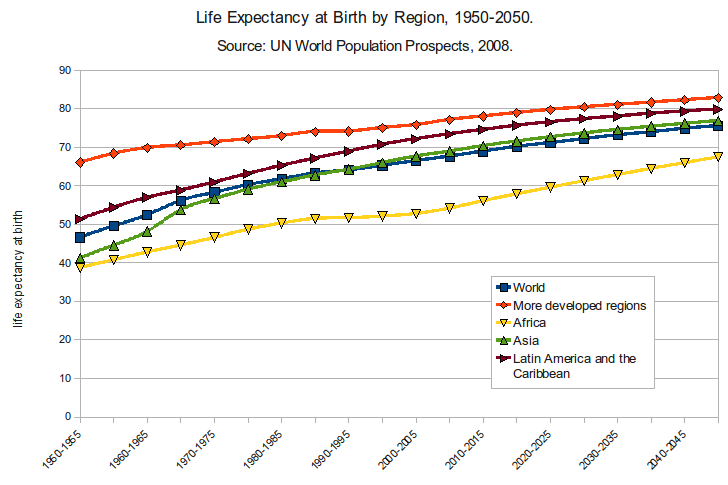
Personally, I see the situation as less grim than you seem to.
I have a few things to say about your contention I have looked for light under lamp posts, but I am just going to let that pass by saying I do not think so.
Your chance, and mine, and any random person’s chance of living to a ripe old age, and doing so while remaining sharp and active, is far higher than it was for our parents, no matter our respective ages.
BTW, I also find that recent studies show that rates of dementia are falling rather sharply in recent years, in contrast to your assertion that these are known for a “fact” to be increasing.
Here is a recent report.
I was reading on this extensively over the past several years, as my once quite youthful and healthy (at age 72) mom contracted that awful illness, and in fact died of it just this last Spring, although after surviving with the condition for an achingly long period of time.
https://www.nytimes.com/2016/11/21/health/dementia-rates-united-states.html
I used to think Malthus was a wally but I’ve now modified my opinion. His analysis was perfectly valid from an historical point of view. Unfortunately he published his thoughts just as the “great divergence” took place and general productivity grew & grew, independent of agricultural output. Adam Smith published his seminal work & the US declared independence. The world has got a little warmer, the concentration of CO2 in the atmosphere has recovered from disastrously low levels and populations have become self limiting as they get richer. Except in those places where “we” forbid them from exporting their goods to us, using DDT, Fluorine for cooling & Carbon based fuels & generally hobble their efforts to improve their lot. No wonder they have decided to invade us.
His analysis was not even valid from an historical point of view. It never was necessary to take preventive step to control population before it reach the death threshold. Food don’t disappear some day, it first gets scarcer and more expensive (and more unusual: that’s where you start eating snails, leaves, roots or whatever), so some people just die (children and sick, old people that have rather die, or just ordinary people robed or food or killed by some desperado…) and others go away where they hope for food, and this is enough to control population, to the real necessary level.
More often than not, you die from something else than hunger, but you die anyway.
Storage, transport and trade are the keys. There will always be excess in one year somewhere. Eventually, the population could get to big but I suspect an order of magnitude more before we need to panic.
I believe Archibalds post was more about country by country wheat deficits, a very valid point in terms of economic and political stability,and migration. Noting that Russia could double their food production is more an argument against a Mathusian catastrophic development than in favour of it on a worldwide scale. Bill Gates Foundation’s effort to limit population growth in developing countriesacknowledges that economic and political stability benefits from lower rates and that dependency on aid is reduced. For many countries without imports of huge quantities of food, starvation would be a fact today.
not valid at all. All cities in the world are in huge food-deficit, depending of food coming from somewhere else. Where the “somewhere else” is in the same country or not is irrelevant, except maybe in wartime under effective blockade (although people starved in Lenigrad despite USSR still having far enough food during WWII)
One must remember that Archibald has predicted that the Earth will seriously cool due to low solar activity, and this will have a big impact on crop production, and especially in the breadbaskets of the far north such as Canada. That this would be abrupt, powerful, and long lasting. It is global cooling that will cause the crisis, and absent it, well, it will just be another failed prediction. We will certainly see. Two failed crop years should just about do it.
Agriculturalists adjust planting decisions seasonally. In North America the area of concentration of a particular crop can shift. Some operators may suffer unrecoverabley. The whole system is quite robust. A “black swan event” – say a big asteroid in Iowa {Manson Crater} – would produce a different outcome.
A widespread and unprecedented cold snap that covers a wide area in the middle of the growing season could indeed be catastrophic though. It is conceivable that some such event could travel around the globe and affect the major growing regions of the northern hemisphere.
Such an event is unlikely, obviously, but not impossible.
No one really knows how unlikely, it seems to me, but it has not happened in our lifetimes, or in recent memory. Some even dispute if the so-called Year Without A Summer really was one.
But for sure, if some event killed a large proportion of the major crops and left no time to replant and no salvageable harvest in the affected areas, I think there is no telling how bad it could be in terms of total deaths in the ensuing months and years.
I think the hundreds of millions of cats and dogs would be in serious peril, as would anything even remotely edible.
And those running out of food would not just die quietly, I think we can figure on that being true.
It would be bad, but for who and how many…?
Some would be in far better position that others by dint of their location and abilities, their skills, knowledge, tools and resources, and stocks of stored food. Other by dint of brutality.
And some would be badly positioned, by living in a large city with many others who have no way to produce or gather anything (Here kitty kitty kitty…).
Let’s hope we do not find out.
And let’s quite wasting money on solving problems that no one has ever properly explained are even a potential problem.
2 degrees (or even 4 or 6) warming a disaster, on our ice age having, partially frozen solid planet?
How so?
So far all we have heard are fake reasons to worry about this.
So, we have a beautiful theory. (Sounds of Richard Feynman)
It cannot be absolutely proven but even worse it takes ONLY ONE reasonably rigorous experiment to blast it out-of-the-water.
Theory= (Saturated) fat is bad
Experiment= Observe some people eating 25% of Cals from protein and 75% Cals from (saturated) fat
E.g The Innuit people. Possibly also the Nenet, Bushmen and various South Sea Islanders eating fish and coconut oil
Result= They are healthy and ‘most everyone else is getting the ‘Diseases Of The Modern World’
We have an assertion via the 2nd graph that everything is rosy and on-the-up.
But hang on,that graph says that (via eyeball and surprisingly that both the Rest of World and Europe are getting 11% of their Calories from protein.
That’s less than half of what the ‘healthy’ people are eating. Even worse, much of that ‘protein’ is coming from vegetable protein. Since when was the blueprint for a plant any use as a blueprint for an animal. Certainly some animals eat plants but they eat vast amounts of stuff and reject almost equally vast amounts.
‘Eat-like-a-horse’ anyone?
We cannot eat like horses, or cows, or sheep/goats. We don’t have the stomachs or stomach chemistry.
Plant protein is making us ill. Coeliac Disease anyone, any number of autoimmune disorders, Anaphylactic Shocks and finally Lewy Body Syndrome (dementia to you and me).
All= protein disorders.
And how might only 11% of our Cals from protein manifest itself?
Irritability (trollery & Ad Hominism) , muddled thinking (tell me about Climate Change and Radiation), poor memory and certainly not least, bloated stomachs.
Sounds like almost the Entire World has something akin to what Mr Archibald mentioned – Kwashiorkor
You personally don’t even need to run the Low-Carb-High-Fat and No Booze diet.
Mr Trump has been running it for most of his life – you just need to see photos of him versus those of Obama.
Trump= alive, animated & self confident even in still photos
Obama pictures – frozen, dull, dead on his feet and even before that epic gaffe with the frozen teleprompt.
Does Trump even need/use a teleprompt?
Even worse, what Cals we do get are coming from a well recognised chemical depressant (glucose=sugar= all carbohydrate food) and even worse that that, the stuff sets off Dopamine in our brains and actually rewards us for ‘being ever so clever’ and actually eating it.
As it trashes out Insulin systems, destroys memory, makes us sleepy & lazy, dehydrates us and bloats our livers with fat as the hapless organ tries to get rid of the stuff
We are all victims of Kwashior and sleep walking into disaster
In case anyone missed my previous ravings, since my first ever post on here, The Disaster is going to be a ‘Lack of Dirt’
And how many people reading this are thinking..
“Oh shut up man, go have a beer and chill out”
If they are, that is EXACTLY my point.
See the problem we’ve got, even Spellcheckers can be affected.
But they are, after all, a Human Invention so nothing less than a foul-up can be expected……..
https://en.wikipedia.org/wiki/Kwashiorkor
“They are healthy and ‘most everyone else is getting the ‘Diseases Of The Modern World’”
Just gonna say one thing, politely: Baloney.