Guest opinion: Dr. Tim Ball
In the 1990s a clear divide existed between the east (the Soviet Union and China) who said climate change is cyclical and the west (the US and Europe) who believed it was chaotic. The former argued that all we need to do is determine the major cycles and how they interact to start understanding and to predict. The latter that climate was chaotic as expressed in the Intergovernmental Panel on Climate Change (IPCC) Third Assessment Report and predictions were not possible.
In climate research and modeling, we should recognize that we are dealing with a coupled non-linear chaotic system, and therefore that the long-term prediction of future climate states is not possible.
Chaos theory was the source of the Lorenz based story prevalent at the time that if a butterfly flaps its wings in Japan it arrives as a storm in California many days later.
The media reported the divide as a political difference, a product of the Cold war. In fact, the divide continues with Russia and China consistently offering different views and challenging more extreme claims in the Intergovernmental Panel on Climate Change (IPCC) Reports. Of course, as long as they are listed as “developing nations,” they always vote for a transfer of wealth as set out in the Kyoto Protocol and its replacement, the Green Climate Fund.
My views on the dichotomy began to formulate earlier from empirical evidence. Research and analysis of data quantified from the Hudson’s Bay Company weather diaries and instrumental records detected a very strong 22-year drought cycle in the middle latitude record for York Factory on Hudson Bay. I included the results in my doctoral thesis (1982) against the advice of my supervisor. He did not disagree with my work; he just thought it was too controversial for my committee to accept. I left it in, and it triggered an interesting experience. The chairman of the committee, Professor C. G. Smith[1], who studied historical precipitation records, especially those of the Radcliffe Observatory, did something unusual. After all the committee members asked their questions, he asked them to agree to tell me I had passed so we could then partake in an unfettered discussion about the issue of cycles.
Part of the discussion included the early work on tree rings in North America, particularly the work of A.E. Douglass, founder of the Laboratory of Tree-Ring Research at the University of Arizona in 1937. As that biography notes,
“He discovered a correlation between tree rings and the sunspot cycle.”
His work became the basis of dendrochronology, which triggered work in tree ring sequences as a proxy indicator for a wide range of correlations. Of course, correlation does not mean cause and effect, but it does trigger searches for potential mechanisms.
One graph (Figure 1) illustrates the type of work produced and shows the correlation between the 22-year sunspot cycle and drought periods across the Great Plains as deduced from tree rings.

Figure 1
It is interesting because when I used the graph in presentations to western North American farmers I did not add to it but simply noted that the sequence anticipated a drought in the late 1980s and that is precisely what occurred. Also notice the decline in sunspot numbers associated with the Dalton Minimum from 1790 to 1830. It is tempting to assume the different durations of droughts, one longer from circa 1820 and the other shorter from approximately 1840 was a result of the reduction in sunspot numbers.
Before we organized the conference on the impact of the 1815 volcanic eruption of Tambora, it was assumed the eruption caused the decline in global temperature of the period. While preparing for the conference, it became apparent to myself and fellow organizers, Cynthia Wilson and Richard Harington, that global temperatures were already in decline and a likely explanation was the decline in sunspot numbers. Remember, this was pre-Svensmark’s cosmic theory. Indeed, the idea of even a correlation between sunspots and temperature was just gaining wider legitimacy from the work of John Eddy. As a result, we invited him to be the keynote speaker at the conference. The question that emerged during the conference was how would the impact of Tambora change if global temperatures were rising at the time. The same questions were asked the impact on precipitation patterns, especially droughts. One of my contributions to the symposium was to detail the severe drought in Central Canada from approximately 1816 to 1819. I will return to the significance of these observations later.
Two other experiences reinforced my views on the cyclical versus the chaos controversy. The first occurred when I was invited by the editors to submit a chapter to the book Climate Since A.D. 1500. The editors had each chapter author review another author’s chapter. I worked with Ye. P. Borisenkov, the Soviet historical climatologist, whose chapter “Documentary Evidence from the U.S.S.R” used the Russian Chronicles among other sources. Borisenkov’s work was recognized as a major contribution to the current claims of a cooling over the next few decades by Dr. Abdussamatov.
The second event occurred when I gave a paper at the 1988 Annual Geophysical Society General Assembly in Bologna, Italy that focused on evidence for climate change from historical records. This was among the earliest public presentations of climate research from the vast potential of the Vatican archives. It was also an early public presentation of the remarkable resources from China. In both the Russian and Chinese connections I learned that the leaders, Russian Czars, and Chinese Emperors, kept weather and crop journals for a very practical reason. They needed to prepare for the social unrest that inevitably followed crop failures.

Through the work with Borisenkov, I became aware of Nikolai Kondratieff (variously Kondratiev) and his theory of climate and economic cycles. It was this focus on food production, especially subsistence crops like cereal grains, which led to the first practical application of the cyclical approach in Russia. Between 1919 and 1921 Kondratieff plotted the relationship between grain production and drought and produced the K-Cycle. It was a predictive tool based on the idea that all economies and civilizations exist based on their ability to feed themselves. An important idea that led to my dictum that, there are no farms in the cities, but there are no cities without farms. In the west, the most common application of Kondratieff and other climate cycles are in the financial markets. It is summarized in books such as “Climate: The Key to Understanding Business Cycles.” I also learned that other Russian climatologists were doing much better, more open, and innovative work, such as the work on energy balance of Mikhail Budyko.
I later learned more about Chinese climatology when working with Chinese climatologists. The Chinese realized that to improve their economy and achieve greater control required increased food production. They realized, to maintain large work forces in urban areas you required vastly improved food production. I learned very early in studying history that an Agricultural Revolution preceded the Industrial Revolution. The Chinese were already triple–cropping in many parts of southern China but there was vast potential in the north-eastern region. They were charged with working with Canadian climatologists and agronomists to study how and why Canadian farmers were so successful in crop production in cold climates.
Parallel to these different studies and analyses of climate, the philosophical views of the pattern of evolution were changing. In the west the biblical view of Neptunism, the pre-and post-flood worlds was replaced by Uniformitarianism. This was generally adapted and adopted as the notion that change is very gradual over long periods of time. I believe it is a major reason why the unchanging nature of the Sun/Earth relationship remained the view. This persisted, even though Croll and others culminating in the work of Milankovitch, showed it was constantly changing.
The two notions crossed paths in 1960 when MIT meteorologist and computer modeler, Edward Lorenz, introduced the aforementioned butterfly, with its wider application as the Chaos Theory. This view seemed to resurrect and confirm the 19th century claims of Cuvier that changes occurred triggered by extreme events or catastrophes. In the 20th century, Stephen Jay Gould combined the two views with what he called punctuated-equilibrium. This proposed that gradual change was periodically interrupted by catastrophic events. It certainly seems to fit events like the eruption of Tambora, but also applies to events like the asteroid that wiped out the dinosaurs.
These discussions raised important questions about the difference between equilibrium and steady–state. This included the apparent resilience of the atmosphere to catastrophic events and the inevitable role of feedbacks, questions, and challenges still central to climate research and pushed aside by the singular focus of the Intergovernmental Panel on Climate Change (IPCC).
Right now, the easterners, particularly people like Abdussamatov and Usoskin, are making better predictions about the coming cooling trend as they follow the solar cycles than the IPCC, now represented by the IPCC. Of course, there are some of us in the west who believe the Russians are closer to reality. Consider the comments by Joe Bastardi on the trend in this video. But why listen to him? He is one of those deniers. Joe can use my argument that those who call us deniers and are mostly the chaos believers need to be right to explain why their forecasts, both weather, and climate, are so wrong. Is it possible that Joe and all us deniers will become part of the Russian collusion investigation?
[1] Craddock, J. M., and C. G. Smith (1978), An investigation into rainfall recording at Oxford, Meteorol. Mag., 107, 257–271.
Discover more from Watts Up With That?
Subscribe to get the latest posts sent to your email.
the ocean tides are cyclical. they most definitely repeat. they are also chaotic. they. cannot be predicted reliably from first principles.
rather we predict the tides the same way humans learned to predict the seasons. using the position of the heavenly bodies in the sky. also known as astrology.
Elements of tides are predictable, ie those based upon astronomy, but other aspects aren’t, such as those dependent on local geography.
tide height is due to resonance based on the shape of the ocean basin.. gravity simply sets the water in motion. the height repeats when the positions repeat and thus can be predicted from orbital mechanics.
gravity drives the tides but it does not predict them. fill a shallow dinner plate with water and start it swirling by repeatedly tipping the plate. gravity is the tipping motion. now use an irregular shaped plate and predict the waters height at the edges. the height repeats when the tipping repeats.
it is not gravity itself but the cyclical motion of the gravity that makes the system predictable.
but prediction cannot be calculated from first principles. rather it is given by observation of previous states.
I think this is more what Dr Ball is talking about. predicting from observation vs predicting from calculation.
Cyclical, Buffered, Random, Metastable, Range Bound. What did I miss? Oh.. Settled.
Fractal is not appreciated. Understand Mandlebrot sets you should.
– my inner Yoda.
Going up a level: Eastern philosophy is Steady State; Western is Big Bang. Big space, big time scale, cycles within cycles. Small space, short time, chaos rules.
When they resort to calling you names it just shows that they have nothing intelligent to say.
It reflects the nineteenth century geological argument between uniformitarians and catastrophists.
The uniformitarians won the argument until the link between meteor/asteroid impacts and major geological and biological changes was established,particularly by the Alvarezs.
https://en.wikipedia.org/wiki/Alvarez_hypothesis
Now it seems that the earth tracks along in a uniformitarian sort of way until things are unexpectedly and catastrophically disrupted after which things get going again on a slightly [or even significantly] different track.
Before the Alvarez’ catastrophism had already made a comeback with the Bretz Floods.
Depends on your interpretation of “cyclic” I guess. To me cyclic implies that we will return to a previous state once the cycle is over. I don’t know that is true with climate. It’s not a closed system; the atmosphere is open to space, there are fluctuations in solar irradiation, there are precessions and slight changes in other bodies of our system which influence our position in space and our relationships with other bodies of influence; in short, we will not return exactly to a previous state, ever. But there are obviously heavy influences on our climate, which are mostly predictable based upon our current level of knowledge, and show similarity from iteration to iteration. Patterns maybe, but not true cycles.
We can be sure to a high degree of certainty that, without human intervention of some kind, global climate will return to its predominant condition of the past 2.6 million years, ie massive ice sheets in the NH.
And over an even longer time frame, the poles will be opened up to ocean gyres and the Earth will return to its hothouse mode (no glaciers at all, the poles will be above freezing enough of the year there will be no permanent icecaps).
To be sure. On the scale of tens or hundreds of millions of years, the next Hot House phase is certain, especially as the sun’s output increases at one percent per 110 million years.
Nice informative essay as usual from you Tim. Uniformatarianism may mean something different in climate science, but it was coined by geologist James Hutton in the 18th Century and was essentially “the present is the key to the past”. Because most geological processes are long term in general, erosion, mountain building, accumulation of sediments and in duration, plate tectonics and so on, it probably got interpreted as meaning stability and gradualness. It was adopted by other sciences to simply mean that the laws of nature are constant.
However, when I was taught it 60yrs ago (at the University of Manitoba, by the way) it didn’t exclude catastrophism. It was known we had had Ice “ages” (now called glacial maxima), we had explosive volcanic activity, were struck by bolides (Sudbury Nickel deposit) , that there had been mass extinctions, etc, etc.
The university itself, as you know is on the floor of former Lake Agassiz, perhaps the best known and studied glacial lake in the world. Most geology (and I am sure geography) graduates from U of M are more specialist in the Pleistocene, even if they went on into petroleum or mining geology, than many of today’s climate scientists.
I mapped the Precambrian Shield for a number of years in Manitoba and never failed to include measurements of the ice movement directions, eskers, strandlines of former L Agassiz, barchan sand dunes behind the beaches (like Saudi Arabia except for being overgrown with jackpine) etc. I even discovered a section of the old Missouri River when it flowed north to Hudson’s Bay during the Eemian – complete with reddish quartz pebbles, opalized wood, etc. Most of my 60yr career has been as a mining geologist and metallurgist (Msc ec geology, Bsc)
The things that happened in the past can happen now and in the future. The simple idea is, if you are up on a mountain and you see ripple marks in a sandstone, you can be confident it was formed in moving water, or fossils of shellfish are trivial in their interpretation.
Most of my 60yr career has been in mining (geology and engineering) and I’m still working – Canada, US, Africa and Latin America.
part of comment on career end of third last paragraph, please remove (I attempted to move it on my #$& cell phone! )
Good for you.
Even Lyell recognized that there were catastrophic events in geologic history, and even visible today. But to him, they occurred against the backdrop of uniform processes, and were themselves in some sense part of the uniformity, occurring at more or less regular intervals.
His views evolved over time. Lyell only reluctantly accepted Darwin and Wallace’s theory of evolution; for much of his life, he maintained a steady-state view of the Earth and its inhabitants, arguing that as one species went extinct, another appeared. This was partly because of his belief in a long-standing, deep division between humans and animals, in which mankind’s superiority to animals was moral, not physical. Between the time he published “Principles of Geology” in 1830-1833 (so important to Darwin) and “Antiquity of Man” in 1863, Lyell changed his views. In the first book, he agreed with Cuvier that no humans predated the current epoch. In the second, he extended humanity’s existence back in time. His acceptance of Darwinian evolution and human prehistory weren’t the only times Lyell had to surrender his beliefs; he also came to support Louis Agassiz’s theory of the Ice Age, when gigantic ice sheets covered much of the northern hemisphere in the Pleistocene epoch. Lyell withheld his support of Agassiz’s theory for decades, because it stood in direct opposition to his own hypotheses of a steady-state Earth.
Darwin resented Lyell’s assertion that Darwin’s discovery of natural selection was just rehased Lamarck, which of course it isn’t. It’s the anti-Lamarck.
Aggassiz also was supported by his convert the catastrophist Buckland, with whom Lyell had previously broken over uniformitarianism. Rev. Buckland was the quintessential Victorian eccentric, perhaps now best known for describing the first dinosaur. Or maybe for his eating his way through the animal kingdom.
Dear Dr. Ball.
You write “Chaos theory was the source of the Lorenz based story prevalent at the time that if a butterfly flaps its wings in Japan it arrives as a storm in California many days later.”
But, in truth, Lorenz was the “father” of chaos theory, not the other way around. Edward Lorenz inspired and created chaos theory during his early years as a meteorologist while he was in pursuit of a mathematical model of climate.
Dr. Lorenz is well known as a physicist associated with MIT, Dartmouth and Harvard. Kevin Trenberth was one of his more notable students.
Not really relevant to the discussion, but the link that Dr, Ball provides to illustrate the uniformitarianism principle https://www.uniformitarianism.net/ is actually a false front for a series of linked pages promoting creationism, a young earth (“radiometric dating is all wrong and the earth is a few thousand years old”), the biblical flood, “intelligent” design, and on and on. No criticism of Dr. Ball, but it’s interesting how these people try to get their foot in the door by starting with real geology and then try to suck you in through their links, trying to demonstrate that it’s all wrong.
The rule of logic, reason and science, everything that is lumped together as “the Enlightenment” is under attack. The most imminent threat is from the CAGW movement, because it is well under way to advancing its aim of restructuring industrial society. This other battle front, superficially less threatening because it only operates on an (anti) intellectual level is also crucial. It’s not going away. If we ignore it, our great-grandchildren might be receiving their only education at a madrassa (or the christian equivalent).
Smart Rock,
When I went to the link provided and, out of curiosity, checked the home page, I was a little surprised that Ball had chosen that site as his authority. While I don’t have any criticism of the content of the link itself, it seems to me that it opens him to potential criitcism that it is not an unbiased source. If it were me, I would have even gone with Wikipedia instead of the link he chose.
Smart rock, it’s bigger than that. The target is the provenance of the Enlightenment and western civilization achievements and the attackers are the guilt-ridden very same people! In a most insidious way, this behavior of the new left is not a very subtle form of гасisм. Apologizing for, and sullying the fruits of these developments is ugly and harmful to the whole world.
The West didn’t invent civilization. My ancestors long ago were forest dwellers, hunters, while the great civilizations of the Near and Far East, Mexico and Peru, etc. were in flower thousands of years ago. It’s not superiority that made the West’s Enlightenment, Industrial Revolution and modern economic prosperity possible. One could argue reasonably that the West were late bloomers (Our biggest discovery is that freedom brings these wonderful fruits unbidden) . I believe the self-loathing neo left are neurotic (hopefully not psychotic). It is definitely deviant behaviour.
Your ancestors five hundred years ago were far more advanced than the civilizations of the New World. When the steel weapon-armed and armored Conquistadors fell upon the Americas, the most advanced civilizations here, the Inca and Aztec, were just entering the Bronze Age. The Americas were thousands of years behind the Old World.
However, the height of New World civilization, the Maya, had already fallen. Highest that is in every way but metallurgy. They had writing, arithmetic and astronomy more advanced than their Aztec successors.
Climate got ’em.
Tony,
The climate change hypothesis for Classic Maya Collapse has been thoroughly debunked.
https://www.nature.com/articles/srep36976
Frome the link:
“This cluster may have contributed to the piecemeal collapse of the Classic Maya civilization…”
I think that debunks your debunk.
Tony,
Are you nuts?
How does a cluster of earthquakes equate to “climate change”?
I mean, seriously.
“Gabro November 26, 2017 at 9:50 pm
Tony,
Are you nuts?
How does a cluster of earthquakes equate to “climate change”?”
It doesn’t as anyone who has studied earthquakes, and I have when I lived in New Zealand, knows. In my experience, and I have had this discussions with these types before, only those who believe CO2 emissions from human activities is causing the climate to change also believe climate change causes earthquake swarms.
Bit of a jump from the article’s “may have contributed” to your “debunked”.
Gabro, I was thinking farther back than 500yrs ago (on the brink of the Enlightenment). The Aztecs, I’ll grant you, dated from only 1300s, the others more than a thousand years before that.
https://classzone.com/net_explorations/U4/U4_article1.cfm
Besides, the conquistadores might also be characterized as uncivilized in some measures, like the Huns who sacked Rome. Surely an advanced civilization like India’s didn’t spare them being regularly overpowered by ferocious inferior hordes from Afghanistan, Persia, etc. I’m sure you give my main point in any case.
A 22 year sunspot cycle?
That debate is also cyclical. Never ending.
If we reject the 22 year sunspot cycle should we also reject the roughly 20 year drought cycle in the North American plains? Each of these has been independently observed, and if both of them are just coincidences, that is a much bigger coincidence than if just one of them were a coincidence.
NATURAL CYCLES DRIVE CLIMATE CHANGE.
A recent paper emphasizes the importance of the Millennial Cycle and supports my earlier forecasts of a coming long term cooling .
. Harmonic Analysis of Worldwide Temperature Proxies for 2000 Years
Horst-Joachim Lüdecke1, *, Carl-Otto Weiss2
The Open Atmospheric Science Journal
ISSN: 1874-2823 ― Volume 11, 2017
Year: 2017
Volume: 11
First Page: 44
Last Page: 53
Publisher Id: TOASCJ-11-44
DOI: 10.2174/1874282301711010044
“Abstract
The Sun as climate driver is repeatedly discussed in the literature but proofs are often weak. In order to elucidate the solar influence, we have used a large number of temperature proxies worldwide to construct a global temperature mean G7 over the last 2000 years. The Fourier spectrum of G7 shows the strongest components as ~1000-, ~460-, and ~190 – year periods whereas other cycles of the individual proxies are considerably weaker. The G7 temperature extrema coincide with the Roman, medieval, and present optima as well as the well-known minimum of AD 1450 during the Little Ice Age. We have constructed by reverse Fourier transform a representation of G7 using only these three sine functions, which shows a remarkable Pearson correlation of 0.84 with the 31-year running average of G7. The three cycles are also found dominant in the production rates of the solar-induced cosmogenic nuclides 14C and 10Be, most strongly in the ~190 – year period being known as the De Vries/Suess cycle. By wavelet analysis, a new proof has been provided that at least the ~190-year climate cycle has a solar origin.”
The paper also states “……G7, and likewise the sine representations have maxima of comparable size at AD 0, 1000, and 2000. We note that the temperature increase of the late 19th and 20th century is represented by the harmonic temperature representation, and thus is of pure multiperiodic nature. It can be expected that the periodicity of G7, lasting 2000 years so far, will persist also for the foreseeable future. It predicts a temperature drop from present to AD 2050, a slight rise from 2050 to 2130, and a further drop from AD 2130 to 2200 (see Fig. 3), upper panel, green and red curves.”
Climate is controlled by natural cycles. Earth is just past the 2003+/- peak of a millennial cycle and the current cooling trend will likely continue until the next Little Ice Age minimum at about 2650.See the Energy and Environment paper at http://journals.sagepub.com/doi/full/10.1177/0958305X16686488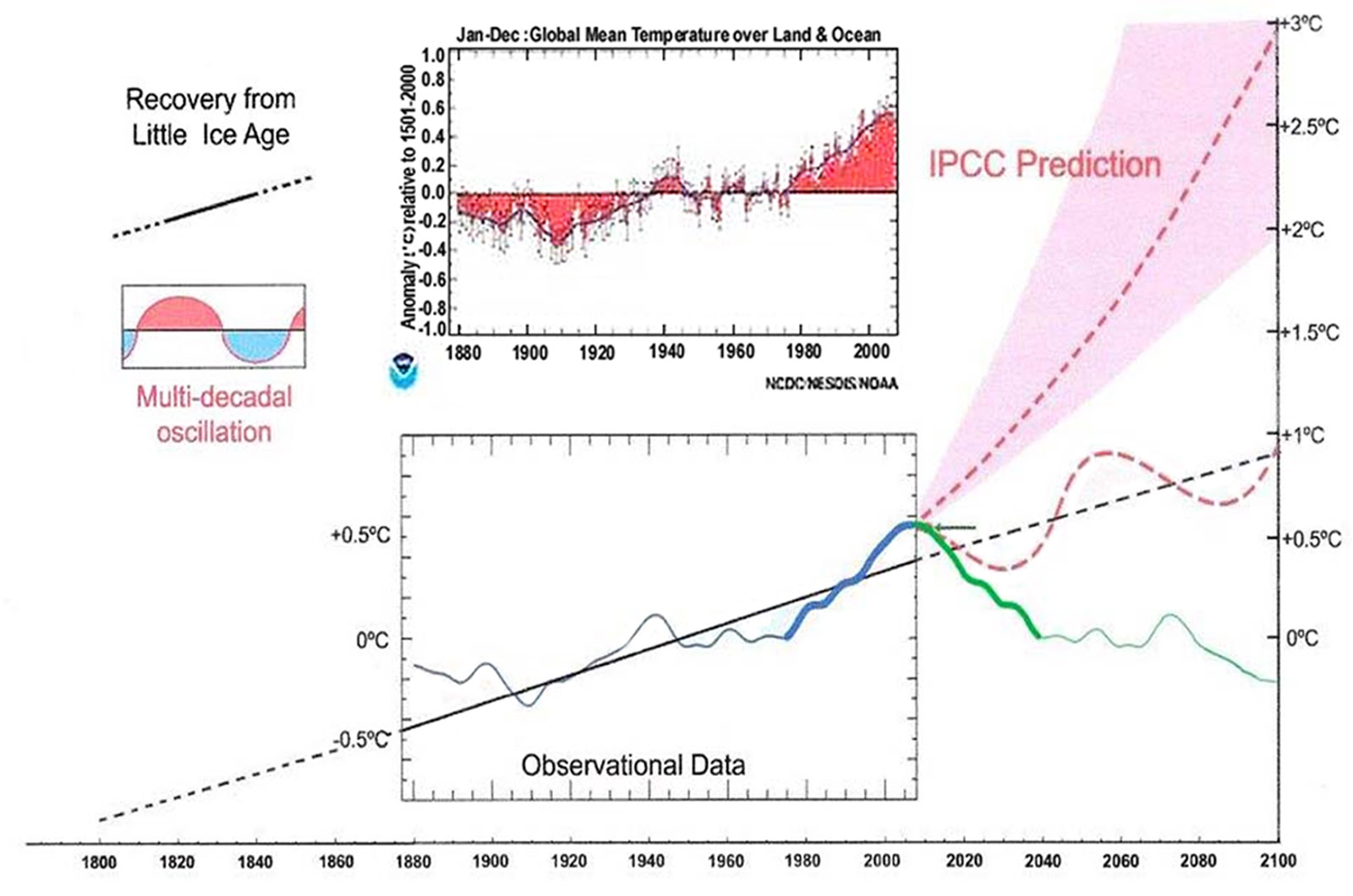
and an earlier accessible blog version at http://climatesense-norpag.blogspot.com/2017/02/the-coming-cooling-usefully-accurate_17.html
Here is the abstract:
“ABSTRACT
This paper argues that the methods used by the establishment climate science community are not fit for purpose and that a new forecasting paradigm should be adopted. Earth’s climate is the result of resonances and beats between various quasi-cyclic processes of varying wavelengths. It is not possible to forecast the future unless we have a good understanding of where the earth is in time in relation to the current phases of those different interacting natural quasi periodicities. Evidence is presented specifying the timing and amplitude of the natural 60+/- year and, more importantly, 1,000 year periodicities (observed emergent behaviors) that are so obvious in the temperature record. Data related to the solar climate driver is discussed and the solar cycle 22 low in the neutron count (high solar activity) in 1991 is identified as a solar activity millennial peak and correlated with the millennial peak -inversion point – in the UAH6 temperature trend in about 2003. The cyclic trends are projected forward and predict a probable general temperature decline in the coming decades and centuries. Estimates of the timing and amplitude of the coming cooling are made. If the real climate outcomes follow a trend which approaches the near term forecasts of this working hypothesis, the divergence between the IPCC forecasts and those projected by this paper will be so large by 2021 as to make the current, supposedly actionable, level of confidence in the IPCC forecasts untenable.”
The forecasts in Fig 12 of my paper are similar to those in Ludecke et al.
Fig. 12. Comparative Temperature Forecasts to 2100.
Fig. 12 compares the IPCC forecast with the Akasofu (31) forecast (red harmonic) and with the simple and most reasonable working hypothesis of this paper (green line) that the “Golden Spike” temperature peak at about 2003 is the most recent peak in the millennial cycle. Akasofu forecasts a further temperature increase to 2100 to be 0.5°C ± 0.2C, rather than 4.0 C +/- 2.0C predicted by the IPCC. but this interpretation ignores the Millennial inflexion point at 2004. Fig. 12 shows that the well documented 60-year temperature cycle coincidentally also peaks at about 2003.Looking at the shorter 60+/- year wavelength modulation of the millennial trend, the most straightforward hypothesis is that the cooling trends from 2003 forward will simply be a mirror image of the recent rising trends. This is illustrated by the green curve in Fig. 12, which shows cooling until 2038, slight warming to 2073 and then cooling to the end of the century, by which time almost all of the 20th century warming will have been reversed. Easterbrook 2015 (32) based his 2100 forecasts on the warming/cooling, mainly PDO, cycles of the last century. These are similar to Akasofu’s because Easterbrook’s Fig 5 also fails to recognize the 2004 Millennial peak and inversion. Scaffetta’s 2000-2100 projected warming forecast (18) ranged between 0.3 C and 1.6 C which is significantly lower than the IPCC GCM ensemble mean projected warming of 1.1C to 4.1 C. The difference between Scaffetta’s paper and the current paper is that his Fig.30 B also ignores the Millennial temperature trend inversion here picked at 2003 and he allows for the possibility of a more significant anthropogenic CO2 warming contribution
It is well past time for a paradigm shift in the forecasting methods used by establishment climate science. The whole dangerous global warming delusion is approaching collapse
“that are so obvious in the temperature record”
You are placing quite a bit of weight on this single piece of evidence.
Norman.
Do you think the squawk thing makes you more or less credible?
More or less capable of grown-up discussion?
You aren’t being squawked at.
Whereas you place you irrational beliefs on zero evidence.
EMPTY.
“tony mcleod November 25, 2017 at 8:01 pm
You are placing quite a bit of weight on this single piece of evidence.”
And you post links to a site about ice loss. When I looked at the data that graph was made from I found that most, if not all, was based on estimates. Dr. (Make a note of the Dr. in his title Mr. McLeod) Page does not appear to posting anything based on estimates.
What Ice loss?
Arctic sea ice extent is above what it has been for 90-95% of the last 10,000 years. !
SQUAWK
(mcloudmouth)…
I intend to squawk – quite loudly – at ParrotG55 every time it squawks at me.
“tony mcleod November 25, 2017 at 10:52 pm
I intend to squawk – quite loudly – at ParrotG55 every time it squawks at me.”
But why won’t you debate the data at the links you post, esp the ice loss links?
Again, The Clod has absolutely ZERO evidence to counter the FACTS.
You are a pathetic little man, McClod.
SQUAWK.
tony mcleod
“I intend to squawk – quite loudly – at ParrotG55 every time it squawks at me.”
Very grown up.
The lack of intellect OOZES from you. 😉
HotScot
“Very grown up.”
Me or the Parrot?
“Me or the Parrot?”
One and the same.. you just don’t realise it.
Lorenz’ “finding” that non-linear differential equations may lead to “chaotic” solutions isn’t, in my opinion, a proven fact. So-called “chaotic” behavior in mathematical equations is easily observed in recurrence equations, in which future values of a function depend on an earlier value or earlier values. Chaotic functions depend on the existence of an attractor, about which non-periodic but bounded values revolve. The notion of an attractor is associated with the existence of a fixed point, a point where the next value of a function is equal to the current value, i.e. f(x) = x.
In my opinion, the existence of attractors – and thus chaos – in numerical solutions of differential equations is due to the fact that the equations are being solved numerically. Analytical solutions, if they could be found, would not necessarily exhibit chaotic behavior.
Lorenz’ equations give the derivatives with respect to time of three variable, x, y, and z. Time does not appear explicitly in any of the equations, a condition which is dubbed “autonomous.” Yet an analytical solution, should one ever be found, would consist of x(t) = F(t), y(t) = G(t), z(t) = H(t); in other words, the only variable on the right hand side would be time, t. Numerical solutions, however, have both time and the prior value of the dependent variable on the right hand side. They are thus recurrence equations, where the original set may have nothing to do with recurrence. In particular, if the solution is cyclic in any manner (periodic or otherwise), the numerical solution will always have a fixed point where the derivative is zero, and yet there may be no analytic analog.
A number of approximate analytic solutions to the Lorenz equations have been found using homotopy methods. All consist of functions x(t), y(t), z(t), and not x(x,t),y(y,t), z(z,t). None of the approximate solutions (which are very close to the numerical solutions over a wide range) exhibit any sensitivity to initial conditions, nor could they.
I think that the whole notion of chaos is associated only with recurrence relations. Analytic solutions of differential equations are not recurrence relations, but numerical solutions are by their very nature. Thus, I think that the supposed chaotic nature of the numerical solutions of the Lorenz equations is an artifact of the very nature of numerical solution of differential equations.
if my ruler gives me units divided by 3, u might think i can only measure thirds, right?
but the computer makes my paltry integers into a number of infinite precision with a click.
u should see what can be done with data compression! when u remove all redundancy you have static!
it’s not hard, then, to argue that static is merely perfectly ordered compressed data.
oh- statistics! with that, u can twist a rope and a leaf and a snake and a tree into a whole elephant.
the fact that every event is equally improbable means it is unlikely that anything happened ever but if it did, it is surely a miracle, eh?
Huh?
and to think the universe computes in base 1 yet no fraction of a bit goes uncounted…
don’t worry if you don’t get the jokes. boffins have yet to discover the humor force that keeps everything from ask murdering everything else.
also, nothing ruins a joke like having to explain it, so nope. let it go.
Michael S. Kelly 11/25/2017 @ur momisugly 8:47 pm
Your post is a thin shaft of light cutting through a dense fog enveloping this article from top to bottom. Your light would be a broader, brighter beam if, first, you’d get rid of the scare quotes.
When Philosopher David Stove identified Karl Popper, the father of Post Modern Science (the disorder infecting most of academic science) as the lead of four irrationalists, Stove invoked two principle criteria: first, these cranks denied four centuries of stunning progress in science (i.e., Modern Science since its founding by Bacon), and second, their writing style included neutralizing success words in science, principally putting quotes around words to denigrate them. Stove’s sterling example of the latter was a sign advertising “Fresh” Fish.
Your “Fresh” Fish is merely a comical distraction from your opinion in the first sentence, which happens to be contradicted by your next sentences, which lead to a fairly decent speculative conclusion. The fact of chaos is observable in dynamical systems, defined as systems governed by equations. However, nothing in the Real World is governed by equations. Computers and computer models are. The Real World does not and cannot inherit properties from man’s models of it. It has no coordinate systems, no parameters, and especially no initial conditions save for the fantastic Big Bang.
One particularly egregious inheritance from Popper’s deconstruction of Modern Science was his disdain for definitions. So trained, apparently, Lorenz struggled to compose a definition for chaos. Nonetheless, he did conclude that chaos was deterministic and possessing a certain property of the equations of a dynamical system. Id., 1991, p. 449. That property was an extreme, even unobservable, sensitivity to initial conditions.
Lorenz (1991) made no attempt to define dynamical systems, but the best definitions since say that dynamical systems are systems governed by equations. (If anyone objects to that deduction, he is free to submit another definition for the sake of argument, or to continue to participate in an irrational dialog.)
Post Modern Science has created a consensus-like majority of academic scientists who routinely communicate without distinguishing between their models and the little portion of the Real World that their models are supposed to represent. Lorenz himself fell victim to this confusion when he wrote, The atmosphere and its surroundings constitute a chaotic dynamical system, … . Lorenz (1991) p. 450. IPCC made exactly the same mistake in its surprisingly good Glossaries (considering its gross errors in the science of its models). E.g., AR4 Glossary, p. 944.
IPCC concludes that the atmosphere is chaotic when its model is the thing that is chaotic. Its conclusion is an excuse for the fact that its model can’t predict climate.
Jeff Glassman 11/26/2017 7:05 am
Good point on the scare quotes. (I almost wrote: “Good” point on the scare quotes, but not everyone gets that I have a sense of humor.) I’ll refrain in the future, except, possibly, when I use the word “laser.” No, definitely when I use the word “laser.”
The rest of your comments were spot on, particularly your observation that nothing in the real world is governed by equations. The phrase governing equations (I’m afraid to use quotes at all, now) has been a pet peeve of mine since grad school, where it was ubiquitous in any discussion of the Navier-Stokes equations. I challenged all of my professors who used it, and they usually protested that it was a mere figure of speech. But it eventually became very clear to me that to a person, they actually had this notion that the equations were what told reality what to do. It reflects the fact that that most don’t realize that equations can sometimes be used to describe reality, though not always, and rarely perfectly.
The Navier-Stokes equations are widely regarded as being the governing equations (quotes really would work here, just sayin’) of fluid dynamics, even though their original derivation is based on continuum mechanics, which has no fundamental correspondence to the behavior of real fluids. (It would later be realized that taking the velocity moments of the Boltzmann transport equation yields the Navier-Stokes equations, but the implications of that have barely been touched.) There is certainly no reason to believe that the NS equations could ever predict the onset and structure of turbulence, the most important feature of fluid flow.
The fact that the NS equations are not tractable by analytical methods has allowed us to pretend that none of those problems exist. Numerical solutions, the only ones possible, have the same flaw as the solutions of the Lorenz equations, multiplied many times. It isn’t any wonder that CFD solutions can be made to look like turbulence, but getting them to sort of represent actual turbulence always requires tuning the constants (in, for example, the k-epsilon model) to match test data. The chaotic nature of recurrence equations as opposed to smooth functions of time and space may pass for turbulence, but it is really just expensive curve-fitting.
Tremendous comment, Mr. Glassman. (Aren’t you glad I didn’t write “Tremendous”? Doh!)
yay! somebody else who gets it that popper was a mystic who simply repackaged platonic essense – ‘now with extra freshness!’
“They asked each other countless riddles, such as who played the Cisco
Kid and what was Krypton. In the end Dildo won the game. Stumped at last for a
riddle to ask, he cried out, as his hand fell on his snub-nosed .38, “What
have I got in my pocket?” This Goddam failed to answer, and growing impatient,
he paddled up to Dildo, whining, “Let me see, let me see.” Dildo obliged by
pulling out the pistol and emptying it in Goddam’s direction. The dark spoiled
his aim, and he managed only to deflate the rubber float, leaving Goddam to
flounder. Goddam, who couldn’t swim, reached out his hand to Dildo and begged
him to pull him out, and as he did, Dildo noticed an interesting-looking ring
on his finger and pulled it off. He would have finished Goddam off then and
there, but pity stayed his hand. “It’s a pity I’ve run out of bullets” he
thought, as he went back up the tunnel, pursued by Goddam’s cries of rage.
[?? .mod]
To the Moderator: I couldn’t think of any comeback for gnomish, but for some reason this scene from Harvard Lampoon’s Bored of the Rings popped into my head. It seemed appropriate at the time.
[Yes, and thank you for the attribute for that extended quote. .mod]
gnomish 11/26/2017 @ur momisugly 7:15 pm, Michael S. Kelly 11/26/2017 @ur momisugly 7:48 pm
Alas, poor gnomish, we knew him. Choke on that, fool, eh, Michael?
Actually, we ought to cut gnomish some slack. Pity him for having neither a shift key nor a spell checker on his communication device, but kudos for his compact assemblage of Platonic essence by a mystic.
In philosophy, essence has to do with the existence of certain kinds of universals in the Real World, much like chaos (and linearity/nonlinearity and thermodynamic equilibrium, for that matter.) But like chaos, essences have their place in our models of language. In the rigor of formal linguistics (harking back to Aristotle), a thing to be defined is a definiendum (species), its genus (genos) and the differentia (diaphora). In that context, the essences of a thing are its differentia. Certain fields of knowledge thrive on ignoring such things, including philosophy, litigation, and both Popper and his invention, Post Modern Science.
Mystic Karl (“I am not a scientist”) Popper also had a problem distinguishing among members of the genus of universals. His philosophy of science turned on his presumption that each scientific proposition was either in fact a Universal Generalization (UG), or equivalent to one. He is recognized by his example, “All ravens are black.” Applying his keen insight as a logician, he deduced that UGs could not be experimentally affirmed, but that they could be disproved with a single contradiction. Therefore, his model of a scientific proposition had to be expressible (though, as he made explicit, not testable) in the negative, a form he called falsification, and for that he would earn himself another differentia. Of course, no self-respecting Modern Scientist would ever construct such a model. But UGs actually exist in science. They appear in definitions, except by Karl (“definitions do not matter”) Popper.
And since in Popper’s model, scientific propositions could not be tested, he replaced Bacon’s strictly objective validation with a triad he called intersubjectivity. It comprises peer review, publication, and consensus support, each within a certified community. His deconstruction of Modern Science produced a sterile version, Post Modern Science, and over the past half a century, an epidemic of unreproducible studies infecting professional publications. Example: AGW, aka Climate Change, certified valid, but in real science, a failed conjecture.
For this article, the thing in need of a definition, the definiendum, is chaos, a system in a chaotic state. Its genus is the set of all deterministic processes, i.e., systems governed by equations dependent on initial conditions. Chaos possesses one differentia, its essence (h.t. to gnomish), namely that any trajectory is unpredictable because it depends on the unresolvable or otherwise indeterminate fine structure of its initial conditions. The climate system and each of its subsystems fail even to fit the genus.
Jeff Glassman 11/27/2017 at 3:16 pm
Wow! You are the first person I’ve encountered in the past 40 years who is conversant with Aristotelian linguistics. I first learned of these concepts in a very rigorous course in formal logic (read: Aristotle’s brand, not the symbolic games taught today). They are closely linked with the nature of conceptual knowledge, the mode of cognition we humans enjoy. We fail to accept them today at the peril of…well, of progress. I won’t say that it imperils our very existence, but it actually could under unusual circumstances.
I forgot to thank you for the intro to David Stove. In return, I introduce you to Hasok Chang. He is an historian of the philosophy of science, not the fundamental philosopher that Stove was. I’ve been reading his book Inventing Temperature: Measurement and Scientific Progress. As an engineer who lives by measured data, and one who has a deep appreciation of the ins and outs of measurement, I found myself stunned by some of the more basic questions pointed out in that book. Anyone who is interested in global warming should read it. I warmly recommend it.
heh- i don’t have to use the shift key. this is the internet – one doesn’t bother backing up for typos, either.
also i’m adopted and my mom dresses me funny. and idgaf.
addressing the content, though, is just easy for me and i’ll have a word with you about plato’s noumenal essence.
the distinguishing characteristic (not to be confused with ‘essences’ as you seem to do) is that it is unknowable – in this way plato violates the law of the excluded middle to create his supernatural realm.
this is what distinguishes ‘post modern science’ from reasoning.
you are free to define your terms however you wish – and i’ll work with that. but plato did not use your definition, i think.
if you can get over your bad self, i invite you to discuss epistemology here https://dhf66.wordpress.com
punctuation can be discussed here where it’s of vital importance, mmk?
chaos is where determinism fizzles out, right?
it’s because no 2 entities are identical (otherwise there would be only one)
a generalization must ignore the individual case- but they are all individual cases.
Michael S. Kelly ==> There is a great deal of experimental data showing that the findings of non-linear maths actually appear in the real world in a almost all fields of scientific endeavor. In biology in population studies, in medicine in heart beat patterns and abnormalities — see my series on Chaos and Climate.
There is a reading list in the series (repeated several times) giving the best sources for general understanding.
The surprising thing is that the disturbing aspects of Chaos Theory are found in real world physical systems — like climate — and not just in the numbers spit out by computers.
Kip Hansen November 28, 2017 at 3:51 pm
It’s an honor to be recognized by you. I have no doubt that there are numerous phenomena which exhibit chaotic behavior in the widely-understood sense. I also have no doubt that models of all of those phenomena involve finite difference calculus, where “chaos” is (somewhat) readily understood, and abounds for non-linear systems.
The point I’m trying to drive home is that a finite difference equation has it’s dependent variable as a function of, among other things, earlier values of its dependent variable. The analytical solution of a differential equation does not (and cannot) have its dependent variable on the right hand side. That would violate several fundamentals of mathematics. And it is the extremum of a cyclic period function where the derivative is equal to zero, and the future value of the dependent variable equals the present value. That is the definition of a “fixed point,” which is a necessary condition for chaos.
A cyclic recurrence equation will always have at least two fixed points, and thus will be subject to chaos. There is no guarantee that the solution of a non-linear set of differential equations will have any fixed points, and thus, none that guarantee chaotic behavior. However, a numerical solution of a set of such equations automatically has the potential for fixed points. I think it’s a line of reasoning worth pursuing.
Some presumed chaos is simply order which we can’t sort out. Other chaos might indeed be irreducibly chaotic, to borrow an ID concept.
Perhaps chaos, overall, is cyclic?
I started in early 70s the study relating the role of the Sun and the Moon on geomagnetic field and meteorology [manually as computers and calculators are not available and that too outside office work]. I published several papers (national and international journals) using these results. Just at that time, In Indian Parliament, a question was raised: Is average onset (southwest monsoon) date of Delhi June 19 is correct? Then, to answer this question [I was assigned along with my boss], we developed a methodology and submitted the results to DG of IMD: the average onset date of Delhi as 2nd July. During this process I collected data of actual dates as declared by IMD for the past years for 32 met sub-divisions. I plotted the onset dates of Kerala Coast (this is the place used to declare onset over India) and found there is some sort of cyclic nature in the series. I fitted this data to 10-year moving average and observed it showing a 52-year cyclic pattern.
In 70s, on my own (in addition to official work) developed formulae for the estimation of solar radiation [global & net], evaporation, evapotranspiration, cloud cover to sunshine, etc. These I got them published in Solar Energy Journal (USA). Estimated the radiation data for series and subjected to power spectral analysis [wrote programmes in Fortran IV] and found the results followed sunspot cycle.
I got an opportunity to study the Mahalapye data in Botswana. This showed 60 year cycle. I presented this at a symposium.
When I was a Ph.D. student in Canberra I attended a group discussion wherein an Indian professor [Singh] showed Canberra has 66 year cycle [paleo-climatological data study — sediments near to Canberra]. I brought to the notice of the speaker that similar cycle is seen in Durban/ South Africa Precipitation data around this latitude.
I studied later northeast Brazil, Mozambique, Ethiopia precipitation. All these are, I discussed in my book published in 1993.
After my return to India from UNO assignments, I studied Indian rainfall data. These are published in my later books and as well at several seminar programmes. Here I tried to see the link with astrological cycle used in India and Chine [60-year cycle]. However, these cycles at individual locations and regions show quite different from national level. They followed a width of the cycle reduction as we approach equator. At some locations it is clearly seen the sunspot cycle and multiples pattern.
Dr. S. Jeevananda Reddy
Chaos simply implies that a system or process is incompletely or insufficiently characterized and unwieldy, which precludes prediction outside of a limited frame of reference (i.e .”scientific” logical domain). For example, a human life is a chaotic process, so is evolution. They can be modeled (or predicted) within a limited frame of reference, but lack of skill and/or knowledge, precludes establishing the time of illness, death,etc.
The unmistakable sinusoidal nature of global warming/cooling trends is about to be confirmed in about 5 years when: 1) a weak La Niña cycle starts in early 2018, 2) both the PDO and AMO are in their respective 30-yr cool cycles, 3) the weakest solar cycle since 1790 starts in 2021 and 4) the weakest solar cycle since 1645 starting in 2032, which will mark the beginning of a 50~75-yr Grand Solar Minimum event leading to a general global cooling trend for the next 80+ years.
For the CAGW’s hypothesis to be confirmed, a warming trend of 0.3C/decade must start from tomorrow and continue for the next 8 straight decades… Any delay of such an impossible Warming trend simply increases requisite future warming trend for hypothetical confirmation…
In about 7 years, CAGW will be laughed at…
If the Earth does finally leave this ice age that we are in will this be to the benefit of the human race or will it be a disaster for us. All the extra land available because of the water locked up in ice has been to our advantage when all this melts it will be the age of the fish unless we can adapt to that change.
Weather can be both chaotic and cyclical. The chaos is constrained by the state of the solar system and the local galactic family and where in the universe we are. The solar system and galactic family as a system are chaotic and cyclic. The cycles are imperfect and never repeat exactly and cannot. The local system is racing across space at an enormous rate and regardless of any internal cycles that have strong similarities, the local system never returns to a previous state. Like the hand that having writ moves on.
An example of cyclic chaos is the tip of a bullwhip. It is cyclic and constrained by its length, but the tip can crack in an infinite number of places. It is chaotic because it cannot be known where the tip will be with certainty each time it cracks. It is assumed a human is a component of the whip’s system. Because weather can be both, climate, which is a derivative of weather, can be both as climate follows weather.
we don’t understand climate yet..
You and I might not understand it lemiere, but there are pleny of people who do.
Really? The IPCC definition of “climate” is the average of 30 years of weather. Well, I sure understand how to make up averages.
“but there are pleny of people who do”
Yes, you have made it patently obvious that you know NOTHING about climate.
Except it is quite obvious and easily demonstrable that we and they do not. We cannot explain or predict El Ninos for example or the other large scale apparent cycles – and as this discussion shows there is not even agreement about whether they are cycles.
So why would you make such an obviously false claim?
tony mcleod
“but there are pleny of people who do.”
Who?
Thanks.
“we don’t understand climate yet.”
You could substitute any field of science into that statement couldn’t you? In other words it’s a bit meaningless. That was my point.
But no, lol, it becomes an “obviously false claim”, and gets squawked at.
1/. There is no reason why it cannot be both – cycles superimposed on chaotic behaviour. Think of a ‘breathy’ note from a flute. The note (cycle) is there, but so too is the random noise (chaotic) component.
2/. Chaotic behaviour often shows quasi-periodic behaviour for many quasi-cycles…until it shifts to other attractors.
In short this is largely a semantic argument. We know for sure that the fundamental behaviour has at least a large chaotic component, yet we also see periodic behaviour as resonant systems like the NAO respond to chaotic drivers.
It is important to remember Korzybski.
“The map (model) is not the territory.”
Cycles and chaos are our (inadequate) maps of climate: it is, ultimately what it is.
If people were to spend less time arguing which map or model is the One True Map (or Model) and instead realise that all are flawed to an extent (the amount of information in the universe would require a computer the size of the universe to represent it as a model) and that models are not Reality in itself – and that goes right up to the material-Realism that underpins science itself – it is, in the end, just another model – then we wouldn’t waste so much time arguing whether models are true – they can’t be – but instead restrict ourselves to their accuracy and applicability.
Applying Fourier analysis to climatic variables will obviously detect at least two spectral lines – the annual and the diurnal. There is probably some influence of the moon cycles as well.
There may be more. But only a very very long term analysis of data we haven’t actually got would detect decadal or centennial length cycles reliably. We sorta feel that ice ages are cyclical,. and yet their appearance is not massively cyclical, just periodic.
My point being here, that we lack enough data to falsify either position, so argument remains mere hypothesising at this point.
It is disheartening to spend 20 minutes carefully constructing a post, to have it disappear into a black hole.
Leo, never do more than 5 words in WordPress !
Compose on your word processor & copy across, then you can resend when it goes on a trip to infinity.
1saveenergy
Now you tell us.
🙂
Just another way to save energy & effort (:-))
In about 1980, my work colleagues were getting deep into geostatistics for mineral exploration and mining. One day we chatted on about cross correlations and cross semivariograms. Keen to exercise, I went looking for some long term data in earth science applications. In those days I subscribed to Scientific American and gave past copies to our corporate library. The longest useful record gave sunspot counts back to 1750 or so, IIRC. Other data came from diverse commodities like the counts of various furs from the Hudson’s Bay Company, maybe fox and lynx, the weight of tomatos harvested in West USA, the copper price on the London Metal Exchange, the annual USA wheat harvest and the California rainfall record. These I can remember, there might have been a couple more. I no not recall using any temperature time series. If it was not in SciAm, I did not use it.
I fiddled around in spare time with correlation matrices using geostatistical methods, including lagging and data at various resolutions over time, like weekly to monthly to annual prices on metals trading.
The exercise was lost long ago, but from time to time an article surfaces that touches on this past recreational computing. There were correlations in the data, some looking strong enough to make me think about mechanisms. It is eerie to see how often the correlation theme, usually computed conventionally, crops up again for some of the variables that ScAm publshed.
But now that Journal has lost its way and researchers seem to need to homogenise data to death before computing correlations.
It would be beautiful to repeat the exercise but I am now too tied up to try. What started out as an inquisitive investigation seems to have become involved in mainstream research. Geoff.
“The Transition from Uniformitarianism to Catastrophism.”
Fundamentally it’s what Eisenhower warned about capture by scientific elites and there’s more money in perpetual crisis and catastrophism when you compare and contrast scientific output-
http://www.abc.net.au/news/2017-09-29/coral-regeneration-raises-hopes-for-great-barrier-reef-recovery/9001518
https://www.theguardian.com/environment/2017/feb/08/massive-ancient-undersea-landslide-discovered-off-the-great-barrier-reef
http://www.abc.net.au/news/2017-01-15/ancient-samples-great-barrier-reef-recover-but-new-threats-study/8182822
http://www.scienceinpublic.com.au/marine/toughreefs
http://www.sciencealert.com/scientists-just-discovered-a-1-000-km-coral-reef-at-the-mouth-of-the-amazon
So from that sample of scientific discovery and what you’ve heard more generally are you relaxed and comfortable about coral reefs or a worried doomsdayer wanting intervention? We might guess some scientific stances on that-
http://www.abc.net.au/news/2017-11-26/scientists-discover-game-changer-for-great-barrier-reef/9190200
but make sure you fit in with the appropriate stance-
http://www.heraldsun.com.au/blogs/andrew-bolt/censoring-peter-ridd/news-story/277a6e82695f1564e1133c16e0dc6e1b
Of course if coral reefs naturally recover from all sorts of stresses and you actively intervene in that process then you can give yourself a big pat on the back for doing good works just like they did with hunting Crown of Thorns starfish during plagues. Correlation can be a great gift that keeps on giving.
Climate is not chaotic, it is probabilistic. Withing that are many competing cycles, trends, and forcings.