
Guest essay by Eric Worrall
Standard & Poor, the credit rating agency which in 2015 paid $1.4 billion to regulators to settle legal action related to its role in the 2008 subprime mortgage fiasco, now thinks that renewable power is the future.
‘Tide has turned’: Global rating agency says climate economics trump politics
Peter Hannam
OCTOBER 14 2017
The global shift from fossil fuels to renewable energy will continue regardless of political action such as President Donald Trump’s decision to withdraw the US from the Paris climate agreement or outbursts from ex-Australian prime ministers, a senior ratings analyst says.
“The tide has turned,” said Michael Wilkins, the head of climate and environmental risks at Standard & Poor’s Global Ratings, adding the transition meant the economic viability of assets such as coal mines and coal-fired power stations would be “vastly impaired”.
Mr Wilkins’ comments come as new S&P research points to deep falls in the costs of renewable energy as other groups report important shifts by corporations at home and abroad on climate risks.
The risks include challenges their businesses will face in a carbon-constrained world but also the physical damage posed by more extreme weather events as the planet heats up.
…
Solar photovoltaic costs, which have halved in the last few years, will fall another 35 per cent by 2020, Mr Wilkins predicted.
“You could argue we’ve reached a tipping point,” he said, adding that with falling storage prices, intermittent energy sources could soon compete with traditional fossil-fuels on dispatchability grounds alone even without including their environmental advantages.
…
Frankly I’m shocked that an organisation which prides itself on prudential advice would take such a position.
Mr Wilkins by his own statements is talking about events which haven’t happened yet. He thinks renewables “could” soon be competitive with dispatchable fossil fuels, because of falling prices. He believes falls in the price of renewable generation and energy storage costs will continue.
Mr Wilkins might be right – if generation and storage prices fall sufficiently, if the wild superstorms predicted by alarmists start to manifest, renewables might start to look good. But claiming “the tide has turned” on the basis of a chain of unsubstantiated maybes is a ridiculous position for an agency which prides itself on its prudence.
You would think a ratings agency like S&P would have learned a little caution about hyping speculative future profits, given how they recently got their fingers badly burned because of their over-optimistic assessments of the value of subprime mortgage bonds which subsequently collapsed.
My experience in the telecomms market is that market analysts spend a lot of time seeking the opinion of key players, those with a commercial interest in the success of the market, and then sell their opinions back to these players to reinforce their opinion. Not a lot of analysis seemed to go on.
I don’t imagine the energy market is that much different.
Apparently the S&P never heard of the advanced nuclear reactors that employ molten salt – their ignorance about future energy trends are quite evident. And apparently they also haven’t examined the prices Tesla’s solar roofing company is charging for their roofs – $50,000 to $75,000 was the range for typical roof sizes. They claim these roofs can be cheaper than not having one, when you examine the costs (actually using estimated power costs) – of course to save any money, you need to live in the right place (a Southwestern U.S. desert would do) and also need a $15,000 to $23,000 govt subsidy, so claiming the price is cheaper really means cheaper TO YOU. They provide a mortgage , if need be, for the roof, so if you try to sell your house, you need to sell the roof
and its mortgage as well. Just another day, another example of Tesla’s logic, and misleading claims (they recently paid tens of millions in fines because that same roofing company (controlled partly by Tesla) was found to be fraudulently making claims of savings to customers.
Andrew Worth appears to be the same left wing troll known as Andrew W. who infests other websites.
As for S&P, think back to high school and look who wound up in the financial industry – the B team.
I always turn to the S&P for information about future energy technologies.
One would have to question why? You probably need to explain that one.
If you have to explain a joke it isn’t funny
George Lopez had the same problem the other night.
Hilarious. Notice the ubiquitous hedge – “could”.
Intermittent sources will never compete on dispatchability grounds until feasible (not just possible) storage technology is invented. There’s no guarantee that will happen.
but you – and everyone
else here – knows that’s coming,
and probably sooner than anyone
expects.
what will the excuses be then?
S&P backs…Madoff.
S&P fine $5 Billion for defrauding investors.
https://www.google.com/amp/mobile.reuters.com/article/amp/idUSBRE9130U120130205
I love ‘outburst’. That language is a ‘sell’ indicator. The chap’s unbalanced .
Just how far must the price of photovoltaic fall before it can deliver power at midnight ?
How far must the price of photovoltaic fall before it can deliver power at midnight ?
@crackers345 October 14, 2017 at 9:48 pm
asks “why is not all “nameplate” output not “dispatchable?”
what is the definition of each?
Lets look at PV, a PV panel gives its maximum power output at local noon, if the panel is oriented directly towards the sun and the suns rays strike it perpendicularly.
Any other condition, and the panel produces less power.
Especial at night, where in the real world, it produces zero power.
Nameplate capacity or say 4 kW only occurs, potentially for a few minutes per day in the summer, at all other times the device is producing less.
Dispatchability: in the real world, someone is monitoring the electrical grid. They have screens in front of them showing power to the grid from all of the generators online currently. All customers are using all of this power. The amount used has to equal the amount generated.
Now, the operator gets a call from station X, saying the cooling temperature is showing an unexpected rise and they with have to stop generating their 1GW within the next 5 minutes to investigate.
The operator/dispatcher looks at the rest of his list of generating stations, phones two up and says over the next 5 mins were losing 1G can you both ramp up to take the slack. They do, grid remains stable and life going on with monotonous regularity, no drama, and the public (and greens) are oblivious to the work going on in the background that gives them stable electric.
Now, who is the dispatcher going to phone if he only has PV or wind available?
At night there is no PV electric. Wind is wind, by law the companies have to ‘take’ all the wind created electric there is. There is no extra power available.
The dispatcher has no choice, they can only call on dispatchable power sources: gas, nuclear, hydro or storage; to give instantly variable, controllable and dispatchable electrical power.
South Australia shows what high penetration of renewables does to the stability of a grid: a whole state is blacked out.
It would be laughable if it were not so serious.
“It would be laughable if it were not so serious.”
It’s madness to replace stable, reliable, dispatchable energy sources (coal, gas, nuclear) with unstable, unreliable, non-dispatchable ones (wind/solar) that require backup by the former. Absolute madness.
“The tide has turned,” said Michael Wilkins, the head of climate and environmental risks at Standard & Poor’s Global Ratings, adding the transition meant the economic viability of assets such as coal mines and coal-fired power stations would be “vastly impaired”.
As the head of “climate and environmental risks” (whatever the heck that is), of course he’d say that. His “analysis” is completely ideologically motivated, and not based on reality. Anyone who based financial decisions on what drivel he spouts would have to be a fool. And as they say, “a fool and his money are soon parted”.
The War (Specifically) On Nuclear Energy has escalated to a new level. No one — not even the vociferous defenders of coal-for-electricity status quo — see coal as anything but an economic base that has to be protected from shock until the better comes along.
Make no mistake. This is NOT about promoting so-called renewables. It is a divide and conquer strategy to take nuclear out of the equation.
United States nuclear energy is complicit in nuclear’s demise in their ludicrous promotion of SMR (small modular reactors). They are either complicit or stupid. Taking the necessary base load economy of >1GWe per reactor and demoting nuclear to “the option that only billionaires could possibly afford for their survival enclaves.” The only way these defenders of the atom could possibly have saved nuclear is by publicly and loudly pressing for Thorium based molten reactors, the only viable and workable next stage in nuclear evolution.
Instead, they are gnawing at the ends of old plots — dangerously mixing fission and water on a smaller scale, the must know they are rendering the technology irrelevantly expensive. It’s almost as if they have been offered a golden parachute as their children’s children might some day be boiling water to stave off cholera to (dim) LED light.
Recalling Moody’s 2009 financial hit piece warning potential nuclear investors, then their most recent 12-Oct-2017 upgrade of outlook from ‘negative’ to ‘stable’, of (specifically) China General Nuclear… I cannot help but imagine that the fix is in. China will be encouraged to gather investment from Wall Street to modernize in the most efficient way possible, while the United States and Europe is to follow a long industrial decline into energy-poverty, a state something like Medieval serfdom and third world colonization, but with a few smartphones in hand.
Of course natural gas will save us because we have a zillion years’ reserves. Another flash in the pan, and the day will soon arrive when the U.S. is exporting more natural gas than it is permitted to use, because it has become a colony once more.
hocus, can we bury the
nuclear waste in
your backyard?
Let’s do some math people.
First, the average residence uses 35 Kw per day.
The average cost of solar panels in the US was $3.15 per watt in 2017 (doesn’t include batteries and inverters).
http://news.energysage.com/wp-content/uploads/2017/02/6.13-Solar-in-States-Graphic-Update.png
Now, the Sun don’t shine all day so on average you will only get 30% nameplate capacity (7 hours/24 hours), which ALWAYS seems to be ignored by the solar advocates and the solar panel sellers.
So if you want to go off-grid with solar on your home …
—> $360,000 (lasts 15-20 years)
—> $80,000 (lasts 5-10 years)
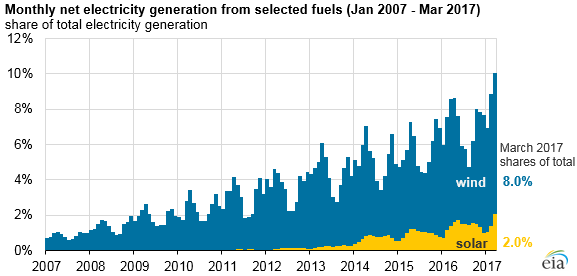
The math don’t work people. Now if you want to generate 30% of your needs or pretend selling back to the grid is the same as supplying a whole homes worth of energy needs, of course the costs come down. But then, you are not actually fully replacing electricity generated by coal and gas plants. Which is why solar only accounts for less than 3% of total electricity generation in 2017. Math don’t lie, but solar people do.
—> $360,000 (lasts 15-20 years) – Solar Panels
—> $80,000 (lasts 5-10 years) – Batteries and Inverters
Bill Illis wrote that “First, the average residence uses
35 Kw per day.”
of course not!
in the last year i’ve used an average
of 306 watts.
7.3 kWh per day.
From the one plug in your mommy’s basement?
If he failed to include a “forward loooking statements” disclaimer, he should get perp-walked…
Read more: Forward Looking http://www.investopedia.com/terms/f/forward-looking.asp#ixzz4vaDvtUji
Follow us: Investopedia on Facebook
When one is virtue signalling one gets a pass from the forward looking statement. (a.k.a. “The science is in!”)
I can’t think of a major bank, fund manager or asset manger (or insurance company) not involved in renewables, green bonds etc.
This is a mainstream investment now.
In the past the equivalent organizations paid homage to the religious authorities of their time.
Only with subsidies, Griffie.
I can’t think of a major bank or fund manager or asset manager who didn’t dabble in subprime mortgages in their day.
Stringing together al of the what-ifs, but not yets. Some of them are just vague promises. All of them built on exaggerated fear and a forced belief system that doing without and paying more is better than an unlimited energy supply on demand.
And the worldwide housing bubble abetted by ratings agencies.
Sustainable, renewable, green profits. It’s a financing industry’s dream.
There is no penalty for being wrong in any of this, save the billion or two to regulators (a mere pittance), because no one loses their own shirt. Someone else does and the government is inclined to bail out foolish investments if they are big enough. Until shirtless, broke prognosticators and government officials are dumped on a desert island and left there to fend for themselves, this will continue. People with billions apparently don’t care who gets hurt or who loses as long as they continue to rake in the bucks. Dishonesty in everything is so common now—I hesitate to invest in anything short of supplies and food for the coming disaster. At least if I’m wrong, I can eat my error! It’s just so sad that lies and deception are the norm now. We are a lost people…..
Warmists desperately want to declare a tipping point on the solution before the problem gets discredited.
“Warmists desperately want to declare a tipping point…”
Mmmm but that’s the point… S and P are not your mainstream Warmists. In fact the mere fact they are saying this stuff would genuinely indicate that renewables are indeed being taken seriously by the big boys. Denial of that fact is just plain dumb.
I’ve no doubt renewables are being taken seriously as a money making opportunity. Just like subprime mortgages were.
I was working in the London financial district during the subprime crisis. Everyone I talked to knew they were utter cr@p, but everyone was playing greater fool theory games.
Some skilful brokers survived and prospered, but an awful lot of wealth was destroyed in the crash.
Looks to me like an attempt to deny the facts based on a meaningless analogy.
In order for intermittent renewables (solar/wind/wave/tide etc) to work in the same way that conventional plan does you need to add
shot term storage
medium term storage
long term storage
in conventional plant short term storage means that the turbine generators keep spinning even if the load suddenly increases; the energy in the rotating mass smooths out short term demand imbalances.
With renewables you need batteries.
In conventional plant running off a stored energy source like gas or uranium you have a tank or a reactor full of energy that you can draw on to meet – say – a evening peak.
With renewables you need bigger batteries.
In conventional plant running off a stored energy source like gas or uranium you have a local stockpile full of energy that you can draw on to meet – say – winter.
With renewables you need batteries so big that any failure in them would result in a release of energy tat would make Hiroshima look like a firecracker.
Note that currently, the cost of providing these batteries is not borne by renewable companies, nor yet is it costed as part if the cost of renewable energy all together. Only the consumer sees his bills increasing.
Currently load balancing is done, not by batteries, but by virtue of what conventional plant is left extant. That plant has to work twice as hard in terns of plant damaging start stop and ramp up and down performance and is subjected to extra mechanical stresses by short term demand fluctuations, but receives less revenue as renewable plant output is always taken preferentially. So they have t charge more for what electricity they are supplying.
These added cots are not costed into the ‘cost of renewables’ either. Since wind-farm operators and solar farms don’t have to pay them, they can remain profitably subsidised whilst gas plant simply closes down
leaving (in the UK) a major problem in that the ability to offset renewable failure has to be met with…
DIESEL GENERATORS. STOR (short term operational reserve) gas guzzling plant designed to be capital cheap but fuel hungry, in place in case renewables let us down as they do every night and all winter for solar, when we most need power (just after dark especially in winter). This plant negates al the carbon emission gains that might have been had from renewables. But then, curiously enough EU directives on climate change are nor couched in terms of emission reductions, but in terms of renewable obligations. It is almost as if they knew tat renewable energy would make not difference to overall carbon reduction…
What you see here s the complete an utter failure of renewables to compete on a level playing field with conventional generators. And that is because the inherent features of conventional generation, in terms of its ability to meet demand, were implicit and never given a financial value. Renewable energy has capitalized on the fact that the only tradable commodity is watt hours, (and carbon) to supply what is essentially a sub standard, to the point of being virtually useless, product, for which it also receives a subsidy
No value is placed upon the ability to meet demand fluctuations…by the grid. so the grid itself must pick up the tab by commissioning storage of one form or another to handle the dispatch at renewables cannot deliver.
None of these costs are born by renewable operators.
All of these costs are borne by consumers.
If you wanted to reduce emissions, you should have built nuclear power. But you cant make a fast buck out of nuclear. you can out of massively subsidised windmills though. And a lot of those are European and have the ear of Brussels.
2004-2014: renewable energy consumption rising twice as fast as demand — at the expense of fossil fuels. (And without all the deaths & suffering from fossil fuel air pollution.)
Renewables do nothing for the environment, There may be fear of running out of fossil fuels. I doubt government action can improve the outcome over just letting the free market operate. Forcing major investments in uneconomic power sources actually wastes resources and lowers our living standards.
“with falling storage prices, intermittent energy sources could soon compete with traditional fossil-fuels on dispatchability grounds alone even without including their environmental advantages.”
Weasel words. You can help cope with short term spikes, but batteries just does not scale to time-shift power. Ten days of no wind happens. Ten days of storage ( for average UK winter demand is a bit under 10,000 Gw-hrs, just for the UK alone, i.e. around 300 times the TOTAL output of Tesla’s Nevada gigafactory or 50x the projected WORLD output of lithium ion batteries in 2020.
Every once in a while I’ll see an article asking why the big 3 credit rating companies got off Scott- free in the sub-prime mortgage crisis. Saw one the other day…..perhaps S&P, Fitch and Moody’s did too. They’ve suffered no loss of business (they own 95% of the credit rating business worldwide), have suffered no judicial or legislative actions, no law-suits, no prison time, and have been pressed into no reforms. That’s right, its business as usual. So, every once in a while someone asks….why is that? A very good question, and one that must be on their minds also. As in, “what can we do to look nice, and socially responsible?” Enter the environment.