By Christopher Monckton of Brenchly
Joe Born (March 12) raises some questions about our paper Why models run hot: results from an irreducibly simple climate model, published in January in the Science Bulletin of the Chinese Academy of Sciences.
To get a copy of our paper, go to scibull.com and click on “Most Read Articles”. By an order of magnitude, our paper is the all-time no. 1 in the journal’s 60-year archive for downloads either of the abstract or of the full text.

Mr Born says that he is not sure he should take on trust our assertion that the Planck or instantaneous climate-sensitivity parameter is about 0.31 Kelvin per Watt per square meter; that we “obscure” the influences on the fraction of equilibrium temperature response attained in a given year; that we have used that fraction “improperly”; that we have incorrectly assumed a steep initial increase in temperature response; that we have relied on a model generated by a step-function representing the effects of a sudden pulse in CO2 concentration rather than one in which concentration increases by little and little; that it is “not clear” how we have determined that the 0.6 K committed but unrealized global warming predicted by the IPCC was not likely to occur; that our model should have taken more explicit account of the fact that different feedbacks operate over different timescales; that we were wrong to state that in an electronic circuit the output voltage transits from the positive to the negative rail at loop gains >1; and that our discussion of electronic circuitry was “unnecessary”.
Phew! I shall answer each of these points briefly.
First, however, Mr Born’s essay is predicated on a fundamental assumption that is flat wrong. He says that increasing CO2 concentration raises the optical density of the atmosphere, in turn raising the effective altitude [so far so good],
“and, lapse rate being what it is, reduces the effective temperature from which the Earth radiates into space, so less heat escapes, and the Earth warms”.
No. The characteristic-emission layer – the “altitude” from which the Earth appears to radiate spaceward, and at which, uniquely in the climate system, the fundamental equation of radiative transfer applies – is the locus of all points at or above the Earth’s surface at which incoming and outgoing radiation are equal. In general, the mean altitude of the locus of these balance-points rises as a greenhouse gas is added to the atmosphere. Thus far, Mr Born is correct.
His fundamental error lies in his assertion that the increase in the Earth’s characteristic-emission altitude reduces the effective temperature at that altitude, “so less heat escapes, and the Earth warms”.
The truth, which follows from the definition of the characteristic-emission layer and from the fundamental equation of radiative transfer that applies uniquely at that layer, is that the Earth’s effective radiating temperature is unaffected by a mere change in the mean altitude of that layer. It is not, as Mr Born says it is, “reduced” as the altitude increases.
The radiative-transfer identity, first derived empirically by the Slovene mathematician Stefan and demonstrated theoretically five years later by his Austrian pupil Ludwig Boltzmann, equates the flux density at the characteristic-emission layer with the product of three parameters: the emissivity of that layer; the Stefan-Boltzmann constant; and the fourth power of temperature.
Now, the flux density is constant, provided that total solar irradiance is constant (which, averaged over the 11-year cycle, it broadly is), and provided that the Earth’s albedo does not change much (it doesn’t). Emissivity is as near constant at unity as makes no difference; and the Stefan-Boltzmann constant is – er – constant. It necessarily follows that the temperature of the emission layer is constant unless any of the other three terms in the equation changes – and none of them changes much, if at all, merely in response to an increase in the mean altitude of the characteristic-emission layer.
Precisely because the effective radiating temperature at the characteristic-emission layer is near-constant under an increase in the mean altitude of the characteristic-emission layer, and precisely because the lapse rate of atmospheric temperature with altitude is very nearly constant under that increase, it is the surface temperature, not the effective radiating temperature at the characteristic-emission altitude, that rises in response to that increase in altitude.
Many of the subsequent errors in Mr Born’s understanding appear to flow from this one.
So to the individual points he makes.
First, the value of the Planck parameter. We stated in our paper that we had accepted the IPCC’s stated value. We might also have explained that we did not take it on trust. Indeed, the first of many fundamental errors in the climate modelers’ methodology that I identified, back in 2006, was the mismatch between the official value 0.31 K W–1 m2 and the Earth’s surface value 0.18 K W–1 m2 that was implicit in Kevin Trenberth’s 1997 paper on the Earth’s radiation budget.
As our paper explains, to a first approximation the Planck parameter is simply the first differential of the fundamental equation of radiative transfer – i.e., 0.27 K W–1 m2. However, allowance for the Hölder inequality obliges us to integrate the differentials latitude by latitude, based on variations in both radiation and temperature. That brings the value up by about one-sixth, to 0.31 K W–1 m2.
To verify that the modelers had done this calculation correctly, I asked John Christy for 30 years’-worth of satellite mid-troposphere temperature anomaly data in latitudinal steps of 2.5 degrees and spent a weekend doing the zenith angles, frustal geometry and integration myself. My value for the Planck parameter agreed with that of the IPCC to three decimal places. And, precisely because all of the parameters in the fundamental equation of radiative transfer are as near constant as makes no difference, the Planck parameter is not going to change all that much in our lifetime.
Next, Mr Born says we “obscure” the influences on the fraction equilibrium temperature response attained a given number of years after a radiative perturbation. Far from it. We begin by making an elementary point somehow not stated by Mr Born: that if there be any feedbacks (whether net-positive or net-negative) operating on the climate object, then the instantaneous and equilibrium temperature responses to a given radiative perturbation will not be identical, and there will be some pathway, over time to equilibrium, by which the temperature response will increase (with net-positive feedbacks) or decrease (with net-negative feedbacks) compared with the instantaneous response.
We continue by explaining the IPCC’s values – in its 2007 and 2013 reports – for the principal temperature feedbacks. We further explain that the response to feedbacks over time is not linear, but (assuming the IPCC’s strongly net-positive feedbacks) follows a curve in which, typically, half the approach to equilibrium occurs in the first 100 years, and the remainder occurs over the next 3000 years (see e.g. Solomon et al., 2009). We also provide a simple table of values over time that are unlikely to introduce too much error. The table was derived from a graph in Gerard Roe’s magisterial paper of 2009 on feedbacks and the climate. Far from obscuring anything, we had made everything explicit.

Mr Born goes on to say we had used the fraction of equilibrium temperature response “improperly”. However, it is trivial that in all runs of our model that concerned equilibrium sensitivity (and most of them did) that fraction is simply unity. In those runs that concerned instantaneous sensitivity (some did), that fraction is simply the ratio of the Planck to the equilibrium sensitivity parameter. In those runs that concerned transient sensitivity, we were dealing with sub-centennial timescales, so that up to half of the equilibrium response should have been evident. All of this is uncontroversial, mainstream climate science. Admittedly, it is very badly explained in the IPCC’s documents: but not the least value of our paper has been in explaining simple concepts such as this one.
Next Mr Born says we have incorrectly assumed a steep initial increase in temperature response (one can see this steep initial response quite clearly in Roe’s graph). Mr Born may or may not be right that there should not be a steep initial increase; but, like it or not, that is the assumption the IPCC and others make. We provided worked examples in the paper to show this. In short, Mr Born’s quarrel on this point is not with us but with the IPCC.
Furthermore, once we had calibrated the model using the IPCC’s assumptions and had obtained much the same sensitivities as it had published, we then adopted assumptions that seemed to us to be less inappropriate, and ran the model to reach our own estimates of climate sensitivity: around 1 K per Co2 doubling.
One of those assumptions, attested to by a growing body of papers in the literature, some dozen of which we cited, is that temperature feedbacks are probably net-negative. Here, for instance, is a graph from Lindzen & Choi (2009), showing the predictions of 11 models compared with measurements from the ERBE and CERES satellites:

Given the probability that temperature feedbacks are net-negative, we ourselves had not assumed a strong initial temperature increase: for that assumption, made by the IPCC, depends crucially on strongly net-positive feedbacks, some of which – such as water vapor – are supposed to be quick-acting. However, the ISCCP data appear to suggest no increase in column water vapor in recent decades, and even something of a decrease at the crucial mid-troposphere altitude:

Mr Born complains that in determining the fraction of equilibrium temperature response at any given year we relied on a model generated by a step-function representing the effects of a sudden pulse in CO2 concentration rather than one in which concentration increases by little and little. So we did: however, as the paper explains, we tested the model to ensure that the results it generated over, say, 100 years were much the same as those of the IPCC. It generated broadly similar results.
As it happens, I had first come across the problem of stimuli occurring not instantaneously but over a term of years when studying the epidemiology of HIV transmission. My then model, adopted by some hospitals in the national health service, overcame the problem by the use of matrix addition, but sensitivity tests showed that assuming a single stimulus all at once produced very little difference compared with the time-smeared stimulus, merely displacing the response by a few years. Similar considerations apply to the climate.
Besides, our model is just that – a model. If Mr Born does not like our values for the fraction of equilibrium temperature response attained after a given period, he is of course free to choose his own values by whatever more complex method he may prefer. But, unless he chooses values that depart a long way from mainstream climate science, the final sensitivities he determines with our simple model will not be vastly different from our own estimates.
Next, Mr Born says it is “not clear” how we have determined that the 0.6 K committed but unrealized global warming predicted by the IPCC was not likely to occur. On the contrary, it is explicitly stated. We assumed ad argumentum that all warming since 1850 was anthropogenic, ran our model and found that the variance between its predicted warming to 2014 and the observed outturn was nil, implying – as explicitly stated in the paper, that there is no committed but unrealized global warming in the pipeline. See table 4 of our paper.
Interestingly, the official answer of the “hokey team” to our point is that we should have assumed that more than all the warming since 1850 was manmade. On that point, we disagree. For They cannot at once argue that the hefty increase in solar activity between the Maunder Minimum 0f 1645-1715 and the near-Grand Maximum of 1925-1995 had no influence on global temperature, but that the decline in solar activity since its peak in 1960 is so great that it would have caused significant cooling in the absence of anthropogenic forcings over the period.

Mr Born also complains that our model should have taken more explicit account of the fact that different feedbacks operate over different timescales. Well, our transience fraction may be tuned at will to take account of that fact. And we even presented a table of values of that fraction over time to take account of a mainstream, conventional distribution of temperature feedbacks and their influences over time. If Mr Born disagrees with Dr Roe’s curve, he is of course entirely free to substitute his own. We presented not tablets of stone but a model.
Next, Mr Born devotes much ink but not much light to his assertion that we were wrong to state that in an electronic circuit the output voltage transits from the positive to the negative rail at loop gains >1. We consulted the reviewed literature; a process engineer with three doctorates, who also consulted the literature; a doctor of climatology specializing in feedback analysis as applied to the Earth’s climate; and a Professor ditto (the last two being among the top six worldwide in this highly specialist field). I also discussed the question of the response-versus-loop-gain curve with a group of IPCC lead authors at a talk I gave at the University of Tasmania three years ago.
Not one of these eminent advisers agrees with Mr Born. That, on its own, does not mean he is wrong: but it does mean that the point we raise is at least respectable.
The Bode feedback-amplification equation is entirely clear: at loop gains >1 the equation mandates that the temperature response becomes negative. In an electronic circuit one can of course – as Mr Born does at rather tedious length – find ways of making the circuit oscillate even in the absence of loop gains >1, and one can find ways of making it not oscillate even at loop gains >1.
However, the equation actually used in the climate models (including ours) is, like it or not, the Bode system-gain equation. Mr Born carefully plots only that part of the graph of the equation below a loop gain of 1:

However, our paper plots the graph both sides of a loop gain of unity. A loop gain of 1 is equivalent to the feedback sum of 3.2 Watts per square meter per Kelvin in Mr Born’s graph, for in the climate the loop gain is the product of the feedback sum and the Planck parameter, and the Planck parameter is the reciprocal of 3.2.

On reading Mr Born’s piece one would think the point we had raised was both trivial and inappropriate. However, the specialists whom we consulted, and the equation itself, suggest that our point is both non-trivial and substantial.
Indeed, the Professor, until I debated the issue with him before a learned society somewhere in Europe a couple of years back, was a true-believer in the profitably catastrophist viewpoint. When I displayed the full plot of the Bode equation he went white.
He wrote to me afterwards, sending me a paper in which he had himself urged caution in the use of Bode in climate modeling. A few weeks ago he got in touch again to say he has thought about the matter ever since and has now concluded – damn you, Monckton – that I am right, and that in consequence climate sensitivity cannot be more than 1 K and may be less.
He has submitted a paper for peer review. If that paper is published, and if it proves correct, the science will indeed be settled – but in a direction entirely uncongenial to the profiteers of doom.
One of the IPCC lead authors in Tasmania interrupted my talk when I showed the full Bode graph and said: “Have you published this?” No, I replied. “But you must,” he said. “This changes everything!” Yes, I said, I rather think it does.
If the Bode equation is inappropriate for loop gains >1, then it may also be inappropriate for loop gains <1. It may – at least in its unmodified form – be the wrong equation altogether. And without it one cannot get away with claiming the absurdly high and unphysical sensitivities the IPCC profits by asking us to believe in.
At minimum, tough asymptotic bounds to constrain the behavior of the equation at the singularity should be imposed. That, at any rate, is what the very small variability of global temperature over the past 810,000 years would suggest: and, on that point, Mr Born surely agrees with us.

The hokey team have responded to this point by saying that the paleoclimate record (showing temperature varying by only 3.5 K either side of the long-run mean over the past 810,000 years) demonstrates high net-positive feedback in response to very small forcings over the period.
Accordingly, I consulted an eminent geologist who said the positive and negative forcings over so long a timescale were very substantial. So I consulted another geologist. He said the same.
Mr Born’s final point is that our discussion of electronic circuitry was “unnecessary”. Not so. The models use an equation taken from electronic circuitry, where it represents a real event, the phase-transition of the voltage from the positive to the negative rail at a loop gain of unity, and misapply it to the climate, which is an object in a class to which that equation does not apply, especially at the very high loop gains implicit in the IPCC’s estimates of climate sensitivity.
There are two principal reasons why the Bode equation – unless it is modified in some fashion analogous to Mr Born’s modification of a circuit to prevent its output from behaving as it would otherwise do – does not apply to the climate.
First, as temperature feedbacks and hence loop gain increase, there comes no moment at which the effect of the feedbacks is to reverse the output and push temperatures down, though that is what the Bode equation in the form in which it is applied to the climate models mandates.
Secondly, in an electronic circuit the output [voltage] is a bare output: it does not act to equilibrate the circuit following the perturbation amplified by the feedback. In the climate, however, an increase in surface temperature is precisely the mechanism by which the object self-equilibrates, and the Bode equation simply does not model this situation.
For these reasons, we considered it important to raise an early red flag about the applicability of the Bode equation. We are not the first to have done so, but as far as we know our brief treatment of the problem is more explicit than anything that has been published before in the reviewed literature.
I have a further paper on the Bode question in the works that has passed review by an eminent expert in the field (I don’t know who, but the journal is in awe of him). The paper will be published in the next few months.

At no point did that reviewer (or any reviewer) question the validity of the point we raised. On the contrary, he said that the paper was a good definition of a real problem. The paper describes the problem in some detail and raises questions designed to lead to a solution.
Readers who have struggled through to this point may now like to read our paper in Science Bulletin for themselves. There is, perhaps, not a lot wrong with it after all.
For They cannot at once argue that the hefty increase in solar activity between the Maunder Minimum 0f 1645-1715 and the near-Grand Maximum of 1925-1995 had no influence on global temperature,
Except that there very likely was no such ‘hefty’ increase and no Grand modern Maximum:
http://www.leif.org/research/Revisiting-the-Sunspot-Number.pdf
http://www.leif.org/research/SSN-Since-1749.png
hhtp://www.leif.org/research/MM-Not-So-Grand.png
http://www.leif.org/research/MM-Not-So-Grand.png
seems like quite an increase from around 1700 to the late 20th century, if I’m looking at your chart the correct way, leif.
Now, that doesn’t mean that the increase in temperature we have experienced is caused by this increase….
Mr Svalgaard’s first graph does not go back to 1645: indeed, it excludes not only the entire Maunder Minimum but also the rapid recovery in solar activity from 1715-1745. His second graph appears to show a not inconsiderable increase in solar activity between the Maunder Minimum of 1645-1715 and the near-Grand Maximum of 1925-1995.
Furthermore, there is considerable historical and even artistic evidence of exceptional cold on both sides of the Atlantic during the Maunder Minimum, consistent with the Little Ice Age. What does Sami Solanki think? His 2005 paper described the Maunder Minimum as the period of least solar activity since the last Ice Age 11,400 years previously, and the near-Grand Maximum of 1925-1995 as almost the most active period in 11,700 years.
Does Dr Solanki accept the subsequent revisions that appear to have been made to the sunspot and other solar activity records? And, if we are now claiming that we know better how many sunspots there were in 1645-1715 than some of those who were observing them at the time, how many more revisions must we endure? The seemingly speculative revisions to the sunspot record are beginning to look like the questionable revisions to the early 20th-century global temperature record. Every adjustment to the record seems to be an adjustment designed to minimize the influence of natural forcings, so as to maximize the apparent impact of anthropogenic influences.
Sure, when the truth is inconvenient, blame the data, or cherry pick some version that conforms.
From a talk to be given at the International Astronomical Union’s general assembly in August:
The new Sunspot and Group Numbers: a full recalibration
Clette, F., Svalgaard, L., Cliver E.W., Vaquero, J.M., Lefèvre, L.+ more authors:
After a 4-year research effort, we present here the first end-to-end revision of the Sunspot Number since the creation of this multi-secular reference index of solar activity by Rudolf Wolf in 1849 and the simultaneous re-calibration of the Group Number (Hoyt and Schatten 1998), which leads to the elimination of the past incompatibility between those two independent but equivalent data sets. […]
The new Sunspot Number series definitely excludes a progressive rise in average solar activity between the Maunder Minimum and an exceptional Grand Maximum in the late 20th century.
If you have problems with this address the issue as presented in Space Science Reviews last year:
http://www.leif.org/research/Revisiting-the-Sunspot-Number.pdf
instead of regurgitating obsolete claims from old papers.
Mr Svalgaard’s first graph does not go back to 1645: indeed, it excludes not only the entire Maunder Minimum but also the rapid recovery in solar activity from 1715-1745.
What is so typical of your sleights of hand, you ignore that most of your ‘hefty’ increase took place from 1749 on:
http://www.leif.org/research/Monckton-Flaw-5.png
but what else can one expect from an activist.
What a shame that Mr Svalgaard is not keeping the tone scientific. Let us, please, avoid mere yah-boo.
My reproduction of the Hathaway graph shows a far greater increase in solar activity from around 1695-1735 than thereafter. That period also coincided with the most rapid rate of increase in the entire Central England temperature record. Thereafter, the Hathaway shows solar activity as quite stable until it began to increase in the 20th century. And over the period of stable solar activity the Central England temperature was also stable. Then the Sun became more active – according to Hathaway’s graph, at any rate – and, sure enough, Central England temperature also showed increases, no doubt enhanced somewhat by CO2 emissions in the late 20th century.
There does, therefore, seem to be some degree of correlation between changes in solar activity as indicated by sunspot number and changes in surface temperature (assuming, as one may, that the Central England temperature is not an altogether unworthy proxy for global temperature). So the point I made in the head posting was not altogether unmeritorious.
It is hard, when you consistently ignore the science and persists with false statements [for whatever reason]. You claim:
My reproduction of the Hathaway graph shows a far greater increase in solar activity from around 1695-1735 than thereafter.
The English sentence is muddled; you seem to have lost your facility of clear expression. One interpretation is that you are saying that solar activity from 1695 to 1735 increased ‘far’ more than from 1735-2000 [‘thereafter’], but as everybody can see
http://www.leif.org/research/Monckton-Flaw-6.png
comparing the green and blue boxes that that is not the case. Another interpretation is that you claim that activity in the green box is ‘far’ greater than in the blue box. Either way, you are way off base. Now, is that deliberate or just sloppiness or perhaps plain ignorance? You make the call. The standard interpretation is that activity increased dramatically from ~1700 until recently. This is now being seriously challenged.
[corrected link, see below .mod]
The actual quote “Interestingly, the official answer of the “hokey team” to our point is that we should have assumed that more than all the warming since 1850 was manmade. On that point, we disagree. For They cannot at once argue that the hefty increase in solar activity between the Maunder Minimum 0f 1645-1715 and the near-Grand Maximum of 1925-1995 had no influence on global temperature, but that the decline in solar activity since its peak in 1960 is so great that it would have caused significant cooling in the absence of anthropogenic forcings over the period”
Assuming your chart is correct and M2nckton’s is not. Looking at above chart increase from about ~1680 to 1750 50 to 120, decrease 1850 to 2000 120 to 140. Leif are you suggesting that the increase in your own graph between 1680 to 1750 had no affect on temperature but that the non change from 1850 to 2000 absent from CAGW would have caused a drop? Otherwise, I really fail to see your point. The AGW crowd needs to explain what would have caused a drop in temperatures since 1850, before they can say that Monckton should have used a negative number. Your chart does nothing to change that argument. Now perhaps it would have been clearer if it was stated in that way. And, since I don’t know what the actual hockey team statement was I do not know if they mentioned the sun or not as the change that would have lowered temperatures. If they didn’t it is somewhat a strawman argument. If they did then all Monckton needs to do to satisfy you would be to use your second chart as a source, correct?
My point is that solar activity has very little to do with the climate and that Monckton could really have benefited from not invoking an un-substantiated solar connection, and that with a [we think now] unrealistic and obsolete view of said activity. CO2 and CAGW have little or nothing to do with this. Neither his model, nor IPCC’s rely on solar activity being a major driver.
Even with the corrected SPN there is a variation in TSI on the order of 1 +/- 0.5 Wm-2 with a long duration. That would produce roughly a 0.25 to 0.35 Wm-2 imbalance depending on your choice of reference. So somewhere between 25% and 50% of the climate change could easily be solar on century time scales.
“After a 4-year research effort, we present here the first end-to-end revision of the Sunspot Number ”
OK. So you have “revised”, in other words, “changed”, or “altered”, or “fudged, because these days we know better than those stupid old people”, the data to fit with what you believe the numbers should be?
I have read some of what you have written, Leif, and I cannot see that you make out your case convincingly. You seem to have fallen into the trap of many a practitioner, in many a field, of trying to find something new in the same old data. When, in fact, sometimes the same old data is exactly that – and should just be left alone.
The most obvious example is your extrapolation backwards from present measurement techiques, via satellites and improved telescopes, to your “knowing” what error margins to apply to observations centuries ago.
You do this with a level of assurance which is entirely unscientific. You also present this data as the best available evidence, rather than being truthful – namely, that it’s just your own model of what you think might be the case.
Your pomposity works against you at every turn. If you think history will remember you, you are sadly mistaken, because history (at least in the sciences) only remembers the hubrists as fools. It’s the truly great scientists, who questioned their own theories and invited others to debunk them, who are remembered down the ages.
Which do you want to be, Leif?
Sunspots were and [deliberately] still are counted with small telescopes, here are some:
http://www.leif.org/research/Wolfs-Handhelds.jpg
These original telescopes still exist and are used actively today to check the old counts [with good results].
Your other ruminations are nonsense.
So their objection was invalid either way?
Since it is a bit muddled, it is hard to say. Perhaps Mr. Monckton could be a guiding light as what he meant…
It would be better if Mr Hart were to read the full sentence in the head posting, which is clear and makes sense, rather than the half-sentence cited by Mr Svalgaard.
to go with my comment of 7:40 pm:
http:/www.leif.org/research/Monckton-Flaw-6.png
Why does the graph not show?
Trying to put place a blank line before and after
http://www.leif.org/research/Monckton-Flaw-6.png
[added 1 more front slash after http:/ .mod]
“As solar activity is not a parameter in Monckton’s ‘model’, he should never have brought it up”
You forget, Leif, that everything you do is only a “model”. You are not an experimental scientist – you are a “modeller”. You, in fact, spend your entire life taking data and other peoples’ models and reintepreting them.
You are a “modeller”. And you are trying to convince us that your interpretation – your “models” – are better than everyone else’s.
I am concerned with observations [counting of sunspots] having counted more than 60,000 of them. Monckton is the modeler. But there is nothing wrong with models as such, as models are condensations of our knowledge. Data without a model to interpret them do not mean anything.
The solar proxy data and temperature proxy data correlate too well to simply be a coincidence. Seriously Dr. Svalgaard, if not solar variability then what do you think causes the minor temperature fluctuations (like the ones inferred during the Holocene) on this planet? Are you of the same opinion of the hockey team that these past temperature variations did not even occur or do you attribute some other cause?
http://www.nature.com/ngeo/journal/v7/n4/full/ngeo2094.html
captdallas2 0.8 +/- 0.2 March 17, 2015 at 6:25 am
Even with the corrected SPN there is a variation in TSI on the order of 1 +/- 0.5 Wm-2 with a long duration. That would produce roughly a 0.25 to 0.35 Wm-2 imbalance. So somewhere between 25% and 50% of the climate change could easily be solar on century time scales
No, a 1 W/m2 change in TSI over a long enough period produces a temperature change of 1/1361/4 = 0.000184 of 288K = 0.05 K which is totally in the noise.
.
Apparently lsvalgaard has a mental block, or is purposely obfuscating total increase with rate of increase.
A greater Rate of increase is clearly demonstrated in Mocktons graph as occurring during the Maunder Minimum. Chopping off the Maunder Minimum and then saying it’s not so is as disingenuous as illogical.
As activity goes up from zero the rate of increase is infinity, but the rate of increase is not important. What is important is the amount of increase. If I had nothing in my pocket and I get a dollar, the rate [defined as (new amount – old amount)/old amount] is infinite, but the amount is only 1 dollar. If I then get 100 dollars, the amount increased by 100 dollars, but the rate is no longer infinite.
As solar activity is not a parameter in Monckton’s ‘model’, he should never have brought it up, especially since he fancies obsolete data. That is all.
Leif:
you posted a chart which seems to indicate a significant increase in solar activity from the late 18th century to the late 20th century…Is this a correct interpretation of the graphic you posted?
No, the correct interpretation is that solar activity rose to about equal heights in the 18th, 19th, and 20th centuries, and that there therefore is not a linear, progressive increase over that time. I’l show that inconvenient truth again:
http://www.leif.org/research/SSN-Since-1749.png
The conclusion of the recalibration paper [ http://www.leif.org/research/Revisiting-the-Sunspot-Number.pdf ] is:
“Regarding the impact of the new SN recalibration, the most prominent implication is the significant reduction of the upward trend in the average amplitude of solar cycles that was present in the original GN series between the 18th and the late 20th century. The recalibrated series indicates that 11-yr peak SNs during the 18th and 19th century were comparable to those observed during the recent interval of strong activity during the second half of the 20th century. The scenario of the initial post-Minimum recovery is still uncertain, as the exact amplitude of the first cycles of the 18th century remains difficult to establish given the scarcity of observations over that period. Still, the vanishing upward trend over the last 250 years questions the existence of a modern “Grand Maximum” in the 20th century […] which resulted primarily from the erroneous transition between Wolf and Wolfer in the Hoyt and Schatten GN time series. As this “Grand Maximum” concept rests on the occurrence of out-of-range amplitudes of the solar cycle, it is definitely contradicted by the re-calibrated and reconciled SN and GN series.”
Leif:
1) thanks for responding and clarifying, and
2) the graph I was referring to actually went back a few more decades, (lsvalgaard, 7:52 pm) to the beginning of the 18th century, when the index seemed to be much lower. It appears that the idex went from around 70-80 to around 130…That does seem to be a substantial increase, I might not be capable of reading your chart, but thats what it looks like when the page loads on my computer… now,i dont believe in cherry picking, so i accept your explanation.
thanks again.
david
There are almost no observations during 1730-1750, so any sunspot number values for that interval are highly uncertain which means that there is very little hope of comparing earlier counts with newer counts using overlapping observers. In 1722, George Graham in London discovered that the geomagnetic declination [the amount by which a compass needle deviates from pointing true north] varied during the day. In order to even observe this, solar activity [Extreme Ultraviolet radiation to be precise] must have been comparable to modern values.
Foukal & Eddy [yes, that Eddy!] note that the observations of the ‘red flash’ at solar eclipses in 1706 and 1715 implies that “a significant level of solar magnetism must have existed even when very few spots were observed, during the latter part of the Maunder Minimum”, see Slide 27 of http://www.leif.org/research/Another-Maunder-Minimum.pdf
Leif:
I reread your response to me, and I have to ask,
why did you change my question?
here is the wording in my post to you:
” you posted a chart which seems to indicate a significant increase in solar activity from the late 18th century to the late 20th century…”
And here are the terms of your response:
“and that there therefore is not a linear, progressive increase over that time”
I never inferred a “linear, progressive increase”
Looking at the pseudo sinusoidal nature of the time series you presented to us, its hard to imagine that any thinking person would infer some linear increase.
i merely noted that your own chart seemed to show that solar activity had increased from the early 18th century to the late 20th century. Do you feel this isn’t the case, that solar activity levels of those two time periods are roughly equivalent?
Im aware that it seems highly unlikely that variance in TSI over this period is responsible for changes in temperature, but one wonders what to make of the graphical data you presented.
Im curious…what other observations in the sunspot index do you discount?
If the time series you present is flawed to the degree that you seem to conclude, why present the chart?
An increase of about 120% from its low in the early 18th century to say, 1990 may be an artifact of poor observations in the early 1700’s, if so, why present the data in the first place?
I changed it because your question was incomplete. You might as well have said between 1996 and 2001 where it went from almost zero to 120, a more than 1000% increase. Or from 1705 to 2008 where there is a 500% decrease. In determining long-term trends you should make the comparison of extended periods. Our conclusion was that there is little difference between the 18th, 19th, and 20th centuries.
its hard to imagine that any thinking person would infer some linear increase
Yet, that is what Monckton’s graph is intended to show.
what other observations in the sunspot index do you discount?
We do not discount any observations, on the contrary we try to use all the observations available. But raw observations do not take into account differences in telescopes, observer acuity, and method of counting. We try to assess these factors [as did Wolf and Hoyt & Schatten].
I’ve given up trying to find correlations. The average global temperature doesn’t correlate with anything – TSI, sunspots, cosmic rays or anything else. We are looking at a random walk that has expanding excertions over expanding time scales. The only exception must be between the Earth’s orbit and ice ages.
Yep. And Earth’s atmospheric ability to over long term and short term spans of time to increase/decrease absorption of SWIR deep into oceans, along with our oceans’ varying ability to mix, layer, pile it up, and distribute this stored potential heat is the most likely source of our temperature trends. The entire ocean has an overturning circulation measured in 100’s of years while several shorter surface cycles are greater than 50 years, while still others are decades long, and still others can make a complete cycle in less than 5 years.
Given that the oceans are a HUGE MASSIVE heat distributing system, the puny addition of ppm anthropogenic CO2, or the puny addition of a tiny fraction increase of a small fraction of solar radiation we sit in the path of, is a comparative nonstarter for me.
That seems like a very good defence.
But I would like to hear Joe Born’s reply to this reply. I do hope he asks to write a post here.
Pedant’s corner.
It’s the “National Health Service” not the “national health service”. That matters to some of us. Obviously tweaking noses is part of the game, hence “hokey”, but why pick more fights at once than necessary.
Thank you for getting back on track. Excellent post Mr. Monckton. I am sorry the entire post was immediately sidetracked by an agenda barely if at all, cogent to the message of your post. The solar affect on climate is indeed a different matter entirely, and involves far more then simple TSI equations. It is a worthy subject to discuss, (at another time) but was certainly not the intent of your post, nor is your post in anyway dependent on which version of the solar record is used.
Lately at WUWT I have noticed the initial response is more often a thread diversion by some with an agenda.
Bingo.
I have noticed the same.
It’s like a person looking to purchase a car pointing out to a used car salesman the high-mileage on a car and the oil stain underneath it and the car salesman asking why they didn’t notice the radio works and the steering wheel is included free.
MCourtney
March 16, 2015 at 2:08 pm
That seems like a very good defence.
But I would like to hear Joe Born’s reply to this reply. I do hope he asks to write a post here.
———————-
That is not a good defence, but actually a very confusing and paradoxical one,,,,,as far as I can tell.
Where the complex climate models go wrong.
By Christopher Monckton of Brenchly
I my self accept respect and acknowledge the Moncton’s work and struggle in this one.
As far as I can tell Monckton has done a good job in pointing out where and how the complex climate models are or go wrong.
As far as I can tell Joe Born did not challenge or tried to show any fault as far as this goes up to this point.
But where Monckton goes wrong and paradoxically wrong is when he tries to right that wrong with his simpler model.
And that is what Joe Born reply was about, if I did not misunderstand Joe, that is.
You see is all about the feedbacks.
There is where and when the Moncton’s paradox is borne, so to speak.
In principle AGW has no problem or any paradox when it claims and propagates that CO2 emissions and RF become a climate changer in the anthropogenic era.
Their assumption of the feedbacks support the claim that RF becomes a climate changer when actually it was not such as previously in the terms of natural climate change.
Moncton does a good job on showing that the assumption of their feedbacks is wrong because such feedbacks are wrong, so to speak.
But when Monckton tries to right that wrong, by somehow claiming and showing better feedbacks, different ones than the AGWers than Monkton goes in a paradoxical position, because simply Monckton is relying in the same principle that CO2 and RF are a climate changer.
At that point he is in contradiction with the very basics of Climatology, where RF is not considered as a climate changing force……..and unless he accepts that he is an AGWer he must accept that he is in contradiction with Climatology.
If he somehow accepts that he is an AGWer, probably a lukewarmer or a BAGWer (Benign) then he has to face his own paradox, where RF is a climate changing force but in the same time it is not a climate changing force.
Monckton says:
“Mr Born’s final point is that our discussion of electronic circuitry was “unnecessary”. Not so. The models use an equation taken from electronic circuitry, where it represents a real event, the phase-transition of the voltage from the positive to the negative rail at a loop gain of unity, and misapply it to the climate……..”
The electronic circuitry in question firmly holds and propagates the main AGW principle, the RF being (becoming) the main driving force of climate change.
The other thing is that while Monckton can rightly claim that his simple model can point out where the complex GCMs go wrong still it will be not wise to even imply that his simple model can or does do what actually the GCM “beasts” can do. These two kinds are worlds apart.
Even in their wrong the GCMs are very very beautiful, the ugliness remains with the human misinterpretation of that wrong.
I my self see that that wrong is the best ever we could have ever expected or imagined from GCMs.
We mostly learn through our errors…..and that one is a superb beautiful error, on my view that is.
cheers
The difference between solar activity from the Maunder Minimum/Dalton Minimum in contrast to the Modern Maximum is very significant.
Some of the reasons why the models are off are because they neglect or assign wrong relative importance to the following items:
Geo -Magnetic Field Strength Of The Earth.
Solar Variability and Associated Secondary Effects. Way underestimated.
CO2 ‘S Role– far to much importance.
Initial State Of The Climate- probably wrong or incomplete.
Lack Of Understanding Of Feedbacks. Especially clouds.
Aerosols – The models do not address them properly.
This is why even in hindsight the models can not get it right and why basic atmospheric predictions they made such as the hot spot in the lower troposphere in the tropics and a more zonal atmospheric circulation pattern in response to global warming have not come to pass.
The difference between solar activity from the Maunder Minimum/Dalton Minimum in contrast to the Modern Maximum is very significant.
The evidence favors that it is not. See also e.g.
http://www.leif.org/EOS/2011GL046658.pdf
“the best estimate of magnetic activity, and presumably TSI, for the least‐active Maunder Minimum phases appears to be provided by direct measurement in 2008–2009”
Leif,
Your “evidence” seems to change as the years go by. Perhaps you should alter your attitude towards what is “evidence” and “fact”, and admit that what you are producing is just another “model”?
A degree of humility does all who call themselves scientists a whole lot of good, from time to time. I’ve read your opinions for many years now, and I believe that you have lost – or at least misplaced – that essential trait recently.
Model, model, model, model. That entire paper, Leif – with the exception of modern numbers – is based on modelled outputs. As the years go by, you seem to become more and more sure of your models, rather than less sure of them.
Now, that’s what I’d expect of an econometrician, not a scientist.
Models [including that of Monckton] are expressions of our knowledge about phenomena. And if you would care to actually look into the matter, you would find that no models are involved in counting sunspots. Here is a drawing of the solar disk a few days ago:
http://www.specola.ch/e/drawings.html
You can count the spots yourself.
And here are some drawings by Galileo, no models involved.
http://galileo.rice.edu/sci/observations/sunspot_drawings.html
Sounds like not a single comment modifies a single claim, conclusion, position extrapolation.
Really? Perfection at first go?
What error have you found Doug?
In response to Mr Proctor, i shall of course be happy to address any particular scientific defect he may conceive that he has come across in our paper. However, the paper was very thoroughly peer-reviewed by three diligent reviewers, ironing out many defects. And I have responded in a surely considered, careful and well-evidenced way to the queries raised by Mr Born. I do not claim perfection, but – for the reasons carefully enunciated in the head posting, I am not sure that Mr Born’s criticisms of our paper are well founded.
Doug, really? We have been subject to numerous studies that say the end of the world as we know it will occur in the next five to ten years since the 1990’s. The proposed models to date only barely work if the past is cooled and the present relies on an increasingly fewer number of rural temperature measurement stations that are approximated by urban centers hundreds to thousands of kilometers away (i.e., UHI writ large).
Do you believe, or do you not believe, that the older models were “perfect” when first proposed? If you do, then say so now or just go away.
What a nonsensical statement, making a contradictory comment does not automatically require modifications to a claim or conclusion. Making a well supported strong argument can lead to modification absent a stronger response.
The challenge to one item in the article has been responded to in substance and as an attempt at misdirection. Perhaps you would like to re-read the comments and see if it modifies your bias.
We’ll leave discussion of perfection to theologians. Yes. Really.
Alx, Doug said “Sounds like not a single comment modifies a single claim, conclusion, position extrapolation.
Really? Perfection at first go?” What challenge did he make to one specific item? None in this specific post by Doug. I see that in later posts he got busy with specific issues. Also, what is my bias? The truth is that previous model projections do not conform to observable reality and this is acknowledged by those who made the models. If reality met, or exceeded model projections, my perspective would be different. But the bottom line is that a tremendous amount of energy can not be accounted for and either the previous models are wrong or the temperature measurement devices are wildly inaccurate. Which is it?
Alx, on second read I may have wrongly concluded that you were addressing my comment and not Doug’s original post. If I was wrong, apologies,
All of these machinations are unnecessary with the simple summary that the absorptive spectrum for CO2 is already dominated by H2O, and that H2O changes phases as gas, liquid and solid at normal temperatures. The energy absorbed and released in these phase changes is so huge it drowns out all other Atmospheric gasses. It’s called the water cycle! Meanwhile. CO2 only changes phases at MINus 109 degrees, a temperature rarely attained anywhere on Earth. See my blog “How in the universe can CO2 control the Earth’s Weather … At Paullitely.com
And add the fact that gaseous CO2’s emissivity is a paltry 0.0017, at least 400 times lower than water vapor. My analogy is that you have a car parked in the middle of a Texas desert at noon in July. The car is painted flat black (water vapor) and it absorbs quite a bit of radiation. The inside of that car is going to get really hot. On top of that black paint you place two drops of light grey paint (CO2) and it only absorbs a fraction of what water vapor will. It is NOT going to make that car any hotter… since both materials are absorbing the same wavelengths from the same energy field at the same time… and water does it so much better. Gases at the pressures found in the vast majority of our atmosphere are not really very good at holding on to heat and are really non radiators until you get close to vacuum pressures. A dry desert at night is a good example. It gets cold FAST without water vapor… and even if the CO2 could radiate at surface pressures (it can’t) that 15µm photon’s energy level is around -80°C so the only thing its warming up is space.
EXcellent analogy NeilsZoo !!!
Lord Monckton,
When was the latest update on the length of the pause? I have been anxiously awaiting that and I am curious if it has seen any changes lately.
In response to Cold in Wisconsin, the latest graph – including data to the end of February 2015 – shows no global warming for 18 years 3 months. Now that weakish el Nino conditions appear to be intermittently present, I should expect the length of the Pause to shorten over the coming months. However, if the el Nino is followed by a la Nina the Pause may begin to lengthen again at the end of this year.
Meanwhile, I am in future gong to include the changes in sea temperature measured by the ARGO bathythermographs in my monthly round-up. This will show that in the 11 full years oif the ARGO record the rate of increase in ocean temperature – which, over a sufficiently long period, will be perhaps the most reliable indicator of the long-run temperature trend – is equivalent to just 0.2 Celsius degrees per century, notwithstanding record increases in CO2 emissions.
I did send the graphs to Anthony as usual, but he did not publish them. I suspect he may be waiting for another uptick in the length of the Pause. My own feeling is that the monthly data and six-monthly comprehensive updates should be published whichever way the trend is going. However, Bob Tisdale now does a mid-month update here which will give you some of the information also to be found in my own monthly updates – though I think it is not as visually clear as my presentation of the data.
Mr. Monckton, regarding the ARGO bathythermographs, do you have any concern regarding their accuracy in that they move, and therefore are continually measuring disparate areas of the ocean, both latitude and longitude, as well as changing locations relative to ocean currents?
In response to David A, the ARGO bathythermographs are the least ill-resolved method we have. But one should not place too heavy a reliance on their results: for each buoy has to cover 200,000 cubic kilometers of ocean. How reliable is such sparse coverage likely to be? Willis Eschenbach puts it thus: ARGO is the equivalent of taking a single temperature and salinity profile to represent the whole of Lake Superior – less than once a year.
The truth is that the ocean is really too big for us to measure its temperature changes with sufficient precision even to establish the direction of a trend, let alone its magnitude. ARGO is merely an indication.
I am less concerned about the fact that the buoys move about. In view of the extreme variability of temperature change in different parts of the ocean, the major problem is that the coverage is woefully insufficient to draw precise conclusions.
The pause will soon run into 19 years in a La Nina.
As one can see the data shows clearly their is a solar /climate correlation. Leif’s own data further supports this. Read below.
http://jonova.s3.amazonaws.com/graphs/model-trend/scaffetta-2013-mwp-fig23.gif
Now if one looks at this chart(in the above) the bottom one with the blue temperature curve and compares it to the latest study showing the solar secular cycle one will see a good correlation between global temperature and the solar secular cycle.
The solar secular cycle trend from 1610-2010, and the absolute values of the solar secular cycle trend correlating with the global temperature trends (1610-2010), and absolute values of the global temperature.
The solar secular cycle trend also shows a distinct increase in solar activity from the period 1930-2005 period, versus the period from 1650-1930 in that the solar secular cycle through out that period of time never exceeds 125 ,in contrast to being above 125 from the 1930-2005 period of time, with a peak of 160!
In addition if one examines the data, at times when the solar secular trend breaks 100 on the down slide the global temperature trend is down although the global temperature value starting points may differ most likely due to other climate items superimposed upon the global temperature trend such as the state of the PDO,AMO or ENSO.
During the times when the solar secular trend broke 100 those being the period 1660 -1720 and 1780-1830 both corresponding to the Maunder Minimum and Dalton Minimum ,the global temperature trend is in a definitive down trend. In addition even from the period 1880-1905 when the solar secular cycle approaches the 100 value, the global temperature trend is slightly down once again.
Then on the other hand, when the solar secular cycle trend exceeds 125 from 1930 -2005 the temperature trend is up and shoots really up when the great climatic shift takes place in 1978 which is when the PDO ,shifted from it’s cold to warm phase.
The data from the above shows quite clearly that when the solar secular cycle breaks 100 on the down slope look for a global temperature cooling trend to begin from what ever level the global absolute temperature is at, and when the solar secular cycle rises and breaks through 100 on the upside look for a global temperature trend to rise from what ever level the global absolute temperature is at.
A general rule I see is when the solar secular cycle exceeds 125 global temperatures trend up or are at a higher level and when it breaks 100 on the downside global temperatures trend down or are at a lower level.
If this latest solar information is correct and that is a big if ,but if it is correct, it shows the climate is more sensitive to primary ,and the secondary effects associated with solar variability.
In addition my low average value solar parameter criteria for cooling may be able to be adjusted up some , due to this latest information.
One last note, it looks like around year 2010 the solar secular cycle trend finally broke 100 n the down swing which would be the first time since 1830, when the solar secular cycle broke 100 on the up swing and had since stayed above that level until year 2010.
THE GRAPH SHOWING THE SOLAR SECULAR CYCLE IS ON PAGE 13 OF THE PDF I HAVE SENT . LOOK BELOW.
http://www.leif.org/EOS/Maunder-Minimum-Not-So-Grand.pdf
From your link: “the solar activity from 1609 to 1723 was not dramatically different
from that over the past 300 yr”,
contradicting your assertion that “The difference between solar activity from the Maunder Minimum/Dalton Minimum in contrast to the Modern Maximum is very significant.”
so enough of this nonsense.
I rarely see the integrative effect of the ocean enter into these discussions. A small increase accumulated over many years may result in a large change in outcome. Given the ocean’s ability to absorb and store SW radiation in the thermocline (which is a very inefficient radiator of LW energy), couldn’t heat transport from the equatorial region to poles explain how temperature can show both a weak direct correlation with TSI but a large lagged (by the transport delay) correlation?
Jeff, I agree. You may wish to see my comment in this very thread.
http://wattsupwiththat.com/2015/03/16/where-the-complex-climate-models-go-wrong/#comment-1885275
“Leif’s own data supports it…”
I think that it should be made clear here that :eif’s “data”, as presented is not “data”, but his own “model” of the data.
It may be right, it may not. However, you should not present what Leif produces as “data” – it plainly is not that.
Anto, is there an observation/count of sunspots you consider to be data or are you saying that all observation counts are models?
More data, and this is why AGW theory will be obsolete before this decade ends and why the models will never work. The models are being fed erroneous data and wrong data without proper weighting of data and in some cases just omitting the data completely.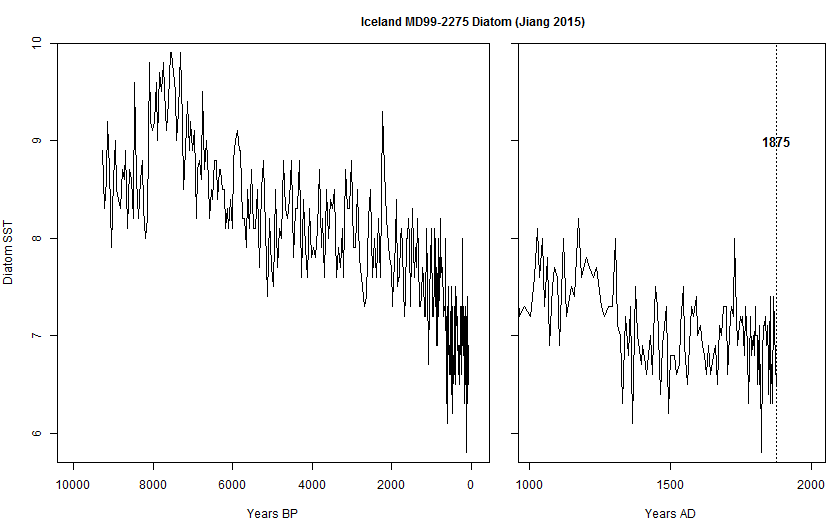
More data which shows since the Holocene Optimum from around 8000BC , through the present day Modern Warm Period( which ended in 1998) the temperature trend throughout this time in the Holocene, has been in a slow gradual down trend(despite an overall increase in CO2, my first chart ), punctuated with periods of warmth. Each successive warm period being a little less warm then the one proceeding it.
My reasoning for the data showing this gradual cooling trend during the Holocene ,is Milankovitch Cycles were highly favorable for warming 10000 years ago or 8000 BC, and have since been in a cooling cycle. Superimposed on this gradual cooling cycle has been solar variability which has worked sometimes in concert and sometimes in opposition to the overall gradual cooling trend , Milankovitch Cycles have been promoting.
Then again this is only data which AGW enthusiast ignore if it does not fit into their scheme of things. I am going to send just one more item of data and rest my case.
http://www.murdoconline.net/wordpress/wp-content/uploads/2011/01/gisp2-ice-core-temperatures.jpg
I am not sure that Mr del Prete’s final graph is appropriate, since the data are not brought up to the present. It looks, by eye, as though the data run only to about 1850, and there has been getting on for 1 K of warming since then.
But his point about the apparent correlation between high levels of solar activity and high global temperature may have some force. i have seen several analyses indicating that the time-integral of solar activity is quite a good predictor of temperature change. However, I have not yet seen this done in the peer-reviewed literature.
By far and away the easiest way to predict temperature is sunspot activity levels. And using past as probability, we can safely say we are at the tail end of the present Interglacial and the history of previous events shows us that another Ice Age will come at some point in the next +-4,000 years.
This chart by Richard Alley is very instructive. Look at the last year. It’s 95 years before 2000. That’s in 1905. The temperature is more than 1 C cooler than the Medieval Warm Period and 2 C and 2.5 C cooler than Roman and Minoan warm periods. It debunks Mann’s hockey stick. And yet Alley is a known AGW believer and resource person to Al Gore.
(Another wasted effort by a banned sockpuppet. Comment DELETED. -mod)
(Another wasted effort by a banned sockpuppet. Comment DELETED. -mod)
Dr. Strangelove says:
The temperature is more than 1 C cooler than the Medieval Warm Period and 2 C and 2.5 C cooler than Roman and Minoan warm periods. It debunks Mann’s hockey stick. And yet Alley is a known AGW believer and resource person to Al Gore.
Correctomundo. Alley has been constantly backing and filling, ever since he jumped on the climate gravy train. But his climbdown does not wipe away his previous work. Years ago Alley showed that CAGW is nonsense. It is still nonsense.
Also, I wonder why “icanthelpmyself” would gratuitously throw out my name in this thread, where I’ve made no comments? It’s probably because I called him out on the Tim Ball thread for not knowing that latitude has an effect on temperature. He didn’t know that. He showed he’s a newbie on this whole subject, so please just disregard him. He has plenty to learn. He can start with learning the basics: that global warming has the greatest effect at night, and in winter, and at the higher latitudes.
(Another wasted effort by a banned sockpuppet. Comment DELETED. -mod)
Greenland is not The World.
==========
there is no data series that samples “the world”. The satellites come close, but NASA prefers to not use them because even though its name includes NATIONAL … SPACE …, the satellite data doesn’t show the right message.
Instead NASA gives us GISTEMP, a homogenized mix of ground station data run through a meat grinder., using raw materials supplied by different countries, with vastly different standards of data hygiene. What if McD’s made hamburger that way? Can you really mix road kill with prime grade A beef and not affect the flavor?
Explain why it is that NASA satellites can measure the height of the ocean to 1mm, but they apparently cannot make a satellite to measure the temperature of the earth’s surface?
How is it that a $19 hand held IR thermometer with laser pointer can accurately measure the temperature of objects remotely, but NASA with billions of dollars worth of satellites still relies on Peter Dufus to read the thermometer nailed to the local post office wall to calculate the earth’s average temperature?
“Greenland is not The World.”
Show me your empirical data where Greenland is warming and the world is cooling for 100 years or longer. Mann’s hockey stick is from tree rings in the US. Al Gore’s 400,000-year temperature chart is from ice cores in Antarctica. Is US or Antarctica the world world? You can’t have it both ways. If you accept Mann and Gore, you should accept Alley. Or reject them all. But the problem with the hockey stick is Mann spliced tree ring proxy data and thermometer data to “hide the decline.”
(Another wasted effort by a banned sockpuppet. David spent a lot of time on that one. Comment DELETED. -mod)
What ice cores are you talking about? Look at the Vostok ice core. See the peak 2,200 years ago. That’s the Roman warm period. See the high 3,600 years ago. That’s the Minoan warm period. Even the Little Ice Age was warm in Antarctica. See the peak 400 years ago.
http://mclean.ch/climate/figures_2/Vostok_to_10Kybp.gif
By the way, what’s all these talk about temperature today being unprecedented? Both GISP and Vostok show so many points above the zero line (warmer than today) in last 10,000 years.
Very nice point by point rebuttal.
But there is no suggestion that the Bode equation is inappropriate for loop gains >1 because that is a completely unstable system and no one, no even the IPCC, is suggesting that true net feedback is positive. If it were the world would be like Venus or the moon.
There seems to be a lot of confusion because the IPCC talks about “net feedback” EXCLUDING the Planck feedback, which is strongly negative and overpowers all the rest put together. So there is not question of even approaching l loop gain of 1.
Now you are correct that a simple linear feedback as represented cannot accurately represent the T^4 Planck feedback over a wide range. This can only be *approximated* as linear over a narrow range.
The real issue is over whether the “net feedbacks” excluding Planck f/b either add to or reduce Planck f/b . The models *assume* net +ve that reduces Planck and the evidence is that they are wrong. That is why they run hot.
As Professor McKitrick pointed out in a recent lecture (and see also Monckton of Brenchley, 2008), the upper bounds of the IPCC’s values for the principal climate-relevant temperature feedbacks do exceed unity. And there is no theoretical reason why they should not do so. However, there is a theoretical reason why the Bode equation cannot possibly apply under such a regime: and if it does not apply to a feedback sum above unity the question does arise, like it or not, whether it is the right equation at all.
The Planck “feedback” is not a feedback, but part of the reference-frame for determination not only of the direct warming to be expected in response to a forcing but also, et separatim, of the magnitude of the closed-loop gain. It should really be expressed, therefore, in units of Kelvin per Watt per square meter (see Roe, 2009, for a brief discussion).
Our paper does explain how the Planck parameter is deployed in the climate-sensitivity equation. The net feedback sum is not added to or subtracted from the Planck parameter, as “Mike” suggests: it is multiplied by it.
Hello Mike
The models run hot because the models are forced, “molested”, intentionally or not, then the assumption arises through a wrong interpretation, the AGW interpretation (the 3C CS),,,,,,,,,,,as far as I can tell GCMs basically simulate the climate and atmosphere functioning and do not assume such things like the assumption you point at.
The assumptions generally are not a “cause” of warming in the GCMs but actually are after effects consequences.
Of course I could be wrong……
Cheers
Your post could have been much shorter if you’d just said where the complex climate models go right.8-)
(A real sunset vs a CGI sunset. Which really inspires more awe?)
If it’s great CGI , I’m in awe of both ; one as nature and one as art .
Both are art and both are nature. All is one. All is good.
Leif Svalgaard
March 16, 2015 at 2:00 pm
So, despite appearances, you are in agreement with Monckton: “They cannot at once argue that the hefty increase in solar activity between the Maunder Minimum …..”
Either there was a grand max and it’s now cooling or there was no max and therefore it cannot now be evoked as a cause of cooling.
As usual the hypocritical alarmists want it both ways: “solar was irrelevant during warming but is now the reason for the pause. “
Either there was a grand max and it’s now cooling or there was no max and therefore it cannot now be evoked as a cause of cooling.
Although this subject is obscured by people being imprecise, I think the usual contention is that maximum solar activity means warming.
–Either there was a grand max and it’s now cooling or there was no max and therefore it cannot now be evoked as a cause of cooling.
Although this subject is obscured by people being imprecise, I think the usual contention is that maximum solar activity means warming.–
Yes.
But maximum solar activity can mean greater variation- or more change
in given amount of time.
Though this point might be too much like global warming is same meaning as climate change- and so, be likewise regarded as invalid.
But it is max activity not max heating.
Monckton seems to think ‘warmer’, although his ‘thinking’ is not altogether clear.
It would be better if Mr Svalgaard avoided yah-boo.
It would be best if you avoided peddling bad science and not having the guts to admit it.
It would plainly be better if Leif avoided playing the man, and attended to the argument. Christopher, as well.
My adventures in climate science are more of the broad stroke type and I don’t go into the nut and bolt details. However, I detected an epiphany in your discussion of the ‘entire’ Bode diagram but am not sure what it portends. Am I to read the hyperbolic graph above a gain of 1 as abruptly dropping down to deep negative from high positive? I thought everything blew up in climate and electronics beyond “1”.
Mr Pearse has indeed spotted the significance of the singularity at a loop gain of unity in the Bode equation. At that point in an electronic circuit, the current transits from the positive to the negative rail: i.e., it goes round the circuit the other way about, so that the voltage that was doing its best to become infinitely positive tries its best to become infinitely negative.
In the climate, however, no such reversal is physically possible. Wiser minds than mine are working on this real difficulty, and I am hoping that an expert paper on the subject that is now in peer review will make everything clear.
It is of course obvious that the Bode graph as it stands does not really represent even an electronic circuit. There are obvious asymptotic bounds preventing an infinite positive (or, above unity, negative) voltage from being output by the circuit.
Another reason why the Bode equation – at least in its unmodified form – seems inapplicable to the climate is that temperature change – the output – is the very instrument by which the climate system self-equilibrates. Bode simply does not model this self-regulation. The use of Bode, I believe, especially in combination with implausibly high net feedback sums, is the reason why the more complex models erroneously predict far more warming than has occurred or will occur as a consequence of Man’s sins of emission.
Mr Pearse has indeed spotted the significance of the singularity at a loop gain of unity in the Bode equation. At that point in an electronic circuit, the current transits from the positive to the negative rail: i.e., it goes round the circuit the other way about, so that the voltage that was doing its best to become infinitely positive tries its best to become infinitely negative.
No, dammit! You are making the implied assumption that your input is positive to begin with! You’re just being sloppy. The reality of your model is that it inverts for gains greater than unity and you can have a system which is stable with gains greater than unity. You just have to be careful that you have adequate phase margin. Stop being so sloppy.
In the climate, however, no such reversal is physically possible. Wiser minds than mine are working on this real difficulty, and I am hoping that an expert paper on the subject that is now in peer review will make everything clear.
Yes, this is a good observation to make. It flies directly in the face of the catastrophists.
It is of course obvious that the Bode graph as it stands does not really represent even an electronic circuit. There are obvious asymptotic bounds preventing an infinite positive (or, above unity, negative) voltage from being output by the circuit.
Over the frequency and amplitude range of interest, it does. If your circuit is unstable (resonances in a completely undamped system or positive feedback), then you fail a basic criterion for frequency analysis and are in a different regime altogether.
Another reason why the Bode equation – at least in its unmodified form – seems inapplicable to the climate is that temperature change – the output – is the very instrument by which the climate system self-equilibrates. Bode simply does not model this self-regulation.
I don’t even know what this means. I’m not even sure what “The Bode Equation” is, since what anyone in control theory would call your model is a transfer function. Voltage (or position, or temperature, or pressure head, or…) is the very instrument by which a properly designed circuit self-equilibrates. It is both the input signal and the output. If it couldn’t do so, then there would be no notion of a stable feedback loop.
If the open-loop gain of a feedback system is a decreasing function of input level, the system will stabilize into periodic oscillation satisfying the Barkhausen criteria (unity gain, zero phase-shift). This quasi-equilibrium state is near the mid-point of the phase transition at the singularity in your Bode analysis. Observing the paleoclimate plots, one is struck by their similarity to a so called limit-cycle oscillation in which the required gain reduction comes from some hard limit in the system (e.g. an op-amp on its rail has zero small-signal gain). Such stably unstable systems, when forced with a periodic signal will under certain conditions phase-lock to the source, even if the forcing function is quite small (google “injection locked oscillators”). Perhaps the entire climate system is injection locked to the Milankovitch cycle which might explain how it’s small influence is able to exert such dramatic influence on temperature.
I agree that adding GHGs (all else remaining equal) would raise the effective radiating height and that the effective radiating height would be the same temperature as before and not at a lower temperature as proposed by AGW theory.
However, radiation from within the atmosphere direct to space would increase and so less energy returns to the surface in adiabatic descent than was taken up in adiabatic ascent. At any given moment half the atmosphere is rising and half is descending because everything that goes up must come down.
That reduction in energy returning to the surface in adiabatic descent offsets any surface warming effect from the presence of GHGs in the atmosphere so that surface temperature does not change and nor does the effective radiating height
Thus the effect of GHGs is simply to reapportion totalradiation to space between radiation to space from the surface and radiation to space from within the atmosphere.
More GHGs means more radiation to space from within the atmosphere and less radiation to space from the surface and vice versa.
A simple illustration:
i) If the atmosphere had no radiative capability at all then ALL radiation to space would be from the surface.
ii) If the atmosphere were 100% radiatively efficient then ALL radiation to space would be from within the atmosphere.
In reality, no atmosphere is 100% radiatively efficient so in practice the proportion of radiation escaping to space is split between surface andatmosphere in proportion to the radiative efficiency of the atmospheric gases.
It is convection involving adiabatic cooling on ascent and adiabatic warming on descent which varies as necessary to balance conduction between surface and atmosphere with radiation in from space and radiation out to space.
That balancing process allows the atmosphere to remain suspended against gravity indefinitely whilst energy in from space and out to space remains the same.
Climate changes are then induced by cloudiness variations caused by solar effects from above modulated by oceanic effects from below.
“Climate changes are then induced by cloudiness variations caused by solar effects from above modulated by oceanic effects from below.
Yep, that makes sense. Now all “science” has to do is model “all the effects” of cloud formation and maybe, just maybe, in the next 200 years, we may have a “real climate model”. Who knows? If you get to that point, something out in the universe may throw a monkey wrench in the works.
Steven,
one of your better comments.
When you get to the next stage, understanding that tropospheric convective circulation in the Hadley, Ferrel and Polar cells would not accelerate but stall without radiative subsidence, then your model will be complete.
Radiative gases are not neutral in our atmosphere. They are coolants.
They would not stall due to continuing uneven surface heating giving rise to density differentials in the horizontal plane.
Radiative gases are neutral when one considers both their insulating effect AND their ability to radiate to space from within the atmosphere which causes less energy to be returned to the surface on descent than was taken up during ascent.
Radiative gases have a net cooling effect. Time to brush up on your radiative physics Stephen.
Unless you understand that radiative gases cool the atmosphere you’re not in the league. “Neutral” is for losers. Currently you are little better than Momckton, a loser. I understand you are Australian. Therefore I am within my rights to demand better.
Konrad,
Radiative gases both cool the atmosphere by radiating to space and warm the surface by slowing longwave radiation from the surface to space.
The difference between kinetic energy taken up in convective ascent and kinetic energy returned to the surface in convective descent changes as necessary to adjust for the radiative characteristics of the atmosphere.
The net thermal effect is zero but GHGs do reapportion radiation to space from within the atmosphere and radiation to space from the surface.
That is all that they do.
TS.6.2 Key Uncertainties in Drivers of Climate Change
• Paleoclimate reconstructions and Earth System Models indicate
that there is a positive feedback between climate and the carbon
cycle, but confidence remains low in the strength of this feedback,
particularly for the land. {6.4}
“…remains low…” Since when? Fo-ever?
IPCC AR5 acknowledges uncertainty about the magnitude of feedback.
The plethora of uncertainties listed in TS.6 pretty much follows the uncertainties identified in the APS workshop findings.
Read the homework assignment, folks.
This again seems to underline a misunderstanding brought about by the inappropriate use of terms by IPCC.
The pathway will *always* increase to equilibrium, even with the strongest -ve f/b. The difference is how quickly it reaches equilibrium and what the final offset is. There is no “instantaneous” response other than in dT/dt, it always takes time for temperature of a body to increase in response to a radiative change.
I support this effort to clarify short-comings but there is a fundamental lack of understanding of feedbacks in much of this writing.
A well argued response to the rebuttal
I am most grateful for the kind words of “wickedwenchfan”. What is striking about the discussion of our paper here at WUWT is how – with very few exceptions – those who are contributing are doing so in a genuine spirit of scientific enquiry. I welcome that very much, which is why I am grateful for Mr Born’s discussion of our paper, even if I do not agree with his conclusions.
In response to “Mike”, the feedbacks and their influence and mutual amplification are well and clearly explained in our paper. One accepts that the word “instantaneous” is a term of art which incorrectly conveys the impression that a forcing brings about an immediate change in temperature, when in practice various homeostatic factors, notably the massive heat capacity of the ocean, damp the immediacy of the response.
However, one should be clear that the action of net-negative feedbacks is to diminish, and not to augment, the instantaneous or (perhaps better expressed) zero-feedback response. And if there is a slowly-acting negative feedback, it may well be that the zero-feedback or Planck response will occur before the negative feedback has acted, in which event the path from zero feedback to equilibrium after all feedbacks have acted will be a negative path. For this reason, there is nothing in the equations that dictates “Mike’s” conclusion that “the pathway will ALWAYS increase to equilibrium”.
Lord Monckton,
You said:
“temperature change – the output – is the very instrument by which the climate system self-equilibrates”
I don’t think that is right as per my post at 3.36pm.
The instrument by which the climate system self-equilibriates is by way of variations in the balance between energy taken up in adiabatic ascent and energy brought down in adiabatic descent.
The more GHGs are present the greater the difference because the more radiation that escapes to space from within the atmosphere the less can be brought down again.
“..the instantaneous or (perhaps better expressed) zero-feedback response. ” There terminology is a problem here. Planck f/b is not the “zero feeback” it is the most powerful feedback that ensures a workable climate. The others that everyone is arguing about just tweak it up or down a bit.
There are probably no “slow acting” f/b on the time scales being discussed ( decadal to centennial ) , there may be a later cooling but this would be due to thermal intertia of the oceans. The negative f/b induced by surface warming can easily last longer than the initial warming disturbance. The opposite of this can be seen after Pinatubo when the warming feedback continued after the aerosols had subsided. ( This is the explanation of errors noted in Santer 2014, which to be fair he did document, even though he failed to realise his errors). But that’s probalby already stepping outside the bounds of the simplistic Bode model.
Be careful how much of the IPCC elixir you drink, there is a lot less “polar amplification ” in Antarctica. That’s just part of the AGW spin. Antarctica is supposed to be warming too but the sea ice is growing. AGW does not produce the “solar see-saw” which is probably more of the reason that the Arctic was warming quicker.
No, the Planck “feedback” is not a feedback, and it is rightly not treated in the same way as the true temperature feedbacks in the central equations that determine climate sensitivity.
And polar amplification is what one would expect – all other things being equal. The fact that the Arctic has been warming and the Antarctic cooling suggest that such little warming as has occurred is not yet global.
the Arctic has been warming and the Antarctic cooling suggest that
=======
there was a recent paper that showed the energy escaping from each N/S hemisphere was essentially equal to a fraction of a percent. As such, heat must flow from one hemisphere to the other to maintain this balance due to orbital mechanics and differences in land mass.
this would explain the polar see-saw. heat flowing from one hemisphere to the other to maintain the radiative balance will alternately warm and cool the opposing poles.
“…we then adopted assumptions that seemed to us to be less inappropriate, and ran the model to reach our own estimates of climate sensitivity: around 1 K per Co2 doubling.”
I think that is a far closer estimation than IPCC, globally. It is much less in the tropics.
I asked at Science of Doom if
“Temperature at night drops rapidly and goes up during the day depending on the level of Greenhouse gases.
The temperature that it rises to during the day must reflect the amount of GHG and the sub amount of CO2 present,
To my mind this should mean there is no real lag time with respect to a GHG level dictating a temperature level.
Secondly energy in equals energy out so the amount of energy present to heat the air doesn’t change.
* Therefore is it possible to have a hot blanket of air and a colder land or sea temperature? in a warming [atmospheric] world?
Does the earth and sea have to heat up over time or if the energy is in balance would it just be the air that gets a few degrees warmer and which would “go away at night”.
Y”Precisely because the effective radiating temperature at the characteristic-emission layer is near-constant under an increase in the mean altitude of the characteristic-emission layer, and precisely because the lapse rate of atmospheric temperature with altitude is very nearly constant under that increase, it is the surface temperature, not the effective radiating temperature at the characteristic-emission altitude, that rises in response to that increase in altitude.”
*The second question is why do you have to be so sure about GHG and water vapor only being an add on forcing. As you know there is a lot going on about clouds and balance of temperature by more clouds more albedo to the stage where such feedback might be negative.
If there is more than one effect possible in a complex system you should not rule out other possibilities no matter how much you attempt to prove AGW.
On this score you state
“GCMs all come to the conclusion that more GHGs results in a hotter world (2-6ºC). the result is clear and indisputable.”
This fails the science test with a range of 2.0 to 6.0 degrees.
CO2 causes a known rise in temperature [GHG effect] which you could state independent of models.
The fact that given said CO2 input GCM can range 4.0 degrees in their expected effect make them neither clear nor indisputable.
Sorry for my intemperate attitude.
pleased for any scientific feedback, particularly on the first question which is ignorant rather than evil.
“Mike”, who kindly prefers our best estimate of climate sensitivity to that of the IPCC, is correct to point out that any warming will be less in the tropics than elsewhere, because the climate system advects the warmth poleward from the tropics, so that at the poles there will be about twice as much warming as the global average: this is known as “polar amplification”.
Sorry for adding too much above
I was wanting to say
Your answer
“Precisely because the effective radiating temperature at the characteristic-emission layer is near-constant under an increase in the mean altitude of the characteristic-emission layer, and precisely because the lapse rate of atmospheric temperature with altitude is very nearly constant under that increase, it is the surface temperature, not the effective radiating temperature at the characteristic-emission altitude, that rises in response to that increase in altitude.”
seems to explain my question
Rest of response was to SOD , not you.
I should say none of the AGW enthusiast believe in the data.
Here is the data ,now you need to reconcile your theory with the data. Good Luck.
http://www.c3headlines.com/are-todays-temperatures-unusual/
From a layman’s point of view, if feedbacks are >1 then oceans should already be at James Hansen’s (since withdrawn) boiling scenario. If CO2 caused water vapour to increase to a point where the water vapour caused more warming than the CO2 the warming from the water vapour would cause yet more increases in water vapour which must also have feedback loops greater than 1 (water vapour does after all have a greenhousyness six times greater than CO2 assigned to it) leading to a compounding self generating warming ad infinitum.
James Hansen’s claim that Venus’s surface temperature 225% the gray body temperature in its orbit is a risible falsehood the failure to universally repudiate of which is emblematic of the utter nonscience of 97% of those who label themselves climate scientists . No spectrum exhibits such an extreme heat gain with respect to the solar spectrum . See http://cosy.com/Science/HeartlandBasicBasics.html .
Oh, I am no James Hansen fan (I’m a Wicked Wench fan 🙂 ). In fact it his extreme past statements that were among the first things that had me questioning the CAGW assertions.
My (I hope) common sense logic had me looking at the CO2 concentrations (96.5%) and mass of CO2 in comparison to Earth (92 times the mass by memory which equalled approx 230,000 times the number of CO2 molecules compared to Earth) of Venus and following the trajectory of the IPCC future temperature graphs. My conclusion was that according to the IPCC worst case projections (hockey stick) Earth’s temperature would surpass that of Venus before CO2 concentrations hit 1% of the atmosphere. That to me was absurd! Even the linear graphs had Earth surpassing Venus at 5% CO2 concentration (those showing 2C rise for 560ppm).
I am still waiting for a rebuttal of any kind from any scientist about my observations. I would welcome one, to be honest, as my friends keep telling me I must be missing something and surely the scientists have an explanation. Maybe. Prove me stupid and simplistic, someone. Anyone!
Wick, how many doublings would be required to reach the Venus concentration?
1% (10,000 PPM) of the atmosphere is about five plus doublings. This is about 5 C using the direct affect, and about 15 degrees C using approximate mean IPCC feedbacks.
\
The linearity of sensitivity based on doubling CO2 is certainly a legitimate subject. The CAGW Venus analogy has been quite thoroughly criticized with atmospheric density and proximity to the Sun being primary reasons for Venus T.
I often hear that the temp, relationship with CO2 is logarithmic, but the alarmist graphs do not reflect this. Follow the actual trajectory of the graphs they show and we do not see a doubling of CO2 for each 1C or 2C or whatever the scale proposed by those on here. What we see is a linear trend for the Luke warm projections or a hockey stick compounding trend for the alarmist trends. If the graph trajectories did in fact show the five doublings for give equal increases, all of us here could leave the augment up to academics to haggle over details as the fearful “C” in CAGW would cease to exist.
The reason given for the linear graph or hockey stick graphs is water vapour feedbacks. My response: did the water feedback not exist between 1850 and today?
Do you see my point? Regardless of what CO2 does to water, it is included in the mathematics behind the graph that explain 280ppm to 400ppm=+0.8C if the projection for 520ppm=+1.6C then it also follows that 1480ppm=+8C and 12280ppm (1.22%)=+80C!
That is THEIR graph not mine, and that is for just a linear relationship. It is much worse in the hockey stick.
The revaluation in these graphs is obscured because usually the temperature is not shown with CO2 concentrations but with years, 2C by 2100 or whatever. But in the text of the article showing the graph will be the date of the expect “doubling of pre industrial levels of CO2” as well. Simply place 560ppm on said date and you will discover the graphs trend is always linear or compounding, never logarithmic. Again, I call out the common sense rebuttal to the alarmists. If the trajectory of your graph shows seas boiling at CO2 concentrations that are approximately the same as my outward breath, isn’t that a sign that you are barking mad?
David;
plot the slope of the graphs and you will see wicked is correct.
Where Complex Models Go Wrong
It’s not complex models that go wrong; it’s simpleton modelers that are the problem.
Let’s assume that modelers have a hotline to Heaven, and by the grace of God are able to assemble a model that accounts for every little forcing function, feedback loop, and so on.
All that model is going to be able to provide is a qualitative description of how climate might behave in the future.
To believe that the model is going to give the modeler the power to actually forecast the climate is absolutely imbecilic.
Oops … gotta go … the Lord’s on the Line …
Models are programmed on deterministic machines using deterministic code attempting a veneer of non-determinism by using pseudo-random number generators, which are so-called because the code generating them is necessarily deterministic.
Even a chaotic object is deterministic, but the solecism of the modellers is to assume, even in the absence of any data describing the sub-grid-scale processes without which the deterministic object that is the climate is not determinable, that they can predict the evolution of that object when on the evidence of the failure of their predictions to date it is plain that they cannot.
Chaotic objects are deterministic at infinity. Anything less and they are not. So, while one can theoretically predict future climate, for all practical purposes the prediction will show no more skill than a coin toss.
However, the IPCC models show one fascinating trait. They universally predict too high. The odds of this happening by chance are astronomically small.
I for one would like to see MOB or Briggs write an article on just how unlikely it is that 100+ climate models could all be wrong in the same direction.