On the futility of climate models: 'simplistic nonsense'

Guest essay by Leo Smith – elevated from a comment left on WUWT on January 6, 2015 at 2:11 am (h/t to dbs)

edsel-fine-engineering

As an engineer, my first experience of a computer model taught me nearly all I needed to know about models.

I was tasked with designing a high voltage video amplifier to drive a military heads up display featuring a CRT.

Some people suggested I make use of the acoustic coupler to input my design and optimise it with one of the circuit modelling programs they had devised. The results were encouraging, so I built it. The circuit itself was a dismal failure.

Investigation revealed the reason instantly: the model parametrised parasitic capacitance into a simple single value: the reality of semiconductors is that the capacitance varies with applied voltage – an effect made use of in every radio today as the ‘varicap diode’. for small signals this is an acceptable compromise. Over large voltage swings the effect is massively non linear. The model was simply inadequate.

Most of engineering is to design things so that small unpredictable effects are swamped by large predictable ones. Any stable design has to work like that. If it doesn’t, it ain’t stable. Or reproducible.

That leads to a direct piece of engineering wisdom: If a system is not dominated by a few major feedback factors, it ain’t stable. And if it has a regions of stability then perturbing it outside those regions will result in gross instability, and the system will be short lived.

Climate has been in real terms amazingly stable. For millions of years. It has maintained an average of about 282 degrees absolute +- about 5 degrees since forever.

So called ‘Climate science’ relies on net positive feedback to create alarmist views – and that positive feedback is nothing to do with CO2 allegedly: on the contrary it is a temperature change amplifier pure and simple.

If such a feedback existed, any driver of temperature, from a minor change in the suns output, to a volcanic eruption must inevitably trigger massive temperature changes. But it simply never has. Or we wouldn’t be here to spout such nonsense.

With all simple known factors taken care of the basic IPCC style equation boils down to:

∆T = λ.k.log( ∆CO2)

where lambda (λ) is the climate sensitivity that expresses the presupposed propensity of any warming directly attributable to CO2 (k.log(CO2)) radiative forcing and its resultant direct temperature change to be amplified by some unexplained and unknown feedback factor, which is adjusted to match such late 20th century warming as was reasonably certain.

Everyone argues over the value of lambda. No one is arguing over the actual shape of the equation itself.

And that is the sleight of hand of the IPCC…arguments about climate sensitivity are pure misdirection away from the actuality of what is going on.

Consider an alternative:

∆T = k.log( ∆CO2) + f(∆x)

In terms of matching late 20th century warming, this is equally as good, and relies merely on introducing another unknown to replace the unknown lambda, this time not as a multiplier of CO2 driven change, but as a completely independent variable.

Philosophically both have one unknown. There is little to choose between them.

Scientifically both the rise and the pause together fit the second model far better.

Worse, consider some possible mechanisms for what X might be….

∆T = k.log( ∆CO2) + f(∆T).

Let’s say that f(∆T) is in fact a function whose current value depends on non linear and time delayed values of past temperature. So it does indeed represent temperature feedback to create new temperatures!

This is quite close to the IPCC model, but with one important proviso. The overall long term feedback MUST be negative, otherwise temperatures would be massively unstable over geological timescales.

BUT we know that short term fluctuatons of quite significant values – ice ages and warm periods – are also in evidence.

Can long term negative feedback create shorter term instability? Hell yes! If you have enough terms and some time delay, it’s a piece of piss.

The climate has all the elements needed. temperature, and water. Water vapour (greenhouse gas: acts to increase temperatures) clouds (reduce daytime temps, increase night time temps) and ice (massive albedo modifiers: act to reduce temperatures) are functions of sea and air temperature, and sea and air temperature are a function via albedo and greenhouse modifiers, of water vapour concentrations. Better yet, latent heat of ice/water represents massive amounts of energy needed to effect a phase transition at a single temperature. Lots of lovely non-linearity there. Plus huge delays of decadal or multidecadal length in terms of ocean current circulations and melting/freezing of ice sheets and permafrost.

Not to mention continental drift, which adds further water cycle variables into the mix.

Or glaciation that causes falling sea levels, thus exposing more land to lower the albedo where the earth is NOT frozen, and glaciation that strips water vapour out of the air reducing cloud albedo in non glaciated areas.

It’s a massive non linear hugely time delayed negative feedback system. And that’s just water and ice. Before we toss in volcanic action, meteor strikes, continental drift. solar variability, and Milankovitch cycles…

The miracle of AGW is that all this has been simply tossed aside, or considered some kind of constant, or a multiplier of the only driver in town, CO2.

When all you know is linear systems analysis everything looks like a linear system perturbed by an external driver.

When the only driver you have come up with is CO2, everything looks like CO2.

Engineers who have done control system theory are not so arrogant. And can recognise in the irregular sawtooth of ice age temperature record a system that looks remarkably like a nasty multiple (negative) feed back time delayed relaxation oscillator.

Oscillators don’t need external inputs to change, they do that entirely within the feedback that comprises them. Just one electron of thermal noise will start them off.

What examination of the temperature record shows is that glaciation is slow. It takes many many thousands of years as the ice increases before the lowest temperatures are reached, but that positive going temperatures are much faster – we are only 10,000 years out of the last one.

The point finally is this: To an engineer, climate science as the IPCC have it is simplistic nonsense. There are far far better models available, to explain climate change based on the complexity of water interactions with temperature. Unfortunately they are far too complex even for the biggest of computers to be much use in simulating climate. And have no political value anyway, since they will essentially say ‘Climate changes irrespective of human activity, over 100 thousand year major cycles, and within that its simply unpredictable noise due to many factors none of which we have any control over’


UPDATE: An additional and clarifying comment has been posted by Leo Smith on January 6, 2015 at 6:32 pm

Look, this post was elevated (without me being aware…) from a blog comment typed in in a hurry. I accept the formula isn’t quite what I meant, but you get the general idea OK?

If I had known it was going to become a post I’d have taken a lot more care over it.

Not used k where it might confuse,. Spotted that delta log is not the same as log delta..

But the main points stand:

(i) The IPCC ‘formula’ fits the data less well than other equally simple formulae with just as many unknowns.

(ii) The IPCC formula is a linear differential equation.

(iii) There is no reason to doubt that large parts of the radiative/convective thermal cycle/balance of climate are non linear.

(iv) There are good historical reasons to suppose that the overall feedback of the climate system is negative, not positive as the IPCC assumes.

(v) given the number of feedback paths and the lags associated with them, there is more than enough scope in the climate for self generated chaotic quasi-periodic fluctuations to be generated even without any external inputs beyond a steady sun.

(vi) Given the likely shape of the overall real climate equation, there is no hope of anything like a realistic forecast ever being obtained with the current generation of computer systems and mathematical techniques. Chaos style equations are amongst the hardest and most intractable problems we have, and indeed there may well be no final answer to climate change beyond a butterfly flapping its wings in Brazil and tipping the climate into a new ice age, or a warm period, depending 😉

(vii) A point I didn’t make: a chaotic system is never ‘in balance’, and even its average value has little meaning, because its simply a mathematical oddity – a single point on a range where the system never rests – it merely represents a point between the upper and lower bounds; Worse, is system with multiple attractors, it may not even be anywhere near where the systems orbits fr any length of time.

In short my current thinking says :

– there is no such thing as a normal climate, nor does it have a balance that man has disturbed , or could disturb. Its constantly changing and may go anywhere from ice age to seriously warm over extremely long periods of time. It does this all by itself. There need be no external drivers to move it from one attractor to another or cause it to orbit any given attractor. That climate changes is unarguable, that anything beyond climate itself is causing it, is deeply doubtful. That CO2 has a major effect is, on the data, as absurd as claiming that CO2 has no effect at all.

What we are looking at here is very clever misdirection cooked up for economic and political motives: It suited many peoples books to paint CO2 emissions as a scary pollutant, and a chance temporary correlation of rising temperatures and CO2 was combined in a linear way that any third rate scientist could understand to present a plausible formula for scary AGW. I have pointed out that other interpretations of the data make a non scary scenario, and indeed, post the Pause,. actually fit the data better.

Occam’s razor has nothing to say in defence of either.

Poppers falsifiability is no help because the one model – the IPCC – has been falsified. The other can make no predictions beyond ‘change happens all by itself in ways we cannot hope to predict’. So that cannot be falsified. If you want to test Newton’s laws the last experiment you would use is throwing an egg at a spike to predict where the bits of eggshell are going to land….

Net result is climate science isn’t worth spending a plugged nickel on, and we should spend the money on being reasonably ready for moderate climate change in either direction. Some years ago my business partner – ten years my junior wanted to get key man insurance in case I died or fell under a bus. ‘How much for how much’ ‘well you are a smoker, and old, so its a lot’ It was enough in fact to wipe out the annual profits, and the business, twice over. Curiously he is now dead from prostate cancer, and I have survived testicular cancer, and with luck, a blocked coronary artery. Sometimes you just take te risk because insuring against it costs more … if we had been really serious about climate change we would be 100% nuclear by now. It was proven safe technology and dollar for dollar has ten times the carbon reduction impact than renewables. But of course carbon reduction was not the actual game plan. Political control of energy was. Its so much easier and cheaper to bribe governments than compete in a free market…

.

IF – and this is something that should be demonstrable – the dominant feedback terms in the real climate equations are non linear, and multiple and subject to time delay, THEN we have a complex chaotic system that will be in constant more or less unpredictable flux.

And we are pissing in the wind trying to model it with simple linear differential equations and parametrised nonsense.

The whole sleight of hand of the AGW movement has been to convince scientists who do NOT understand non linear control theory, that they didn’t NEED to understand it to model climate, and that any fluctuations MUST be ’caused’ by an externality, and to pick on the most politically and commercially convenient one – CO2 – that resonated with a vastly anti-science and non-commercial sentiment left over from the Cold War ideological battles . AGW is AgitProp, not science. AGW flatters all the worst people into thinking they are more important than they are. To a man every ground roots green movement has taken a government coin, as have the universities, and they are all dancing to the piper who is paid by the unholy aggregation of commercial interest, political power broking and political marketing.

They bought them all. They couldn’t however buy the climate. Mother Nature is not a whore.

Whether AGW is a deliberate fraud, an honest mistake, or mere sloppy ignorant science is moot. At any given level it is one or the other or any combination.

What it really is, is an emotional narrative, geared to flatter the stupid and pander to their bigotry, in order to make them allies in a process that if they knew its intentions, they would utterly oppose,.

Enormous damage to the environment is justified by environmentalists because the Greater Cause says that windmills and solar panels will Save the Planet. Even when its possible to demonstrate that they have almost no effect on emissions at all, and it is deeply doubtful if those emissions are in any way significant anyway.

Green is utterly anti-nuclear. Yet which- even on their own claims – is less harmful, a few hundred tonnes of long lived radionuclides encased in glass and dumped a mile underground, or a billion tonnes of CO2?

Apparently the radiation which hasn’t injured or killed a single person at Fukushima, is far far more dangerous than the CO2, because Germany would rather burn stinking lignite having utterly polluted its rivers in strip mining it, than allow a nuclear power plant to operate inside its borders .

Years ago Roy Harper sang

“You can lead a horse to water, but you cannot make him drink

You can lead a man to slaughter, but you’ll never make him think”


I had a discussion with a gloomy friend today. We agreed the world is a mess because people don’t think, they follow leaders, trends, emotional narratives, received wisdom.. Never once do they step back and ask, ‘what really is going on here?’. Another acquaintance doing management training in the financial arena chalked up on the whiteboard “Anyone who presages a statement with the words ‘I think’ and then proceeds to regurgitate someone else’s opinions, analysis or received wisdom, will fail this course and be summarily ejected’

And finally Anthony, I am not sure I wanted that post to become an article. I dont want to be someone else’s received wisdom. I want the buggers to start thinking for themselves.

If that means studying control theory systems analysis and chaos mathematics then do it. And form your own opinions.

“Don’t follow leaders, watch your parking meters”

I say people don’t think. Prove me wrong. Don’t believe what I say, do your own analysis. Stop trusting and start thinking.

I’ll leave you with a final chilling thought. Consider the following statement:

“100% of all media ‘news’ and 90% of what is called ‘science’ and an alarming amount of blog material is not what is the case, or even what people think is the case, but what people for reasons of their own, want you to think is the case”

Finally, if I ever get around to finishing it, for those who ask ‘how can it be possible that so many people are caught up in what you claim to be a grand conspiracy or something of that nature?’ I am on the business of writing a philosophical, psychological and social explanation. It entitled ‘convenient lies’ And it shows that bigotry prejudice stupidity and venality are in fact useful techniques for species survival most of the time.

Of course the interesting facet is the ‘Black Swan’ times, when it’s the most dangerous thing in the world.

Following the herd is safer than straying off alone. Unless the herd is approaching the cliff edge and the leaders are more concerned with who is following them than where they are going…

AGW is one of the great dangers facing mankind, not because its true, but because it is widely believed, and demonstrably false.

My analysis of convenient lies shows that they are most dangerous in times of deep social and economic change in society, when the old orthodoxies are simply no good.

I feel more scared these days than at any time in the cold war. Then one felt that no one would be stupid enough to start world war three. Today, I no longer have that conviction. Two generations of social engineering aimed at removing all risk and all need to actually think from society has led to a generation which is stupid enough and smug enough and feels safe enough to utterly destroy western civilisation simply because they take it totally for granted. To them the promotion of the AGW meme is a success story in terms of political and commercial marketing. The fact that where they are taking us over a cliff edge into a new dark age, is something they simply haven’t considered at all.

They have socially engineered risk and dissent out of society. For profit. Leaving behind a population that cannot think for itself, and has no need to. Its told to blindly follow the rules.

Control system theory says that that, unlike the climate, is a deeply unstable situation.

Wake up, smell the coffee. AGW is simply another element in a tendency towards political control of everything, and the subjugation of the individual into the mass of society at large. No decision is to be taken by the individual, all is to be taken by centralised bureaucratic structures – such as the IPCC. The question is, is that a functional and effective way to structure society?

My contention is that its deeply dangerous. It introduces massive and laggy overall centralised feedback, Worse, it introduces a single point of failure. If central government breaks down or falters, people simply do not know what to do any more. No one has the skill or practice in making localised decisions anymore.

The point is to see AGW and the whole greenspin machine as just an aspect of a particular stage in political and societal evolution, and understand it in those terms. Prior to the age of the telegraph and instantaneous communications, government had to be devolved – the lag was too great to pass the decisions back to central authority. Today we think we can, but there is another lag – bureaucratic lag. As well as bureaucratic incompetence.

System theory applied to political systems, gives a really scary prediction. We are on the point of almost total collapse, and we do not have the localised systems in place to replace centralised structures that are utterly dysfunctional. Sooner or later an externality is going to come along that will overwhelm the ability of centralized bureaucracy to deal with it, and it will fail. And nothing else will succeed, because people can no longer think for themselves.

Because they were lazy and let other people do the thinking for them. And paid them huge sums to do it, and accepted the results unquestioningly.

Happy new year

5 2 votes
Article Rating

Discover more from Watts Up With That?

Subscribe to get the latest posts sent to your email.

674 Comments
Inline Feedbacks
View all comments
Robert W Turner
January 6, 2015 11:39 am

This argument is what drove me to the skeptic side in the first place and it’s one we know with almost no doubt to be true. There has been possibly several occasions where the Earth’s climate system has not been stable, i.e. Permo-Triassic extinction, but for the most part it is a remarkably stable. Calling the climate instable over the past 200 years is akin to saying a slate top pool table top is uneven because you looked at it under an SEM.

Reply to  Robert W Turner
January 6, 2015 2:29 pm

+10. That is why Mann’s hockey stick that disappeared MWP and LIA is so important to warmunists, and will be part of their Lysenko equivalent end.

bones
Reply to  Rud Istvan
January 7, 2015 11:53 am

+11

Kermit
January 6, 2015 11:39 am

Good article. I come from another angle. I have spent more than two decades using computer models to anticipate commodity market price changes. These are also, as the IPCC calls climate, coupled, non-linear chaotic systems. Recently I got into a discussion over at ARS Technica, where I made the point that what was being done was a clear case of curve-fitting a computer model to (poor quality) historical data. I did not receive a good welcome when I pointed out that climate modeling was very similar to what Richard Feynman wrote about and called Cargo Cult Science. In fact, what is being done in the modeling to determine sensitivity factors appears exactly like what Feynman talks about with an example of Millikan measuring the charge on an electron. I referred to Euan Mearns’ blog. I won’t repeat everything here, but if anyone is interested, this is the last page of the ARS Technica comments:
http://arstechnica.com/science/2014/12/emit-some-co2-its-warming-influence-should-peak-in-about-a-decade/?comments=1&start=160

dEEBEE
Reply to  Kermit
January 6, 2015 3:14 pm

Aging done the same for about the same number of years, IMO, the climate models are worse than the $3,000 commodity trading systems commonly available with parameters or rules tightly fitted to the past.

Alx
Reply to  Kermit
January 6, 2015 7:40 pm

Cargo Cult behavior has been a significant issue in all software development. I may have the details wrong, but the gist is during WWII natives on an island were trained to wave flags to guide incoming planes delivering supplies. The supplies were shared with the appreciative natives. When the war was over the allies and their planes left, but the natives still went out to the runways waving the landing flags expecting the planes to deliver useful supplies as they had in the past. The moral of the story for developers is before you can program a system you have to understand how the system works. Sounds obvious but your would be surprised how much programming can go on with little understanding of what the hell is going on.
The natives obviously did not understand the relationship between the delivery of supplies and their flag waving. In the same way climate modelers are programming away while having little understanding of the system (climate) they are modeling. A pretty excellent example of Cargo Cult Science.

Todd
January 6, 2015 11:40 am

I am just trying to figure this out. The equation:
∆T = λ.k.log( ∆CO2)
must have some valid region of operation, right?
Clearly, going from one molecule of CO2 int the atmosphere to two molecules does not produce the same result as going from 250 ppm to 500 ppm.
Also, isn’t the form of this equation wrong?
Going from 250 ppm to 300 ppm (delta of 50 ppm) cannot have the same effect as going from 1100 ppm to 1150 ppm, right? What am I missing?

Nick Stokes
Reply to  Todd
January 6, 2015 11:59 am

Indeed so. As I noted above, it should be
∆T = λ.k.∆(log( CO2))

Curious George
Reply to  Nick Stokes
January 6, 2015 1:10 pm

Nick, do you agree that if we remove all CO2, the hell will freeze over?

Reply to  Nick Stokes
January 7, 2015 9:32 am

So Nick why do we have quote you, but you don’t quote others?

Patrick Collins
Reply to  Todd
January 6, 2015 2:23 pm

I’m sure someone will correct me if necessary… The CO2 doubling constant is valid if the initial and final CO2 levels are sufficient to absorb and re-radiate all of the earth emitted energy in the CO2 sensitive band. Going from 1 to 2 total atmospheric CO2 molecules would invalidate the formula, out of band.

J
January 6, 2015 11:51 am

Todd, the log function takes care of the delta.
Inside the log() can only be a pure number- no units. So a ratio of the CO2. If it goes from 100 to 200 OR from 200 to 4000ppm, both doublings, then the ratio is 200/100=2 or 400/200=2. the same.
In your example 300/250 does not equal 1150/1100, even though the change is 50ppm.
This is from the logarithmic form of Beers law. The ratio of intensities is the transmission, but Beer’s law is based on absorbance which is log of the transmittance.

Owen in GA
Reply to  J
January 6, 2015 12:19 pm

What you are stating isn’t really \Delta\left(CO_2\right) but more like \frac{CO_{2_f}-CO_{2_i}}{CO_{2_i}}

Reply to  J
January 7, 2015 1:06 pm

It’s not from Beer’s law, it’s due to spectral broadening, for weak absorbers it’s linear, moderate absorbers it’s log and strong absorbers it’s square root.

Rob
January 6, 2015 11:53 am

Well explained article in terms even a geologist could understand. I would however, exchange ‘continental drift’ with the term plate tectonics.

Reply to  Rob
January 6, 2015 12:07 pm

Why?

LeeHarvey
Reply to  Stephen Skinner
January 6, 2015 12:52 pm

Makes the continents seem like vagrants, otherwise.

Rob
Reply to  Stephen Skinner
January 7, 2015 3:56 pm


Plate Tectonics is the modern term, continents don’t drift, they are components of the lithospheric plates that are driven by Earth’s mantle convection. Leo is spot on to point out that processes associated with plate tectonics have far greater impact to overall ‘climate’ than a singular minor atmospheric compound. Plate tectonics showed how scientists (geologists, physicists, biologists, and oceanographers) pieced together fundamental data, ideas, and many wrong directions (to help identify the right direction) to provide and predict meaningful discovery (and to continue to modify those ideas, without jerry rigging outcomes), something that CO2 driven climate change and climate science in general (in its current format) just can’t seem to do.

Reply to  Rob
January 6, 2015 9:24 pm

showing my age. ‘continental drift’ was in my day the hottest and most controversial thing in geography class.
IT became plate tectonics about that time. In fact reviewing the wiki entry shows that actually plate tectonics was the mechanism that finally explained why contnents did in fact drift.

PiperPaul
January 6, 2015 11:55 am

I rate this post +0.0103 on the Inverse Tiljander Scale.

parochial old windbag
January 6, 2015 11:56 am

I’ve just been thirty years into the future and taken a look around. The weather is fine. It was the least of our problems. The biggest obstacle we faced in those three decades was the suffocating self-righteousness of the scientific classes. Fortunately, eventually, we abandoned science when we realised it was nothing but window dressing for the same smug certainties that have always tripped up humankind. I’m right. You’re wrong. You don’t know the basic physics. Why I oughta…..

Yawrate
January 6, 2015 11:59 am

From a control systems engineer, nicely done! Thank you Leo.

David S
January 6, 2015 12:00 pm

The futility of climate models is as futile as arguing against AGW alarmists. Whilst we may win every individual argument . AGW propaganda and indoctrination is winning the war. If actual climate results as have occurred over the last 18 years can’t swing the debate in our favour then the discrediting of climate formulations aren’t going to do it either. Unfortunately the population of decision makers who spend our money on this climate nonsense are not listening and only selectively hear arguments that further their own interests. Any logical discussion is ignored.
If people don’t understand that validation of models can only be proven correct by showing them working in the real world then showing them that their models are wrong isn’t going to do it. Ironically the AGW movement spends most of its time trying to change facts to fit its models. There is no acceptance that their models could be ( and in fact clearly are) wrong. When all the headlines say is that 2014 was a record year ( although it wasn’t ), they should be saying that 2014 was another year of climate model failures.
No amount of disproving of models is going to stop the determination of the AGW alarmists to push their agenda.

Reply to  David S
January 6, 2015 1:20 pm

You have a vote. Use it. You have a voice. Use it in places like op eds and letters to your representatives. When Naomi Oreskes babbles in the NYT about loosening evidentiary standards, you may be sure reality (pause, polar ice, sea level, polar bears, busted Energiewende in Germany, …) is finally catching up to warmunist propaganda. It is just that there is a ways to go yet given all the vested reputational and financial interests in CAGW. Rome was not built in a day. CAGW won’t be unbuilt in a day, either.

Jim Francisco
Reply to  David S
January 6, 2015 3:53 pm

I think you make a very good point David S. I have been trying to figure out how this horror story can be stopped. Arguing the science is not working. Maybe some kind of amnesty period for the lead CAGW people. A guaranteed job of equal pay. I know we would like to see them punished for the harm they have caused but just as punishing Germany after WW1 did not turn out well they should be offered a way out before they cause any more harm.

Chris Wright
Reply to  David S
January 7, 2015 6:15 am

Sadly, the only thing that may bring this immoral nonsense to an end is sustained global cooling….
Or would it? My guess is that the vast majority of people don’t actually know there has been no warming in this century. Simply by trumpeting every new short-term record, which has zero scientific significance, people will assume that the records must have been caused by continued global warming.
Having said that, after sustained global cooling, there will probably be no more warm records, depending on how much the records are ‘adjusted’. But I’m sure these people will find ways of deceiving everyone with the enthusiastic help of the BBC, the Guardian and all the others. Apart from anything else, many jobs depend on the continued climate change scare.
Chris

January 6, 2015 12:03 pm

The trouble is listening to engineers went out of fashion around the early 80s and around the same time science had to start proving itself economically. How has that turned out? Although, I think in the UK we stopped listening to engineers a while before.
Thank you for this Leo. The key line for me was:
“The miracle of AGW is that all this (previous paragraphs) has been simply tossed aside, or considered some kind of constant, or a multiplier of the only driver in town, CO2.”

masInt branch 4 C3I in is
January 6, 2015 12:04 pm

Two thumbs up for the article.
I would revise ‘Continental Drift’ to Plate Tectonics (mantle recycling of carbon, hydrogen, sulfur and silica compounds (with a load of heavy elements) on long time scales and aerosols on short time scales and mountains like the himalayas et al that add steering to the near-surface wind fields — Greenland among other things has elevations in excess of 3 km at Summit [high, dry and dang cold]).

Bart
January 6, 2015 12:04 pm

Eustace Cranch January 6, 2015 at 11:33 am
David in Texas January 6, 2015 at 11:06 am
You fellows make the point that is generally used to explain all this away – you can have internal positive feedbacks if the system is dominated by negative feedback to stabilize it. The positive feedback then simply results in magnification.
However, it cannot simply be taken for granted that it would. For example, suppose we have a perturbed system of the form
dT/dt = -alpha*T + beta*C
and suppose C is a function of temperature and external forcing, C = gamma*T + f. Then,
dT/dt = -(alpha-beta*gamma)*T + beta*f
The system is stable if alpha – beta*gamma is greater than zero. The alpha term tends to be very large, because it is related to T^4 radiation (alpha is proportional to To^3 where To is the temperature state about which the equations are linearized), so the system would almost certainly be stable.
Now, however, suppose that C obeys a differential equation of the form
dC/dt = gamma*T + f
This system with the dT/dt equation above is always unstable – the solutions of the characteristic equation are at -alpha/2 +/- sqrt((alpha/2)^2 + beta*gamma), and one of the roots is always positive.
Climate models generally assume the CO2 response for C as in the first case. In actual fact, CO2 evolves according to the second case.
Even with the massive negative feedback of SB radiation, this system would be unstable. Result: it is not possible to have significant sensitivity of temperature to CO2 in the present climate state.

Bart
Reply to  Bart
January 6, 2015 12:07 pm

I should have specified that alpha, beta, and gamma are all positive constant values based on the linearization of the dynamic model.

David Socrates
Reply to  Bart
January 6, 2015 12:17 pm

Bart, Hocker made the same mistake that McLean (2009) made in his ENSO paper.
1) Correlation is not causation
2) Taking the derivative removes the long term trend(s)
PS….why are you now using a running mean of 24 instead of the 12 in previous incarnations of your “graph?”

Bart
Reply to  David Socrates
January 6, 2015 12:21 pm

Not going to let you pollute this thread with your inanities. Go away.

David Socrates
Reply to  David Socrates
January 6, 2015 12:23 pm

Look at how the “derivative” removes the long term trend of the data
..
http://www.woodfortrees.org/plot/esrl-co2/from:1959/derivative/plot/esrl-co2/from:1959/offset:-330

Ferdinand Engelbeen
Reply to  David Socrates
January 7, 2015 11:15 am

Bart as proven to you plenty of times, the year by year variability is caused by (tropical) vegetation (proven by the reverse CO2 and δ13C variations), which reacts on temperature (and drought) changes (Pinatubo, El Niño). Higher temperatures give more temporarily CO2 release, until the “fuel” (vegetation debris of previous years) is gone or the temperature/drought is reversing.
The longer term (> 3 years) increase of CO2 is proven not from vegetation, as (global) vegetation is a net sink for CO2 since ~1990.
http://www.ferdinand-engelbeen.be/klimaat/klim_img/temp_dco2_d13C_mlo.jpg
Two different processes, short and long term, which have nothing to do with each other. That means that you can’t deduce from the short term variability that the long term increase in C is temperature dependent…

David Socrates
Reply to  David Socrates
January 7, 2015 11:29 am

Bart hasn’t “proven” anything.

If he claims “causation” he’s committing the same error(s) that McLean and Hockey made.
..
1) Correlation is not causation.
2) The derivative removes the long term trend.

Bart
Reply to  David Socrates
January 7, 2015 12:10 pm

No, Ferdinand, you are wrong. As explained many times, there is no evidence of the phase distortion which would be necessary for your assertions to hold any water.

Ferdinand Engelbeen
Reply to  David Socrates
January 7, 2015 3:43 pm

Bart, there is no phase distortion if one CO2 producing/removing process is temperature dependent and the other CO2 producing process is not temperature dependent (as is the case for human emissions).
Neither if two independent processes are both temperature dependent: the seasonal variability and the 2-3 years disturbances both depend on temperature, but the disturbances have no influence on the phase lag of CO2 after temperature over the seasons, which is opposite to the reaction of CO2 on temperature for the disturbances.
You still think that one process is responsible both for short term and long term CO2 changes caused by temperature…

Bart
Reply to  David Socrates
January 7, 2015 5:00 pm

No. Wrong. The slope in temperature has to cause the slope in the rate of change of CO2 unless it is taken out. Taking it out would require a high pass filtering operation which takes out the trend, while leaving very low frequency components untouched. That dynamic necessarily would leave a marked phase distortion right in the middle of the observation band.
It isn’t there. The slope in temperature therefore necessarily is causing the slope in CO2 concentration. Human emissions also have a slope in the rate of change. There is little room for them which is not already explained by the temperature relationship. Ergo, human emissions cannot be having a significant impact.
This is all quite ordinary behavior for a negative feedback system. There really is no doubt about it.

Bart
Reply to  David Socrates
January 7, 2015 5:16 pm

What you do not seem to get, Ferdinand, is that your idealized “short term” process can only be short term if it does not react to the slope in temperature, i.e., if it has a high pass response. That response would necessarily distort the phase. It doesn’t. Therefore, your conceptualization of what is driving the short and long term is wrong.

David Socrates
Reply to  David Socrates
January 9, 2015 6:21 pm

PS Mr. Bart

Just a suggestion for you in future analysis of data.

If you take the 12 or 24 month mean of one variable in your chart (i.e. CO2)…make sure you also take the 12/24 month mean of the temperature in the same chart. Because if you do not do that, you are making the mistake of comparing apples to oranges.
Your chart will then look like this.
http://www.woodfortrees.org/plot/esrl-co2/from:1959/mean:24/derivative/plot/hadcrut4sh/from:1959/mean:24/scale:0.22/offset:0.10
Good luck fixing that chart to “prove” something

Robert B
Reply to  Bart
January 6, 2015 3:45 pm

A bit of hand waving might be more effective. LS wrote “If such a feedback existed, any driver of temperature, from a minor change in the suns output, to a volcanic eruption must inevitably trigger massive temperature changes.” More importantly, if the models require volcanic eruptions and variable out put of air-borne aerosols from human activity to produce periods of pauses, how come the correlation is so good?
http://www.woodfortrees.org/graph/esrl-co2/from:1959/mean:24/derivative/plot/hadcrut4sh/from:1959/scale:0.22/offset:0.10

Ferdinand Engelbeen
Reply to  Robert B
January 7, 2015 11:29 am

Robert, you are looking at the small year-by-year variability around the trend, which is (near) entirely caused by temperature changes. The variability is +/- 1 ppmv around the trend.
The trend itself is (near) entirely caused by human emissions, as these show an incredible high correlation with the increase in the atmosphere of 95 ppmv with 170 ppmv of human emissions since 1900:
http://www.ferdinand-engelbeen.be/klimaat/klim_img/acc_co2_1900_cur.jpg
In this case I am pretty sure that human emissions cause the increase, as the reverse cause-and-effect would be rather impossible.
Further, it would be very difficult for any natural cause to have the same effect in exact ratio and timing as human emissions…

Bart
Reply to  Robert B
January 7, 2015 12:12 pm

This plot has almost zero information in it beyond an increase in both emissions and atmospheric concentration. It has no probative value for the debate.

Bart
Reply to  Robert B
January 7, 2015 12:44 pm

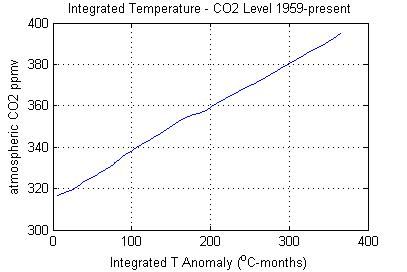
Here is a similar plot versus the temperature integral.
http://i1136.photobucket.com/albums/n488/Bartemis/tempco2_zps55644e9e.jpg

Ferdinand Engelbeen
Reply to  Robert B
January 7, 2015 3:59 pm

Except that plotting the integral of temperature has no physical meaning: if you have a fixed temperature offset, that doesn’t produce a continuous stream of CO2 in the atmosphere without a reaction of the increased CO2 pressure in the atmosphere on CO2 influx and outflux in the oceans (and vegetation):
http://www.ferdinand-engelbeen.be/klimaat/klim_img/upwelling_temp.jpg
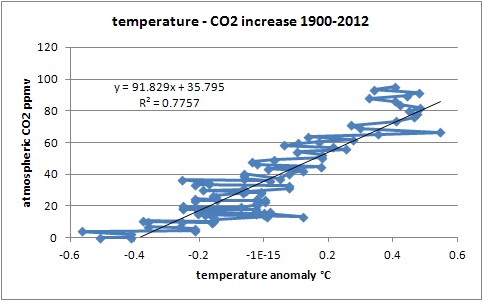
The difference between the temperature increase and the CO2 increase is quite clear:
http://www.ferdinand-engelbeen.be/klimaat/klim_img/temp_co2.jpg
A temperature change of near halve the scale has hardly an effect on CO2 levels, but double that would give the 100 ppmv increase over 112 years…
Further, the 1960-1975 period shows a decrease in temperature, 1975-2000 an increase, 2000-current is flat, while CO2 simply follows human emissions, not temperature:
http://www.ferdinand-engelbeen.be/klimaat/klim_img/temp_co2_acc_1960_cur.jpg

Bart
Reply to  Robert B
January 7, 2015 4:53 pm

“…the integral of temperature has no physical meaning…”
Yes, it does. If the ocean surface is being progressively driven higher in CO2 concentration, that produces outgassing which progressively drives atmospheric concentration higher, and the rate of outgassing is temperature modulated.
You keep trying to impose what you want the dynamic to be instead of coming to terms with what the data indicate it is. The rate of change of CO2 in the atmosphere is unequivocally related affinely to global temperature anomaly. There is no doubt about it.

Bart
Reply to  Robert B
January 7, 2015 4:54 pm

To clarify, Ii the ocean surface is being progressively driven higher in CO2 concentration due to upwelling of CO2 enriched waters, then the rest follows.

David Socrates
Reply to  Robert B
January 7, 2015 5:02 pm

“There is no doubt about it.”
..
Yes there is a lot of doubt about it.
Namely that human emissions of CO2 are the cause, not “T”

Bart
Reply to  Robert B
January 7, 2015 5:03 pm

Any process which influences CO2 concentration with relatively steady, temperature modulated, rate would beget an essentially affine relationship between CO2 concentration and the integral of temperature. There is nothing unphysical about it.

David Socrates
Reply to  Robert B
January 7, 2015 5:05 pm

Bart, the oceans are a sink for CO2 not a curse with respect to atmospheric concentrations of CO2

David Socrates
Reply to  Robert B
January 7, 2015 5:06 pm

Typo….”source” not “curse”

Reply to  Robert B
January 7, 2015 5:57 pm

Socks says:
Yes there is a lot of doubt about it.
Namely that human emissions of CO2 are the cause, not “T”

I’ll agree with the first part if you replace “a lot” with “little”. It’s no big deal, just a matter of degree.
The second part of your comment is what’s called a non sequitur. It’s just an assertion, baseless in this case, which doesn’t follow.

David Socrates
Reply to  Robert B
January 7, 2015 6:08 pm

Dbstealey

I can’t replace “a lot” with “a little” because the 40% increase of CO2 from 280 ppmv to 400 ppmv is due to humans, and not due to “T”
If you think that “T” is the cause, I suggest you look at the ice core record.

Back 175,000 years ago, when “T” was higher than it is today, yet CO2 never exceeded 300 ppmv

Reply to  Robert B
January 7, 2015 6:47 pm

Socks says:
when “T” was higher than it is today, yet CO2 never exceeded 300 ppmv
Most folks would say, “Of course, global temps go up despite CO2, not because of it!” Duh…

David Socrates
Reply to  Robert B
January 7, 2015 6:53 pm

Whazzzamatta Mr. Dbstealey…..do you have a problem facing the fact that 175,000 years ago, CO2 was not at 400 ppmv?

David Socrates
Reply to  Robert B
January 7, 2015 7:03 pm

In other words, why didn’t CO2 follow T?

Reply to  Robert B
January 7, 2015 7:41 pm

Socks, get a grip on reality.
The entire claim of you and your alarmist pals is that a rise in CO2 [“carbon”] will lead to runaway global warming. At least that’s the basic scare — but as each piece of it is debunked in turn, it constantly morphs into a slightly new narrative.
So, you folks have a problem. Because as you have been forced to admit by the real world, global T can rise fast without any added CO2.
Welp. There goes your whole conjecture, along with your scare.
As you see, I don’t have a problem. But you do: credibility.

David Socrates
Reply to  Robert B
January 7, 2015 7:44 pm

Dbstealey, your deflection doesn’t work

Why is it that 175,000 years ago, when it was warmer than it is today, did CO2 not exceed 300 ppmv?

Ferdinand Engelbeen
Reply to  Robert B
January 8, 2015 1:07 am

Bart, there is no phase distortion because the CO2 reactions on temperature are from different processes with largely different phases:
1. seasonal:
– 5 ppmv/°C
– CO2 down with temperature
– CO2 and δ13C opposite to each other
– cause: extra-tropical vegetation
2. short term (2-3 years):
– 4-5 ppmv/°C
– CO2 up with temperature
– CO2 and δ13C opposite to each other
– cause: tropical vegetation
3. (very) long term:
– 8 ppmv/°C
– CO2 up with temperature
– CO2 and δ13C parallel each other
– cause: deep oceans
4. past 160 years:
– +110 ppmv
– temperature independent
– CO2 and δ13C opposite to each other
– cause: human emissions
The short term processes don’t react on the long term changes, because these have “phases” far beyond any influence on the short term phases: thousands of years for the deep oceans to at least 680 years for human emissions, which are not temperature dependent. If you combine a short term variation with a very long term increase, there is no distortion at all, even not after integration:
http://www.ferdinand-engelbeen.be/klimaat/klim_img/matlab_sin_t_co2_slope.jpg

Ferdinand Engelbeen
Reply to  Robert B
January 8, 2015 3:16 am

Bart :
Yes, it does. If the ocean surface is being progressively driven higher in CO2 concentration, that produces outgassing which progressively drives atmospheric concentration higher, and the rate of outgassing is temperature modulated.
Come on Bart, that needs an incredible coincidence of timing and quantities compared to human emissions: upwelling (and temperature) increasing in ratio with human emissions since 1850, which is contradicted by about all observations:
– Oceans are net sinks for CO2 as all observations of DIC (total carbon) and recently pH show.
– Oceans have a positive δ13C rate. Both the atmosphere and the ocean surface show a sharp drop in δ13C, in ratio to human emissions. If the deep oceans should give extra upwelling, the δ13C should go up in the atmosphere, not down.
– More upwelling also means more uptake, as the mass balance for natural circulation is more sink than source. But there is not the slightest indication for an increased throughput of CO2 through the atmosphere, to the contrary.
– Temperature has its ups and downs, but CO2 simply follows human emissions, not temperature.

Bart
Reply to  Robert B
January 8, 2015 9:53 am

I you truly understood how feedback systems work, you would know that it is not only not unlikely, but quite ordinary. And, no, your demonstration is not applicable. You have temperature driving the rate of change of CO2. That temperature has a trend in it, as well as shorter term variation. The response must be to all components, unless the trend is somehow filtered out. That filtering process would leave signs of phase distortion. There is none. Hence, the trend in temperatures is causing the trend in the rate of change of CO2. Emissions also have a trend in their rate of input. There is no significant room left over for them.
There is no way around it, and all your handwaving assertions cannot change it. There is no doubt about it. A temperature modulated process is the driver of atmospheric CO2. Human inputs have little effect.

Ferdinand Engelbeen
Reply to  Robert B
January 8, 2015 12:53 pm

Bart:
I you truly understood how feedback systems work
Bart I may have forgotten most of the theoretical background, but after 34 years of practical work with chemical processes, including a few run-away reactions, I think that I know what a feedback process is.
What you don’t see is that the temperature driving CO2 has a very limited influence on CO2 levels over all historical times and there is hardly any feedback from CO2 on temperature.
That means that nature has managed to keep an equilibrium between temperature and CO2 levels of ~8 ppmv/K over at least the past 800,000 years with sufficient fast (order of decades) negative feedbacks
You have temperature driving the rate of change of CO2.
That is what you think, but temperature levels drive CO2 levels over all times with a lag, except for the past 160 years, and the rate of change of temperature drives the rate of change of CO2. Temperature doesn’t drive the rate of change of CO2 as there is no lag between T and dCO2/dt in the short term variability, that is an artifact from taking the derivative of only one of the two variables. The lag is between dT/dt and dCO2/dt.
The slope of dT/dt is near zero and not responsible for the slope in dCO2/dt, but the slope of dCO2/dt(emissions) is twice the slope of dCO2/dt(atmosphere)…
Further, you reject all observations which demonstrate that your theory can’t be true: vegetation is a proven sink for CO2, based on the oxygen balance. The oceans are a proven sink of CO2, based on the mass balance, millions of DIC and pCO2 (and recently pH) measurements and the too high δ13C level, which excludes the oceans as important source both for an increase in throughput and an increase in the atmosphere. And there is not the slightest sign of an increased release of CO2 from any other source, known or unknown…
As human emissions fit all observations and your theory doesn’t fit any observation, I think that there is more than sufficient proof that your theory isn’t right…

David Socrates
Reply to  Robert B
January 8, 2015 1:07 pm

Ferdinnand.

No amount of physical real world evidence that you can provide will persuade Bart to renounce his “theory”. The reason is clear. Bart is using the definition of causation as his linchpin. Bart’s logic goes like this. T causes CO2 under all conditions. Since T is a cause, and CO2 is the effect, therefore CO2 cannot cause warming, hence AGW is false.
So, no matter how much evidence you have that CO2 levels today are independent of T, Bart cannot accept the evidence, as it destroys his logical construct.

Bart
Reply to  Robert B
January 8, 2015 4:41 pm

“What you don’t see is that the temperature driving CO2 has a very limited influence on CO2 levels over all historical times…”
Nobody sees that. They infer it from preconceptions, and dubious proxy measurements which superficially seem consistent with it. But, consistency is not proof, the proxies are not verifiable, and the preconceptions are not unique.
In the end, though, it does not matter whether they are right or wrong. We do not need to know the manner in which temperatures affected CO2 in the long ago past to know what the relationship is in the modern era. It is evident that, since at least 1958, the rate of change of CO2 is modulated by temperatures.
“…and there is hardly any feedback from CO2 on temperature.”
I mostly agree with that. If there is any positive feedback, it is squelched by other negative feedbacks. If it were not, the system would be unstable.
“That is what you think, but temperature levels drive CO2 levels over all times with a lag, except for the past 160 years…”
To be specific, a 90 degree phase lag, since at least 1958. And, that requires an integral relationship.
“…and the rate of change of temperature drives the rate of change of CO2. “
No. It is quite clear from the plots. There is absolutely no wiggle room. The empirical relationship is
dCO2/dt = k*(T – T0)
Temperature is driving the rate of change of CO2 in the atmosphere, and has been since at least 1958.
“Temperature doesn’t drive the rate of change of CO2 as there is no lag between T and dCO2/dt in the short term variability…”
Which means there is a 90 deg phase lag between T and CO2, which means there is an integral relationship. It isn’t arguable. It’s staring you right in the face.
“The lag is between dT/dt and dCO2/dt.”
Or, between T and CO2. It is a 90 degree phase lag. That indicates that there is an integral relationship.
“The slope of dT/dt is near zero…”
The relationship is
dCO2/dt = k*(T – T0)
The slope in T is responsible for the slope in dCO2/dt. The rate of emissions also has a slope. There is little to no room for it.
“Further, you reject all observations which demonstrate that your theory can’t be true”
No, I reject that there is a unique explanation for those observations. There is a unique explanation for the integral relationship we see. The unique relationship wins over those subject to other explanations.
“As human emissions fit all observations …”
Human emissions do not fit with the rate of change. They do not explain the variability, and their long term trend is already taken up by the temperature relationship.
Moreover, human emissions are accelerating. Atmospheric concentration is at a steady rate. They are therefore incompatible as cause and effect.

Reply to  Robert B
January 8, 2015 6:26 pm

Why is it that 175,000 years ago, when it was warmer than it is today, did CO2 not exceed 300 ppmv?
You don’t even understand how thoeroughly that deconstructs your belief system.
Do you?

David Socrates
Reply to  Robert B
January 8, 2015 6:31 pm

“You don’t even understand how that deconstructs your belief system”

Try explaining how it does.

Ferdinand Engelbeen
Reply to  Robert B
January 9, 2015 6:08 am

Bart:
Nobody sees that. They infer it from preconceptions, and dubious proxy measurements which superficially seem consistent with it.
As said, you don’t like any data which contradicts your theory, thus the data must be wrong…
at least 1958, the rate of change of CO2 is modulated by temperatures.
Modulated, yes, driving the trend, no. There is not the slightest indication that there is any increase in any natural source of CO2, causing an overall increase in throughput (as the net effect still is more sink than source) and causing an increase of CO2 in the atmosphere…
To be specific, a 90 degree phase lag, since at least 1958. And, that requires an integral relationship.
Look again at your plot: there is zero lag between T and dCO2/dt. That is not an integral relationship, but that is the base for your formula:
dCO2/dt = k*(T – T0)
But the formula doesn’t include the negative feedback caused by the increased CO2 pressure in the atmosphere:
dCO2/dt = k*(T1 – T0) – k2*(P – P1)
Where P is the actual pCO2(atm) and P1 is the atmospheric CO2 pressure in equilibrium with the oceans for the average ocean temperature T1. That gives that the increase in the atmosphere is limited after any temperature increase and/or any deep ocean upwelling increase:
http://www.ferdinand-engelbeen.be/klimaat/klim_img/upwelling_incr_temp.jpg
The plot shows the effect of a 10% increase in CO2 upwelling (either concentration or deep ocean flux) at the tropics, followed by an 1 K increase in sea surface temperature.
The latter effect is probably overblown, as I used 17 ppmv/K, while in the literature one can find 4 to 17 ppmv/K and the long term average as seen in ice cores is 8 ppmv/K.
For the current P-P1 difference (~110 μatm), the net sink rate is ~2.15 ppmv/year. That gives an e-fold decay rate of the excess CO2 in the atmosphere of slightly over 50 years or a half life time of ~40 years. Fast enough to follow ice ages, but not fast enough to suppress the short term changes caused by temperature changes.

Bart
Reply to  Robert B
January 9, 2015 9:43 am

Ferdinand Engelbeen January 9, 2015 at 6:08 am
“There is not the slightest indication that there is any increase in any natural source of CO2, causing an overall increase in throughput…”
Name an anthropogenic source of any size which is modulated by temperature. Anthropogenic input does not depend on temperature. That is why the emissions and atmospheric concentration are currently diverging. Anthropogenic emissions are accelerating. Atmospheric CO2 concentration is not, and at the same time that temperatures have plateaued. That is no coincidence.
“Look again at your plot: there is zero lag between T and dCO2/dt. That is not an integral relationship…”
That is a self-contradition right in one sentence. If
dCO2/dt = k*(T – T0)
then
CO2 = CO2(0) + integral(k*(T-T0))
It’s an identity relationship.
“But the formula doesn’t include the negative feedback caused by the increased CO2 pressure in the atmosphere:
dCO2/dt = k*(T1 – T0) – k2*(P – P1)”

Such a term, if it were significant in the era 1958-present, would cause massive and readily observable phase distortion. There is none, and you are clutching at straws.

Reply to  Robert B
January 9, 2015 9:58 am

Bart January 9, 2015 at 9:43 am
Ferdinand Engelbeen January 9, 2015 at 6:08 am
“There is not the slightest indication that there is any increase in any natural source of CO2, causing an overall increase in throughput…”
Name an anthropogenic source of any size which is modulated by temperature.

A natural sink of CO2 (the ocean) is modulated by temperature via Henry’s law which causes the modulation in the CO2, the overall growth in CO2 (the ~linear component) is due to anthropogenic source which is growing about 4ppm/year.

David Socrates
Reply to  Robert B
January 9, 2015 10:07 am

This is why Bart makes me laugh.

Mr Calculus claims that I don’t know what a “derivative” is.

Then Mr. Calculus says, “It’s an identity relationship.”

Too bad Mr Calculus forgot about that wonderful thing called the “Constant of Integration”…..which if he wasn’t asleep in class at the time, insures that the operations of derivative and integration are not “identity” relationships.

Thanks for the humor Mr. Calculus

Bart
Reply to  Robert B
January 9, 2015 10:10 am

A more complete set of equations should be something like
dCO2/dt = (CO2eq – CO2)/tau + E
dCO2eq/dt = k*(T – T0)
CO2eq is the instantaneous equilibrium level set, perhaps, by the irresistible force of outgassing from upwelling CO2 rich ocean waters. E is anthropogenic emissions, and tau is a time constant relating to the power of the sinks. The (CO2eq – CO2)/tau term models your partial pressure dynamic.
If the sinks are active, then tau is short, and the impact of E is on the order of E*tau, which is small. CO2 then tracks CO2eq.
This is a very ordinary feedback dynamic.

Bart
Reply to  Robert B
January 9, 2015 11:30 am

Phil. January 9, 2015 at 9:58 am
“A natural sink of CO2 (the ocean) is modulated by temperature via Henry’s law which causes the modulation in the CO2”
It does not fit the data. The data fit a curve of the form of a proportionality constant (at least reasonably constant in the modern era) times appropriately baselined temperature anomaly. Temperature anomaly has been rising roughly linearly since 1958, with a plateau in the past decade and a half or so.
The rate of emissions has been rising linearly, and continues to do so. Were this dynamic of emissions coupled with Henry’s Law responsible for it, the rate of atmospheric rise would have been quadratic, and in the last decade+, become linear.
It has not. The rate of atmospheric rise has been essentially linear, and in the last decade+, essentially constant.
There is a deeper reason that we should not expect emissions to be the driving force, but I do not think I could get it across in this forum. The above is sufficient.

Bart
Reply to  Robert B
January 9, 2015 11:39 am

David Socrates January 9, 2015 at 10:07 am
Another ineffably stupid comment. David, you are either A) incredibly ignorant, B) just trying to derail the discussion, or C) both. In any case, you are not helping your side. You haven’t stated a single thing either apposite or valid in the entire thread. Do yourself and your friends a favor: butt out.

David Socrates
Reply to  Robert B
January 9, 2015 5:09 pm

Bart, if you are incapable of defending your supposed “theory” I can understand. Your arrogance is your downfall. You need to understand that it is incredibly easy to poke holes in your “theory” because it is not causative, it is merely a simplistic correlation. Your methodology is also easy to find fault in.
..
Too bad you can’t deal with someone that pokes holes in your position. A good scientist would be able to handle criticism of their work, but you can’t There’s a reason that your “theory” can’t make it into a respectable science journal. It can’t pass peer review.

Bart
Reply to  Robert B
January 9, 2015 6:00 pm

There is nothing to defend against, David. You haven’t offered anything even remotely approaching a substantive criticism.

David Socrates
Reply to  Robert B
January 9, 2015 6:11 pm

” You haven’t offered anything even remotely approaching a substantive criticism.”
1) Namely that human emissions of CO2 are the cause, not “T”
2) the oceans are a sink for CO2
3) Back 175,000 years ago, when “T” was higher than it is today, yet CO2 never exceeded 300
4) operations of derivative and integration are not “identity” relationships.
However Mr. Bart, the biggest "criticism" I have offered is to point out that your "evidence" is very poor. A contrived chart from WFT does not show "causation"
..
Your relationship shows correlation. It does not show causation.
And the biggest mistake you have made is saying I don't know what a "derivative" is………

Reply to  Robert B
January 9, 2015 6:46 pm

Socks,
Have you noticed that most everyone disagrees with you here? I think that’s the consensus, anyway.
Maybe you should go back and re-examine your basic beliefs. For example, why do you still believe that CO2 will have a measurable effect on the planet? The IR window is sarturated with CO2 molecules; more won’t make any measurable difference.
Global warming has stopped. That’s the bottom line. The ‘carbon’ scare has fizzled. Why can you not accept that? “Man-made climate change” is nonsense. The public doesn’t buy it any more. The bloom is off the rose. Jump ship while you can.

David Socrates
Reply to  Robert B
January 9, 2015 6:57 pm

Dbstealey….
..
I’m impressed.
Now you are arguing using “consensus” as evidence.
….
Do you enjoy being part of the 3%?

“The IR window is sarturated with CO2 molecules;”
..
Now you are funny.

The satellites in orbit can measure the outbound IR. If the window was “saturated” why can they measure it?
..
I suggest you read this… http://citeseerx.ist.psu.edu/viewdoc/summary?doi=10.1.1.131.3867
Get up to speed on measuring outbound IR.
“Global warming has stopped.”
..
Really?….better read the press release from the Japan Meteorologic Agency.
….
“Man-made climate change” is nonsense”

You crack me up. But if you are happy being part of the 3% of the folks that can’t see straight, that is your choice.

Bart
Reply to  Robert B
January 9, 2015 7:18 pm

These are merely assertions. Assertions are not evidence. It was the refusal to take assertions at face value which brought forth the Enlightenment, and allowed humankind to break the shackles of superstition and rule by self-proclaimed authorities. Those who insist that one must bow down to the proclamations of authority figures are primitive throwbacks to a pre-Enlightenment era. That is not “science”. That is pre-science. That is medievalism. That is ignorance, poverty, and death.
It is quite obvious you had no idea what a derivative was when you wrote: “Look at how the “derivative” removes the long term trend of the data.” I refrained from responding, “Holy cow! Somebody alert the Fields Medal committee! Who’da thunk it!” But, there was no need. Everyone saw it. Everyone had a good chuckle. I doubt any who were watching will ever consider you a serious commenter again. I especially enjoyed MiCro’s pithy comment at January 8, 2015 at 6:34 pm. And, Janice Moore’s at January 8, 2015 at 6:37 pm.
Then you wrote absurd things like ‘Too bad Mr Calculus forgot about that wonderful thing called the “Constant of Integration”’ when my equation clearly had just that in CO2(0). Everything you have written has either been totally irrelevant like the one above, or laughably unaware like the this one. It is very obvious that you are flailing in deep water way over your head, and there is no point in attempting to throw you a lifeline and educate you as learning is obviously not your primary purpose.
The only thing you have contributed to the threads here has been comedic sideshow. But, I did not want that. I wanted a serious conversation with the likes of Ferdinand and Phil and Fred et al. But, it seems you cannot keep the clowns out when they are determined to make a spectacle of themselves. Now please, for the last time, and for your own good… Go away.

David Socrates
Reply to  Robert B
January 9, 2015 7:32 pm

Bart….

OK….I guess I’ll have to drop down to your level of comprehension.
1) Here is the raw CO2 data
..
http://www.woodfortrees.org/plot/esrl-co2

2) Here is the raw CO2 data with the “derivative”
..
http://www.woodfortrees.org/plot/esrl-co2/derivative

3) Here is the raw CO2 data and the derivative on the same chart
..
http://www.woodfortrees.org/plot/esrl-co2/plot/esrl-co2/derivative

4) Here is the raw CO2 data and the derivative with an offset on the raw data
..
http://www.woodfortrees.org/plot/esrl-co2/offset:-330/plot/esrl-co2/derivative
5) Here is the raw CO2 data, the derivative and their associated trend lines.
..
http://www.woodfortrees.org/plot/esrl-co2/offset:-330/plot/esrl-co2/derivative/plot/esrl-co2/offset:-330/trend/plot/esrl-co2/derivative/trend

Now if you can’t see that applying the derivative function on the raw data removes the long term trend in that data……..
….
So again, I will repeat my claim…..
….
” “Look at how the “derivative” removes the long term trend of the data”

Bart
Reply to  Robert B
January 9, 2015 7:38 pm

Yeah, David. I know. We all know. Now, drink your milk and cookies like a good little boy, and go to bed.

David Socrates
Reply to  Robert B
January 9, 2015 7:41 pm

PS Mr Calculus
..
“when my equation clearly had just that in CO2(0)”

The constant of integration is not fixed, and is arbitrary. I can select a different value, such as 1,000,001 which would invalidate the equation. Nothing prevents me from doing so, and nothing in your argument prevents this number as a constant. With a value of 1,000,001 your equation now has a CO2 concentration of 1,000,0001 parts per million which is logically impossible. Unless you have provided a constraint to the equation of your theory, the integration fails due to the integration constant. Good luck trying to “educate” someone that rips your attempt at proffering a hypothesis. It’s much too weak to withstand the scrutiny of someone with a good rounding in mathematics.
Keep on posting your “theory” and I will continue to have fun poking holes in it.

Reply to  Robert B
January 9, 2015 7:45 pm

Socks,
Rather than doing what comes easy — refuting your nonsense point by point — let me just condense it: you are full of carp. Everything you argue is either deceptive, or based on assertions that support the alarmist Narrative. No one agrees with you, either. Truth has nothing whatever to do with the Narrative you promote, whose purpose is to put a hoax over on productive citizens.
Finally, anyone can play with the WoodForTrees site and create millions of charts, but most of them are worthless, as are all the ones you posted.

David Socrates
Reply to  Robert B
January 9, 2015 7:45 pm

“Now, drink your milk and cookies like a good little boy, and go to bed.”

Classic ad-hominem

You know Bart, when you start using that as an argumentative technique, it’s a clear sign you’ve lost
You have yet to address the fact that your “theory” is mere correlation
….
Will you now respond by calling me names?

Reply to  David Socrates
January 13, 2015 9:48 am

You are not male? You should have done a duet with Johnny Cash – Boy named Sue meets girl named David.

David Socrates
Reply to  Robert B
January 9, 2015 7:49 pm

Dbstealey

You post, ” you are full of carp. ”

Could you please be more specific and point out to me what part of this post
http://wattsupwiththat.com/2015/01/06/on-the-futility-of-climate-models-simplistic-nonsense/#comment-1832548
don’t you understand.
I would be more than happy to explain it if you don’t understand the specifics.

Bart
Reply to  Robert B
January 10, 2015 10:53 am

“The constant of integration is not fixed, and is arbitrary.”
Ah…(chuckle), no dear boy. The constant of integration is fixed by the initial condition.
“Classic ad-hominem”
No, that would fall under the heading of classic ridicule. I strive for patience, but one can abide only so much errant nonsense.

David Socrates
Reply to  Robert B
January 10, 2015 11:09 am

“classic ridicule?”
Your ad-hominem approach is so juvenile.
..
Why do you feel the need to insult someone that pokes holes in your “correlation?”
..
PS ….except you never stated the “initial condition”
..
Want me to take down your use of 12 month averaging on CO2 data in your supposed “evidence?”

Bart
Reply to  Robert B
January 10, 2015 11:57 am

‘Why do you feel the need to insult someone …?”’
Because, despite your repeated self-inflicted wounds, complete lack of self-awareness, and yawning deficit of technical skill, you refuse to slink away in embarrassment as one should have long ago at this point.
No, I do not want to see your “take down”. It is painful to watch you flounder so cluelessly. It’s like watching a special needs child throw a tantrum – not at all pleasant.
You have accomplished nothing here, David. Your “points”, when you have had anything approaching one, have no object, no relevance, no value. You don’t know what you are talking about, you don’t understand your argument, and you lack even the basic skill to know it.
You do not see me treating Ferdinand or Phil in this manner, do you? That is because, though they have not yet fully grasped the logic and import of the argument, they are making cogent points which merit a respectful response.
You have none of that. You have nothing. Zip. Nada. Nothing. You are, as it is said, not even wrong. You’re off in an entirely alternate universe, babbling incoherently to an audience of one.

Ferdinand Engelbeen
Reply to  Robert B
January 10, 2015 1:30 pm

Bart January 9, 2015 at 10:10 am :
A more complete set of equations should be something like
dCO2/dt = (CO2eq – CO2)/tau + E
dCO2eq/dt = k*(T – T0)

Not agreed, as CO2eq, not dCO2/dt does depend of k*(T-T0). That gives:
dCO2/dt = (CO2eq – CO2)/tau + E + dT/dt
Where CO2eq = k(T-T0)
and that doesn’t imply that the k is large and tau is short…
Temperature does change the CO2 equilibrium between (sea)water and the atmosphere, but that equilibrium doesn’t change over time, it is fixed per Henry’s law.
From the literature, k gives a net result in the order of 8 ppmv/K (4-17 ppmv/K) before a new equilibrium is reached. That is all. That is the real, measured influence of temperature on the equilibrium of CO2 from the oceans, today from a single sample to the whole ocean surface (3 million measurements) and in the (far) past (from ice cores).
You need some 12°C ocean surface temeprature increase to give the 110 ppmv CO2 increase by temperature alone…
You can invoke some extra upwelling, but there is not the slightest sign of such an increase in upwelling. Even so, the bulk of the increase then would be from the upwelling, not from temperature.
Moreover, tau is easy to calculate, as all other variables are known in this case: slightly over 50 years for the last years and still about the same as 18 years ago:
http://www.john-daly.com/carbon.htm
As E hardly shows any variability (none detectable) and tau is long, that doesn’t disturb the synchronization or the variability caused by temperature variations. All what happens is that the sink capacity varies year by year which gives a steady increase caused by E and a variability of dCO2/dt around the trend caused by temperature changes. The total CO2 rate of change in the atmosphere then is:
http://www.ferdinand-engelbeen.be/klimaat/klim_img/dco2_em4.jpg
Where the red line is dCO2/dt = (CO2eq – CO2)/tau + E for a tau of slightly over 50 years and a CO2eq change of 8 ppmv/°C over a pre-industrial value of 290 ppmv.

Ferdinand Engelbeen
Reply to  Robert B
January 10, 2015 1:45 pm

Some addition:
In
dCO2/dt = (CO2eq – CO2)/tau + E + dT/dt
the term dT/dt needs some factor to calculate dCO2 from dT. On short term that is a factor 4-5, based on the 1991 Pinatubo and 1998 El Niño. Thus the ultimate formula then is:
dCO2/dt = (CO2eq-CO2)/tau + E + k2*dT/dt
Where CO2eq = k*(T-T0)
k = 8
k2 = 4-5
tau = ~51
which gives the above result…

Bart
Reply to  Robert B
January 10, 2015 1:54 pm

“Where CO2eq = k(T-T0)”
Doesn’t work. Does not produce 90 deg phase lag which indicates integration.
This is what you want the dynamic to be, but not what it very clearly is. You have to deal with the system as it observably is, not what you want it to be.
“Temperature does change the CO2 equilibrium between (sea)water and the atmosphere, but that equilibrium doesn’t change over time, it is fixed per Henry’s law.”
Only for a closed system. Continuous upwelling of CO2 rich ocean waters to the surface, for example, would continuously shift the equilibrium level. As the rate at which they outgas to the atmosphere would be proportional to temperature anomaly relative to an appropriate baseline, that would result in a dynamic of the form
dCO2/dt = k*(T – T0)
“…for a tau of slightly over …”
When you use an incorrect model, your calculations will be incorrect.

Bart
Reply to  Robert B
January 10, 2015 1:58 pm

Should have said
dCO2eq/dt = k*(T – T0)
Since tau is necessarily short, they become approximately equal.

Ferdinand Engelbeen
Reply to  Robert B
January 10, 2015 3:36 pm

Bart:
“Where CO2eq = k(T-T0)”
Doesn’t work. Does not produce 90 deg phase lag which indicates integration.

That is exactly the point of discussion: your
dCO2/dt = k(T-T0) doesn’t show a 90 deg. phase lag, but you do integrate T…
The real influence of temperature is in the third term:
k2*dT/dt, which gives a 90 deg phase lag between dCO2/dt and dT/dt.
This is what you want the dynamic to be, but not what it very clearly is. You have to deal with the system as it observably is, not what you want it to be.
Bart, as all observations show a limited change in pCO2 equilibrium between ocean waters and atmosphere for a fixed change in temperature, you can’t make that a floating equilibrium…
Only for a closed system. Continuous upwelling of CO2 rich ocean waters to the surface, for example, would continuously shift the equilibrium level. As the rate at which they outgas to the atmosphere would be proportional to temperature anomaly relative to an appropriate baseline, that would result in a dynamic of the form
dCO2/dt = k*(T – T0)

Again, any change in upwelling is an independent factor of temperature, even if temperature will modulate the CO2 flux from that upwelling. That is an extra term N(atural) in the equation. The extra CO2 then is largely from the upwelling, hardly from temperature change: less than 3% in influx for 1 K increase in temperature, as the pCO2(ocean) increase is not more than 8 μatm/K at the upwelling places and the influx is in direct ratio to the pCO2 difference between oceans and atmosphere (~350 μatm in the upwelling zones).
Even with 10% more upwelling (for which is no sign), that gives not more than 30 ppmv increase, as the term (CO2eq-CO2)/tau increases and after some time equals the extra input.
Only when your upwelling shows a continuous, slightly quadratic increase over time, you know a 4-5 fold in the period 1959-current (like human emissions do), then you will have a steady increase of CO2 in the atmosphere…
“…for a tau of slightly over …”
When you use an incorrect model, your calculations will be incorrect.

Nothing to do with a model, simply applying the observed sink rate and the observed increase in the atmosphere, which in average looks like a simple linear process and applying Henry’s law for the ocean equilibrium with the atmosphere at any area of the oceans…

Bart
Reply to  Robert B
January 10, 2015 6:40 pm

“That is exactly the point of discussion: your
dCO2/dt = k(T-T0) doesn’t show a 90 deg. phase lag, but you do integrate T…”

Of course I integrate T. That is what the equation shows. If
dCO2/dt = k*(T – T0)
then
CO2 = CO2(0) + integral(k*(T-T0))
They are two ways of expressing the same relationship. I do not integrate temperature anomaly to get dCO2/dt. I integrate it to get CO2. And, there is a 90 deg phase lag between T and CO2.
“The real influence of temperature is in the third term:
k2*dT/dt, which gives a 90 deg phase lag between dCO2/dt and dT/dt.”

There is no phase lag between dCO2/dt and dT/dt in your model
dCO2/dt = (CO2eq-CO2)/tau + E + k2*dT/dt
The response from dT/dt to dCO2/dt here is high pass – the phase goes from a 90 deg lead at low frequency to zero degrees at high frequencies. See phase plot here.
“…you can’t make that a floating equilibrium…”
“Equilibrium” is an informal way of saying it and not strictly proper, but yes, you can make a time varying attractor for the atmospheric CO2 level. I spelled one way out for you in having an increase in CO2 enriched waters upwelling from the deep oceans.
“The extra CO2 then is largely from the upwelling, hardly from temperature change…”
The temperature does not account for the initial level of outgassing, but its effect is significant. It accounts for the slope in the rate of change of CO2, and for the variation.
This is no different from anything I have been saying.
“…as the term (CO2eq-CO2)/tau increases and after some time equals the extra input.”
No. CO2 will track CO2eq in the equation. As long as CO2eq is rising, CO2 will rise.
“…which in average looks like a simple linear process and applying Henry’s law for the ocean…”
As I explained above, that is not consistent with the observations.

Ferdinand Engelbeen
Reply to  Robert B
January 11, 2015 6:35 am

Bart
Of course I integrate T. That is what the equation shows. If
dCO2/dt = k*(T – T0)
then
CO2 = CO2(0) + integral(k*(T-T0))

That is your equation, but dCO2/dt doesn’t depend of T, dCO2/dt depends of dT/dt, as good as CO2 depends of T:
CO2 = CO2(0) + k2*(T-T0)
where k2 = 8 ppmv/K over at least the past 800,000 years, before the human emissions made a difference.
or CO2 = CO2(0) + integral(k*dT/dt)
The latter term is very small: around 6 ppmv since the Little Ice Age…
The response from dT/dt to dCO2/dt here is high pass – the phase goes from a 90 deg lead at low frequency to zero degrees at high frequencies
What I said is that dCO2/dt lags dT/dt with 90 deg, but that is for all frequencies, as this is not a filtered process: it is an open loop process where CO2 simply follows T with a 90 deg. lag, whatever the frequency (but that does influence the amplitude: lower at high frequencies). That is anyway the case for seasons to 2-3 years. But I suppose that you can make that fit better with a sin() function or so for the dT/dt term…
We are not talking about radio frequencies here, but about relative slow physical-chemical processes where the removal of any extra CO2 in the atmosphere is an order of magnitude slower than the frequencies of interest.
I spelled one way out for you in having an increase in CO2 enriched waters upwelling from the deep oceans.
Bart, upwelling causes more CO2 to the atmosphere, but that doesn’t change the temperature equilibrium. The temperature equilibrium does influence the CO2 influx and outflux, but that is not more than 3%/K change in temperature, the ultimate result is a slightly higher increase (8 ppmv/K) in the atmosphere than from the upwelling alone.
The temperature does not account for the initial level of outgassing, but its effect is significant. It accounts for the slope in the rate of change of CO2, and for the variation.
As the effect of temperature is not more than 3%/K of the initial outgassing, its effect does influence the variability (which may be small in the upwelling) but hardly influences the slope or the finite increase in the atmosphere from the increased upwelling and the increased temperature.
No. CO2 will track CO2eq in the equation. As long as CO2eq is rising, CO2 will rise.
CO2 tries to track CO2eq, but as CO2eq only shows a small, fixed change with temperature (per Henry’s law and measured at lots of places), the current CO2 levels are way higher than CO2eq, which gives that tau is relative long, far too long to remove all human emissions in the same year.
That CO2eq changes a little with temperature was extensively discussed by Paul_K at Bishop Hill’s blog, fourth comment:
Note that this model is completely compatible with Henry’s Law – including the fact that for a fixed temperature change, the model does, if left alone, equilibrate at a new constant concentration value of CO2.. In your model CO2eq never stops changing for a sustained (even small) change in temperature, which is physically impossible.
As I explained above, that is not consistent with the observations.
As shown in the graph here, the simple linear sink process still is largely within the natural variability caused by temperature variability)…

Bart
Reply to  Robert B
January 11, 2015 11:34 am

“That is your equation, but dCO2/dt doesn’t depend of T, dCO2/dt depends of dT/dt, as good as CO2 depends of T:
CO2 = CO2(0) + k2*(T-T0)”

NO! It is very clear from the plot of the data. That is NOT the relationship. You must deal with the system as it is, not how you wish it to be.
“…it is an open loop process where CO2 simply follows T with a 90 deg…”
And, -20 dB/decade gain response. It is an integral process. There is absolutely no doubt about this.
“We are not talking about radio frequencies here, but about relative slow physical-chemical processes where the removal of any extra CO2 in the atmosphere is an order of magnitude slower than the frequencies of interest.”
It does not matter if it is radio frequencies or any other natural process. All processes subject to differential relations behave the same way.
“Bart, upwelling causes more CO2 to the atmosphere, but that doesn’t change the temperature equilibrium.”
Correct. The temperature change is caused by other processes, probably solar/lunar forcing interacting with the natural dynamics of the oceans.
“The temperature equilibrium does influence the CO2 influx and outflux, but that is not more than 3%/K change in temperature”
Whatever the percentage, it is multiplicative and cumulative as long as new CO2 keeps upwelling into the system.
“…but as CO2eq only shows a small, fixed change with temperature…”
It shows a large change with ocean upwelling, which would be modulated by the temperatures.
“That CO2eq changes a little with temperature was extensively discussed by Paul_K at Bishop Hill’s blog, fourth comment:”
You have completely misunderstood Paul_K’s input, as I and others have told you. His model is the same as mine, with the addition of a small restoring term
τ * dCO2/dt = ΔT – f(T)* ΔCO2
He missed a necessary coupling factor with ΔT. It should be
τ * dCO2/dt = k*τ*ΔT – f(T)* ΔCO2
which reduces to
dCO2/dt = k*ΔT – (f(T)/τ)* ΔCO2
The only difference is the last term, but this is necessarily very small to match the observations, and can be neglected over the timeline of observation since 1958. In that way, you recover entirely my equation.
ΔT is the temperature anomaly relative to the appropriate baseline. You do not see d(ΔT)/dt on the right side of this equation – that would produce the wrong phase relationship. As Paul_K himself says further down:

“Bart,
Thanks for your responses. You, Murray Salby and I all share a common view that the modern observational data displays an approximate relationship of the form
dCO2/dt = gamma* (T-Te)”

Paul_K’s only concern was my claim that the dynamic would lead to an unstable system if there were a positive response of temperature to CO2. It is true that the addition of a small restoring term allows a small positive temperature sensitivity to CO2 while remaining stable. But, it cannot be a significantly positive sensitivity, because of the weakness of the restoring term.
“As shown in the graph here, the simple linear sink process still is largely within the natural variability caused by temperature variability)…”
You are fooling yourself, and grasping at straws. Emissions are accelerating. Concentration is not. The relationship from temperature anomaly to atmospheric CO2 is an integral one. There is no room here to have a significant effect from human emissions.

Bart
Reply to  Robert B
January 11, 2015 11:44 am

“…it is an open loop process where CO2 simply follows T with a 90 deg. lag, whatever the frequency…”
Such a lag does not just happen. It is necessarily the result of an integrating process. For any natural system with minimum phase,
90 deg. lag, whatever the frequency = integration
It is an equivalence relationship. You cannot sidestep the math. You cannot dismiss the phase as unimportant. The 90 deg phase lag indicates uniquely an integration.

Ferdinand Engelbeen
Reply to  Robert B
January 12, 2015 7:27 am

Bart:
NO! It is very clear from the plot of the data. That is NOT the relationship. You must deal with the system as it is, not how you wish it to be.
Just compare the T variability and the dT/dt variability, that is a similar form, only shifted with 90 deg. There is no reason to prefer the ΔT causes dCO2/dt over the form
CO2 = CO2(0) + k2(T-T0)
to the contrary, as the latter follows Henry’s law: an increase in CO2 in the atmosphere forms a negative feedback to the increase caused by higher temperatures. That is as good the case for a static as for a dynamic system and that is what is seen in 800,000 years of ice cores.
The current slope in dCO2/dt is entirely caused by human emissions, which have double that slope. Temperature has hardly a slope and the resulting influence is not more than 6 ppmv CO2 since the LIA.
If your formula was right, a warming coke bottle always would explode, as the increase in temperature gives a continuous release of CO2 and thus a continuous increase of CO2 pressure under the cork, without any feedback from the increased pressure…
and, -20 dB/decade gain response. It is an integral process
Sorry, that doesn’t follow. The -20dB/decade is the Bode Theorem, which is for a closed loop. Here we have an open loop with a simple gain, with negligible feedback. The total response is ~8 ppmv/K with a one-way warming lag of ~800 years. The short term transient response is 4-5 ppmv/K for seasonal to 2-3 years.
It is an integrating process where CO2 levels respond to T-T0 without any limit in bandwidth as the feedback is in the pressure change, not in temperature.
Whatever the percentage, it is multiplicative and cumulative as long as new CO2 keeps upwelling into the system.
Again, you forget the negative feedback from the increased pressure in the atmosphere:
– The highest ocean CO2 pressure is at the upwelling sites near the equator. The total CO2 influx there is estimated to be 40 GtC/year (not important if that is a lot smaller or larger, it is about the influence of temperature).
The total sink rate near the poles also is estimated at ~40 GtC/year into the deep oceans (slightly higher, because the deep oceans are a sink for CO2).
40 GtC/year CO2 input is the result of 750 – 400 = 350 μatm CO2 pressure difference between oceans and atmosphere.
Let us assume that the CO2 influx increased with 10% for the same temperature:
44 GtC/year is the result of 750 – 400 = 350 μatm, but at the sink side, nothing happens yet as the pressure in the atmosphere is not (yet) increased: still 40 GtC/year sink rate.
An increase of 1°C at source and sink side increases the local pCO2 with 8 μatm, thus the influx near the equator increases to:
44 * (758 – 400) / (750 – 400) = 45 GtC/year (that is an increase of 2.2%…)
while the output at the poles decreases to ~39 GtC/year
The difference with the sinks thus gives an increase of 6 GtC/year (~3 μatm/year, that is near 3 ppmv/year) in the atmosphere for the first year. Less and less in the following years as the CO2 increase in the atmosphere pushes more CO2 into the sinks and reduces the outflux at the upwelling zones…
With an increase of 8 μatm CO2 in the atmosphere (just a few years…), the result of the temperature increase is already fully neutralized. With an increase of ~18 μatm, the CO2 influx and outflux are again in the same (dis)equilibrium as before the extra upwelling at an increased throughput of ~42 GtC/year. Thus in total, a 10% extra upwelling and 1 K temperature increase is fully equilibrated by an increase of 26 ppmv in the atmosphere:
http://www.ferdinand-engelbeen.be/klimaat/klim_img/upwelling_incr_temp.jpg
In this plot, the temperature influence still was estimated at 17 ppmv/K, which is overblown.
You have completely misunderstood Paul_K’s input, as I and others have told you. His model is the same as mine, with the addition of a small restoring term
Paul_K:
This equation is based on the assumption that the process of release of solute with temperature change starts off quickly and slows down as the concentrations adjust – a commonly observed phenomenon for the transient behavior of chemical equilibration processes.
I don’t think that I misunderstood Paul_K, as the additional term is the essential difference between us: the restoring term is not small as the foregoing example shows, it is the influence of temperature which is small…
The relationship from temperature anomaly to atmospheric CO2 is an integral one. There is no room here to have a significant effect from human emissions.
The integral of temperature minus the integral of the temperature caused increase of pCO2 in the atmosphere gives an increase of 6 ppmv since 1959, that is all:
At the current temperatures and pressures, the influx rate of CO2 from the deep oceans increased theoretically from the baseline in 1959 from 40 GtC/year to 40.6 GtC/year, but that is fully compensated with a 6 ppmv increase of CO2 in the atmosphere.
The measured increase in the atmosphere was 70 ppmv since 1959, in total 110 ppmv above the temperature dictated equilibrium. That gives a net sink rate of ~5 GtC/year (all sinks combined, deep oceans at ~3.5 GtC/year). Human emissions are currently ~10 GtC/year…

Bart
Reply to  Robert B
January 12, 2015 8:13 am

“Just compare the T variability and the dT/dt variability, that is a similar form, only shifted with 90 deg. There is no reason to prefer the ΔT causes dCO2/dt over the form
CO2 = CO2(0) + k2(T-T0)”

Yes, there is. T is not in phase with CO2. If you cannot match the phase, you do not have a match.
“If your formula was right, a warming coke bottle always would explode…”
Put a Coke bottle on your stove and turn the eye up to high, watch it explode.
“The -20dB/decade is the Bode Theorem, which is for a closed loop.”
No, Ferdinand. The Bode gain-phase theorem is applicable for any analytic rational transfer function. And, the -20 dB/decade gain factor is readily observable in the data. Otherwise, we would not match
dCO2/dt = k*(T – T0)
The higher frequency formations in T would be much greater amplitude than those in dCO2/dt.
“Again, you forget the negative feedback from the increased pressure in the atmosphere:”
Again, you forget the continuous pumping of new CO2 into the system from CO2 enriched waters.
Yes, you send one parcel up. It outgasses, and nudges CO2 higher, but then stops. Now, you send another parcel up. The same thing happens. You send a continuous stream of CO2 enriched parcels up, and you get a continuous increase in atmospheric CO2. All you have to have is upwelling water which is higher in pCO2 than the atmosphere.
Vary the temperature, and you will vary the rate at which outgassing occurs. That is consistent with what the data show us is happening. Your scenario is not consistent with that data record.
“the restoring term is not small as the foregoing example shows, it is the influence of temperature which is small…”
A) Your foregoing example is not Paul_K’s system. It has the wrong phase response. He does not have dT/dt as an input to dCO2/dt, he has ΔT = T-Te, i.e., the same input as I have with Te=T0.
B) If the influence of any restoring force were large, it would result in marked phase distortion in the output. It must, therefore, be too small to be observable in the data record since 1958. The result is the same whether it is there or not: human inputs have negligible effect.
Bottom line: you cannot ignore the phase response. You must match the phase. Phase response is not arbitrary. It comes about from the specific form of the system. CO2 = CO2(0) + k2(T-T0) is unequivocally wrong. It matches neither phase, nor amplitude across the spectrum.
And, that is my final word, until we meet again.

Bart
Reply to  Robert B
January 12, 2015 8:19 am

Note in the above, in case this is causing any confusion: T0 is not T(0). I am using T0 as just a variable to indicate a particular instantaneous “equilibrium” level of T at which outgassing would cease.

Ferdinand Engelbeen
Reply to  Robert B
January 13, 2015 3:23 pm

Bart, January 12, 2015 at 8:13 am
Put a Coke bottle on your stove and turn the eye up to high, watch it explode.
Yes, that is at 100°C or so, but your formula says that 2°C warming is enough to burst the bottle, as that induces an extra, continuous flux of CO2 from the liquid into the gas under the cork, without any reaction on the flux caused by the resulting pressure increase…
Again, you forget the continuous pumping of new CO2 into the system from CO2 enriched waters.
Yes, you send one parcel up. It outgasses, and nudges CO2 higher, but then stops. Now, you send another parcel up. The same thing happens. You send a continuous stream of CO2 enriched parcels up, and you get a continuous increase in atmospheric CO2. All you have to have is upwelling water which is higher in pCO2 than the atmosphere.

Bart, what I described was for a continuous pumping of parcels of CO2 enriched deep ocean waters into the atmosphere, that happens already today and probably since the earth has oceans. The resulting CO2 release at the upwelling zones (mainly the eastern equatorial Pacific) is currently estimated at about 40 GtC/year. The pCO2 there is at a maximum of 750 μatm.
If the deep ocean upwelling increased with 10%, that would give an instantly increase of influx to 44 GtC/year. A temperature increase of 1°C would increase that to 45 GtC/year. So far we agree.
What you don’t take into account is that the influx is not only temperature and upwelling dependent, but also pressure (difference) dependent: the influx is in direct ratio to the difference pCO2(ocean) – pCO2(air).
If the CO2 level in the atmosphere increased to 750 ppmv, the CO2 influx at the upwelling zones would be zero, because the pressure in the atmosphere is in equilibrium with the ocean surface, even if the upwelling doubled or tripled.
All what the extra input does is increase the CO2 pressure in the atmosphere until a new equilibrium between upwelling, temperature and pressure is reached.
In the case of (global) temperature, 8 ppmv/°C increase of CO2 in the atmosphere is sufficient to restore the initial in and out fluxes.
In the case of more upwelling, that depends of the extra amounts, but as both the CO2 release decreases with increased pressure in the atmosphere and the CO2 sinks increase with increased pressure, the new dynamic equilibrium is reached at an increase of pCO2 which reduces the extra influx to halve the initial value.

Bart
Reply to  Bart
January 7, 2015 5:15 pm

What you do not seem to get, Ferdinand, is that your idealized “short term” process can only be short term if it does not react to the slope in temperature, i.e., if it has a high pass response. That response would necessarily distort the phase. It doesn’t. Therefore, your conceptualization of what is driving the short and long term is wrong.

Ferdinand Engelbeen
Reply to  Bart
January 8, 2015 3:00 am

Bart, what you don’t seem to get is that the short term processes are completely independent of the long term process that is the main driver for the current CO2 rise, which is human emissions. Deep ocean temperature is the main driver for ice ages and interglacials at a rate of 0.02 ppmv/year during a deglaciation (even less the other way out), immeasurable distortion of that on processes which are seasonal or 2-3 years frequency and human emissions are not temperature dependent… The resulting curve is the simple sum of the increase caused by human emissions and the short term disturbance from temperature changes where the pressure difference between atmosphere and oceans (and plant alveoli) is driving the overall sink rate.

Bart
Reply to  Bart
January 8, 2015 9:44 am

This is a narrative. A set of assertions of how you think things should be, but lacking proof. The lack of phase distortion establishes that you are wrong.

Ferdinand Engelbeen
Reply to  Bart
January 8, 2015 1:19 pm

Bart, we know with reasonable accuracy the effect of short term variability of T on CO2 over the seasons and the short term disturbances (Pinatubo, El Niño), both in the order of 5 ppmv/K with a lag of CO2 after T.
We know with reasonable accuracy the effect of (very) long term T changes: ~8 ppmv/K over the MWP-LIA cooling up to glacial-interglacial transitions with (very) long lags of CO2.
Now you have a theory that the 110 ppmv increase since 1850 (70 ppmv since 1960) is caused by an increase of 0.8 K (0.6 K since 1960) temperature with zero lag in variability and a continuous influx of CO2 from that small change in temperature without any feedback from the sink processes (oceans and vegetation)…
Seems to me that there is something wrong with your theory…

Bart
Reply to  Bart
January 8, 2015 4:48 pm

“Bart, we know with reasonable accuracy the effect of short term variability of T on CO2 over the seasons and the short term disturbances (Pinatubo, El Niño), both in the order of 5 ppmv/K with a lag of CO2 after T.”
That is incorrect. The relationship in the modern era is
dCO2/dt = k*(T – T0)
The sensitivity k is in units of ppmv/K/unit-of-time. You cannot just ignore the evidence, and assert the dynamic is something other than what you see in that plot.
“…and a continuous influx of CO2 from that small change in temperature…”
No. The temperature did not create the influx, it merely modulates it.

Bart
Reply to  Bart
January 8, 2015 5:29 pm

David, you do not understand. You’re not qualified. Anyone who thinks it is news that a derivative turns a trend into a constant should not be participating in this debate. I could no more explain these plots to you than I could explain spontaneous photon emission to a squirrel. Now, please, for the second time, go away.

David Socrates
Reply to  Bart
January 8, 2015 5:56 pm

“You’re not qualified”

And you are so wrong about that.
Here is proof that the derivative destroys the long term trend in the data
..
http://www.woodfortrees.org/plot/esrl-co2/offset:-330/plot/esrl-co2/derivative
Reality must be hard for you

Reply to  Bart
January 8, 2015 6:09 pm

socrates says:
And you are so wrong about that.
If it were not for the non sequitur fallacy, Socks wouldn’t have much to say.
Without an explanation, that comment just does not follow.
Since Socks protests, I wonder what his own CV is? Or even if he has a CV? [For that matter, I wonder how he holds a job that allows him to post to blogs throughout the workday — just like Brandon does! Man, these alarmists sure are lucky in their employment… unless, of course, they aren’t employed. That would explain it, no?]
One thing I would like explained is: how the offset and scale factor was decided upon. The last chart is a hoot, too. Socks still doesn’t understand how charts work. There’s no teaching him, either, that’s a given.
Anyway, this is getting away from the original article, which points out that climate models are simplistic nonsense. They are. Models are what the alarmist crowd hangs it’s collective hat on. And they are wrong. All of them.

David Socrates
Reply to  Bart
January 8, 2015 6:17 pm

Dbstealey,
..
“Yes, those of us up to speed on the subject know that global temperature (T) rises or falls the most at night”
..
Don’t worry about my job. I would worry about your understanding of reality.

Reply to  Bart
January 8, 2015 6:18 pm

What job? Posting on blogs 24/7?
Now, about that mythical CV…

David Socrates
Reply to  Bart
January 8, 2015 6:25 pm

“What job? ”

Don’t worry about it …it’s none of your concern.

PS
http://www.woodfortrees.org/plot/esrl-co2/offset:-330/plot/esrl-co2/derivative
Shows how the “derivative” removes the long term trend. Why don’t you comment on that.

Reply to  David Socrates
January 8, 2015 6:34 pm

“Shows how the “derivative” removes the long term trend. Why don’t you comment on that.”
You do know if the trend is constant, that’s exactly what a derivative would do, right?

Reply to  Bart
January 8, 2015 6:30 pm

Don’t worry about it …it’s none of your concern.
LOLOL!!
Keep deflecting…
But really, how do you folks manage to comment on blogs constantly, when regular folks are busy earning a living? Do you have an understanding boss?
Nah, I think being unemployed is the answer. What boss would tolerate that sort of behavior?

Janice Moore
Reply to  Bart
January 8, 2015 6:31 pm

Take a calculus class, Socrates the Younger.
“The way to gain a good reputation is to endeavor to be what you desire to appear.”
Socrates the Elder

David Socrates
Reply to  Bart
January 8, 2015 6:35 pm

Janice Moore
Why don’t you explain why the “derivative” function as shown here…..
http://www.woodfortrees.org/plot/esrl-co2/offset:-330/plot/esrl-co2/derivative
Removes the long term trend in CO2 data.

Janice Moore
Reply to  Bart
January 8, 2015 6:37 pm

Mr. Socrates: that you ask for an explanation of the obvious proves that trying to explain would be pointless.

David Socrates
Reply to  Bart
January 8, 2015 6:38 pm

Dbstealey

” how do you folks manage to comment on blogs”
Try and focus on the discussion at hand, and leave the ad-hominem out of it.
..
My employment situation is not significant to the discussion of how the derivative removes the long term trend in the data. Why don’t you attempt explaining it.

Janice Moore
Reply to  Bart
January 8, 2015 6:41 pm

My reply about not explaining the obvious was directed to your request to D. B. Stealey at 6:31pm today.
To answer your other Q about explaining derivatives: because that is not my job.

David Socrates
Reply to  Bart
January 8, 2015 6:45 pm

Great Janice Moore !!
Please take the “explanation of the obvious” and direct it to Mr Bart and his dCO2/dt “theory”

Janice Moore
Reply to  Bart
January 8, 2015 6:51 pm

David Socrates…. (head shake and a chuckle). I think…. it is time to call it a night, hm?
YOU ARE GETTING JUST PLAIN SILLY, NOW!
The “Great Janice Moore”
#(:))

David Socrates
Reply to  Bart
January 8, 2015 7:01 pm

Janice Moore
..
What is “JUST PLAIN SILLY” is the error that Bart makes. He has swallowed Hocker’s argument hook line and sinker. The dCO2/dt argument makes the same error that McLean (2009) makes with respect to the ENSO.
1) Correlation is not causation
2) The derivative removes the long term trend in the data.

David Socrates
Reply to  Bart
January 8, 2015 7:19 pm

Janice Moore

Here is the critique of the McLean paper
..
http://www.cgd.ucar.edu/staff/trenbert/trenberth.papers/2009JD012960.pdf

It is also the reason Hocker will never get his work to pass peer review.

Janice Moore
Reply to  Bart
January 8, 2015 7:23 pm

Okay. Mr. Socrates (llolololoolo). (re: you at 7:01pm today)
You got a couple of those things right, but…
“One of These Things Is Not Like the Others” — (Sesame Street — youtube)

Did you get it?
Good!
You are on your way to learning about derivatives. Just 73 more courses to take!
You can do it!
Yes, this was an attempt at humor (thought I’d better explain … heh).
TRYING to have some FUN….
(but, you’re making it kinda tough, Socrates)

Bart
Reply to  Bart
January 8, 2015 7:30 pm

dbstealey January 8, 2015 at 6:09 pm
“One thing I would like explained is: how the offset and scale factor was decided upon.”
Basically, I just eyeballed it, and chose values which produced a reasonable fit, while integrating reasonably closely into the observed CO2.
If someone wanted, they could use constrained least squares to get a better fit. I do not have time to polish it up. The model isn’t perfect*, and the measurements have errors, but the signal to noise ratio is high – high enough to see the rather stark relationship between temperatures and CO2 rate of change and draw appropriate conclusions.
* A more accurate model would weight the surface data to focus in on active regions, and allow for random drift and such.

David Socrates
Reply to  Bart
January 8, 2015 7:31 pm

Janice, you are doing an excellent job in the humor endeavor.

This comment made me laugh …“Take a calculus class, Socrates”

After that, anything you said was mostly irrelevant

David Socrates
Reply to  Bart
January 8, 2015 7:41 pm

Bart your “observed CO2” plot breaks when you look at the 1997 – present time interval

You know, when “T” is flat, and CO2 rose by about 35 ppm.

http://www.woodfortrees.org/plot/esrl-co2/from:1997/mean:12/plot/uah/from:1997/scale:0.22/offset:0.14/integral/offset:338
How does your “theory” explain the fact that global temps are flat but CO2 rises?
What is dCO2/dt when (T-Teq) is zero? (like the past 15-17 years?)

Ferdinand Engelbeen
Reply to  Bart
January 9, 2015 6:33 am

David Socrates
How does your “theory” explain the fact that global temps are flat but CO2 rises?
What is dCO2/dt when (T-Teq) is zero? (like the past 15-17 years?)

Bart then changes Teq to the right value and changes the factor to fit the trends (would be quite small for a glacial-interglacial change…)… That is all what Bart has done: curve fitting over the past 55 years and then make unwarranted conclusions of cause and effect.
If you use the right offset and factor, you can fit any straight line (which the temperature increase more or less is) with any other straight line (which the dCO2/dt trend is).
The problem is in the variability: because Bart uses the same factor for the amplitude of the variability as for the trend, the amplitude strongly depends of the difference in slopes between T and dCO2/dt. That means that since 1997 the amplitude of the variability is approaching infinity, as he needs a huge factor to match the trends for that time frame.
If you plot the trend lines in his 1959-current diagrams, you will see that the trends don’t completely match, but the amplitudes do. If you make a perfect match of the trends, the amplitudes don’t match anymore…
It simply proves (besides a lot of other indications) that the variability and trend of dCO2/dt have nothing to do with each other and are caused by different processes…

David Socrates
Reply to  Bart
January 9, 2015 6:54 am

Ferdinand
..
Another interesting quirk of the Bart theory is the following.

He uses the chart
http://www.woodfortrees.org/plot/esrl-co2/from:1979/mean:12/derivative/plot/uah/from:1959/scale:0.22/offset:0.14
..
As “evidence.”
..
But note that if you look at the tail end of the chart up to the present time
http://www.woodfortrees.org/plot/esrl-co2/from:2011/mean:12/derivative/plot/uah/from:2011/scale:0.22/offset:0.14
The red line for the derivative of CO2 stops six months prior to the end of the temperature data.
..
So, in order to discover what the dCO2/dt for December 2014 is, you have to wait until July 2015 for it to show up in the “evidence”

In other words, the “evidence” for today’s value depends on data from the future.

I don’t think that is a very good way to show a causal relationship.

Reply to  David Socrates
January 9, 2015 8:24 am

I’ve been working with global CO2 data and these runnning annual slope data represent a global signiture of atmospheric CO2. That is, there is no significant difference in such plots from pole to pole. It is calculated on twelve months and centered on the middle month. This factors out the large annual variations that are latitude dependent. A running twelve months difference will give you a similar plot. The UAH temperature data are monthly averages which show a strong ENSO signal. To get the combined plot, the temperature data are normalized to the CO2 rate of change date and offset to match the peaks and valleys. It is strong evidence that natural emission rates from the tropics are atmospheric temperature dependent. Presently, I am doing mass balances on the the Arctic and the Antarctic. Multiple regression analysis reveals that both the ENSO temperature signal and anthropogenic emission rates are statistically significant, ENSO being stronger than anthropogenic.

Bart
Reply to  Bart
January 9, 2015 9:34 am

Ferdinand Engelbeen January 9, 2015 at 6:33 am
You are going off the rails.If you are going to recognize a guy who doesn’t even know what a derivative is on your team, you are going to lose credibility.
“If you use the right offset and factor, you can fit any straight line (which the temperature increase more or less is) with any other straight line (which the dCO2/dt trend is).”
That is what you are doing with the emissions data. The temperature data match both the trend and the variability. The emissions data do not.

Bart
Reply to  Bart
January 9, 2015 9:49 am

fhhaynie January 9, 2015 at 8:24 am
Will be interested to see what you come up with. “Statistically significant” is, of course, different from “significant”. With anthropogenic emissions estimated at something like 3% of natural emissions, I expect their impact to be on the order of 3% of the total, which is not a very significant proportion.

David Socrates
Reply to  Bart
January 9, 2015 9:56 am

“a guy who doesn’t even know what a derivative is ”

Too funny.

Keep it up Bart….you crack me up.
..
You can’t even tell the difference between correlation and causation, making a judgement about what I know?

Reply to  Bart
January 9, 2015 4:53 pm

Socks says:
How does your “theory” explain…
How many times must we explain that skeptics of the man-made global warming conjecture have nothing to prove. We have no global warming theory or conjecture to defend. The onus is on the alarmists who floated the CAGW conjecture, to defend it. The onus is not on skeptics. If it were, skeptics would be in the position of having to prove a negative.
I have tried to teach that to socks, with the same miserable results. So the misunderstanding pops up again, and must be explained again.

David Socrates
Reply to  Bart
January 9, 2015 5:00 pm

Dbstealey.

You are free to keep sticking your head in the sand if that is your desire. However, real scientists realize that the 0.8 degree C rise in global temps in the past 100-150 years needs an explanation. “Natural variation” is not sufficient. Secondly, the 400 ppmv of CO2 in the atmosphere is “unprecedented” in the 800,000 year ice core record.
(reference: http://www.physics.mcgill.ca/~gang/eprints/eprintLovejoy/neweprint/Anthro.climate.dynamics.13.3.14.pdf for the rejection of H-zero)

Ferdinand Engelbeen
Reply to  Bart
January 10, 2015 11:49 am

David, we may be on the same line about Bart’s theory, but we are not on the same line about global “warming”.
In short:
– The direct theoretical effect (based on Modtran radiation changes) of 2xCO2 is ~0.9°C, all the rest is models, of which over 95% fail already today to follow the real temperature trend.
– The latest estimated for 2xCO2, based on empirical data, not theory or models show 1-1.5°C for 2xCO2, the longer the “pause” gets, the lower that value will be.
– The theoretical increase in radiation balance with the current 30% increase of CO2 is about 2 W/m2. The main sinks are the oceans, but the ocean heat content increase (as far as reliable) over the past decade needs less than 1 W/m2 for the observed warming. A small change in cloud cover has already more effect…
– Something natural – whatever that may be – is the cause of the current “pause” in the warming, but as we don’t know what it is, the same natural cause may be responsible for (a large part of) the warming 1975-2000. Because it is unknown it is not included in climate models, neither in any theoretical calculation…
– The 97% scientists who agree is complete nonsense, as what they agree upon is so broad that near everybody can agree on that. A much better insight on what lives in the scientific community can be seen in the enquiry from GKSS:
https://www.academia.edu/2365610/A_Survey_of_Climate_Scientists_Concerning_Climate_Science_and_Climate_Change

David Socrates
Reply to  Bart
January 10, 2015 12:09 pm

Yes Mr Ferdinand Engelbeen

We agree on more than one item.
The 97% thing is an appeal to authority. I’m with you on that point.
The problem with the empirical data on 2xCO2’s measurement is that we cannot accurately gauge the thermal inertia of the planet as a whole. We need both more time and more data to narrow the error bands.
..
I refuse to use the word “pause”. From a statistical point of view, the current data not only says “there has been no global warming in X years”…..the current data also says “there has been no global cooling in X years”…truth of the matter is that what 2-sigma significance really says is……”We can’t say anything about the trend” or in simpler terms, “We don’t know” If you want to talk about 1-sigma confidence intervals, that is another story.

Reply to  David Socrates
January 10, 2015 2:35 pm

David,
“we cannot accurately gauge the thermal inertia of the planet as a whole. We need both more time and more data to narrow the error bands.”
We have lots of data for both a measure of 24 hour response and the surface response as the length of day changes.

David Socrates
Reply to  Bart
January 10, 2015 2:55 pm

Mi Cro
..
Yes we have lots of data, but we lack the most important data necessary.
.
We don’t have enough data on the response of the world’s oceans to gauge the planet’s response to any given forcing.

January 6, 2015 12:12 pm

The formula :
∆T = k.log( ∆CO2) + f(∆T)
I believe this might explain why CO2 lags temps (vs leading temps) in the Vostok ice core data. Perhaps some dat that suggests this is a more appropriate formulation.

Janice Moore
Reply to  Jeff L
January 6, 2015 3:58 pm

Ice core Proxies and CO2 Equations
At about 18:02 to 34:00 on the below video, you will see Dr. Murry Salby’s slides of:
Conservation Equation, then, the Cross-covariance Between CO2 and Temp Equation (arrived at by multiplying the Conservation Eq. by Temp.), then, –> etc… .
— using ice core proxies to prove that CO2 lags temp by a quarter cycle.
Dr. Murry Salby – Hamburg, April, 2013

Ferdinand Engelbeen
Reply to  Janice Moore
January 7, 2015 11:57 am

Janice, Dr. Salby is completely wrong on CO2 in ice: these only underestimate rapid changes, smaller than the resolution (=averaging time) of the ice core. But that doesn’t change the average. If the factor 10 (from an earlier video, here he speaks of a factor 15) underestimation after a period of 100,000 years was true, then we have:
– a negative CO2 value for the last glacial period, as the 300 ppmv peak value lasted 10,000 years in the last interglacial (the Eemian), followed by 100,000 years of 180 ppmv values. If the 300 ppmv was in reality 3000 ppmv (as Dr. Salby alleges), then that was spread over 110,000 years (CO2 can’t creep out of the total of ice layers, as the atmosphere is currently much higher…), then the original values during the glacial period would have been around 180 – 270 = -90 ppmv, effectively killing (near) all life on earth…
– an enormous decrease of CO2 over time: a factor 10 for each CO2 level 100 kyear back in time: that means 300*10^8 CO2 800,000 years ago. That is more carbon as CO2 than the earth has in stock, carbonate rock and sediments included…
Thus sorry, Janice, what Dr. Salby says here is physically impossible…

Janice Moore
Reply to  Janice Moore
January 8, 2015 2:26 pm

Hello, Mr. Englebeen, we meet again!
1. Assertion {at 11:57am on 1/7/15}: “the original values during the glacial period would have been around 180 – 270 = -90 ppmv, effectively killing (near) all life on earth…”
Answer:
{Note: I am granting, ad argumentum, for the purpose of this reply, that you have correctly applied Dr. Salby’s damping in ice/diffusion equation {at about 23:00 in the lecture} and all of his other analyses re: ice core proxies.}
Yes. That is to say, your theory rules this possibility out by fiat, a priori. That is not science, it is a guess.
**********************************
2. Assertion {addressed to Bart at 1:19pm, today}:
“Now you have a theory {…} without any feedback from the sink processes (oceans and vegetation)… .”
Answer:
Come, now, Mr. Englebeen. You are better than that. As if. You know very well that Bart is well aware of and has taken into account carbon mass balance and natural sources and sinks. Tsk, tsk.
**************************************
3. Assertion {addressed to Bart at 12:53pm today}:
“… the too high δ13C level, { } excludes the oceans as important source both for an increase in throughput and an increase in the atmosphere.”
Answer:
You are making an unsupported assumption here. Dr. Salby and others assert, based on observations, that natural CO2 sources DO alter atmospheric Carbon 13.
From my notes on Dr. Salby’s Hamburg lecture (posted by me on this thread on 1/6/15 at 3:58pm):
*
*
*
– CAGWers claim that human CO2 dilutes atmospheric Carbon 13; for this to be true, native sources of CO2 must NOT dilute C13. [35:41]
– Native Sources of CO2 – 150 (96%) gigatons/yr — Human CO2 – 5 (4%) gtons/yr. Native = 2 orders of magnitude greater than human. [36:34]
– Native sinks approximately* balance native sources —
*approximately = even a small imbalance can overwhelm any human CO2. [37:01]
– Since many native sources also involve Carbon 13, leaner than in the atmosphere, “ALL BETS ARE OFF.” [37:34]
– What controls atmospheric CO2 is net emission from ALL sources and sinks. [33:47]
– CO2 being conserved in the atmosphere, it is homogenized, i.e., evenly distributed, over long time periods (as observed, for land levels only, via satellites). [39:14]
– High CO2 values (per SCIAMACHY satellites) are big CO2 sources – Note: they are not in industrialized nor highly populated regions (they are in Amazon basin, tropical Africa, and SE Asia). [39:40]
– Observed deviations of global mean (natural) CO2 deviate widely, sometimes more than 100% from year to year, decade to decade – they are INcoherent with human CO2 emission rate, i.e, net global natural emission evolves independently of human emission. [41:20]
– Observed global (land or ocean measurements) CO2 emission has strong sensitivity (.93 correlation [43:41]) to surface properties (mostly temperature, c = .8, and also soil moisture), i.e., increase in either increases CO2 native emissions. [42:35]
C13 has strong coherence with temp. and soil moisture, but inversely, temp. up = C13 down. [44:28]
— These opposite changes of C13 and CO2 are the same ones seen in the ice proxy record. [45:15]
– The satellite record shows that the emissions are clearly NOT human, unless human emissions cause volcanic eruptions and El Nino. [45:22]
*
*
*
Good to see you again, Mr. Englbeen.
HAPPY NEW YEAR, may 2015 be your best year, so far!
Janice

Bart
Reply to  Janice Moore
January 8, 2015 6:48 pm

Good job, Janice.

Janice Moore
Reply to  Janice Moore
January 8, 2015 6:55 pm

Oh, Bart, one of my scientist heroes! THANK YOU!
Wow!
#(:))

Ferdinand Engelbeen
Reply to  Janice Moore
January 9, 2015 7:16 am

Hello Janice,
Some reactions:
1. If Salby is right, the original CO2 level of 100,000 years ago as measured in an ice core is a factor 10 (15) too low. That is only possible if there was migration of CO2 in the ice core in that time frame.
If that is the case, then the 300 ppmv measured over a period of about 10,000 years (interglacial) was originally 3000 ppmv and that has spread over the 100,000 long glacial period. That means that the CO2 levels during the glacial period (according to Salby) were much lower than the 180 ppmv which is measured now. CO2 can not disappear in ice (modern sublimation techniques recover >99% of all CO2 out of the samples), thus that means negative values in ice cores before the peak 3000 ppmv CO2 had largely migrated over the total time frame. 180 ppmv is already at the border of survival of C3 plants, it doesn’t look like that there was much migration in ice cores, or the original level would have been fatal for a lot of plants (and animals).
Further, the net result of migration only stops when there is no difference in CO2 levels anymore. But we see peaks of ~300 ppmv during all interglacials, each 100,000 years further back in time. If Salby was right, then the first peak was originally 3000 ppmv, the second peak was 30,000 ppmv, etc.
2. Bart’s formula only shows the influence of temperature without any feedback. That means that for a fixed temperature increase, the increase of CO2 goes on forever. Which is physically impossible…
3. There are only two main sources of low-13C: fresh organics and fossil organics. All other known sources (oceans, volcanoes, rock weathering,…) are higher in 13C/12C ratio than the atmosphere. Thus if one of the other sources was the cause of the increase, the 13C/12C ratio in the atmosphere would go up, while we see a firm drop since humans added fossil fuels.
Thus either fossil or recent organics are the cause. We know from the oxygen measurements that the biosphere as a whole (land and sea plants, microbes, molds, insects, animals) is a net producer of oxygen, thus a net user of (preferentially) 12CO2. Thus not the cause of the drop in 13CO2… The earth is greening… Something Salby should know if he had followed the (not so) recent literature.
C13 has strong coherence with temp. and soil moisture, but inversely, temp. up = C13 down. [44:28]
These opposite changes of C13 and CO2 are the same ones seen in the ice proxy record. [45:15]

First sentence is right, second sentence is not right: over glacial-interglacial changes the δ13C level and CO2 levels parallel each other: the (deep) oceans are the cause of the increase of CO2, not increasing plant life, as that sucks CO2 out of the atmosphere (more plant growth in general at higher temperatures and more area freed from ice). Moreover, the change in δ13C is a few tenths of a per mil over the whole warming period and a few tenths of a per mil variability over the whole Holocene. Since 1850, the drop of δ13C is 1.6 per mil, far beyond anything seen over the past 800,000 years…

Reply to  Jeff L
January 10, 2015 8:40 am

To david,
The long term trend in the CO2 data should equal the average value of the short term derivative for the same time period. The derivative data from wood for trees appears to be calculated as a running two months difference and should be multiplied by 6 to be in ppm/year units. The short term (two months running trend)gives us information related to short term changes in net accumulation rates. These rate changes are at least an order of magnitude greater than anthropogenic emissions. The problem in the analysis is in determining what fraction of the long term derivative is natural and what is anthropogenic. One should not assume that there are no long term changes in natural emissions.

Bart
Reply to  fhhaynie
January 10, 2015 10:46 am

You sure about that scaling, Fred? When I integrated the temperature data, it appeared to me the data were in months, and so the scaling was degC-months. I thought the numerical derivative of CO2 was in ppm/month, so you would multiply by 12 to get ppm/year. It seems very odd to output stuff in ppm/(2 months). I’ll have to look at it more closely to confirm, but you might want to double check.

Reply to  Bart
January 10, 2015 1:26 pm

I looked at the raw data and the derivative gives no units and the values match the running two month differences (ie Mar – Jan centered on Feb) of the accumulation data. Also, I did running means and slopes on three months of accumulation data and got values 6 times the reported derivative values. What you are working with could be different from the data that David linked to. Your first plot did have running twelve months slopes.

Ferdinand Engelbeen
Reply to  fhhaynie
January 10, 2015 11:09 am

Fred, the problem is in the fact that you can’t deduce the cause of the CO2 trend from the variability in the rate of change, as by taking the derivative you have removed the trend itself.
From the opposite CO2 and 13C/12C changes it is clear that the variability in the rate of change is near completely caused by temperature changes (mostly ENSO on tropical forests). But that says next to nothing about the cause of the trend in the derivative, which anyway is not caused by vegetation: the whole biosphere is a net, increasing sink for CO2, the earth is greening.
Both human emissions and the increase in the atmosphere show a slightly quadratic trend over time:
http://www.ferdinand-engelbeen.be/klimaat/klim_img/temp_co2_acc_1960_cur.jpg
If you take the derivatives (WfT has not the emissions data in its database), the slope of the CO2 emissions derivative is about twice the slope of the CO2 rate of change in the atmosphere, while the slope of the derivative of temperature is near zero:
http://www.ferdinand-engelbeen.be/klimaat/klim_img/temp_dco2_d13C_mlo.jpg
Thus in my opinion, based on all available data, the variability is near completely caused by the influence of temperature on the sink rate (oceans and vegetation), but the trend in CO2 is near completely caused by human emissions…

Reply to  Ferdinand Engelbeen
January 10, 2015 2:13 pm

Bart’s argument is that the twelve months derivative (slope) of CO2 is a function of temperature, not that the slope is a function of the twelve months derivative of temperature. Normalize the Hadcrut raw data to the CO2 derivative data and do your second plot from 1960 and see what you get. Also, you can fit the temperature data to a segment of a long wave length sign wave to compare in your first plot.

Ferdinand Engelbeen
Reply to  fhhaynie
January 11, 2015 4:50 am

Fred, I know that Bart combines the short term variability of temperature and its longer term (more or less linear) trend to “prove” that temperature is the driver of both the short term variability and trend of the CO2 rate of change.
While that is true for the dT/dt and dCO2/dt, and CO2 and T, as both show a (process caused) 90 deg. lag, the timing of T and dCO2/dt has no lag, thus T is not the cause of the variability in dCO2/dt. That is the result of taking the derivative which shifts dCO2/dt 90 deg back in time, so that variations in dCO2/dt and T synchronize.
Moreover dT/dt causes the variability in dCO2/dt as that is a direct influence of temperature (and drought, ENSO) on tropical forests. But vegetation is not the cause of the increase of CO2 in the atmosphere over longer periods (>3 years): the biosphere is a net sink for CO2.
Thus while the short term variability in sink capacity is modulated by the variability in temperature, there is no reason to assume that the long term trend is temperature related…

Reply to  Ferdinand Engelbeen
January 11, 2015 6:19 am

Your circular reasoning mass balance want let you accept that natural emissions can be increasing over the longer than a year term or that such increases are not enough to make a difference. You know that natural emissions are around twenty times anthropogenic emissions and a few percent increase in natural emissions is in the same order of magnitude as anthropogenic emissions. As for the net sink “theory”, all the major sink areas do not function when they are frozen or dry.

Ferdinand Engelbeen
Reply to  fhhaynie
January 12, 2015 7:48 am

fhhaynie:
Of course, natural emissions and sinks do change over time, but as long as human emissions are larger (twice) the increase in the atmosphere, it is difficult to explain that the human emissions are not the cause of the increase. There is no sign that any natural source increased over time and there is no sign that the throughput in the atmosphere increased over time.
Further, the biosphere is a proven sink for CO2 (from the oxygen balance) and the oceans are too high in 13C/12C ratio to explain the rapid drop in ratio as well as in the atmosphere as in the ocean surface.
The difference between natural inputs and outputs was always more sink than source in the past 55 years and the variability of the net difference was only halve the human input:
http://www.ferdinand-engelbeen.be/klimaat/klim_img/dco2_em2.jpg
Thus while many natural inputs are an order of magnitude larger than the human input, the total variability of all natural sources and sinks together is relative small, only halve the human input and always negative (for yearly averages).

Reply to  Ferdinand Engelbeen
January 12, 2015 8:31 am

Bart’s temperature relationship indicates that longterm changes in natural accumulation rates is significant and my mass balance analysis on Arctic data indicates that the resulting natural accumulation rate is about twice that of the anthropogenic. Try doing your mass balance on the Arctic without the assumption that there is no longterm change in natural emission rates. Also, to be a valid relationship, it should track changes with time so your definition of long term has to be a fraction of the time of your data. Try five or ten years.

Ferdinand Engelbeen
Reply to  fhhaynie
January 12, 2015 11:33 am

fhhaynie
The medium long term increase in the atmosphere tracks the human emissions quite well, here for a 5-year running average:
http://www.ferdinand-engelbeen.be/klimaat/klim_img/dco2_em_avg.jpg
only the 1991 Pinatubo eruption is an outlier.
For a 10-year average, it only gets better…
I don’t think it is possible to have a detailed mass balance at any place of the world, we only have a quite accurate global mass balance as CO2 is readily mixed in the atmosphere. But if local CO2 levels are of some indication of local in/out fluxes, here the yearly averages at Barrow compared to Mauna Loa, Samoa and the South Pole:
http://www.ferdinand-engelbeen.be/klimaat/klim_img/co2_trends_1995_2004.jpg
It doesn’t seem to me that there is more variability at Barrow over yearly averages than for the other places, even if the seasonal variation at Barrow is largest of all stations. Moreover, the year by year variability is in the order of +/-1 ppmv around the trend, while the trend is 2-2.5 ppmv/year and human emissions around 5 ppmv/year…
Maybe some better local mass balances can emerge from OCO-2 and other satellites after a few full years of measurements…

Reply to  Ferdinand Engelbeen
January 12, 2015 11:52 am

Question, why do you think Pinatubo influenced Co2 sink rate?
Second, I wonder what time of year Barrow and the S Pole, well actually when all of them were measured.

Reply to  Ferdinand Engelbeen
January 12, 2015 12:51 pm

Your first figure is based on the assumption that natural emission rates are always balanced out by sink rates and sink rates only take up about half of the anthropogenic emission. It is a forced fit. Normalize the CO2 derivative data, the emissions data, and any tropical zone atmospheric temperature using a five year averaging period for each and find out which gives you the best fit. As to the second figure, as I have stated before, the derivatives of all those lines are essentially the same and represent a global signature for CO2. The derivatives are NET accumulation rates. So if anthropogenic emissions are uniformly distributed, you should be able to to estimate the relative contributions of natural and anthropogenic in any latitude zone.

Ferdinand Engelbeen
Reply to  fhhaynie
January 12, 2015 12:21 pm

Mi Cro,
The influence of the Pinatubo explosion was two-fold: a small decrease in temperature, mainly in the tropics, which increases CO2 uptake (or less release) by the oceans and the scattering of sunlight by the debris/aerosols high up the stratosphere. That made that leaves, normally in the shadow of other leaves during part of the day, received more incoming light, thus more photosynthesis and less CO2 increase…
Modern CO2 monitoring is continuous at all stations.
Mauna Loa monitoring is described here:
http://www.esrl.noaa.gov/gmd/ccgg/about/co2_measurements.html
They measure 10-second snapshots during 20 minutes of successive 2 input lines from a small tower. Then successive monitor 3 calibration gases with exactly known composition to calculate the slope between measured voltage and CO2 for the past hour. The hourly CO2 average + stddev of these calculated CO2 snapshots is published, the hourly averages are marked if something shows that not “background” CO2 was measured, like enriched by CO2 coming downslope from volcanic vents or upslope (depleted) from the valley, or instrument failure,… The marked data are not used in daily to yearly averages, but that hardly makes a difference: maximum 0.1 ppmv if you include or exclude the “outliers”.

Ferdinand Engelbeen
Reply to  fhhaynie
January 12, 2015 3:14 pm

fhhaynie,
Your first figure is based on the assumption that natural emission rates are always balanced out by sink rates and sink rates only take up about half of the anthropogenic emission. It is a forced fit.
What? I didn’t make any assumption, besides that the carbon in CO2 can’t be destroyed or can be created out of nothing… Emissions are quite well known from taxes, maybe somewhat underestimated (to avoid taxes), which only increases the sink rate. Increase in the atmosphere is quite exactly measured. The difference is always what nature as a whole absorbs or releases in that year.
That may be all human emissions (as mass, not original molecules) plus a lot more in one year and more release than sink in the next year, which will show up as a decrease of CO2 in one year and an increase of CO2 in the atmosphere larger than the human emissions in the next year…
Thus it is nature itself that shows that the natural CO2 inputs and outputs are quite balanced and that the sinks are larger than the sources no matter if any individual source or sink doubled or halved from one year to the next or switched from sink to source or vv. The net result of all natural ins and outs together is what the graph shows for each year as sink rate.
That the average is about halve the yearly emissions is just coincidence, as the sink rate is directly proportional to the pCO2 difference between atmosphere and oceans (and plant alveoli), near independent of the emissions of that year. If we should stop one year with all emissions, the sink rate the first year would be the same, thus decreasing CO2 in the atmosphere.
That the slope of the derivative is near a straight line is the result of the slightly quadratic increase of the (emissions and) increase in the atmosphere (and thus the sink rate). The variability around that slope is (near) entirely from temperature variability, which modulates the sink rate.
The only way that Bart’s formula may work is when the natural sources completely paralleled the increase of human emissions at the same ratio and timing over the past 55 years: a 4-5 fold increase over that time frame. For which is not the slightest indication.
So if anthropogenic emissions are uniformly distributed, you should be able to estimate the relative contributions of natural and anthropogenic in any latitude zone.
Fred, one can’t deduce anything about the cause of a trend by looking at the derivatives: you have effectively removed the trend. In this case all what you can say is that the origin of the increase in the atmosphere is slightly quadratic in slope…
What one can say by looking at the second figure is that the increase in the atmosphere starts at sea level in the NH and needs time to distribute with altitude and latitude towards the SH.
The global increase is 2-2.5 ppmv/year, the NH ground level leads with 1 ppmv (6 months) the NH height of Mauna Loa (3,400 m) and with 2-3 ppmv (12 months) the SH at sea level + 6 months at 3,000 m height of the South Pole.
As 90% of human emissions are in the NH at ground level, and show a slightly quadratic increase (and a lot of other observations that fit), that seems to me a good candidate for the origin of the increase. The proposed alternative: an increased upwelling from the deep oceans, which main source is in the SH Pacific before the Peruvian/Chilean coast, seems rather implausible if you look at the lead/lags (and a lot of other observations)…

Reply to  Ferdinand Engelbeen
January 12, 2015 3:38 pm

So you say. Who to believe? I look to see what the data tells me not what I want the data to show. Do you agree that the derivative is the measured net rate of accumulation on any time scale or not? Please, for others, describe how you do your mass balance.

Ferdinand Engelbeen
Reply to  fhhaynie
January 13, 2015 3:52 pm

Fred, the mass balance:
increase in the atmosphere = natural inputs – natural outputs + human emissions
For the past years, that is about:
4 GtC/year = X GtC/year – Y GtC/year + 9 GtC/year
X – Y = – 5 GtC/year
Where 1 ppmv in the atmosphere = 2.12 GtC
Whatever X and Y may be, nature was a net sink for CO2 over the past 55 years.
Some more details are known about the gross fluxes in nature, approximately (in = into the atmosphere):
Ocean surface over the seasons:
50 GtC in, 50.5 GtC out, net 0.5 GtC/year sink (based on ocean measurements and buffer theory)
Deep oceans, continuous between poles and equator and back via the atmosphere:
40 GtC in, 43.5 GtC out, net 3.5 GtC/year sink (based on tracer measurements and rest balance)
Total biosphere over the seasons:
60 GtC in, 61 GtC out, net 1 GtC/year sink (based on measurements of oxygen use, increasing sink since 1990)

Reply to  Ferdinand Engelbeen
January 13, 2015 4:32 pm

The idea that nature has been a net sink is where you fail. Both natural and anthropogenic emissions have been increasing resulting in net accumulation. You are assuming a natural net sink in order to sink up half of anthropogenic emissions to get your mass balance. You could just as well estimate increased natural emissions and show that anthropogenic emissions are insignificant. Data indicate that both are increasing and you should be able to get a better handle on those assumed average flux rates you are using.

Ferdinand Engelbeen
Reply to  fhhaynie
January 14, 2015 8:23 am

fhhaynie
The idea that nature has been a net sink is where you fail. Both natural and anthropogenic emissions have been increasing resulting in net accumulation.
It is possible that the natural emissions have been increasing, but there is no sign of that in any observation. But even if that was the case, the natural sinks must have increased as much as the natural emissions, except for the year by year variability (which is halve the human emissions) or you can’t have less increase in the atmosphere than of the human emissions alone (there are hardly any human sinks…).
There is no sign of an increased throughput (increased natural sources + increased natural sinks) either.
If you add extra CO2 from natural sources and from humans, without increased sinks, the net result would be a larger increase in the atmosphere than from human emissions alone.
You can’t have AND an increase in net natural AND human emissions AND have only halve the increase of human emissions (as mass) in the atmosphere: what goes in minus what goes out is less than the human emissions (in mass), thus human emissions are fully responsible for the increase in the atmosphere as natural sinks were always larger than the natural sources over the past 55 years…

Reply to  Ferdinand Engelbeen
January 14, 2015 8:39 am

Ferdinand Engelbeen commented

The idea that nature has been a net sink is where you fail. Both natural and anthropogenic emissions have been increasing resulting in net accumulation.
It is possible that the natural emissions have been increasing, but there is no sign of that in any observation. But even if that was the case, the natural sinks must have increased as much as the natural emissions, except for the year by year variability (which is halve the human emissions) or you can’t have less increase in the atmosphere than of the human emissions alone (there are hardly any human sinks…).
There is no sign of an increased throughput (increased natural sources + increased natural sinks) either.
If you add extra CO2 from natural sources and from humans, without increased sinks, the net result would be a larger increase in the atmosphere than from human emissions alone.
You can’t have AND an increase in net natural AND human emissions AND have only halve the increase of human emissions (as mass) in the atmosphere: what goes in minus what goes out is less than the human emissions (in mass), thus human emissions are fully responsible for the increase in the atmosphere as natural sinks were always larger than the natural sources over the past 55 years…

While your conclusion does fit the facts, your “no sign of an increased throughput” doesn’t mean there isn’t any in the least expected of places (hence why we don’t really expect it).
That new Co2 satellite will help us better understand the flow of Co2 in the environment.

Reply to  Ferdinand Engelbeen
January 14, 2015 10:14 am

Your circular reasoning fails again. The sinks don’t take up all of the natural emissions and leave half of the anthropogenic emissions in the atmosphere. The sinks are taking up about 95 percent of both leaving about five percent of both as accumulation. Also, a larger fraction of the natural increase could be biological (the Brazilian blob) resulting in the observed long term changes in the 13 CO2 index. Try putting some confidence limits on your flux numbers.

Ferdinand Engelbeen
Reply to  fhhaynie
January 14, 2015 12:47 pm

Mi Cro:
While your conclusion does fit the facts, your “no sign of an increased throughput” doesn’t mean there isn’t any in the least expected of places (hence why we don’t really expect it).
I have no problem with accepting that some individual input or output fluxes may have doubled or halved over time, because all we know with reasonable accuracy is the end result over a year: more sink than source and a year by year variability of +/- 1 ppmv, although more and more detailed fluxes are known from the installation of tall towers with inputs over different heights and more and more satellite measurements are coming in…
The “no sign of an increased throughput” is based on different estimates of the residence time of any CO2 molecule in the atmosphere. That is around 5 years, but that slightly increased over time: the oldest estimates are slightly shorter than the most recent estimates. That points to a rather stable throughput in an increasing amount of CO2 in the atmosphere.
Here a graph of the different estimates:
http://jennifermarohasy.com/2009/09/why-i-am-an-anthropogenic-global-warming-sceptic-part-3/
Where the red line is not the residence time of CO2, it is the decay time of an extra amount of CO2 in the atmosphere, according to the Bern model, as used by the IPCC. The following discussion was focused on that difference…

Ferdinand Engelbeen
Reply to  fhhaynie
January 14, 2015 2:49 pm

fhhaynie
The sinks are taking up about 95 percent of both leaving about five percent of both as accumulation.
Agreed, except that it is about 20% of each that is replaced, not 95%, as both inputs are distributed over the total mass of CO2 in the atmosphere and the outputs take out the mixture.
Moreover, the sinks react on total CO2 in the atmosphere above equilibrium with the oceans and vegetation, not on the CO2 input of that year. That is only ~2.5 ppmv/year (~5 GtC/year) from a 110 ppmv extra pressure in the atmosphere…
If and only IF the natural and human inputs were both responsible for the increase, then the sink rate would be in ratio to the contribution of each:
Natural inputs are ~150 GtC/year responsible for 4.7 GtC net sink rate
Human inputs are ~10 GtC/year responsible for 0.3 GtC net sink rate
or the net natural sink rate still is 4.7 GtC/year while the net contribution of human emissions still is 9.7 GtC/year…
That is the real contribution of each net flux to the increase in the atmosphere.
That means that there is no contribution of the natural carbon cycle to the increase of CO2 in the atmosphere, only a lot of circulation through the atmosphere from natural sources and sinks and more sink than source.
Also, a larger fraction of the natural increase could be biological (the Brazilian blob) resulting in the observed long term changes in the 13 CO2 index. Try putting some confidence limits on your flux numbers.
That simply is impossible, as the oxygen balance shows that the earth is greening: the biosphere as a whole is a net, increasing sink for CO2, as the oxygen balance shows: More oxygen is produced by plants by photosynthesis than is used by plant decay and feed and food for insects, animals, humans…See:
http://www.sciencemag.org/content/287/5462/2467.short
http://www.bowdoin.edu/~mbattle/papers_posters_and_talks/BenderGBC2005.pdf
Both with confidence limits…

January 6, 2015 12:19 pm

Engineers know how to explain, and good ones do it best! Thanks for an easy to understand explanation!

Resourceguy
January 6, 2015 12:22 pm

Let’s see a show of hands on how many climate models hold plants constant in the equations.

Joe Civis
January 6, 2015 12:35 pm

Well done Leo!
Joe Civis (also an Engineer)

January 6, 2015 12:50 pm

The general nature of the major (short run, not long run) negative feedback which must exist is probably Lindzen’ adaptive infrared iris hypothesis(2000), which Willis Eschenbach has independently developed here in his thermoregulation posts. The essence is tropical convection cells (thunderstorms) which move latent heat in water vapor into the upper troposphere. There, condensation into rain not only releases the heat where it has an easier time radiating to space (less GHG ‘fog’ to get through), the precipitation lowers the water vapor concentration reducing its GHG effect. Both are negative feedbacks as a function of temperature and water interactions.
That this is so is supported by the CMIP5 tropical upper troposphere hotspot that does not exist observationally. It explains why CMIP5 undermodels rainfall by nearly a factor of 2. And it explains why observational UTrH declined with warming, while GCMmodels have it roughly constant (see AR4 WG1 black box 8.1).
Even ignoring the mathamatical difficulties of nonlinear dynamic convection cells (which can be somewhat mitigated by boundary conditions of strange attractors in N-1 Poincare space), this process cannot be simulated by GCMs because computationally intractable. Grid cells would need to be on the order of less than 10×10 km. The finest CMIP5 resolution in about 110×110. As gird size shrinks, not only does the number of cells go up exponentially, the time steps have to shrink exponentially. It is roughly a three orders of magnitude beyond todays best supercomputers problem which (in discussing clouds) AR5 WG1 7 says won’t be resolved for decades, if ever.
So the models are parameterized and tuned instead with respect to the ‘iris’ phenomena. The CMIP5 archive experimental design has tuning from roughly 1975 to YE2005. So of course GCMs run hot forward and have missed the pause/hiatus. Simple consequence of Akasofu’s 2009 observations.
Essays Models all the way Down, Humidity is still Wet, Cloudy Clouds, and Sensitive Uncertainty in Blowing Smoke contain longer explanations, vivid illustrations, and literature references for all this.

GromitDog
Reply to  Rud Istvan
January 6, 2015 2:41 pm

“…The essence is tropical convection cells (thunderstorms) which move latent heat in water vapor into the upper troposphere. There, condensation into rain not only releases the heat where it has an easier time radiating to space (less GHG ‘fog’ to get through)…”
Are you (or Willis or whoever) implying the tops of thunderstorm are the same or greater temperature than the surface where the parcel originated due to latent heating so all this ‘heat’ can radiate to space?
References please…

Reply to  GromitDog
January 6, 2015 4:43 pm

Of course not. The cumulonimbus tops are usually well below freezing. Bottoms are near ambient surface. Hail, cold downdraft straight line winds, and all that. Hence the large circular windshear sensors at every major airport.
But a convective cell generates upward momentum from its mass, and its core will be (even given altutude lapse rates) warmer than its surroundings until topped out by windshear ( the anvil portion of a thunderhead). You need to read up on convective Tstorms. And on what happens to latent heat when water vapor comdenses in a phase transition. Then get back.

Ian W
Reply to  GromitDog
January 7, 2015 2:17 am

GromitDog –

Are you (or Willis or whoever) implying the tops of thunderstorm are the same or greater temperature than the surface where the parcel originated due to latent heating so all this ‘heat’ can radiate to space?

You appear to be trying to impose Stefan Boltzmann radiative laws to latent heat release on state change – this is incorrect.
The latent heat of water is not altered by ambient temperature. When water vapor changes state there is a standard latent heat of state change. If that state change gives off latent heat then that amount of heat will radiate and will not be altered by ambient temperature changes.
So a water droplet freezing will radiate the same latent heat whether it freezes in ambient temperatures of 263K or 203K
Updrafts in the Hadley Cells in the Intertropical Convergence Zone can be over 100kts and often carry water vapor and liquid water droplets to 30,000ft. You can see this radiation on the GOES satellite infrared imagery.

GromitDog
Reply to  GromitDog
January 7, 2015 5:37 am

@Rud –
“…The cumulonimbus tops are usually well below freezing.”
Which is *exactly* my point, thank you! The tops of thunderstorms have less heat to radiate to space compared to surface parcels in the tropics (or most anywhere else). The latent heat is nearly irrelevant because it only adds 2.5 F additional heat to the 5.5 F dry adiabatic *cooling* process. If the top of a thunderstorm is around -70F, even after all the latent heat released on the way up, there is still less LWIR to radiate out to space than there was at the surface.
“…warmer than its surroundings until topped out by windshear ( the anvil portion of a thunderhead).”
uhh, no. The thunderstorms flatten out because they reach the tropopause which is a temperature inversion (temp gets warmer w/ height instead of colder) & the parcels stop lifting…and the latent heat process stops, btw. Wind shear is irrelevant to the thermodynamic process.
“You need to read up on convective Tstorms. And on what happens to latent heat when water vapor condenses in a phase transition. ”
Already have 40 years experience, thanks!

mpainter
Reply to  GromitDog
January 7, 2015 11:37 am

Grommitt confuses temperature with heat.

jai mitchell
January 6, 2015 12:55 pm

your simplistic analysis doesn’t bear out against the actual published work.
for instance, a small part of the climate models is the temperature feedback responses. . .
maybe you can read and understand this paper, if so, then you would be very glad to understand that these are certainly NOT simple models. If, however, you cannot understand it, then I can certainly understand why you might call them simple.
http://www.atmos-chem-phys.net/11/1417/2011/acp-11-1417-2011.pdf
Emulating coupled atmosphere-ocean and carbon cycle models with
a simpler model, MAGICC6 – Part 1: Model description and
calibration
M. Meinshausen et. al. (2011)

Reply to  jai mitchell
January 6, 2015 1:39 pm

jai mitchell,
I see. Still no measurements quantifying AGW.
Got it. Carry on…

jai mitchell
Reply to  dbstealey
January 9, 2015 10:53 pm

Pay attention:

Chip Javert
Reply to  jai mitchell
January 6, 2015 2:50 pm

The “…actual published work…”?
How about the actual “…actual data…”?

DD More
Reply to  jai mitchell
January 6, 2015 3:03 pm

Jan, I know English may not be your native language, so it may be you who does not get the ‘simple models’. From your referenced paper.
Table 1. Overview of calibration exercises. The hemispheric land and ocean surface air temperatures and ocean heat uptake were used for each experiment.
Calibration Method Experiments Useda Calibrated Parametersb
I. “Basic/AR4-like” Idealized Scenarios (1pctto2×, 1pctto4×) 1T2×, RLO, Kz
II. “Medium” Idealized Scenarios (1pctto2×, 1pctto4×) 1T2×, RLO, Kz, dKztop, dT, kNS, kLO, μ
Idealized Scenarios (1pctto2×, 1pctto4×)
III. “Full” and Multi-Forcing Runs 1T2×,RLO, Kz, dKztop, dT, kNS, kLO, μ
(20c3m, COMMIT, SRESB1, SRESA1B)
a The scenarios are: 1pctto2×= 1% annual CO2 concentration increase until CO2 doubling, then stabilization; 1pctto4×= 1% annual CO2 concentration increase until CO2 quadrupling, then stabilization; 20c3m = historical 20th century run; COMMIT= year 2000 concentration stabilization; sresb1 = IPCC SRES B1 scenario; sresa1b = IPCC SRES A1B scenario.
b The calibrated parameters are as follows: 1T2× = climate sensitivity (KW−1m2), i.e., warming after a doubling of CO2 concentrations; RLO=Land-Ocean warming ratio at equilibrium; Kz = vertical diffusivity in ocean (cm2 s−1); = sensitivity of feedback factors to radiative forcing change 1Q away from doubled pre-industrial CO2 forcing level 1Q2×, see Eq. (A51); dKztopdT =sensitivity of vertical diffusivity at mixed layer boundary to global-mean surface temperatures (i.e., thermal stratification). A linear diffusivity profile change is assumed for layers between the mixed and bottom layers; kLO = Land-Ocean heat exchange coefficient (Wm−2 K−1); μ = an amplification factor for the ocean to land heat exchange (see Eq. A50).
I seem to recall something about number of parameters and elephants waving their trunks. That was with 5 parameters and these guys are using 8. “Now I’ve seen an elephant fly!”
http://www.johndcook.com/blog/2011/06/21/how-to-fit-an-elephant/

Janice Moore
Reply to  jai mitchell
January 6, 2015 3:49 pm

Jai Mitchell, whether or not “these are certainly NOT simple models,” the fact remains that:
the IPCC’s climate models are JUNK.
Proof here: http://wattsupwiththat.com/2013/07/27/another-uncertainty-for-climate-models-different-results-on-different-computers-using-the-same-code/

mebbe
Reply to  jai mitchell
January 6, 2015 9:09 pm

jai mitchell,
Although you use the terms ‘simple’ and ‘simplistic’ in your comment, it appears that you don’t know that they’re not synonyms of one another.
‘Simplistic’ means ‘simpler than what is called for.’. It doesn’t imply simplicity by any other criterion.
Anyway, Leo Smith called the climate models ‘simplistic’, he didn’t call them ‘simple’.
Funnily enough, the paper you linked to does refer repeatedly to ‘simple’ models and how well they emulate complex models.

provoter
January 6, 2015 12:57 pm

“The miracle of AGW is that all this has been simply tossed aside, or considered some kind of constant, or a multiplier of the only driver in town, CO2.
When all you know is linear systems analysis everything looks like a linear system perturbed by an external driver.
When the only driver you have come up with is CO2, everything looks like CO2.”

Boom.

Ed
Reply to  provoter
January 7, 2015 7:04 pm

Provoter: That just about simplified it to a simplistic level….. or not. But I hear a complaint from the hammer and nails. 🙂

January 6, 2015 1:01 pm

See 11:57AM and 11:12 AM comments above.
Also,The climate models are built without regard to the natural 60 and more importantly 1000 year periodicities so obvious in the temperature record. Their approach is simply a scientific disaster and lacks even average commonsense .It is exactly like taking the temperature trend from say Feb – July and projecting it ahead linearly for 20 years or so. They back tune their models for less than 100 years when the relevant time scale is millennial.
The entire UNFCCC -IPCC circus is a total farce- based, as it is, on the CAGW scenarios of the IPCC models which do not have even heuristic value. The earth is entering a cooling trend which will possibly last for 600 years or so.
For estimates of the timing and extent of the coming cooling based on the natural 60 and 1000 year periodicities in the temperature data and using the 10Be and neutron monitor data as the most useful proxy for solar “activity” check the series of posts at
http://climatesense-norpag.blogspot.com
The post at
http://climatesense-norpag.blogspot.com/2014/07/climate-forecasting-methods-and-cooling.html
is a good place to start. One of the first things impressed upon me in tutorials as an undergraduate in Geology at Oxford was the importance of considering multiple working hypotheses when dealing with scientific problems. With regard to climate this would be a proper use of the precautionary principle .-
The worst scientific error of the alarmist climate establishment is their unshakeable faith in their meaningless model outputs and their refusal to estimate the possible impacts of a cooling rather than a warming world and then consider what strategies might best be used in adapting to the eventuality that cooling actually develops

Another Ian
January 6, 2015 1:02 pm

Somewhat O/T
Seems to me that there is a “positive forcing” common in one activity in the world and that is making a graded track with a bulldozer.
The blade on a dozer is in front of the track system, so a rise in the front idler is magnified at the blade edge. And again (negatively) when the track passes over the hump. And more-so when the track gets to the hump just created. And worse at the next one.
Takes operator skill to minimise (I guess this is called minimising the instability) and needs caution when driving on such tracks.

Reply to  Another Ian
January 6, 2015 1:06 pm

That’s why old bull dozer operators take advantage of angling the blade. Damps out the oscillations. Call it the tropical convection cell of pioneer road building.
pbh

Charles Hart
Reply to  Another Ian
January 6, 2015 3:19 pm

That’s why they use road graders for the finish work. Bulldozers are just used to get it close.

Robert B
Reply to  Another Ian
January 6, 2015 3:37 pm

Not that off topic. Something as simple as the corrugation of dirt roads is not understood properly. If the IPCC guys get to it, all cars other than their luxury mobile homes will be banned.

AlecM
January 6, 2015 1:07 pm

I’m an engineer too, with lots of heat transfer experience. When you hot roll steel, 0.9 emissivity, its net radiative heat loss only exceeds natural convection at ~100 deg C. For aluminium, ~300 deg C. The Earth’s surface emits net mean surface IR at ~63 W/m^2; 40 via the Atmospheric Window ( 8 – 14 microns ), 23 via non self-absorbed H2O bands, absorption depth a few kms, no real warming.
The claim of 157.5 W/m^2 ‘Clear Sky Atmospheric Greenhouse Factor’ being absorbed and thermalised in the lower atmosphere is based on the assertion from 1981_Hansen_etal.pdf that there is a discrete -18 deg C OLR emitting zone between 5 and 6 km, also radiating downwards. It doesn’t exist.
This is part of a ‘bait and switch’ claiming ‘back radiation’ is a real energy flux instead of the atmospheric radiant Emittance, potential energy flux to Absolute Zero. They create the following energy balance: 238.5 total SW atmospheric warming + 333 ‘back radiation’ – 238.5 Down |OLR| = 333, 40% increase over reality.
66% increase in lower atmosphere warming is partitioned between oceans and the atmosphere; upper atmosphere cooling is increased 36% compared with reality. Until 2010 we didn’t know how they got the imaginary extra humidity; it’s done on the GISS models by assuming ~35% more low level cloud albedo than reality. This heats the sunlit modelled ocean air by twice the rise above mean temperature compared with cooling under clouds; exponential evaporation kinetics purports imaginary future evaporation whilst keeping mean hind-cast temperatures at the correct level.
When Hansen warned US Congress in 1988 of more lower atmosphere warming, more upper atmosphere cooling, higher humidity as [CO2] increased, all these were modelling artefacts. I’ve left the best bit until last. In 1977, co-IPCC founder Sir John Houghton showed that lapse rate convection means no temperature difference between surface and local (~30 m ) atmosphere. 157.5 W/m^2 would need 15.47 K temperature drop (assumes 0.75 atmospheric Emissivity), cooler atmosphere than since the Ordovician Ice Age, 444 million years ago. There can be no Enhanced GHE!
Because the atmosphere self-controls via the water cycle warming for all well mixed GHGs, making it near zero, we explain the ‘hiatus’. The previous warming was the positive ENSO plus the real AGW from Asian aerosols, now saturated. When Houghton co-founded the IPCC using the Hansen ‘mistake’, it seems he gave up Science.
PS The problem is that for >50 years, US Atmospheric Science has taught incorrect radiative physics so most people imagine emitters continuously spew out photons; incorrect – you must use wave mechanics plus Maxwell’s Equations. Net surface IR flux is the vector sum of Irradiances at a plane just outside the surface. In time, Science will prevail and eject the fraudsters and incompetents.

1sky1
Reply to  AlecM
January 6, 2015 4:10 pm

Spot on!

ghl
Reply to  AlecM
January 6, 2015 7:04 pm

Alecm
You are making progress.
“Net surface IR flux is the vector sum of Irradiances at a plane just outside the surface”
You used to say that incoming photons inhibited outgoing emissions.
“most people imagine emitters continuously spew out photons; incorrect ”
No wait, you still say it.
For a moment there I had hopes.

AlecM
Reply to  ghl
January 7, 2015 12:11 am

The photon only exists at the instance of energy transfer to or from matter; see Planck’s disspiative oscillators.
The ‘inhibition’ is the vector interaction of Poynting Vectors; Maxwell’s Equations.

ghl
Reply to  ghl
January 8, 2015 2:06 pm

AlecM
So in a vacuum a photon exists as ….?

AlecM
Reply to  ghl
January 8, 2015 10:49 pm

In vacuum, a photonic energy packet is enclosed in the vector sum of the Irradiances t a plane or a point.
In other words, it is a virtual entity which is only activated by measurement.
Heisenberg knew this……

Bill Parsons
January 6, 2015 1:15 pm

WRT you opening photo…
Would that climate models had followed the same “turkey flight” trajectory of the Edsel… gone in three years (1958-60). Maybe we’ve reached the “beginning of the end”.

Pete in Cumbria UK
Reply to  Bill Parsons
January 6, 2015 3:15 pm

There was, of all things and I really am serious, an Edsel parked in side-street in Carlisle (right up here in the furthest corner of Cumbria) about 3 weeks ago. Never seen before nor since.
You had to form an orderly queue to get a glimpse of it.
I don’t think any more cameras could have flashed if Scarlett Johanssen had come to town wearing only a smile and some No 5
Be careful what you wish for and all that…..

Eustace Cranch
Reply to  Pete in Cumbria UK
January 6, 2015 5:01 pm

Shoot, a neighbor on my block had one for years. Terrible paint, quite a bit of rust, but it ran, and he made a good bit of money renting it out for weddings.

Peter O'Brien
January 6, 2015 1:42 pm

“If such a feedback existed, any driver of temperature, from a minor change in the suns output, to a volcanic eruption must inevitably trigger massive temperature changes.”
Thank you, Leo, for this observation. It is one that I have long thought should be made more often and forcefully by sceptics. In particular, why did the temperature rise generated by the huge El Nino of 1998 so quickly dissipate, rather than being amplified. Surely, the warming ‘pause’ that has followed that event is counter-intuitive to this idea of amplification?

Reply to  Peter O'Brien
January 6, 2015 9:34 pm

You will find another anomaly in the response to Pinatubo (sp?) . I can’t recall where I read the paper, but the IPCC positive feedback should have amplified the response to Pinatubo to create a sort of nuclear winter. It didn’t.
My memory of that paper is not good, but the impression I left with was that the feedback had to be about zero,. That is the effects of Pinatubo ash and aerosol was precisely what you would expect in there was no temperature amplification at all.
There is so much evidence against the feedback being there and yet its all so ignored.

January 6, 2015 1:43 pm

An ignoramus’s question: what’s the difference between positive and negative feedbacks, as described in the post? Positives are bad, and negatives are good? Would somemone scientific indulge me with a sentence of two? Thanks.

Reply to  UltimateBooks (@UltimateBooks)
January 6, 2015 2:38 pm

U. Books,
Not a bad question at all. An elevator explanation:
With negative feedbacks, the system is hard to perturb. It will tend to remain the same, because negative feedback tends to pull the system back to it’s long term base line.
With positive feedbacks, a tiny change can make the system go out of control.
[/elevator speech.]
Holding a microphone next to it’s speaker will amplify the very faint sounds it picks up. You get a positive feedback loop; the system reinforces the feedback — and you will immediately hear loud squeals from the speaker: positive feedback.
That analogy holds with the planet: if negative feedbacks control the climate, there is nothing to worry about. Any oscillations or amplification will be promptly damped out. But if positive feedback was the controlling factor, the planet would either hit its extreme limit as an icehouse, or a hothouse world. With positive feedbacks a system will promptly go to extremes.
But since the planet’s temperature has been extremely steady [temperatures at the equator have remained within ±1ºC for more than a billion years], the obvious conclusion is that negative feedbacks control the climate system.
The alarmist narrative claims that positive feedbacks will result in runaway global warming and climate catastrophe. But there is no evidence whatsoever of that happening.

Reply to  dbstealey
January 6, 2015 3:33 pm

Thank you vwery much. I really appreciate it. And sorry for the typos. I can spell but my iPad has a mind of its own.

Reply to  dbstealey
January 6, 2015 3:41 pm

I swear I did not write “vwery.” 😉

Reply to  dbstealey
January 6, 2015 4:30 pm

Here’s my understanding of what happens with positive feedbacks. When the CO2 forcing stabilizes, the climate will come into equilibrium, so there’ll be no danger of runaway global warming,

The changes we have seen in the climate so far are only part of the full response we can expect from the current energy imbalance, caused only by the greenhouse gases we have released so far. Global average surface temperature has risen between 0.6 and 0.9 degrees Celsius in the past century, and it will likely rise at least 0.6 degrees in response to the existing energy imbalance.
As the surface temperature rises, the amount of heat the surface radiates will increase rapidly. If the concentration of greenhouse gases stabilizes, then Earth’s climate will once again come into equilibrium, albeit with the “thermostat”—global average surface temperature—set at a higher temperature than it was before the Industrial Revolution.
However, as long as greenhouse gas concentrations continue to rise, the amount of absorbed solar energy will continue to exceed the amount of thermal infrared energy that can escape to space. The energy imbalance will continue to grow, and surface temperatures will continue to rise.

http://earthobservatory.nasa.gov/Features/EnergyBalance/page7.php

Reply to  spaatch
January 6, 2015 4:47 pm

So if the sensitivity is low and anthropogenic emissions are not causing most or all of the rise in CO2 concentrations, the AGW arguement for reducing the burning of fossil fuels has no legs to stand on.

Reply to  UltimateBooks (@UltimateBooks)
January 6, 2015 2:47 pm

UB, see posts above for references.
For a simple analogy, think about a simple weight hanging from a spring, motionless. The system is in equilibrium. Now ‘force’ the system by stretching the spring (what adding CO2 is supposed to do to climate). The weight starts to bob up and down on the spring (described in first year physics by partial differential equations).
Now air friction, heating losses from elastic distention of the spring, and a bunch of other stuff provide ‘negative’ feedback. We all know that eventually the spring and weight settle down to their prior motionless state unless there is another ‘forcing’. That is negative feedback– it damps the system.
If there was somehow positive feedback, the system would oscillate ever more violently until finally the spring broke and the weight flew off. Which is why one comment above said if you ever land on a planet with net positive feedback, get off ASAP. And another said such circuits will melt down.
Apologies for borrowing the analogy from Feynman’s Lectures on Physics (1962-63) Book 1. But it is another illustration of how the warmunist ‘Cargo Cult religion’ is mostly devoid of real basic science, despite all the trappings. Another Feynman reference.

Reply to  Rud Istvan
January 6, 2015 3:37 pm

Thank you very much for your response. I really appreciate it. I love coming here for some sanity, and explanations by people who know what they are talking about. I’m just embarrassed, sometimes, to ask dumb questions, but I’m learning.

Reply to  Rud Istvan
January 6, 2015 5:04 pm

UB, one thing I learned long ago. There are no dumb questions.
The dumber the question, the smarter the questioner probably is. Not having specific knowledge is not dumb. It is merely uninformd concerning the facts behind the question.
Inspector Columbo comes readily to mind…AH, Sir, just one more question (pats pockets)…
Glad to have been of some small service as you educate yourself on a wickedly complex topic.

Nick Stokes
Reply to  Rud Istvan
January 6, 2015 5:37 pm

The spring/weight system is a false analogy. It has, when you remove friction etc, no mechanism for energy loss, and if you force an input with no outlet, something’s gotta give.
Climate has a loss mechanism, which is S-B IR radiation to space. Here’s a circuit analogue. You connect a 1mA current source to earth through a 1 kΩ resistance. The source is at 1V (Ohm’s law).
Then you feed back half the current. That feedback current also has to flow through the resistor. Some linear stuff says that you now have 2mA flowing. The 1mA feedback is half that, and there is still the 1mA from the current source. And 2V across the resistor.
That is linear, stable; what you see from the source is a doubled resistance.
If you feed back 90% of current, the resistance is 10x. And 100% means that indeed no current can get out. Runaway, V= ∞. But there is a big range of positive feedback before you get there.
In climate, we are at about the 2 kΩ stage. Mainly, a rise of 1K raises the temperature, increases up IR, and the warmth increases humidity, wv radiates back about half the increased IR, and the effective resistance to out IR is doubled. But still stable.

Reply to  Rud Istvan
January 6, 2015 6:00 pm

Nick, nice try. It was an analogy to explain negative feedback to UB. Finding you responding to it means it was a ‘treffer’.
Else you would not be babbling on down thread here using non-resonant circuit analogies that have no feedbacks and are therefore irrelevant.
You are busted in terms of general science. But that is not new news, as AW’s opening response already revealed.

Nick Stokes
Reply to  Rud Istvan
January 6, 2015 6:32 pm

“using non-resonant circuit analogies that have no feedbacks”
Resonance is in no way a requirement for feedback.

Reply to  Rud Istvan
January 7, 2015 5:10 am

An excellent analogy. For a positive one, we can take a look at a Disney movie – The Absent Minded Professor, and his invention, Flubber. Flubber was an example of a positive feedback, where a little energy interjected into the system was multiplied by positive feedbacks.
Fortunately, Flubber is just make believe.

Reply to  Rud Istvan
January 7, 2015 5:12 am

The above response was directed towards Rud Istvan’s analogy., not any mutterings of stokes.

Reply to  UltimateBooks (@UltimateBooks)
January 6, 2015 10:14 pm

Positive feedback acts to amplify changes, negative feedback acts to oppose changes.
Too much positive feedback leads to runaway.
That’s the case for static system, dynamic systems are a bit more complicated. Imagine a system where the negative feedback arrives late. For a while the system changes unimpeded. Then the negative feedback comes along and tries to stop it, but its already changed, so it starts to back down on the change, but the negative feedback is still telling it to back down even after it HAS backed down, so the system goes into reverse and undershoots and it takes yet more time before the negative feed back that has done the job stops trying to do it, and things start to get back to normal. If the feedback is too great instead of stabilising the system it turns it into an oscillator.
Are you familiar with the terms ‘tank slapper’ and ‘tail happy’ from the motor racing fraternity? The vehicle starts to lose grip at the rear, so you turn into the skid and reduce power, which massively pulls the back end in so fast it goes into a skid in the opposite direction..ouch. Got the T shirt on that one many times.
The trick is to use feed forward – you have to add anticipation to the feedback so it knows what’s going to happen before it has happened, and adjust itself a bit. A good racing driver will start to uncorrect and reapply power well before the car is back square with the road.
The fundamental issue is that time delayed negative static feed back makes a dynamic oscillator. Add in two or three negative feed back paths with different time delays and maybe a touch of non linearity – like a steering rack with lots of play in it, and some worn out shock absorbers and a toolbox sliding around the trunk and you can get all sorts of wildly unpredictable behaviours.
And that is really what I am saying ‘fits the bill’ for climate. negative feedback and plenty of it via various different paths all of which have different delays and many of which exhibit non linear transfer functions turns a stable system not into an oscillator, but into a chaotic system that is always over correcting and is never stable except briefly and by pure coincidence. Conversely the gain is such that its never truly unstable either. It will not go beyond certain limits.
I maintain that that matches what we know of climate far better than linear simple models.
It maps well onto la nina and el nino events too. Sometimes they look periodic, and there is a certain tendency to be there in a periodic fashion, but sometimes they just are not there at all for periods too.
Static systems are the easiest to analyse,(think bridges) then linear dynamic ones with few feedback paths (a radio set or amplifier perhaps) . Go for multiple feedback paths with varying delays and non linearity and you have the most complex systems analysis its possible to get. Engineers avoid building machines like that simply because they fail in being what machines should be. Predictable. They make great toys though.

is as good as it gets to show how the magnets – which represents three independent negative feedback paths (gravity is a fourth) trying to pull the pendulum to their preferred ‘stable’ state cause it to wobble around massively with no guarantee it will end up over any given one of them. If there was no friction in the system you can imagine than it would wobble forever, and it night, depending on how much energy was in it, stay for a large period of time orbiting one magnet, before jumping off to orbit another. This is very much the simplest non linear negative feedback dynamic system you can build where the time lag is a function of the mass and inertia of the pendulum bob.
In chaos maths that is a ‘system with three attractors’.

Speed
Reply to  Leo Smith
January 7, 2015 3:40 am

Suggested reading: PID controller
http://en.wikipedia.org/wiki/PID_controller

Reply to  Leo Smith
January 7, 2015 5:09 am

Interesting that the pendulum does seem to go through similar variations in its motion before settling on an attractor. Perhaps this appearance disappears over many trials.

Editor
Reply to  Leo Smith
January 7, 2015 10:03 am

Comment on this non-linerar system — ah, yes. Fine example of a simple non-linear system, with three attractors (both literally and in the chaos theory sense).
Pearse is absolutely correct — “the pendulum does seem to go through similar variations in its motion before settling on an attractor.” — similarity of this type is a feature of chaos, not a bug ( eek…a geek computer joke!). Many chaotic system have sequential results that seem entirely random, yet “appear” to have similarities in different segments or periods — some appear so “similar” that one swears they are periodic or repeating sequences — but they are not found to be so when looked at numerically. . Some of those system are quite beautifully ordered if looked at in slightly different ways.
Try the suggested reading list on the topic.