By Viv Forbes, Rosewood Qld Australia
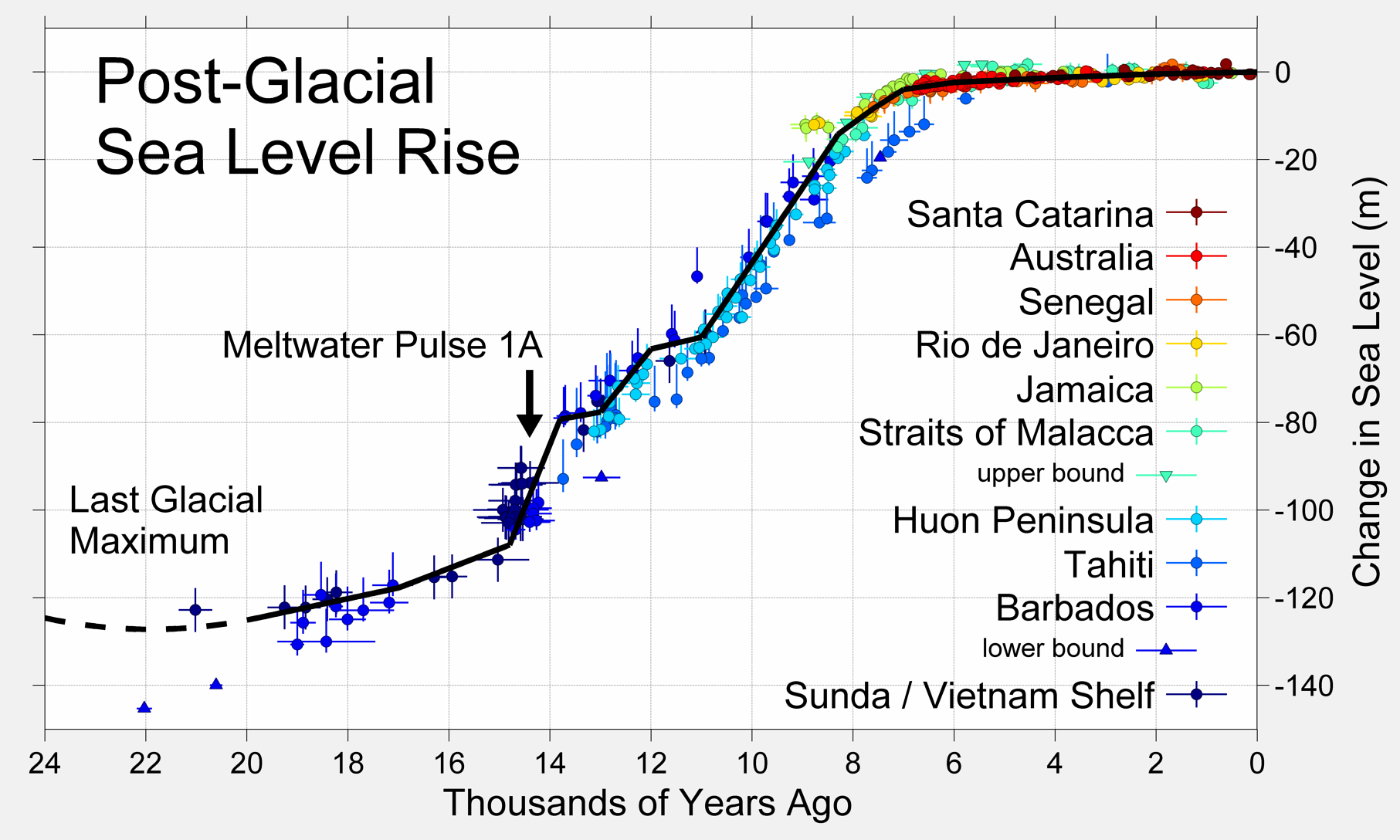 Sea levels have been rising and falling without any help from humans for as long as Earth’s oceans have existed.
The fastest and most alarming sea changes to affect mankind occurred at the end of the Pleistocene Ice Age. Seas rose about 130m about 12,000 years ago, at times rising at five metres per century. Sea levels then fell as ice sheet and glaciers grew in the recent Little Ice Age – some Roman ports used during the Roman Warm Era are now far from the sea even though sea levels have recovered somewhat during the Modern Warm Era.
Many natural factors cause sea levels to rise – melting of land-based glaciers and ice sheets; warming and expansion in volume of the oceans; extraction of groundwater which ends up in the oceans; and sediments, sewerage, plant debris and volcanic ash washed into the oceans by rivers, storms and glaciers. In addition, tectonic forces cause some blocks of land to rise while others fall, hence the paradox of sea levels appearing to rise on one coastline while falling on another.
Currently the world’s oceans are rising at about 1mm per year, which has not changed much with the great industrialisation since 1945. Amongst all the factors moving the restless sea, man’s production of carbon dioxide is obviously an insignificant player.
Sea levels are always changing, at times very destructively. Waves move sea levels by a few metres and at places like Derby, WA, king tides can move sea levels by eleven metres. Then there are rogue waves up to 30 metres high which have sunk oil tankers, and tsunamis which can smash coastlines with a ten metre wall of water moving at over 800 km per hour.
Despite coping with all of the above, climate alarmists say we should be scared to death by the threat of seas rising gently at 1mm PER YEAR. Even a slow-moving sloth could escape water rising at that rate.
King Canute showed his nobles that no man can hold back the rising sea. It’s time the climate alarmists learned Canute’s lesson and focussed on real world problems.
Even if we ceased using all carbon fuels for electricity and transport, no one could measure the effect of that huge sacrifice on global sea levels.
For those who wish to read more:
Rising Seas are Nothing New:
http://carbon-sense.com/2013/11/30/nothing-new-about-climate-change/
History falsifies climate alarmist sea level claims:
http://carbon-sense.com/wp-content/uploads/2013/12/endlich-sea-level-claims.pdf
The Ocean Thermometer:
http://carbon-sense.com/wp-content/uploads/2013/12/ocean-thermometer.pdf
Global Mean Sea Levels:
Tide Gauges show that Average Sea level rise is 0.9m per year:
http://stevengoddard.wordpress.com/2013/12/25/average-sea-level-rise-rate-is-0-9-mmyear/
Rogue Waves – the real sea monsters:
http://www.scientificamerican.com/article/rogue-waves-ocean-energy-forecasting/
High Tides at Derby, Western Australia:
http://www.derbytourism.com.au/useful-information/tides
Viv said:
Even a slow-moving sloth could escape water rising at that rate.
The issue is not whether people can “escape” water rising at that rate, a statement like that is an insult to the communities already affected, such as farmers in the Mekong River Delta:
http://www.mrcmekong.org/the-mekong-basin/stories-from-the-mekong/living-on-the-edge-of-the-rising-sea/
Of course they can escape, but they’ve lost their livelihood, that’s the issue.
Those of us whose life and living have been tied up with seas, shores, and land, know that sea level changes are insignificant, not really findable in the noise. We find the same from research of old levels (same with temperatures). For crying out loud, I live on an inland raised beach, and am not fearful except of tsunami. Brett Keane, New Zealand
Chris,
Continued isostatic sinking of the delta while the fluvial sediment flux has been reduced by the construction of 30 dams within the Mekong basin dams will have had a significant local impact on their livelihoods.
Chris:
I am getting very frustrated at the repeated misrepresentations of the excellent argument provided by Viv Forbes in his above article. Clearly, Viv Forbes’ argument is very good when nobody disputes it but many try to misrepresent it.
The most recent misrepresentation is provided by your post at June 18, 2014 at 8:45 pm which says in total
NO! The “insult” to those people is provided by your assertion that their real problem should be ignored and the trivial sea level rise addressed instead.
The essay by Viv Forbes argues that preparation for sea level change needs to accommodate ALL the likely changes at a location, and when that is done then defence against e.g. storm tides would provide defence against foreseeable sea level rise of a few mm per year. As the essay says
The reasons why delta sedimentation is not increasing their land area need to be addressed if they are excessive. It is a local issue of sea inundation in the Mekong Delta and – as the article by Viv Forbes asserts – local actions to address it are needed. The trivial few mm/year of “sea level rise” are not relevant.
Richard
Richard,
I am not sure what you are talking about. You say
NO! The “insult” to those people is provided by your assertion that their real problem should be ignored and the trivial sea level rise addressed instead.
I said nothing of the kind, tell me where I stated that their real problems should be ignored. You then say
The essay by Viv Forbes argues that preparation for sea level change needs to accommodate ALL the likely changes at a location, and when that is done then defence against e.g. storm tides would provide defence against foreseeable sea level rise of a few mm per year.
His essay does not say that. Please quote the exact lines where he says or implies that. In fact, he states “King Canute showed his nobles that no man can hold back the rising sea. It’s time the climate alarmists learned Canute’s lesson and focussed on real world problems.” If anything, Forbes is saying that it is pointless to make efforts to hold back the sea.
Greg Goodman
Jim Butts
Chris
et al.
For Sea Level trends, consult the NOAA mean SL charts for the U.S. coasts. These settle the issue and they show that SL has been steady, not rising, for over fifteen years. All gauges on the west coast show a flat trend, as do all gauges on the Gulf coast, with the exception of Grand Isle, La, which is undergoing rapid susidence. All NOAA gauges on the east coast show this flat trend, up to the Chesapeake Bay sites, which record the subsidence of that area as a rise in SL.
I agree that there has been a lot of fabricated SL rise that has gained currency. The U of Colorado is one of the worst of these.
BW, I Googled NOAA’s publication, “The Budget of Recent Sea Level Rise 2005-2012.” When I clicked on what looked like the appropriate link, what came up instead was NOAA’s 2012 State of the Climate: Sea-Level Rise (http://www.climate.gov/news-features/understanding-climate/2012-state-climate-global-sea-level). This Web page, dated July 31, 2013, states: “Global average sea level in 2012 was 1.4 inches above the 1993-2010 average, which was the highest yearly average in the satellite record.” While acknowledging that sea levels fluctuate from year to year, NOAA’s chart indicates a recent trend substantially greater than 1 mm/year: “Since satellite-based global measurements began in 1993, global mean sea level has risen between 2.8 and 3.6 millimeters per year (0.11-0.14 inches/year).”
I just found Budget of Recent Sea Level Rise but am limited at the moment to slow dial up and still waiting for the PDF to open.
Marlo Lewis:
Note that your NOAA link uses Satellite data, not the NOAA sea level gauge information. The reason is that satellite data can be rigged, as in this study, which is a product of the University of Colorado, the notorious fabricator of sea level rise. Tidal gauge data is not so easily rigged.
If you go to this link, you will get a pop-up from the U of Colorado for a survey response.
Chris:
Your post at June 19, 2014 at 6:59 am purports to be a reply to my post at June 19, 2014 at 1:50 am which is here.
Your post says to me
Don’t come that with me, sonny. If you did not want to be called on it then you should not have written it, and you did.
I was replying to your post at June 18, 2014 at 8:45 pm which says in total
Clearly, you were asserting that the few mm per year sea level rise that “Even a slow-moving sloth could escape” was causing their loss of livelihood and, you said, “that’s the issue”.
It is NOT “the issue” and I said it is not.
Not content with claiming you did not write what you did, you follow that by claiming the article does not say what it does when you quote my saying
and reply
The article says
You try to misrepresent that as “it is pointless to make efforts to hold back the sea”. No, it says it is pointless addressing the trivially small rise that “Even a slow-moving sloth could escape water rising at that rate”.
Richard
Richard,
I’ll try one more time. Forbes mentions big events that we are “coping with” as a way saying that sea level rise is trivial and unimportant by comparison. He is mixing together 2 very different issues. Large scale disasters such as typhoons, tsunamis and rogue waves hit locations unexpectedly, and preparation is mainly around warning systems, evacuation plans and perhaps some preventive measures such as planting mangroves. Japan suffered a terrible tsunami a few years ago, but even a wealthy nation like Japan cannot afford to build dykes or blocking islands along its entire coastline – it would be cost prohibitive. Therefore, the kinds of “coping” mechanisms he alludes to simply do not exist, outside a few exceptions like gates on the Thames and what the Netherlands has done.
While sea level rise does not have the short term catastrophic impact of these events, it will have long term impacts, and, unlike a tsunami, will affect 1000s of kms of coastline.
Chris:
Your post at June 20, 2014 at 9:33 am begins saying
I object to you again trying to misrepresent Forbes’ article.
You lied about what you wrote, you lied about what Forbes’ article says, and when that is pointed out you don’t withdraw and/or apologise but again attempt misrepresent what Forbes wrote.
Forbes did NOT only talk about rare events but also about tidal ranges and large waves.
Sea defences (e.g. walls) need to cope with those and they do. Those defences need maintenance and any maintenance can incorporate adaptation to changes since the previous maintenance.
The trivial rise of so-called mean sea level is so small and so slow that it can be ignored.
Forbes is clearly right about this. And you mention one illustration of it. The Thames Barrier is needed because the South East of England is sinking back into the Earth as response to the end of the last ice age. So, London needs the protection of the Barrage from an effect of isostatic rebound and the trivial rise of so-called mean sea level is so small and so slow that it can be ignored.
Richard
Mpainter,
I was not aware that University of Colorado Sea Level Research Group is a notorious sea level rise fabricator. They claim their satellite data are calibrated and corrected with tide gauge data (http://sealevel.colorado.edu/). Questions: (1) Is there solid documented evidence of such fabrication? (2) When it comes to global temperatures, skeptics prefer satellite data to surface station data. Only satellite data come close to being global. They are not affected by local distortions due to urban heat islands, improper siting of thermistors, inhomogenious equipment, gaps in station histories, and more. Why doesn’t the same logic weigh in favor of satellites for global sea level measurement? (3) Tide gauge data must be adjusted for land subsidence, which can increase relative sea level in coastal cities up to 10 times as much as global factors such as ocean warming and melting glaciers, according to an article recently posted on WUWT (http://wattsupwiththat.com/2014/05/01/in-some-coastal-cities-subsidence-now-exceeds-absolute-sea-level-rise-up-to-a-factor-of-ten/). To me, that suggests tide gauge data can easily be gamed to inflate sea-level rise. Not so?
Richard,
Wrong again, and as your other posts have always shown, you go into attack dog mode when you fail to win an argument. You completely missed the main point I made, and in fact provided 0 refutation of it.
Sea walls, dykes and other man made defenses are NOT an option for the majority of global coastlines – the costs would be prohibitive. In particular for third world countries such as Bangladesh, Pakistan and Vietnam. They are NOT being built in SE Asia where I live, even in tsunami prone places such as Indonesia – the cost is too high. So pretending that these defenses are in place around the world, and that increased sea levels are inconsequential to these defenses is completely disingenuous thinking.
Your comment “The trivial rise of so-called mean sea level is so small and so slow that it can be ignored” is patently false, and has already been proven to be so in places like Vietnam, where sea gauges have measured increases of between 1.75 and 2.65 mm/year, and they area already seeing impacts of sea level rise.
http://ir.lib.u-ryukyu.ac.jp:8080/bitstream/123456789/5368/1/No84p45.pdf
The trivial rise of so-called mean sea level is so small and so slow that it can be ignored” is patently false, and has already been proven to be so in places like Vietnam, where sea gauges have measured increases of between 1.75 and 2.65 mm/year, and they area already seeing impacts of sea level rise.
1.75mm to 2.65mm per year is in fact trivial
Chris:
I am replying to your offensive and untrue post at June 21, 2014 at 9:49 am.
Your claim that I did not answer your main point is fallacious. I have answered each point you have made, and you cite none which I have missed.
I have not lost any arguments because you have provided no arguments. And I have refuted all of your lies and misrepresentations with facts, quotations and simple logic.
I have not adopted an “attack dog” attitude. On the contrary I have been both polite and restrained in my responses to your blatant lies and twaddle.
Importantly, you again ignore reality and post nonsense. Please check your fallacious assertions before posting them. For example, Bangladesh is expanding because of delta accretion: its effective sea level is falling and not rising as you assert.
And as joe_dallas says at June 21, 2014 at 10:08 am
Please raise the standards of your behaviour.
Richard
Your comment “The trivial rise of so-called mean sea level is so small and so slow that it can be ignored” is patently false, and has already been proven to be so in places like Vietnam, where sea gauges have measured increases of between 1.75 and 2.65 mm/year, and they area already seeing impacts of sea level rise.
http://ir.lib.u-ryukyu.ac.jp:8080/bitstream/123456789/5368/1/No84p45.pdf
Chris
I just read the article you cited – the “peer reviewed” study has the standard projection of a 1meter rise in sea level by the year 2100. Do you realize that in order to achieve a 1 meter rise in seal level in the next 86 year, the rate of sea level rise has to increase by a factor of 10x-15x.
Why is it that the warmists ignore basic science.
Marlo Lewis
Please excuse this tardy response.
Go read the fine print at the U of Colorado at their sea level site. Their satellite SL data is plotted on a sloped base. The slope is invented (they say theoretical). They also invent an expansion of the volumes of the ocean basins (again, they say theoretical). By various subtrifuges, they invent a sea level rise which they present as a measured fact. It is pure invention.There is no sea level rise in a general world-wide sense. This is confirmed by the NOAA tidal gauges- go see the NOAA mean sea level charts for the various stations on our coasts- there are some 30-40 of these. These show a flat trend for the last 15-20 years or so. The Chesapeake Bay stations show a rising sL, but this merely records the subsidence of the area, which see. Otherwise, with one or two exceptions, all NOAA gauges for the west coast show a steady SL trend, as do all Gulf Coast gauges and East coast gauges (as far north as Virginia). The exceptions record either local uplift or susidence.
Now here is the matter- we can believe the NOAA gauges as a certainly. If the SL on US coasts is steady, without rise, can the rest of the world’s oceans be rising? To argue so is absurd.
Marlo Lewis
More on the fabrication by the U of Colorado. Any tidal gauges that they cite as supporting their data of rising sea level is most likely to be a subsiding gauge. Subsidence registers at the gauge as a rising SL, and in fact subsidence has the same practical effect as a general rise in SL at that particular shore. But local subsidence is not a general world-wide rise in SL, such as when meltwater is added to the oceans at the end of the ice age.
It is an assured fact that they can offer no US gauge data as support unless it is a subsiding gauge. Unadulterated satellite data should show a steady SL trend.
Richard, you have repeatedly ignored my main point, which is this: Forbes says that rising sea levels are inconsequential in comparison to the types of large scale phenomena that affect coastal areas. The large scale phenomena include tsunamis, rogue waves and king tides. He implies that because we are already “coping” with those, that any impacts of sea level rise are insignificant in comparison. The kind of coping solutions countries are putting in place – early warning systems, better evacuation plans, etc, are not in any way barriers to the disasters. There may be a few exceptions such as the Thames, Netherlands, but those represent a fraction of a percent of global coastlines. When Viv can point me to projects where countries are building 1000+ km long dykes/breakwaters/barriers to prevent these disasters, then I’ll gladly acknowledge his point. Otherwise, it is nothing more than a red herring.
Nils-Axel Morner is probably the world’s expert on sea level changes. He has recently published a paper entitled: Deriving the Eustatic Sea Level Component in the Kattaegatt Sea.
Astract: Changes in global sea level is an issue of much controversy. In the Kattegatt Sea, between Denmark and Sweden, the glacial isostatic component factor is well established and the axis of tilting has remained stable for the last 8000 years. At the point of zero regional crustal movements, there are three tide gauges indicating a present rise in sea level of 0.8 to 0.9 mm/yr for the last 125 years. This value provides a firm record of the regional eustatic rise in sea level in this part of the globe.
Full Text: http://www.as-se.org/gpg/Download.aspx?ID=16723
Chris:
Your post at June 25, 2014 at 10:19 pm begins saying
NO! Absolutely not!
I have “ignored” nothing you have written and I have repeatedly objected to your blatant misrepresentation of Forbes’ article which you have again repeated and I have here quoted.
I see no reason to refute that bollocks again so I cite my post at June 20, 2014 at 9:57 am which is here and completely rejected it.
Richard