'Correcting' Trenberth et al.

(See the note below before taking this post seriously – Anthony)

Guest essay by Steven Wilde

clip_image002

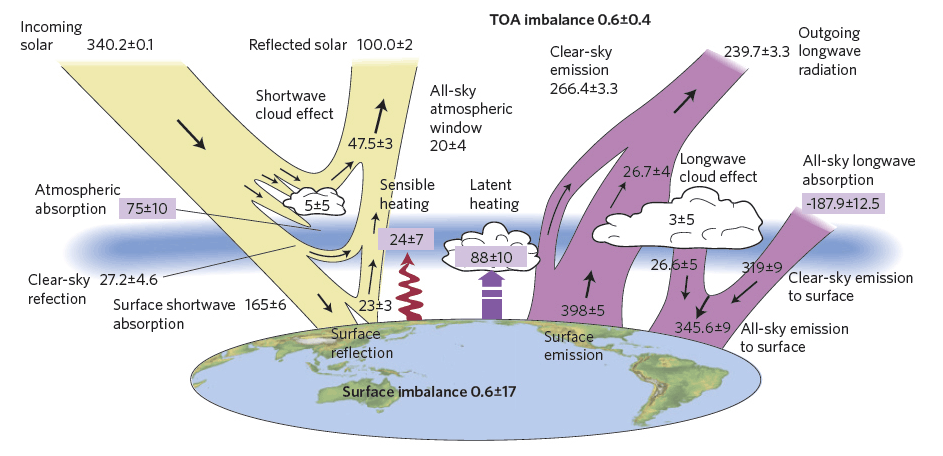
Here we see the classic energy budget analysis supporting the hypothesis that the surface of the Earth is warmer than the S-B equation would predict due to 324 Wm2 of ‘Back Radiation’ from the atmosphere to the surface.

It is proposed that it is Back Radiation that lifts the surface temperature from 255K, as predicted by S-B, to the 288K actually observed because the 324 Back Radiation exceeds the surface radiation to the air of 222 Wm2 ( 390 Wm2 less 168 Wm2) by 102 Wm2. It is suggested that there is a net radiative flow from atmosphere to surface of 102 Wm2.

I now discuss an alternative possibility.

The portions I wish to focus on are:

i) 390 Wm2 Surface Radiation to atmosphere

ii) 78 Wm2 Evapo-transpiration surface to atmosphere

iii) 24 Thermals surface to atmosphere

iv) 324 Back Radiation atmosphere to surface

The budget needs to be amended as follows:

The 78 Wm2 needs to be corrected to zero because the moist adiabatic lapse rate during ascent is less than the dry lapse rate on adiabatic descent which ensures that after the first convective cycle there is as much energy back at the surface as before Evapo-transpiration began.

The 24 Wm2 for thermals needs to be corrected to zero because dry air that rises in thermals then warms back up to the original temperature on descent.

Therefore neither ii) nor iii) should be included in the radiative budget at all. They involve purely non radiative means of energy transfer and have no place in the radiative budget since, being net zero, they do not cool the surface. AGW theory and the Trenberth diagram incorrectly include them as a net surface cooling influence.

Furthermore, they cannot reduce Earth’s surface temperature below 255K because both conduction and convection are slower methods of energy transmission than radiation. To reduce the surface temperature below 255K they would have to work faster than radiation which is obviously not so.

They can only raise a surface temperature above the S-B expectation and for Earth that is 33K.

Once the first convective overturning cycle has been completed neither Thermals nor Evapo-transpiration can have any additional warming effect at the surface provided mass, gravity and insolation remain constant.

As regards iv) the correct figure for the radiative flux from atmosphere to surface should be 222 Wm2 because items ii) and iii) should not have been included.

That also leaves the surface to atmosphere radiative flux at 222 Wm2 which taken with the 168 Wm2 absorbed directly by the surface comes to the 390 Wm2 required for radiation from the surface.

The rest of the energy budget diagram appears to be correct.

So, how to decide whether my interpretation is accurate?

I think it is generally accepted that the lapse rate slope marks the points in the atmosphere where there is energy balance within molecules that are at the correct height for their temperature.

Since the lapse rate slope intersects with the surface it follows that DWIR equals UWIR for a zero net radiative balance if a molecule at the surface is at the correct temperature for its height. If it is not at the correct surface temperature it will simply move towards the correct height by virtue of density variations in the horizontal plane (convection).

Thus, 222 UWIR at the surface should equal 222 DWIR at the surface AND 222 plus 168 should add up to 390 and, of course, it does.

AGW theory erroneously assumes that Thermals and Evapo-transpiration have a net cooling effect on the surface and so they have to uplift the radiative exchange at the surface from 222 Wm2 to 324 Wm2 and additionally they assume that the extra 102 Wm2 is attributable to a net radiative flux towards the surface from the atmosphere.

The truth is that there is no net flow of radiation in any direction at the surface once the air at the surface is at its correct temperature for its height, which is 288K and not 255K. The lapse rate intersecting at the surface tells us that there can be no net radiative flux at the surface when surface temperature is at 288K.

A rise in surface temperature above the S-B prediction is inevitable for an atmosphere capable of conducting and convection because those two processes introduce a delay in the transmission of radiative energy through the system. Conduction and convection are a function of mass held within a gravity field.

Energy being used to hold up the weight of an atmosphere via conduction and convection is no longer available for radiation to space since energy cannot be in two places at once.

The greenhouse effect is therefore a product of atmospheric mass rather than radiative characteristics of constituent molecules as is clearly seen when the Trenberth diagram is corrected and the lapse rate considered.

Since one can never have more than 390 Wm2 at the surface without increasing conduction and convection via changes in mass, gravity or insolation a change in the quantity of GHGs cannot make any difference. All they can do is redistribute energy within the atmosphere.

There is a climate effect from the air circulation changes but, due to the tiny proportion of Earth’s atmospheric mass comprised of GHGs, too small to measure compared to natural variability.

What Happens When Radiative Gases Increase Or Decrease?

Applying the above correction to the Trenberth figures we can now see that 222 Wm2 radiation from the surface to the atmosphere is simply balanced by 222 Wm2 radiation from the atmosphere to the surface. That is the energy being constantly expended by the surface via conduction and convection to keep the weight of the atmosphere off the surface. We must ignore it for the purpose of energy transmission to space since the same energy cannot be in two places at once.

We then have 168 Wm2 left over at the surface which represents energy absorbed by the surface after 30 Wm2 has been reflected from the surface , 77 Wm2 has been reflected by the atmosphere and 67 Wm2 has been absorbed by the atmosphere before it reaches the surface.

That 168 Wm2 is then transferred to the atmosphere by conduction and convection leaving a total of 235 Wm2 in the atmosphere (168 plus 67).

It is that 235 Wm2 that must escape to space if radiative balance is to be maintained.

Now, remember that the lapse rate slope represents the positions in the atmosphere where molecules are at their correct temperature for their height.

At any given moment convection arranges that half the mass of the atmosphere is too warm for its height and half the mass is too cold for its height.

The reason for that is that the convective process runs out of energy to lift the atmosphere any higher against gravity when the two halves equalise.

It must follow that at any given time half of the GHGs must be too warm for their height and the other half too cold for their height.

That results in density differentials that cause the warm molecules to rise and the cold molecules to fall.

If a GHG molecule is too warm for its height then DWIR back to the surface dominates but the molecule rises away from the surface and cools until DWIR again equals UWIR.

If a GHG molecule is too cold for its height then UWIR to space dominates but the molecule then falls until DWIR again equals UWIR.

The net effect is that any potential for GHGs to warm or cool the surface is negated by the height changes relative to the slope of the adiabatic lapse rate.

Let’s now look at how that outgoing 235 Wm2 is dealt with if radiative gas concentrations change.

It is recognised that radiative gases tend to reduce the size of the Atmospheric Window (40 Wm2) so we will assume a reduction from 40 Wm2 to 35 Wm2 by way of example.

If that happens then DWIR for molecules that are too warm for their height will increase but the subsequent rise in height will cause the molecule to rise above its correct position along the lapse rate slope with UWIR to space increasing at the expense of DWIR back to the surface and rising will only stop when DWIR again equals UWIR.

Since UWIR to space increases to compensate for the shrinking of the atmospheric window (from 40 Wm2 to 35 Wm2) the figure for radiative emission from the atmosphere will increase from 165 to 170 which keeps the system in balance with 235 Wm2 still outgoing.

If the atmosphere had no radiative capability at all then radiative emission from the atmosphere would be zero but the Atmospheric Window would release 235 Wm2 from the surface.

If the atmosphere were 100% radiative then the Atmospheric Window from the surface would be zero and the atmosphere would radiate the entire 235 Wm2.

==============================================================
Note: I’m glad to see a number of people pointing out how flawed the argument is. Every once in awhile we need to take a look at the ‘Slayer’ mentality of thinking about radiative balance, just to keep sharp on the topic. At first I thought this should go straight into the hopper, and then I thought it might make some good target practice, so I published it without any caveat.

Readers did not disappoint.

Now you can watch the fun as they react over at PSI.  – Anthony

P.S. Readers might also enjoy my experiment on debunking the PSI light bulb experiment, and note the reactions in comments, entirely opposite to this one. New WUWT-TV segment: Slaying the ‘slayers’ with Watts

Update: Let me add that the author assuredly should have included a link to the underlying document, Earth’s Global Energy Budget by Kiehl and Trenberth …

0 0 votes
Article Rating

Discover more from Watts Up With That?

Subscribe to get the latest posts sent to your email.

417 Comments
Inline Feedbacks
View all comments
Editor
April 8, 2014 2:34 pm

Steven Mosher says: “Group A
“Anthony, Willis, Tisdale, Monckton…”
“Group A: sometimes right, sometimes wrong…”
“Other difference. You will note over time that group A is actually open to changing their minds.”
Another difference. Group A is known also for correcting their mistakes, and moving on.

gbaikie
April 8, 2014 2:38 pm

Stephen Wilde says:
April 8, 2014 at 10:25 am
Willis said:
“It doesn’t matter that “the moist adiabatic lapse rate during ascent is less than the dry lapse rate”. That’s true … but it doesn’t return energy to the surface, that would be a violation of the Second Law”
It doesn’t return energy to the surface. It reconverts PE to KE as it approaches the surface. No violation.”
That interesting part of it.
How much?
I mean is largely to do with nighttime temperature and does it add a degree or 2 to night time temperatures [globally]?
-It does matter that the dry rate is greater than the moist rate because there is then more warming on the descent than there was cooling on the ascent for the same distance of travel.-
So, it’s more significant in drier regions??
-In the hydro cycle it is primarily radiation from condensate that reaches space and not radiation from the bulk air mass.-
“I find it quite bizarre that Steven Wilde claims that the earth’s surface doesn’t lose heat by either conduction/convection or evaporation, but purely by radiation. That flies in the face of all common sense as well as physics.”
-The surface both loses and regains heat from conduction / convection. That is the point that has been missed.
First KE is taken up and converted to PE and then it is brought down and converted back to KE. The adiabatic portion is net zero because no new energy enters or leaves. There is a diabatic portion too but that is replaced by new incoming solar energy.-
So could say it this way, tropics with higher troposphere- this height matters?

climatereason
Editor
April 8, 2014 2:51 pm

I am very uncomfortable with Stephen being humiliated in this way. If his article was not up to scratch it might have been better to have told him why, and not run the item.
tonyb

DirkH
April 8, 2014 2:58 pm

MikeB says:
April 8, 2014 at 7:18 am
“When the CO2 molecule absorbs the photon it is elevated to an ‘excited’ state. Left to its own devices it would re-emit this photon within a few milliseconds and revert to its ‘ground’ state.”
“What’s more, the process is reversible”
That’s why I mentioned Kirchhoff’s law. It state that in local thermodynamic equilibrium thermalization and dethermalization *MUST* happen to equal amounts. Therefore; absorption is followed by re-emission even if thermalization happens.

gbaikie
April 8, 2014 3:01 pm

–While this effect surely exists, you are greatly exaggerating the effects. The world is a huge place. The dip of the horizon in radians is sqrt(2h/r) where h is the height of the eye and r is the radius of the earth. At a height of 20 km, the extreme case, this is a dip of 4.5°. In other words, at that altitude the horizon is at 4.5° below true horizontal.–
There is more area involved in first 4.5°, as compared to second 4.5° -and as one continues up.
In terms of sphere.
Like sphere of earth. So if equator is horizon, 4.5° above equator has more earth surface than 4.5° to 9° and as continues up. So 23 degree latitude north and south is about 40% of surface area of Earth.
So just saying in terms radiating into sphere, a few degrees above horizon may be more than it might seem.
And I think this aspect is significant in terms of ocean and it’s radiant properties and it’s low reflective quality in regard to a low horizon.

DirkH
April 8, 2014 3:06 pm

Duster says:
April 8, 2014 at 9:59 am
“Therefore, with each re-emission, statistically, the photon is more likely to move way from the surface rather than toward it. With each increase in altitude that probability of an inward move diminishes. Again, the number of potential inward paths is never 50% except at the immediate surface.”
You’re right.

Tonyb
April 8, 2014 3:15 pm

Anthony
I think you will have succeeded in dissuading the submission of unsuitable articles and demonstrated that scepticism is alive and well at wuwt
Tonyb

Box of Rocks
April 8, 2014 3:40 pm

So, who can cut the snark and come up with a better diagram?
” Today we have a similar debate over this. Anyone know what this is? Class? Anyone? Anyone? Anyone seen this before? The ‘energy budget’ . Anyone know what this says? It says that at this point the earth is accumulating energy. This is very controversial. Does anyone know what Vice President Bush called this in 1980? Anyone? Something-d-o-o thermodynamics cs. “Voodoo” thermodynamics.
So after everyone gets their panties unbunched, a few of all y’all will produce a better diagram, right. Not only will it be better, you will willing accept criticism no matter how bad.
As for sad smiley faces, build a better diagram. Your ‘aw shit’ tarnished your reputation.

Bart
April 8, 2014 4:31 pm

Many here appear to worry that speculations like this harm the reputation of skeptics with the warmist brigades.
That is like worrying that fan dancing will harm your reputation with streetwalkers. Those clowns have led the world on a multi-trillion dollar wild goose chase with pie-eyed conjectures which have failed utterly to pan out.
Which is worse? A fellow grasping for understanding of what went wrong with the above prognostications? Or, a coterie of Black Knights from a Monty Python skit who insist, after all their limbs have been lopped off at the stump, that it’s only a flesh wound?

John West
April 8, 2014 4:32 pm

Box of Rocks, there are better ones:
Showing uncertainty:

Showing more than one atmospheric layers:

Showing net heat flows:

[Thanks, John. I’ve brought the images inline. The middle of the three is mine, with two layers. It is the simplest model which can be energy-balanced (output at each atmospheric layer equals input, with half going up and half going down). -w]

joeldshore
April 8, 2014 4:43 pm

ferd berple says:

if GHG is radiating 324 inwards, it must be radiating 324+ outwards.

This is the sort of argument that sounds reasonable but is false. For an infinitesimally-thin layer so that there is never more than one absorption event, it would be true. However, when there are multiple absorptions and re-emissions, it is false.
It is easy enough to simulate this with a simple 1-dimensional random walk: Start off at point x = 0 and move to x = 1. From that point on, flip a coin and go up by 1 if it’s heads and go down by 1 if it’s tails. Stop when you reach either the top of the atmosphere (say, x = 10) or hit the surface again (x = 0). Your logic would say that we are as likely to end up at the top of the atmosphere (say, x = 10) than down at the surface (say x = 0). However, if you perform the experiment, you will find out this is not the case. In fact, you have something like nine times the chance of ending back at the surface than at the top of the atmosphere. [If I remember correctly, the escape probability is 1/(N-1) where N is the value of x that we call the top of the atmosphere.]

GHG theoretically warms the surface at the expense of cooling the atmosphere. The lapse rate gravitationally limits the temperature difference between the two. Since we are already at the gravitational limit for lapse rate, further increases in GHG will simply increase the rate of convection, cooling the surface in an amount equal to any increase in back radiation.

The process by which increasing GHGs increases the surface temperature is not by increasing the lapse rate. It is by raising the effective radiating level (i.e., roughly speaking, the level in the atmosphere at which a photon has a better than even chance to escape to space without being absorbed). That effective radiating level sets the altitude at which the temperature must be ~255 K and then the actual surface temperature is obtained by extrapolating down from that altitude to the surface using the observed environmental lapse rate (which is generally some compromise of the moist and dry adiabatic lapse rates). When that level increases, the surface temperature will increase.
It is kind of amazing that you (and Stephen who says “ferd berple has it right”) don’t seem to understand the most basic concepts of the theory that you are supposedly challenging.

Eric Barnes
April 8, 2014 4:56 pm

“Bart says:
April 8, 2014 at 4:31 pm
Many here appear to worry that speculations like this harm the reputation of skeptics with the warmist brigades.
That is like worrying that fan dancing will harm your reputation with streetwalkers. Those clowns have led the world on a multi-trillion dollar wild goose chase with pie-eyed conjectures which have failed utterly to pan out.
Which is worse? A fellow grasping for understanding of what went wrong with the above prognostications? Or, a coterie of Black Knights from a Monty Python skit who insist, after all their limbs have been lopped off at the stump, that it’s only a flesh wound?

Well put Bart. And thanks for the article Stephen. As for most of the comments I’ll take my mother’s advice.

Kano
April 8, 2014 5:15 pm

I have a stupid question not all the energy we receive is reflected as heat, some goes into mass, isn’t it true that 25 kwh of energy will increase an objects mass by 1 microgram, what about energy stored as fossil fuels (photosynthesis)

April 8, 2014 5:18 pm

I don’t trust analyses that examine lots of details. It’s too easy to overlook something critical. (Cutting to the essentials omits detail that might be useful in modelling dynamic changes with time, but it is less prone to error and gives good steady-state insights.) For example, there is one error in this paper that seems to be critical:

… if a molecule at the surface is at the correct temperature for its height. If it is not at the correct surface temperature it will simply move towards the correct height by virtue of density variations in the horizontal plane (convection).

This is incorrect. The temperature gradient determined by the adiabatic lapse rate represents a maximum gradient. Molecules on the ground level that are hotter than the lapse rate wrt the layer above will convect upwards, but colder molecules will sit there just fine, unless conduction or radiation intervene. Think of it like a pile of sand: too steep, sand grains roll downhill, but too shallow? It doesn’t heap itself up.
Does this mistake invalidate the whole paper? I don’t know, but it isn’t my job to find out. The author should fix this mistake and all the others people suggest and put up a revised version. That’s a tall order given the many details involved, but it is to the author’s credit for making the attempt, and to Anthony’s that he posted it despite his personal misgivings.

April 8, 2014 5:19 pm

joeldshore says:
April 8, 2014 at 4:43 pm
“The process by which increasing GHGs increases the surface temperature is not by increasing the lapse rate. It is by raising the effective radiating level (i.e., roughly speaking, the level in the atmosphere at which a photon has a better than even chance to escape to space without being absorbed).”
You and others keep saying this, yet radiosonde data contradicts this notion. What is true: your theory or the data?

george e. smith
April 8, 2014 5:19 pm

“””””…..joeldshore says:
April 8, 2014 at 4:43 pm
ferd berple says:
if GHG is radiating 324 inwards, it must be radiating 324+ outwards.
This is the sort of argument that sounds reasonable but is false. For an infinitesimally-thin layer so that there is never more than one absorption event, it would be true. However, when there are multiple absorptions and re-emissions, it is false. ……”””””””
Joel, while I generally agree with your statement, I don’t think you have presented it very well.
For any arbitrary atmospheric layer, that is radiating, however you want to explain how that happens, the radiation spectrum, depends on say the H2O or CO2 line frequencies, and the effects of density and Doppler broadening due to local Temperature. That radiation is isotropic, so half goes up, and half goes down.
The upward proceeding LWIR radiation, encounters a less dense atmosphere, and a colder one, so the GHG absorption spectrum lines are less broadened.
The downward proceeding radiation, encounters a denser warmer atmosphere which has broader GHG absorption lines, so the downward radiation is more likely to be re-absorbed, than is the upward, which continues to get a less blocked passage to freedom as it proceeds towards space.
So yes; multiple re-absorption / re-emission does occur, but the atmospheric gradients favor the escape route, over the return to surface route.

April 8, 2014 5:22 pm

Anthony, keep up the good work. Nothing is wrong with publishing a submission like Stephen’s. It was a good test for skeptics.

JustAnotherPoster
April 8, 2014 5:32 pm

Can I ask a really dumb global warming theory question ? The earth is about 4 billion years old. The suns been warming the planet for all this time ‘green house gases’ have existed in our atmosphere for millions of years. Why isn’t the planet much hotter?
If the mechanism presented for the theory is correct. Greenhouse Gases have been present in our atmosphere for millions of years.
Why haven’t we already overheated ?

gbaikie
April 8, 2014 5:49 pm

“Can I ask a really dumb global warming theory question ? The earth is about 4 billion years old. The suns been warming the planet for all this time ‘green house gases’ have existed in our atmosphere for millions of years. Why isn’t the planet much hotter?”
Earth was warmer roughly 10 million years ago, and warmer than this 50 million years ago. And has been coolest in last hundred million years in the last 2 to 3 million years.
We are in an ice box climate. Which has cold oceans and polar ice caps, and such condition are not “normal” in terms of Earth history for last 500 million years.
Here:
http://joannenova.com.au/2010/02/the-big-picture-65-million-years-of-temperature-swings/
http://geology.utah.gov/surveynotes/gladasked/gladice_ages.htm
4.5 Billion Years of the Earth’s Temperature:
http://muchadoaboutclimate.wordpress.com/2013/08/03/4-5-billion-years-of-the-earths-temperature/

joeldshore
April 8, 2014 6:03 pm

Ron C. says:

“The process by which increasing GHGs increases the surface temperature is not by increasing the lapse rate. It is by raising the effective radiating level (i.e., roughly speaking, the level in the atmosphere at which a photon has a better than even chance to escape to space without being absorbed).”
You and others keep saying this, yet radiosonde data contradicts this notion. What is true: your theory or the data?

How does radiosonde data contradict this? Hint: If you are thinking about the lack of a so-called “hot spot” in the troposphere, that has absolutely nothing to do with what I am talking about.

gbaikie
April 8, 2014 6:09 pm

– Kano says:
April 8, 2014 at 5:15 pm
I have a stupid question not all the energy we receive is reflected as heat, some goes into mass, isn’t it true that 25 kwh of energy will increase an objects mass by 1 microgram, what about energy stored as fossil fuels (photosynthesis)-
Hmm. Well, a lot of energy of sunlight is stored in Earth oceans.
Energy is also stored in the ground of your yard. One actually harvest energy from your yard-
geothermal energy:
http://firstgeothermalenergy.com/geothermal_faq.html
Also one buries water pipe at some depth under ground so that cold weather doesn’t freeze the water in the pipes.

joeldshore
April 8, 2014 6:09 pm

JustAnotherPoster says:

Can I ask a really dumb global warming theory question ? The earth is about 4 billion years old. The suns been warming the planet for all this time ‘green house gases’ have existed in our atmosphere for millions of years. Why isn’t the planet much hotter?

Because as the planet heats up, it emits more energy back into space.
In other words, the question to be asked is: “How warm will does the temperature of the Earth have to be in order that it emits back into space the same amount of energy as it receives from the sun?” (So that it neither warms nor cools globally.) And, the answer is that how warm it has to be depends on various factors, including the amount of greenhouse gases in the atmosphere. The Earth has to be about 33 deg C warmer because of the effects of greenhouse gases than it would be without those effects (assuming all else, including albedo, remain the same).

Editor
April 8, 2014 6:11 pm

I’m as much on the outside of this whole post as anyone. By that I mean I didn’t discuss this with Anthony in any sense, and in general I know nothing about what’s going on with the blog, what gets published and doesn’t … actually, Anthony and I don’t communicate much, and (fortunately) when we do our emails are usually about boats and boating.
However, for those of you who think that Anthony somehow “set Steven up”, nothing could be further from the truth. What happened is that Steven Wilde sent a proposed post to Anthony, and Anthony published it without changing one word and without comment.
I’m sorry, but there is absolutely nothing in there that anyone can fault Anthony for doing. Are you guys busting him for not editing the piece? Are you busting him for not commenting on the piece? Are you busting him for not warning Steven that the reception would be hostile? Everything here gets a hostile reception, it’s called science. Think about what Anthony actually did.
Now … did Anthony expect that Steven’s most unusual claims would get much uncomplimentary attention? Of course he did, because Steven’s claims are, in Steven Mosher’s words, “not even wrong”. They rest on profound misunderstandings of what has been established science for over two centuries.
However, I’m sure that Steven Wilde himself knew that he was in for a rough ride with lots of heavyweight opposition. He’d be a fool not to know that, and although he’s got some zany substitutes for physics in his universe, I’ve never thought him a fool.
So the fact that Anthony knew it would receive harsh attacks and did not say anything to Steven is absolutely no reason to attack Anthony, because Steven Wilde knew that going in.
In short, Anthony just published the piece, and did nothing else. He did nothing blameworthy at all … and in any case, blaming the publisher when a newly launched scientific post goes hard aground on a reef of ugly facts is merely an attempt to divert attention from the wreck.
w.

KevinK
April 8, 2014 6:22 pm

Slartibartfast says:
“I’d be happier if “Back radiation” or “Backradiation” were erased from the GW lexicon. It’s just radiation. There isn’t anything special about it that merits a new name.
Except it’s been “used”, maybe. But radiation doesn’t care who had it next to last.”
“REPLY: That’s a good idea, really the only thing that is happening is retarding the escape of energy to space – Anthony”
With respect,
“retarding” is a very poor word choice.
A
better choice might be: “Slowing the velocity of the energy escaping to space”. However that is clearly incorrect since the energy (LWIR in this case) is speeding away from the surface at close to the speed of light in a vacuum, and accelerating as the atmosphere diminishes and transitions into a vacuum. While doing so the surface is left bereft of the energy that just left.
Then of course some (less than 50%) of that packet of energy returns for another try at warming the surface. This time its velocity decreases as the atmosphere becomes denser. And it again heats the surface which then cools. This effect (GHE/Backradiation, whatever you want to name it) simply delays the flow of energy through the Sun/Earth/Atmosphere/Universe system by causing some of the energy to make multiple passes through the system. It alternates as thermal energy (when absorbed by water/rocks/gases) and light when propagating between absorptions.
This creates a simple hybrid optical/thermal delay line. A similar effect happens inside an optical integrating sphere. It should be noted that when the energy input is “steady state” like sunshine this effect cannot be observed with the tools (FLIR/Radiometers, etc.) currently available.
This “delay line” effect only amounts to a few tens of milliseconds of delay to the energy flowing through the system. This is an important distinction from an effect that slows the velocity of (i.e. retards) energy flowing through a system like common thermal insulators (fiberglass, etc) do.
This slowing of velocity can (under the right circumstances; i.e. every other velocity in the system is faster) result in a higher retention of energy (i.e. a higher temperature).
So please go ahead and educate me about radiation flowing through a system, I’d love to hear your ideas.
Oh, and the light bulb experiment is both a poor theoretical example (the surface of the earth is not like a light bulb for purposes of energy flow considerations) and poorly executed by many folks. A light bulb is only a portion of an illumination system and it does interact with all other portions of the system (power supply AC/DC, reflectors, ambient temperatures, gases, the material used in the envelope, etc. etc.). It’s easy to set one up and measure it, it is quite another thing to properly understand what the measurements are telling you.
The missing heat is currently traveling away from the Earth as a spherical LWIR wavefront that is “X + d” light years away. In this equation X is the elapsed time since the energy arrived (100 years for sunlight from 1914) and “d” represents the slight delay from the “GHE”. This delay is of course a statistical distribution since some photons will bounce many times (Earth/Atmosphere/Earth/Atmosphere/Earth/Universe) and others will directly exit with no delay. “d” likely averages 5 milliseconds.
There, allow the comment if you wish, I’ll take my lumps.
Cheers, Kevin.

April 8, 2014 6:23 pm

joeldshore says:
April 8, 2014 at 6:03 pm
I provided references up thread, not about the missing hotspot. Please check it out before dismissing.

1 4 5 6 7 8 17