
UPDATE: New table added below.
While searching for something else, I came across this entertaining collection of grand predictive failures related to resources and climate change, along with some of the biggest predictive failures of Paul Ehrlich. I thought it worth sharing.
Exhaustion of Resources
“Indeed it is certain, it is clear to see, that the earth itself is currently more cultivated and developed than in earlier times. Now all places are accessible, all are documented, all are full of business. The most charming farms obliterate empty places, ploughed fields vanquish forests, herds drive out wild beasts, sandy places are planted with crops, stones are fixed, swamps drained, and there are such great cities where formerly hardly a hut… everywhere there is a dwelling, everywhere a multitude, everywhere a government, everywhere there is life. The greatest evidence of the large number of people: we are burdensome to the world, the resources are scarcely adequate to us; and our needs straiten us and complaints are everywhere while already nature does not sustain us.”
- In 1865, Stanley Jevons (one of the most recognized 19th century economists) predicted that England would run out of coal by 1900, and that England’s factories would grind to a standstill.
- In 1885, the US Geological Survey announced that there was “little or no chance” of oil being discovered in California.
- In 1891, it said the same thing about Kansas and Texas. (See Osterfeld, David. Prosperity Versus Planning : How Government Stifles Economic Growth. New York : Oxford University Press, 1992.)
- In 1939 the US Department of the Interior said that American oil supplies would last only another 13 years.
- 1944 federal government review predicted that by now the US would have exhausted its reserves of 21 of 41 commodities it examined. Among them were tin, nickel, zinc, lead and manganese.
- In 1949 the Secretary of the Interior announced that the end of US oil was in sight.
Claim: In 1952 the US President’s Materials Policy Commission concluded that by the mid-1970s copper production in the US could not exceed 800,000 tons and that lead production would be at most 300,000 tons per year.
Data: But copper production in 1973 was 1.6 million tons, and by 1974 lead production had reached 614,000 tons – 100% higher than predicted.
Claims: In 1968, Paul R. Ehrlich wrote The Population Bomb and declared that the battle to feed humanity had been lost and that there would be a major food shortage in the US. “In the 1970s … hundreds of millions are going to starve to death,” and by the 1980s most of the world’s important resources would be depleted. He forecast that 65 million Americans would die of starvation between 1980-1989 and that by 1999, the US population would decline to 22.6 million. The problems in the US would be relatively minor compared to those in the rest of the world. (Ehrlich, Paul R. The Population Bomb. New York, Ballantine Books, 1968.) New Scientist magazine underscored his speech in an editorial titled “In Praise of Prophets.”
Claim: “By the year 2000 the United Kingdom will be simply a small group of impoverished islands, inhabited by some 70 million hungry people … If I were a gambler, I would take even money that England will not exist in the year 2000.” Paul Ehrlich, Speech at British Institute For Biology, September 1971.
Claim: Ehrlich wrote in 1968, “I have yet to meet anyone familiar with the situation who thinks India will be self-sufficient in food by 1971, if ever.”
Data: Yet in a only few years India was exporting food and significantly changed its food production capacity. Ehrlich must have noted this because in the 1971 version of his book this comment is deleted (Julian Simon, The Ultimate Resource, Princeton: Princeton Univesity Press, 1981, p. 64).
The Limits to Growth (1972) – projected the world would run out of gold by 1981, mercury and silver by 1985, tin by 1987, zinc by 1990, petroleum by 1992, and copper, lead and natural gas by 1993. It also stated that the world had only 33-49 years of aluminum resources left, which means we should run out sometime between 2005-2021. (See Donella Meadows et al., The Limits to Growth: A Report for the Club of Rome’s Project on the Predicament of Mankind. New York: New American Library, 1972.
Claim: In 1974, the US Geological Survey announced “at 1974 technology and 1974 price” the US had only a 10-year supply of natural gas.
Data: The American Gas Association said that gas supplies were sufficient for the next 1,000-2,500 years. (Julian Simon, Population Matters. New Jersey: Transaction Publications, 1990): p. 90.
Population and Poverty
In the mid 1970s the US government sponsored a travelling exhibit for schoolchildren titled, “Population: The Problem is Us.” (Jacqueline Kasun, The War Against Population, San Francisco: CA, Ignatius, 1988, p. 21.)
In 1973, Supreme Court Justice Potter Stewart’s vote in Roe v. Wade was influenced by this idea, according to Bob Woodward and Scott Armstrong: “As Stewart saw it, abortion was becoming one reasonable solution to population control” (quoted in Newsweek of September 14, 1987, p. 33.).
In 1989, when the US Supreme Court was hearing the Webster case, Justice Sandra Day O’Connor brought the idea of overpopulation into a hypothetical question she asked of Charles Fried, former solicitor-general, “Do you think that the state has the right to, if in a future century we had a serious overpopulation problem, has a right to require women to have abortions after so many children?”
World Bank president Barber Conable calls for population control because “poverty and rapid population growth reinforce each other” (Washington Post, July 16, 1990, p. A13)
Prince Philip advises us that “It must be obvious by now that further population growth in any country is undesirable” (Washington Post, May 8, 1990, p. A26)
37 Senators wrote President Bush in support of funding for population control (Washington Post, April 1, 1990, p. H1)
The Trilateral Commission and the American Assembly call for reduction in population growth (U. S. News and World Report, May 7, 1990)
Newsweek‘s year-ending cover story concluded that “Foremost of the new realities is the world’s population problem” (December 25, 1990, p.44)
The president of NOW warns that continued population growth would be a “catastrophe” (Nat Hentoff in the Washington Post, July 29, 1989, p. A17)
Ted Turner (Atlanta Journal Constitution, Wed. Dec. 2, 1998) in an address to the Society of Environmental Journalists in Chattanooga – blamed Christianity for overpopulation and environmental degradation, and argued that the people who disagree with him are “dummies.” He stated in part, “The Judeo-Christian religion says man was given dominion over everything, and his salvation was that he was to go out and increase and multiply. Well, we have done that … to the point where in Calcutta, it’s a hellhole. So it’s not an environmentally friendly religion.”
Ellen Goodman laments “People Pollution” (Washington Post, March 3, 1990, p. A25)
Herblock cartoon shows that the U. S. neglecting the “world population explosion” (Washington Post, July 19, 1990, p. A22)
Hobart Rowen likens population growth to “the pond weed [which] grows in huge leaps” (Washington Post, April 1, 1990, p. H8).
A Newsweek “My Turn” suggests giving every teen-age girl a check for up to $1200 each year that she does not have a baby “in order to stop the relentless increase of humanity” (Noel Perrin. “A Nonbearing Account”, April 2, 1990, p. 9).
Climate Change
Claim Jan. 1970: “By 1985, air pollution will have reduced the amount of sunlight reaching earth by one half.” Life Magazine, January 1970. Life Magazine also noted that some people disagree, “but scientists have solid experimental and historical evidence to support each of the predictions.”
Data: Air quality has actually improved since 1970. Studies find that sunlight reaching the Earth fell by somewhere between 3 and 5 percent over the period in question.
Claim April 1970: “If present trends continue, the world will be … eleven degrees colder by the year 2000. This is about twice what it would take to put us in an ice age.” Kenneth E.F. Watt, in Earth Day, 1970.
Data: According to NASA, global temperature has increased by about 1 degree Fahrenheit since 1970.

Claim 1970: “In ten years all important animal life in the sea will be extinct. Large areas of coastline will have to be evacuated because of the stench of dead fish.” Paul Ehrlich, speech during Earth Day, 1970.
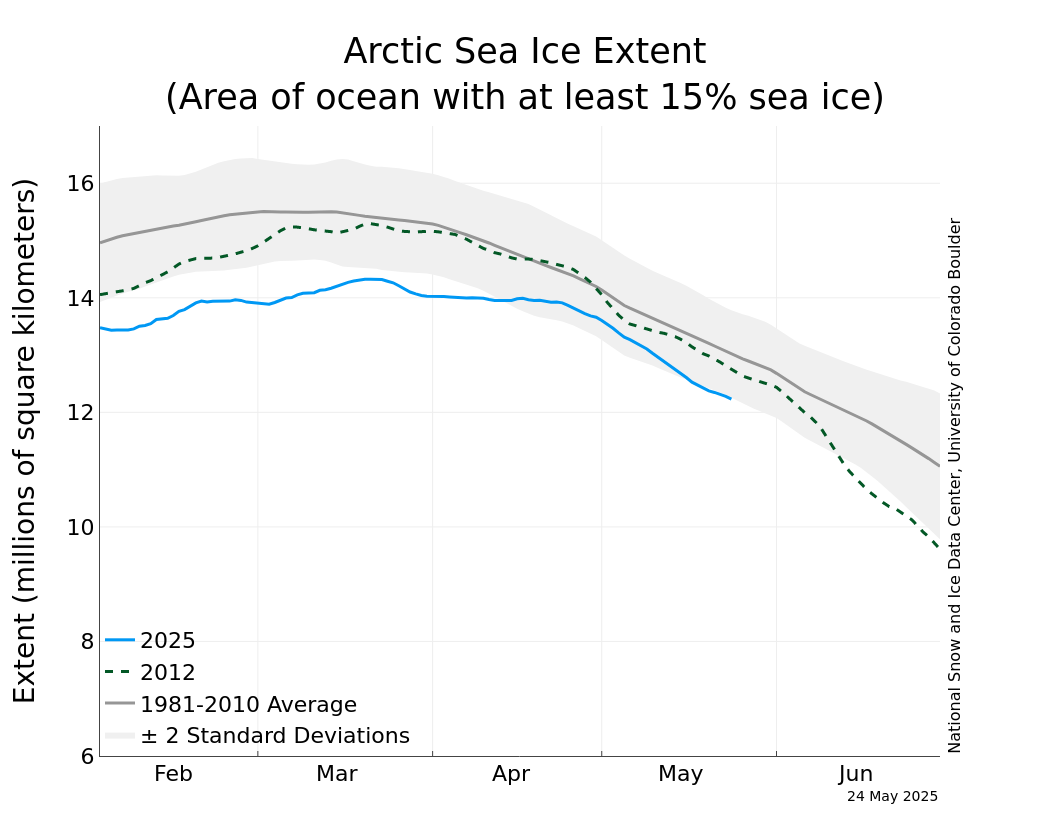
Claim 1972: “Artic specialist Bernt Balchen says a general warming trend over the North Pole is melting the polar ice cap and may produce an ice-free Arctic Ocean by the year 2000.” Christian Science Monitor, June 8, 1972.
Data: Ice coverage has fallen, though as of last month, the Arctic Ocean had 3.82 million square miles of ice cover — an area larger than the continental United States — according to The National Snow and Ice Data Center.
Claims 1974: “… when metereologists take an average of temperatures around the globe they find the atmosphere has been growing gradually cooler for the past three decades. The trend shows no indication of reversing. Climatological Cassandras are becoming increasingly apprehensive, for the weather aberrations they are studying may be the harbinger of another ice age. Telltale signs are everywhere–from the unexpected persistence and thickness of pack ice int eh waters around Iceland to the southward migration of a warmth-loving creature like the armadillo from the Midwest. When Climatologist George J. Kukla of Columbia University’s Lamont-Doherty Geological Observatory and his wife Helena analyzed satellite weather data fro the Northern Hemisphere, they found that the area of ice and snow cover had suddenly increased by 12% in 1971 and the increase has persisted ever since. Areas of Baffin Island in the Canadia Arctic, for example, were once totally free of any snow in summer; now they are covered year round.”
Later in the article, “Whatever the cause of the cooling trend, its effects could be extremely serious, if not catastrophic. Scientists figure that only a 1% decrease in the amount of sunlight hitting the earth’s surface could tip teh climatic balance, and cool the planet enough to send it sliding down the road to another ice age within only a few hundred years.”
Source: “Another Ice Age,” Time Magazine, June 24, 1974.
Claim 1989: “Using computer models, researchers concluded that global warming would raise average annual temperatures nationwide two degrees by 2010.” Associated Press, May 15, 1989.
Data: According to NASA, global temperature has increased by about 0.7 degrees Fahrenheit since 1989. And U.S. temperature has increased even less over the same period.

Claims: “Britain’s winter ends tomorrow with further indications of a striking environmental change: snow is starting to disappear from our lives.”
“Sledges, snowmen, snowballs and … are all a rapidly diminishing part of Britain’s culture, as warmer winters–which scientists are attributing to global climate change–produce not only fewer white Christmases, but fewer white Januaries and Februaries.”
“London’s last substantial snowfall was in February 1991.” “Global warming, the heating of the atmosphere by increased amounts of industrial gases, is now accepted as a reality by the international community.”
According to Dr. David Viner, a senior research scientist at the climatic research unit (CRU) of the University of East Anglia, within a few years “children just aren’t going to know what snow is” and winter snowfall will be “a very rare and exciting event.” Interviewed by the UK Independent, March 20, 2000.
“David Parker, at the Hadley Centre for Climate Prediction and Research in Berkshire, says ultimately, British children could have only virtual experience of snow.”
See “Snowfalls are now just a thing of the past.” The Independent. March 20, 2000.
Data: “Coldest December Since records began as temperatures plummet to minus 10 C bringing travel chaos across Britain.” Mailonline. Dec. 18, 2010.
Claim: “[By] 1995, the greenhouse effect would be desolating the heartlands of North America and Eurasia with horrific drought, causing crop failures and food riots … [By 1996] The Platte River of Nebraska would be dry, while a continent-wide black blizzard of prairie topsoil will stop traffic on interstates, strip paint from houses and shut down computers.” Michel Oppenheimer and Robert H. Boyle, Dead Heat, St. Martin’s Press, 1990. Oppenheimer is the Albert G. Milbank Professor of Geosciences and International Affairs in the Woodrow Wilson School and the Department of Geosciences at Princeton University. He is the Director of the Program in Science, Technology, and Environmental Policy at the Wilson School. He was formerly a senior scientist with the Environmental Defense Fund, the largest non-governmental organization in the U.S. that examines problems and solutions to greenhouse gases.
Data: When asked about these old predictions Oppenheimer stated, “On the whole I would stand by these predictions — not predictions, sorry, scenarios — as having at least in a general way actually come true,” he said. “There’s been extensive drought, devastating drought, in significant parts of the world. The fraction of the world that’s in drought has increased over that period.”
However, that claim is not obviously true. Data from NASA’s Goddard Space Flight Center show that precipitation — rain and snow — has increased slightly over the century.
—
How could scientists have made such off-base claims? Dr. Paul Ehrlich, author of “The Population Bomb” and president of Stanford University’s Center for Conservation Biology, told FoxNews.com that ideas about climate science changed a great deal in the the ’70s and ’80s.
Ehrlich told FoxNews.com that the consequences of future warming could be dire.
=============================================================
Source: University of Georgia, Terry College of Business. Economics 2200, Economic Development of the US, David B. Mustard
http://www.terry.uga.edu/~mustard/courses/e2200/pop.htm
UPDATE: reader Dennis Wingo writes in with this table:
Great article. I went into this myself in my book “Moonrush“, I took all of the predictions for the depletion of resources from the book and marked in red the deadlines that had already passed. All of the predictions failed.

omnologos says:
January 19, 2013 at 3:59 am
Does anybody know of a collection of predictions that turned out right?
================================================================
Here’s one.
“The sun’ll come out
Tomorrow
Bet your bottom dollar
That tomorrow
There’ll be sun!”
Little Orphan Annie
(Of course, she wasn’t a climate scientist so maybe this one doesn’t count.)
The antidote for “Limits to Growth” is an excellent book published in 1984
The Doomsday Myth: 10,000 Years of Economic Crises
by Texas A&M professors Maurice and Smithson.
Link to a summary I wrote about it under “No Cornucopia of Gas”
Betting on one’s convictions: Ehrlich was the loser in his bet against Julian Simon.
Here is Julian Simon’s account of the wager: “BETTING ALL HUMAN WELFARE WILL IMPROVE” http://www.juliansimon.com/writings/Articles/EHRLICH6.txt
Luís says:
January 19, 2013 at 9:40 am
Am I reading you right? The Club of Rome projected that half of the worlds energy and commodities resources would be depleted by 2010? And you claim this was the actual outcome?
Man, I’d have to see the citation for that claim, that half of the world’s energy and commodities are already used up. Me, I misdoubts that somewhat largely … even the idea that there is some fixed amount of resources is wrong. Resources are only limited by our imagination. If we can safely and economically use the methane clathrates, there is a huge energy resource there. Or consider the natural gas resource. It was one size until people started horizontal fracking, and now the resource is many times the size … which means that there is no such thing as a “natural gas resource” of a certain fixed size. Instead, the size of the resource is a function of our technological capability to utilize it.
Until we developed nuclear power, there was no nuclear fuel resource. Now, I suppose the Club of Rome is busy calculating the uranium resource, and dividing it by the current rate of use plus a 2.6 annual increase, to give us the date we’ll run out.
… meanwhile, back in the real world, I read that the Japanese have worked on genetically modifying sponges to filter uranium from seawater … if they succeed, what does that do to the uranium resource?
This is why running a scenario where “half of this resource would get depleted by 2010” makes no sense at all. The Club of Rome assumed that humans are like bacteria—bacteria grow exponentially until they run out of room to live, then they die catastrophically.
Humans don’t work that way. For example, when the Dutch ran out of room, they pushed the sea back, made some more land, and reduced their population growth rate. When the world ran out of magnesium, DuPont chemists invented a way to extract it from sea water. Of course, there was talk before that about the world magnesium crisis, the coming end of the known supplies of magnesium, the dire predictions of magnesium shortages would have done the Club proud.
The other thing that the Club of Rome folks never seemed to grasp is that the world doesn’t need resources. It needs the services those resources provide. In other words, the world doesn’t need copper for communications. It needs communications. Lately communications has migrated to optic fiber and to wireless. Think about how much copper it would have taken to provide telephone service around the planet. The Club of Rome error was in thinking we’d run out of copper to wire up the planet’s phones. We don’t need copper for phones, we just need phones.
w.
“the world doesn’t need copper for communications the world needs communications” . . that needs saying over and over and over again.
We are having a huge debate about platinum sources and resources right now considering what is going on in South Africa and Zimbabwe. My input was simply to point out that platinum group metals ( PGM ) will be replaced by something more readily available, cheaper and more effective in those countries where they are needed. It didn’t go down well but chemistry, physics and the resulting technology will do that.
So to paraphrase Willis, we dont need catalytic convertors, we need clean exhaust emissions.
Limits to Growth is Malthusian gibberish with a glossy coat of numerology.
Here is an excellent summary of Malthusian theory-
http://mises.org/daily/1675
“It is . . . a curious irony that the general biological principle which he put forward comes steadily closer to being true, the further one departs from the human case, and is a grotesque falsity only in the one case which really interested Malthus: man.”
“In conclusion, the Malthusian problem is one that economics solves. No wonder the Malthusians want to get rid of economics. Their rule only applies in noneconomic “societies.” And, even then, only in its abridged Misesian form.”
“The environmental movement of today is aiming toward living in a non-economic “society” by showing why it would be unpleasant to live in. It is staggering how a movement like this could amass such a following.”
Here are some additional observations by Julian Simon about predictions by doomsayers and the placing of bets on them. It seems to me that he had them all nailed. http://www.juliansimon.com/writings/Articles/BETNEW2.txt
Ted Turner
““The Judeo-Christian religion says man was given dominion over everything, and his salvation was that he was to go out and increase and multiply. Well, we have done that … to the point where in Calcutta, it’s a hellhole.”
========================================================
He’s so wrong on so many points. But I don’t want to start a “thread jacking” so I’ll refrain from pointing out the stupidity of his statement.
(Though he might be right about Calcutta.)
Pamela Gray says: January 19, 2013 at 8:48 am
******
Pamela,
Since you have brought this subject up…….
You have voiced a very strong opinion as “pro-Choice”.
There is an organization here in Texas that is a “first of its kind” in these United States. Since you are such a strong advocate for “choice” it seems to be perfect for you. It got its start when someone noted a couple physically dragging their teen-aged daughter into a Planned Parenthood abortion mill to have a forced abortion. The police were called and also a lawyer. The lawyer got a restraining order to prevent the parents from forcing their daughter to get an abortion.
A topic for debate: Should women who choose life for their baby be supported and defended as fiercely as those who choose the opposite?? Or is the only valid choice abortion?
The Texas Center for the Defense of Life gives legal support to women who WANT to have their child but are being coerced into having an abortion. It is a dirty little secret that nobody talks about, but a significant number of women are coerced, by their parents, their husband/boyfriend, Child Protective Services, etc.
An acquaintance of ours talks about that (among other things) here:
http://www.bing.com/videos/search?q=carol+everett&view=detail&mid=7C333A07E708A738516C7C333A07E708A738516C&first=0
Now, I am not suggestion any change in Roe vs. Wade. I am not suggesting any changes at all. All I suggest is that people, particularly women, should be fully aware of what “choice” is. You should be aware because this issue is one of your defining beliefs; it defines you as a person.
The Texas Center for the Defense of Life is having a fundraiser in Austin, TX on March 5. You and your Sweetheart would be welcome to go as our guests should you be in the area. It’s about real choice.
Regards,
Steamboat Jack
(Jon Jewett’s evil twin)
Over at Dot Earth, commenter Asteroid Miner proposed a limit to human population on Earth when the human species weighs the same as the Earth. I disagree. Technology could be developed to continuously build out the diameter of the Earth with thousands of ‘floors’.
Assuming people could be packed into 1 meter square slots, the surface (land and sea) would be completely coated with the human infestation at a population of about 5.1 x 10^14, or 510,000 Billion people. With a growth rate of 1 Billion per 10 years, that will take about 5 million years.
Assuming people weigh about 60 kg, the human weight will equal Earth’s weight at a population of 6×10^24/60 = 10^23 people, or a little less than 0.2 mol of people. As Sagan would mutter, this will take ‘billions and billions’ of years.
Reaching these limits is as plausible as using tree rings to measure ambient temperature to a tenth of a degree (C/F/K/R).
You may have missed the title:
Imagine if your whole comment was put up as a new post on WUWT. I could also accuse you of:
You should have just dropped the attacks and simply said something like “here are some successful predictions by the way”.
Rud Istvan says:
January 19, 2013 at 10:30 am
Aw, jeez, here come the peak oilers. What did we do to deserve this? Mention a few bad predictions about oil, and peak oilers pop out of the woodwork. There are as many peak oil theories as there are peak oil fanatics. All of them want to tell the world about M. King Hubbard. Believe me, Rud, we’ve heard of him, you and your friends always want to talk about the King. I read about him. Move on, that was 1970.


Lets start with the reality. The world has not yet seen peak oil, nor is there any indication that we are nearing peak oil, based on production.
Data Source (Excel Workbook)
Next, we can compare that to years of proved reserves, which is years of oil in the ground at current usage rates and accessible with current technology:
For “Years of Proved Reserves”, I have taken that years proved reserves and divided each one by that years oil consumption rate. That gives me how many years of reserves remained at that years usage rates.
Note that in 1980 we had about thirty years of proved reserves at 1980 usage rates. In 2011, despite the world using much more oil than in 1980, we had over fifty years of proved reserves at 2011 usage rates.
So I’m sorry, Rud, but I’m no more interested in peak oil alarmism than I am in climate alarmism. We have lots and lots and lots of all kinds of fossil fuels, conventional and unconventional. And we haven’t even touched the methane clathrates. We’re not about to run out of fossil fuels. I’d suggest that you get used to it and let your crusade go, or you will assuredly spend the entire remaining years of your life railing about the sky falling, with no one paying any more attention to you than they do now.
w.
Correction:
Imagine if your whole comment was put up as a new post on WUWT. I could also accuse you of:
Rud Istvan
“probable peak in food calory production sometime around 2050”
Does that prediction take into account advances in food production like high efficiency farming, saltwater irrigated food production systems, and genetic modification advancement of crops?
http://www.plantlab.nl/4.0/
http://12.000.scripts.mit.edu/mission2014/solutions/seawater-farming
http://ejournal.vudat.msu.edu/index.php/mmg445/article/viewFile/95/40
Robert Austin says:
“Since the male of the species will never be placed in the jeopardy of pregnancy, their opinion on the matter is worthless.”
Worthless? Really? It takes two to tango, Robert.
Pamela says:
“It is typical of men to paint reproductive rights with jarring colors devoid of female reason.”
“Female reason”? That is to reason as Post Normal Science is to science.
Here’s a question, just for the fun of it: if a man impregnates a woman [consensually], and he wants to raise the child, even if by himself, does the woman still get to make the sole decision if she wants to abort?
Conversely, if a man accidentally impregnates a woman [again, consenual sex], and the man wants it aborted, does he have any say in the matter?
“Waiter! Popcorn!” ☺
WRT prediction: “In 1885, the US Geological Survey announced that there was “little or no chance” of oil being discovered in California.”
Mark Mills: California Could Be the Next Shale Boom State; Thanks to the Golden State’s dire fiscal situation, don’t be surprised if the governor were to proclaim: ‘There will be oil.’
Some interesting points:
Californians this year will pay an additional 6 Billion in income tax thanks to Governor Brown, who has been on t.v. recently claiming he has put the state’s debt crisis behind them. Of note, then:
…And the fact is that California is still (at half the production rates of the ’60’s) the fourth-hightest oil producer in the U.S.
http://online.wsj.com/article/SB10001424127887323353204578128733463180210.html
D Böehm Stealey says:
January 19, 2013 at 11:41 am
…
“Waiter! Popcorn!” ☺
——————————
Sir, you are a braver man than I. When I saw Pamela’s original post, I felt like a kid who’d found a really big firework in a shed. Thoughts like, ‘Do I dare? It’d probably be truly spectacular, but do I really want to blow up my face and half the block…’
…looks like Publix’s natural flavored microwave popcorn in my pantry for this afternoon. 🙂
It’s nice to read when the likes of George Monbiot admitted last year that he was wrong on peak oil. He thinks there’s “There’s enough to fry us all”
http://www.guardian.co.uk/commentisfree/2012/jul/02/peak-oil-we-we-wrong
This should be made into a pamphlet that can be handed out (say, at schools) or readily delivered to any Greenie turning up at the door telling us we can’t burn wood anymore or rattling Save the Polar Bear tins. Excellent article. This one should be spread around.
I’ll make a prediction that this won’t stop till we stop bying their CRAP and demand longer lasting and safer products. By making things last longer will take the presure of the enviroments natural resources http://www.youtube.com/watch?v=D56nut_9e8s and help stop pollution at every level. The planet and it’s ever growing popullation can’t aford to go down the path of the American way of life ( consumerism.)
Rud Istvan says:
“There are 5 tight oil formations in the US. The largest is the Bakken in North Dakota. Technically recoverable reserves are about 4Bbbl.
By comparison, the Ghawar field in Saudi Arabia has 65Bbbl of remaining TRR, all economic. Yet Mighty Gwahar hit peak production about 2000. Read Simmons book Twilight in the Desert for technical details.”
FIVE “tight oil formations” in the US???? Actually, the are hundreds, probably thousands. There are five more stacked just under the Bakken alone. Some of the lower units were just fracked last month with good results. Reserves will keep climbing with technology. Oh, then there is the rest of the world, such as the Bazhenov in Siberia.
And please, don’t tell me to consult Simmons on Ghawar. He spent a few days in Saudi talking to people he did not understand. My wife spent a few years there, and a few more with Exxon research working on it. Simmons holds poorly developed ideas based on limited data, and limited expertise.
jmorpuss:
re your post at January 19, 2013 at 12:05 pm.
It can be filed under “Predictions certain to fail” because it makes the same mistaken presumption (repeatedly explained in this thread) as Ehrlich’s predictions.
Richard
Mark Bofill,
Pamela and I go back a long way, to the beginning of WUWT. [I’m sure she remembers the part I wanted to cast her in: “Rain is all like super secret seal commando, aka Agent “Syng”man, an’ this Journalist hottie…” ☺]. I respect her intelligence and her views.
But men have a point of view, too. Don’t we get any say regarding our children? <–[hypothetical question; doesn't apply to me. Our boy has flown the coop, and now works at Siemens]. Remember that those are mens’ children, too.
[Not enough popcorn to start with the child support issues.]
I think essays like this should start of with Thomas Malthus who in 1798 started off all this doom business with a prediction that England would collapse by the mid 19th century as population was growing exponentially while food was growing linearly. Just as he was speaking the first fruits of the industrial revolution were becoming available in the form of farm machinery that trebled the efficiency of farming, and there was no mass starvation.
[Reply: OK, I fixed it for you. This time… -ModE 😉 ]
No mass starvation