
UPDATE: New table added below.
While searching for something else, I came across this entertaining collection of grand predictive failures related to resources and climate change, along with some of the biggest predictive failures of Paul Ehrlich. I thought it worth sharing.
Exhaustion of Resources
“Indeed it is certain, it is clear to see, that the earth itself is currently more cultivated and developed than in earlier times. Now all places are accessible, all are documented, all are full of business. The most charming farms obliterate empty places, ploughed fields vanquish forests, herds drive out wild beasts, sandy places are planted with crops, stones are fixed, swamps drained, and there are such great cities where formerly hardly a hut… everywhere there is a dwelling, everywhere a multitude, everywhere a government, everywhere there is life. The greatest evidence of the large number of people: we are burdensome to the world, the resources are scarcely adequate to us; and our needs straiten us and complaints are everywhere while already nature does not sustain us.”
- In 1865, Stanley Jevons (one of the most recognized 19th century economists) predicted that England would run out of coal by 1900, and that England’s factories would grind to a standstill.
- In 1885, the US Geological Survey announced that there was “little or no chance” of oil being discovered in California.
- In 1891, it said the same thing about Kansas and Texas. (See Osterfeld, David. Prosperity Versus Planning : How Government Stifles Economic Growth. New York : Oxford University Press, 1992.)
- In 1939 the US Department of the Interior said that American oil supplies would last only another 13 years.
- 1944 federal government review predicted that by now the US would have exhausted its reserves of 21 of 41 commodities it examined. Among them were tin, nickel, zinc, lead and manganese.
- In 1949 the Secretary of the Interior announced that the end of US oil was in sight.
Claim: In 1952 the US President’s Materials Policy Commission concluded that by the mid-1970s copper production in the US could not exceed 800,000 tons and that lead production would be at most 300,000 tons per year.
Data: But copper production in 1973 was 1.6 million tons, and by 1974 lead production had reached 614,000 tons – 100% higher than predicted.
Claims: In 1968, Paul R. Ehrlich wrote The Population Bomb and declared that the battle to feed humanity had been lost and that there would be a major food shortage in the US. “In the 1970s … hundreds of millions are going to starve to death,” and by the 1980s most of the world’s important resources would be depleted. He forecast that 65 million Americans would die of starvation between 1980-1989 and that by 1999, the US population would decline to 22.6 million. The problems in the US would be relatively minor compared to those in the rest of the world. (Ehrlich, Paul R. The Population Bomb. New York, Ballantine Books, 1968.) New Scientist magazine underscored his speech in an editorial titled “In Praise of Prophets.”
Claim: “By the year 2000 the United Kingdom will be simply a small group of impoverished islands, inhabited by some 70 million hungry people … If I were a gambler, I would take even money that England will not exist in the year 2000.” Paul Ehrlich, Speech at British Institute For Biology, September 1971.
Claim: Ehrlich wrote in 1968, “I have yet to meet anyone familiar with the situation who thinks India will be self-sufficient in food by 1971, if ever.”
Data: Yet in a only few years India was exporting food and significantly changed its food production capacity. Ehrlich must have noted this because in the 1971 version of his book this comment is deleted (Julian Simon, The Ultimate Resource, Princeton: Princeton Univesity Press, 1981, p. 64).
The Limits to Growth (1972) – projected the world would run out of gold by 1981, mercury and silver by 1985, tin by 1987, zinc by 1990, petroleum by 1992, and copper, lead and natural gas by 1993. It also stated that the world had only 33-49 years of aluminum resources left, which means we should run out sometime between 2005-2021. (See Donella Meadows et al., The Limits to Growth: A Report for the Club of Rome’s Project on the Predicament of Mankind. New York: New American Library, 1972.
Claim: In 1974, the US Geological Survey announced “at 1974 technology and 1974 price” the US had only a 10-year supply of natural gas.
Data: The American Gas Association said that gas supplies were sufficient for the next 1,000-2,500 years. (Julian Simon, Population Matters. New Jersey: Transaction Publications, 1990): p. 90.
Population and Poverty
In the mid 1970s the US government sponsored a travelling exhibit for schoolchildren titled, “Population: The Problem is Us.” (Jacqueline Kasun, The War Against Population, San Francisco: CA, Ignatius, 1988, p. 21.)
In 1973, Supreme Court Justice Potter Stewart’s vote in Roe v. Wade was influenced by this idea, according to Bob Woodward and Scott Armstrong: “As Stewart saw it, abortion was becoming one reasonable solution to population control” (quoted in Newsweek of September 14, 1987, p. 33.).
In 1989, when the US Supreme Court was hearing the Webster case, Justice Sandra Day O’Connor brought the idea of overpopulation into a hypothetical question she asked of Charles Fried, former solicitor-general, “Do you think that the state has the right to, if in a future century we had a serious overpopulation problem, has a right to require women to have abortions after so many children?”
World Bank president Barber Conable calls for population control because “poverty and rapid population growth reinforce each other” (Washington Post, July 16, 1990, p. A13)
Prince Philip advises us that “It must be obvious by now that further population growth in any country is undesirable” (Washington Post, May 8, 1990, p. A26)
37 Senators wrote President Bush in support of funding for population control (Washington Post, April 1, 1990, p. H1)
The Trilateral Commission and the American Assembly call for reduction in population growth (U. S. News and World Report, May 7, 1990)
Newsweek‘s year-ending cover story concluded that “Foremost of the new realities is the world’s population problem” (December 25, 1990, p.44)
The president of NOW warns that continued population growth would be a “catastrophe” (Nat Hentoff in the Washington Post, July 29, 1989, p. A17)
Ted Turner (Atlanta Journal Constitution, Wed. Dec. 2, 1998) in an address to the Society of Environmental Journalists in Chattanooga – blamed Christianity for overpopulation and environmental degradation, and argued that the people who disagree with him are “dummies.” He stated in part, “The Judeo-Christian religion says man was given dominion over everything, and his salvation was that he was to go out and increase and multiply. Well, we have done that … to the point where in Calcutta, it’s a hellhole. So it’s not an environmentally friendly religion.”
Ellen Goodman laments “People Pollution” (Washington Post, March 3, 1990, p. A25)
Herblock cartoon shows that the U. S. neglecting the “world population explosion” (Washington Post, July 19, 1990, p. A22)
Hobart Rowen likens population growth to “the pond weed [which] grows in huge leaps” (Washington Post, April 1, 1990, p. H8).
A Newsweek “My Turn” suggests giving every teen-age girl a check for up to $1200 each year that she does not have a baby “in order to stop the relentless increase of humanity” (Noel Perrin. “A Nonbearing Account”, April 2, 1990, p. 9).
Climate Change
Claim Jan. 1970: “By 1985, air pollution will have reduced the amount of sunlight reaching earth by one half.” Life Magazine, January 1970. Life Magazine also noted that some people disagree, “but scientists have solid experimental and historical evidence to support each of the predictions.”
Data: Air quality has actually improved since 1970. Studies find that sunlight reaching the Earth fell by somewhere between 3 and 5 percent over the period in question.
Claim April 1970: “If present trends continue, the world will be … eleven degrees colder by the year 2000. This is about twice what it would take to put us in an ice age.” Kenneth E.F. Watt, in Earth Day, 1970.
Data: According to NASA, global temperature has increased by about 1 degree Fahrenheit since 1970.

Claim 1970: “In ten years all important animal life in the sea will be extinct. Large areas of coastline will have to be evacuated because of the stench of dead fish.” Paul Ehrlich, speech during Earth Day, 1970.
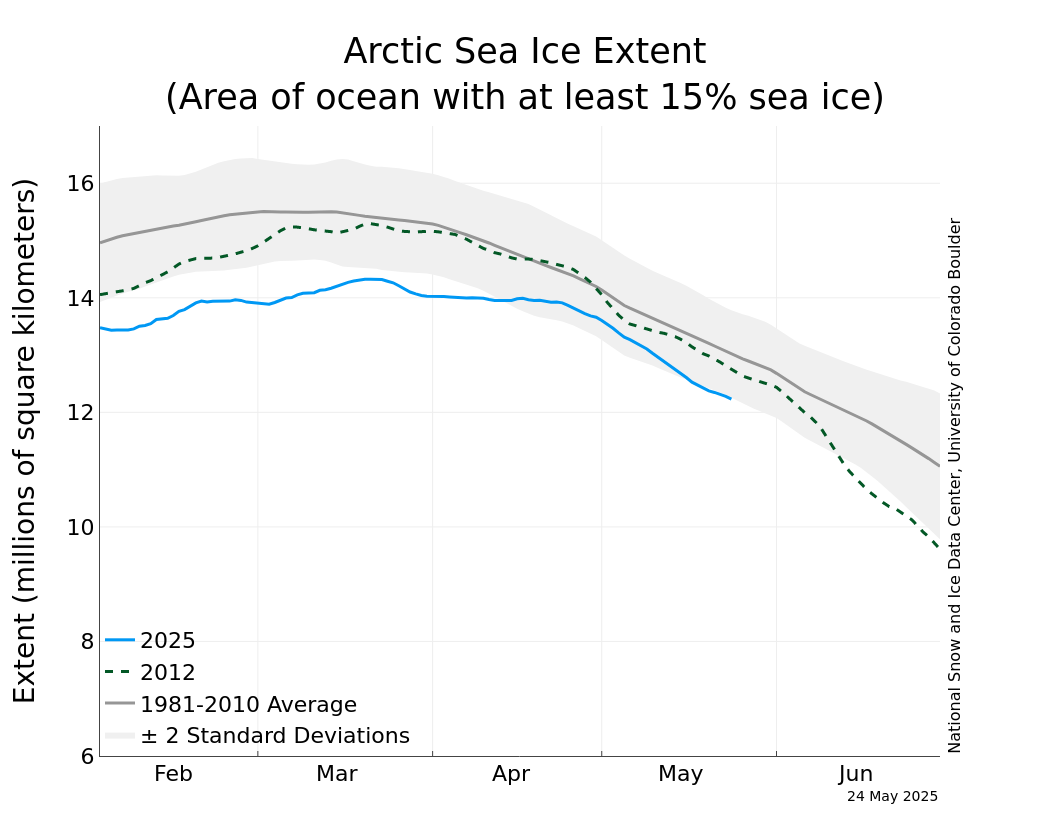
Claim 1972: “Artic specialist Bernt Balchen says a general warming trend over the North Pole is melting the polar ice cap and may produce an ice-free Arctic Ocean by the year 2000.” Christian Science Monitor, June 8, 1972.
Data: Ice coverage has fallen, though as of last month, the Arctic Ocean had 3.82 million square miles of ice cover — an area larger than the continental United States — according to The National Snow and Ice Data Center.
Claims 1974: “… when metereologists take an average of temperatures around the globe they find the atmosphere has been growing gradually cooler for the past three decades. The trend shows no indication of reversing. Climatological Cassandras are becoming increasingly apprehensive, for the weather aberrations they are studying may be the harbinger of another ice age. Telltale signs are everywhere–from the unexpected persistence and thickness of pack ice int eh waters around Iceland to the southward migration of a warmth-loving creature like the armadillo from the Midwest. When Climatologist George J. Kukla of Columbia University’s Lamont-Doherty Geological Observatory and his wife Helena analyzed satellite weather data fro the Northern Hemisphere, they found that the area of ice and snow cover had suddenly increased by 12% in 1971 and the increase has persisted ever since. Areas of Baffin Island in the Canadia Arctic, for example, were once totally free of any snow in summer; now they are covered year round.”
Later in the article, “Whatever the cause of the cooling trend, its effects could be extremely serious, if not catastrophic. Scientists figure that only a 1% decrease in the amount of sunlight hitting the earth’s surface could tip teh climatic balance, and cool the planet enough to send it sliding down the road to another ice age within only a few hundred years.”
Source: “Another Ice Age,” Time Magazine, June 24, 1974.
Claim 1989: “Using computer models, researchers concluded that global warming would raise average annual temperatures nationwide two degrees by 2010.” Associated Press, May 15, 1989.
Data: According to NASA, global temperature has increased by about 0.7 degrees Fahrenheit since 1989. And U.S. temperature has increased even less over the same period.

Claims: “Britain’s winter ends tomorrow with further indications of a striking environmental change: snow is starting to disappear from our lives.”
“Sledges, snowmen, snowballs and … are all a rapidly diminishing part of Britain’s culture, as warmer winters–which scientists are attributing to global climate change–produce not only fewer white Christmases, but fewer white Januaries and Februaries.”
“London’s last substantial snowfall was in February 1991.” “Global warming, the heating of the atmosphere by increased amounts of industrial gases, is now accepted as a reality by the international community.”
According to Dr. David Viner, a senior research scientist at the climatic research unit (CRU) of the University of East Anglia, within a few years “children just aren’t going to know what snow is” and winter snowfall will be “a very rare and exciting event.” Interviewed by the UK Independent, March 20, 2000.
“David Parker, at the Hadley Centre for Climate Prediction and Research in Berkshire, says ultimately, British children could have only virtual experience of snow.”
See “Snowfalls are now just a thing of the past.” The Independent. March 20, 2000.
Data: “Coldest December Since records began as temperatures plummet to minus 10 C bringing travel chaos across Britain.” Mailonline. Dec. 18, 2010.
Claim: “[By] 1995, the greenhouse effect would be desolating the heartlands of North America and Eurasia with horrific drought, causing crop failures and food riots … [By 1996] The Platte River of Nebraska would be dry, while a continent-wide black blizzard of prairie topsoil will stop traffic on interstates, strip paint from houses and shut down computers.” Michel Oppenheimer and Robert H. Boyle, Dead Heat, St. Martin’s Press, 1990. Oppenheimer is the Albert G. Milbank Professor of Geosciences and International Affairs in the Woodrow Wilson School and the Department of Geosciences at Princeton University. He is the Director of the Program in Science, Technology, and Environmental Policy at the Wilson School. He was formerly a senior scientist with the Environmental Defense Fund, the largest non-governmental organization in the U.S. that examines problems and solutions to greenhouse gases.
Data: When asked about these old predictions Oppenheimer stated, “On the whole I would stand by these predictions — not predictions, sorry, scenarios — as having at least in a general way actually come true,” he said. “There’s been extensive drought, devastating drought, in significant parts of the world. The fraction of the world that’s in drought has increased over that period.”
However, that claim is not obviously true. Data from NASA’s Goddard Space Flight Center show that precipitation — rain and snow — has increased slightly over the century.
—
How could scientists have made such off-base claims? Dr. Paul Ehrlich, author of “The Population Bomb” and president of Stanford University’s Center for Conservation Biology, told FoxNews.com that ideas about climate science changed a great deal in the the ’70s and ’80s.
Ehrlich told FoxNews.com that the consequences of future warming could be dire.
=============================================================
Source: University of Georgia, Terry College of Business. Economics 2200, Economic Development of the US, David B. Mustard
http://www.terry.uga.edu/~mustard/courses/e2200/pop.htm
UPDATE: reader Dennis Wingo writes in with this table:
Great article. I went into this myself in my book “Moonrush“, I took all of the predictions for the depletion of resources from the book and marked in red the deadlines that had already passed. All of the predictions failed.

You had me with you till that last part. It is typical of men to paint reproductive rights with jarring colors devoid of female reason. Interpretation of data and the writing of laws on child birth and abortion, and ubiquitous publications of opinions of such things, are usually placed into media by men (as the one above was). I tell you what, when you are the ones to bear the baby bump, deliver the bundle into the world, and suckle at the breast, you can have a say as to what abortion is used for. I truly wish men would stay out of an issue that rightfully belongs and solely belongs to the reasoned minds of women and their ObGyn. I truly wish that.
In 1894, the Times of London estimated that by 1950 every street in the city would be buried nine feet deep in horse manure. One New York prognosticator of the 1890s concluded that by 1930 the horse droppings would rise to Manhattan’s third-story windows. A public health and sanitation crisis of almost unimaginable dimensions loomed.
http://futuryst.blogspot.co.uk/2007/10/parables-and-horseshit.html
“Sam Norton (@Elizaphanian) says: Anyone who thinks we’re not running up against some resource limits needs to have an … explanation for why the tripling of oil prices over the last decade has seen no significant increase in the production of oil.”
You’re using the wrong measuring stick – one that shrinks every year. There is no scarcity of oil but rather an overabundance of dollars. Measured in terms of gold, oil has been relatively stable in price for decades. Measured in terms of gold, the price of oil has actually dropped about 40% since 2003.
If only Benny and the Inkjets, a.k.a. Ben Bernanke, could print gold instead of green confetti…
One more failed prediction:
http://www.benhills.com/articles/the-war/item/199-forgotten-city-faces-the-truth-the-bomb-fifty-years-of-fallout
[…]
“In a speech two days later [after Hiroshima], he [War Minister Anami] referred specifically to the “new type of bomb”. If Hiroshima’s significance is that it began the nuclear era, Nagasaki’s, many historians believe, is that it ended the greatest war ever to engulf the planet.
It made a liar of Hirohito’s War Minister, Korechika Anami, who had been demanding every Japanese fight to the death and strutting around in the days after Hiroshima boasting: “I am convinced the Americans only had one bomb, after all.” That was surely history’s most preposterous miscalculation.
[…]
I’d like to add: measured in gold, oil is almost EXACTLY the same price now as it was 50 years ago (1963). About 12 barrels of oil for one ounce of gold.
Oh Sam, the price of oil hasn’t tripled because it is scarcer. The price of oil has tripled because cartels control production, the Asian market is using more and more oil while we use less, [and we get less than 5% of our oil from the middle east,] the speculative market in oil futures isn’t rational and has driven the price up but that is artificial and could fall at any time. And last the value of the dollar has fallen.
But oil hasn’t gotten scarcer.
All this is why peak oil is so much wishful thinking not only that it doesn’t even consider changes in technology or the markets.
I’m surprised none of the Malthusianists have trotted out Easter Island yet. Typically presented as the example of isolated and limited resource exploitation invariably leading to ecological and societal disaster and proclaim it is analogous to Earth and our future. These comparisons not only disregard the difference in diversity of resources and technological advancement but also ignore basic math. Even if Easter Islanders went from population “tipping point” to near ecological disaster in 100 years (ridiculously short estimate) then given the island’s 163.6 km2 area and Earth’s 150,000,000 km2 land area the analogy if valid would mean that we have approximately 92 million years to either “de-isolate” Earth or improve oceanic exploitation giving us another 360,000,000 km2 translating into another 220 million years.
I don’t know but it seems easily doable to me that in a fraction of that time we could be developing extraterrestrial resources.
Robbie, no it isn’t being claimed that resources are in endless supply. What is being claimed is that technology is always changing and in ways you usually don’t predict, and that humans are adaptable. We humans adapt to changes in our environment.
All of the predictions of doom are based on unchanging technology, science, and behavior. That is what we are calling stupid. And it also points out why the predictions of doom on the part of the Catastrophic Anthropomorphic Climate Change crowd are so much bunk.
Sam Norton
January 19, 2013 at 2:03 am
You better have a look at the price of oil vs the price of gold over time: http://pricedingold.com/crude-oil/
Well in the case of tin, the prediction was quite accurate, for the USA. Tin concentrations are quite rare and none have been found in the USA in recent times. Quite a useful metal.
Pamela: If men stay COMPLETELY out of the baby issue, we won’t have a problem. I can’t see where immaculate conception ever occurred except in one case. Perhaps there’s new science out there that makes sperm and does the artificial insemination. Man haters should be singing this from the rooftops and since no melody is heard at present, I doubt such science exists. Sure, you’re fine with using men for sex, sperm and a checkbook. I pity any male children you may have accidentally had the misfortune to carry to live birth. Of course, abortion can effectively limit the number of those annoying males. Maybe if we just kept enough to harvest sperm from the world would be utopia, you think?
Sam Norton (@Elizaphanian) says: January 19, 2013 at 2:03 am
Sam’s comment is fair in that the Club of Rome “predictions” had (the standard) caveats. I could not find the book available electronically. I find it interesting that the Club of Rome does not provide an electronic copy – but there may be copyright issues. The review Sam linked is here http://www.simmonsco-intl.com/content/documents/whitepapers/172.pdf. The Simmons paper strikes me as more of an advocacy piece than a reasoned review of Limits to Growth.
While stating that Limits to Growth did not claim what folks say, the Simmons paper does not explain what it did say. For that you have to go to Wikipedia: http://en.wikipedia.org/wiki/The_Limits_to_Growth. About 1/3 of the way down is the table with accompanying discussion. Importantly, the caveats are also listed.
The exponential index has been interpreted as a prediction of the number of years until the world would “run out” of various resources, both by environmentalist groups calling for greater conservation and restrictions on use, and by skeptics criticizing the index when supplies failed to run out.[15][16][17][18] What The Limits to Growth actually has is the above table, which has the current reserves (that is no new sources of oil are found) for oil running out in 1992 assuming constant exponential growth.
So irrespective of what environmentalists used to say about the Limits to Growth, the current party line is that it was an examination of exponential growth rates in (primarily) population and the impact on resources and not really predictions at all.
If you have not seen the Peak Farmland post, pop over to Judith’s and have a read. Fascinating. http://judithcurry.com/2013/01/05/peak-farmland/.
Pamela Gray says:
January 19, 2013 at 8:48 am
You had me with you till that last part. It is typical of men to paint reproductive rights with jarring colors devoid of female reason. Interpretation of data and the writing of laws on child birth and abortion, and ubiquitous publications of opinions of such things, are usually placed into media by men (as the one above was). I tell you what, when you are the ones to bear the baby bump, deliver the bundle into the world, and suckle at the breast, you can have a say as to what abortion is used for. I truly wish men would stay out of an issue that rightfully belongs and solely belongs to the reasoned minds of women and their ObGyn. I truly wish that.
=================================================
Right Pam, totally agree. All we have to do, in order to be consistent, is to relieve all men of their obligations to any children they may sire or obligations to the women who relieve men of any choice in the matter, and then you’d have a point.
But, I think that takes us beyond the scope of this blog forum. I think the larger point one can gain from dire predictions of our population is that it’s the same as oil or anything else. It isn’t anything to worry about. I’m a bit disappointed we didn’t see some Malthus quotes…..
And, unless we’re confused about what sort of people they are…..
The “pushed at me ad” appearing at the beginning of the post is for that great book – yes, the one with ‘limits’ in the title. What a hoot. What dumb algorithms. Someone alert Jeff Bezos.
~~~~~~
A couple of comments followed Robbie’s (@3:28) shout out to “Mr. Watts!”
What I thought most interesting is that over the past several years Anthony has spent considerable time documenting and posting his (&family’s) first adopter approach to enviro/resource issues. There is the small car (Smart ?), the solar installation, the LED lights inside the house, . . ., and my favorite – Kenji as a member of the Union of Concerned Scientists. These are nothing like business as usual. Maybe Robbie can list personal experiences on the bloody cutting edge of technology. Waiting . . .
Alice Cheshire says:
January 19, 2013 at 9:24 am
“I can’t see where immaculate conception ever occurred except in one case.”
That would be the birth of Mary, Mother of Christ. This is related to sperm in what way?
We all know Ehrlich to be a fool, but there were good technical people at Stanford sucked into the same erroneous thinking. The Dean of Mineral Sciences, Charles Park Jr. wrote “Affluence in Jeopardy, Minerals and the Political Economy”. (1968). In the book he reviews every strategic mineral, and concluded we are in deep doo-doo. He was wrong of course, but he was no idiot. He just lacked imagination. We used the book in a geology course of mine, and I was quite convinced.
Later, in my carreer in the oil business I learned that one must realize that the next great thing is always out there, and just because I can’t tell you what it is, it doesn’t mean it won’t come. In 1988 I made a list of ten oil plays which I thought would emerge with horizontal drilling. I hit some, but I missed the Bakken. I did know enough, however, to dismiss the “peak oil” hysteria. I could imagine I missed a few.
I think the parallels to climate science are strong.—The David Suzukis are just another Ehrlich, but there are also smart and sincere people out there who are convinced we have an AGW problem, they just lack the imagination to see the alternative scenarios.
Dear Anthony,
“Limits to Growth” is the result of a decade of studies at the MIT leaded by Jay Forrester. I read the 20 and didn’t find the sort of failed claims you imply, even though I contend with several methodological aspects of the book. The original model had a single and non discriminative resource pool that bundled together energy and commodities. In the standard scenario half of this resource would get depleted by 2010, about 40 years after the model was run. The actual rate of world resource consumption has so far followed the trend lines produced by the model, according to which the world should be now entering an industrial activity decline. There are seven more scenarios in the book, some of which produce steady states with high industrial activity, upon alternative courses of action (recycling, technological shift, etc). The version of the book I read had no references to exhaustion dates you produce. Besides that, as I explained above the model is not designed to produce such dates, since it bundles all resources together, and its outputs are industrial activity, population and pollution. Wherever those metal exhaustion dates come from they cannot come from the Limits to Growth model.
William Stanley Jevons had many contributions to Science, the best known possibly the so called Jevons Paradox. He published “The Coal Question” in 1963, in which he explained why exponential growth of coal extraction in the UK couldn’t possibly last forever. This was the first serious critique of the production-to-reserves methodology that completely missed the exponential growth dynamics. Contrary to what Anthony claims, Jevons never studied the exhaustion of coal reserves (which will never happen), but rather the end of coal extraction growth. He alluded to a peak in the following century, which is today acknowledged as a spot on call, since the actual peak took place in 1913, with production describing an almost perfect logistic cycle, characteristic of exponential resource extraction (the kind of behaviour the Limits to Growth model tries to reproduce). Those interested to know the real story, and where Jevons exactly failed, are invited to check this link:
http://www.theoildrum.com/node/8241
It is sad to see Anthony risking his credibility and of his website with this sort of posts. It is hard to understand why on this matter Anthony should take the side of the IPCC, echoing their stories of perpetual growth. Readers interested on a scientific account of the relationship between resource depletion and climate change are advised to watch this lecture:
curious ‘a priori’ omniscience by claimants of insurmountable barriers to achievement including claims of barriers to an achievement of a significant concurrent increase in population and its per capita wealth. That takes care the intellectual status of Neo- Malthusians out of Stanford.There is no known limits to human growth on earth or anywhere else since there are no known limits to the universe and, as an essential inherent part of that, there is no known limits to the achievements of human beings as reasoning beings.
Look at and consider the immense imports available to private enterprise from uphill in the potential energy gradient.
Earth is just the happenstance womb of human beings, it is not the required womb of human beings. Earth is just the happenstance origin of current resources, it is not the required origin. The existing science / technology / industrialization is the happenstance achievement of innovators and energizers, it is not the requirement of future science / technology / industrialization achieved by anyone who chooses to create them.
There will always be those who try to set limits on the future of humanity, they can prevail only through organized intimidation and physical force (thugs) against free individual human achievers and energizers. Yawn, the thugs are self-defeating . . .
I think it is serving justice to leave, strictly to themselves, those who claim omniscient limits and whose goal is aiding non-achievement. N’est ce pas? They deserve themselves in there self-limiting of themselves. : )
John
Luis says:
“Jevons… published ‘The Coal Question’ in 1963, in which he explained why exponential growth of coal extraction in the UK couldn’t possibly last forever.”
Ya know, even I could have predicted that.
Pamela Gray says:
January 19, 2013 at 8:48 am
Amen Pamela.
I find just so irksome to hear some righteous male bloviating on abortion, usually decrying the “murder of the unborn”. Since the male of the species will never be placed in the jeopardy of pregnancy, their opinion on the matter is worthless. With fifty percent of the populace, there is no shortage of female opinion available to inform the matter.
Global Cooling was the rage in 1974 based on a 3 decade cooling trend. Global Warming was the rage by 1989 but according to global temperature charts the warming trend didn’t begin until after 1980. This means the warming trend had been going on for only 9 years when the great predictions of CAGW doom began.
Seems to me this is a very brief time period of correlation to be basing such a theory on especially since CO2 began rising long before 1980. And now we’re told of course the current non-warming trend isn’t long enough to falsify the theory.
Sam Norton (@Elizaphanian) says:
January 19, 2013 at 2:03 am
Actually, they did project those dates, based on the known reserves and an exponentially increasing consumption rate. It is in the table in the book.

They also projected longer times to running out, using once again an exponentially increasing consumption rate PLUS the assumption that new reserves would be discovered.
My problem with their work is the hugely naive assumption of exponentially increasing consumption rates. They assume an increase of 2.6% per year. The “Rule of 70”, familiar to accountants like myself, says that means a doubling of consumption every 70 / 2.6 = 27 years, or a thirteen-fold increase per century … riiiight …
Nature doesn’t do exponential for very long, certainly not centuries.
The Club of Rome’s assumption that exponential growth will continue unchecked until some catastrophe stops it simply hasn’t held up. In fact, the assumption of exponential growth of resource consumption itself hasn’t held up. We can use primary energy consumption as an example. Here is the Club of Rome prediction from 1972 (2.6% increase per year), compared to ugly reality:
As you can see, far from experiencing 2.6% exponential growth, or indeed any kind of exponential growth at all, the change in energy use over time has been roughly linear. Not exponential at all. Linear.
And this is the huge misunderstanding at the basis of the errors of the Club of Rome. They assume exponential growth exists and will continue, unchecked and un challenged, until some catastrophe topples it in a grand orgy of looting and rioting in the streets, the primordial “Ehrlichean Collapse” that Paul to this day insists is just around the corner.
Instead of Club of Rome exponential growth followed by Ehrlichean collapse, what seems to happen is that a million small everyday catastrophes effectively prevent the exponential growth that the Club of Rome folks both fear and feature. That makes the growth linear, and keeps things from collapsing.
All the best,
w.
In reference to the comments about the A-word, let me throw some fat on the fire:
http://womenshistory.about.com/od/quotes/a/Florynce-Kennedy-quotes.htm
• If men could get pregnant, abortion would be a sacrament.
Regrettable selection/confirmation bias in the choice of failed predictions.
Here are counter examples. M. King Hubbert, Shell research geologist, predicted in a 1956 peer reviewed geophysics journal that peak US oil production would be about 1970. It was, despite the subsequent development of the north slope and the gulf of Mexico. In 1971, he predicted that global peak conventional oil would be about 2000. In 1998, laHerre and Cambell said conventional oil would peak about 2005. Prof. Defeeyes of Princeton has written three books confirming that indeed global peak conventional oil was about 2006. Unconventional oil is mainly Venezuelan tar sands in the Orinoco, and Canadian tar sands in the Athabasca region of Alberta. Despite the Orinoco, and despite $100/bbl crude, Venezuela hit peak oil production about 2000.
There are uninformed people like Orzag who say the US will become an exporter, when it presently consumes about 19mbbl/day, produces about 9, and imports about 10. Fracking tight oil, and all that. There are 5 tight oil formations in the US. The largest is the Bakken in North Dakota. Technically recoverable reserves are about 4Bbbl. TRR for all 5 is about 18Bbbl. According the the ever optimistic industry itself, if governmental regulations do not interfer the most that could be produced is about 3mbbl/ day by about 2030. That assumes the Keystone pipeline and a lot of other facilities get built, instead of stopped.
By comparison, the Ghawar field in Saudi Arabia has 65Bbbl of remaining TRR, all economic. Yet Mighty Gwahar hit peak production about 2000. Read Simmons book Twilight in the Desert for technical details. Even after reworking the Haradh section of Gwahar, production is slowly declining with watercut above 50%. Annual production cannot be increased without damaging the field and reducing ultimately recoverable reserves. Such is the nature of peak oil.
There are three separate ways to estimate how much oil remains to be discovered, ever. These include creaming curves (Cambell’s and Hubbert’s approach), Hubbert linearization (Defeeyes approach), and the probit transform (Rutledges approach at Caltech, especially useful for coal). All three say less than 20% more petroleum remains to be discovered, period. And that means global peak oil from all sources by around 2020, and certainly before 2030.
Stupid predictions like Ehrlich’s deserve ridicule. But there are a lot of reasonable, sound science based predictions that do not. Peak fossil fuel production is among them, as is a probable peak in food calory production sometime around 2050. Those topics are explored using basic facts in my book Gaia’s Limits.
This site is supposedly dedicated to a discussion of sound science, with deserved factual debunking of unsound propositions and bad science. Many posters here have gone off into ‘belief land’ concerning fundamental peak oil geophysics. You may not like the conclusions, but but if you think they are not sound, bring facts rather than ill formed opinions, or obviously stupid conclusions like Orzags (quasimofficial Obama administration view 2012) on future US oil independence. That is as stupid as most of what Jim Hansen and Michael Mann say about CAGW.
Please raise your game to a level worthy of WUWT.
One wonders if any of the latter day Nostra-dumbasses ever review the abject failure of their old predictions and resolve to shut up in the future.