
UPDATE: New table added below.
While searching for something else, I came across this entertaining collection of grand predictive failures related to resources and climate change, along with some of the biggest predictive failures of Paul Ehrlich. I thought it worth sharing.
Exhaustion of Resources
“Indeed it is certain, it is clear to see, that the earth itself is currently more cultivated and developed than in earlier times. Now all places are accessible, all are documented, all are full of business. The most charming farms obliterate empty places, ploughed fields vanquish forests, herds drive out wild beasts, sandy places are planted with crops, stones are fixed, swamps drained, and there are such great cities where formerly hardly a hut… everywhere there is a dwelling, everywhere a multitude, everywhere a government, everywhere there is life. The greatest evidence of the large number of people: we are burdensome to the world, the resources are scarcely adequate to us; and our needs straiten us and complaints are everywhere while already nature does not sustain us.”
- In 1865, Stanley Jevons (one of the most recognized 19th century economists) predicted that England would run out of coal by 1900, and that England’s factories would grind to a standstill.
- In 1885, the US Geological Survey announced that there was “little or no chance” of oil being discovered in California.
- In 1891, it said the same thing about Kansas and Texas. (See Osterfeld, David. Prosperity Versus Planning : How Government Stifles Economic Growth. New York : Oxford University Press, 1992.)
- In 1939 the US Department of the Interior said that American oil supplies would last only another 13 years.
- 1944 federal government review predicted that by now the US would have exhausted its reserves of 21 of 41 commodities it examined. Among them were tin, nickel, zinc, lead and manganese.
- In 1949 the Secretary of the Interior announced that the end of US oil was in sight.
Claim: In 1952 the US President’s Materials Policy Commission concluded that by the mid-1970s copper production in the US could not exceed 800,000 tons and that lead production would be at most 300,000 tons per year.
Data: But copper production in 1973 was 1.6 million tons, and by 1974 lead production had reached 614,000 tons – 100% higher than predicted.
Claims: In 1968, Paul R. Ehrlich wrote The Population Bomb and declared that the battle to feed humanity had been lost and that there would be a major food shortage in the US. “In the 1970s … hundreds of millions are going to starve to death,” and by the 1980s most of the world’s important resources would be depleted. He forecast that 65 million Americans would die of starvation between 1980-1989 and that by 1999, the US population would decline to 22.6 million. The problems in the US would be relatively minor compared to those in the rest of the world. (Ehrlich, Paul R. The Population Bomb. New York, Ballantine Books, 1968.) New Scientist magazine underscored his speech in an editorial titled “In Praise of Prophets.”
Claim: “By the year 2000 the United Kingdom will be simply a small group of impoverished islands, inhabited by some 70 million hungry people … If I were a gambler, I would take even money that England will not exist in the year 2000.” Paul Ehrlich, Speech at British Institute For Biology, September 1971.
Claim: Ehrlich wrote in 1968, “I have yet to meet anyone familiar with the situation who thinks India will be self-sufficient in food by 1971, if ever.”
Data: Yet in a only few years India was exporting food and significantly changed its food production capacity. Ehrlich must have noted this because in the 1971 version of his book this comment is deleted (Julian Simon, The Ultimate Resource, Princeton: Princeton Univesity Press, 1981, p. 64).
The Limits to Growth (1972) – projected the world would run out of gold by 1981, mercury and silver by 1985, tin by 1987, zinc by 1990, petroleum by 1992, and copper, lead and natural gas by 1993. It also stated that the world had only 33-49 years of aluminum resources left, which means we should run out sometime between 2005-2021. (See Donella Meadows et al., The Limits to Growth: A Report for the Club of Rome’s Project on the Predicament of Mankind. New York: New American Library, 1972.
Claim: In 1974, the US Geological Survey announced “at 1974 technology and 1974 price” the US had only a 10-year supply of natural gas.
Data: The American Gas Association said that gas supplies were sufficient for the next 1,000-2,500 years. (Julian Simon, Population Matters. New Jersey: Transaction Publications, 1990): p. 90.
Population and Poverty
In the mid 1970s the US government sponsored a travelling exhibit for schoolchildren titled, “Population: The Problem is Us.” (Jacqueline Kasun, The War Against Population, San Francisco: CA, Ignatius, 1988, p. 21.)
In 1973, Supreme Court Justice Potter Stewart’s vote in Roe v. Wade was influenced by this idea, according to Bob Woodward and Scott Armstrong: “As Stewart saw it, abortion was becoming one reasonable solution to population control” (quoted in Newsweek of September 14, 1987, p. 33.).
In 1989, when the US Supreme Court was hearing the Webster case, Justice Sandra Day O’Connor brought the idea of overpopulation into a hypothetical question she asked of Charles Fried, former solicitor-general, “Do you think that the state has the right to, if in a future century we had a serious overpopulation problem, has a right to require women to have abortions after so many children?”
World Bank president Barber Conable calls for population control because “poverty and rapid population growth reinforce each other” (Washington Post, July 16, 1990, p. A13)
Prince Philip advises us that “It must be obvious by now that further population growth in any country is undesirable” (Washington Post, May 8, 1990, p. A26)
37 Senators wrote President Bush in support of funding for population control (Washington Post, April 1, 1990, p. H1)
The Trilateral Commission and the American Assembly call for reduction in population growth (U. S. News and World Report, May 7, 1990)
Newsweek‘s year-ending cover story concluded that “Foremost of the new realities is the world’s population problem” (December 25, 1990, p.44)
The president of NOW warns that continued population growth would be a “catastrophe” (Nat Hentoff in the Washington Post, July 29, 1989, p. A17)
Ted Turner (Atlanta Journal Constitution, Wed. Dec. 2, 1998) in an address to the Society of Environmental Journalists in Chattanooga – blamed Christianity for overpopulation and environmental degradation, and argued that the people who disagree with him are “dummies.” He stated in part, “The Judeo-Christian religion says man was given dominion over everything, and his salvation was that he was to go out and increase and multiply. Well, we have done that … to the point where in Calcutta, it’s a hellhole. So it’s not an environmentally friendly religion.”
Ellen Goodman laments “People Pollution” (Washington Post, March 3, 1990, p. A25)
Herblock cartoon shows that the U. S. neglecting the “world population explosion” (Washington Post, July 19, 1990, p. A22)
Hobart Rowen likens population growth to “the pond weed [which] grows in huge leaps” (Washington Post, April 1, 1990, p. H8).
A Newsweek “My Turn” suggests giving every teen-age girl a check for up to $1200 each year that she does not have a baby “in order to stop the relentless increase of humanity” (Noel Perrin. “A Nonbearing Account”, April 2, 1990, p. 9).
Climate Change
Claim Jan. 1970: “By 1985, air pollution will have reduced the amount of sunlight reaching earth by one half.” Life Magazine, January 1970. Life Magazine also noted that some people disagree, “but scientists have solid experimental and historical evidence to support each of the predictions.”
Data: Air quality has actually improved since 1970. Studies find that sunlight reaching the Earth fell by somewhere between 3 and 5 percent over the period in question.
Claim April 1970: “If present trends continue, the world will be … eleven degrees colder by the year 2000. This is about twice what it would take to put us in an ice age.” Kenneth E.F. Watt, in Earth Day, 1970.
Data: According to NASA, global temperature has increased by about 1 degree Fahrenheit since 1970.

Claim 1970: “In ten years all important animal life in the sea will be extinct. Large areas of coastline will have to be evacuated because of the stench of dead fish.” Paul Ehrlich, speech during Earth Day, 1970.
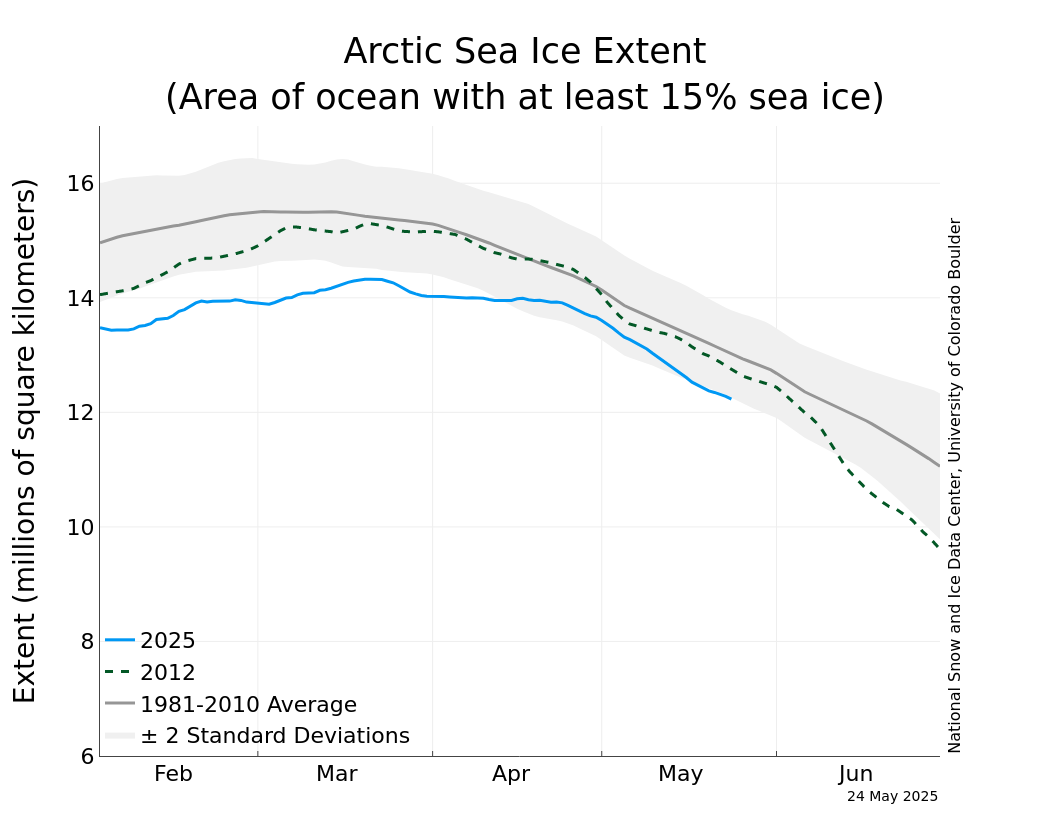
Claim 1972: “Artic specialist Bernt Balchen says a general warming trend over the North Pole is melting the polar ice cap and may produce an ice-free Arctic Ocean by the year 2000.” Christian Science Monitor, June 8, 1972.
Data: Ice coverage has fallen, though as of last month, the Arctic Ocean had 3.82 million square miles of ice cover — an area larger than the continental United States — according to The National Snow and Ice Data Center.
Claims 1974: “… when metereologists take an average of temperatures around the globe they find the atmosphere has been growing gradually cooler for the past three decades. The trend shows no indication of reversing. Climatological Cassandras are becoming increasingly apprehensive, for the weather aberrations they are studying may be the harbinger of another ice age. Telltale signs are everywhere–from the unexpected persistence and thickness of pack ice int eh waters around Iceland to the southward migration of a warmth-loving creature like the armadillo from the Midwest. When Climatologist George J. Kukla of Columbia University’s Lamont-Doherty Geological Observatory and his wife Helena analyzed satellite weather data fro the Northern Hemisphere, they found that the area of ice and snow cover had suddenly increased by 12% in 1971 and the increase has persisted ever since. Areas of Baffin Island in the Canadia Arctic, for example, were once totally free of any snow in summer; now they are covered year round.”
Later in the article, “Whatever the cause of the cooling trend, its effects could be extremely serious, if not catastrophic. Scientists figure that only a 1% decrease in the amount of sunlight hitting the earth’s surface could tip teh climatic balance, and cool the planet enough to send it sliding down the road to another ice age within only a few hundred years.”
Source: “Another Ice Age,” Time Magazine, June 24, 1974.
Claim 1989: “Using computer models, researchers concluded that global warming would raise average annual temperatures nationwide two degrees by 2010.” Associated Press, May 15, 1989.
Data: According to NASA, global temperature has increased by about 0.7 degrees Fahrenheit since 1989. And U.S. temperature has increased even less over the same period.

Claims: “Britain’s winter ends tomorrow with further indications of a striking environmental change: snow is starting to disappear from our lives.”
“Sledges, snowmen, snowballs and … are all a rapidly diminishing part of Britain’s culture, as warmer winters–which scientists are attributing to global climate change–produce not only fewer white Christmases, but fewer white Januaries and Februaries.”
“London’s last substantial snowfall was in February 1991.” “Global warming, the heating of the atmosphere by increased amounts of industrial gases, is now accepted as a reality by the international community.”
According to Dr. David Viner, a senior research scientist at the climatic research unit (CRU) of the University of East Anglia, within a few years “children just aren’t going to know what snow is” and winter snowfall will be “a very rare and exciting event.” Interviewed by the UK Independent, March 20, 2000.
“David Parker, at the Hadley Centre for Climate Prediction and Research in Berkshire, says ultimately, British children could have only virtual experience of snow.”
See “Snowfalls are now just a thing of the past.” The Independent. March 20, 2000.
Data: “Coldest December Since records began as temperatures plummet to minus 10 C bringing travel chaos across Britain.” Mailonline. Dec. 18, 2010.
Claim: “[By] 1995, the greenhouse effect would be desolating the heartlands of North America and Eurasia with horrific drought, causing crop failures and food riots … [By 1996] The Platte River of Nebraska would be dry, while a continent-wide black blizzard of prairie topsoil will stop traffic on interstates, strip paint from houses and shut down computers.” Michel Oppenheimer and Robert H. Boyle, Dead Heat, St. Martin’s Press, 1990. Oppenheimer is the Albert G. Milbank Professor of Geosciences and International Affairs in the Woodrow Wilson School and the Department of Geosciences at Princeton University. He is the Director of the Program in Science, Technology, and Environmental Policy at the Wilson School. He was formerly a senior scientist with the Environmental Defense Fund, the largest non-governmental organization in the U.S. that examines problems and solutions to greenhouse gases.
Data: When asked about these old predictions Oppenheimer stated, “On the whole I would stand by these predictions — not predictions, sorry, scenarios — as having at least in a general way actually come true,” he said. “There’s been extensive drought, devastating drought, in significant parts of the world. The fraction of the world that’s in drought has increased over that period.”
However, that claim is not obviously true. Data from NASA’s Goddard Space Flight Center show that precipitation — rain and snow — has increased slightly over the century.
—
How could scientists have made such off-base claims? Dr. Paul Ehrlich, author of “The Population Bomb” and president of Stanford University’s Center for Conservation Biology, told FoxNews.com that ideas about climate science changed a great deal in the the ’70s and ’80s.
Ehrlich told FoxNews.com that the consequences of future warming could be dire.
=============================================================
Source: University of Georgia, Terry College of Business. Economics 2200, Economic Development of the US, David B. Mustard
http://www.terry.uga.edu/~mustard/courses/e2200/pop.htm
UPDATE: reader Dennis Wingo writes in with this table:
Great article. I went into this myself in my book “Moonrush“, I took all of the predictions for the depletion of resources from the book and marked in red the deadlines that had already passed. All of the predictions failed.

D. B. Stealey says:
January 21, 2013 at 11:54 am
Re: Willis/Ace
“A couple of years ago we had a discussion here regarding the total volume of humanity on Earth. Turns out that you could put every person on Earth into a one kilometre sphere, with room to spare.”
A more practical measure is you could fit all of us into Lake superior with 15 sq metres to tread water in, or 90billion people in the lake with1 sq m to tread water in. Still, we don’t take up much room.
Gary Pearse says:
January 21, 2013 at 6:57 pm
Yeah, but that’s without Climate Ace’s patented infinite population growth … now all we need is the Infinity Drive, and we’re home free …
w.
– – – – – – –
Pamela Gray,
The main post was about failed predictions in the areas of: 1) Exhaustion of Resources, 2) Population and Poverty, and 3) Climate Change.
Abortion was only discussed explicitly in the section on population. It was not addressed in the context of climate change.
The main post’s view was highly critical of population bomb alarmism. It countered false claims / predictions about dire needs to for drastic population control. Forced or encouraged abortion is often one of the alarming population proponent’s favorite options for their mitigation against their claims of imminent population explosions. I find it immoral that they advocate such forced or encouraged abortions. If the discussion upsets you then I can understand why, it upsets me. But we must be willing to discuss such things in order to counter the advocates of such abortion policies whether it is upsetting or not.
John
It is none of anybody else’s business and does not belong in discussions of climate change. That men make it so, and I suppose even women, speaks to the incredible degree in which one group of people wish to control another group of people. It also speaks to the far fetched assumptions people are willing to make on both sides of the climate change discussion when it comes to motivations for abortion as a form of wide spread population control. None of which have any bearing on the realities of the private discussion had between patient and physician.
However, this issue brings up an important sobering phenomenon. When adult self-determination is pried from our hands and becomes the business of others, including the right to choose whether or not to end ones own pregnancy, freedom is harmed for all.
I see that the BAUsters have not quite got their heads around the fact that they are behaving as if some predictions are correct. They are happy to scoffter all sorts of OP’s predictions. But when it comes to accepting that BAU is built around some basic predictions they run for cover. That is, they discuss everything other than the likelihood that the predictions will stand the test of time.
What are these predictions again?
(1) That humankind will indefinitely be able to master nature
(2) That infinite population growth is desirable. (BAUsters in Australia, BTW, belong to the Big Australia Boosters… they happily envisage an Australia which has 100 million people.
(3) That there are NO limits to growth and never will be.
(4) That there will ALWAYs be a technological solution to whatever.
Which of these predictions were addressed in any substance, in any intrinsic fashion by the BAU boosters upstring?
Not (1), because it is a cross-fingers job. Past performance, as the fund managers always remind us, is no guarantee of future performance. This prediction is based on hope.
Not (2) because not one BAU booster has any idea of addressing population issues. The BAU prediction is that everything will be all right on the day. BAU boosters have no idea how to stop between 500 million and 1000 million from going to bed hungry each night. They have no idea of what to do about the 5-15 million children who die of starvation every year: except to burn even more fossil fuels.. Even if we are burning more fossil fuels than ever before and we have more hunger than ever before and more children dying of starvation per annum on a regular basis than ever before. The BAU population, she’ll be right mate, prediction is failing now, not at some time in the future.
Not (3) Embedded in BAU is the utter necessity of growth. The implicit prediction is that the growth can, and must, and will continue. That is a BAU predicator. Therefore, the implicit prediction is that growth will continue to happen for millenia and that there will never be any practical limits to growth of the global economy.
Not (4). Technology is not doing the job now, so BAU. The prediction that things can only get better is already limited, genetically. We are experiencing massive loss of the global gene pool and the potential that the loss represents. Technology can’t even stop this, let alone promise to contain future losses.
It is easy enough to pick off various human failues in the prediction game. What is not so easy is for BAU boosters to acknowledge that their whole approach to life is based on predictions that are matters of hope and guesswork.
Let’s consider your position then . .
Do you really believe that the current level of population, technology and energy use is already above the optimum for the Earth and mankind? If you do perhaps you could state what we should revert to.
On the one hand we are faced with mankind continuing to do what it has always done. Striving onwards and upwards at the individual and collective levels arriving where we are today and itching to progress further tomorrow. On the other hand should we voluntarily deny any further growth to any and all living on Earth while we wind back to some ill defined benchmark only you can know? Some poorly remembered halcyon, pastoral past where only the good can live and be happy. A past nobody living in it today is enjoying very much hence they take off on mass to live in our horrible world of technological, social and economic progress.
Furthermore I notice you have introduced a new acronym , BAU, business as usual meaning what exactly? Every day brings new things and ideas which, if they work, add to our existence and if they don’t are discarded. You seem to think that leaping gaily backwards to old types of energy and doing business will have results different from last time.
You seem to think you are a kind of progressive fellow but in fact you are an old fashioned conservative with fascist overtones. You cannot decide which bits of society and mankind will flourish and grow, or decline and die. Only each individual acting in his own enlightened self interest can do that and all of those individual acts are what drive mankind inexorably into the future.
Mankind is also a force of nature. We effect everything which is how we have arrived at this point of our evolution. You, and all of the arrayed alarmists , will not stop mankind’s march into the future. If you and your allies achieve your goals in one place progress will simply pop up somewhere else and people will go there just as they do today.
I know that you all find the future scary and intimidating but it isn’t because we are driven to adapt to it or it to us. That is what sets us apart from the dumb beasts and our destiny lies in the stars. To get to those stars we will throw off the limitations little men like you and Hansen and Mann and all of the left/liberal world try and impose because it is man’s absolute nature to progress. Look at where we are today and embrace your humanity so you can start to dream about a far more exciting tomorrow.
Climate Ace,
Since you’ve apparently got fingers in your ears and have no intention of doing anything but spam the same canned argument over and over again, let me humor you and let’s see where it takes us, ok?
I don’t know exactly what a BAUster or BAU booster is, but lets say I’m one, for the sake of argument, in that I support a status quo of relative political freedom, capitalism, industrialization, and technology. If this leads me to tilt with strawmen, understand that I can’t argue about your point if you won’t clearly explain what you mean in the first place, and help me out by clarifying. But in good faith, lets proceed.
My read is that you’re saying I operate under some assumptions, you’re calling them predictions; whatever, fine.
(1) That humankind will indefinitely be able to master nature.
(2) That infinite population growth is desirable.
(3) That there are No limits to growth and never will be.
(4) That there will ALWAYs be a technological solution to whatever.
For the sake of argument and to keep things moving along, let’s just grant you items (1), (3), and (4). In other words, OK, let’s say that I agree that these are my assumptions or predictions. I can’t agree to item (2), because frankly I neither know nor care in my BAU world whether or not infinite population growth is desirable. The closest I can come with you on this point is to agree that yup, to the extent that overcrowding becomes a problem, I’m going to rely on technology to fix it.
OK. I’ve taken the bait. Now, where are we going with this? Well, you go on to point out why these things are wrong, let’s have a look.
Not (1) Past performance is no guarantee of future performance. It sure isn’t, that’s right, but so what? Share what you propose as a better method, and if it makes sense maybe you’ll persuade somebody. I mean, surely you wouldn’t think it reasonable if I told you to quit using some method that’s given good results in the past and suggested no alternative method, right? But also, I need to point out that there needn’t BE any guarantees; we don’t live in a wiffle ball world. We do the best we can with what we’ve got to solve our human problems, because it’s all we can do.
Not (2) … I don’t know if I can paraphrase your argument concisely, but let me try. None among us BAU boosters has any idea of addressing population issues, we assume it will work out under the BAU scenario of burning more fossil fuels, and this is not working because we’ve got more children starving than ever before is the best I can honestly do with it. There are alot of directions I could go with this. I could call factual bullshit on each of the three distinct points (nobody has an idea how to address, nothing to do but burn more fossil fuel, and BAU isn’t working). I could ask why you don’t consider nuclear power BAU. But instead, why don’t we cut to the chase. Suppose every word you are saying here is the simple, gospel truth. Once again, what alternative do you propose? Persuade me that there’s some alternative to BAU, because I certainly don’t intend to simply lay down in the dirt and die because you say BAU isn’t working.
Not (3) … BAU requires growth. You don’t actually make an argument against anything here. I’m not sure what you’re trying to get at. I think global economic growth for millenia sounds pretty good actually, can you lay out the problem for me?
Not (4) … I can’t make heads or tails of this. I honestly don’t have the first clue what you’re talking about. How are we experiencing massive loss of the global gene pool, why should we care, and why should technology have anything to do with it? If you want to clarify this, if you feel it’s important, please do, but I don’t know what to make of it one way or the other as is.
You conclude that my whole approach to life as a BAU booster is a matter of hope and guesswork. If that’s what you want to call it, fine; I don’t have a problem with it. Now, I’ve done what I can to meet you partway so we can move along with your argument. Kindly do not come back and waste my time spamming the same complaints about BAU at me. PLEASE. Explain where you’re going with this. Propose your better system that doesn’t involve hope and guesswork and maybe we’ll get someplace.
– – – – – – – – –
Climate Ace,
Human beings have a specific identity as human beings. It is our natural capacity to reason about nature. It is a voluntary capacity that flourishes in free exchange of ideas and of the products of those ideas. That is an ‘is’ not an optimism.
Your argument says the above is the problem that dooms Earth. Others like me say it ‘is’ the necessity of human beings to live as human beings; to live rational lives as reasoning beings. Your ‘limit’ based dooms are, to them, artificial constructs from misapplied reason.
The reality is human beings will use their reason on nature to live well as reasoning beings, no matter what the time, place or hardship. You are saying humans cannot do that; you say we are doomed on Earth by our nature.
My advice to you is that human beings as human beings can only achieve well being by a actions that are not contrary to our nature. You mistake that ‘is’ as optimism.
John
Climate Ace says:
January 22, 2013 at 2:43 am
Straw man alert! Cleanup on aisle three!
Ace, nobody that I’ve read(except you) has said anything about “indefinitely” mastering nature. I don’t even know what “mastering nature” means in your world.
Nobody I’ve read (except you) has said anything about “infinite population growth” being possible or desirable.
Nobody I’ve read (except you) says that there are NO limits to growth.
Nobody (but you) says that there will ALWAYS be a technological solution.
What we do say is that business as usual has gotten us this far. It does have problems, and it can always be improved, and in fact, constant improvement is a characteristic of BAU. It has lifted billions out of poverty and enriched the world. But it can always be made better, changed, that’s part of the BAU deal. BAU today is nothing like BAU a hundred years ago.
But you, Ace, want to throw it out and replace it with … what, exactly? The Climate Ace paradise of horse drawn carriages? The non-technological solution? What is it that you propose to supplant the most productive system the world has ever seen? How do you plan to feed the nine billion, Ace, if you think BAU is the suxxor?
Serious questions, my friend, although I freely admit they may be beyond your cranial horsepower … the main point is, however, that standing around and whining that the current system has problems ,as you have done over and over to terminal boredom, goes nowhere. Lead, follow, or get out of the way, my friend … all you’re doing now is carping and caviling, and that doesn’t help anyone.
w.
Climate Ace Says
I see that the BAUsters have not quite got their heads around the fact that they are behaving as if some predictions are correct. They are happy to scoffter all sorts of OP’s predictions. But when it comes to accepting that BAU is built around some basic predictions they run for cover. That is, they discuss everything other than the likelihood that the predictions will stand the test of time.
What are these predictions again?
(1) That humankind will indefinitely be able to master nature
(2) That infinite population growth is desirable. (BAUsters in Australia, BTW, belong to the Big Australia Boosters… they happily envisage an Australia which has 100 million people.
(3) That there are NO limits to growth and never will be.
(4) That there will ALWAYs be a technological solution to whatever.
I echo Wills and take it a step further, you are blinded by even your own language.
In (1) you make this claim that humankind will indefinitely be able to master nature. In that sentence you reveal a fundamental philosophical premise that is built into the human self hatred movement, which is that somehow humankind is not part of nature. Lets take your premise that we are modifying nature. Yep, but 3.5 billion years ago so did oxygen excreting microbes. Those microbes completely destroyed the existing biosphere and recreated it in an image that is in control to this day. Those same microbes have become so efficient that they have endangered their own existence by drawing down the CO2 concentrations so much as to help to bring about over a million years worth of global ice ages. So much so as to have been a contributing factor in the deaths of the planets megafauna in the last ice age…
A History of Atmospheric CO2 and Its Effects on Plants, Animals, and Ecosystems
…Miocene were low enough (180-320 ppm; Pagani, Freeman, and Arthur 1999) to potentially cause a significant decrease in plant productivity, particularly in C3 species. Herbivores, such as browsers that fed almost exclusively on C3 vegetation, would have been especially susceptible to such changes. Janis, Damuth, and Theodor (2000) proposed that the decrease in species diversity of ungulate browsers during the Miocene was due to reduced plant productivity mediated by declining CO2 levels. Fruthermore, the decline in the diversity of grazing mammals, particular horses, at the end of the Miocene, may have been the result of declining plant productivity (MacFadden 2000). Low CO2 concentrations have also been implicated in the extinctions of the Pleistocene megafauna. Gutherie (1984) proposed that environmental change during the last glacial period caused a decrease in plant availability. Morever, they suggested that the predominant plant defenses (alkaloids, cyanide) selected for under this climactic regime would have been more toxic to the megafauna (mammals with primarily simple stomach digestion, e.g., mammoths) than to ruminants (i.e. caribou)
Humans are reversing that CO2 deficit in the biosphere and yet somehow we are not part of nature by doing so? Your premise is based upon nothing more than the self hatred that comes from so many of the liberal ilk of our age. Lord Attenborough is one of them. From his latest.
http://www.telegraph.co.uk/earth/earthnews/9815862/Humans-are-plague-on-Earth-Attenborough.html
The television presenter said that humans are threatening their own existence and that of other species by using up the world’s resources.
He said the only way to save the planet from famine and species extinction is to limit human population growth.
Total poppycock! The ONLY WAY? Is Lord Attenborough a planetary systems engineer? Does he understand the extent of the resources that are available to us in our solar system? Does he understand industrialization in space? Is he an expert on fusion energy? He is none of these and yet he feels that he can make a definitive, axiomatic statement like the above.
He is wrong.
Your premise (2) has already been shown to be wrong. Wealthy societies make fewer babies. Look at the population growth rates in Europe, Japan, and now even China and the USA. A recent article in Slate points to and acknowledges that we may actually see a global population decline before the end of the 21st century.
http://www.slate.com/articles/technology/future_tense/2013/01/world_population_may_actually_start_declining_not_exploding.html
“For hundreds of thousands of years,” explains Warren Sanderson, a professor of economics at Stony Brook University, “in order for humanity to survive things like epidemics and wars and famine, birthrates had to be very high.” Eventually, thanks to technology, death rates started to fall in Europe and in North America, and the population size soared. In time, though, birthrates fell as well, and the population leveled out. The same pattern has repeated in countries around the world. Demographic transition, Sanderson says, “is a shift between two very different long-run states: from high death rates and high birthrates to low death rates and low birthrates.” Not only is the pattern well-documented, it’s well under way: Already, more than half the world’s population is reproducing at below the replacement rate.
The demographic transition is real and is in progress around the world. Thus your second premise is found to be false.
As for (3), you are right, there are no practical limits to material growth. Spiritual growth is our biggest problem as a species. In the United States in 1967 we began to turn away from growth toward your ideal of wealth redistribution. Again, how is that working out? Again, we were on a path toward developing the material wealth of our entire solar system and the mindset that you represent here turned our nation and the world away from it. If the amount of money spent on the Apollo program had continued for 30 years NONE of the issues that you are so exercised about would exist today and we would have a human civilization on Mars, the Moon, and probably in free space through O’Neil colonies.
We don’t have a problem with limits to growth, what we have is a limited vision of the future, and that is what you represent here.
As for technological solutions (4), no unfortunately there isn’t because the wickedness of the human heart cannot be healed with any level of technology. Yet, those of your ilk reject the concept of the higher power that provides exactly that healing. That is your deepest problem. You lack faith, you lack vision, you live in fear, and you want that fear to rule not only your life, but my life and the life off all humans on the planet. No sir, we reject your ideas as they are the ideas of death, not of life. We have an amazing opportunity to have a level of wealth for all of our 9 billion fellow citizens that is as far above the poverty level of today as today was to 10,000 years ago, when life was short, brutish, and hard.
Mad Max or Star Trek, these are our choices and we have made ours.
@Dennis wingo – Ace can’t help himself he’s a victim of being part of the establishment in the Canberra government complex
Climate Ace
=======================================================================
The terms I have put in bold font indicate simply the most obvious ways in which you are tilting against straw-windmills of your own imagination.
One need not adopt such radically implausible terms as ‘always’ and ‘indefinitely’ and ‘infinitely’ and ‘no limits’ to think that humans are a lot more adaptable and resourceful than green extremists allow. Just for one example, I don’t know of anyone who thinks that ‘infinite’ human population growth is desirable or plausible or even possible.
You are wailing against straw men. That is a classic argumentative failing of people who don’t exhibit a sincere quest for understanding.
@Dennis wingo – Ace can’t help himself he’s a victim of being part of the establishment in the Canberra government complex
Anthony, well then he will understand the Mad Max analogy more than most. As I am able to you can track the IP addresses of your wordpress audience, so that is interesting.
This is on the same day that one of my dear friend’s Australian Uranium mine safety instructor Mark Sonter is making a presentation in Los Angeles about mining asteroids…….
While I think that what Deep Space Industries wants to do is far beyond their ability to pull off, I like the vision…… If we put resources into what they want to do instead of the $700 billion dollar a year green fiasco, we would solve our planetary problems of wealth, poverty, and resource depletion.
I have noticed a trend with various folks that they are claiming that “eventuallynthey will be proved correct” or they are busy trying to re-write history so as to re-cast their former statements.
For the former–“eventually” is s vastly slippery term as “eventually” the sun will burn out and Erlich will get his massive “fish kills.” 😉 For the latter…well we have the list above. 🙂