
UPDATE: New table added below.
While searching for something else, I came across this entertaining collection of grand predictive failures related to resources and climate change, along with some of the biggest predictive failures of Paul Ehrlich. I thought it worth sharing.
Exhaustion of Resources
“Indeed it is certain, it is clear to see, that the earth itself is currently more cultivated and developed than in earlier times. Now all places are accessible, all are documented, all are full of business. The most charming farms obliterate empty places, ploughed fields vanquish forests, herds drive out wild beasts, sandy places are planted with crops, stones are fixed, swamps drained, and there are such great cities where formerly hardly a hut… everywhere there is a dwelling, everywhere a multitude, everywhere a government, everywhere there is life. The greatest evidence of the large number of people: we are burdensome to the world, the resources are scarcely adequate to us; and our needs straiten us and complaints are everywhere while already nature does not sustain us.”
- In 1865, Stanley Jevons (one of the most recognized 19th century economists) predicted that England would run out of coal by 1900, and that England’s factories would grind to a standstill.
- In 1885, the US Geological Survey announced that there was “little or no chance” of oil being discovered in California.
- In 1891, it said the same thing about Kansas and Texas. (See Osterfeld, David. Prosperity Versus Planning : How Government Stifles Economic Growth. New York : Oxford University Press, 1992.)
- In 1939 the US Department of the Interior said that American oil supplies would last only another 13 years.
- 1944 federal government review predicted that by now the US would have exhausted its reserves of 21 of 41 commodities it examined. Among them were tin, nickel, zinc, lead and manganese.
- In 1949 the Secretary of the Interior announced that the end of US oil was in sight.
Claim: In 1952 the US President’s Materials Policy Commission concluded that by the mid-1970s copper production in the US could not exceed 800,000 tons and that lead production would be at most 300,000 tons per year.
Data: But copper production in 1973 was 1.6 million tons, and by 1974 lead production had reached 614,000 tons – 100% higher than predicted.
Claims: In 1968, Paul R. Ehrlich wrote The Population Bomb and declared that the battle to feed humanity had been lost and that there would be a major food shortage in the US. “In the 1970s … hundreds of millions are going to starve to death,” and by the 1980s most of the world’s important resources would be depleted. He forecast that 65 million Americans would die of starvation between 1980-1989 and that by 1999, the US population would decline to 22.6 million. The problems in the US would be relatively minor compared to those in the rest of the world. (Ehrlich, Paul R. The Population Bomb. New York, Ballantine Books, 1968.) New Scientist magazine underscored his speech in an editorial titled “In Praise of Prophets.”
Claim: “By the year 2000 the United Kingdom will be simply a small group of impoverished islands, inhabited by some 70 million hungry people … If I were a gambler, I would take even money that England will not exist in the year 2000.” Paul Ehrlich, Speech at British Institute For Biology, September 1971.
Claim: Ehrlich wrote in 1968, “I have yet to meet anyone familiar with the situation who thinks India will be self-sufficient in food by 1971, if ever.”
Data: Yet in a only few years India was exporting food and significantly changed its food production capacity. Ehrlich must have noted this because in the 1971 version of his book this comment is deleted (Julian Simon, The Ultimate Resource, Princeton: Princeton Univesity Press, 1981, p. 64).
The Limits to Growth (1972) – projected the world would run out of gold by 1981, mercury and silver by 1985, tin by 1987, zinc by 1990, petroleum by 1992, and copper, lead and natural gas by 1993. It also stated that the world had only 33-49 years of aluminum resources left, which means we should run out sometime between 2005-2021. (See Donella Meadows et al., The Limits to Growth: A Report for the Club of Rome’s Project on the Predicament of Mankind. New York: New American Library, 1972.
Claim: In 1974, the US Geological Survey announced “at 1974 technology and 1974 price” the US had only a 10-year supply of natural gas.
Data: The American Gas Association said that gas supplies were sufficient for the next 1,000-2,500 years. (Julian Simon, Population Matters. New Jersey: Transaction Publications, 1990): p. 90.
Population and Poverty
In the mid 1970s the US government sponsored a travelling exhibit for schoolchildren titled, “Population: The Problem is Us.” (Jacqueline Kasun, The War Against Population, San Francisco: CA, Ignatius, 1988, p. 21.)
In 1973, Supreme Court Justice Potter Stewart’s vote in Roe v. Wade was influenced by this idea, according to Bob Woodward and Scott Armstrong: “As Stewart saw it, abortion was becoming one reasonable solution to population control” (quoted in Newsweek of September 14, 1987, p. 33.).
In 1989, when the US Supreme Court was hearing the Webster case, Justice Sandra Day O’Connor brought the idea of overpopulation into a hypothetical question she asked of Charles Fried, former solicitor-general, “Do you think that the state has the right to, if in a future century we had a serious overpopulation problem, has a right to require women to have abortions after so many children?”
World Bank president Barber Conable calls for population control because “poverty and rapid population growth reinforce each other” (Washington Post, July 16, 1990, p. A13)
Prince Philip advises us that “It must be obvious by now that further population growth in any country is undesirable” (Washington Post, May 8, 1990, p. A26)
37 Senators wrote President Bush in support of funding for population control (Washington Post, April 1, 1990, p. H1)
The Trilateral Commission and the American Assembly call for reduction in population growth (U. S. News and World Report, May 7, 1990)
Newsweek‘s year-ending cover story concluded that “Foremost of the new realities is the world’s population problem” (December 25, 1990, p.44)
The president of NOW warns that continued population growth would be a “catastrophe” (Nat Hentoff in the Washington Post, July 29, 1989, p. A17)
Ted Turner (Atlanta Journal Constitution, Wed. Dec. 2, 1998) in an address to the Society of Environmental Journalists in Chattanooga – blamed Christianity for overpopulation and environmental degradation, and argued that the people who disagree with him are “dummies.” He stated in part, “The Judeo-Christian religion says man was given dominion over everything, and his salvation was that he was to go out and increase and multiply. Well, we have done that … to the point where in Calcutta, it’s a hellhole. So it’s not an environmentally friendly religion.”
Ellen Goodman laments “People Pollution” (Washington Post, March 3, 1990, p. A25)
Herblock cartoon shows that the U. S. neglecting the “world population explosion” (Washington Post, July 19, 1990, p. A22)
Hobart Rowen likens population growth to “the pond weed [which] grows in huge leaps” (Washington Post, April 1, 1990, p. H8).
A Newsweek “My Turn” suggests giving every teen-age girl a check for up to $1200 each year that she does not have a baby “in order to stop the relentless increase of humanity” (Noel Perrin. “A Nonbearing Account”, April 2, 1990, p. 9).
Climate Change
Claim Jan. 1970: “By 1985, air pollution will have reduced the amount of sunlight reaching earth by one half.” Life Magazine, January 1970. Life Magazine also noted that some people disagree, “but scientists have solid experimental and historical evidence to support each of the predictions.”
Data: Air quality has actually improved since 1970. Studies find that sunlight reaching the Earth fell by somewhere between 3 and 5 percent over the period in question.
Claim April 1970: “If present trends continue, the world will be … eleven degrees colder by the year 2000. This is about twice what it would take to put us in an ice age.” Kenneth E.F. Watt, in Earth Day, 1970.
Data: According to NASA, global temperature has increased by about 1 degree Fahrenheit since 1970.

Claim 1970: “In ten years all important animal life in the sea will be extinct. Large areas of coastline will have to be evacuated because of the stench of dead fish.” Paul Ehrlich, speech during Earth Day, 1970.
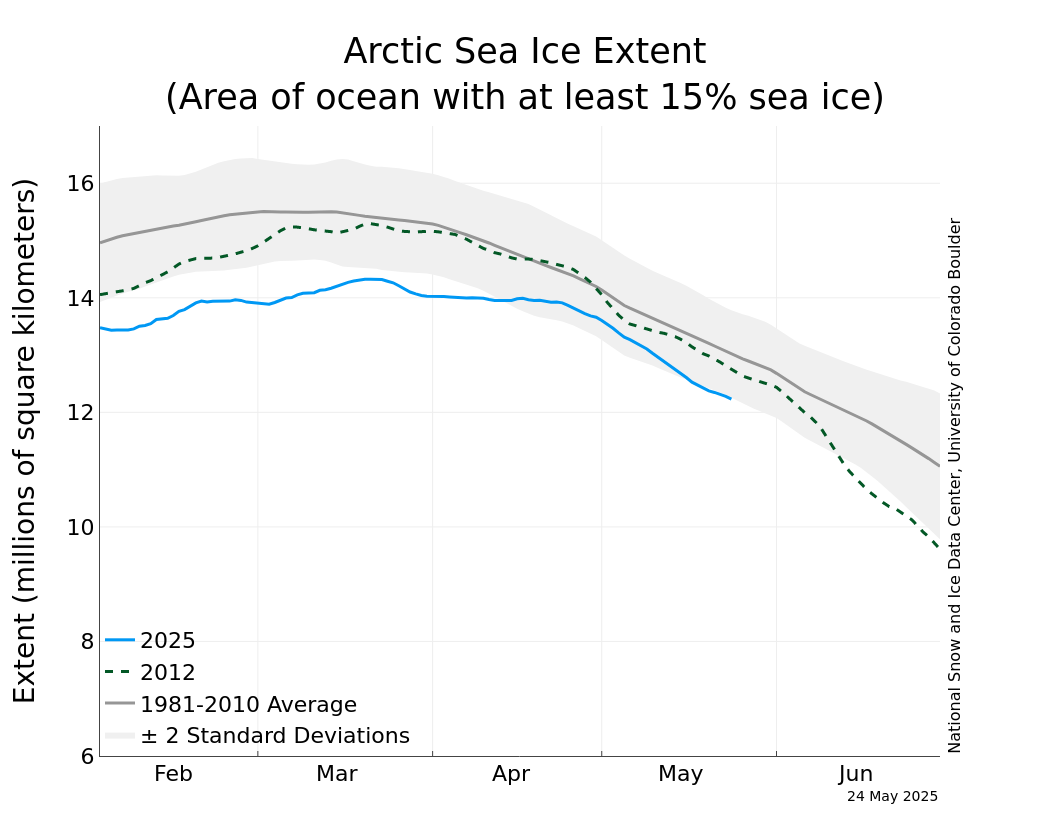
Claim 1972: “Artic specialist Bernt Balchen says a general warming trend over the North Pole is melting the polar ice cap and may produce an ice-free Arctic Ocean by the year 2000.” Christian Science Monitor, June 8, 1972.
Data: Ice coverage has fallen, though as of last month, the Arctic Ocean had 3.82 million square miles of ice cover — an area larger than the continental United States — according to The National Snow and Ice Data Center.
Claims 1974: “… when metereologists take an average of temperatures around the globe they find the atmosphere has been growing gradually cooler for the past three decades. The trend shows no indication of reversing. Climatological Cassandras are becoming increasingly apprehensive, for the weather aberrations they are studying may be the harbinger of another ice age. Telltale signs are everywhere–from the unexpected persistence and thickness of pack ice int eh waters around Iceland to the southward migration of a warmth-loving creature like the armadillo from the Midwest. When Climatologist George J. Kukla of Columbia University’s Lamont-Doherty Geological Observatory and his wife Helena analyzed satellite weather data fro the Northern Hemisphere, they found that the area of ice and snow cover had suddenly increased by 12% in 1971 and the increase has persisted ever since. Areas of Baffin Island in the Canadia Arctic, for example, were once totally free of any snow in summer; now they are covered year round.”
Later in the article, “Whatever the cause of the cooling trend, its effects could be extremely serious, if not catastrophic. Scientists figure that only a 1% decrease in the amount of sunlight hitting the earth’s surface could tip teh climatic balance, and cool the planet enough to send it sliding down the road to another ice age within only a few hundred years.”
Source: “Another Ice Age,” Time Magazine, June 24, 1974.
Claim 1989: “Using computer models, researchers concluded that global warming would raise average annual temperatures nationwide two degrees by 2010.” Associated Press, May 15, 1989.
Data: According to NASA, global temperature has increased by about 0.7 degrees Fahrenheit since 1989. And U.S. temperature has increased even less over the same period.

Claims: “Britain’s winter ends tomorrow with further indications of a striking environmental change: snow is starting to disappear from our lives.”
“Sledges, snowmen, snowballs and … are all a rapidly diminishing part of Britain’s culture, as warmer winters–which scientists are attributing to global climate change–produce not only fewer white Christmases, but fewer white Januaries and Februaries.”
“London’s last substantial snowfall was in February 1991.” “Global warming, the heating of the atmosphere by increased amounts of industrial gases, is now accepted as a reality by the international community.”
According to Dr. David Viner, a senior research scientist at the climatic research unit (CRU) of the University of East Anglia, within a few years “children just aren’t going to know what snow is” and winter snowfall will be “a very rare and exciting event.” Interviewed by the UK Independent, March 20, 2000.
“David Parker, at the Hadley Centre for Climate Prediction and Research in Berkshire, says ultimately, British children could have only virtual experience of snow.”
See “Snowfalls are now just a thing of the past.” The Independent. March 20, 2000.
Data: “Coldest December Since records began as temperatures plummet to minus 10 C bringing travel chaos across Britain.” Mailonline. Dec. 18, 2010.
Claim: “[By] 1995, the greenhouse effect would be desolating the heartlands of North America and Eurasia with horrific drought, causing crop failures and food riots … [By 1996] The Platte River of Nebraska would be dry, while a continent-wide black blizzard of prairie topsoil will stop traffic on interstates, strip paint from houses and shut down computers.” Michel Oppenheimer and Robert H. Boyle, Dead Heat, St. Martin’s Press, 1990. Oppenheimer is the Albert G. Milbank Professor of Geosciences and International Affairs in the Woodrow Wilson School and the Department of Geosciences at Princeton University. He is the Director of the Program in Science, Technology, and Environmental Policy at the Wilson School. He was formerly a senior scientist with the Environmental Defense Fund, the largest non-governmental organization in the U.S. that examines problems and solutions to greenhouse gases.
Data: When asked about these old predictions Oppenheimer stated, “On the whole I would stand by these predictions — not predictions, sorry, scenarios — as having at least in a general way actually come true,” he said. “There’s been extensive drought, devastating drought, in significant parts of the world. The fraction of the world that’s in drought has increased over that period.”
However, that claim is not obviously true. Data from NASA’s Goddard Space Flight Center show that precipitation — rain and snow — has increased slightly over the century.
—
How could scientists have made such off-base claims? Dr. Paul Ehrlich, author of “The Population Bomb” and president of Stanford University’s Center for Conservation Biology, told FoxNews.com that ideas about climate science changed a great deal in the the ’70s and ’80s.
Ehrlich told FoxNews.com that the consequences of future warming could be dire.
=============================================================
Source: University of Georgia, Terry College of Business. Economics 2200, Economic Development of the US, David B. Mustard
http://www.terry.uga.edu/~mustard/courses/e2200/pop.htm
UPDATE: reader Dennis Wingo writes in with this table:
Great article. I went into this myself in my book “Moonrush“, I took all of the predictions for the depletion of resources from the book and marked in red the deadlines that had already passed. All of the predictions failed.

“as is a probable peak in food calory production sometime around 2050.”
Predictions that far out are meaningless, because we have no idea what technology wil be available in 40 years from now. That’s about as sensible as trying to predict Google and Facebook in 1972.
Food is easy to produce, so long as you have cheap energy. Right now we mostly use sunlight to provide that energy, but if we should need to we could move production entirely indoors with artificial energy sources. We’re also heading toward producing meat in vats rather than animals over the next couple of decades, which should vastly increase the amount of crops available to humans.
Some years ago on a mailing list we tried to work out the ultimate carrying capacity of the Earth, and so long as we had a source of cheap energy no-one could get it down to less than trillions. I don’t think I’d want to live on an Earth with that many people, but there’s no fundamental reason we could find why it couldn’t be done.
Which is precisely why the anti-human movement want to increase the cost of current energy sources and prevent development of new ones.
D Böehm Stealey says:
January 19, 2013 at 12:16 pm
Mark Bofill,
Pamela and I go back a long way, to the beginning of WUWT. [I’m sure she remembers the part I wanted to cast her in: “Rain is all like super secret seal commando, aka Agent “Syng”man, an’ this Journalist hottie…” ☺]. I respect her intelligence and her views.
But men have a point of view, too. Don’t we get any say regarding our children? <–[hypothetical question; doesn't apply to me. Our boy has flown the coop, and now works at Siemens]. Remember that those are mens’ children, too.
[Not enough popcorn to start with the child support issues.]
—————————–
I meant no disrespect to Pamela whatsoever. I was intrigued by her post because while I really don't understand what she meant by 'female' reason, the overall tone of the message and the wish that men would stay out of the issue because of their gender and physical inability to gestate seemed frankly sexist to me and therefore controversial, but not completely out of the bounds of reasonable argument either.
I'm an odd duck in that I don't start with an a priori conviction that a sexist viewpoint is necessarily wrong, but it's certainly politically incorrect and therefore interesting (at least to me).
A woman carries the child to term and suffers hardship mere males conceiveth not. Does this disqualify men from having an intelligent opinion on the subject? Is that even what Pamela meant? 🙂 I don't know, but it's certainly fun to speculate.
D Böehm Stealey says:
January 19, 2013 at 12:16 pm
[Not enough popcorn to start with the child support issues.]
===============================================================
Humor break.
When my son was 12 or 13 he wanted to raise a little extra money so he wrote a flyer to put on the doors in the neighborhood. The problem was, if they didn’t know him and how old he was, it read like he was a “handyman” rather than a kid looking for odd jobs. We were discussing how to rephrase the flyer to communicate that when his little sister chimed in, “He could write it in crayon. Then they’d know.”
JohnH says:
January 19, 2013 at 2:32 am
You forgot the one about London disappearing under a mountain of Horse poo from Horse drawn carriages made in the 1800′s, the automotive car came to the rescue 😉
===========
And the Tube – 150 years old this month!
Auto
Willis says:
“The other thing that the Club of Rome folks never seemed to grasp is that the world doesn’t need resources. It needs the services those resources provide. In other words, the world doesn’t need copper for communications. It needs communications. Lately communications has migrated to optic fiber and to wireless. Think about how much copper it would have taken to provide telephone service around the planet. The Club of Rome error was in thinking we’d run out of copper to wire up the planet’s phones. We don’t need copper for phones, we just need phones.”
Cities of the world upto their armpits in horse c**:. The internal combustion engine!
Running out of copper: Fibre optics!
Running out of coal gas: Natural Gas!
Running out of Natural Gas: Shale Gas!
Running out of coal:Nuclear energy!
Running out of uranium: Thorium!
Ultimately Nuclear fusion, by the time we have ran out of hydrogen the Sun will be a red giant.
Mankind’s resourcefulness has kept us going for thousands of years and will continue to keep us going. Did our ancestors fret about no more flint? Along came bronze, when they thought that copper and tin might become scarce, along came iron, then aluminium, plastics, carbon fibre. Forests cut down for paper, then e-mail came along, the list is endless.
Doom-mongers are just that, doom-mongers, I remember when our Chief Medical Officer solemnly declared a few years ago that swine flu deaths could be upto 60,000. The actual toll was 250!
Ignore them all!!
Arthur Dent says:
January 19, 2013 at 2:26 am
As that famous philosopher Yogi Berra is quoted as saying “Predictions are difficult, especially about the future.” Human beings have a habit of making predictions that subsequently come back to haunt them:
“I think there is a world market for maybe five computers.” Thomas Watson, chairman of IBM, 1943
==========
In my world – I have a desk-top; a work laptop; an I-Pad (which I struggle with, still); and a Blackberry. My wife has a desk-top, and a laptop. plus a work desk-top. the kids have goodness knows waht. And I don’t think we are that unusual.
Making predictions is indeed difficult – especially about the future – Berra was spot-on
And climate?
I don’t know. But CO2 is only one variable. Albedo, the Sun’s output, continental positioning, vulcanism, and many others, may have an influence. Possibly a significant one.
Auto
Robert Austin says:
January 19, 2013 at 10:09 am
I find just so irksome to hear some righteous male bloviating on abortion, usually decrying the “murder of the unborn”. Since the male of the species will never be placed in the jeopardy of pregnancy, their opinion on the matter is worthless.
————————-
If males are somehow un-entitled to an opinion on abortion then why are you offering one? I also wasn’t aware that female opinion on abortion was unanimously pro-abort.
OT @ur momisugly D Böehm Stealey & Mark Bofill
While I don’t think a man’s wishes should be totally ignored, ultimately childbirth is not risk free and since you don’t have the right to force someone to risk their life for your child the decision ultimately rests with the mother until the fetus has personhood status and the right to life (an open question to be sure, but IMHO would be @ur momisugly viability (~28 weeks)). Admittedly, most everyone will voluntarily risk their life to save almost anyone else’s child, the key word there is voluntarily.
CodeTech says:
January 19, 2013 at 3:02 am
(Concludes) The planet is a HUGE place.
=====================
Right!
Too right!
Try going across the South Atlantic at about fifteen knots – nine days without seeing anything other than water and sea birds – more of the former, as you would expect!
Around Africa at ten knots – six weeks or so [and then anchor for two weeks off Rotterdam!].
Or note that Tennessee is about 500 miles from end-to-end.
Or patrolling the Somali basin – to try to prevent piracy – with twenty warships, is like patrolling the contiguous USA [the lower 48] with twenty squad cars – albeit each able to drive for 24/7/365 – if limited to 35 mph [maximum]. Forty-eight states; twenty squad cars: you do the maths. Not all that many will have squad car even half the time. Idaho sees one every Tuesday, unless there’s an ‘R’ in the month . . . . .
And the recent nastiness in Algeria – that country measures 2,381,741 sq km [per CIA Factbook]; the largest country wholly within Europe is France – 643,801 sq km – less than a third the size. And the UK – right up there at #80, smaller than Gabon or Guinea – 243,610 sq km.
The planet is a HUGE place for we humans.
John West,
To boil the discussion down to it’s essence: where, exactly, do we draw the line? What [legal] say do men have in this particular discussion? Any at all?
James Cross says:
January 19, 2013 at 4:40 am
Predictions are very hard, especially about the future. – Niels Bohr
=============
Well, one of those chaps – if not Berra, nor Bohr, the Wilde or Lincoln or Churchill . . . . . .
I don’t think predictions are easy, though, whoever is rightly attributed with this. [Shakespeare? groucho Marx?]
Auto
D Böehm Stealey says:
“What [legal] say do men have in this particular discussion?”
As with all societal decisions, voting eligible men and women legally “have a say” as to when a fetus is considered a person. As for “a say” on an individual pregnancy, again, it’s the woman whose life is at risk and therefore ultimately her decision (pre-fetus-personhood).
– – – – – – – –
Pamela Gray,
In the consideration of the issues surrounding abortion and population bomb doomsayers I am guided by a purely modern intellect whom I have come to admire.
John
This is a really good short video on the subject (strong language warning):
Re: Limits to Growth: A couple of folks have pointed out that the issue with the failed “predictions” is that they were based on an invalid model. One major failure of limits to growth predictions is the failure to consider how dramatically wealth has increased. The Simmons paper discussed above discusses India and China as sort of poster children for world poverty. Consider this: http://en.wikipedia.org/wiki/List_of_countries_by_number_of_mobile_phones_in_use. While I agree there is enormous poverty – it is a different type of poverty than 50 years ago. So the resources we need to live consume a much smaller proportion of the the income that we have.
Re: Peak oil: Willis pretty much covered it at 11:36 am. I have some observations:
1. The discussion claiming validity for peak oil now distinguishes between conventional and unconventional oil. I’m not sure when this distinction crept into the terminology. I suspect that when what is unconventional oil today “peaks” we will have a another change in the terms of the discussion for whatever comes next to meet our needs for hydrocarbon fuel.
2. It is likely that the peak oil folks will eventually be proven as correct as anybody who might have predicted peak horses in the 19th century. Not because we will run out of ways of finding or creating oil, but because we will move on and not have a need for ever increasing supplies of oil.
3. Peak oil theory suffers from the same income problem as the Club of Rome. Irrespective of how much energy costs today, it is roughly the same or a smaller proportion of (in the US) personal consumption expenditures.(you can pull the chart here: http://www.bea.gov/iTable/index_nipa.cfm.
mogamboguru says:
January 19, 2013 at 7:54 am
Sam Norton (@Elizaphanian) says:
—————————————————————————————————-
Try “Devaluation of the Dollar”.
fact is that the Dollar was devaluated (inflated) three-fold over the exact timeframe to which you are referring to (see the Dollar vs. Gold-ratio). Therefore, the price of Crude has in fact not changed one bit. It’s only the currency in which it is priced, which has lot two-thirds of it’s value, compared to oil / Gold, during the past 19 years.
Hyperinflation coming – anyone? .
====================================
Well, with Quantitative Easing – and the imperative need for (mostly Western) Governments to inflate their way out of debt – and their utter inability to control inflatiom when it does ignite – I vote ‘Yes’ .
Indeed – I vote ‘Yes – in spades’.
Look for index-linked thinggummies – especially if – as in the UK – they are backed by the Government – ILSCs etc. A decent mix of shares may give you some coverage, too.
Hyperinflation coming – anyone? .
Ummmmmmmmmmmmm – yes.
Planet Earth is a huge place for humans, particularly when enjoyed at human scale rates. I use a rule of six while traveling to scale my observations. An A/C travels about 350 mph, an automobile travels about 1/6 of that ~60 mph, a bicyclist at about 1/6 of that at ~10 mph and a pedestrian might do 3 miles in an hour.
I saw much of the US state of Georgia riding my bicycle nearly 100 miles per day. Georgia’s pine barrens now are divided into cropped woodlots that are ten minutes on a side. One rides past a maximally dense mono-culture of pine for ten minutes, followed by ten minutes of scarified stubblefield, and then ten minutes of saplings – all day long on a bicycle and in hours from an air-conditioned automobile.
Same for potatoes in Illinois (ever been overwhelmed by potato blossom fragrance?), wheat in Nebraska and corn in Kansas. Bicycle the Badlands (Theodore Roosevelt N.P.) and imagine walking behind a wagon pulled by oxen – for months. From the ground, from the best of vantage points, one cannot see the vista of the Grand Canyon in one eyeful. Siberia is even bigger and Asia bigger yet. How many years did it take humankind to walk out of Africa?
Auto
I take my stab with my own predictions while I look at Ehrlich’s latest. None of them are tongue in cheek and they are optimistic although a bit vague on timelines.
http://broadspeculations.com/2013/01/19/predictions-are-very-hard/
The predictions of scientists aren’t scientific predictions, except when they derived from well articulated and empirically supported theories.
I wish the media understood this.
Robert say’s at 1.47
Robert Only 20% of a barrel of oil goes towardes fuel production and here’s a list of what the rest goes towardes List of 144 of about 6000 http://www.ranken-energy.com/Products%20from%20Petroleum.htm .
Rud Istvan says:
January 19, 2013 at 10:30 am
Many others have commented and adequately addressed your claims on peak oil which I won’t address in detail.
Unfortunately one of your questionable claims relates to heavy oil in Venezuela. Increase in production has stopped because of Chavez, not peak oil. He has lost all the engineers etc that know how to find and produce the heavy stuff. Also he has run off all the foreigners who invested and brought the technology to his country. His own countrymen have moved to neighboring countries with all their expertise and exploring for heavy oil elsewhere. Failure to mention this detracts from the credibility of your claims.
New finds and local production often peak because of political positions, just like in the US where virtually all the efforts to explore and produce moved overseas until exploration and production resumed on lands not controlled by federal politicians. One exception to this occured when the Clinton administration encouraged production in the Gulf and Bush also opened up opportunities. Why do you think large oil companies like ExxonMobil take significant risk by investing overseas and ultimately over 50% of their earnings come from these investments. It’s bad government regulations and putting high potential federal lands off limits that forced companies to increase activities overseas.
I lived in Mexico in the late 60’s working on a project to process heavy crudes and people in the know informed me that virtually no new oil finds were realized after the US companies were thrown out during Nationalization circa 1930. Only many decades later were foreign companies allowed back and new production accelerated.
Whatever will eventually be shown the truth about CAGW there is no doubt the human race is a blot on the planet. I certainly don’t subscribe to the CAGW viewpoint but I despair when looking at the destruction of the environment routinely and continually occurring.
<<<<<<<<<<>>>>>>>>>
I remember in my economic minerals course (1975) learning how huge resources had been devoted to finding a photographic process which did not use silver. Polymers, metallic salts, nothing could replace the need for silver…..ummm…..gosh, that digital film is cheap!
“… I certainly don’t subscribe to the CAGW viewpoint but I despair when looking at the destruction of the environment routinely and continually occurring…”
Ian, that’s a fair comment and I strongly suspect that you will find the vast majority of WUWT readers agreeing with you, myself included. I grieve for the misdirection CAGW has caused to genuine environmental concerns – all those $billions needlessly diverted away from real issues; real problems that could have been addressed over the past two decades. Instead all of that money has been frittered away chasing phantoms predicted by fictional digital models… It’s a modern tragedy – and history will not be kind to the perpetrators.
@ur momisugly andrewmharding at 12:53
You, sir, win the prize, having grasped the situation precisely. Nobody cares about oil. We do care about the products made from it, and what those products can do.
The chemical engineers have already paved the way for doing without oil. We have gas-to-liquids plants that produce diesel and jet fuel. We can easily make any other hydrocarbon, such as gasoline or lubricating oils. We are not anywhere close to running out of gas.
We can do the same with coal, and some places do that already. There are hundreds of years of known coal reserves.
The Earth’s crust has barely been scratched.