…the predicted size makes this the smallest sunspot cycle in about 100 years

(Updated 2012/05/01)
From: http://solarscience.msfc.nasa.gov/predict.shtml
The current prediction for Sunspot Cycle 24 gives a smoothed sunspot number maximum of about 60 in the Spring of 2013. We are currently over three years into Cycle 24. The current predicted size makes this the smallest sunspot cycle in about 100 years.
The prediction method has been slightly revised. The previous method found a fit for both the amplitude and the starting time of the cycle along with a weighted estimate of the amplitude from precursor predictions (polar fields and geomagnetic activity near cycle minimum). Recent work [see Hathaway Solar Physics; 273, 221 (2011)] indicates that the equatorward drift of the sunspot latitudes as seen in the Butterfly Diagram follows a standard path for all cycles provided the dates are taken relative to a starting time determined by fitting the full cycle. Using data for the current sunspot cycle indicates a starting date of May of 2008. Fixing this date and then finding the cycle amplitude that best fits the sunspot number data yields the current (revised) prediction.
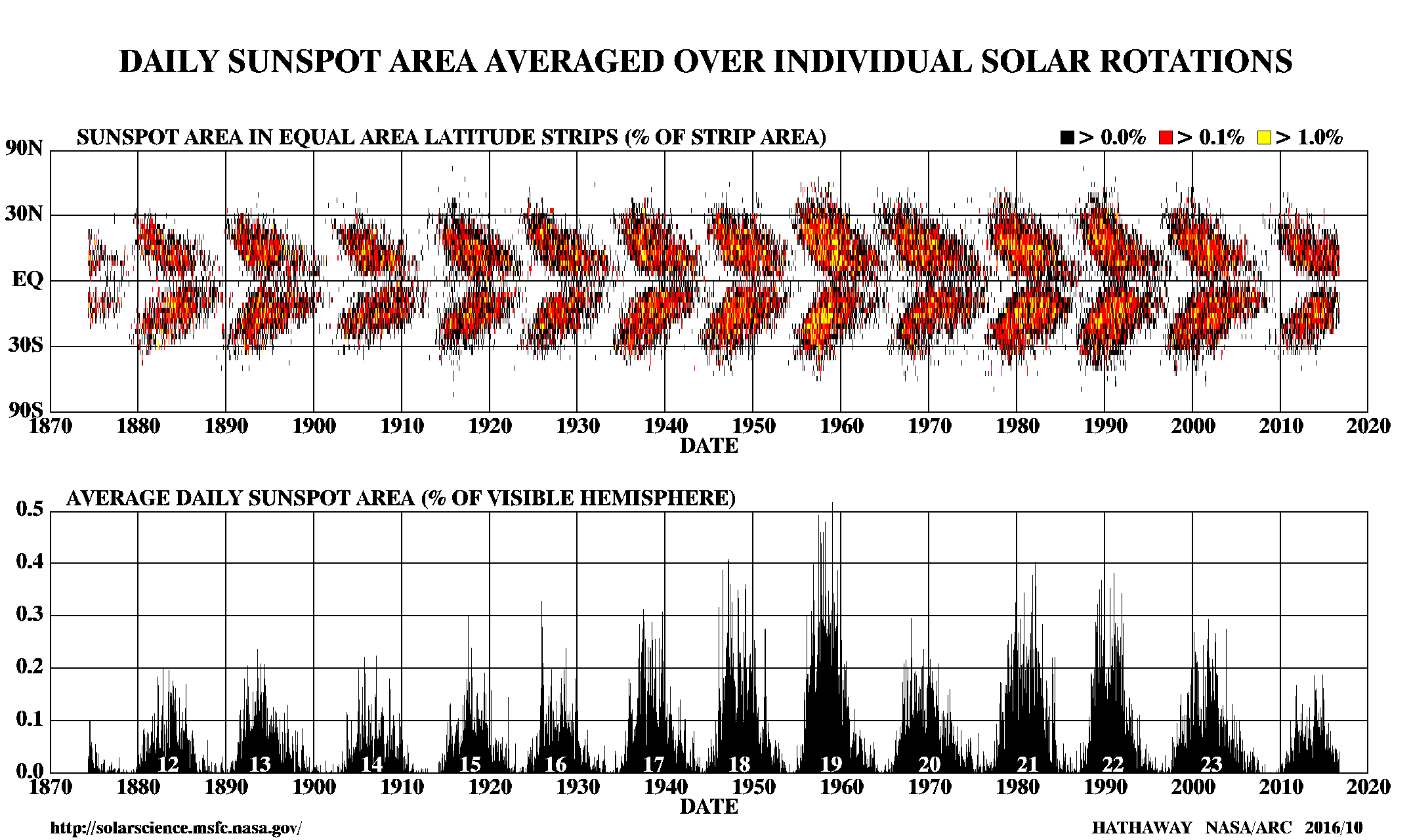

Click on image for larger version.
Predicting the behavior of a sunspot cycle is fairly reliable once the cycle is well underway (about 3 years after the minimum in sunspot number occurs [see Hathaway, Wilson, and Reichmann Solar Physics; 151, 177 (1994)]). Prior to that time the predictions are less reliable but nonetheless equally as important. Planning for satellite orbits and space missions often require knowledge of solar activity levels years in advance.
A number of techniques are used to predict the amplitude of a cycle during the time near and before sunspot minimum. Relationships have been found between the size of the next cycle maximum and the length of the previous cycle, the level of activity at sunspot minimum, and the size of the previous cycle.
Among the most reliable techniques are those that use the measurements of changes in the Earth’s magnetic field at, and before, sunspot minimum. These changes in the Earth’s magnetic field are known to be caused by solar storms but the precise connections between them and future solar activity levels is still uncertain.
Of these “geomagnetic precursor” techniques three stand out. The earliest is from Ohl and Ohl [Solar-Terrestrial Predictions Proceedings, Vol. II. 258 (1979)] They found that the value of the geomagnetic aa index at its minimum was related to the sunspot number during the ensuing maximum. The primary disadvantage of this technique is that the minimum in the geomagnetic aa index often occurs slightly after sunspot minimum so the prediction isn’t available until the sunspot cycle has started.
An alternative method is due to a process suggested by Joan Feynman. She separates the geomagnetic aa index into two components: one in phase with and proportional to the sunspot number, the other component is then the remaining signal. This remaining signal has, in the past, given good estimates of the sunspot numbers several years in advance. The maximum in this signal occurs near sunspot minimum and is proportional to the sunspot number during the following maximum. This method does allow for a prediction of the next sunspot maximum at the time of sunspot minimum.
A third method is due to Richard Thompson [Solar Physics 148, 383 (1993)]. He found a relationship between the number of days during a sunspot cycle in which the geomagnetic field was “disturbed” and the amplitude of the next sunspot maximum. His method has the advantage of giving a prediction for the size of the next sunspot maximum well before sunspot minimum.
We have suggested using the average of the predictions given by the Feynman-based method and by Thompson’s method. [See Hathaway, Wilson, and Reichmann J. Geophys. Res. 104, 22,375 (1999)] However, both of these methods were impacted by the “Halloween Events” of October/November 2003 which were not reflected in the sunspot numbers. Both methods give larger than average amplitude to Cycle 24 while its delayed start and low minimum strongly suggest a much smaller cycle.
The smoothed aa index reached its minimum (a record low) of 8.4 in September of 2009. Using Ohl’s method now indicates a maximum sunspot number of 70 ± 18 for cycle 24. We then use the shape of the sunspot cycle as described by Hathaway, Wilson, and Reichmann [Solar Physics 151, 177 (1994)] and determine a starting time for the cycle by fitting the latitude drift data to produce a prediction of the monthly sunspot numbers through the next cycle. We find a maximum of about 60 in the Spring of 2013. The predicted numbers are available in a text file, as a GIF image, and as a pdf-file. As the cycle progresses, the prediction process switches over to giving more weight to the fitting of the monthly values to the cycle shape function. At this phase of cycle 24 we now give 66% weight to the amplitude from curve-fitting technique of Hathaway, Wilson, and Reichmann Solar Physics 151, 177 (1994). That technique currently gives similar values to those of Ohl’s method.
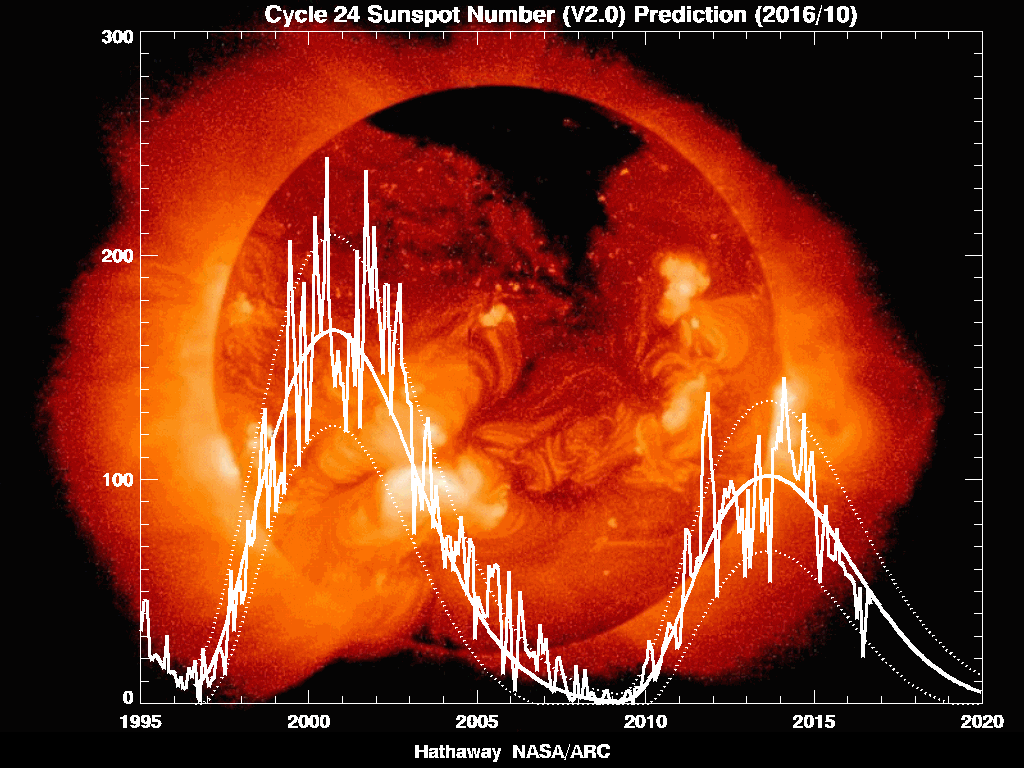
Note: These predictions are for “smoothed” International Sunspot Numbers. The smoothing is usually over time periods of about a year or more so both the daily and the monthly values for the International Sunspot Number should fluctuate about our predicted numbers. The dotted lines on the prediction plots indicate the expected range of the monthly sunspot numbers. Also note that the “Boulder” numbers reported daily at www.spaceweather.com are typically about 35% higher than the International sunspot number.
Another indicator of the level of solar activity is the flux of radio emission from the Sun at a wavelength of 10.7 cm (2.8 GHz frequency). This flux has been measured daily since 1947. It is an important indicator of solar activity because it tends to follow the changes in the solar ultraviolet that influence the Earth’s upper atmosphere and ionosphere. Many models of the upper atmosphere use the 10.7 cm flux (F10.7) as input to determine atmospheric densities and satellite drag. F10.7 has been shown to follow the sunspot number quite closely and similar prediction techniques can be used. Our predictions for F10.7 are available in a text file, as a GIF image, and as a pdf-file. Current values for F10.7 can be found at: http://www.spaceweather.ca/sx-4-eng.php.

Discover more from Watts Up With That?
Subscribe to get the latest posts sent to your email.
Robert in Perth- It was a genuine pleasure to read your post today.
MarkW says: May 3, 2012 at 9:40 am
Allan says: “Serious global cooling could significantly decrease the global grain harvest, which would have major impacts on humanity and the environment.”
Mark says: “There’s plenty of spare (agricultural) capacity should global temperatures turn down.”
OK Mark, let me try to better quantify the question:
1. IF Earth returns to the colder global temperatures of the Maunder Minimum circa 1700, what will be the impact on the global grain harvest?
How long would it take for agriculture to adapt and what grain stores would be required to mitigate shortfalls prior to such adaptation?
What other impacts would matter – e.g. energy supply?
Are we currently capable of managing the impacts of this natural global cooling, or not?
2. Same question for the Dalton Minimum circa 1800.
Does anyone know if this question has been posed and adequately answered amidst all the billions of dollars that have been spent on global warming (aka “climate change”) research?
Because, based on the evidence to date, the catastrophic humanmade global warming crisis does not exist, and natural global cooling, whether moderate or severe, is increasingly probable.
__________
Here is something I just found that I want to remember:
http://ktwop.wordpress.com/2012/03/10/solar-cycles-and-the-landscheidt-minimum/
Does anybody have the animated gif file of the changing Nasa predictions? It used to be on SolarCycle24.com I believe and it was a compilation of the monthly predictions from Nasa that inevitably went down and spread out but I’ve been unable to locate it’s source. It would be interesting to see the predictions animated from 2003 until now.
I guess we can call the “smallest cycle in 100 years” the “consensus scientific view” now.
I wanted to share a great paper by Alexander and others on linkages between solar activity and climate:
Linkages between solar activity, climate predictability and water resource development*
W J R Alexander, F Bailey, D B Bredenkamp, A van der Merwe and N Willemse
TECHNICAL PAPER, JOURNAL OF THE SOUTH AFRICAN, INSTITUTION OF CIVIL ENGINEERING, Vol 49 No 2, June 2007, Pages 32–44, Paper 659
This study is based on the numerical analysis of the properties of routinely observed
hydrometeorological data which in South Africa alone is collected at a rate of more than
half a million station days per year, with some records approaching 100 continuous years
in length. The analysis of this data demonstrates an unequivocal synchronous linkage
between these processes in South Africa and elsewhere, and solar activity. This confirms
observations and reports by others in many countries during the past 150 years.
It is also shown with a high degree of assurance that there is a synchronous linkage
between the statistically significant, 21-year periodicity in these processes and the
acceleration and deceleration of the sun as it moves through galactic space. Despite a
diligent search, no evidence could be found of trends in the data that could be attributed
to human activities.
It is essential that this information be accommodated in water resource development and
operation procedures in the years ahead.
vukcevic says:
May 3, 2012 at 10:28 am
Here it can be seen that geomagnetic changes are of order of hundreds of nTesla
Actually over the whole period something like 10,000 nT, and the correlation you show is not that great, just compare the dBz around 1780 and 1980 where solar activity were about equal, e.g.
“solar activity around AD 1150 and 1600 and in the late eighteenth century was probably comparable to the recent satellite-based observations” http://www.leif.org/EOS/muscheler05nat_nature04045.pdf or
Figure 10 of http://www.leif.org/EOS/muscheler07qsr.pdf
Inevitable conclusion is that the 10Be Antarctica’s data are also of spurious value.
The 10Be record has been corrected for changes in the geomagnetic field, so no such conclusion can be made.
Tim B says:
May 3, 2012 at 11:25 am
I guess we can call the “smallest cycle in 100 years” the “consensus scientific view” now.
It certainly will be when the cycle is over.
Brian H says:
May 3, 2012 at 12:01 am
Daniel Vogler says:
May 2, 2012 at 10:43 pm
solarham.com now has his own private server. his host was not supporting the amount of hits he was getting, had to get his own. Its up and running now, http://www.solarham.com/solarham.com works.
No, it doesn’t. The duplicated “solarham.com” is unnecessary and very peculiar. Just http://www.solarham.com
Oh he fixed it, Been following him on Facebook. he had the /solarham.com until it was fixed.
http://www.facebook.com/SolarHam
“Website Status Update #3
The domain transfer continues this morning. I am unable to make any updates to the site at this time, however you can access SolarHam.com at the following link. http://solarham.com/solarham.com/ . This link is temporary,”
Peak of this solarsycle is behind and it is 60. South peaks next january but it’s about 55 smoothed.
u.k. (us)
“Is it time we stopped trying to predict a non-linear, chaotic system.
It might cut down on foolish attempts to control same ?”
Wisdom.
Leif Svalgaard says, May 3, 2012 at 4:10 am
I expect the South to pick up, it has already begun
Leif, I keep seeing statements to the effect that the northern pole has already switched. How is this determined?
If I plot the WSO polar field strength data it seems the only basis for saying that is to take the raw values including the projection effect, which doesn’t seem reasonable. Given the way the 20nHz filter operates, filtered values are subject to change up to 18 months in arrears but unless there is a rapid swing, the average remains fairly solid throughout and north/south isn’t revised much after about six months. On that basis the current plot looks like this:
http://img718.imageshack.us/img718/5761/20120412.png
Seems to me South will have to pick up pretty sharpish to see both poles switch followed by a lag to reach sunspot max in mid 2013 as has been suggested. I’m guessing it’ll drag on a good deal longer. Maybe we’re looking at a camel, either a double humper or it’ll spit a lot 🙂
Leif Svalgaard says:
May 3, 2012 at 11:57 am
………….
I have added the Dome Fuji data (I have a data file only to 1900), the correction you mention doesn’t appear to be very effective.
http://www.vukcevic.talktalk.net/SSN-dBzAa.htm
AJB says:
May 3, 2012 at 12:35 pm
Leif, I keep seeing statements to the effect that the northern pole has already switched. How is this determined?
I would look at my plot http://www.leif.org/research/WSO-Polar-Fields-since-2003.png and say the North polar field [blue] is reversing right now [dashed blue curve]. If you look at the high resolution data http://sdowww.lmsal.com/sdomedia/SunInTime/2012/05/03/f_HMImag_171.jpg [you may have to click on the image depending on your browser] you can see lots of orange dots [positive polarity] at both poles.
Seems to me South will have to pick up pretty sharpish to see both poles switch
If the past is any guide, the pole can switch rapidly, e.g. http://www.leif.org/EOS/Babcock1959.pdf
“The sign of the north polar field, however, remained positive until November, 1958, when it rather abruptly became negative”.
vukcevic says:
May 3, 2012 at 12:58 pm
the correction you mention doesn’t appear to be very effective.
I have no idea what you are referring to.
AJB says:
May 3, 2012 at 12:35 pm
If I plot the WSO polar field strength data it seems the only basis for saying that is to take the raw values including the projection effect
The WSO observes a very large area as one pixel, see fig. 1 of http://www.leif.org/research/The%20Strength%20of%20the%20Sun's%20Polar%20Fields.pdf
So the field at the pole can have switched, while the average field inside the black square may still be influenced by remaining old fields in the equatorward portion of the square.
Thanks for the explanations, Leif. Much appreciated.
Dr. Svalgaard,
My understanding, NASA does NOT make predictions about Solar activity and Dr. Hathaway’s predictions, though on his NASA website with NASA logos in the page banner, are purely his own effort and not reflective of any official NASA position.
Why is Hathaway steering the public, using his home grown effort, away from official statements made by NOAA?
This doesn’t appear to support intra-agency coordination.
Am I missing something important?
John from CA says:
May 3, 2012 at 4:35 pm
Why is Hathaway steering the public, using his home grown effort, away from official statements made by NOAA?
NASA is not making predictions and Hathaway’s is his alone. That the NASA logo appears does not mean that this is an official NASA website or prediction. There is nothing wrong with Hathaway using the logo. What is wrong is that people misrepresents this. Sometimes simply to throw mud on ‘officialdom’.
Allan MacRae says:
May 3, 2012 at 11:08 am
—————
I recall from James Delingpole’s book “Killing the Earth to Save It” that the global grain surplus (presumably the qty in storage not required to meet immediate consumption needs) is around 15%. In other words, pretty slim. Or to put it another way, no real buffer at all.
I think you had it spot on Allan. If it cools significantly a lot of people are going to be in trouble. Sadly, those presently living hand to mouth will likely fall off the perch in large numbers.
Andall completely preventable. All the trillions of dollars stolen and wasted on AGW mitigation related scams but nothing (?) for the far more realistic prospect of a rapid global cooling. I fear that if it does come to pass, in time this inaction and obfuscation will come to be seen by many as a crime against humanity. And for the ‘Club of Rome’ types it clearly was a pre-meditated one.
Isn’t this article on the NASA website just another manipulation by the AGW conspiracy who use fake sunspot data to make the climate truth movement look bad, when global cooling doesn’t happen and global warming continues despite allegedly decreasing solar activity?
[REPLY: Dr. Perlwitz, this is one of your most infantile, pathetic efforts yet. The view from inside the NASA/GISS fishbowl must be pretty warped indeed. If you can engage here with substance, do it, otherwise get lost. -REP]
Mike Lewis asked:
I do not see why a somewhat decreased solar activity would have a strong effect on the ocean heat content or lead to a drop of the globally averaged surface temperatures, in comparison to the effect by other climate drivers that increase the heat content and the surface temperatures. At least from a point of view of the energy balance.
The radiative forcing between maximum and minimum of the solar cycle has been about 0.3 W/m^2, i.e. between the average over the whole cycle and the minimum, let’s say 0.2 W/m^2 to be conservative. On the other hand, the increase of the radiative forcing by CO2 is about 0.25 W/m^2 per decade at the current rate of change. So, even if the solar activity had staid at the most recent solar activity minimum forever, such decreased solar activity could counteract the radiative forcing increase by CO2 of only 5 to 10 years.
So, I do not see that the global cooling so many here are expecting will happen, if the current rate of increase of greenhouse gases in the atmosphere continues, even if the sun goes to a Maunder minimum like state during the next decades. It will delay global warming only a little bit compared to how it would be if the solar cycles continued as in recent decades, everything else equal.
@REP (whoever it is):
It’s funny how the moderation of an opinion blog that again and again ridicules, smears, or otherwise personally attacks scientists who publish papers with results of research not liked by the maintainers of the website and by many of the commenters can’t even take some little sarcasm that mocks the mindset of many here. You are very sensitive for someone who doesn’t care much about the sensitivity of the ones attacked by this site and its devote followers. Also, your bias shows, since you felt challenged to comment in this case, compared to all the really nasty verbal things produced by other people here you apparently don’t mind, as long as it goes against those evil climate scientists.
[REPLY: Being a little disingenuous are we? This is not the first time you’ve tried to smuggle a stupid, outrageous comment on to this board on the theory that the stupid, ignorant deniers will swallow anything that is anti-science. It is also rather telling that you cannot tell the difference between “ridicules, smears, or otherwise personally attacks scientists who publish papers with results of research not liked by the maintainers of the website” and the systematic deconstruction of appallingly shoddy, politically motivated pseudo-science. As for who, I am: I’m the one who can recognize when he’s not the sharpest knife in the drawer. -REP]
@REP (whoever it is):
“Tried to smuggle”? Why do you say “tried to smuggle”? And not just “wrote”?
This isn’t the hypothesis. My comment is actually based on following hypothesis: The mindset of most of the “skeptic” crowd is setup on the premise that most of the evidence in support of anthropogenic global warming presented by a whole body of research done by thousands of scientists from all over the world for the last decades is fabricated, by manipulating or inventing the underlying data, or by presenting faked results in the peer reviewed scientific literature, and on the belief that there was some kind of global conspiracy that had produced such a “global warming swindle”. A conspiracy that has usurped all the relevant international scientific institutions, academies, and government agencies, pursuing some sinister agenda and driven by non-scientific motives (like getting riches and power by working in academia, achieving nerd world control, or whatever), devilish oppressing the truth, which has its bastion in the Internet blogosphere with blogs like this one here, and in organizations like the Heartland Institute.
If you believe this is what you are doing here. I see mostly disinformation about climate science and the research that is done in the field.
Well, I look forward to your systematic deconstruction of the politically motivated pseudo-science produced by the Heartland Institute and by the crowd at their next “climate conference”.
Also, will there be an article by Anthony Watts on this blog strongly condemning the recent outrageous, politically motivated PR smear campaign by the Heartland Institute that has put up billboards where it equalizes, by applying guilt by association, people, including many climate scientists, who maintain that anthropogenic global warming is real and threatening, with mass and serial murderers? We will see.
[REPLY: It was your boss, “Death Trains” Hansen who suggested “crimes against humanity” trials for fossil fuel CEOs if I recall. Why don’t you attend the Heartland Conference your self and do the deconstruction. I plan to be there and will happily buy you a beer. You might also consider reading Montford’s The Hockey Stick Illusion and Laframboise’s Delinquent Teenager. -REP]
@REP (whoever it is):
Firstly, your reference to Hansen in reply to what I said about the Heartland Institute campaign is a tu quoque argument. Secondly, Hansen expressed his personal opinion about the consequences of coal burning for human life, although I wouldn’t have used this choice of words. His statement refers to the causal relationship between coal burning and the death of people how he sees it. How is this equal to smearing people by purely applying guilt by association, which is what the Heartland Institute does in their campaign and in their justification for this smear campaign?[*] (BTW: Just for clarification. Hansen is technically not by boss).
[*] http://climateconference.heartland.org/our-billboards/
As for your book recommendations. I prefer scientific publications that genuinely inform me about results from research in climate science, but if you think I could learn something from those books, what about I give you my address, and you send the books to me through Amazon (or whatever bookstore you prefer)?
What about my hypothesis about the mindset of most “skeptics”? Do you think I’m way off how I describe the views of this crowd (your view?)? You have fallen silent about this.
[REPLY: This is a volunteer “part-time” job and I’m off to do some errands. If you pay for your own books you’re more likely to read them. Who knows, a whole new vista may open up for you. -REP]
To Jan P. Perlwitz
I’d answer that the mindset of the majority of people that support the hypothesis of AGW misunderstand “the greenhouse effect” of CO2 and that misunderstanding has no bearing on the actual science or scientists that study atmospheric CO2. I’d also observe that radiative power difference may not be the prime driver in ocean temperature. It seems rather obtuse to be able to understand that CO2 isn’t even a source of energy but can affect ocean temperature while not contemplating that slight differences in the type of solar radiation might affect things like cloud cover. It’s the observation and correlation of sunspot activity to historical temperature changes that’s of interest. Just as AGW is the observation of the correlation of CO2 concentration with temperature changes. Turning correlation into causation is where the science comes in. Every scientist should be skeptical of every theory that turns correlation into causation but it doesn’t mean they shouldn’t explore those theories and propose them. Lastly, terms like “Climate Change Denier” that is reminiscent of “Holocaust Denier” is particularly offensive to me. Associating a difference of opinion about how, what, where and when natural resources should be used with someone that consciously decides to murder people is abhorrent. I certainly understand that AGW proponents believe their solutions will save lives even if I disagree and believe personally that those same solutions will cost lives. Please return the courtesy.
Jan P. Perlwitz says:
May 4, 2012 at 6:34 am
Don’t see future cooling, so how about increased global cloud levels for one?
Matt G says:
May 4, 2012 at 1:02 pm
Don’t see future cooling, so how about increased global cloud levels for one?
Global low [the ones supposedly influenced by cosmic rays] cloud cover is actually decreasing:
http://mclean.ch/climate/Cloud_global.htm
Jan P. Perlwitz
On uncertainty, see: Nigel Fox of NPL Uncertain, impaired, models, especially his observations and presentation that cloud uncertainties are 93% of total. With sign and magnitude of water vapor feedback dominated by clouds, there is not much quantitative left to support CO2 arguments pro/con.