…the predicted size makes this the smallest sunspot cycle in about 100 years

(Updated 2012/05/01)
From: http://solarscience.msfc.nasa.gov/predict.shtml
The current prediction for Sunspot Cycle 24 gives a smoothed sunspot number maximum of about 60 in the Spring of 2013. We are currently over three years into Cycle 24. The current predicted size makes this the smallest sunspot cycle in about 100 years.
The prediction method has been slightly revised. The previous method found a fit for both the amplitude and the starting time of the cycle along with a weighted estimate of the amplitude from precursor predictions (polar fields and geomagnetic activity near cycle minimum). Recent work [see Hathaway Solar Physics; 273, 221 (2011)] indicates that the equatorward drift of the sunspot latitudes as seen in the Butterfly Diagram follows a standard path for all cycles provided the dates are taken relative to a starting time determined by fitting the full cycle. Using data for the current sunspot cycle indicates a starting date of May of 2008. Fixing this date and then finding the cycle amplitude that best fits the sunspot number data yields the current (revised) prediction.
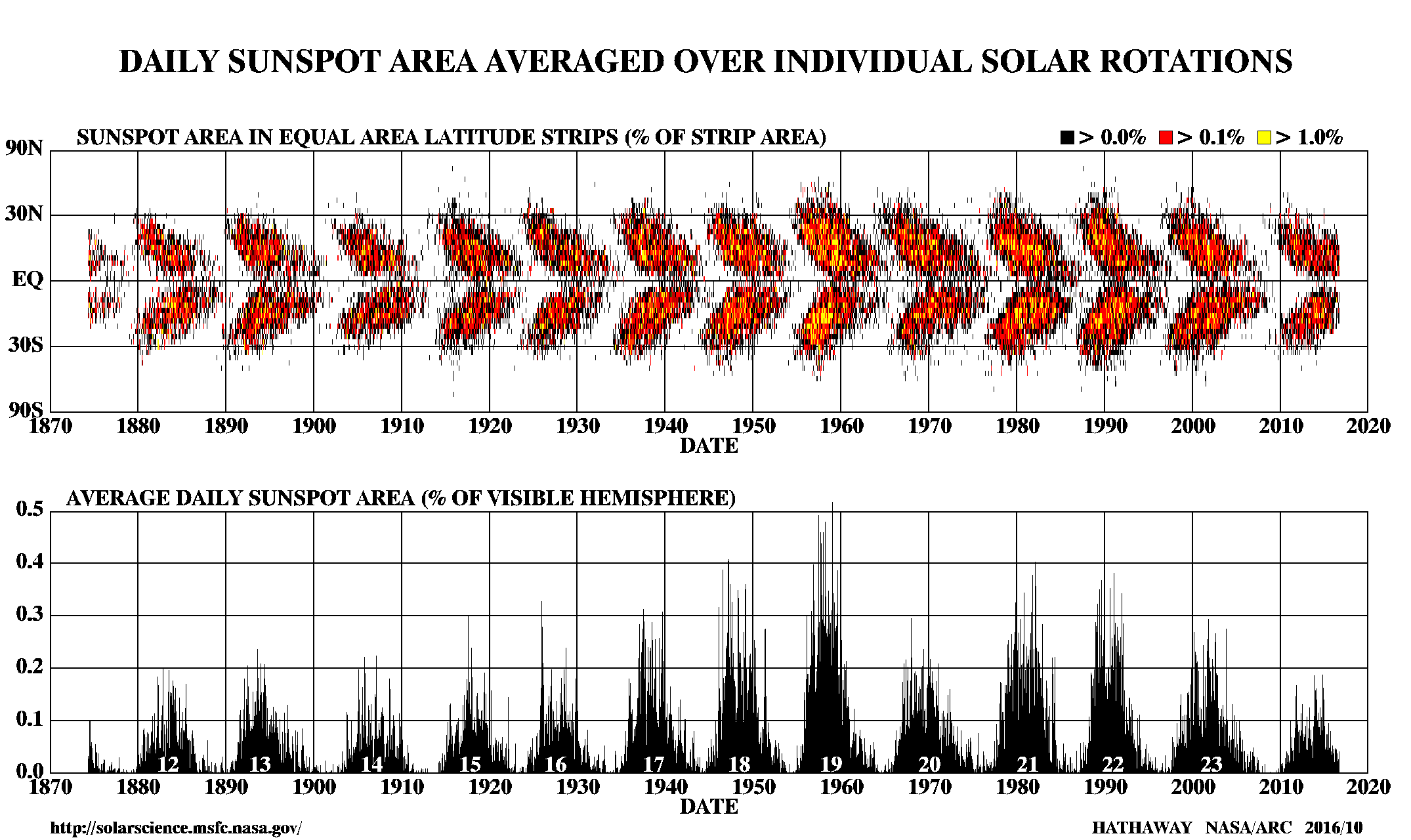

Click on image for larger version.
Predicting the behavior of a sunspot cycle is fairly reliable once the cycle is well underway (about 3 years after the minimum in sunspot number occurs [see Hathaway, Wilson, and Reichmann Solar Physics; 151, 177 (1994)]). Prior to that time the predictions are less reliable but nonetheless equally as important. Planning for satellite orbits and space missions often require knowledge of solar activity levels years in advance.
A number of techniques are used to predict the amplitude of a cycle during the time near and before sunspot minimum. Relationships have been found between the size of the next cycle maximum and the length of the previous cycle, the level of activity at sunspot minimum, and the size of the previous cycle.
Among the most reliable techniques are those that use the measurements of changes in the Earth’s magnetic field at, and before, sunspot minimum. These changes in the Earth’s magnetic field are known to be caused by solar storms but the precise connections between them and future solar activity levels is still uncertain.
Of these “geomagnetic precursor” techniques three stand out. The earliest is from Ohl and Ohl [Solar-Terrestrial Predictions Proceedings, Vol. II. 258 (1979)] They found that the value of the geomagnetic aa index at its minimum was related to the sunspot number during the ensuing maximum. The primary disadvantage of this technique is that the minimum in the geomagnetic aa index often occurs slightly after sunspot minimum so the prediction isn’t available until the sunspot cycle has started.
An alternative method is due to a process suggested by Joan Feynman. She separates the geomagnetic aa index into two components: one in phase with and proportional to the sunspot number, the other component is then the remaining signal. This remaining signal has, in the past, given good estimates of the sunspot numbers several years in advance. The maximum in this signal occurs near sunspot minimum and is proportional to the sunspot number during the following maximum. This method does allow for a prediction of the next sunspot maximum at the time of sunspot minimum.
A third method is due to Richard Thompson [Solar Physics 148, 383 (1993)]. He found a relationship between the number of days during a sunspot cycle in which the geomagnetic field was “disturbed” and the amplitude of the next sunspot maximum. His method has the advantage of giving a prediction for the size of the next sunspot maximum well before sunspot minimum.
We have suggested using the average of the predictions given by the Feynman-based method and by Thompson’s method. [See Hathaway, Wilson, and Reichmann J. Geophys. Res. 104, 22,375 (1999)] However, both of these methods were impacted by the “Halloween Events” of October/November 2003 which were not reflected in the sunspot numbers. Both methods give larger than average amplitude to Cycle 24 while its delayed start and low minimum strongly suggest a much smaller cycle.
The smoothed aa index reached its minimum (a record low) of 8.4 in September of 2009. Using Ohl’s method now indicates a maximum sunspot number of 70 ± 18 for cycle 24. We then use the shape of the sunspot cycle as described by Hathaway, Wilson, and Reichmann [Solar Physics 151, 177 (1994)] and determine a starting time for the cycle by fitting the latitude drift data to produce a prediction of the monthly sunspot numbers through the next cycle. We find a maximum of about 60 in the Spring of 2013. The predicted numbers are available in a text file, as a GIF image, and as a pdf-file. As the cycle progresses, the prediction process switches over to giving more weight to the fitting of the monthly values to the cycle shape function. At this phase of cycle 24 we now give 66% weight to the amplitude from curve-fitting technique of Hathaway, Wilson, and Reichmann Solar Physics 151, 177 (1994). That technique currently gives similar values to those of Ohl’s method.
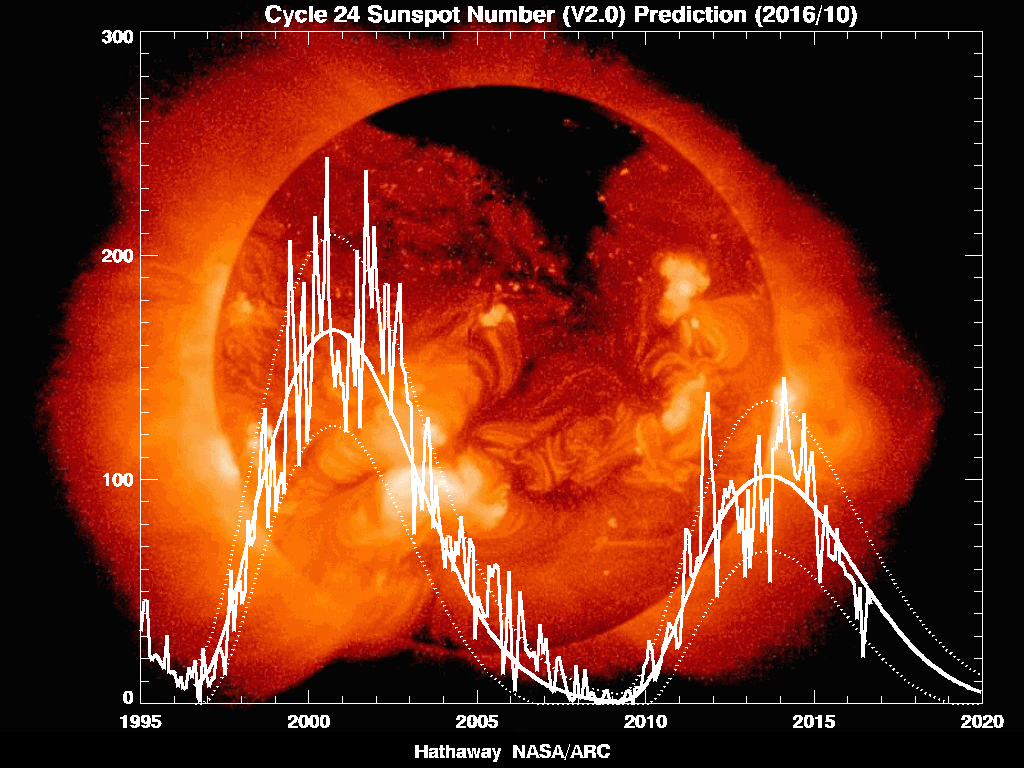
Note: These predictions are for “smoothed” International Sunspot Numbers. The smoothing is usually over time periods of about a year or more so both the daily and the monthly values for the International Sunspot Number should fluctuate about our predicted numbers. The dotted lines on the prediction plots indicate the expected range of the monthly sunspot numbers. Also note that the “Boulder” numbers reported daily at www.spaceweather.com are typically about 35% higher than the International sunspot number.
Another indicator of the level of solar activity is the flux of radio emission from the Sun at a wavelength of 10.7 cm (2.8 GHz frequency). This flux has been measured daily since 1947. It is an important indicator of solar activity because it tends to follow the changes in the solar ultraviolet that influence the Earth’s upper atmosphere and ionosphere. Many models of the upper atmosphere use the 10.7 cm flux (F10.7) as input to determine atmospheric densities and satellite drag. F10.7 has been shown to follow the sunspot number quite closely and similar prediction techniques can be used. Our predictions for F10.7 are available in a text file, as a GIF image, and as a pdf-file. Current values for F10.7 can be found at: http://www.spaceweather.ca/sx-4-eng.php.

Discover more from Watts Up With That?
Subscribe to get the latest posts sent to your email.
Is SC 24 peaking already???
http://www.solen.info/solar/solcycle.html
… or is it tricking us?
http://www.solen.info/solar/cyclcomp2.html
But I put this in wikipedia for SC24 a month ago with full credit to Dr. Svalgaard. NASA failed to mention his paper.
Leif Svalgaard says:
Success has many fathers. Failure is an orphan.
This success has only one father, my thanks to the younger daughter.
http://www.vukcevic.talktalk.net/SSN.htm
Could four poles explain the Maunder Minimum’s ‘large, sparse, and primarily Southern Hemispheric sunspots’?
=================
You almost have to feel sorry for the poor Warmunistas. Everything was going so well for them until: SC23 turned out to be so weak and now SC24 looks to be the lowest in 100 years.
To make matters worse, CERN was finally allowed to conduct the CLOUD experiment and it turns out GCRs do, in fact, nucleate inorganic compounds, which create increased cloud cover and cooler global temperatures.
I can’t wait for Svensmark peer-pending paper to come out, showing the evidence that +50 nanometer cloud seeds are possible in the Scensmark Effect.
Does anyone have any news approximately when Svensmark paper will be out? TIA.
Robert in Perth (soon to be back in South Africa) says:
May 3, 2012 at 1:08 am
Leif, In your 2004 paper you pointed out that 2011 should see solar maximum and I thought that you were merely teased us with your comment of “Welcome to Solar Max” on the TSI diagrams on your website.
Low cycles have a long drawn-out maximum that can last several years. For me, that maximum began in 2011 and will last several more years.
It appears to me that for the foreseeable future we will have a Sun with 2 south poles and common sense tells me that this must have some noticeable effect on Earth’s climate.
This situation is quite common, for example also in cycle 19, see http://www.leif.org/EOS/Babcock1959.pdf and I don’t expect any effect on the climate, but then apparently ‘common sense is not so common’.
Has solar maximum in fact been reached in 2011 as your TSI diagram reflects and not in 2012 as predicted by Alvestad or is there going to be explosion in sunspot activity in the Sun’s southern hemisphere?
I expect the South to pick up, it has already begun
Anthony, thank you for the Facebook link to your articles. It makes it easy to share with my sphere of friends the great articles your site posts. The AGW crowd is getting uneasy, recently Jim Rossi of UNLV a graduate in sustainability posted upon my Facebook page. There are some very rude manners out there. Dinner on me when you are in Sacramento.
From 90 in May 2013 to 60 in Jan 2013. Wow. Big change. — John M Reynolds
blogoriginator says: May 3, 2012 at 12:45 am
Can anybody tell me what kind of Global Temperature we’re facing in the next ten years?
____________________
History – 2002:
On 1 September 2002, I wrote in an article in the Calgary Herald:
” If solar activity is the main driver of surface temperature [as I believe it is] rather than CO2, we should begin the next cooling period by 2020 to 2030.”
This conclusion was based on decades of study, and a phone call to Dr. Tim Patterson, Carleton University Paleoclimatologist, who had studied natural warming and cooling cycles that he believed were related to the Gleissberg (Wolf) Cycle.
We were also aware of Hathaway’s now-failed prediction of SC24 peaking at Tmax ~160, and the prediction by NASA? that SC25 would be very weak.
At the time, I was (and still am) unsure if the warming and cooling cycle were better related to the PDO than the Gleissberg – If it is the PDO, global cooling could commence sooner, perhaps about now.
____________________
Update – 2012:
Recent information include the much-lower prediction of a Rmax of ~60 for SC24, and recent work, which I have scanned but not studied, on solar impacts on Earth’s climate.
Accordingly, I have little choice but to hold to my 2002 statement – the next natural global cooling period will commence by 2020-2030.
Caveat: It is possible we were “late” in this prediction, and that global cooling has already begun, but it is not yet serious or significant.
Will global cooling become serious and significant? I do not know, but I think this is a very real possibility – there is a significant probability of serious global cooling commencing by 2020-2030, or sooner.
____________________
Implications of Serious Global Cooling:
Serious global cooling could significantly decrease the global grain harvest, which would have major impacts on humanity and the environment.
If this occurs, based on current political realities, humanity will be woefully unprepared. It would, in my opinion, be sensible to start now making cost-effective preparations for this possibility.
These measures would include ensuring that stockpiles of grain are adequate, and accelerating the further development of frost-resistant crops.
Is this an alarmist position? Another misguided application of the “Precautionary Principle”? I suggest not – first, the net costs of my modest proposal are not that great, especially when one considers the huge amount of American corn that is currently being squandered in corn ethanol production. My proposal costs much less than the very costly, inefficient and self-serving “green energy” schemes of the global warming movement, Furthermore, I have no financial interest in promoting climate alarmism, and a sincere interest in reducing the needless suffering of humanity and the resulting destruction of the environment.
I still find the predictions of De Jager most accurate and in contrast to Svalgaard he does see an important role for solar fluctuations in the earth’s climate. The recent warming period until 1999 is in his view not unusual given the variations in solar forcing through the last centuries.
De Jager, Duhau, Journal of Atmospheric and Solar-Terrestial Physics (2008):
“We find that the system is presently undergoing a transition from the recent Grand Maximum to another regime. This transition started in 2000 and it is expected to end around the maximum of cycle 24 foreseen for 2014, with a maximum sunspot number Rmax= 68+/-17. At that time a period of lower solar activity will start. That period will be one of regular oscillations, as occurred between 1730 and 1923. The first of these oscillations may even turn out to be as strongly negative as around 1810, in which case a short Grand Minimum similar to the Dalton one might develop. This moderate-to-low-activity episode is expected to last for at least one Gleissberg cycle (60-100 years).”
De Jager adapted this expectation in 2010 based on new observations and better interpretations to an Rmax of 55. Also the Grand Minimum is expected to be deeper and Maunder like.
There is (to science as yet unknown) close correlation between the solar activity and the geomagnetic field intensity change in the Antarctica, at location of the geographic South Pole.
http://www.vukcevic.talktalk.net/SSN-dBzAa.htm
(all required data are included)
This should be of interest to all those who are interested in solar, geomagnetic and climate sciences.
Leif Svalgaard says:
Success has many fathers. Failure is an orphan.
“Victory has a THOUSAND fathers, but defeat is an orphan” was “made famous” by President Kennedy “as he assumed responsibility for the Bay of Pigs fiasco.” Mr. Safire cites the 1942 use
by Count Ciano. But, he says, phrase watcher Paul Hoffman reports that the the exact phrase the president used “is spoken by the character portraying Field Marshal von Rundstedt in the film ‘The Desert Fox’ .'”
an earlier version comes from the son in law of Mussolini, Count Caleazzo Ciano (1942. La victoria trova cento padri, e nessuno vuole riconoscere l’insuccesso. – The Ciano Diaries 1939-1943
The original may come from Tacitus in his “Agricola”. the translatoin reads:
“This is an unfair thing about war; victory is claimed by all but defeat is assigned to one alone”
EvilDenier says:
May 2, 2012 at 4:08 pm
”Climate(global temperature) has nothing to do with the Sun” God please tell me you’re kiding.
No it’s caused by electromagnetic waves that permeate space and hit the surface of the earth. They then shake up the surface which causes it to warm and in turn heat the air. The heated air then rises and the electromagnetic waves escape back into space. Unfortunately some bump into carbon dioxide on the way up and are absorbed then split into many bits and scattered in all directions. For some reason they don’t seem to hit the carbon dioxide on the way down.
Luckily the chance of them actually hitting a carbon dioxde molecule is minute so most make it out to space where they shoot off in all directions obviously frightened by their experience on our planet.
What’s goind on with the so called solar conveyor belt. If I remember the discussions correctly, that was supposed to be a predictor of not the next cycle, but the one after, in this case cycle 25. A few years ago, that thing pretty much ground to a halt.
Has anyone considered that high energy CRF may be a cause, not the effect of changes in solar activity.
Perhaps high energy CRF is modulated by celestial bodies outside the solar system. The rays may act as a catalyst or buffer for certian types of recations. Of course, large force with appropriate periodicities are probably too far away.
blogoriginator says:
May 3, 2012 at 12:45 am
Can anybody tell me what kind of Global Temperature we’re facing in the next ten years?
Yes.
“It Will Fluctuate.”
(h/t to: J.P. Morgan)
Scottish Sceptic says:
May 2, 2012 at 5:06 pm
…
That book, “Famine in Scotland: ‘the ill years’ of the 1690s” is on Google Books with a pretty substantial preview online
http://books.google.com/books?id=RiLjHZdt-sMC&pg=PP1&dq=%22Famine+in+Scotland+the+ill+years+of+the+1690s
vukcevic says:
May 3, 2012 at 6:06 am
There is (to science as yet unknown) close correlation between the solar activity and the geomagnetic field intensity change in the Antarctica, at location of the geographic South Pole.
Spurious correlations don’t need causes or explanations.
Leif Svalgaard says: May 3, 2012 at 8:16 am
@ur momisugly vukcevic
Spurious correlations don’t need causes or explanations.
http://www.vukcevic.talktalk.net/SSN-dBzAa.htm (all data included)
40 years ago, as a young scientist, you would have been excited by prospect of investigating something new, now as an experienced scientist of international repute, you just can’t be bothered, far easier and more expedient to dismiss every unknown as ‘spurious’, not to mention that it may discredit the idea of ‘leveling’ of the historic sunspot number values.
Despite many valuable observations and comments, which I always pay lot of attention to, your attitude is getting ‘spuriouser and spuriouser’.
No harm done in exchanging opinions regardless of if being just an odd ‘coincidence’ or some physical process previously unknown.
I also wish it wasn’t there. 🙂
“Serious global cooling could significantly decrease the global grain harvest, which would have major impacts on humanity and the environment.”
Here in the US, we are still paying farmers not to farm, and using about 1/3rd of our corn crop to make car fuel.
There’s a lot of farmland in places like New England that were abandoned when they couldn’t compete with the newly opened mid-west. Those areas could be converted back to farms. Millions of suburban homeowners could re-start the WWII era victory gardens.
It may not be pleasant, but we could also start eating lower on the food chain. Less meat and more grains. That would allow a lot more people to be fed as well.
There’s plenty of spare capacity should global temperatures turn down.
vukcevic says:
May 3, 2012 at 9:12 am
No harm done in exchanging opinions regardless of if being just an odd ‘coincidence’ or some physical process previously unknown. I also whish it wasn’t there. 🙂
Yes, there is harm, as it detracts from studying the real thing. For every ‘physical process previously unknown’ there are thousands of spurious correlations and coincidences that lead nowhere.
Ok, let’s say that correlation is spurious, but the data from which delta Bz is calculated is accepted as good by most reputable science establishments.
Delta Bz as calculated, is relatively good match for the Antarctica’s 10Be deposition records. Here it can be seen that geomagnetic changes are of order of hundreds of nTesla
http://www.vukcevic.talktalk.net/SSN-dBzAa.htm
while heliospheric magnetic field at the Earth’s orbit is of order only of few nTesla
http://www.leif.org/research/Heliospheric%20Magnetic%20Field%201835-2010.ppt#4
Inevitable conclusion is that the 10Be Antarctica’s data are also of spurious value.
What do you make of it?
Leif says “I expect the South to pick up, it has already begun.”
Well maybe, I looked at rbateman’s butterfly plot above. And while the density of spots at the very far right seems slightly higher, there doesn’t yet seem to be any movement toward the equator. I compared rbatemans butterfly with the NASA one, and it seems that while cyle 14 is the closest match to rbateman, it’s clear that Cyc24 SH has less equatorward drift than 14 did.
So Nature rhymes, but doesn’t repeat.
Leif Svalgaard says:
May 3, 2012 at 4:10 am
I expect the South to pick up, it has already begun
It has already begun to retreat once more back towards the South Solar Pole, where the Coronal Hole awaits it. This general retreat is #3 for the Southern Solar Sunspot Belt. There may be other retreats before 2011, but the data is too haphazard due to lack of spots.
When you put your infamous “Welcome to Solar Max” version #1 on your daily graph, Leif, you marked the current max point of advances of the Southern Solar Sunspot Belt. This last run did not get as far towards the Solar Equator. So, my friend, don’t 2nd guess yourself. You nailed it.