By WUWT regular “Just The Facts”
I am often amused by claims that we understand Earth’s climate system, are able to accurately measure its behavior, eliminate all potential variables except CO2 as the primary driver of Earth’s temperature and make predictions of Earth’s temperature decades into the future, all with a high degree of confidence. I have been studying Earth’s climate system for several years and have found it to be a ridiculously complex, continually evolving and sometimes chaotic beast. Furthermore, our understanding of Earth’s climate system is currently rudimentary at best, our measurement capabilities are limited and our historical record is laughably brief. To help demonstrate the complexity of Earth’s climate system I have been compiling a list of all of the variables potentially involved in Earth’s climate system. This is a work in progress so additions, recommendations, corrections, questions etc. are most welcome. Once I develop this further and polish it up a bit I plan to convert it into a new WUWT Reference Page.
UPDATED: This list has undergone significant revisions and improvements based upon crowdsourcing the input of an array of very intelligent and knowledgeable contributors below. Additionally, this list was posted in comments in WUWT a few times previously, receiving input from a number of other very intelligent and knowledgeable contributors. This thread, along with links to the precursor threads below, will thus serve as the bibliography for the forthcoming WUWT Potential Climatic Variables reference page (unless someone can up with a better name for it…:)
1. Earth’s Rotational Energy;
http://en.wikipedia.org/wiki/Rotational_energy
http://en.wikipedia.org/wiki/Earth%27s_rotation
http://www.physicalgeography.net/fundamentals/6h.html
results in day and night;
http://wiki.answers.com/Q/Why_does_rotation_cause_day_and_night
causes the Coriolis Effect;
http://en.wikipedia.org/wiki/Coriolis_effect
imparts Planetary Vorticity on the oceans;
http://oceanworld.tamu.edu/resources/ocng_textbook/chapter12/chapter12_01.htm
and manifests as Ocean Gyres;
http://en.wikipedia.org/wiki/Ocean_gyre
the Antarctic Circumpolar Current;
http://en.wikipedia.org/wiki/Antarctic_Circumpolar_Current
http://en.wikipedia.org/wiki/File:Conveyor_belt.svg

Arctic Ocean Circulation;
http://www.whoi.edu/page.do?pid=12455&tid=441&cid=47170&ct=61&article=20727
http://www.john-daly.com/polar/flows.jpg
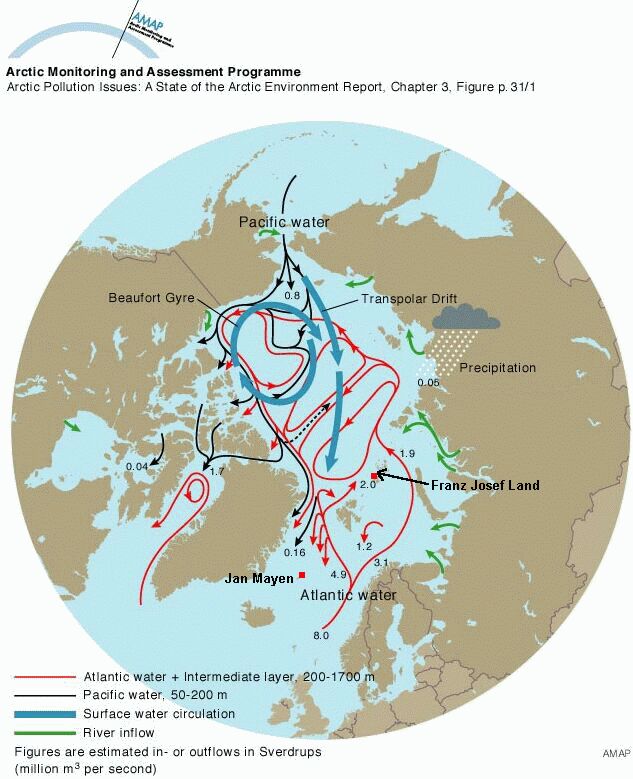
can result in the formation of Polynya;
http://en.wikipedia.org/wiki/Polynya
and causes the Equatorial Bulge:
http://en.wikipedia.org/wiki/Equatorial_bulge
Earth’s Rotational Energy influences Atmospheric Circulation;
http://en.wikipedia.org/wiki/Atmospheric_circulation
including the Jet Stream;
http://en.wikipedia.org/wiki/Jet_stream
Westerlies;
http://en.wikipedia.org/wiki/Westerlies
Tradewinds;
http://en.wikipedia.org/wiki/Trade_wind
Geostrophic Wind;
http://en.wikipedia.org/wiki/Geostrophic_wind
Surface Currents;
http://www.windows2universe.org/earth/Water/ocean_currents.html h
http://en.wikipedia.org/wiki/Ocean_current
through Ekman Transport;
http://en.wikipedia.org/wiki/Ekman_transport
http://oceanmotion.org/html/background/ocean-in-motion.htm
Tropical Cyclones;
http://en.wikipedia.org/wiki/Tropical_cyclone
Tornadoes:
http://en.wikipedia.org/wiki/Tornado
and Polar Vortices;
http://en.wikipedia.org/wiki/Polar_vortex
which “are caused when an area of low pressure sits at the rotation pole of a planet. This causes air to spiral down from higher in the atmosphere, like water going down a drain.”
http://www.universetoday.com/973/what-venus-and-saturn-have-in-common/
Here’s an animation of the Arctic Polar Vortex in Winter 2008 – 09:
When a Polar Vortex breaks down it causes a Sudden Stratospheric Warming:
http://en.wikipedia.org/wiki/Sudden_stratospheric_warming
Earth’s Rotational Energy influences Plate Tectonics;
http://en.wikipedia.org/wiki/Plate_tectonics
“By analyzing the minute changes in travel times and wave shapes for each doublet, the researchers concluded that the Earth’s inner core is rotating faster than its surface by about 0.3-0.5 degrees per year.
That may not seem like much, but it’s very fast compared to the movement of the Earth’s crust, which generally slips around only a few centimeters per year compared to the mantle below, said Xiaodong Song, a geologist at the University of Illinois at Urbana-Champaign and an author on the study.
http://www.livescience.com/9313-earth-core-rotates-faster-surface-study-confirms.html
The surface movement is called plate tectonics. It involves the shifting of about a dozen major plates and is what causes most earthquakes”:
http://en.wikipedia.org/wiki/Earthquake
Volcanoes;
http://en.wikipedia.org/wiki/Volcano
and Mountain Formation;
http://en.wikipedia.org/wiki/Mountain_formation
which can influence the creation of Atmospheric Waves:
http://en.wikipedia.org/wiki/Atmospheric_wave
Lastly, Rotational Energy is the primary driver of Earth’s Dynamo;
http://en.wikipedia.org/wiki/Dynamo_theory
which generates Earth’s Magnetic Field;
http://en.wikipedia.org/wiki/Earth%27s_magnetic_field
and is primarily responsible for the Earthy behaviors of the Magnetosphere;
http://en.wikipedia.org/wiki/Magnetosphere
with certain secular variations in Earth’s magnetic field originating from ocean flow/circulation;
http://news.nationalgeographic.com/news/2009/06/090622-earths-core-dynamo.html
http://iopscience.iop.org/1367-2630/11/6/063015/fulltext
though Leif Svalgaard notes that these are minor variations, as the magnetic field originating from ocean flow/circulation “is 1000 times smaller than the main field generated in the core.”
Also of note, “Over millions of years, [Earth’s] rotation is significantly slowed by gravitational interactions with the Moon: see tidal acceleration.
http://en.wikipedia.org/wiki/Tidal_acceleration
“The presence of the moon (which has about 1/81 the mass of the Earth), is slowing Earth’s rotation and lengthening the day by about 2 ms every one hundred years.”
“However some large scale events, such as the 2004 Indian Ocean earthquake, have caused the rotation to speed up by around 3 microseconds.[21] Post-glacial rebound, ongoing since the last Ice age, is changing the distribution of the Earth’s mass thus affecting the Moment of Inertia of the Earth and, by the Conservation of Angular Momentum, the Earth’s rotation period.”
http://en.wikipedia.org/wiki/Earth%27s_rotation
2. Orbital Energy, Orbital Period, Elliptical Orbits (Eccentricity), Tilt (Obliquity) and Wobble (Axial precession):
http://en.wikipedia.org/wiki/Specific_orbital_energy
http://en.wikipedia.org/wiki/Synodic
http://www.physicalgeography.net/fundamentals/6h.html
creates Earth’s seasons;
http://en.wikipedia.org/wiki/Season
which drives annual changes in Arctic Sea Ice;
and Antarctic Sea Ice;
the freezing and melting of which helps to drive the Thermohaline Circulation;
http://en.wikipedia.org/wiki/Thermohaline_circulation
and can result in the formation of Polynyas:
http://en.wikipedia.org/wiki/Polynya
Earth’s orbit around the Sun, Earth’s tilt, Earth’s wobble and the Moon’s orbit around Earth, Earth’s Rotation, and the gravity of the Moon, Sun and Earth, act in concert to determine the constantly evolving Tidal Force on Earth:
http://en.wikipedia.org/wiki/Tidal_force
This Tidal Force is influenced by variations in Lunar Orbit;
http://en.wikipedia.org/wiki/Orbit_of_the_Moon
as seen in the Lunar Phases;
http://en.wikipedia.org/wiki/Lunar_phase
Lunar Precession;
http://en.wikipedia.org/wiki/Lunar_precession
Lunar Node;
http://en.wikipedia.org/wiki/Lunar_node
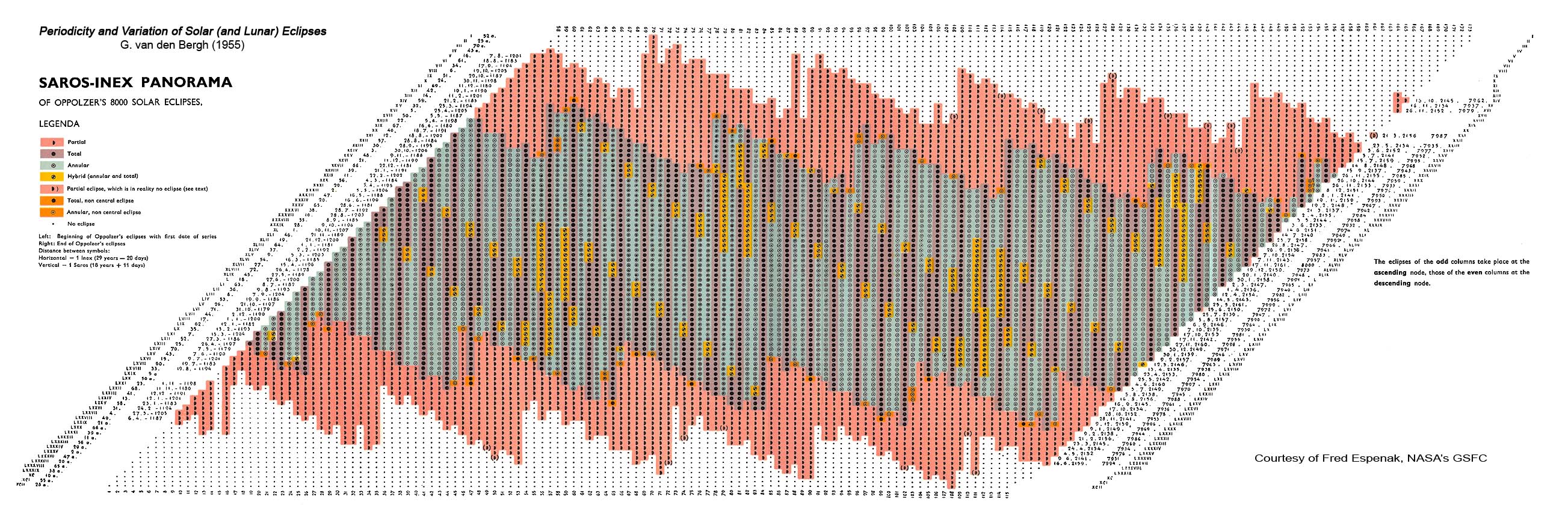
Saros cycles;
http://en.wikipedia.org/wiki/Saros_cycle
and Inex cycles:
http://en.wikipedia.org/wiki/Inex
The combined cycles of the Saros and Inex Cycles can be visualized here:
http://eclipse.gsfc.nasa.gov/SEsaros/image/SEpanoramaGvdB-big.JPG
Over longer time frames changes to Earth’s orbit, tilt and wobble called Milankovitch cycles;
http://en.wikipedia.org/wiki/Milankovitch_cycles
may be responsible for the periods of Glaciation (Ice Ages);
http://www.homepage.montana.edu/~geol445/hyperglac/time1/milankov.htm
that Earth has experienced for the last several million years of its climatic record:
http://en.wikipedia.org/wiki/Ice_age
Also of note, over very long time frames, “the Moon is spiraling away from Earth at an average rate of 3.8 cm per year”;
http://en.wikipedia.org/wiki/Lunar_distance_%28astronomy%29
http://curious.astro.cornell.edu/question.php?number=124
3. Gravitation:
http://en.wikipedia.org/wiki/Gravitation
The gravity of the Moon, Sun and Earth, Earth’s rotation, Earth’s orbit around the Sun, Earth’s tilt, Earth’s wobble and the Moon’s orbit around Earth act in concert to determine the constantly evolving Tidal Force on Earth:
http://en.wikipedia.org/wiki/Tidal_force
This tidal force results in that result in Earth’s Ocean Tide;
http://en.wikipedia.org/wiki/Tide
http://www.themcdonalds.net/richard/astro/papers/602-tides-web.pdf
Atmospheric Tide;
http://en.wikipedia.org/wiki/Atmospheric_tide
and Magma Tide:
http://www.springerlink.com/content/h7005r0273703250/
Earth’s Gravity;
http://en.wikipedia.org/wiki/Convection#Gravitational_or_buoyant_convection
http://visibleearth.nasa.gov/view_rec.php?id=205
in concert with Tidal Forces, influence Earth’s Ocean Circulation;
http://www.eoearth.org/article/Ocean_circulation
which influences Oceanic Oscillations including El Niño/La Niña;
http://en.wikipedia.org/wiki/El_Ni%C3%B1o-Southern_Oscillation
the Pacific Decadal Oscillation (PDO);
http://en.wikipedia.org/wiki/Pacific_Decadal_Oscillation
the Atlantic Multi-Decadal Oscillation (AMO);
http://en.wikipedia.org/wiki/Atlantic_Multidecadal_Oscillation
the Indian_Ocean_Dipole (IOD)/Indian Ocean Oscillation (IOO) and;
http://en.wikipedia.org/wiki/Indian_Ocean_Dipole
can result in the formation of Polynyas:
http://en.wikipedia.org/wiki/Polynya
Gravity Waves;
http://en.wikipedia.org/wiki/Gravity_wave
which may be partially responsible for the Quasi-Biennial Oscillation (QBO);
http://en.wikipedia.org/wiki/Quasi-biennial_oscillation
“on an air–sea interface are called surface gravity waves or Surface Waves”;
http://en.wikipedia.org/wiki/Surface_wave
“while internal gravity waves are called Inertial Waves”:
http://en.wikipedia.org/wiki/Inertial_waves
“Rosby Waves;
http://en.wikipedia.org/wiki/Rossby_waves
Geostrophic Currents
http://en.wikipedia.org/wiki/Geostrophic
and Geostrophic Wind
http://en.wikipedia.org/wiki/Geostrophic_wind
are examples of inertial waves. Inertial waves are also likely to exist in the core of the Earth”
Earth’s gravity is the primary driver of Plate Tectonics;
http://en.wikipedia.org/wiki/Plate_tectonics
“The Slab Pull;
http://en.wikipedia.org/wiki/Slab_pull
force is a tectonic plate force due to subduction. Plate motion is partly driven by the weight of cold, dense plates sinking into the mantle at trenches. This force and the slab suction force account for most of the overall force acting on plate tectonics, and the Ridge Push;
force accounts for 5 to 10% of the overall force.”
Plate Tectonics drive “cycles of ocean basin growth and destruction, known as Wilson cycles;
http://csmres.jmu.edu/geollab/fichter/Wilson/Wilson.html
involving continental rifting;
http://en.wikipedia.org/wiki/Rift
seafloor-spreading;
http://en.wikipedia.org/wiki/Seafloor_spreading
subduction;
http://en.wikipedia.org/wiki/Subduction
and collision.”:
http://en.wikipedia.org/wiki/Continental_collision
“Climate change on ultra-long time scales (tens of millions of years) are more than likely connected to plate tectonics.”
“Through the course of a Wilson cycle continents collide and split apart, mountains are uplifted and eroded, and ocean basins open and close. The re-distribution and changing size and elevation of continental land masses may have caused climate change on long time scales”;
http://www.pbs.org/wgbh/nova/ice/chill.html
a process called the Supercontinent Cycle:
http://en.wikipedia.org/wiki/Supercontinent_cycle
Earth’s gravity is responsible for Katabatic Wind:
http://en.wikipedia.org/wiki/Katabatic_wind
4. Solar Energy;
http://en.wikipedia.org/wiki/Solar_energy
results is Solar Radiation/Sunlight;
http://en.wikipedia.org/wiki/Solar_radiation
which varies based upon 11 and 22 year cycles:
http://en.wikipedia.org/wiki/Solar_cycle
Total Solar Irradiance (TSI);
http://www.ngdc.noaa.gov/stp/solar/solarirrad.html
appears to fluctuate “by approximately 0.1% or about 1.3 Watts per square meter (W/m2) peak-to-trough during the 11-year sunspot cycle”:
http://en.wikipedia.org/wiki/Solar_variation
Solar Energy also drives the Hydrological/Water Cycle;
http://en.wikipedia.org/wiki/Hydrological_cycle
within the Hydrosphere;
http://en.wikipedia.org/wiki/Hydrosphere
as Total Solar Irradiance (TSI) causes evaporation;
http://en.wikipedia.org/wiki/Evaporation
that drives cloud formation;
http://en.wikipedia.org/wiki/Cloud
results in precipitation;
http://en.wikipedia.org/wiki/Precipitation_%28meteorology%29
that results in the Water Distribution on Earth;
http://en.wikipedia.org/wiki/Water_distribution_on_Earth
creates surface runoff;
http://en.wikipedia.org/wiki/Runoff_%28water%29
which result in rivers;
http://en.wikipedia.org/wiki/River
and drives erosion:
http://en.wikipedia.org/wiki/Erosion
Solar energy is also “The driving force behind atmospheric circulation is solar energy, which heats the atmosphere with different intensities at the equator, the middle latitudes, and the poles.”
http://www.scienceclarified.com/As-Bi/Atmospheric-Circulation.html
Atmospheric Circulation;
http://en.wikipedia.org/wiki/Atmospheric_circulation
includes Hadley Cells;
http://en.wikipedia.org/wiki/Hadley_cell
Ferrel Cells;
http://en.wikipedia.org/wiki/Atmospheric_circulation#Ferrel_cell
Polar Cells;
http://en.wikipedia.org/wiki/Polar_cells
and Polar Vortexes:
http://en.wikipedia.org/wiki/Polar_cells
all of which help to create Wind;
http://en.wikipedia.org/wiki/Wind
that influence Surface Currents;
http://www.windows2universe.org/earth/Water/ocean_currents.html
http://en.wikipedia.org/wiki/Ocean_current
through Ekman Transport;
http://en.wikipedia.org/wiki/Ekman_transport
http://oceanmotion.org/html/background/ocean-in-motion.htm
and also cause Langmuir circulations
http://en.wikipedia.org/wiki/Langmuir_circulation
Solar energy is also a driver of the Brewer-Dobson Circulation
http://en.wikipedia.org/wiki/Brewer-Dobson_circulation
Atmospheric Waves;
http://en.wikipedia.org/wiki/Atmospheric_wave
including Atmospheric Tides
http://en.wikipedia.org/wiki/Atmospheric_tide
as well as evaporation and condensation may help to drive changes in Atmospheric Pressure:
http://en.wikipedia.org/wiki/Atmospheric_pressure
http://www.atmos-chem-phys-discuss.net/10/24015/2010/acpd-10-24015-2010.pdf
Solar Ultraviolet (UV) radiation;
http://en.wikipedia.org/wiki/Ultraviolet
appears to vary by approximately 10% during the solar cycle;
http://www.nasa.gov/topics/solarsystem/features/solarcycle-sorce.html
has been hypothesized to influence Earth’s climate;
http://wattsupwiththat.com/2011/04/05/courtillot-on-the-solar-uv-climate-connection/
however Leif Svalgaard argues that,
This is well-trodden ground. Nothing new to add, just the same old, tired arguments. Perhaps a note on EUV: as you can see here (slide 13)
http://lasp.colorado.edu/sorce/news/2008ScienceMeeting/doc/Session1/S1_03_Kopp.pdf the energy in the EUV band [and other UV bands] is very tiny; many orders of magnitude less than what shines down on our heads each day. So a larger solar cycle variation of EUV does not make any significant difference in the energy budget.
http://wattsupwiththat.com/2011/04/05/courtillot-on-the-solar-uv-climate-connection/#comment-636477
Additionally variations in Ultraviolet (UV) radiation may influence the break down of Methane;
(Source TBD)
Infrared Radiation;
http://en.wikipedia.org/wiki/Infrared
Solar – Wind;
http://science.nasa.gov/science-news/science-at-nasa/1999/ast13dec99_1/
Solar – Coronal Holes;
http://helios.gsfc.nasa.gov/chole.html
Solar – Solar Energetic Particles (SEP);
http://helios.gsfc.nasa.gov/sep.html
Solar – Coronal Mass Ejection;
http://www.esa.int/esaSC/SEMF75BNJTF_index_0.html
http://www.ratedesi.com/video/v/8AuCE_NNEaM/Sun-Erupts-to-Life-Unleashes-a-Huge-CME-on-13-April-2010
Solar Magnetosphere Breach;
Solar Polar Field Reversal;
http://science.nasa.gov/science-news/science-at-nasa/2001/ast15feb_1/
Solar Sector Boundary;
http://science.nasa.gov/heliophysics/focus-areas/magnetosphere-ionosphere/
Grand Minimum;
Leif Svalgaard says: February 6, 2011 at 8:26 pm
If L&P are correct and sunspots become effectively] invisible [not gone] it might mean another Grand Minimum lasting perhaps 50 years. During this time the solar cycle is still operating, cosmic rays are still modulated, and the solar wind is still buffeting the Earth.”
“It will lead to a cooling of a couple of tenths of a degree.”
Solar Influences on Climate:
http://www.leif.org/EOS/2009RG000282.pdf
Statistical issues about solar–climate relations
http://www.leif.org/EOS/Yiou-565-2010.pdf
5. Geothermal Energy;
http://en.wikipedia.org/wiki/Geothermal_energy
influences Earth’s climate especially when released by Volcanoes;
http://en.wikipedia.org/wiki/Volcano
“which are generally found where tectonic plates are diverging;
http://en.wikipedia.org/wiki/Divergent_boundary
or converging”;
http://en.wikipedia.org/wiki/Convergent_boundary
however, “intraplate volcanism has also been postulated to be caused by mantle plumes”:
http://en.wikipedia.org/wiki/Mantle_plume
“These so-called “hotspots”;
http://en.wikipedia.org/wiki/Hotspot_%28geology%29
for example Hawaii, are postulated to arise from upwelling diapirs;
http://en.wikipedia.org/wiki/Diapir
from the core-mantle boundary, 3,000 km deep in the Earth.”
Volcanoes have been shown to influence Earth’s climate;
http://www.geology.sdsu.edu/how_volcanoes_work/climate_effects.html
http://www.longrangeweather.com/global_temperatures.htm
including in the infamous Year Without a Summer;
http://en.wikipedia.org/wiki/Year_Without_a_Summer
which was partially caused by the 1815 eruption of Mount Tambora;
http://en.wikipedia.org/wiki/1815_eruption_of_Mount_Tambora
and is called a Volcanic Winter:
http://en.wikipedia.org/wiki/Volcanic_winter
“Volcanic Ash;
http://en.wikipedia.org/wiki/Volcanic_ash
particles have a maximum residence time in the troposphere of a few weeks.
The finest Tephera;
http://en.wikipedia.org/wiki/Tephra
remain in the stratosphere for only a few months, they have only minor climatic effects, and they can be spread around the world by high-altitude winds. This suspended material contributes to spectacular sunsets.
“The greatest volcanic impact upon the earth’s short term weather patterns is caused by sulfur dioxide gas;”
http://en.wikipedia.org/wiki/Sulfur_dioxide
“In the cold lower atmosphere, it is converted to Sulfuric Acid;
http://en.wikipedia.org/wiki/Sulfuric_acid
sulfuric acid by the sun’s rays reacting with stratospheric water vapor to form sulfuric acid aerosol layers. The aerosol remains in suspension long after solid ash particles have fallen to earth and forms a layer of sulfuric acid droplets between 15 to 25 kilometers up. Fine ash particles from an eruption column fall out too quickly to significantly cool the atmosphere over an extended period of time, no matter how large the eruption.
Sulfur aerosols last many years, and several historic eruptions show a good correlation of sulfur dioxide layers in the atmosphere with a decrease in average temperature decrease of subsequent years. The close correlation was first established after the 1963 eruption of Agung volcano in Indonesia when it was found that sulfur dioxide reached the stratosphere and stayed as a sulfuric acid aerosol.
Without replenishment, the sulfuric acid aerosol layer around the earth is gradually depleted, but it is renewed by each eruption rich in sulfur dioxide. This was confirmed by data collected after the eruptions of El Chichon, Mexico (1982) and Pinatubo, Philippines (1991), both of which were high-sulfur compound carriers like Agung, Indonesia.”
http://volcanology.geol.ucsb.edu/gas.htm
There is also some evidence that if “volcanic activity was high enough, then a water vapor anomaly would be introduced into the lower stratosphere before the anomaly due to the previous eruption had disappeared. The result would be threefold in the long term: stratospheric cooling, stratospheric humidification, and surface warming due to the positive radiative forcing associated with the water vapor.”
See: http://journals.ametsoc.org/doi/pdf/10.1175/1520-0442(2003)016%3C3525%3AAGSOVE%3E2.0.CO%3B2#h1
Geothermic Energy can also warm the atmosphere through Hot Springs;
http://en.wikipedia.org/wiki/Hot_springs
Or warm the ocean through Hydrothermal Vents:
http://en.wikipedia.org/wiki/Hydrothermal_vent
Which can be a factor in Hydrothermal Circulations:
http://en.wikipedia.org/wiki/Hydrothermal_circulation
6. Outer Space/Cosmic/Galactic Influences;
http://en.wikipedia.org/wiki/Outer_space
http://en.wikipedia.org/wiki/Cosmos
http://en.wikipedia.org/wiki/Galaxy
including Asteroids;
http://en.wikipedia.org/wiki/Asteroid
Meteorites;
http://en.wikipedia.org/wiki/Meteorite
and Comets;
http://en.wikipedia.org/wiki/Comet
can all significantly impact Earth’s climate upon impact.
It has been hypothesized that Galactic Cosmic Rays;
http://en.wikipedia.org/wiki/Galactic_cosmic_ray
http://en.wikipedia.org/wiki/Cosmic_ray
modulated by Solar Wind, may influence cloud formation on Earth:
Galactic Magnetic Fields also result in the;
http://www.scholarpedia.org/article/Galactic_magnetic_fields
Galactic Tide;
http://en.wikipedia.org/wiki/Galactic_tide
which may influence the hypothesized Oort cloud;
http://en.wikipedia.org/wiki/Oort_Cloud
“Besides the galactic tide, the main trigger for sending comets into the inner Solar System is believed to be interaction between the Sun’s Oort cloud and the gravitational fields of near-by stars or giant molecular clouds.”
7. Magnetic Forces;
http://en.wikipedia.org/wiki/Earth%27s_magnetic_field
Earth Core Changes:
http://physicsworld.com/cws/article/news/42580
“appears to be generated in the Earth’s core by a dynamo process, associated with the circulation of liquid metal in the core, driven by internal heat sources”
impact the Magnetosphere;
http://en.wikipedia.org/wiki/Magnetosphere
including movement of the Geomagnetic Poles:
http://www.ngdc.noaa.gov/geomag/GeomagneticPoles.shtml
http://news.nationalgeographic.com/news/2009/12/091224-north-pole-magnetic-russia-earth-core.html
8. Atmospheric Composition
http://en.wikipedia.org/wiki/Atmosphere_of_Earth
Nitrogen (N2) represents approximately 780,840 ppmv or 78.084% of Earth’s Atmosphere;
http://en.wikipedia.org/wiki/Nitrogen
Oxygen (O2) represents approximately 209,460 ppmv or 20.946%;
http://en.wikipedia.org/wiki/Oxygen
Argon (Ar) represents approximately 9,340 ppmv or 0.9340%;
http://en.wikipedia.org/wiki/Argon
Carbon Dioxide (CO2) represents approximately 390 ppmv or 0.039%;
http://en.wikipedia.org/wiki/Carbon_dioxide
contributes to the Greenhouse Effect;
?
and
influences the rate of Plant Growth;
http://www.sjsu.edu/faculty/watkins/CO2plants.htm
Neon (Ne) represents approximately18.18 ppmv or 0.001818%;
http://en.wikipedia.org/wiki/Neon
Helium (He) represents approximately 5.24 ppmv (0.000524%);
http://en.wikipedia.org/wiki/Helium
Krypton (Kr) represents approximately 1.14 ppmv (0.000114%);
http://en.wikipedia.org/wiki/Krypton
Methane (CH4) represents approximately 1.79 ppmv (0.000179%);
http://en.wikipedia.org/wiki/Methane
contributes to the Greenhouse Effect;
?
Hydrogen (H2) represents approximately 0.55 ppmv (0.000055%);
http://en.wikipedia.org/wiki/Hydrogen
Nitrous Oxide (N2O) represents approximately 0.3 ppmv (0.00003%);
http://en.wikipedia.org/wiki/Nitrous_oxide
contributes to the Greenhouse Effect;
?
Ozone (O3) represents approximately 0.0 to 0.07 ppmv (0 to 7×10⁻⁶%);
http://en.wikipedia.org/wiki/Ozone
Nitrogen Dioxide (NO2) represents approximately 0.02 ppmv (2×10⁻⁶%) (0.000002%);
http://en.wikipedia.org/wiki/Nitrogen_dioxide
Iodine (I2) represents approximately 0.01 ppmv (1×10⁻⁶%) (0.000001%) and;
http://en.wikipedia.org/wiki/Iodine
Ammonia (NH3) represents a trace amount of Earth’s Atmosphere:
http://en.wikipedia.org/wiki/Ammonia
Additional atmosphere components includes Water vapor (H2O) that represents approximately 0.40% over full atmosphere, typically 1%-4% at surface.
http://en.wikipedia.org/wiki/Water_vapor;
Aerosols;
http://en.wikipedia.org/wiki/Aerosol
that “act as cloud condensation nuclei, they alter albedo (both directly and indirectly via clouds) and hence Earth’s radiation budget, and they serve as catalysts of or sites for atmospheric chemistry reactions.”
“Aerosols play a critical role in the formation of clouds;
http://en.wikipedia.org/wiki/Clouds
Clouds form as parcels of air cool and the water vapor in them condenses, forming small liquid droplets of water. However, under normal circumstances, these droplets form only where there is some “disturbance” in the otherwise “pure” air. In general, aerosol particles provide this “disturbance”. The particles around which cloud droplets coalesce are called cloud condensation nuclei (CCN) or sometimes “cloud seeds”. Amazingly, in the absence of CCN, air containing water vapor needs to be “supersaturated” to a humidity of about 400% before droplets spontaneously form! So, in almost all circumstances, aerosols play a vital role in the formation of clouds.”
http://www.windows2universe.org/earth/Atmosphere/aerosol_cloud_nucleation_dimming.html
Particulates;
http://en.wikipedia.org/wiki/Particulates
including Soot/Black Carbon;
http://en.wikipedia.org/wiki/Soot
http://en.wikipedia.org/wiki/Black_carbon
Sand;
http://en.wikipedia.org/wiki/Sand
Dust
http://en.wikipedia.org/wiki/Dust
“Volcanic Ash;
http://en.wikipedia.org/wiki/Volcanic_ash
particles have a maximum residence time in the troposphere of a few weeks.
The finest Tephera;
http://en.wikipedia.org/wiki/Tephra
remain in the stratosphere for only a few months, they have only minor climatic effects, and they can be spread around the world by high-altitude winds. This suspended material contributes to spectacular sunsets.
The major climate influence from volcanic eruptions is caused by gaseous sulfur compounds, chiefly Sulfur Dioxide;
http://en.wikipedia.org/wiki/Sulfur_dioxide
which reacts with OH and water in the stratosphere to create sulfate aerosols with a residence time of about 2–3 years.”
“Emission rates of [Sulfur Dioxide] SO2 from an active volcano range from 10 million tonnes/day according to the style of volcanic activity and type and volume of magma involved. For example, the large explosive eruption of Mount Pinatubo on 15 June 1991 expelled 3-5 km3 of dacite magma and injected about 20 million metric tons of SO2 into the stratosphere. The sulfur aerosols resulted in a 0.5-0.6°C cooling of the Earth’s surface in the Northern Hemisphere.”
http://volcanoes.usgs.gov/hazards/gas/index.php
“The 1815 eruption [of Mount Tambora] is rated 7 on the Volcanic Explosivity Index, the only such eruption since the Lake Taupo eruption in about 180 AD. With an estimated ejecta volume of 160 cubic kilometers, Tambora’s 1815 outburst was the largest volcanic eruption in recorded history.”
“The eruption created global climate anomalies that included the phenomenon known as “volcanic winter”;
http://en.wikipedia.org/wiki/Volcanic_winter
1816 became known as the “Year Without a Summer”;
http://en.wikipedia.org/wiki/Year_Without_a_Summer
because of the effect on North American and European weather. Agricultural crops failed and livestock died in much of the Northern Hemisphere, resulting in the worst famine of the 19th century.”
http://en.wikipedia.org/wiki/Mount_Tambora
“In the spring and summer of 1816, a persistent “dry fog” was observed in the northeastern US. The fog reddened and dimmed the sunlight, such that sunspots were visible to the naked eye. Neither wind nor rainfall dispersed the “fog”. It has been characterized as a stratospheric sulfate aerosol veil.”
“The greatest volcanic impact upon the earth’s short term weather patterns is caused by sulfur dioxide gas;”
http://en.wikipedia.org/wiki/Sulfur_dioxide
“In the cold lower atmosphere, it is converted to Sulfuric Acid;
http://en.wikipedia.org/wiki/Sulfuric_acid
sulfuric acid by the sun’s rays reacting with stratospheric water vapor to form sulfuric acid aerosol layers. The aerosol remains in suspension long after solid ash particles have fallen to earth and forms a layer of sulfuric acid droplets between 15 to 25 kilometers up. Fine ash particles from an eruption column fall out too quickly to significantly cool the atmosphere over an extended period of time, no matter how large the eruption.
Sulfur aerosols last many years, and several historic eruptions show a good correlation of sulfur dioxide layers in the atmosphere with a decrease in average temperature decrease of subsequent years. The close correlation was first established after the 1963 eruption of Agung volcano in Indonesia when it was found that sulfur dioxide reached the stratosphere and stayed as a sulfuric acid aerosol.
Without replenishment, the sulfuric acid aerosol layer around the earth is gradually depleted, but it is renewed by each eruption rich in sulfur dioxide. This was confirmed by data collected after the eruptions of El Chichon, Mexico (1982) and Pinatubo, Philippines (1991), both of which were high-sulfur compound carriers like Agung, Indonesia.”
http://volcanology.geol.ucsb.edu/gas.htm
There is also some evidence that if “volcanic activity was high enough, then a water vapor anomaly would be introduced into the lower stratosphere before the anomaly due to the previous eruption had disappeared. The result would be threefold in the long term: stratospheric cooling, stratospheric humidification, and surface warming due to the positive radiative forcing associated with the water vapor.”
See: http://journals.ametsoc.org/doi/pdf/10.1175/1520-0442(2003)016%3C3525%3AAGSOVE%3E2.0.CO%3B2#h1
9. Albedo
http://en.wikipedia.org/wiki/Albedo
“or reflection coefficient, is the diffuse reflectivity or reflecting power of a surface. It is defined as the ratio of reflected radiation from the surface to incident radiation upon it. Being a dimensionless fraction, it may also be expressed as a percentage, and is measured on a scale from zero for no reflecting power of a perfectly black surface, to 1 for perfect reflection of a white surface.”
Clouds
http://en.wikipedia.org/wiki/Clouds
Aerosols
http://en.wikipedia.org/wiki/Aerosol
“act as cloud condensation nuclei, they alter albedo (both directly and indirectly via clouds) and hence Earth’s radiation budget, and they serve as catalysts of or sites for atmospheric chemistry reactions.”
“Aerosols play a critical role in the formation of clouds. Clouds form as parcels of air cool and the water vapor in them condenses, forming small liquid droplets of water. However, under normal circumstances, these droplets form only where there is some “disturbance” in the otherwise “pure” air. In general, aerosol particles provide this “disturbance”. The particles around which cloud droplets coalesce are called cloud condensation nuclei (CCN) or sometimes “cloud seeds”. Amazingly, in the absence of CCN, air containing water vapor needs to be “supersaturated” to a humidity of about 400% before droplets spontaneously form! So, in almost all circumstances, aerosols play a vital role in the formation of clouds.”
http://www.windows2universe.org/earth/Atmosphere/aerosol_cloud_nucleation_dimming.html
Snow
Ice
Water
Particulates
http://en.wikipedia.org/wiki/Particulates
Soot/Black Carbon
http://en.wikipedia.org/wiki/Soot
http://en.wikipedia.org/wiki/Black_carbon
Algae (Ocean Surface)
10. Biology
http://en.wikipedia.org/wiki/Biology
“Phototrophs
http://en.wikipedia.org/wiki/Photoautotroph
are the organisms (usually plants) that carry out photosynthesis;
http://en.wikipedia.org/wiki/Photosynthesis
to acquire energy. They use the energy from sunlight to convert carbon dioxide and water into organic materials to be utilized in cellular functions such as biosynthesis and respiration.” “In plants, algae, and cyanobacteria, photosynthesis uses carbon dioxide and water, releasing oxygen as a waste product.”
Chemoautotrophs;
http://en.wikipedia.org/wiki/Chemotroph
are “organisms that obtain carbon through Chemosynthesis;
http://en.wikipedia.org/wiki/Chemosynthesis
are phylogenetically diverse, but groups that include conspicuous or biogeochemically-important taxa include the sulfur-oxidizing gamma and epsilon proteobacteria, the Aquificaeles, the Methanogenic archaea and the neutrophilic iron-oxidizing bacteria.”
Bacteria – TBD
Fungi – TBD
Protozoa – TBD
Chromista – TBD
Animal – Anthropogenic including:
Carbon Dioxide;
http://en.wikipedia.org/wiki/Carbon_dioxide
contributes to the Greenhouse Effect;
?
and
influences the rate of plant growth ;
http://www.sjsu.edu/faculty/watkins/CO2plants.htm
Methane
http://en.wikipedia.org/wiki/Methane
Nitrous Oxide
Ozone
Particulates, especially Black Carbon/Soot
Aerosols
Icebreakers/Arctic Shipping/Fishing/Cruise-Line Transits
Contrails
Nuclear Power Generation – Including Ships
Land Use Changes – Including De and Re-Forestation
Urban Heat Islands
Run Off From Asphalt/Urban Heat Islands
Fossil Fuel Energy Generation Waste Heat –
Renewables – Wind Farms, Solar Arrays, Dams and Ethanol
Sewage/Wastewater Treatment Discharge
etc.
Animal – Non-Anthropogenic including
Plankton
Beaver (Genus Castor)
http://en.wikipedia.org/wiki/Beaver
etc.
11. Chemical
Fossil Fuels:
Coal
Oil shale
Petrochemicals
– Petroleum
– Mineral Oil
Asphalt
Tar Pits/Sands
Methane
http://en.wikipedia.org/wiki/Methane
etc.
“Photosynthesis;
http://en.wikipedia.org/wiki/Photosynthesis
is a chemical process that converts carbon dioxide into organic compounds, especially sugars, using the energy from sunlight.”
“Chemosynthesis;
http://en.wikipedia.org/wiki/Chemosynthesis
is the biological conversion of one or more carbon molecules (usually carbon dioxide or methane) and nutrients into organic matter using the oxidation of inorganic molecules (e.g. hydrogen gas, hydrogen sulfide) or methane as a source of energy, rather than sunlight, as in photosynthesis.”
Reactions:
Combustion
– Forest Fires
– Fossil Fuels
– – Methane
http://en.wikipedia.org/wiki/Methane
etc.
Conversion of Methane, CO2, etc.
12. Physics – Other
Temperature
http://en.wikipedia.org/wiki/Temperature
Pressure
http://en.wikipedia.org/wiki/Pressure
States of Matter
http://en.wikipedia.org/wiki/State_of_matter
Heat Conduction
http://en.wikipedia.org/wiki/Heat_conduction
Convection
http://en.wikipedia.org/wiki/Convection
Thermal Radiation
http://en.wikipedia.org/wiki/Thermal_radiation
Thermodynamics
http://en.wikipedia.org/wiki/Laws_of_thermodynamics
-Entropy
http://en.wikipedia.org/wiki/Entropy
General summaries of the potential variables involved in Earth’s climate system;
http://www.physicalgeography.net/fundamentals/7y.html
http://oceanservice.noaa.gov/education/pd/climate/factsheets/whatfactors.pdf
Leif Svalgaard says:
“Apart from the fact that you overstate the amount; it is only 0.08 W/m2 [ten times less].”
Yes 0.08 sorry!
“The radioactive decay does not change on time scales of interest,…”
Are we sure about that?
http://news.stanford.edu/news/2010/august/sun-082310.html
Leif Svalgaard says: July 3, 2011 at 12:06 pm
“justthefactswuwt says: July 3, 2011 at 1:03 am
Based on these estimates, on average about 51% of the 1.3 Watts per square meter (W/m2) would reach the surface, thus on average .663 Watts per square meter (W/m2) of the energy would reach the surface.”
Of the 342 W/m2 available, 168 W/m2 = 49% is absorbed by the surface. You are off by some factor of 1000 or 1000/4, so it is not clear what you mean.
Somehow I’ve allowed myself to be dragged into a stupid discussion on how much of the “approximately 0.1% or about 1.3 Watts per square meter (W/m2)” 11 year cycle variation in solar radiation that’s “received at the outer surface of Earth’s atmosphere”, makes it through to Earth’s surface. It seems like a pointless exercise as the atmosphere introduces so many additional variables as to make the resultant estimate unnecessarily imprecise. Given that the 11 year cycle variation of about 1.3 Watts per square meter (W/m2) at the outer surface of Earth’s atmosphere isn’t sufficient to have a large influence on Earth’s temperature, it seem pointless to try to estimate and use the smaller and less precise number at surface level. What do you think?
justthefactswuwt says:
July 3, 2011 at 3:33 pm
Given that the 11 year cycle variation of about 1.3 Watts per square meter (W/m2) at the outer surface of Earth’s atmosphere isn’t sufficient to have a large influence on Earth’s temperature, it seem pointless to try to estimate and use the smaller and less precise number at surface level. What do you think?
We don’t even know the albedo well enough for this to matter. To first order, what reaches the surface will scale with what comes from the sun. Just do the calculation in percent and the problem goes away: dTSI/TSI =0.1% and dT/T = 0.1/4%. The 4 is from S-B law, not spherical Earth. So with dT/T = 0.025% of 288K we get dT = 0.072 K
izen says: July 3, 2011 at 4:16 am
The PDO and El Niño/La Niña variations are defined as certain patterns of physical observation, mostly of sea surface temperature, air pressure and ocean current directions.
“The PDO index is calculated from sea surface temperatures and sea level pressures.”
http://www.appinsys.com/GlobalWarming/PDO.htm
“The El Nino / Southern Oscillation (ENSO) is an oceanic / atmospheric oscillation of the equatorial Pacific / southern Pacific. Various indexes have been derived from measurements in the area.”
http://www.appinsys.com/GlobalWarming/ENSO.htm
It is circular to have the pattern of temperature/pressure/current direction values defined as the cause of … the pattern of temp/pressure/vector values.
The PDO is a value derived from measurement, it isn’t an active causal agent in its own right.
The causes of ocean circulation and oceanic oscillations are reasonably well known, if you look at the bottom of the WUWT Ocean Oscillation Page;
http://wattsupwiththat.com/reference-pages/oceanic-oscillation/
you’ll see that a summary of the key variables involved in Ocean Circulation. Regardless of the exact cause of the PDO cycle, this chart;
http://www.climate4you.com/images/PDO%20AnnualIndexSince1900%20With7yearRunningAverage.gif
seems to indicate that we are entering a PDO Cold Regime, and are in for an extended stay. This graphic;
http://www.appinsys.com/GlobalWarming/PDO_files/image002.jpg
provides a good comparative visual of the difference in Pacific Sea Surface Temperatures during Cold and Warm PDO Regimes.
Do you think that some portion of the increase in temperature between 1975 and 2005 might have been caused by oceanic circulations and cycles, as indicated by the increase the Sea Surface Temperature that occurred during the PDO Warm Regime?
I suspect other posts have clarified it better by now but I’ll try once more…
The 0.1% change in solar energy is measured in two contexts which give different values, but are the SAME solar variation.
For a square meter in space perpendicular to the Sun the solar variation is ~1.3W/m2 the 0.1% of 1366W/m2
But as you have pointed out a percentage of that is reflected and plays no further part in the energy balance.
But the inclination of the surface to the Sun also matters. For instance during a polar summer the sun never sets and the pole gets the full 1366W/m2 24hr a day.
But that 1366W is shining on FAR more than a square meter because the inclination of the Sun is so low.
Because the Earth is a rotating sphere each 1366W/m2 from the Sun is effectively spread over 4m2 of the Earths surface. Therefore the lower figure is 0.1% of the total solar energy per square meter of the Earths SURFACE.
Not a square meter perpendicular to the Sun above the atmosphere.
I don’t understand the point of this exercise. I agree that the .1% variation in TSI during the solar cycle is not a significant factor in the warming between 1975 – 2005, from wherever you want to measure it. I want your opinion of whether the Ocean Circulation/Cycles might be a significant factor in the global warming that occurred between 1975 – 2005 and what it might portend for the next 25 – 30 years…
Michael Tobis says:
July 1, 2011 at 7:25 pm
> If CO2 perturbation decay time were short, CO2 concentrations would go down during a recession.
China is now the largest CO2 emitter by country. They didn’t have a recession, I don’t know if their growth rate slowed down.
One thing that was interesting at ICCC #6 is the disagreement about CO2 dwell time in the atmosphere. Alan Carlin didn’t talk about it, but I read his recent paper on the way down. His review of the literature left him convinced the dwell time is short. Some people at the ICCC said the dwell time is long.
Either way, I’m not too concerned. The key thing, CO2 feedback (plus H2O) appears greatly overstated. I talked to one scientist who expects to have a paper out soon adding to that theme.
izen says:
July 3, 2011 at 11:53 am
The story that Galileo dropped a small and large cannonball from the Pisa belfry is probably fiction. But he did use a neat logical argument that all objects of different weights fall at the same speed. CO2 doesn’t fall any faster than N2.
The molecules of gas are moving at around 500m/s or about a THOUSAND miles an hour. There is no way with those velocities you will get gases stratifying out by weight within the first few miles of the atmosphere. If they did.. O2 heavier than N2, we would be walking in a few inches of CO2 and with our heads in pure oxygen!
Sigh. You’re imagining our real atmosphere to be an ‘ideal gas atmosphere’ – as if it’s empty space with molecules zipping around at great speeds through it, bouncing off each other and so ‘mixing thoroughly’, etc. . “Real” and ideal” are technical terms in physics when referring to gases. The ideal gas is an imaginary construct, no real gas is like an ideal gas nor does any real gas obey ideal gas law. You need to look up the difference, but you need to be vigilant, AGWScience takes bits of descriptions from physics and mixes and mismatches, takes out of context. You are giving an AGWScience description of our atmosphere because it says that nitrogen, oxygen and carbon dioxide are ideal gases, but they’re not, they are real. Real gases have volume, etc. Our atmosphere is not empty space with tiny hard dots with no volume travelling at these vast speeds through it bouncing off other molecules also travelling through empty space at these vast speeds..
How does sound travel in your world?
You’ll need to get to grips with volume and the rest. Now, I don’t know if the first of these links is written by someone who knows the difference and is being disingenuous or just repeating an AGWScience meme, much as you’ve given an AGWScience standard meme response about speed and stratification into layers, it doesn’t matter here, the important thing is to note where it has been done.
That is a fib. It’s taken direct from ideal gas description, and doesn’t relate at all to real gases which have attractive force.
This is where, how, AGWScience has taken its description of gas molecules and pretends that this is a description of real gas molecules in our real world. That heading should include the word “Ideal”. As here:
[The last sentence is where AGWScience refers back to in its emphasis on radiation as the means of heat transfer and avoids mention of convection which requires an understanding of real volume and why AGW supporters think that the only effect of electromagnetic waves is to create heat, so have great difficulty understanding that the “Solar” energies such as Visible can’t actually heat water, but think that because blue light penetrates further in the ocean it is heating the ocean.]
Anyway, although it appears the first piece is making a distinction between ideal and real gases, it isn’t, it is saying that this is a description of Gases, but this is a description of Ideal Gas. Which is purely imaginary and comes from the beginning of first exploration into such things. The article gives the appearance of being about real gases, but these AGW memes are slipped in so the difference is not obvious, but hidden, he is mixing and taking out of context.. Especially because he gives the history of the named originators he gives the appearance of covering the subject, but, he has missed one out.
Now, you have to bear in mind as I said earlier, that AGWScience does not have any internal consistency in its ‘science’, it cherry picks and is perfectly happy to use conflicting ideas as it is to use ideal gas properties for real gases by taking descriptions out of context as here in the first link and from which you get your picture of our atmosphere as empty space with all these molecules speeding through it at great speeds. Not all energy creates heat in interactions, the ideal gas laws are wrongly applied to the real world..
Our atmosphere is a real gaseous volume of Air, gases and liquids are fluids so what we have pressing down on us at around a ton per sq ft is a heavy fluid, not empty space. It is volumes of this fluid moving around which is the way heat is transferred through convection in our real atmosphere and which in turn gives us ‘wind’; when a volume of this fluid is heated and becoming less dense rises into colder volumes above it, the heavier denser volumes displace the lighter volumes, what we feel as wind. Wind is volumes of the gas Air on the move. These do not cross over from one hemisphere to the other, although there is some mixing at the equator, but follow basic circulation patterns within their own hemispheres.
One description I read to get the ‘feel’ of this our real atmosphere. Imagine standing at the bottom of a swimming pool with 10′ of water above you, now go out into the middle of a field – the atmosphere of the fluid gas Air above us is like that. A ton of it on our shoulders. “Half of the Earth’s atmosphere is squashed down into the first 3 miles above, 90% is squashed into the first 10 miles. Above 10 miles the air is so thin that the pressure is less than the best vacuums on the surface of the earth.” Sorry, missing source for that. It is not empty space.
That there is ’empty’ space between molecules means that gases can be compressed, the high and low pressures we feel in our atmosphere. If it were really empty space with volumeless molecules zipping through it we would have no sound. We have sound because the weight of that volume under gravity stops molecules from zipping through it. They may well be moving at great speeds, but they’re going nowhere fast.
Sound is passed through the fluid Air as waves are passed through the ocean, the Air doesn’t move as wind, but the energy from the sound causes the molecules of the volume Air to vibrate and knock into the molecules around it causing them to vibrate and that vibration is passed along through the air. When they stop vibrating they’re still where they started.
Now, within all that. Molecules of nitrogen and oxygen are practically the same weight, together the combination gas Air. Making up practically 100% of our atmosphere, dry weight, apart from water vapour the rest are trace gases. Water vapour is a gas, it is lighter than the gas air, it always rises in air, evaporation. So too, heavier gases sink in air. Carbon dioxide is one and a half times heavier than air, it sinks, displacing air.
Whether one molecule or a bunch of them together, heavier than air gases will sink and lighter than air gases will rise.
In mines methane is a hazard, it used to be tested for in a new mine by sending someone in covered in wet towels and carrying a lit candle on a long pole – because lighter than air methane pools at the ceilings. Careful if you’re invited to a pss-up in a brewery, that you don’t fall asleep on the floor next to open vats of beer brewing… Large amounts of carbon dioxide will displace the lighter oxygen and suffocate you. A hazard around active volcanoes venting, because it will gather in a layer in hollows, until dispersed by something acting on it to move it such as wind. It cannot diffuse into air of its own volition as if it were an ideal gas.
Gary D. says:
June 30, 2011 at 5:39 pm (Edit)
Please pardon a probably really dumb question, but this is something that has been bugging me for a while. The ENSO Sea Surface Temperature graphic here .
http://www.osdpd.noaa.gov/data/sst/anomaly/anomnight.current.gif
So then is it Vorticity that makes the SST leave the wake pattern that it does in the oceans? The speed of rotation at the poles versus the speed of rotation at the equator and the speed of rotation at deeper depths versus the speed of rotation at the surface, along with the ocean currents, that causes changes in various water temperatures.
It’s a good question. If you watch the Equatorial Pacific in this 1 year Sea Surface Temperature animation as the La Nina takes hold last year;
http://www7320.nrlssc.navy.mil/global_ncom/anims/eqp/sst12m.gif
you’ll see curling. This curling is also apparent in the same location in this 1 year Sea Surface Salinity animation:
http://www7320.nrlssc.navy.mil/global_ncom/anims/glb/sss12m.gif
This curling motion would seem consistent with the configuration of these vorticity diagrams, but not of their location:
http://oceanworld.tamu.edu/resources/ocng_textbook/chapter12/Images/Fig12-5.htm
Whether or not these features are caused by Planetary Vorticity or Relative Vorticity;
http://oceanworld.tamu.edu/resources/ocng_textbook/chapter12/chapter12_01.htm
I am not sure. We know that planetary vorticity is a major player in ocean circulation;
“12.4 Important Concepts
1. Vorticity strongly constrains ocean dynamics.
2. Vorticity due to Earth’s rotation is much greater than other sources of vorticity.
3. Taylor and Proudman showed that vertical velocity is impossible in a uniformly rotating flow. The ocean is rigid in the direction parallel to the rotation axis. Hence Ekman pumping requires that planetary vorticity vary with latitude. This explains why Sverdrup and Stommel found that realistic oceanic circulation, which is driven by Ekman pumping, requires that f vary with latitude.
4. The curl of the wind stress adds relative vorticity to central gyres of each ocean basin. For steady state circulation in the gyre, the ocean must lose vorticity in western boundary currents.
5. Positive wind stress curl leads to divergent flow in the Ekman layer. The ocean’s interior geostrophic circulation adjusts through a northward mass transport.
6. Conservation of absolute vorticity in an ocean with constant density leads to the conservation of potential vorticity. Thus changes in depth in an ocean of constant density requires changes of latitude of the current.”
however, per numbers 4 and 5, relative vorticity might also be the cause of the equatorial features.
There is an Equatorial Bulge; (Added under 1. Rotational Energy)
http://en.wikipedia.org/wiki/Equatorial_bulge
that is a result of Earth’s rotation, however Planetary Vorticity “is greatest at the poles where it is twice the rotation rate of Earth. Note that the vorticity vanishes at the equator and that the vorticity in the southern hemisphere is negative because φ is negative.”
http://oceanworld.tamu.edu/resources/ocng_textbook/chapter12/chapter12_01.htm
The University of Miami’s Cooperative Institute for Marine and Atmospheric Studies CIMAS has great site that is cataloging all of the surface currents;
http://oceancurrents.rsmas.miami.edu/
with a great level of detail for various geographic regions;
http://oceancurrents.rsmas.miami.edu/atlantic/north-equatorial.html
unfortunately they haven’t had the time and resources to study the Pacific yet:
http://oceancurrents.rsmas.miami.edu/pacific/pacific.html
I hope this helps to answer your question.
Myrrh says:
July 3, 2011 at 8:57 pm
Sigh. You’re imagining our real atmosphere to be an ‘ideal gas atmosphere’ – as if it’s empty space with molecules zipping around at great speeds through it, bouncing off each other and so ‘mixing thoroughly’,
double sigh. The air is to a very high approximation an ideal gas. Even near the center of the sun where the density is ten times that of lead, the material is very nearly an ideal gas. Your ideas about this are as wrong as they can be. Amazing that there are people out there who can be so wrong while pretending to know anything at all.
zen says:
July 2, 2011 at 5:03 pm
You are right on this: Tambora, at 2 Pg doesn’t equate to current rates of about 31 Pg/yr. My argument is weak here.
The climate does not appear to be unstable, however that lack of evidence is not evidence of a lack of instability, I grant you. Tornadoes are probably a good example of chaos theory in action: a buildup with little happening, a sudden burst of terrific change and activity and a very sudden end. A hurricane seems less of an example, as the process is incremental and progressive, and once started drifts away rather than stops abruptly. Weather systems and the climate are even longer term. progressive and incremental things.
CO2 as CAGW is positioned as a keystone gas with sudden, large and unexpected temperature effects. Temperature events are certainly sudden and unexpected, but going up and down don’t seem to be well correlated with CO2 changes. I understand the if A then B, if B not necessarily A problem with CO2 and temperature changes. But so far the temperature changes are slow, incremental and progressive, and less than the worrisome levels by the IPCC. If CO2 is not a keystone gas with a Mandelbrot chaotic nature, then the CAGW worry is untenable.
The evidence so far is not observational, but modelling. If we could agree to that, then what would be left is the argument about how much the Precautionary Principle should be applied. But since the science is “settled” and the outcome “certain” we cannot do that. Yet that is the crux: does CO2 additions to the atmosphere at 2 ppmv/yr from 392 to 560 or more trigger some detrimental and radical temperature change? So far the evidence says “no”. When does this threshold event occur? The IPCC model says there is a multiplier effect, but so far we are not seeing anything out of the historical mode if a 60-year cyclicity is allowed.
I see that by 2015 the difference between the IPCC warmist theories and the skeptics will be large enough and the trends going in the opposite directions long enough to determine if one is broken or at least sufficiently weakened for the CAGW threat to go away or – perish the thought – be about to bite our butts.
@-Leif Svalgaard says:
July 3, 2011 at 12:06 pm
“..(izen).Because the Earth is a rotating sphere each 1366W/m2 from the Sun is effectively spread over 4m2 of the Earths surface. Therefore the lower figure is 0.1% of the total solar energy per square meter of the Earths SURFACE.”
“Why is this even being discussed?”
———————
Because a poster (Michael Tobias) using the lower figure of solar energy per square meter of the Earth surface was accused of getting the figure wrong and failing to use ‘giggle’ or search engines to get the ‘right’ figure.
It was a classic example of Dunning-Kruger, ignorance resulting in the accusation that someone with more accurate knowledge is wrong because they do not match the pre-conceptions already held.
@- justthefactswuwt says:
July 3, 2011 at 4:43 pm
“The causes of ocean circulation and oceanic oscillations are reasonably well known, if you look at the bottom of the WUWT Ocean Oscillation Page;
http://wattsupwiththat.com/reference-pages/oceanic-oscillation/
you’ll see that a summary of the key variables involved in Ocean Circulation. ”
No, that page provides a lot of DESCRIPTION of the various ocean currents and patterns of behavior, but very little in the way of explanation of CAUSES.
@- Doug Proctor says:
July 3, 2011 at 10:45 pm
“The evidence so far is not observational, but modelling. If we could agree to that, then what would be left is the argument about how much the Precautionary Principle should be applied. But since the science is “settled” and the outcome “certain” we cannot do that. Yet that is the crux: does CO2 additions to the atmosphere at 2 ppmv/yr from 392 to 560 or more trigger some detrimental and radical temperature change?”
The evidence so far is observational. The measured rise in anthropogenic CO2. The measured absoprtion spectrum of CO2. The measured increase and spectal change in downwelling longwave radiation. The measured drop and spectral change in outgoing LW radiation.
And the measured rise in land and sea surface temperatures, the rise in sea level, the fall in glacier mass balance, the loss of polar sea ice, the increase in atmospheric water vapour, the decrease in snow cover and the various biological changes in growing times and extent for plants and animals.
Whether the incremental temperature change in response to the incremental rise in CO2 is detrimental or ‘radical’ in its effects on human society and specifically agricultural production systems is uncertain. And has more to do with uncertainty about the flexibility and robustness of societal responses than the magnitude of the climate change already experienced and most likely in the pipeline…
Leif Svalgaard says:
July 3, 2011 at 9:44 pm
double sigh. The air is to a very high approximation an ideal gas. Even near the center of the sun where the density is ten times that of lead, the material is very nearly an ideal gas. Your ideas about this are as wrong as they can be. Amazing that there are people out there who can be so wrong while pretending to know anything at all.
🙂 Shrug, looking in a mirror Leif? Typical irrelevance or misdirection coupled with ad homs in replies from you when you don’t know what you’re talking about but like to pretend you do or deliberate distraction in an attempt to confuse to continue promoting AGWScience fiction memes. Don’t much care, I gave up expecting a straight answer from you a while back. Recall the last one? Let me known when you’re willing to actually interact with what’s being said.
As I mentioned earlier, there is no internal consistency from AGWScience fiction inc. Because here they describe the molecules of our atmosphere as ideal gases, nitrogen, oxygen and carbon dioxide, but exclude water vapour – why? Because they say water vapour is localised and doesn’t stay in the atmosphere for any length of time.. ??!
So, because AGWScience deliberately joins out of context or disproved concepts to its promotion of its ideology/science fiction, the unwary get the impression that molecules of carbon dioxide are zipping through empty space bouncing off the other molecules and so thoroughly mixing that it can’t become unmixed, and so is proportionally the same all through the atmosphere and that it can accumulate and stay up for hundreds and even thousands of years because ideal gases don’t have weight and volume relative to each other and therefore do not separate out. Believers of this science fiction package have no sense of how the real carbon dioxide moves in the atmosphere, the Carbon Life Cycle is a closed book to them. As is the Water Cycle, because explaining that would have to bring in that water vapour is lighter than Air and carries heat away from the Earth. Where they mention the Earth would be 67°C without the water cycle, it is garbled so the connection to real properties and processes can’t be made.
The whole real world is a closed book to those enmeshed in AGWScience. They argue from out of context laws and physical impossibilities because that is what they have been taught. Those producing the memes know very well what is possible and not from traditional science, blue visible Light cannot heat water..
Those real applied scientists working in various fields know that molecules are real, have real properties relative to each other, interact with each other in different ways, that attraction and volume is not negligible; see the etc. on the tutorvista link.
Gases do not move at vast speeds through real air, they vibrate where they are – how sound travels: http://www.mediacollege.com/audio/01/sound-waves.html
Myrrh says:
July 4, 2011 at 5:00 am
Let me known when you’re willing to actually interact with what’s being said.
Hard to interact with nonsense.
here they describe the molecules of our atmosphere as ideal gases, nitrogen, oxygen and carbon dioxide, but exclude water vapour – why? Because they say water vapour is localised and doesn’t stay in the atmosphere for any length of time.. ??!
Right, it rains at times, even snows here and there.
Gases do not move at vast speeds through real air, they vibrate where they are – how sound travels
Sound waves have nothing to do with the thermal motions of the molecules. Here you can learn more about gases: http://en.wikipedia.org/wiki/Kinetic_theory
@-Myrrh says:
July 4, 2011 at 5:00 am
“Those real applied scientists working in various fields know that molecules are real, have real properties relative to each other, interact with each other in different ways, that attraction and volume is not negligible;”
If it is not negliable you will be able to give at least an estimate of how much the real atmosphere does deviate from the ideal gas law at the usual range of temperature, pressure and volume found in the real world.
Here’s a clue –
http://hyperphysics.phy-astr.gsu.edu/hbase/kinetic/waal.html
Note that the number of moles of gas involved is ma factor, the greater the amount of gas the closer to the ideal gas equations things become. For the total atmosphere the real applied scientists working on jet engine design for instance know that the deviation from the ideal gas laws is negligable and can be ignored.
It really only becomes a factor at very high temperatures and pressures, although as Leif has indicated, for light atoms like hydrogen and helium it isn’t much of a factor at the temperatures and pressures in the solar interior.
Before you can credibaly claim that a whole branch of science has egregiously ignored the difference between the ideal gas laws and the behavior of the atmosphere which might require the application of Van der Waals equation, or the Redlich–Kwong equation of state, or Soave modification of Redlich-Kwong or Peng–Robinson equation of state or even the Elliott, Suresh, Donohue equation of state; you need to show that they NEED to allow for these modifications – and don’t.
Do you have any evidence that the ‘real atmosphere’ needs these modifications to the ideal gas laws to describe climate interactions? Or that the ‘AGWscience’ does NOT use them where appropiate?
“Gases do not move at vast speeds through real air, they vibrate where they are – how sound travels: http://www.mediacollege.com/audio/01/sound-waves.html”
Sound travels as a density variation and not as individual air molecules travelling from source to ear.
But the molecules of air ARE moving at vast speeds of around 1000 miles an hour, and bouncing around and off each other continually. Perhaps this will help you grasp this subject better –
http://www.uccs.edu/~tchriste/courses/PHYS549/549lectures/gasses.html
You might like to calculate the mean free path, the distance traveled between collisions for an air molecule at room temperature and pressure.
Myrrh says:
July 4, 2011 at 5:00 am
> Gases do not move at vast speeds through real air, they vibrate where they are
Vibrate in this context means moving back and forth, well not necessarily in line, more of bouncing around. In wind free conditions there’s no net movement, in a wind, air molecules are trending in the direction of the wind.
Ultimately sound is carried by air molecules, the pressure waves are carried by air molecules bouncing off each other. In near ideal gases (like air), the mean free path where they aren’t significantly interacting is long relative the distance where electrons are repelling each other during each bounce.
Sound travels about 1000 feet per second, some 300 m/s. This implies the average speed of air molecules away from the sound source is 300 m/s. The actual speed has to be significantly higher since molecules are really flying around in all directions. I don’t know what that speed is, but I wouldn’t call it a vast speed.
You note that air molecules vibrate – please describe how you envision the momentum of air molecules changes as they vibrate – that may help us understand how you see gases behave.
F. Ross says: June 30, 2011 at 5:42 pm
On the serious side how about the possible affect(s) of large scale wind farms on the atmosphere. For your consideration:
http://www.savewesternny.org/environment.html
and
http://people.ucalgary.ca/~keith/WindAndClimateNote.html
Yes, Renewables – Wind Farms, Solar Arrays, Dams and Ethanol added to 10. Biology – Animal – Anthropogenic. Thank you
izen says: July 3, 2011 at 11:01 pm
Because a poster (Michael Tobias) using the lower figure of solar energy per square meter of the Earth surface was accused of getting the figure wrong and failing to use ‘giggle’ or search engines to get the ‘right’ figure.
It was a classic example of Dunning-Kruger, ignorance resulting in the accusation that someone with more accurate knowledge is wrong because they do not match the pre-conceptions already held.
For the record, the poster (Michael Tobis) stated that, “As far as I know, nothing in the published literature indicates anything larger than 0.3 W/m^2 peak-to-peak solar variability on decadal-to-century time scales.”
http://wattsupwiththat.com/2011/06/30/earths-climate-system-is-ridiculously-complex-with-draft-link-tutorial/#comment-692690
I said that this statement was wrong, and provided links to several data sources and published literature all using the much more common “approximately 0.1% or about 1.3 Watts per square meter (W/m2) peak-to-trough during the 11-year sunspot cycle” measured at the ”outer surface of Earth’s atmosphere”:
http://wattsupwiththat.com/2011/06/30/earths-climate-system-is-ridiculously-complex-with-draft-link-tutorial/#comment-692901
You subsequently admitted that I was right, “You are right that there is much in the literature that refers to the top of atmosphere figure,”
http://wattsupwiththat.com/2011/06/30/earths-climate-system-is-ridiculously-complex-with-draft-link-tutorial/#comment-692945
You are also wrong as “The Dunning–Kruger effect is a cognitive bias in which unskilled people make poor decisions and reach erroneous conclusions, but their incompetence denies them the metacognitive ability to appreciate their mistakes.”
http://en.wikipedia.org/wiki/Dunning%E2%80%93Kruger_effect
I leave it to readers to determine where the Dunning–Kruger effect might apply in this particular exchange…
@- justthefactswuwt says: July 3, 2011 at 4:43 pm
No, that page provides a lot of DESCRIPTION of the various ocean currents and patterns of behavior, but very little in the way of explanation of CAUSES.
This is verges on semantics, which I have no interest in. We understand the key contributors of energy into ocean circulation, which I refer to as the causes. However, I agree that we have a “very little in the way of explanation” as to how all of these factors interact to generate specific Oceanic Oscillations. Are you suggesting that we should be ignoring the PDO, El Nino/La Nina, etc. until we are able to explain exactly why they occur?
Why won’t you answer my question, i.e. Do you think that some portion of the increase in Earth’s temperature that occurred between 1975 and 2005 might be related to Ocean Circulation/Cycles, as indicated by the increase the Sea Surface Temperature that occurred in the pacific during the PDO Warm Regime? If so, what do you think this might portend for the next 25 – 30 years?
So, I was perusing the weather picture of the day link, and saw this one of the Black Forest in Germany:
http://weatherpictureoftheday.com/2011/05/27/black-forest-storms/
I was admiring the thunderheads, when I read the caption: “When the weather conditions are right the Black Forest in southern Germany can turn into a thunderstorm factory.” That got me thinking about all the trees that used to be in the United States that were cut down. All those forests producing clouds. So I decided to see if I could find a map showing the severity of these land use changes, and I found this one. I couldn’t get the website to work, and I’m a little pressed for time at the moment, but you’ll get the picture.
http://www2.estrellamountain.edu/faculty/farabee/biobk/deforest.jpg
How much of the warming curve did IPCC attribute to lack of cloud cover from deforestation (or: the positive feedback on land use changes)? None, they consider land use changes as a regional effect, and do not consider the associated reduction in cloud cover from deforestation.
Wil says: June 30, 2011 at 4:12 pm
I also spotted a phenomena I was completely unfamiliar with: Namely in the North Poles region Ice Map it appears when melting in that region first begin most every-time it’s in the region between Ellesmere Island (Canada) and just slightly North of Thule, Greenland. Perhaps someone could help me understand why that particular region first, what are the ocean currents in that Strait, Strait water temperature at various depths, or peculiar weather patterns that cause such an effect. That particular melts appear before surrounding ice even begins to melt – never would have noticed but for this exercise. That’s weird. I’ve always seen ice melt at the edges first then moved backward. That particular area is not a normal ice melt – it should not melt in the middle first.
commieBob says: June 30, 2011 at 6:38 pm
There are places where the water never melts, they are called polynya.
http://en.wikipedia.org/wiki/Polynya
I’ve added Polynya to three sections, 1. Earth’s Rotational Energy, 2. Orbital Energy, Orbital Period, Elliptical Orbits (Eccentricity), Tilt (Obliquity) and Wobble (Axial precession) and 3. Gravitation.
Also, one of the causes of Polynya is Katabatic Wind:
http://en.wikipedia.org/wiki/Katabatic_wind
which I’ve added under 3. Gravitation.
Thank you both for your input.
@- justthefactswuwt says:
July 4, 2011 at 9:58 am
“For the record, the poster (Michael Tobis) stated that, “As far as I know, nothing in the published literature indicates anything larger than 0.3 W/m^2 peak-to-peak solar variability on decadal-to-century time scales.”
I said that this statement was wrong, and provided links to several data sources and published literature all using the much more common “approximately 0.1% or about 1.3 Watts per square meter (W/m2) peak-to-trough during the 11-year sunspot cycle” measured at the ”outer surface of Earth’s atmosphere”:”
Okay, one last time.
It depends on which -‘The Published Literature’- you are referring to.
If you confine yourself to the astronomy, solar physics research then it is very unlikely you will see the 0.3W/m2 peak-to-peak figure because they are not concerned with the terrestrial impact of the Sun, only in detecting, measuring, describing and ultimately explaining the variations.
If you confine yourself to the literature published on the climate you are unlikely to see the 1.3W/m2 because this is not comparable with the units used for all the other factors in the energy budget that are given in W/m2 over the EARTH SURFACE. The figure used in the published (Climate/Earth sciences) literature is almost invariably the 0.3W/m2 because this allows easy comparison with all the other energy fluxes.
When M Tobias used the 0.3W/m2 as a climate researcher he was being consistent, and correct, because that is the value of 0.1% solar variation on the Earth which is comparable with the other energy fluxes. If you are familiar with the climate science literature then this value is familiar and how it is derived from the top-of-atmosphere value is well known.
So accusing him of being in error about the magnitude of solar variation and suggesting he use google to correct his ‘mistake’….
justthefactswuwt says:
“I leave it to readers to determine where the Dunning–Kruger effect might apply in this particular exchange…”
Quite.
justthefactswuwt says:
“We understand the key contributors of energy into ocean circulation, which I refer to as the causes.”
There are only three sources of energy contributing to ocean currents. Thermal energy from the sun, gravitational energy from the Earth and tidal interactions with the Moon/Sun and the rotational energy of the Earth.
justthefactswuwt says:
“I agree that we have a “very little in the way of explanation” as to how all of these factors interact to generate specific Oceanic Oscillations. Are you suggesting that we should be ignoring the PDO, El Nino/La Nina, etc. until we are able to explain exactly why they occur?”
No, just that we should use them only as descriptions, not causes. I understand you think this is just semantics, not meaning, but it is a common mistake in science. A set of observations are manipulated into a reified parameter, index or statistically derived definition of a pattern of data. That is then used as IF it was an independent ‘object’ with causal properties.
It is only ever a glorified description.
We dont ignore El Niño events because they have a significant effect on the pacific weather for a year or two, with influences globally. The warmer and colder areas of the pacific surface follow a specific pattern. But that pattern of temperature is NOT an explanation for the temperature distribution.
Describing a weather pattern as an ‘El Niño’ event is only ever that, a description not an explanation.
That is why I am unable to answer you question – “Do you think that some portion of the increase in Earth’s temperature that occurred between 1975 and 2005 might be related to Ocean Circulation/Cycles, as indicated by the increase the Sea Surface Temperature that occurred in the pacific during the PDO Warm Regime? ”
Because it carries the implicit assumption in the ‘might be related’ term that the PDO and other ocean ‘cycles’ are related causally to temperature changes.
The best answer I can give that avoids this misconception is that the ocean ‘cycles’ we see are PART OF the warming observed between 1975 and 2005 (and since). They are a part of the total description we have of the system. They cannot have a primary causal role because they are energy neutral, they can only shape the timing of energy fluxes, and that probably only as a contingent response to the energy inputs and outputs.
izen says:
July 4, 2011 at 11:52 am
There are only three sources of energy contributing to ocean currents. Thermal energy(1) from the sun, gravitational energy(2) from the Earth and tidal interactions(3) with the Moon/Sun and the rotational energy(4) of the Earth.
I do love the irony of a simple mistake directly after someone insults another person’s intelligence.
@-David Falkner
You have counted gravitational energy twice.
Tides and density stratification are different effects driven by the same source of energy.
izen says: July 4, 2011 at 11:52 am
It depends on which -’The Published Literature’- you are referring to.
Clearly, I should have know he was referring to only that “published literature” versus all of the “published literature”, when he erroneously stated that “nothing in the published literature indicates anything larger than 0.3 W/m^2 peak-to-peak solar variability on decadal-to-century time scales.” I’m such an idiot… 🙂
There are only three sources of energy contributing to ocean currents. Thermal energy from the sun, gravitational energy from the Earth and tidal interactions with the Moon/Sun and the rotational energy of the Earth.
I’d argue that there are at least 8 sources of energy at play in Oceanic Circulation:
1. Solar Energy from the Sun
2. Gravitational Effect from Earth
3. Gravitational Effect from Moon
4. Gravitational Effect from Sun
5. Orbital Energy of the Earth
6. Orbital Energy of the Moon
7. Rotational Energy of Earth
8. Geothermal Energy of Earth
Eventually Cosmic Rays might also be added to the list, if it can be shown that Cosmic Rays do in fact influence cloud formation and the associated clouds or lack thereof, influences Oceanic Circulation. Furthermore, Solar Wind might be added if it was found to modulate said Cosmic Rays, such to influence cloud formation and influence Oceanic Circulation. However, at present these associations seem tenuous at best.
We dont ignore El Niño events because they have a significant effect on the pacific weather for a year or two, with influences globally.
Do you agree that that the recent La Niña event is likely had a “significant effect” on Global Temperatures resulting in the rapid drop during the last year?:
RSS Lower Troposphere Temperature Anomaly;
ftp://ftp.ssmi.com/msu/graphics/tlt/plots/rss_ts_channel_tlt_global_land_and_sea_v03_3.png
UAH Mid-Troposphere Temperature Anomaly;
http://www.ncdc.noaa.gov/sotc/service/global/uah-midtrop-global-land-ocean/201105.gif
and UAH Global Lower Atmosphere Temperature Anomaly:
http://www.drroyspencer.com/wp-content/uploads/UAH_LT_1979_thru_May_20111.gif
Because it carries the implicit assumption in the ‘might be related’ term that the PDO and other ocean ‘cycles’ are related causally to temperature changes.
Are you questioning whether Ocean “Cycles” can be “related causally to atmospheric temperature changes”?
The best answer I can give that avoids this misconception is that the ocean ‘cycles’ we see are PART OF the warming observed between 1975 and 2005 (and since).
So when measuring climate sensitivity to CO2, we should be identifying the “PART OF” the warming observed between 1975 and 2005 that might be related to natural oceanic cycles and eliminate it, lest we over estimate Earth’s sensitivity to increased atmospheric CO2 concentrations?
Per this chart from NOAA’s Earth System Research Laboratory;
http://www.esrl.noaa.gov/research/themes/forcing/img/fig1.gif
they don’t seem to account for Ocean Cycles/Oscillations at all. Why?
izen says: July 4, 2011 at 1:54 pm
You have counted gravitational energy twice.
Tides and density stratification are different effects driven by the same source of energy.
Even if we only do it by category I get 5, i.e.:
1. Solar Energy
2. Gravitational Effect
3. Orbital Energy
4. Rotational Energy
5. Geothermal Energy
@- justthefactswuwt says:
July 4, 2011 at 2:30 pm
“Even if we only do it by category I get 5, i.e.:
1. Solar Energy
2. Gravitational Effect
3. Orbital Energy
4. Rotational Energy
5. Geothermal Energy”
Okay, I’ll give you geothermal, would you agree that its total magnitude is about one third of the small variation in the solar ‘constant’ we have dissected in detail?…-grin-
What on Earth, or out of it is – 3. Orbital Energy and how does it move water ?