By WUWT regular “Just The Facts”
I am often amused by claims that we understand Earth’s climate system, are able to accurately measure its behavior, eliminate all potential variables except CO2 as the primary driver of Earth’s temperature and make predictions of Earth’s temperature decades into the future, all with a high degree of confidence. I have been studying Earth’s climate system for several years and have found it to be a ridiculously complex, continually evolving and sometimes chaotic beast. Furthermore, our understanding of Earth’s climate system is currently rudimentary at best, our measurement capabilities are limited and our historical record is laughably brief. To help demonstrate the complexity of Earth’s climate system I have been compiling a list of all of the variables potentially involved in Earth’s climate system. This is a work in progress so additions, recommendations, corrections, questions etc. are most welcome. Once I develop this further and polish it up a bit I plan to convert it into a new WUWT Reference Page.
UPDATED: This list has undergone significant revisions and improvements based upon crowdsourcing the input of an array of very intelligent and knowledgeable contributors below. Additionally, this list was posted in comments in WUWT a few times previously, receiving input from a number of other very intelligent and knowledgeable contributors. This thread, along with links to the precursor threads below, will thus serve as the bibliography for the forthcoming WUWT Potential Climatic Variables reference page (unless someone can up with a better name for it…:)
1. Earth’s Rotational Energy;
http://en.wikipedia.org/wiki/Rotational_energy
http://en.wikipedia.org/wiki/Earth%27s_rotation
http://www.physicalgeography.net/fundamentals/6h.html
results in day and night;
http://wiki.answers.com/Q/Why_does_rotation_cause_day_and_night
causes the Coriolis Effect;
http://en.wikipedia.org/wiki/Coriolis_effect
imparts Planetary Vorticity on the oceans;
http://oceanworld.tamu.edu/resources/ocng_textbook/chapter12/chapter12_01.htm
and manifests as Ocean Gyres;
http://en.wikipedia.org/wiki/Ocean_gyre
the Antarctic Circumpolar Current;
http://en.wikipedia.org/wiki/Antarctic_Circumpolar_Current
http://en.wikipedia.org/wiki/File:Conveyor_belt.svg

Arctic Ocean Circulation;
http://www.whoi.edu/page.do?pid=12455&tid=441&cid=47170&ct=61&article=20727
http://www.john-daly.com/polar/flows.jpg
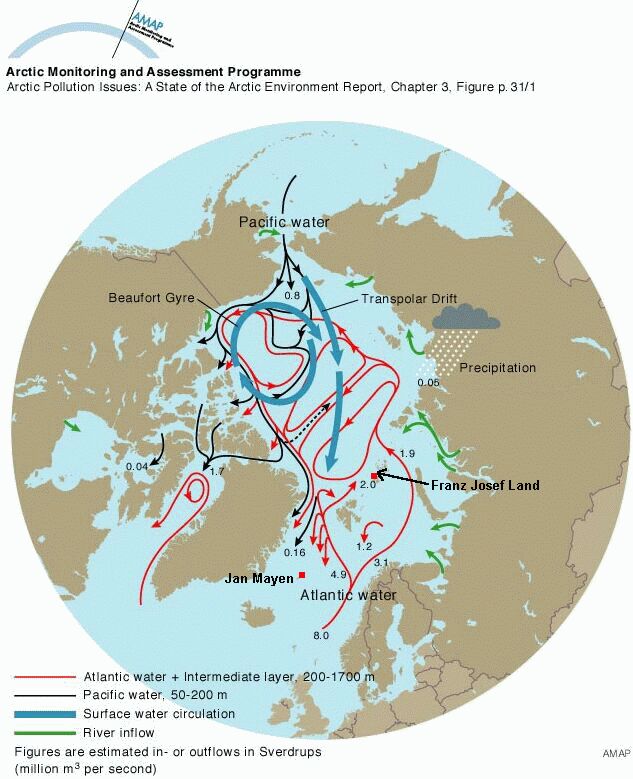
can result in the formation of Polynya;
http://en.wikipedia.org/wiki/Polynya
and causes the Equatorial Bulge:
http://en.wikipedia.org/wiki/Equatorial_bulge
Earth’s Rotational Energy influences Atmospheric Circulation;
http://en.wikipedia.org/wiki/Atmospheric_circulation
including the Jet Stream;
http://en.wikipedia.org/wiki/Jet_stream
Westerlies;
http://en.wikipedia.org/wiki/Westerlies
Tradewinds;
http://en.wikipedia.org/wiki/Trade_wind
Geostrophic Wind;
http://en.wikipedia.org/wiki/Geostrophic_wind
Surface Currents;
http://www.windows2universe.org/earth/Water/ocean_currents.html h
http://en.wikipedia.org/wiki/Ocean_current
through Ekman Transport;
http://en.wikipedia.org/wiki/Ekman_transport
http://oceanmotion.org/html/background/ocean-in-motion.htm
Tropical Cyclones;
http://en.wikipedia.org/wiki/Tropical_cyclone
Tornadoes:
http://en.wikipedia.org/wiki/Tornado
and Polar Vortices;
http://en.wikipedia.org/wiki/Polar_vortex
which “are caused when an area of low pressure sits at the rotation pole of a planet. This causes air to spiral down from higher in the atmosphere, like water going down a drain.”
http://www.universetoday.com/973/what-venus-and-saturn-have-in-common/
Here’s an animation of the Arctic Polar Vortex in Winter 2008 – 09:
When a Polar Vortex breaks down it causes a Sudden Stratospheric Warming:
http://en.wikipedia.org/wiki/Sudden_stratospheric_warming
Earth’s Rotational Energy influences Plate Tectonics;
http://en.wikipedia.org/wiki/Plate_tectonics
“By analyzing the minute changes in travel times and wave shapes for each doublet, the researchers concluded that the Earth’s inner core is rotating faster than its surface by about 0.3-0.5 degrees per year.
That may not seem like much, but it’s very fast compared to the movement of the Earth’s crust, which generally slips around only a few centimeters per year compared to the mantle below, said Xiaodong Song, a geologist at the University of Illinois at Urbana-Champaign and an author on the study.
http://www.livescience.com/9313-earth-core-rotates-faster-surface-study-confirms.html
The surface movement is called plate tectonics. It involves the shifting of about a dozen major plates and is what causes most earthquakes”:
http://en.wikipedia.org/wiki/Earthquake
Volcanoes;
http://en.wikipedia.org/wiki/Volcano
and Mountain Formation;
http://en.wikipedia.org/wiki/Mountain_formation
which can influence the creation of Atmospheric Waves:
http://en.wikipedia.org/wiki/Atmospheric_wave
Lastly, Rotational Energy is the primary driver of Earth’s Dynamo;
http://en.wikipedia.org/wiki/Dynamo_theory
which generates Earth’s Magnetic Field;
http://en.wikipedia.org/wiki/Earth%27s_magnetic_field
and is primarily responsible for the Earthy behaviors of the Magnetosphere;
http://en.wikipedia.org/wiki/Magnetosphere
with certain secular variations in Earth’s magnetic field originating from ocean flow/circulation;
http://news.nationalgeographic.com/news/2009/06/090622-earths-core-dynamo.html
http://iopscience.iop.org/1367-2630/11/6/063015/fulltext
though Leif Svalgaard notes that these are minor variations, as the magnetic field originating from ocean flow/circulation “is 1000 times smaller than the main field generated in the core.”
Also of note, “Over millions of years, [Earth’s] rotation is significantly slowed by gravitational interactions with the Moon: see tidal acceleration.
http://en.wikipedia.org/wiki/Tidal_acceleration
“The presence of the moon (which has about 1/81 the mass of the Earth), is slowing Earth’s rotation and lengthening the day by about 2 ms every one hundred years.”
“However some large scale events, such as the 2004 Indian Ocean earthquake, have caused the rotation to speed up by around 3 microseconds.[21] Post-glacial rebound, ongoing since the last Ice age, is changing the distribution of the Earth’s mass thus affecting the Moment of Inertia of the Earth and, by the Conservation of Angular Momentum, the Earth’s rotation period.”
http://en.wikipedia.org/wiki/Earth%27s_rotation
2. Orbital Energy, Orbital Period, Elliptical Orbits (Eccentricity), Tilt (Obliquity) and Wobble (Axial precession):
http://en.wikipedia.org/wiki/Specific_orbital_energy
http://en.wikipedia.org/wiki/Synodic
http://www.physicalgeography.net/fundamentals/6h.html
creates Earth’s seasons;
http://en.wikipedia.org/wiki/Season
which drives annual changes in Arctic Sea Ice;
and Antarctic Sea Ice;
the freezing and melting of which helps to drive the Thermohaline Circulation;
http://en.wikipedia.org/wiki/Thermohaline_circulation
and can result in the formation of Polynyas:
http://en.wikipedia.org/wiki/Polynya
Earth’s orbit around the Sun, Earth’s tilt, Earth’s wobble and the Moon’s orbit around Earth, Earth’s Rotation, and the gravity of the Moon, Sun and Earth, act in concert to determine the constantly evolving Tidal Force on Earth:
http://en.wikipedia.org/wiki/Tidal_force
This Tidal Force is influenced by variations in Lunar Orbit;
http://en.wikipedia.org/wiki/Orbit_of_the_Moon
as seen in the Lunar Phases;
http://en.wikipedia.org/wiki/Lunar_phase
Lunar Precession;
http://en.wikipedia.org/wiki/Lunar_precession
Lunar Node;
http://en.wikipedia.org/wiki/Lunar_node
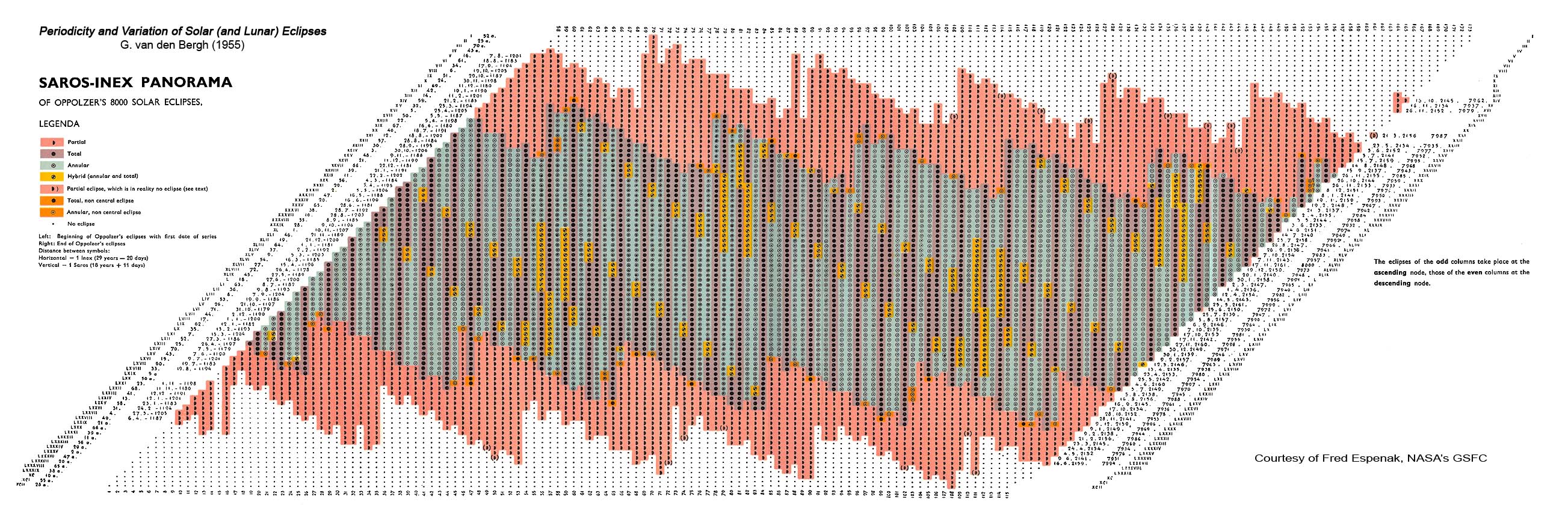
Saros cycles;
http://en.wikipedia.org/wiki/Saros_cycle
and Inex cycles:
http://en.wikipedia.org/wiki/Inex
The combined cycles of the Saros and Inex Cycles can be visualized here:
http://eclipse.gsfc.nasa.gov/SEsaros/image/SEpanoramaGvdB-big.JPG
Over longer time frames changes to Earth’s orbit, tilt and wobble called Milankovitch cycles;
http://en.wikipedia.org/wiki/Milankovitch_cycles
may be responsible for the periods of Glaciation (Ice Ages);
http://www.homepage.montana.edu/~geol445/hyperglac/time1/milankov.htm
that Earth has experienced for the last several million years of its climatic record:
http://en.wikipedia.org/wiki/Ice_age
Also of note, over very long time frames, “the Moon is spiraling away from Earth at an average rate of 3.8 cm per year”;
http://en.wikipedia.org/wiki/Lunar_distance_%28astronomy%29
http://curious.astro.cornell.edu/question.php?number=124
3. Gravitation:
http://en.wikipedia.org/wiki/Gravitation
The gravity of the Moon, Sun and Earth, Earth’s rotation, Earth’s orbit around the Sun, Earth’s tilt, Earth’s wobble and the Moon’s orbit around Earth act in concert to determine the constantly evolving Tidal Force on Earth:
http://en.wikipedia.org/wiki/Tidal_force
This tidal force results in that result in Earth’s Ocean Tide;
http://en.wikipedia.org/wiki/Tide
http://www.themcdonalds.net/richard/astro/papers/602-tides-web.pdf
Atmospheric Tide;
http://en.wikipedia.org/wiki/Atmospheric_tide
and Magma Tide:
http://www.springerlink.com/content/h7005r0273703250/
Earth’s Gravity;
http://en.wikipedia.org/wiki/Convection#Gravitational_or_buoyant_convection
http://visibleearth.nasa.gov/view_rec.php?id=205
in concert with Tidal Forces, influence Earth’s Ocean Circulation;
http://www.eoearth.org/article/Ocean_circulation
which influences Oceanic Oscillations including El Niño/La Niña;
http://en.wikipedia.org/wiki/El_Ni%C3%B1o-Southern_Oscillation
the Pacific Decadal Oscillation (PDO);
http://en.wikipedia.org/wiki/Pacific_Decadal_Oscillation
the Atlantic Multi-Decadal Oscillation (AMO);
http://en.wikipedia.org/wiki/Atlantic_Multidecadal_Oscillation
the Indian_Ocean_Dipole (IOD)/Indian Ocean Oscillation (IOO) and;
http://en.wikipedia.org/wiki/Indian_Ocean_Dipole
can result in the formation of Polynyas:
http://en.wikipedia.org/wiki/Polynya
Gravity Waves;
http://en.wikipedia.org/wiki/Gravity_wave
which may be partially responsible for the Quasi-Biennial Oscillation (QBO);
http://en.wikipedia.org/wiki/Quasi-biennial_oscillation
“on an air–sea interface are called surface gravity waves or Surface Waves”;
http://en.wikipedia.org/wiki/Surface_wave
“while internal gravity waves are called Inertial Waves”:
http://en.wikipedia.org/wiki/Inertial_waves
“Rosby Waves;
http://en.wikipedia.org/wiki/Rossby_waves
Geostrophic Currents
http://en.wikipedia.org/wiki/Geostrophic
and Geostrophic Wind
http://en.wikipedia.org/wiki/Geostrophic_wind
are examples of inertial waves. Inertial waves are also likely to exist in the core of the Earth”
Earth’s gravity is the primary driver of Plate Tectonics;
http://en.wikipedia.org/wiki/Plate_tectonics
“The Slab Pull;
http://en.wikipedia.org/wiki/Slab_pull
force is a tectonic plate force due to subduction. Plate motion is partly driven by the weight of cold, dense plates sinking into the mantle at trenches. This force and the slab suction force account for most of the overall force acting on plate tectonics, and the Ridge Push;
force accounts for 5 to 10% of the overall force.”
Plate Tectonics drive “cycles of ocean basin growth and destruction, known as Wilson cycles;
http://csmres.jmu.edu/geollab/fichter/Wilson/Wilson.html
involving continental rifting;
http://en.wikipedia.org/wiki/Rift
seafloor-spreading;
http://en.wikipedia.org/wiki/Seafloor_spreading
subduction;
http://en.wikipedia.org/wiki/Subduction
and collision.”:
http://en.wikipedia.org/wiki/Continental_collision
“Climate change on ultra-long time scales (tens of millions of years) are more than likely connected to plate tectonics.”
“Through the course of a Wilson cycle continents collide and split apart, mountains are uplifted and eroded, and ocean basins open and close. The re-distribution and changing size and elevation of continental land masses may have caused climate change on long time scales”;
http://www.pbs.org/wgbh/nova/ice/chill.html
a process called the Supercontinent Cycle:
http://en.wikipedia.org/wiki/Supercontinent_cycle
Earth’s gravity is responsible for Katabatic Wind:
http://en.wikipedia.org/wiki/Katabatic_wind
4. Solar Energy;
http://en.wikipedia.org/wiki/Solar_energy
results is Solar Radiation/Sunlight;
http://en.wikipedia.org/wiki/Solar_radiation
which varies based upon 11 and 22 year cycles:
http://en.wikipedia.org/wiki/Solar_cycle
Total Solar Irradiance (TSI);
http://www.ngdc.noaa.gov/stp/solar/solarirrad.html
appears to fluctuate “by approximately 0.1% or about 1.3 Watts per square meter (W/m2) peak-to-trough during the 11-year sunspot cycle”:
http://en.wikipedia.org/wiki/Solar_variation
Solar Energy also drives the Hydrological/Water Cycle;
http://en.wikipedia.org/wiki/Hydrological_cycle
within the Hydrosphere;
http://en.wikipedia.org/wiki/Hydrosphere
as Total Solar Irradiance (TSI) causes evaporation;
http://en.wikipedia.org/wiki/Evaporation
that drives cloud formation;
http://en.wikipedia.org/wiki/Cloud
results in precipitation;
http://en.wikipedia.org/wiki/Precipitation_%28meteorology%29
that results in the Water Distribution on Earth;
http://en.wikipedia.org/wiki/Water_distribution_on_Earth
creates surface runoff;
http://en.wikipedia.org/wiki/Runoff_%28water%29
which result in rivers;
http://en.wikipedia.org/wiki/River
and drives erosion:
http://en.wikipedia.org/wiki/Erosion
Solar energy is also “The driving force behind atmospheric circulation is solar energy, which heats the atmosphere with different intensities at the equator, the middle latitudes, and the poles.”
http://www.scienceclarified.com/As-Bi/Atmospheric-Circulation.html
Atmospheric Circulation;
http://en.wikipedia.org/wiki/Atmospheric_circulation
includes Hadley Cells;
http://en.wikipedia.org/wiki/Hadley_cell
Ferrel Cells;
http://en.wikipedia.org/wiki/Atmospheric_circulation#Ferrel_cell
Polar Cells;
http://en.wikipedia.org/wiki/Polar_cells
and Polar Vortexes:
http://en.wikipedia.org/wiki/Polar_cells
all of which help to create Wind;
http://en.wikipedia.org/wiki/Wind
that influence Surface Currents;
http://www.windows2universe.org/earth/Water/ocean_currents.html
http://en.wikipedia.org/wiki/Ocean_current
through Ekman Transport;
http://en.wikipedia.org/wiki/Ekman_transport
http://oceanmotion.org/html/background/ocean-in-motion.htm
and also cause Langmuir circulations
http://en.wikipedia.org/wiki/Langmuir_circulation
Solar energy is also a driver of the Brewer-Dobson Circulation
http://en.wikipedia.org/wiki/Brewer-Dobson_circulation
Atmospheric Waves;
http://en.wikipedia.org/wiki/Atmospheric_wave
including Atmospheric Tides
http://en.wikipedia.org/wiki/Atmospheric_tide
as well as evaporation and condensation may help to drive changes in Atmospheric Pressure:
http://en.wikipedia.org/wiki/Atmospheric_pressure
http://www.atmos-chem-phys-discuss.net/10/24015/2010/acpd-10-24015-2010.pdf
Solar Ultraviolet (UV) radiation;
http://en.wikipedia.org/wiki/Ultraviolet
appears to vary by approximately 10% during the solar cycle;
http://www.nasa.gov/topics/solarsystem/features/solarcycle-sorce.html
has been hypothesized to influence Earth’s climate;
http://wattsupwiththat.com/2011/04/05/courtillot-on-the-solar-uv-climate-connection/
however Leif Svalgaard argues that,
This is well-trodden ground. Nothing new to add, just the same old, tired arguments. Perhaps a note on EUV: as you can see here (slide 13)
http://lasp.colorado.edu/sorce/news/2008ScienceMeeting/doc/Session1/S1_03_Kopp.pdf the energy in the EUV band [and other UV bands] is very tiny; many orders of magnitude less than what shines down on our heads each day. So a larger solar cycle variation of EUV does not make any significant difference in the energy budget.
http://wattsupwiththat.com/2011/04/05/courtillot-on-the-solar-uv-climate-connection/#comment-636477
Additionally variations in Ultraviolet (UV) radiation may influence the break down of Methane;
(Source TBD)
Infrared Radiation;
http://en.wikipedia.org/wiki/Infrared
Solar – Wind;
http://science.nasa.gov/science-news/science-at-nasa/1999/ast13dec99_1/
Solar – Coronal Holes;
http://helios.gsfc.nasa.gov/chole.html
Solar – Solar Energetic Particles (SEP);
http://helios.gsfc.nasa.gov/sep.html
Solar – Coronal Mass Ejection;
http://www.esa.int/esaSC/SEMF75BNJTF_index_0.html
http://www.ratedesi.com/video/v/8AuCE_NNEaM/Sun-Erupts-to-Life-Unleashes-a-Huge-CME-on-13-April-2010
Solar Magnetosphere Breach;
Solar Polar Field Reversal;
http://science.nasa.gov/science-news/science-at-nasa/2001/ast15feb_1/
Solar Sector Boundary;
http://science.nasa.gov/heliophysics/focus-areas/magnetosphere-ionosphere/
Grand Minimum;
Leif Svalgaard says: February 6, 2011 at 8:26 pm
If L&P are correct and sunspots become effectively] invisible [not gone] it might mean another Grand Minimum lasting perhaps 50 years. During this time the solar cycle is still operating, cosmic rays are still modulated, and the solar wind is still buffeting the Earth.”
“It will lead to a cooling of a couple of tenths of a degree.”
Solar Influences on Climate:
http://www.leif.org/EOS/2009RG000282.pdf
Statistical issues about solar–climate relations
http://www.leif.org/EOS/Yiou-565-2010.pdf
5. Geothermal Energy;
http://en.wikipedia.org/wiki/Geothermal_energy
influences Earth’s climate especially when released by Volcanoes;
http://en.wikipedia.org/wiki/Volcano
“which are generally found where tectonic plates are diverging;
http://en.wikipedia.org/wiki/Divergent_boundary
or converging”;
http://en.wikipedia.org/wiki/Convergent_boundary
however, “intraplate volcanism has also been postulated to be caused by mantle plumes”:
http://en.wikipedia.org/wiki/Mantle_plume
“These so-called “hotspots”;
http://en.wikipedia.org/wiki/Hotspot_%28geology%29
for example Hawaii, are postulated to arise from upwelling diapirs;
http://en.wikipedia.org/wiki/Diapir
from the core-mantle boundary, 3,000 km deep in the Earth.”
Volcanoes have been shown to influence Earth’s climate;
http://www.geology.sdsu.edu/how_volcanoes_work/climate_effects.html
http://www.longrangeweather.com/global_temperatures.htm
including in the infamous Year Without a Summer;
http://en.wikipedia.org/wiki/Year_Without_a_Summer
which was partially caused by the 1815 eruption of Mount Tambora;
http://en.wikipedia.org/wiki/1815_eruption_of_Mount_Tambora
and is called a Volcanic Winter:
http://en.wikipedia.org/wiki/Volcanic_winter
“Volcanic Ash;
http://en.wikipedia.org/wiki/Volcanic_ash
particles have a maximum residence time in the troposphere of a few weeks.
The finest Tephera;
http://en.wikipedia.org/wiki/Tephra
remain in the stratosphere for only a few months, they have only minor climatic effects, and they can be spread around the world by high-altitude winds. This suspended material contributes to spectacular sunsets.
“The greatest volcanic impact upon the earth’s short term weather patterns is caused by sulfur dioxide gas;”
http://en.wikipedia.org/wiki/Sulfur_dioxide
“In the cold lower atmosphere, it is converted to Sulfuric Acid;
http://en.wikipedia.org/wiki/Sulfuric_acid
sulfuric acid by the sun’s rays reacting with stratospheric water vapor to form sulfuric acid aerosol layers. The aerosol remains in suspension long after solid ash particles have fallen to earth and forms a layer of sulfuric acid droplets between 15 to 25 kilometers up. Fine ash particles from an eruption column fall out too quickly to significantly cool the atmosphere over an extended period of time, no matter how large the eruption.
Sulfur aerosols last many years, and several historic eruptions show a good correlation of sulfur dioxide layers in the atmosphere with a decrease in average temperature decrease of subsequent years. The close correlation was first established after the 1963 eruption of Agung volcano in Indonesia when it was found that sulfur dioxide reached the stratosphere and stayed as a sulfuric acid aerosol.
Without replenishment, the sulfuric acid aerosol layer around the earth is gradually depleted, but it is renewed by each eruption rich in sulfur dioxide. This was confirmed by data collected after the eruptions of El Chichon, Mexico (1982) and Pinatubo, Philippines (1991), both of which were high-sulfur compound carriers like Agung, Indonesia.”
http://volcanology.geol.ucsb.edu/gas.htm
There is also some evidence that if “volcanic activity was high enough, then a water vapor anomaly would be introduced into the lower stratosphere before the anomaly due to the previous eruption had disappeared. The result would be threefold in the long term: stratospheric cooling, stratospheric humidification, and surface warming due to the positive radiative forcing associated with the water vapor.”
See: http://journals.ametsoc.org/doi/pdf/10.1175/1520-0442(2003)016%3C3525%3AAGSOVE%3E2.0.CO%3B2#h1
Geothermic Energy can also warm the atmosphere through Hot Springs;
http://en.wikipedia.org/wiki/Hot_springs
Or warm the ocean through Hydrothermal Vents:
http://en.wikipedia.org/wiki/Hydrothermal_vent
Which can be a factor in Hydrothermal Circulations:
http://en.wikipedia.org/wiki/Hydrothermal_circulation
6. Outer Space/Cosmic/Galactic Influences;
http://en.wikipedia.org/wiki/Outer_space
http://en.wikipedia.org/wiki/Cosmos
http://en.wikipedia.org/wiki/Galaxy
including Asteroids;
http://en.wikipedia.org/wiki/Asteroid
Meteorites;
http://en.wikipedia.org/wiki/Meteorite
and Comets;
http://en.wikipedia.org/wiki/Comet
can all significantly impact Earth’s climate upon impact.
It has been hypothesized that Galactic Cosmic Rays;
http://en.wikipedia.org/wiki/Galactic_cosmic_ray
http://en.wikipedia.org/wiki/Cosmic_ray
modulated by Solar Wind, may influence cloud formation on Earth:
Galactic Magnetic Fields also result in the;
http://www.scholarpedia.org/article/Galactic_magnetic_fields
Galactic Tide;
http://en.wikipedia.org/wiki/Galactic_tide
which may influence the hypothesized Oort cloud;
http://en.wikipedia.org/wiki/Oort_Cloud
“Besides the galactic tide, the main trigger for sending comets into the inner Solar System is believed to be interaction between the Sun’s Oort cloud and the gravitational fields of near-by stars or giant molecular clouds.”
7. Magnetic Forces;
http://en.wikipedia.org/wiki/Earth%27s_magnetic_field
Earth Core Changes:
http://physicsworld.com/cws/article/news/42580
“appears to be generated in the Earth’s core by a dynamo process, associated with the circulation of liquid metal in the core, driven by internal heat sources”
impact the Magnetosphere;
http://en.wikipedia.org/wiki/Magnetosphere
including movement of the Geomagnetic Poles:
http://www.ngdc.noaa.gov/geomag/GeomagneticPoles.shtml
http://news.nationalgeographic.com/news/2009/12/091224-north-pole-magnetic-russia-earth-core.html
8. Atmospheric Composition
http://en.wikipedia.org/wiki/Atmosphere_of_Earth
Nitrogen (N2) represents approximately 780,840 ppmv or 78.084% of Earth’s Atmosphere;
http://en.wikipedia.org/wiki/Nitrogen
Oxygen (O2) represents approximately 209,460 ppmv or 20.946%;
http://en.wikipedia.org/wiki/Oxygen
Argon (Ar) represents approximately 9,340 ppmv or 0.9340%;
http://en.wikipedia.org/wiki/Argon
Carbon Dioxide (CO2) represents approximately 390 ppmv or 0.039%;
http://en.wikipedia.org/wiki/Carbon_dioxide
contributes to the Greenhouse Effect;
?
and
influences the rate of Plant Growth;
http://www.sjsu.edu/faculty/watkins/CO2plants.htm
Neon (Ne) represents approximately18.18 ppmv or 0.001818%;
http://en.wikipedia.org/wiki/Neon
Helium (He) represents approximately 5.24 ppmv (0.000524%);
http://en.wikipedia.org/wiki/Helium
Krypton (Kr) represents approximately 1.14 ppmv (0.000114%);
http://en.wikipedia.org/wiki/Krypton
Methane (CH4) represents approximately 1.79 ppmv (0.000179%);
http://en.wikipedia.org/wiki/Methane
contributes to the Greenhouse Effect;
?
Hydrogen (H2) represents approximately 0.55 ppmv (0.000055%);
http://en.wikipedia.org/wiki/Hydrogen
Nitrous Oxide (N2O) represents approximately 0.3 ppmv (0.00003%);
http://en.wikipedia.org/wiki/Nitrous_oxide
contributes to the Greenhouse Effect;
?
Ozone (O3) represents approximately 0.0 to 0.07 ppmv (0 to 7×10⁻⁶%);
http://en.wikipedia.org/wiki/Ozone
Nitrogen Dioxide (NO2) represents approximately 0.02 ppmv (2×10⁻⁶%) (0.000002%);
http://en.wikipedia.org/wiki/Nitrogen_dioxide
Iodine (I2) represents approximately 0.01 ppmv (1×10⁻⁶%) (0.000001%) and;
http://en.wikipedia.org/wiki/Iodine
Ammonia (NH3) represents a trace amount of Earth’s Atmosphere:
http://en.wikipedia.org/wiki/Ammonia
Additional atmosphere components includes Water vapor (H2O) that represents approximately 0.40% over full atmosphere, typically 1%-4% at surface.
http://en.wikipedia.org/wiki/Water_vapor;
Aerosols;
http://en.wikipedia.org/wiki/Aerosol
that “act as cloud condensation nuclei, they alter albedo (both directly and indirectly via clouds) and hence Earth’s radiation budget, and they serve as catalysts of or sites for atmospheric chemistry reactions.”
“Aerosols play a critical role in the formation of clouds;
http://en.wikipedia.org/wiki/Clouds
Clouds form as parcels of air cool and the water vapor in them condenses, forming small liquid droplets of water. However, under normal circumstances, these droplets form only where there is some “disturbance” in the otherwise “pure” air. In general, aerosol particles provide this “disturbance”. The particles around which cloud droplets coalesce are called cloud condensation nuclei (CCN) or sometimes “cloud seeds”. Amazingly, in the absence of CCN, air containing water vapor needs to be “supersaturated” to a humidity of about 400% before droplets spontaneously form! So, in almost all circumstances, aerosols play a vital role in the formation of clouds.”
http://www.windows2universe.org/earth/Atmosphere/aerosol_cloud_nucleation_dimming.html
Particulates;
http://en.wikipedia.org/wiki/Particulates
including Soot/Black Carbon;
http://en.wikipedia.org/wiki/Soot
http://en.wikipedia.org/wiki/Black_carbon
Sand;
http://en.wikipedia.org/wiki/Sand
Dust
http://en.wikipedia.org/wiki/Dust
“Volcanic Ash;
http://en.wikipedia.org/wiki/Volcanic_ash
particles have a maximum residence time in the troposphere of a few weeks.
The finest Tephera;
http://en.wikipedia.org/wiki/Tephra
remain in the stratosphere for only a few months, they have only minor climatic effects, and they can be spread around the world by high-altitude winds. This suspended material contributes to spectacular sunsets.
The major climate influence from volcanic eruptions is caused by gaseous sulfur compounds, chiefly Sulfur Dioxide;
http://en.wikipedia.org/wiki/Sulfur_dioxide
which reacts with OH and water in the stratosphere to create sulfate aerosols with a residence time of about 2–3 years.”
“Emission rates of [Sulfur Dioxide] SO2 from an active volcano range from 10 million tonnes/day according to the style of volcanic activity and type and volume of magma involved. For example, the large explosive eruption of Mount Pinatubo on 15 June 1991 expelled 3-5 km3 of dacite magma and injected about 20 million metric tons of SO2 into the stratosphere. The sulfur aerosols resulted in a 0.5-0.6°C cooling of the Earth’s surface in the Northern Hemisphere.”
http://volcanoes.usgs.gov/hazards/gas/index.php
“The 1815 eruption [of Mount Tambora] is rated 7 on the Volcanic Explosivity Index, the only such eruption since the Lake Taupo eruption in about 180 AD. With an estimated ejecta volume of 160 cubic kilometers, Tambora’s 1815 outburst was the largest volcanic eruption in recorded history.”
“The eruption created global climate anomalies that included the phenomenon known as “volcanic winter”;
http://en.wikipedia.org/wiki/Volcanic_winter
1816 became known as the “Year Without a Summer”;
http://en.wikipedia.org/wiki/Year_Without_a_Summer
because of the effect on North American and European weather. Agricultural crops failed and livestock died in much of the Northern Hemisphere, resulting in the worst famine of the 19th century.”
http://en.wikipedia.org/wiki/Mount_Tambora
“In the spring and summer of 1816, a persistent “dry fog” was observed in the northeastern US. The fog reddened and dimmed the sunlight, such that sunspots were visible to the naked eye. Neither wind nor rainfall dispersed the “fog”. It has been characterized as a stratospheric sulfate aerosol veil.”
“The greatest volcanic impact upon the earth’s short term weather patterns is caused by sulfur dioxide gas;”
http://en.wikipedia.org/wiki/Sulfur_dioxide
“In the cold lower atmosphere, it is converted to Sulfuric Acid;
http://en.wikipedia.org/wiki/Sulfuric_acid
sulfuric acid by the sun’s rays reacting with stratospheric water vapor to form sulfuric acid aerosol layers. The aerosol remains in suspension long after solid ash particles have fallen to earth and forms a layer of sulfuric acid droplets between 15 to 25 kilometers up. Fine ash particles from an eruption column fall out too quickly to significantly cool the atmosphere over an extended period of time, no matter how large the eruption.
Sulfur aerosols last many years, and several historic eruptions show a good correlation of sulfur dioxide layers in the atmosphere with a decrease in average temperature decrease of subsequent years. The close correlation was first established after the 1963 eruption of Agung volcano in Indonesia when it was found that sulfur dioxide reached the stratosphere and stayed as a sulfuric acid aerosol.
Without replenishment, the sulfuric acid aerosol layer around the earth is gradually depleted, but it is renewed by each eruption rich in sulfur dioxide. This was confirmed by data collected after the eruptions of El Chichon, Mexico (1982) and Pinatubo, Philippines (1991), both of which were high-sulfur compound carriers like Agung, Indonesia.”
http://volcanology.geol.ucsb.edu/gas.htm
There is also some evidence that if “volcanic activity was high enough, then a water vapor anomaly would be introduced into the lower stratosphere before the anomaly due to the previous eruption had disappeared. The result would be threefold in the long term: stratospheric cooling, stratospheric humidification, and surface warming due to the positive radiative forcing associated with the water vapor.”
See: http://journals.ametsoc.org/doi/pdf/10.1175/1520-0442(2003)016%3C3525%3AAGSOVE%3E2.0.CO%3B2#h1
9. Albedo
http://en.wikipedia.org/wiki/Albedo
“or reflection coefficient, is the diffuse reflectivity or reflecting power of a surface. It is defined as the ratio of reflected radiation from the surface to incident radiation upon it. Being a dimensionless fraction, it may also be expressed as a percentage, and is measured on a scale from zero for no reflecting power of a perfectly black surface, to 1 for perfect reflection of a white surface.”
Clouds
http://en.wikipedia.org/wiki/Clouds
Aerosols
http://en.wikipedia.org/wiki/Aerosol
“act as cloud condensation nuclei, they alter albedo (both directly and indirectly via clouds) and hence Earth’s radiation budget, and they serve as catalysts of or sites for atmospheric chemistry reactions.”
“Aerosols play a critical role in the formation of clouds. Clouds form as parcels of air cool and the water vapor in them condenses, forming small liquid droplets of water. However, under normal circumstances, these droplets form only where there is some “disturbance” in the otherwise “pure” air. In general, aerosol particles provide this “disturbance”. The particles around which cloud droplets coalesce are called cloud condensation nuclei (CCN) or sometimes “cloud seeds”. Amazingly, in the absence of CCN, air containing water vapor needs to be “supersaturated” to a humidity of about 400% before droplets spontaneously form! So, in almost all circumstances, aerosols play a vital role in the formation of clouds.”
http://www.windows2universe.org/earth/Atmosphere/aerosol_cloud_nucleation_dimming.html
Snow
Ice
Water
Particulates
http://en.wikipedia.org/wiki/Particulates
Soot/Black Carbon
http://en.wikipedia.org/wiki/Soot
http://en.wikipedia.org/wiki/Black_carbon
Algae (Ocean Surface)
10. Biology
http://en.wikipedia.org/wiki/Biology
“Phototrophs
http://en.wikipedia.org/wiki/Photoautotroph
are the organisms (usually plants) that carry out photosynthesis;
http://en.wikipedia.org/wiki/Photosynthesis
to acquire energy. They use the energy from sunlight to convert carbon dioxide and water into organic materials to be utilized in cellular functions such as biosynthesis and respiration.” “In plants, algae, and cyanobacteria, photosynthesis uses carbon dioxide and water, releasing oxygen as a waste product.”
Chemoautotrophs;
http://en.wikipedia.org/wiki/Chemotroph
are “organisms that obtain carbon through Chemosynthesis;
http://en.wikipedia.org/wiki/Chemosynthesis
are phylogenetically diverse, but groups that include conspicuous or biogeochemically-important taxa include the sulfur-oxidizing gamma and epsilon proteobacteria, the Aquificaeles, the Methanogenic archaea and the neutrophilic iron-oxidizing bacteria.”
Bacteria – TBD
Fungi – TBD
Protozoa – TBD
Chromista – TBD
Animal – Anthropogenic including:
Carbon Dioxide;
http://en.wikipedia.org/wiki/Carbon_dioxide
contributes to the Greenhouse Effect;
?
and
influences the rate of plant growth ;
http://www.sjsu.edu/faculty/watkins/CO2plants.htm
Methane
http://en.wikipedia.org/wiki/Methane
Nitrous Oxide
Ozone
Particulates, especially Black Carbon/Soot
Aerosols
Icebreakers/Arctic Shipping/Fishing/Cruise-Line Transits
Contrails
Nuclear Power Generation – Including Ships
Land Use Changes – Including De and Re-Forestation
Urban Heat Islands
Run Off From Asphalt/Urban Heat Islands
Fossil Fuel Energy Generation Waste Heat –
Renewables – Wind Farms, Solar Arrays, Dams and Ethanol
Sewage/Wastewater Treatment Discharge
etc.
Animal – Non-Anthropogenic including
Plankton
Beaver (Genus Castor)
http://en.wikipedia.org/wiki/Beaver
etc.
11. Chemical
Fossil Fuels:
Coal
Oil shale
Petrochemicals
– Petroleum
– Mineral Oil
Asphalt
Tar Pits/Sands
Methane
http://en.wikipedia.org/wiki/Methane
etc.
“Photosynthesis;
http://en.wikipedia.org/wiki/Photosynthesis
is a chemical process that converts carbon dioxide into organic compounds, especially sugars, using the energy from sunlight.”
“Chemosynthesis;
http://en.wikipedia.org/wiki/Chemosynthesis
is the biological conversion of one or more carbon molecules (usually carbon dioxide or methane) and nutrients into organic matter using the oxidation of inorganic molecules (e.g. hydrogen gas, hydrogen sulfide) or methane as a source of energy, rather than sunlight, as in photosynthesis.”
Reactions:
Combustion
– Forest Fires
– Fossil Fuels
– – Methane
http://en.wikipedia.org/wiki/Methane
etc.
Conversion of Methane, CO2, etc.
12. Physics – Other
Temperature
http://en.wikipedia.org/wiki/Temperature
Pressure
http://en.wikipedia.org/wiki/Pressure
States of Matter
http://en.wikipedia.org/wiki/State_of_matter
Heat Conduction
http://en.wikipedia.org/wiki/Heat_conduction
Convection
http://en.wikipedia.org/wiki/Convection
Thermal Radiation
http://en.wikipedia.org/wiki/Thermal_radiation
Thermodynamics
http://en.wikipedia.org/wiki/Laws_of_thermodynamics
-Entropy
http://en.wikipedia.org/wiki/Entropy
General summaries of the potential variables involved in Earth’s climate system;
http://www.physicalgeography.net/fundamentals/7y.html
http://oceanservice.noaa.gov/education/pd/climate/factsheets/whatfactors.pdf
We are not walking through empty space in the fluid volume of gaseous Air around us any more than we are swimming in empty space in the fluid volume of liquid water when we go scuba diving. There is no sound in empty space – sound travels through air similarly as the energy of a wave travels through water, the body, the volume, of water doesn’t move but stays where it is, the wave is energy being passed through – like a Mexican Wave. [A wave in the ocean is not a volume of water travelling – in this it differs from wind which is a volume of air travelling.]
A link I posted earlier – http://www.mediacollege.com/audio/01/sound-waves.html
It’s a matter of scale, molecules travelling at great speeds are not travelling great distances, diffusion is on a nano scale. The molecules which have volume are constrained by the molecules with volume around them. It’s molecules vibrating on the spot and hitting adjacent molecules with volume which passes along sound. [Wind is actual volumes of local air moving, as I’ve described above.]
You have to bear in mind that AGWScience is simply the production department of memes out of whatever concepts are available, they do not represent reality, neither individually nor in combination, and there is no internal consistency between them because of this. You can’t get from their imaginary ideal gas atmosphere to convection of heat transfer in our real gaseous one – hence no need for thermodynamics in its imaginary climate.. And, it doesn’t much care how many people are busy busy busy arguing that our atmosphere is ideal gas therefore carbon dioxide is well-mixed and can’t be separated out and can therefore accumulate for hundreds and thousands of years – all it’s interested in is passing on junk science memes. Here’s an example:
http://multimedia2.up.edu/Physics/TOLE/CascadeVolcanoes/LessonPlans/CO2Gas_Candle_Lesson_VVP.pdf
You would do well to remember, at least to consider, that AGWScience is not interested in enlightening you about the world, but is geared up to creating as much ignorance about it as it can; the more confusion it creates, the more arguments, the better it achieves its objective. This new batch of kids when they grow up will be telling the aging defenders of the ideal gas meme that it’s nonsense that carbon dioxide doesn’t displace air and sink, but they may well believe it is a poison, because that’s the meme being re-inforced to the teachers – “Deadly Incidents of CO2 Poisoning”.
And the link to the Poisonous Volcanic Gas Video takes you to “Teachers on the Leading Edge” http://orgs.up.edu/totle/index.php?q=node/400 and “Poisonous Volcanic Gas Demo”, which is the first demo on the pdf compilation on the heavier than air carbon dioxide. Actually, a very good experiment that anyone can do at home.
The traditional science category distinction between poisonous and non-poisonous is deliberately confused. Carbon dioxide is non-toxic, not poisonous, compare carbon monoxide which is toxic. Carbon dioxide kills by suffocation. The water a person drowns in is not toxic, the pillow used to suffocate, is not toxic (although the perpetrator of such an act might well be..). All in the cause to demonise carbon dioxide, real science is deliberately mangled. Just as it is mangled by taking ideal gas law out of context to create a fictitious atmosphere where radiation prevails in empty space and heavier than air carbon dioxide accumulates, and convection and real thermodynamics don’t happen. So here the meme that the actually benign carbon dioxide which is the building block of us carbon life forms in the Carbon Life Cycle, is instead a poison, is being brainwashed into the supposedly ‘leading edge’ teachers.
What hope for those children to understand the complexities of climate when they grow up with no idea of the real world? Very efficient, takes more time, but less messy than book burning knowledge and mass slaughter of the teachers as in Russia, China and Cambodia in the last century.
So be careful out there, AGWScience mangles the very basic concepts and out of these false assumptions, false premises, builds an impossible through the looking glass with Alice world, but a toxic one, poisoning the mind…
Myrrh says:
July 13, 2011 at 2:54 am
So be careful out there, AGWScience mangles the very basic concepts and out of these false assumptions, false premises
This is just nonsense and the wrong way of fighting AGW. Let us see how your basic concepts fare: Let us start with a simple example: take a bag with a volume of 1 cubic meter [out in empty space, so it contains 100% empty space, that is 1 million little cubic centimeters of empty space, because 1 meter is 100 centimeter, and the volume is thus 100*100*100 cubic centimeters]. Now put in the bag ten little cubes one centimeter on the side of any material you like.How much of the bag is now empty space?
This should be easy for you.
Dr. Svalgaard,
I looked for an updated Solar Polar Field / Rmax graph at your site, but couldn’t find any. Does this mean that this relation does not hold any more?
Hugo M says:
July 13, 2011 at 6:11 am
I looked for an updated Solar Polar Field / Rmax graph at your site, but couldn’t find any. Does this mean that this relation does not hold any more?
The relation is between the polar fields at minimum and Rmax for the next cycle. As the minimum is now passed, the prediction will not change, hence no update. But I am not sure exactly which graph you are referring to.
Why has this discussion become so difficult to retrieve?
Has it been censored??
wermet says: June 30, 2011 at 9:12 pm
Hello Just the Facts,
Hello
Your statement in the first paragraph, “I have been studying Earth’s climate system for several years and have found it to be a ridiculously complex, continually evolving and sometimes chaotic beast,” is incorrect. The closing phrase should read, “and always chaotic beast.
The form of the partial differential equations that need to be solved in order to understand the aerodynamics of the atmosphere ALWAYS result in chaotic behavior. Small deviations in initial conditions, choice of grid construction and time steps will result in markedly different model predictions.
I was very deliberate in choosing “sometimes chaotic”, as I didn’t want to imply that Earth’s climate system is completely chaotic. Certainly there are chaotic occurrences occurring continuously within it, but the overall system seems to maintain a semblance of order and balance in-between its chaotic swings.
We have to consider atmospheric H2O distributions,
I’ve added “Vapor” after “Water” under “8. Atmospheric Composition”
Water Vapor
http://en.wikipedia.org/wiki/Water_vapor
phase changes and associated thermodynamic implications.
Were added to “12. Physics – Other” earlier.
There is particulate distribution tracking and its implications in providing nucleation sources for H2O condensation.
Under 10. Biology – Animal – Anthropogenic we have “Particulates” “Soot/Black Carbon”
http://en.wikipedia.org/wiki/Soot
http://en.wikipedia.org/wiki/Black_carbon
which can definitely have climatic impacts, e.g. “black carbon in soot is the dominant absorber of visible solar radiation in the atmosphere. Anthropogenic sources of black carbon, although distributed globally, are most concentrated in the tropics where solar irradiance is highest. Black carbon is often transported over long distances, mixing with other aerosols along the way. The aerosol mix can form transcontinental plumes of atmospheric brown clouds, with vertical extents of 3 to 5 km. Because of the combination of high absorption, a regional distribution roughly aligned with solar irradiance, and the capacity to form widespread atmospheric brown clouds in a mixture with other aerosols, emissions of black carbon are the second strongest contribution to current global warming, after carbon dioxide emissions. In the Himalayan region, solar heating from black carbon at high elevations may be just as important as carbon dioxide in the melting of snowpacks and glaciers. The interception of solar radiation by atmospheric brown clouds leads to dimming at the Earth’s surface with important implications for the hydrological cycle, and the deposition of black carbon darkens snow and ice surfaces, which can contribute to melting, in particular of Arctic sea ice.”
http://www.nature.com/ngeo/journal/v1/n4/abs/ngeo156.html
however, in terms of nucleation sources;
“Aerosols play a critical role in the formation of clouds. Clouds form as parcels of air cool and the water vapor in them condenses, forming small liquid droplets of water. However, under normal circumstances, these droplets form only where there is some “disturbance” in the otherwise “pure” air. In general, aerosol particles provide this “disturbance”. The particles around which cloud droplets coalesce are called cloud condensation nuclei (CCN) or sometimes “cloud seeds”. Amazingly, in the absence of CCN, air containing water vapor needs to be “supersaturated” to a humidity of about 400% before droplets spontaneously form! So, in almost all circumstances, aerosols play a vital role in the formation of clouds.”
http://www.windows2universe.org/earth/Atmosphere/aerosol_cloud_nucleation_dimming.html
Particulates such as
Sand
http://en.wikipedia.org/wiki/Sand
and Dust
http://en.wikipedia.org/wiki/Dustand do not see
may play a role in cloud nucleation;
http://reef.atmos.colostate.edu/~sue/vdhpage/papers/twohy-etal-2009.pdf
http://journals.ametsoc.org/doi/abs/10.1175/1520-0469%281964%29021%3C0109%3ACNOIP%3E2.0.CO%3B2
but it seems likely to be a minor role.
There are also chemical processes at work in the atmosphere, such as methane (CH4) conversion to CO2 in the presence of O2 and sunlight.
I’ve found, “Sunlight turns carbon dioxide to methane”
http://www.eurekalert.org/pub_releases/2009-03/ps-stc030509.php
but not the other way around.
“Burning methane in the presence of oxygen produces carbon dioxide and water.”;
http://en.wikipedia.org/wiki/Methane
is this what you meant? I’ve added “Conversion of Methane, CO2, etc.” under
“11. Chemical, Reactions”
and welcome further input on this subject.
Thank you for sharing your thoughts.
Myrrh Why has this discussion become so difficult to retrieve?
Has it been censored??
Maybe you should just give an answer to the physics excersise that Dr.Svalaard posted, instead of continuing your increasingly ignorant rants.
Myrrh says: July 12, 2011 at 3:19 am
You’re full of it.
I have had many arguments with Leif and can assure you that he is not “full of it”.
Rob says:
July 16, 2011 at 3:11 am
Maybe you should just give an answer to the physics exercise that Dr Svalgaard posted, instead of continuing your increasingly ignorant rants.
Oh, that was a physics exercise, was it? Looked to me like a typical Leif distraction, irrelevant plus ad hom, hubris, to distract from the fact that he’s learned something..
My last encounter with Leif I also took him seriously, thought I would get a good exchange of ideas with him. That time, he pretended to know all about relativity … He came in with an objection to something I said about general relativity and told me it was x and I should read a page he linked to, I read it, and replied that his answer wasn’t relevant to general relativity and the page he linked even said that it wasn’t about general relativity, so what did he mean? He refused to answer.
If you think that’s a real physics question – why don’t you answer it…?
Leif Svalgaard says:
July 13, 2011 at 5:14 am
Ref my “So be careful out there, AGWScience mangles the very basic concepts and out of these false assumption, false premises”
this is just nonsense and the wrong way of fighting AGW.
!? I’ve given examples.. I realise you’re not at all familiar with these so as I said, we could go through it more slowly. For example, I’ve shown quite conclusively that izen’s claim, based on AGWScience false science premise, the meme that carbon dioxide and oxygen and nitrogen are ideal gases, that carbon dioxide doesn’t stratify out – is wrong . I’ve given examples from real life and even an experiment you can do in your own kitchen, to show that carbon dioxide is heavier than air and separates out. Carbon dioxide is a real gas, it has weight, volume, it takes up space, ideal gases have none of these real world properties – they take up no room in empty space..
Our atmosphere is not empty space, it is filled with gases which have volume, weight, interactions, etc. It is a fluid gas exerting pressure on us and subject to gravity – AGWScience fiction has an atmosphere of nothing with gas molecules just hard dots which bounce off each other – – this totally stupid fiction is being taught in schools – I think it is very important to point out that this is a typical way that AGScience fiction changes real science, real physics. By mangling and taking laws out of context, assigning different properties to things, and so on. It should be fought on this front. It takes someone who knows real physics very well to keep churning this stuff out – its own magisterium…
[out in empty space, so it contains 100% empty space
The only comment I have here, is – prove that space is empty.
Great project!
In the future I hope the following information can be included for all the parameters:
1. Cycles: What are the cycles for each parameter?
2. Variability: What is the change of magnitude during a cycle?
3. Relevance: How sensitive is earth’s climate to each parameter?
I know the IPCC has all this information and the climate models run on it. I’d just like to have it all in one place…
Irony off: Wouldn’t it be great to give estimates wherever we can come up with one?
Myrrh says:
July 16, 2011 at 12:05 pm
Carbon dioxide is a real gas, it has weight, volume, it takes up space, ideal gases have none of these real world properties – they take up no room in empty space..
Our atmosphere is not empty space, it is filled with gases which have volume, weight,…
The purpose of the exercise was to teach you about volumes. Let me repeat:
take a bag with a volume of 1 cubic meter [out in empty space, so it contains 100% empty space, that is 1 million little cubic centimeters of empty space, because 1 meter is 100 centimeter, and the volume is thus 100*100*100 cubic centimeters]. Now put in the bag ten little cubes one centimeter on the side of any material you like. How much of the bag is now empty space?
Since you don’t seem to know what empty means we can start by defining that. If a test particle with non-zero cross-section [i.e. one with its own volume] can travel forever in all directions in a space without ever colliding with any other particles, we say that that space is empty of particles.
Now on to the example. Since the bag has a volume of 100,00,00 cubic centimeters and we put in ten little cubes [each with volume and weight] of each 1 cc for a total volume of 10 cc, there are 100,00,00 – 10 = 99,99,90 cc left, so the empty part [i.e. not occupied by any little cubes] is now 99.999%.
Now on to a real gas. Let us take 1 cubic meter of Nitrogen at 1 atm pressure [which makes up most of our atmosphere]. To capitalize on what you just learned about volumes we ask: “what is the volume of the those real molecules of Nitrogen in that one cubic meter of the real gas Nitrogen. One way of calculating the volume is to realize that one molecule of the real gas N2 has volume and weight. So we can calculate the total volume of all the N2 molecules by multiplying the volume of ONE molecule by the number of molecules in our one cubic meter of the real gas N2. firt the volume of one molecule. As an approximation we’ll assume that the molecule is roughly spherical with a radius R. What is R? This link http://en.wikipedia.org/wiki/Van_der_Waals_radius gives R for N2 as 0.225 nanometers. Other links give 0.1 to 0.25 nm. We’ll take the larger values to take into account that interactions between real gas molecules make them look larger than they are. So the effective radius will be taken as 0.25 nm. This gives us a volume of 4pi/3*(0.25E-9)^3 = 6.54E-29 cubic meter. How many molecules are there in that cubic meter? Well, as a real gas it has weight [mass], in fact 1.25 kg under normal atmospheric temperature and sea level pressure. As N2 consists of 28 nucleons [protons and neutrons plus electrons that don’t weigh much] we can take the weight of one molecule as 28*weight of one neutron or 28*1.675E−27 = 4.7E-26 kg. So, the total number of N2 molecules comes to 1.25/4.7E-26 = 2.7E+25. Recall that one molecule has a volume of 6.54E-29 cubic meter, so the total volume of all the molecules in that 1 cubic meter becomes 2.7E+25*6.54E-29 = 0.00175 cubic meter. Meaning that there is 1 – 0.00175 = 0.99825 cubic meters not occupied by any molecules or by anything else, i.e. is empty. This matches well what the link to Van der Waals said about a real gas: ” In general, at normal laboratory temperatures and pressures, the atoms or molecules of a gas only occupy about 1/1000 of the volume of the gas, the rest being empty space”.
In that empty space the molecules move at high speed [1000 mph]. Even so, diffusion is a slow process, but convection, turbulence, and ‘eddy diffusion’ ensure that gases are mixed well throughout the atmosphere below the tropopause. Direct measurements of the mixing ratios by high flying aircraft and balloons confirm this expectation and empirically we simply find that the inert gases [Helium, Neon, Xenon, etc] are well mixed, thus there is to first order no gravitational separation. Whatever changes there are, are controlled by other factor, such as e.g. for water vapor that condenses out of the atmosphere, the mixing ratio, of course, falls to near zero in the stratosphere. For ozone that is created in the stratosphere, the mixing ratio is also different. For CO2, direct measurements http://www.atmos-chem-phys.org/10/7659/2010/acp-10-7659-2010.pdf show that once you are away from direct sources near the surface, there is very little decrease of the concentration with altitude.
All this is well-known and pertains to real gases as shown by real measurements and is real science.
Myrrh,
Leif is explaining that in the troposphere there is enough convection, turbulence and ‘eddy diffusion’ to overcome the stratification that would otherwise occur from gravitational effects alone. It is a pity that he could not put it so simply.
The situation is slightly different from tropopause upwards because there is less convection, turbulence and ‘eddy diffusion’ above that level and so a greater degree of stratification but even there there is a mix of slow overturning processes such as the Brewer Dobson Circulation.
The reason for the effectiveness of such mixing processes in the troposphere is the sheer amount of empty space between molecules in the atmosphere which gives enough freedom for those mixing processes to have the observed effect for any gases that have a longer residence time than water vapour molecules. Hence the general validity of treating real gases as if they were ideal gases.
Water vapour is very different as you point out because the molecules are constantly being recycled by evaporation and condensation on a very short timescale. I think the residence time of a water molecule is ten days or so but I haven’t checked that recently.
So your basic point that water vapour should be dealt with differently is correct but that is nothing to do with the difference between ideal and real gases. Instead one’s attention should be directed to the power of the evaporation/condensation process in mopping up all surplus energy from IR in the air that is not transported upwards by convection conduction and radiation.
If water vapour and the water cycle are treated correctly then it can readily be seen that the speed of the water cycle is highly variable and very responsive to changes in the energy content of the system at the sea/air interface and at the tropopause.
Such changes in the speed of the water cycle ensure that whenever ANY forcing tries to increase or decrease the natural background differential (dictated by landmass distribution) between sea surface and surface air temperatures then the speed of the water cycle changes to act as a negative system response acting against that forcing process to largely or completely cancel it.
There are only two system changes that can overcome the negative regulatory effects of the variable speed for the water cycle and they are net solar shortwave radiation into the oceans and atmospheric pressure.
The key to the whole climate conundrum is therefore net solar shortwave into the ocean because atmospheric pressure does not change significantly from changes in atmospheric composition.
It turns out that net solar shortwave into the ocean is highly sensitive to global albedo changes via cloudiness variations and as I have said elsewhere those cloudiness changes are highly sensitive to external solar variations (other than raw TSI) and internal oceanic variations.
Changes in composition of the atmosphere from variations in GHG quantities would have an effect but vanishingly small compared to the natural solar and oceanic changes.
Steven, you are probably running ahead a bit too fast for Mirrh, who it still contemplating the nature of ’empty’.
But it seems that youa are also running way ahead when you are drawing far-reaching conclusions like :
The key to the whole climate conundrum is therefore net solar shortwave into the ocean because atmospheric pressure does not change significantly from changes in atmospheric composition.
This seems entirely premature and almost ad-hoc, compared to Dr.Svalgaard’s extremely thorough and basic explanation of why gasses in our atmosphere behave like ideal gasses.
Maybe you can slow it down a bit, and explain what exactly you mean when you claim
There are only two system changes that can overcome the negative regulatory effects of the variable speed for the water cycle and they are net solar shortwave radiation into the oceans and atmospheric pressure.
which you seem to seems to come completely out of thin air.
I think I prefer Dr.Svalgaard’s more thorough approach over your premature assertions.
Rob,
You haven’t seen my previous work. I didn’t link to it yet again for fear of boring those who have already seen it but perhaps I should have done so here it is :
For the top down solar effects on surface pressure distribution:
http://www.irishweatheronline.com/features-2/wilde-weather/the-sun-could-control-earths-temperature/290.html
For the bottom up oceanic effects on surface pressure distribution:
http://www.irishweatheronline.com/features-2/wilde-weather/setting-and-maintaining-of-earth%e2%80%99s-equilibrium-temperature/18931.html
Have fun.
izen says:
July 4, 2011 at 3:16 am
The evidence so far is observational. The measured rise in anthropogenic CO2. The measured absoprtion spectrum of CO2. The measured increase and spectal change in downwelling longwave radiation. The measured drop and spectral change in outgoing LW radiation.
And the measured rise in land and sea surface temperatures, the rise in sea level, the fall in glacier mass balance, the loss of polar sea ice, the increase in atmospheric water vapour, the decrease in snow cover and the various biological changes in growing times and extent for plants and animals.
The observations above are facts not in question, but the causitive connection is in question in this AGW debate. And you have only three independent “facts” here: that CO2 is going up, that CO2 absorbs longwave radiation, and that the temperature has risen globally 0.7C. The rest – melting ice and snow, growing times and ranges, rises in sea-level and rises in outgoing radiation, are all CONSEQUENCES of a global temperature rise.
For CAGW to exist, CO2 must
1) have a very large to unlimited longwave radiation source to absorb (If LWR is less than CO2, the heating ability will decrease with time),
2) create, with water vapour, a significant (2 – 3X) feedback effect on temperature,
3) have a warming power in the absence of or to a much greater power relative to an in-built negative feedback mechanism, and
4) be operating at a time when “normal” processes, i.e. not CO2 caused, are NOT operating (unlike the 1860 – 1930 period).
If any of these four things can be demonstrated either false or with only a portion of their purported influence, then CAGW falls down to some AGW of an amount nonfixable without a total shutdown of the world’s human activity.
Right now Australia is moving to institute CO2 punitive actions that will, by their own admission, have no measurable impact (by themselves) on the forecast temperature rise of the globe. This is a noble effort, but like the Charge of the Light Brigade, drama without reason. Unless A-CO2 is a very strong creation of rising temperatures (including the purported feedback), a 20% or so decrease in our CO2 emissions will do nothing at great cost financially and in terms of self-realization. If you believe that the human race is a virus to be irradicated, or that we must “deindustrialize the economy”, as Hansen and Strong have said, then a weak influence on climate by CO2 can certainly be forced by a reversion to an 18th century world. But if you think that a “reasonable” target of emissions-reduction of 20 – 30% is something we can afford, technically do and have the economic-social will to do, then you must have a powerful CO2 villain to attack.
I state again that there are no measurements to say that the 4 points necessary for CAGW are true, only models. The uncertainty within each one covers off the alternate theories, that changes in insolation (i.e. albedo) or the heat exchange system between the oceans and the atmosphere are responsible for THE MAJORITY of the planet’s heating over the last 50 years.
Ice melting says nothing about CO2. It only says that heat from somewhere is entering ice masses.
The list is so long and the comments so varied that one does not know whether important items were missed.
However, I was looking in vain for the important work by Landscheidt, Fairbridge, Mackey, José, Wilson, Niroma, and Charvàtovà on the 178 year SIM cycle. I see no mention of the planetary orbital influences on the nature of the path of the sun around the centre of the solar system, and the concomitant correlation of the SIM cycle with the solar minima of the last millennium. There are thoughts that the poloidal and toroidal solar magnetic field of the solar dynamo(s) (de Jager/Duhau) are influenced by the cyclical proximity of the “heavy” planets with their own magnetic fields. Both magnetics and gravity may be involved. In any case, the topic supplies a straight correlation to the Wolf, Spörer, Maunder, Dalton and coming “Landscheidt minimum”.
It deserves all attention.
Si non è vera, è bon trovato.
This is what I like so much about WUWT. Everyone seems have a lot of wild opinons, but there is no substance.
Stephen Wilde has a “Hot Water Bottle Effect” theory and out of the blue claims there “There are only two system changes that can overcome the negative regulatory effects of the variable speed for the water cycle and they are net solar shortwave radiation into the oceans and atmospheric pressure.”. OP “Just The Facts” (what’s your real name?) suggests that sea ice retreat is caused by icebreakers from scientific excusions and sewer disposals from cruise ships and throws in everything but the kitchen sink to show that this climate system is so “rediculously complex”, carefully avoiding any mention of core elements of AGW. Meanwhile, Myrrh contemplates the very essence of reality as an argument to deny basic scientific facts.
What you seem to have in common is your ability to make definite statements without a scientific argument. Where are the scientific papers for your pet theory Stephen ? And where is your quantification of the effects of gravity waves or ice breakers on the Arctic sea ice extent ?
That’s why I like Svalgaard. He explains the basics and quantifies the effects. That’s what scientists do. Something you guys can learn a lot from.
No have fun debunking the CAGW theory. Don’t forget to define “CAGW” first, because this is term does not show up in scientific literature. Enjoy.
I am often amused by claims that we understand Earth’s climate system, are able to accurately measure its behavior, eliminate all potential variables except CO2 as the primary driver of Earth’s temperature and make predictions of Earth’s temperature decades into the future, all with a high degree of confidence.
Please show me one reputable, peer reviewed piece of research that makes this claim? You invalidated your entire post in the first paragraph. Well done.
I should add, given the nature of your approach so far, that research that focuses primarily on CO2 is not the same as claiming that CO2 is the only factor.
P.S. Wikipedia doesn’t count, this isn’t primary school.
Rob said:
“Where are the scientific papers for your pet theory Stephen ?”
I referred you to two articles of mine each of which referred to relevant scientific papers.
Rob says: July 19, 2011 at 12:37 am
“Just The Facts” (what’s your real name?)
Soon enough, I just need to write a couple introductory posts…
suggests that sea ice retreat is caused by icebreakers from scientific excusions and sewer disposals from cruise ships
Funny, you left out the wind, soot, fishing boats, freight ships, cruise liners and non-scientific icebreakers, perhaps you should reread this comment as apparently it didn’t sink in:
http://wattsupwiththat.com/2011/06/28/piomas-arctic-sea-ice-volume-model-corrected-still-appears-suspect/#comment-700815
Do you agree that the majority of the decrease in Arctic Sea Ice during the last decade wasn’t caused by Global Warming?
Ed Mertin says: June 30, 2011 at 10:03 pm
Just a fyi, I frequently go to the Smithsonian Large Holocene Eruptions page and then follow up by looking at the Find Eruptions By Date page and it is always telling.
Yes, volcanoes are certainly an important part of the climate system, i.e.:
“The effects of recent volcanic eruptions on winters are modest in scale but historically their effects have been significant.
Most recently, the 1991 explosion of Mount Pinatubo, a stratovolcano in the Philippines, cooled global temperatures for about 2–3 years.[2]
In 1883, the explosion of Krakatoa (Krakatau) created volcanic winter-like conditions. The next four years after the explosion were unusually cold, and the winter of 1887 to 1888 included powerful blizzards.[3] Record snowfalls were recorded worldwide.
The 1815 eruption of Mount Tambora, a stratovolcano in Indonesia, occasioned mid-summer frosts in New York State and June snowfalls in New England and Newfoundland and Labrador in what came to be known as the “Year Without a Summer” of 1816.
A paper written by Benjamin Franklin in 1783 blamed the unusually cool summer of 1783 on volcanic dust coming from Iceland, where the eruption of Laki volcano had released enormous amounts of sulfur dioxide, resulting in the death of much of the island’s livestock and a catastrophic famine which killed a quarter of the population. Temperatures in the northern hemisphere dropped by about 1 °C in the year following the Laki eruption.
In 1600, the Huaynaputina in Peru erupted. Tree ring studies show that 1601 was cold. Russia had its worst famine in 1601 to 1603. From 1600 to 1602, Switzerland, Latvia and Estonia had exceptionally cold winters. The wine harvest was late in 1601 in France, and in Peru and Germany wine production collapsed. Peach trees bloomed late in China, and Lake Suwa in Japan froze early.[4]
In 1452 or 1453, a cataclysmic eruption of the submarine volcano Kuwae caused worldwide disruptions.
The Great Famine of 1315–1317 in Europe may have been precipitated by a volcanic event,[5] perhaps that of Kaharoa, New Zealand, which lasted about five years.[6]
The extreme weather events of 535–536 are most likely linked to a volcanic eruption.”
http://en.wikipedia.org/wiki/Volcanic_winter
Based on a compilation;
1580 ± 20 – VEI6 – Billy Mitchell
1586 – VEI5? – Kelut, Java
1593 – VEI5? – Raung, Java
1600 – VEI6 – Huaynaputina
1625 – VEI5 – Katla
1640 – VEI5 – Komaga-Take, Japan
1641 – VEI6 – Mount Parker
1650 – VEI6 – Kolumbo, Santorini
1660 – VEI6 – Long Island (Papua New Guinea)
1663 – VEI5 – Usu, Japan
1667 – VEI5 – Shikotsu (Tarumai), Japan
1673 – VEI5? – Gamkonora, Halmahera
1680 – VEI5? – Tongkoko, Sulaw
I found 13 major eruptions, between 1580 and 1680 which coincides with the depths of the Little Ice Age:
http://www.eh-resources.org/timeline/timeline_lia.html
http://en.wikipedia.org/wiki/Little_Ice_AgeIt would seem that that the lack of volcanic activity
Whereas from 1900 to present I’ve found;
1902 – VEI6(?) – Santa Maria, Guatemala
1907 – VEI5 – Ksudach, Kamchatka
1912 – VEI6 – Novarupta (Katmai)
1932 – VEI5+ – Azul, Cerro (Quizapu)
1956 – VEI5 – Bezymianny, Kamchatchka
1980 – VEI5 – St Helens, US
1982 – VEI5 – El Chichon, Mexico
1991 – VEI6 – Pinatubo, Philippines
8 major eruptions, and none since 1991. Lower levels of volcanic activity during the 20th Century likely explains a portion of the warming that occurred during the century.
Sources:
http://tomix.homelinux.org/~thomas/eth/7_semester/large-scale_climate_variability_WS_2006_2007/unterlagen/edit/briffa_1600_volcanic.pdf
http://en.wikipedia.org/wiki/Little_Ice_Age#Volcanic_activity
http://en.wikipedia.org/wiki/List_of_large_volcanic_eruptions
http://www.storm2k.org/phpbb2/viewtopic.php?f=67&t=10794
Atticus Dogsbody says: July 19, 2011 at 12:48 am
Please show me one reputable, peer reviewed piece of research that makes this claim? You invalidated your entire post in the first paragraph. Well done.
Addressed in this comment above:
http://wattsupwiththat.com/2011/06/30/earths-climate-system-is-ridiculously-complex-with-draft-link-tutorial/#comment-692222
I thought the IPCC only relied on peer reviewed research to arrive at their unequivocal conclusions…
Atticus Dogsbody says: July 19, 2011 at 12:57 am
P.S. Wikipedia doesn’t count, this isn’t primary school.
Addressed in this comment above:
http://wattsupwiththat.com/2011/06/30/earths-climate-system-is-ridiculously-complex-with-draft-link-tutorial/#comment-692055
Try reading through the thread before you comment, you might actually learn something…
Addressed in this comment above:
And Michael Tobis, quited correctly, pointed out your weaseling.
Try reading through the thread before you comment, you might actually learn something…
I’ve read the thread, bucko, and Wikipedia still doesn’t count. If you aren’t prepared to back up your assertions with real research and honest reporting, then don’t expect to convince anybody who doesn’t inhabit your echo chamber.
Stephen Wilde said I referred you to two articles of mine each of which referred to relevant scientific papers.
Well, I looked through the two articles of yours, and found references to other articles of yours and a link to a WUWT post explaining how ‘skeptics’ should argue about Global Warming. No papers that support your theory of the “Hot Water Bottle Effect”. If I missed it, then by all means, please post it directly. Otherwise, stop fooling yourself with a cherry-picked theory and wake up from your Dunning-Kruger slumber.
Either way, your theory seems to be decimated as we speak, unless the “Hot Water Bottle Effect” refers to the Arctic, where currently all record lows are broken as we speak :
http://www.ijis.iarc.uaf.edu/en/home/seaice_extent.htm