By WUWT regular “Just The Facts”
I am often amused by claims that we understand Earth’s climate system, are able to accurately measure its behavior, eliminate all potential variables except CO2 as the primary driver of Earth’s temperature and make predictions of Earth’s temperature decades into the future, all with a high degree of confidence. I have been studying Earth’s climate system for several years and have found it to be a ridiculously complex, continually evolving and sometimes chaotic beast. Furthermore, our understanding of Earth’s climate system is currently rudimentary at best, our measurement capabilities are limited and our historical record is laughably brief. To help demonstrate the complexity of Earth’s climate system I have been compiling a list of all of the variables potentially involved in Earth’s climate system. This is a work in progress so additions, recommendations, corrections, questions etc. are most welcome. Once I develop this further and polish it up a bit I plan to convert it into a new WUWT Reference Page.
UPDATED: This list has undergone significant revisions and improvements based upon crowdsourcing the input of an array of very intelligent and knowledgeable contributors below. Additionally, this list was posted in comments in WUWT a few times previously, receiving input from a number of other very intelligent and knowledgeable contributors. This thread, along with links to the precursor threads below, will thus serve as the bibliography for the forthcoming WUWT Potential Climatic Variables reference page (unless someone can up with a better name for it…:)
1. Earth’s Rotational Energy;
http://en.wikipedia.org/wiki/Rotational_energy
http://en.wikipedia.org/wiki/Earth%27s_rotation
http://www.physicalgeography.net/fundamentals/6h.html
results in day and night;
http://wiki.answers.com/Q/Why_does_rotation_cause_day_and_night
causes the Coriolis Effect;
http://en.wikipedia.org/wiki/Coriolis_effect
imparts Planetary Vorticity on the oceans;
http://oceanworld.tamu.edu/resources/ocng_textbook/chapter12/chapter12_01.htm
and manifests as Ocean Gyres;
http://en.wikipedia.org/wiki/Ocean_gyre
the Antarctic Circumpolar Current;
http://en.wikipedia.org/wiki/Antarctic_Circumpolar_Current
http://en.wikipedia.org/wiki/File:Conveyor_belt.svg

Arctic Ocean Circulation;
http://www.whoi.edu/page.do?pid=12455&tid=441&cid=47170&ct=61&article=20727
http://www.john-daly.com/polar/flows.jpg
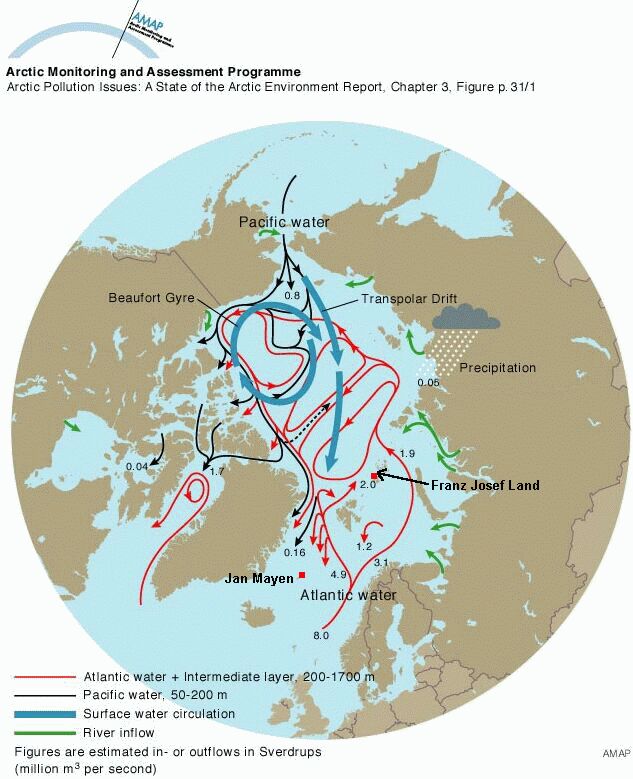
can result in the formation of Polynya;
http://en.wikipedia.org/wiki/Polynya
and causes the Equatorial Bulge:
http://en.wikipedia.org/wiki/Equatorial_bulge
Earth’s Rotational Energy influences Atmospheric Circulation;
http://en.wikipedia.org/wiki/Atmospheric_circulation
including the Jet Stream;
http://en.wikipedia.org/wiki/Jet_stream
Westerlies;
http://en.wikipedia.org/wiki/Westerlies
Tradewinds;
http://en.wikipedia.org/wiki/Trade_wind
Geostrophic Wind;
http://en.wikipedia.org/wiki/Geostrophic_wind
Surface Currents;
http://www.windows2universe.org/earth/Water/ocean_currents.html h
http://en.wikipedia.org/wiki/Ocean_current
through Ekman Transport;
http://en.wikipedia.org/wiki/Ekman_transport
http://oceanmotion.org/html/background/ocean-in-motion.htm
Tropical Cyclones;
http://en.wikipedia.org/wiki/Tropical_cyclone
Tornadoes:
http://en.wikipedia.org/wiki/Tornado
and Polar Vortices;
http://en.wikipedia.org/wiki/Polar_vortex
which “are caused when an area of low pressure sits at the rotation pole of a planet. This causes air to spiral down from higher in the atmosphere, like water going down a drain.”
http://www.universetoday.com/973/what-venus-and-saturn-have-in-common/
Here’s an animation of the Arctic Polar Vortex in Winter 2008 – 09:
When a Polar Vortex breaks down it causes a Sudden Stratospheric Warming:
http://en.wikipedia.org/wiki/Sudden_stratospheric_warming
Earth’s Rotational Energy influences Plate Tectonics;
http://en.wikipedia.org/wiki/Plate_tectonics
“By analyzing the minute changes in travel times and wave shapes for each doublet, the researchers concluded that the Earth’s inner core is rotating faster than its surface by about 0.3-0.5 degrees per year.
That may not seem like much, but it’s very fast compared to the movement of the Earth’s crust, which generally slips around only a few centimeters per year compared to the mantle below, said Xiaodong Song, a geologist at the University of Illinois at Urbana-Champaign and an author on the study.
http://www.livescience.com/9313-earth-core-rotates-faster-surface-study-confirms.html
The surface movement is called plate tectonics. It involves the shifting of about a dozen major plates and is what causes most earthquakes”:
http://en.wikipedia.org/wiki/Earthquake
Volcanoes;
http://en.wikipedia.org/wiki/Volcano
and Mountain Formation;
http://en.wikipedia.org/wiki/Mountain_formation
which can influence the creation of Atmospheric Waves:
http://en.wikipedia.org/wiki/Atmospheric_wave
Lastly, Rotational Energy is the primary driver of Earth’s Dynamo;
http://en.wikipedia.org/wiki/Dynamo_theory
which generates Earth’s Magnetic Field;
http://en.wikipedia.org/wiki/Earth%27s_magnetic_field
and is primarily responsible for the Earthy behaviors of the Magnetosphere;
http://en.wikipedia.org/wiki/Magnetosphere
with certain secular variations in Earth’s magnetic field originating from ocean flow/circulation;
http://news.nationalgeographic.com/news/2009/06/090622-earths-core-dynamo.html
http://iopscience.iop.org/1367-2630/11/6/063015/fulltext
though Leif Svalgaard notes that these are minor variations, as the magnetic field originating from ocean flow/circulation “is 1000 times smaller than the main field generated in the core.”
Also of note, “Over millions of years, [Earth’s] rotation is significantly slowed by gravitational interactions with the Moon: see tidal acceleration.
http://en.wikipedia.org/wiki/Tidal_acceleration
“The presence of the moon (which has about 1/81 the mass of the Earth), is slowing Earth’s rotation and lengthening the day by about 2 ms every one hundred years.”
“However some large scale events, such as the 2004 Indian Ocean earthquake, have caused the rotation to speed up by around 3 microseconds.[21] Post-glacial rebound, ongoing since the last Ice age, is changing the distribution of the Earth’s mass thus affecting the Moment of Inertia of the Earth and, by the Conservation of Angular Momentum, the Earth’s rotation period.”
http://en.wikipedia.org/wiki/Earth%27s_rotation
2. Orbital Energy, Orbital Period, Elliptical Orbits (Eccentricity), Tilt (Obliquity) and Wobble (Axial precession):
http://en.wikipedia.org/wiki/Specific_orbital_energy
http://en.wikipedia.org/wiki/Synodic
http://www.physicalgeography.net/fundamentals/6h.html
creates Earth’s seasons;
http://en.wikipedia.org/wiki/Season
which drives annual changes in Arctic Sea Ice;
and Antarctic Sea Ice;
the freezing and melting of which helps to drive the Thermohaline Circulation;
http://en.wikipedia.org/wiki/Thermohaline_circulation
and can result in the formation of Polynyas:
http://en.wikipedia.org/wiki/Polynya
Earth’s orbit around the Sun, Earth’s tilt, Earth’s wobble and the Moon’s orbit around Earth, Earth’s Rotation, and the gravity of the Moon, Sun and Earth, act in concert to determine the constantly evolving Tidal Force on Earth:
http://en.wikipedia.org/wiki/Tidal_force
This Tidal Force is influenced by variations in Lunar Orbit;
http://en.wikipedia.org/wiki/Orbit_of_the_Moon
as seen in the Lunar Phases;
http://en.wikipedia.org/wiki/Lunar_phase
Lunar Precession;
http://en.wikipedia.org/wiki/Lunar_precession
Lunar Node;
http://en.wikipedia.org/wiki/Lunar_node
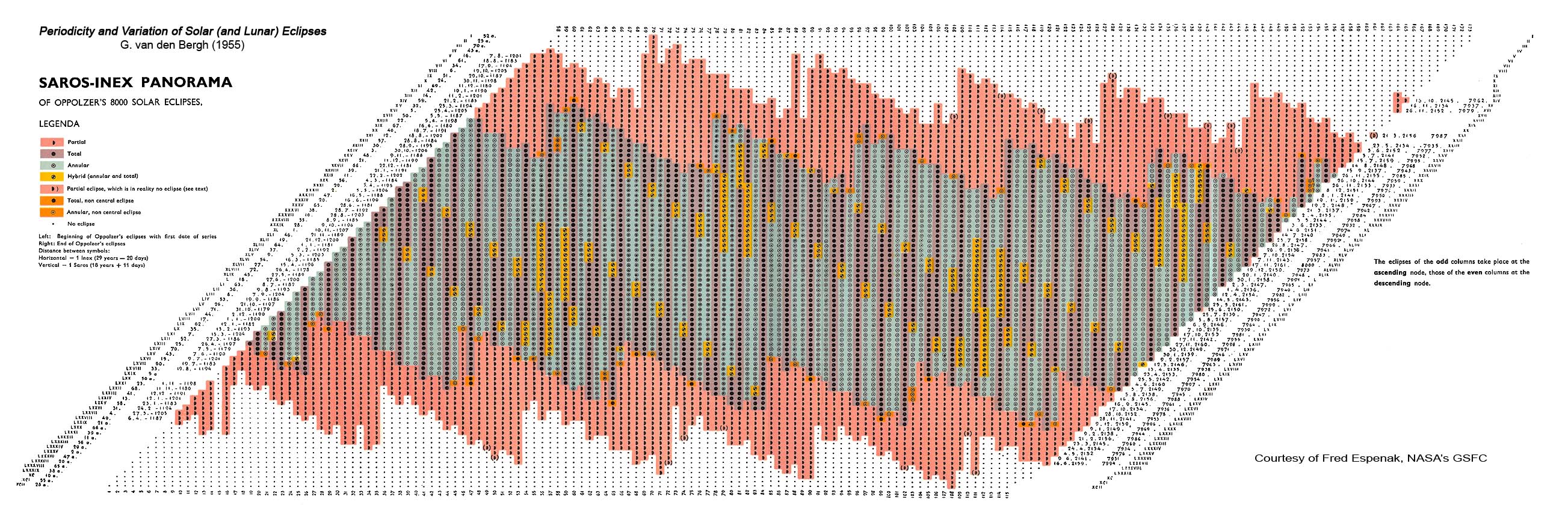
Saros cycles;
http://en.wikipedia.org/wiki/Saros_cycle
and Inex cycles:
http://en.wikipedia.org/wiki/Inex
The combined cycles of the Saros and Inex Cycles can be visualized here:
http://eclipse.gsfc.nasa.gov/SEsaros/image/SEpanoramaGvdB-big.JPG
Over longer time frames changes to Earth’s orbit, tilt and wobble called Milankovitch cycles;
http://en.wikipedia.org/wiki/Milankovitch_cycles
may be responsible for the periods of Glaciation (Ice Ages);
http://www.homepage.montana.edu/~geol445/hyperglac/time1/milankov.htm
that Earth has experienced for the last several million years of its climatic record:
http://en.wikipedia.org/wiki/Ice_age
Also of note, over very long time frames, “the Moon is spiraling away from Earth at an average rate of 3.8 cm per year”;
http://en.wikipedia.org/wiki/Lunar_distance_%28astronomy%29
http://curious.astro.cornell.edu/question.php?number=124
3. Gravitation:
http://en.wikipedia.org/wiki/Gravitation
The gravity of the Moon, Sun and Earth, Earth’s rotation, Earth’s orbit around the Sun, Earth’s tilt, Earth’s wobble and the Moon’s orbit around Earth act in concert to determine the constantly evolving Tidal Force on Earth:
http://en.wikipedia.org/wiki/Tidal_force
This tidal force results in that result in Earth’s Ocean Tide;
http://en.wikipedia.org/wiki/Tide
http://www.themcdonalds.net/richard/astro/papers/602-tides-web.pdf
Atmospheric Tide;
http://en.wikipedia.org/wiki/Atmospheric_tide
and Magma Tide:
http://www.springerlink.com/content/h7005r0273703250/
Earth’s Gravity;
http://en.wikipedia.org/wiki/Convection#Gravitational_or_buoyant_convection
http://visibleearth.nasa.gov/view_rec.php?id=205
in concert with Tidal Forces, influence Earth’s Ocean Circulation;
http://www.eoearth.org/article/Ocean_circulation
which influences Oceanic Oscillations including El Niño/La Niña;
http://en.wikipedia.org/wiki/El_Ni%C3%B1o-Southern_Oscillation
the Pacific Decadal Oscillation (PDO);
http://en.wikipedia.org/wiki/Pacific_Decadal_Oscillation
the Atlantic Multi-Decadal Oscillation (AMO);
http://en.wikipedia.org/wiki/Atlantic_Multidecadal_Oscillation
the Indian_Ocean_Dipole (IOD)/Indian Ocean Oscillation (IOO) and;
http://en.wikipedia.org/wiki/Indian_Ocean_Dipole
can result in the formation of Polynyas:
http://en.wikipedia.org/wiki/Polynya
Gravity Waves;
http://en.wikipedia.org/wiki/Gravity_wave
which may be partially responsible for the Quasi-Biennial Oscillation (QBO);
http://en.wikipedia.org/wiki/Quasi-biennial_oscillation
“on an air–sea interface are called surface gravity waves or Surface Waves”;
http://en.wikipedia.org/wiki/Surface_wave
“while internal gravity waves are called Inertial Waves”:
http://en.wikipedia.org/wiki/Inertial_waves
“Rosby Waves;
http://en.wikipedia.org/wiki/Rossby_waves
Geostrophic Currents
http://en.wikipedia.org/wiki/Geostrophic
and Geostrophic Wind
http://en.wikipedia.org/wiki/Geostrophic_wind
are examples of inertial waves. Inertial waves are also likely to exist in the core of the Earth”
Earth’s gravity is the primary driver of Plate Tectonics;
http://en.wikipedia.org/wiki/Plate_tectonics
“The Slab Pull;
http://en.wikipedia.org/wiki/Slab_pull
force is a tectonic plate force due to subduction. Plate motion is partly driven by the weight of cold, dense plates sinking into the mantle at trenches. This force and the slab suction force account for most of the overall force acting on plate tectonics, and the Ridge Push;
force accounts for 5 to 10% of the overall force.”
Plate Tectonics drive “cycles of ocean basin growth and destruction, known as Wilson cycles;
http://csmres.jmu.edu/geollab/fichter/Wilson/Wilson.html
involving continental rifting;
http://en.wikipedia.org/wiki/Rift
seafloor-spreading;
http://en.wikipedia.org/wiki/Seafloor_spreading
subduction;
http://en.wikipedia.org/wiki/Subduction
and collision.”:
http://en.wikipedia.org/wiki/Continental_collision
“Climate change on ultra-long time scales (tens of millions of years) are more than likely connected to plate tectonics.”
“Through the course of a Wilson cycle continents collide and split apart, mountains are uplifted and eroded, and ocean basins open and close. The re-distribution and changing size and elevation of continental land masses may have caused climate change on long time scales”;
http://www.pbs.org/wgbh/nova/ice/chill.html
a process called the Supercontinent Cycle:
http://en.wikipedia.org/wiki/Supercontinent_cycle
Earth’s gravity is responsible for Katabatic Wind:
http://en.wikipedia.org/wiki/Katabatic_wind
4. Solar Energy;
http://en.wikipedia.org/wiki/Solar_energy
results is Solar Radiation/Sunlight;
http://en.wikipedia.org/wiki/Solar_radiation
which varies based upon 11 and 22 year cycles:
http://en.wikipedia.org/wiki/Solar_cycle
Total Solar Irradiance (TSI);
http://www.ngdc.noaa.gov/stp/solar/solarirrad.html
appears to fluctuate “by approximately 0.1% or about 1.3 Watts per square meter (W/m2) peak-to-trough during the 11-year sunspot cycle”:
http://en.wikipedia.org/wiki/Solar_variation
Solar Energy also drives the Hydrological/Water Cycle;
http://en.wikipedia.org/wiki/Hydrological_cycle
within the Hydrosphere;
http://en.wikipedia.org/wiki/Hydrosphere
as Total Solar Irradiance (TSI) causes evaporation;
http://en.wikipedia.org/wiki/Evaporation
that drives cloud formation;
http://en.wikipedia.org/wiki/Cloud
results in precipitation;
http://en.wikipedia.org/wiki/Precipitation_%28meteorology%29
that results in the Water Distribution on Earth;
http://en.wikipedia.org/wiki/Water_distribution_on_Earth
creates surface runoff;
http://en.wikipedia.org/wiki/Runoff_%28water%29
which result in rivers;
http://en.wikipedia.org/wiki/River
and drives erosion:
http://en.wikipedia.org/wiki/Erosion
Solar energy is also “The driving force behind atmospheric circulation is solar energy, which heats the atmosphere with different intensities at the equator, the middle latitudes, and the poles.”
http://www.scienceclarified.com/As-Bi/Atmospheric-Circulation.html
Atmospheric Circulation;
http://en.wikipedia.org/wiki/Atmospheric_circulation
includes Hadley Cells;
http://en.wikipedia.org/wiki/Hadley_cell
Ferrel Cells;
http://en.wikipedia.org/wiki/Atmospheric_circulation#Ferrel_cell
Polar Cells;
http://en.wikipedia.org/wiki/Polar_cells
and Polar Vortexes:
http://en.wikipedia.org/wiki/Polar_cells
all of which help to create Wind;
http://en.wikipedia.org/wiki/Wind
that influence Surface Currents;
http://www.windows2universe.org/earth/Water/ocean_currents.html
http://en.wikipedia.org/wiki/Ocean_current
through Ekman Transport;
http://en.wikipedia.org/wiki/Ekman_transport
http://oceanmotion.org/html/background/ocean-in-motion.htm
and also cause Langmuir circulations
http://en.wikipedia.org/wiki/Langmuir_circulation
Solar energy is also a driver of the Brewer-Dobson Circulation
http://en.wikipedia.org/wiki/Brewer-Dobson_circulation
Atmospheric Waves;
http://en.wikipedia.org/wiki/Atmospheric_wave
including Atmospheric Tides
http://en.wikipedia.org/wiki/Atmospheric_tide
as well as evaporation and condensation may help to drive changes in Atmospheric Pressure:
http://en.wikipedia.org/wiki/Atmospheric_pressure
http://www.atmos-chem-phys-discuss.net/10/24015/2010/acpd-10-24015-2010.pdf
Solar Ultraviolet (UV) radiation;
http://en.wikipedia.org/wiki/Ultraviolet
appears to vary by approximately 10% during the solar cycle;
http://www.nasa.gov/topics/solarsystem/features/solarcycle-sorce.html
has been hypothesized to influence Earth’s climate;
http://wattsupwiththat.com/2011/04/05/courtillot-on-the-solar-uv-climate-connection/
however Leif Svalgaard argues that,
This is well-trodden ground. Nothing new to add, just the same old, tired arguments. Perhaps a note on EUV: as you can see here (slide 13)
http://lasp.colorado.edu/sorce/news/2008ScienceMeeting/doc/Session1/S1_03_Kopp.pdf the energy in the EUV band [and other UV bands] is very tiny; many orders of magnitude less than what shines down on our heads each day. So a larger solar cycle variation of EUV does not make any significant difference in the energy budget.
http://wattsupwiththat.com/2011/04/05/courtillot-on-the-solar-uv-climate-connection/#comment-636477
Additionally variations in Ultraviolet (UV) radiation may influence the break down of Methane;
(Source TBD)
Infrared Radiation;
http://en.wikipedia.org/wiki/Infrared
Solar – Wind;
http://science.nasa.gov/science-news/science-at-nasa/1999/ast13dec99_1/
Solar – Coronal Holes;
http://helios.gsfc.nasa.gov/chole.html
Solar – Solar Energetic Particles (SEP);
http://helios.gsfc.nasa.gov/sep.html
Solar – Coronal Mass Ejection;
http://www.esa.int/esaSC/SEMF75BNJTF_index_0.html
http://www.ratedesi.com/video/v/8AuCE_NNEaM/Sun-Erupts-to-Life-Unleashes-a-Huge-CME-on-13-April-2010
Solar Magnetosphere Breach;
Solar Polar Field Reversal;
http://science.nasa.gov/science-news/science-at-nasa/2001/ast15feb_1/
Solar Sector Boundary;
http://science.nasa.gov/heliophysics/focus-areas/magnetosphere-ionosphere/
Grand Minimum;
Leif Svalgaard says: February 6, 2011 at 8:26 pm
If L&P are correct and sunspots become effectively] invisible [not gone] it might mean another Grand Minimum lasting perhaps 50 years. During this time the solar cycle is still operating, cosmic rays are still modulated, and the solar wind is still buffeting the Earth.”
“It will lead to a cooling of a couple of tenths of a degree.”
Solar Influences on Climate:
http://www.leif.org/EOS/2009RG000282.pdf
Statistical issues about solar–climate relations
http://www.leif.org/EOS/Yiou-565-2010.pdf
5. Geothermal Energy;
http://en.wikipedia.org/wiki/Geothermal_energy
influences Earth’s climate especially when released by Volcanoes;
http://en.wikipedia.org/wiki/Volcano
“which are generally found where tectonic plates are diverging;
http://en.wikipedia.org/wiki/Divergent_boundary
or converging”;
http://en.wikipedia.org/wiki/Convergent_boundary
however, “intraplate volcanism has also been postulated to be caused by mantle plumes”:
http://en.wikipedia.org/wiki/Mantle_plume
“These so-called “hotspots”;
http://en.wikipedia.org/wiki/Hotspot_%28geology%29
for example Hawaii, are postulated to arise from upwelling diapirs;
http://en.wikipedia.org/wiki/Diapir
from the core-mantle boundary, 3,000 km deep in the Earth.”
Volcanoes have been shown to influence Earth’s climate;
http://www.geology.sdsu.edu/how_volcanoes_work/climate_effects.html
http://www.longrangeweather.com/global_temperatures.htm
including in the infamous Year Without a Summer;
http://en.wikipedia.org/wiki/Year_Without_a_Summer
which was partially caused by the 1815 eruption of Mount Tambora;
http://en.wikipedia.org/wiki/1815_eruption_of_Mount_Tambora
and is called a Volcanic Winter:
http://en.wikipedia.org/wiki/Volcanic_winter
“Volcanic Ash;
http://en.wikipedia.org/wiki/Volcanic_ash
particles have a maximum residence time in the troposphere of a few weeks.
The finest Tephera;
http://en.wikipedia.org/wiki/Tephra
remain in the stratosphere for only a few months, they have only minor climatic effects, and they can be spread around the world by high-altitude winds. This suspended material contributes to spectacular sunsets.
“The greatest volcanic impact upon the earth’s short term weather patterns is caused by sulfur dioxide gas;”
http://en.wikipedia.org/wiki/Sulfur_dioxide
“In the cold lower atmosphere, it is converted to Sulfuric Acid;
http://en.wikipedia.org/wiki/Sulfuric_acid
sulfuric acid by the sun’s rays reacting with stratospheric water vapor to form sulfuric acid aerosol layers. The aerosol remains in suspension long after solid ash particles have fallen to earth and forms a layer of sulfuric acid droplets between 15 to 25 kilometers up. Fine ash particles from an eruption column fall out too quickly to significantly cool the atmosphere over an extended period of time, no matter how large the eruption.
Sulfur aerosols last many years, and several historic eruptions show a good correlation of sulfur dioxide layers in the atmosphere with a decrease in average temperature decrease of subsequent years. The close correlation was first established after the 1963 eruption of Agung volcano in Indonesia when it was found that sulfur dioxide reached the stratosphere and stayed as a sulfuric acid aerosol.
Without replenishment, the sulfuric acid aerosol layer around the earth is gradually depleted, but it is renewed by each eruption rich in sulfur dioxide. This was confirmed by data collected after the eruptions of El Chichon, Mexico (1982) and Pinatubo, Philippines (1991), both of which were high-sulfur compound carriers like Agung, Indonesia.”
http://volcanology.geol.ucsb.edu/gas.htm
There is also some evidence that if “volcanic activity was high enough, then a water vapor anomaly would be introduced into the lower stratosphere before the anomaly due to the previous eruption had disappeared. The result would be threefold in the long term: stratospheric cooling, stratospheric humidification, and surface warming due to the positive radiative forcing associated with the water vapor.”
See: http://journals.ametsoc.org/doi/pdf/10.1175/1520-0442(2003)016%3C3525%3AAGSOVE%3E2.0.CO%3B2#h1
Geothermic Energy can also warm the atmosphere through Hot Springs;
http://en.wikipedia.org/wiki/Hot_springs
Or warm the ocean through Hydrothermal Vents:
http://en.wikipedia.org/wiki/Hydrothermal_vent
Which can be a factor in Hydrothermal Circulations:
http://en.wikipedia.org/wiki/Hydrothermal_circulation
6. Outer Space/Cosmic/Galactic Influences;
http://en.wikipedia.org/wiki/Outer_space
http://en.wikipedia.org/wiki/Cosmos
http://en.wikipedia.org/wiki/Galaxy
including Asteroids;
http://en.wikipedia.org/wiki/Asteroid
Meteorites;
http://en.wikipedia.org/wiki/Meteorite
and Comets;
http://en.wikipedia.org/wiki/Comet
can all significantly impact Earth’s climate upon impact.
It has been hypothesized that Galactic Cosmic Rays;
http://en.wikipedia.org/wiki/Galactic_cosmic_ray
http://en.wikipedia.org/wiki/Cosmic_ray
modulated by Solar Wind, may influence cloud formation on Earth:
Galactic Magnetic Fields also result in the;
http://www.scholarpedia.org/article/Galactic_magnetic_fields
Galactic Tide;
http://en.wikipedia.org/wiki/Galactic_tide
which may influence the hypothesized Oort cloud;
http://en.wikipedia.org/wiki/Oort_Cloud
“Besides the galactic tide, the main trigger for sending comets into the inner Solar System is believed to be interaction between the Sun’s Oort cloud and the gravitational fields of near-by stars or giant molecular clouds.”
7. Magnetic Forces;
http://en.wikipedia.org/wiki/Earth%27s_magnetic_field
Earth Core Changes:
http://physicsworld.com/cws/article/news/42580
“appears to be generated in the Earth’s core by a dynamo process, associated with the circulation of liquid metal in the core, driven by internal heat sources”
impact the Magnetosphere;
http://en.wikipedia.org/wiki/Magnetosphere
including movement of the Geomagnetic Poles:
http://www.ngdc.noaa.gov/geomag/GeomagneticPoles.shtml
http://news.nationalgeographic.com/news/2009/12/091224-north-pole-magnetic-russia-earth-core.html
8. Atmospheric Composition
http://en.wikipedia.org/wiki/Atmosphere_of_Earth
Nitrogen (N2) represents approximately 780,840 ppmv or 78.084% of Earth’s Atmosphere;
http://en.wikipedia.org/wiki/Nitrogen
Oxygen (O2) represents approximately 209,460 ppmv or 20.946%;
http://en.wikipedia.org/wiki/Oxygen
Argon (Ar) represents approximately 9,340 ppmv or 0.9340%;
http://en.wikipedia.org/wiki/Argon
Carbon Dioxide (CO2) represents approximately 390 ppmv or 0.039%;
http://en.wikipedia.org/wiki/Carbon_dioxide
contributes to the Greenhouse Effect;
?
and
influences the rate of Plant Growth;
http://www.sjsu.edu/faculty/watkins/CO2plants.htm
Neon (Ne) represents approximately18.18 ppmv or 0.001818%;
http://en.wikipedia.org/wiki/Neon
Helium (He) represents approximately 5.24 ppmv (0.000524%);
http://en.wikipedia.org/wiki/Helium
Krypton (Kr) represents approximately 1.14 ppmv (0.000114%);
http://en.wikipedia.org/wiki/Krypton
Methane (CH4) represents approximately 1.79 ppmv (0.000179%);
http://en.wikipedia.org/wiki/Methane
contributes to the Greenhouse Effect;
?
Hydrogen (H2) represents approximately 0.55 ppmv (0.000055%);
http://en.wikipedia.org/wiki/Hydrogen
Nitrous Oxide (N2O) represents approximately 0.3 ppmv (0.00003%);
http://en.wikipedia.org/wiki/Nitrous_oxide
contributes to the Greenhouse Effect;
?
Ozone (O3) represents approximately 0.0 to 0.07 ppmv (0 to 7×10⁻⁶%);
http://en.wikipedia.org/wiki/Ozone
Nitrogen Dioxide (NO2) represents approximately 0.02 ppmv (2×10⁻⁶%) (0.000002%);
http://en.wikipedia.org/wiki/Nitrogen_dioxide
Iodine (I2) represents approximately 0.01 ppmv (1×10⁻⁶%) (0.000001%) and;
http://en.wikipedia.org/wiki/Iodine
Ammonia (NH3) represents a trace amount of Earth’s Atmosphere:
http://en.wikipedia.org/wiki/Ammonia
Additional atmosphere components includes Water vapor (H2O) that represents approximately 0.40% over full atmosphere, typically 1%-4% at surface.
http://en.wikipedia.org/wiki/Water_vapor;
Aerosols;
http://en.wikipedia.org/wiki/Aerosol
that “act as cloud condensation nuclei, they alter albedo (both directly and indirectly via clouds) and hence Earth’s radiation budget, and they serve as catalysts of or sites for atmospheric chemistry reactions.”
“Aerosols play a critical role in the formation of clouds;
http://en.wikipedia.org/wiki/Clouds
Clouds form as parcels of air cool and the water vapor in them condenses, forming small liquid droplets of water. However, under normal circumstances, these droplets form only where there is some “disturbance” in the otherwise “pure” air. In general, aerosol particles provide this “disturbance”. The particles around which cloud droplets coalesce are called cloud condensation nuclei (CCN) or sometimes “cloud seeds”. Amazingly, in the absence of CCN, air containing water vapor needs to be “supersaturated” to a humidity of about 400% before droplets spontaneously form! So, in almost all circumstances, aerosols play a vital role in the formation of clouds.”
http://www.windows2universe.org/earth/Atmosphere/aerosol_cloud_nucleation_dimming.html
Particulates;
http://en.wikipedia.org/wiki/Particulates
including Soot/Black Carbon;
http://en.wikipedia.org/wiki/Soot
http://en.wikipedia.org/wiki/Black_carbon
Sand;
http://en.wikipedia.org/wiki/Sand
Dust
http://en.wikipedia.org/wiki/Dust
“Volcanic Ash;
http://en.wikipedia.org/wiki/Volcanic_ash
particles have a maximum residence time in the troposphere of a few weeks.
The finest Tephera;
http://en.wikipedia.org/wiki/Tephra
remain in the stratosphere for only a few months, they have only minor climatic effects, and they can be spread around the world by high-altitude winds. This suspended material contributes to spectacular sunsets.
The major climate influence from volcanic eruptions is caused by gaseous sulfur compounds, chiefly Sulfur Dioxide;
http://en.wikipedia.org/wiki/Sulfur_dioxide
which reacts with OH and water in the stratosphere to create sulfate aerosols with a residence time of about 2–3 years.”
“Emission rates of [Sulfur Dioxide] SO2 from an active volcano range from 10 million tonnes/day according to the style of volcanic activity and type and volume of magma involved. For example, the large explosive eruption of Mount Pinatubo on 15 June 1991 expelled 3-5 km3 of dacite magma and injected about 20 million metric tons of SO2 into the stratosphere. The sulfur aerosols resulted in a 0.5-0.6°C cooling of the Earth’s surface in the Northern Hemisphere.”
http://volcanoes.usgs.gov/hazards/gas/index.php
“The 1815 eruption [of Mount Tambora] is rated 7 on the Volcanic Explosivity Index, the only such eruption since the Lake Taupo eruption in about 180 AD. With an estimated ejecta volume of 160 cubic kilometers, Tambora’s 1815 outburst was the largest volcanic eruption in recorded history.”
“The eruption created global climate anomalies that included the phenomenon known as “volcanic winter”;
http://en.wikipedia.org/wiki/Volcanic_winter
1816 became known as the “Year Without a Summer”;
http://en.wikipedia.org/wiki/Year_Without_a_Summer
because of the effect on North American and European weather. Agricultural crops failed and livestock died in much of the Northern Hemisphere, resulting in the worst famine of the 19th century.”
http://en.wikipedia.org/wiki/Mount_Tambora
“In the spring and summer of 1816, a persistent “dry fog” was observed in the northeastern US. The fog reddened and dimmed the sunlight, such that sunspots were visible to the naked eye. Neither wind nor rainfall dispersed the “fog”. It has been characterized as a stratospheric sulfate aerosol veil.”
“The greatest volcanic impact upon the earth’s short term weather patterns is caused by sulfur dioxide gas;”
http://en.wikipedia.org/wiki/Sulfur_dioxide
“In the cold lower atmosphere, it is converted to Sulfuric Acid;
http://en.wikipedia.org/wiki/Sulfuric_acid
sulfuric acid by the sun’s rays reacting with stratospheric water vapor to form sulfuric acid aerosol layers. The aerosol remains in suspension long after solid ash particles have fallen to earth and forms a layer of sulfuric acid droplets between 15 to 25 kilometers up. Fine ash particles from an eruption column fall out too quickly to significantly cool the atmosphere over an extended period of time, no matter how large the eruption.
Sulfur aerosols last many years, and several historic eruptions show a good correlation of sulfur dioxide layers in the atmosphere with a decrease in average temperature decrease of subsequent years. The close correlation was first established after the 1963 eruption of Agung volcano in Indonesia when it was found that sulfur dioxide reached the stratosphere and stayed as a sulfuric acid aerosol.
Without replenishment, the sulfuric acid aerosol layer around the earth is gradually depleted, but it is renewed by each eruption rich in sulfur dioxide. This was confirmed by data collected after the eruptions of El Chichon, Mexico (1982) and Pinatubo, Philippines (1991), both of which were high-sulfur compound carriers like Agung, Indonesia.”
http://volcanology.geol.ucsb.edu/gas.htm
There is also some evidence that if “volcanic activity was high enough, then a water vapor anomaly would be introduced into the lower stratosphere before the anomaly due to the previous eruption had disappeared. The result would be threefold in the long term: stratospheric cooling, stratospheric humidification, and surface warming due to the positive radiative forcing associated with the water vapor.”
See: http://journals.ametsoc.org/doi/pdf/10.1175/1520-0442(2003)016%3C3525%3AAGSOVE%3E2.0.CO%3B2#h1
9. Albedo
http://en.wikipedia.org/wiki/Albedo
“or reflection coefficient, is the diffuse reflectivity or reflecting power of a surface. It is defined as the ratio of reflected radiation from the surface to incident radiation upon it. Being a dimensionless fraction, it may also be expressed as a percentage, and is measured on a scale from zero for no reflecting power of a perfectly black surface, to 1 for perfect reflection of a white surface.”
Clouds
http://en.wikipedia.org/wiki/Clouds
Aerosols
http://en.wikipedia.org/wiki/Aerosol
“act as cloud condensation nuclei, they alter albedo (both directly and indirectly via clouds) and hence Earth’s radiation budget, and they serve as catalysts of or sites for atmospheric chemistry reactions.”
“Aerosols play a critical role in the formation of clouds. Clouds form as parcels of air cool and the water vapor in them condenses, forming small liquid droplets of water. However, under normal circumstances, these droplets form only where there is some “disturbance” in the otherwise “pure” air. In general, aerosol particles provide this “disturbance”. The particles around which cloud droplets coalesce are called cloud condensation nuclei (CCN) or sometimes “cloud seeds”. Amazingly, in the absence of CCN, air containing water vapor needs to be “supersaturated” to a humidity of about 400% before droplets spontaneously form! So, in almost all circumstances, aerosols play a vital role in the formation of clouds.”
http://www.windows2universe.org/earth/Atmosphere/aerosol_cloud_nucleation_dimming.html
Snow
Ice
Water
Particulates
http://en.wikipedia.org/wiki/Particulates
Soot/Black Carbon
http://en.wikipedia.org/wiki/Soot
http://en.wikipedia.org/wiki/Black_carbon
Algae (Ocean Surface)
10. Biology
http://en.wikipedia.org/wiki/Biology
“Phototrophs
http://en.wikipedia.org/wiki/Photoautotroph
are the organisms (usually plants) that carry out photosynthesis;
http://en.wikipedia.org/wiki/Photosynthesis
to acquire energy. They use the energy from sunlight to convert carbon dioxide and water into organic materials to be utilized in cellular functions such as biosynthesis and respiration.” “In plants, algae, and cyanobacteria, photosynthesis uses carbon dioxide and water, releasing oxygen as a waste product.”
Chemoautotrophs;
http://en.wikipedia.org/wiki/Chemotroph
are “organisms that obtain carbon through Chemosynthesis;
http://en.wikipedia.org/wiki/Chemosynthesis
are phylogenetically diverse, but groups that include conspicuous or biogeochemically-important taxa include the sulfur-oxidizing gamma and epsilon proteobacteria, the Aquificaeles, the Methanogenic archaea and the neutrophilic iron-oxidizing bacteria.”
Bacteria – TBD
Fungi – TBD
Protozoa – TBD
Chromista – TBD
Animal – Anthropogenic including:
Carbon Dioxide;
http://en.wikipedia.org/wiki/Carbon_dioxide
contributes to the Greenhouse Effect;
?
and
influences the rate of plant growth ;
http://www.sjsu.edu/faculty/watkins/CO2plants.htm
Methane
http://en.wikipedia.org/wiki/Methane
Nitrous Oxide
Ozone
Particulates, especially Black Carbon/Soot
Aerosols
Icebreakers/Arctic Shipping/Fishing/Cruise-Line Transits
Contrails
Nuclear Power Generation – Including Ships
Land Use Changes – Including De and Re-Forestation
Urban Heat Islands
Run Off From Asphalt/Urban Heat Islands
Fossil Fuel Energy Generation Waste Heat –
Renewables – Wind Farms, Solar Arrays, Dams and Ethanol
Sewage/Wastewater Treatment Discharge
etc.
Animal – Non-Anthropogenic including
Plankton
Beaver (Genus Castor)
http://en.wikipedia.org/wiki/Beaver
etc.
11. Chemical
Fossil Fuels:
Coal
Oil shale
Petrochemicals
– Petroleum
– Mineral Oil
Asphalt
Tar Pits/Sands
Methane
http://en.wikipedia.org/wiki/Methane
etc.
“Photosynthesis;
http://en.wikipedia.org/wiki/Photosynthesis
is a chemical process that converts carbon dioxide into organic compounds, especially sugars, using the energy from sunlight.”
“Chemosynthesis;
http://en.wikipedia.org/wiki/Chemosynthesis
is the biological conversion of one or more carbon molecules (usually carbon dioxide or methane) and nutrients into organic matter using the oxidation of inorganic molecules (e.g. hydrogen gas, hydrogen sulfide) or methane as a source of energy, rather than sunlight, as in photosynthesis.”
Reactions:
Combustion
– Forest Fires
– Fossil Fuels
– – Methane
http://en.wikipedia.org/wiki/Methane
etc.
Conversion of Methane, CO2, etc.
12. Physics – Other
Temperature
http://en.wikipedia.org/wiki/Temperature
Pressure
http://en.wikipedia.org/wiki/Pressure
States of Matter
http://en.wikipedia.org/wiki/State_of_matter
Heat Conduction
http://en.wikipedia.org/wiki/Heat_conduction
Convection
http://en.wikipedia.org/wiki/Convection
Thermal Radiation
http://en.wikipedia.org/wiki/Thermal_radiation
Thermodynamics
http://en.wikipedia.org/wiki/Laws_of_thermodynamics
-Entropy
http://en.wikipedia.org/wiki/Entropy
General summaries of the potential variables involved in Earth’s climate system;
http://www.physicalgeography.net/fundamentals/7y.html
http://oceanservice.noaa.gov/education/pd/climate/factsheets/whatfactors.pdf
Myrrh says:
July 7, 2011 at 1:11 pm
Something with volume and weight surrounded by others with volume and weight is not in empty space.
Let us compute the volume of the Nitrogen in one cubic meter of air: the Nitrogen in the air weighs 1 kg. Since one N2 molecule weighs 4.76E-26 kg, there are 1 kg/4.76e-26 kg = 2E25 molecules in that 1 kg. Each molecule has a radius of about 1E-10 m, for a volume of 4pi/3*(1E-10)^3 = 4E-30 m^3. So all the 2E25 molecules together take up 2E25*4E-30 = 8E-5, or 0.00008 m^3. The remaining 0.99992 m^3 is empty space [we can omit the other gases that occupy an even smaller volume].
Leif – stop digging yourself into an even bigger hole. You’re confusing ideal and real gases, properties and processes in your rants against me, because, you basically don’t know the difference. And, you’re showing yourself completely incapable of following a simple explanation..
I think I have figured out why Myrrh is so disgruntled. He has realised that ‘AGWscience’, whatever that is, treats water vapour differently from other gases in the atmosphere like CO2, CH4, O2 and N2. He seems to assume that this means the other gases are considered to be ideal gases, while water vapour is not. I have not seen this distinction explicitely stated elsewhere in my formal or informal studies on weather and climate.
This is completely incorrect, and despite Leif’s efforts I don’t think he’s managed to articulate to Myrrh what the problem is.
Myrrh said:
“As I mentioned earlier, there is no internal consistency from AGWScience fiction inc. Because here they describe the molecules of our atmosphere as ideal gases, nitrogen, oxygen and carbon dioxide, but exclude water vapour – why? Because they say water vapour is localised and doesn’t stay in the atmosphere for any length of time.. ??!”
The division is not made in the way Myrrh describes. All the other gases mentioned are ‘well-mixed’ which means that in the free troposphere (indeed, within the homosphere – see http://en.wikipedia.org/wiki/Turbopause) the relative abundance of these gases is about the same (busting another myth of Myrrh’s, but I wont go into it more now). Water vapour is not well-mixed – hence rainforests, deserts, very dry air in aeroplanes etc etc.
So the distinction is between well-mixed gases (most of them) and those that are spatially variable (highly reactive or precipitable ones, eg. water), not between gases that are considered ideal or non-ideal.
Have I hit the nail on the head or missed and hit my thumb?
Stu N, I agree.
Myrrh says:
July 7, 2011 at 4:49 pm
You’re confusing ideal and real gases
I showed you with a very simple calculation what the empty space in the real gas Nitrogen is, namely 99.992%. In an ideal gas that percentage would by 100%. What in that calculation is it that you cannot follow? Give it a try. Explain each step as you understand it and shows us where you can’t follow anymore.
Stu N says:
July 7, 2011 at 5:31 pm
Myrrh said:
“As I mentioned earlier, there is no internal consistency from AGWScience fiction inc. Because here they describe the molecules of our atmosphere as ideal gases, nitrogen, oxygen and carbon dioxide, but exclude water vapour – why?
That is, of course, obvious [except for Myrrh] because water vapor condenses under normal conditions in the atmosphere and thus stops being a gas, and thus not an ideal gas. Cool air [nitrogen] to some -200 C and it too stops being an nearly ideal gas.
KevinK says: June 30, 2011 at 8:01 pm
Nice summary, just one suggestion for additional info regarding the non-linear properties of the materials involved in the climate system;
http://profmaster.blogspot.com/2009/01/thermal-conductivity-of-air-vs.html (sorry I’m not able to post this as a link so you will need to copy and paste)
sky says: July 5, 2011 at 7:31 pm
The planetary climate system is intrinsically a solar-driven thermodynamic one, with enthalpy serving to account for energy states (including work done by transmuted mechanical enegy) and with the profound priciple of entropy directing the energy flow through the material substances of the planet. Strangely, no reference is made to those key concepts.
Myrrh says:
And the land and the atmosphere, heat rises and cold sinks. Convection is the main method of heat transfer in our atmosphere – this is the fluid gas Air, thus convection not radiation – from which we get our weather, our winds are basically created when volumes of hot air rise to be replaced by volumes of cold air. Without a proper understanding of thermodynamics here it isn’t possible to understand, for example, how the Water Cycle is the real greenhouse gas for cooling the Earth as it takes the heat away into the cooler heights where water vapour condenses out and releases the heat, which always flows spontaneously from the hotter to the colder.
I’ve added a new category, “12. Physics – Other” and several of the important physics concepts under it including:
Temperature
http://en.wikipedia.org/wiki/Temperature
Pressure
http://en.wikipedia.org/wiki/Pressure
States of Matter
http://en.wikipedia.org/wiki/State_of_matter
Heat Conduction
http://en.wikipedia.org/wiki/Heat_conduction
Convection
http://en.wikipedia.org/wiki/Convection
Thermal Radiation
http://en.wikipedia.org/wiki/Thermal_radiation
Thermodynamics
http://en.wikipedia.org/wiki/Laws_of_thermodynamics
-Entropy
http://en.wikipedia.org/wiki/Entropy
Additional input on this section is most welcome. Thank you for your help, even you “sky”… 🙂
Alexander Feht says: June 30, 2011 at 8:21 pm
Very useful list, clearly demonstrating the unbelievable arrogance and ignorance of IPCC.
Just two comments:
1) I didn’t notice mentioned a crucial “CO2 increase = vegetation growth” feedback mechanism (increase of CO2 absorption by the plants due to the increase of plants’ growth due to the increase of CO2 content in the atmosphere), which negates any alleged increase of temperature due to the increase of CO2. May be it was included in some already listed category, I don’t know.
I added further description to Carbon Dioxide in categories, “8. Atmospheric Composition” and
“10. Biology – Animal – Anthropogenic” as follow:
Carbon Dioxide;
http://en.wikipedia.org/wiki/Carbon_dioxide
contributes to the Greenhouse Effect;
?
and influences the rate of Plant Growth:
http://www.sjsu.edu/faculty/watkins/CO2plants.htm
I need to find a good link for the Greenhouse Effect as the Wiki is erroneous;
http://en.wikipedia.org/wiki/Greenhouse_effect
and their visual representation of “The Greenhouse Effect”;
http://en.wikipedia.org/wiki/File:Greenhouse_Effect.svg
looks like it’s out of a video game or Las Vegas…
2) Special references to Dr. Svalgaard’s opinions are unnecessary; they don’t deserve any special consideration or exposure.
Leif contributed significantly to the development of the Solar category of this document, especially on this thread:
http://wattsupwiththat.com/2011/01/22/new-wuwt-solar-images-and-data-page/#comment-581590
The specific references to Leif in the list are because he is the source of the references. If you reason to question the accuracy of these references or you have alternate sources that you think are better, please post them below for consideration.
Thank you for your input.
Doug Proctor says: June 30, 2011 at 8:22 pm
It is, however, more of an argument for a warmist, specialist or elitist superiority in understanding or opinion, similar to one some of our post-war parents might have said to us as teenagers: what do you know? they (the government, the scientists, adults) know more than you do.
Not sure how you arrived there. I built the list to try to compile all the variables in one place and add it as a WUWT Reference Page so others could learn from it. My intent is to make a general understanding of Earth’s Climate System more accessible so more people will be in a position to rebut those who claim omnipotent knowledge of Earth’s Climate System. Take care in ascribing motives based on minimal context, as in this case, my intent and your perception of it, appear to be juxtaposed.
The science blogs such as WUWT depend on the acceptance of what has been in legal circles called the Reasonable Man Hypothesis. The RMH suggests that, with a reasonable amount of knowledge, analytical ability and life-world experience, a non-expert can get the sense of what is going on and make a sound judgement of what action should be pursued on that basis.
I agree to an extent, i.e if one is willing to do the homework. Certainly one does not need formal training in order to obtain “a reasonable amount of knowledge” about Earth’s Climate System. However, there is a tremendous amount to be learned and, in the case of Earth’s Climate System, “a reasonable amount of knowledge” should be measured in hundreds, and preferably thousands, of hours.
The climate debate is teaching an entire thinking world that they can, with some effort, determine the reasonableness of what is going on without having to own a closetful of white coats.
Yes, but remember that those with closets-full of white coats, often have brains-full of specialized knowledge, and a reasonable amount of a reasonable amount of knowledge is likely to come from said brains.
Stu N says:
July 7, 2011 at 5:31 pm
I think I have figured out why Myrrh is so disgruntled.
If less time was devoted to analysing the messenger and even a tiny bit more to following the message, you’d have nailed it, put some arnica on your thumb..
For example you say: The division is not made in the way Myrrh describes. All the other gases mentioned are ‘well-mixed’ which means that in the free troposphere ..the relative abundance of these gases is about the same (busting another myth of Myrrh’s, but I wont go into it more now). Water vapour is not well-mixed -hence rainforests, deserts, very dry air in aeroplanes etc etc.
Carbon dioxide is not well-mixed, see AIRS conclusion for the surprise this generated, or follow my explanations for the same effect here. I’ll stick with the example izen gave, in the hope that it will help you to focus. Do try and make the effort not to get sidetracked.
Firstly, what is my point? My point is that there is a phenomenon I have noticed through the years I have been following these arguments between ‘skeptics’ and ‘warmists’ which unites them both, I have called it AGWScience (fiction). As I have described above, AGWScience mixes and takes out of context ideas, concepts, laws, properties, processes from real well-known traditional science in order to promote its particular memes. Individually these are nonsense, taken together they create a whole new science fictional world of impossible physics, literature not science as someone said recently, ‘writings whose value lies in emotional effects’ being one of the meanings of ‘literature’. The whole production of AGWScience should be on the fiction shelves in any rationally organised library. It is science fiction masquerading as real science.
The problem is, it is presented to the world as if it is real, non-fiction, that it has confused even scientists.. So successful has been the promotion of this deceit, that its memes are taken for granted by those who don’t know any better and by scientists whose fields are outside the practical applications related to them. Because AGWScience covers the range of physical phenomena it is widespread that real scientists who can spot the disjunct between one of more memes and real physics in their own discipline, will take another meme as ‘fact’ believing it well-known’ because they hear it repeated so often.
That Carbon Dioxide (CO2) is “well-mixed’ in the atmosphere is a major meme from AGWScience fiction. It is an important meme because much of its fictional reasoning depends on that idea as a base. It promotes that idea by various references to laws and descriptions of properties and processes from the real world of physics. Its only interest is in promoting the memes, so anything from real science can be twisted and used to in order to give these memes a semblance of reality and to that end the first meme it promotes, unceasingly, is that it is real science and those promoting it are real scientists. There are many ways it promotes the fiction that CO2 is well mixed. One of these is taken descriptions applicable only to an ideal gas in reality and giving some of these to the gases in our atmosphere of importance to its general meme that CO2 drives temperature changes via radiation. It doesn’t care about water vapour, it doesn’t want anyone to think about water vapour, because water vapour destroys its fiction about radiation being the prime means of heat transfer. The Water Cycle is not included in AGWScience. AGWScience distracts from appreciating this.
What it does instead, one of the things its does, is promote some descriptions from ideal gas and by so thoroughly attaching these to descriptions of oxygen, nitrogen and carbon dioxide in our atmosphere makes people believe in an impossible physical world, convinced that it is our physical reality. Let’s narrow this down to just one example.
The molecules of gas are moving at around 500m/s or about a THOUSANDD miles an hour. There is no way with those velocities you will get gases stratifying out by weight within the first few miles of the atmosphere.
And I gave examples from the real world and explanations from real traditional physics, that this claim from AGWScience is fiction. Let’s narrow that down to examples.
Read the examples I’ve given.
Discuss these examples and find more for yourselves.
Find which specific concepts from ideal gas descriptions have been used in creating this fiction.
Find which specific concepts from real traditional physics have been jettisoned in creating this fiction.
Enjoy.
……
Myrrh says:
July 9, 2011 at 2:15 am
“The molecules of gas are moving at around 500m/s or about a THOUSANDD miles an hour.”
And I gave examples from the real world and explanations from real traditional physics, that this claim from AGWScience is fiction.
Here is how real traditional physics calculate that speed:
http://hyperphysics.phy-astr.gsu.edu/hbase/kinetic/eqpar.html#c2
Enter 15C for the temperature and you’ll see that the real speed is 1414 mph for water vapor.
Mike says: June 30, 2011 at 9:07 pm
I have always wondered why scientists had to go to grad school! Now we know!
I am not sure what you mean, I haven’t gone to grad school. Furthermore, I disagree with your inference that one must have a formal education to be scientist. While it can certainly help, one can achieve the designation without it, i.e. “A scientist in a broad sense is one engaging in a systematic activity to acquire knowledge. In a more restricted sense, a scientist is an individual who uses the scientific method. The person may be an expert in one or more areas of science. This article focuses on the more restricted use of the word. Scientists perform research toward a more comprehensive understanding of nature, including physical, mathematical and social realms.”
http://en.wikipedia.org/wiki/Scientist
Now it is clear why people with little training are so easily confused.
I question whether “training” is the best way to learn about Earth’s Climate System. I think it’s better to actively identify the gaps in your knowledge and seek to fill them. With access to much of written human knowledge in a matter of a few keystrokes and some great professors hanging out in places like WUWT, one isn’t reliant upon trainers. Furthermore, a diversity of sources and opinions is advantageous when studying such an uncertain subject. I think it is better to be well researched, well read, well taught and well learned, than it is to be well trained…
justthefactswuwt – ta.
There’s a wiki page on Water Vapour not completely screwed up by AGW.. http://en.wikipedia.org/wiki/Water_vapor
I find pages like this, http://www.weatherquestions.com/What_is_water_vapor.htm quite saddening. Someone desperately trying to convey the real nature of the Water Cycle while constrained by AGWScience’s reach. I recall a couple of years ago someone linked to a page in the education basics section on the American Meteorological Society’s web site which clearly stated that CO2 did not drive temperatures. Within days the page disappeared, when increased traffic noted probably.
Leif says:
July 9, 2011 at 8:47 am
Here is now real traditional physics calculate that speed:… Enter 15C for the temperature and you’ll see that the real speed is 1414 mph for water vapor.
But how far is it moving at those speeds? I don’t notice the steam from my kettle zooming out the window at 1414 mph..
Now deal with the second part. The actual claim from AGWScience fiction based on this out of context reference to speeds: “There is no way with those velocities you will get gases stratifying out by weight within the first few miles of the atmosphere.”
The examples I refer to are those I gave earlier of carbon dioxide and methane separating out from the oxygen and nitrogen molecules in our atmosphere. Because, the first is heavier than Air, and the second, lighter – common knowledge in traditional real world physics.
Myrrh says:
July 9, 2011 at 12:36 pm
But how far is it moving at those speeds? I don’t notice the steam from my kettle zooming out the window at 1414 mph..
It is moving at that speed all the time between collisions with other molecules which happens billions of times per second. These collisions change the direction of the molecules all the time so it takes some time to actually get to your window, but it will get there, and the speed would still be 1414 mph [at 15C].
The examples I refer to are those I gave earlier of carbon dioxide and methane separating out from the oxygen and nitrogen molecules in our atmosphere. Because, the first is heavier than Air, and the second, lighter – common knowledge in traditional real world physics.
Actual measurements on top of high mountains, e.g. Mauna Loa shows the same CO2 concentration as at sea level. Measurements taken by aircraft also show very nearly constant mixing ratio [concentration] from 0 to 13 km height, with perhaps a very slight increase in the CO2 concentration with altitude.
Myrrh says:
July 7, 2011 at 4:49 pm
You’re confusing ideal and real gases
I showed you with a very simple calculation what the empty space in the real gas Nitrogen is, namely 99.992%. In an ideal gas that percentage would by 100%. Did you understand that calculation? If not, let us know at which point your understanding failed. If you did understand it, then you also understood that 99.992% of air is empty space, right?
“99.992% of air is empty space, right?”
Actually if one also considers the empty space between the atoms and between electrons and protons then the empty space is even more that that.
The issue is not that betwen ‘ideal’ and ‘real’ gases in any event.
The issue is that AGW theory ascribes a positive feedback to an increase in water vapour in the models whereas in the real world the feedbck is strongly negative whatever the source of a forcing process whether it be towards warming or cooling.
The water cycle speeds up to minimise warming influences and slows down to minimise cooling influences..
Thus the proportion of non water vapour GHGs in the air just goes primarily to the speed of the water cycle and is not a significant contributor to the equilibrium temperature of the system as a whole. We should look to the oceans and atmospheric pressure plus solar shortwave radiation to set that system equilibrium tewmperature and not the atmospheric composition.
In ignoring the influence of the oceans and atmospheric pressure, in focusing entirely on the atmosphere Tyndall et al got it seriously wrong.
The fact that the atmospheric temperature is higher than it ‘should’ be has hardly anything to do with atmospheric composition at all dur to the variable speed of the water cycle.
The entire system is modulated by the speed of the water cycle which is perfectly apparent from observation of the ever changing surface pressure distribution and the ever shifting climate zones.
Stephen Wilde says:
July 9, 2011 at 11:51 pm
“99.992% of air is empty space, right?”
Actually if one also considers the empty space between the atoms and between electrons and protons then the empty space is even more that that.
The issue is not that betwen ‘ideal’ and ‘real’ gases in any event.
That ‘interior’ empty space [including that between the quarks inside the nucleons] is not accessible to other molecules. The ideal/real issue goes to the heart of Myrrh’s ignorance about physics and hence to the role of water vapor as well.
Leif Svalgaard says:
July 9, 2011 at 1:22 pm
It is moving at that speed all the time between collisions with other molecules which happens billions of times per second. These collisions change the direction of the molecules all the time so it takes some time to actually get to your window, but it will get there, and the speed would still be 1414 mph [at 15C].
So, my kitchen is 16’x14’x8′, there are two windows opposite each other along the 16′ length, my kettle is adjacent to one of the windows, both windows are closed, the doors are closed, there are no fans going. How long will it take to get from one side to the other window? What speed is that?
Do you understand the question?
My kitchen is not full of empty space.
Myrrh says:
July 11, 2011 at 1:19 pm
How long will it take to get from one side to the other window? What speed is that?
It will take several minutes, because each molecule undergoes billions of collisions per second at their high 1000 mph speed before they get there. See: http://www.3rd1000.com/chem101/chem102i.htm
And, yes, your Kitchen is 99.992% empty space.
Go through the elementary calculation I gave you of that number. If you have problems with a specific step, we’ll explain that to you when you tell us where you get stuck.
You’re full of it. You claim our atmosphere is empty space and that water vapour travels at 1414 mph through this and then say it doesn’t travel that fast because it’s making all these collisions on the way and then give me a reference to hydrogen sulphide taking several minutes to cross a room, unproven, assumed because of calculating on kinetic theory of gases. Although the chap has to revert to non-kinetic models for real calculations later.. So, let’s go with hydrogen sulphide – it’s slightly heavier than the fluid gas Air, how long will it take to cross from one side to the other, still given that there is no movement of Air at all, certainly no air “vigorously stirred by a mechanical fan”?
Come on Leif – let’s have some proof of real logic from you in this ideal gas empty space kinetic atmosphere of yours.
For anyone reading this and confused by Leif’s hubris in presuming to teach me when he knows nothing about the subject, and moreover showing no ability to think logically.. My kitchen is full of the fluid gas Air, it has weight, volume, is subject to gravity – all the stuff that ideal gases do not have. I can hear the kettle boiling, it is not empty space.. The water vapour is not travelling at 1414 mph through empty space but through a fluid gas Air which is exerting pressure of around a ton per square foot on every surface, but, because considerably lighter than Air, water vapour will rise, it is buoyant in Air. Without convection, and there are no windows open or fans going, movement sideways, to cross the room from one window to the other, will depend on such things as how fast it is being ejected from the kettle. It may never reach the other side. Even though water vapour is constantly evaporating at room temperature it’s movement is up, that’s what buoyant means.
Let’s go with the hydogen sulphide because slightly heavier than air it is more akin to carbon dioxide, which is one and a half times heavier, and brings us back to the point – the confusion between ideal gas and real gases from which we have Leif et al claiming our atmosphere is empty space because the gas molecules making up our atmosphere are unreal, imaginary ideal gases (the definition in real physics of an ideal gas) and so, that travelling at these high speeds gas molecules will travel across my kitchen taking only minutes because only delayed by ideal gas kinetic theory of gas molecules, only by statistics of bounces off each other, and, izen claiming that “there is no way with those velocities you will get gases stratifying out by weight within the first few miles of the atmosphere.”
But we do have gases stratifying out by weight within the first few miles of the atmosphere, we have that all the time, in our real world of real gases. Do your own searches on carbon dioxide heavier than air volcanoes and methane lighter than air mines, there’s still a wealth of fact available. This claim is not just falsified by real life and known real traditional physics, but it’s a claim that could never be made in real life in real physics. It’s stupid. The only reason it is believed by so many is because of the concerted effort to spread the meme from AGWScience that ideal gas describes the properties of real gases and the ideal gas law the processes. It has created an imaginary world of science fiction, in which belief, the real properties of our gases and the real processes and interactions are seen as alien, aren’t believed. And aren’t believed to the extent that the AGWScience fictional world is argued for so strongly that the real physical world can’t be grasped.
Hydrogen sulphide being slightly heavier than air will sink, displacing air. When whatever force that introduced it into a corner of a room has run its course, it will displace the air and sink. Just as carbon dioxide does.
Methane lighter than air will rise to the ceiling of a mine, separating out, stratifying. And will stay separated out for centuries and centuries and.., it will not ‘mix-thoroughly because it obeys ideal gas law and so bounces around off the other molecules and so travels across the mine’. Nor will the hydrogen sulphide take only minutes to cross the room, Leif’s link is to rubbish science.
REPLY: “you’re full of it” ?? I know Dr. Svalgaard personally, and I’ve never known him to link to “rubbish science”. And more importantly, unlike you he has the courage to put his name to his words, so I tend to give anything he might say more credence based on being upfront. Yes H2S will travel across a room in minutes, and I wasn’t laying on the floor when I smelled it my own personal experiments.
I’d think twice about escalating this argument further. Go ahead, make my day. – Anthony
Not sure what you mean by making your day, Anthony. Just what does “escalating this argument further” mean? Does it mean I will be penalised for replying to your comments? Why? Is this a threat to censorship because you’ve taken umbrage? If so, and I have to say that’s how it reads to me, then you’re operating double standards here, one for your ‘mates’ and another for those you’re not really that keen on, it appears to me. I’ve seen several mods replying to complaints about Leif’s ad homs and so on, by saying such things as ‘we’ve got a very light handed policy of moderation here’ and Leif can say what he likes, be as rude as he likes; I’ve even come across references on other blogs to how he gets away with being rude as he likes on WUWT. As here, as he has in past discussions with me and several others I’ve noticed, full of arrogance and disdain to cover up his ignorance about a particular point, because oh, he’s a ‘scientist’. If that’s what you mean, how are you any different from the warmist blogs that censor? Except they don’t make a point of claiming they don’t censor. So what do you mean?
Let him fight his own battles. And if you want to argue the point with me, do it on even ground.
“I know Dr. Svalgaard personally, and I’ve never known him to link to “rubbish science”. And more importantly, unlike you he has the courage to put his name to his words.”
Haha! Welcome to the club Anthony. Now you know what it feels like to get baseless accusations thrown at excellent scientists you personally are acquainted with!
“Without convection, and there are no windows open or fans going, movement sideways, to cross the room from one window to the other, will depend on such things as how fast it is being ejected..”
“Hydrogen sulphide being slightly heavier than air will sink, displacing air. When whatever force that introduced it into a corner of a room has run its course, it will displace the air and sink. Just as carbon dioxide does.”
To get ‘well-mixed’ for carbon dioxide in the atmosphere, AGWScience uses a combination of ‘Brownian’ motion and ‘ideal gas properties/law’ – hence the 99.992% empty space and molecules bouncing off each other without interacting – and they call this ‘diffusion’. The arguments for used to be/maybe still are, like scent travelling through a room, like ink poured into water – for the meme ‘diffused and thoroughly mixed and cannot be unmixed’.
This wiki page shows the absurdity of these descriptions: http://en.wikipedia.org/wiki/Diffusion
The point to notice about diffusion first is scale – “molecular diffusion is relevant only on length scales between nanometer and millimeter.” And second, “diffusion dominates only in perfect thermal equilibrium.”
Steam from a kettle or hydrogen sulphide spreads through a room by convection. In the absence of convection, when the energy propelling has ceased and when there is no other work being done to move these such as fans stirring up the air or currents from open windows, they will revert back to their basic properties relative to the molecules of Air, the real gas molecules nitrogen and oxygen. The lighter water vapour will rise, the heavier hydrogen sulphide will sink. The hydrogen sulphide being not much heavier than air will not sink so dramatically as does carbon dioxide. You can make your own carbon dioxide from ingredients you have in the kitchen and try it for yourselves by pouring it over a lit candle, it will put out the flame because it displaces oxygen.
As I said earlier, AGWScience doesn’t like convection. If it admits such a thing as convection exists it would detract from its meme that heat transfer is only by electromagnetic radiation and it could no longer ignore that water vapour in the atmosphere is the main greenhouse method of cooling the atmosphere – and all the other claims it has built on the false assumption that the real gases of our atmosphere are the imaginary ‘ideal’ and all encounters ‘kinetic’.. It’s not until you put all the AGWScience’s basic memes together that you realise the extent of this fictional world it has created. It’s truly, extraordinarily, absurd.
But they can’t hear any of this, there’s no sound in empty space..
Myrrh says:
July 12, 2011 at 3:19 am
You claim our atmosphere is empty space and that water vapour travels at 1414 mph through this and then say it doesn’t travel that fast because it’s making all these collisions on the way and then give me a reference to hydrogen sulphide
Every physicists would say what I just did. This is standard high-school physics, known for centuries. And it makes no difference which gas you use. The sulfide has the nice feature that you can smell it.
Even you should be able to understand the empty space argument. Let us start with a simple example: take a bag with a volume of 1 cubic meter [out in empty space, so it contains 100% empty space, that is 1 million little cubic centimeters of empty space, because 1 meter is 100 centimeter, and the volume is thus 100*100*100 cubic centimeters]. Now put in the bag ten little cubes one centimeter on the side of any material you like.How much of the bag is now empty space? If you will not answer this, you have lost the argument. If you are unable, just say so and we’ll go even slower. Once we have past that hurdle we’ll continue with the next step.
??! What on earth do you think you’re saying, Leif? Do quit pretending you know what you’re talking about, it’s become really, really, tedious.
If there’s anyone else who’s having a problem with the difference between ideal and real gases, that ideal gases have no properties like volume, try thinking of it by appreciating that our atmosphere is practically, by dry weight, 100% nitrogen and oxygen. These are actually, real ‘things’, they take up space, i.e. they have volume and from volume, weight, are subject to gravity and so on. Nitrogen and Oxygen are gases, together these are the gas Air. Air as a gas is a fluid, so are liquids like water fluids, convection applies in heat transfer. Ideal gas has no real gas properties, it is a construct, an imaginary hard dot taking up no space and having no interactions with other molecules, for example, an ideal oxygen ‘molecule’ will bounce off on meeting an ideal carbon molecule unable to form carbon dioxide. Because Ideal gas molecule have no attraction, etc. and the only result is creation of heat while the molecules remain unchanged, kinetic theory.
This description was something thought of in the early days of exploring gases, it’s basic nonsense – don’t be fooled by the oft seen ‘how real gases deviate from ideal behaviour’… No real gas obeys the ideal gas law – because an ideal gas does not exist. You’ll have to go through quite tortuous mathematical route adding back real life when you begin with the ideal gas equation.. Waals was the first to get to the nub of the problem previous thinking had mangled – http://www.chemistryexplained.com/Te-Va/van-der-Waals-Johannes.html
This reminds me of the Arrenhius nonsense, and there’s a discussion about it on wuwt, that AGWScience take an earlier version of his thoughts because it fits in with the claims they want to make, regardless that a few years later Arrenhius himself said he was wrong, and regardless that later analysis by others showed that Arrenhius was completely wrong. If you begin your thinking from an AGWScience meme, you’re going to get terribly confused about how the real world looks and acts..
To appreciate volume of the gas Air in which we live, i.e. that it takes up space, has weight etc., the best description is to imagine one is standing at the bottom of a swimming pool with ten feet of water above, then, imagine going into an open field – the volume of the real gas Air, the real entity all around and pressing down on you, is like that, air has volume, weight. It’s not empty space around us. ‘Empty’ space begins to appear the higher one gets in the atmosphere – but of course, there are some who say that even this isn’t empty…
Myrrh says:
July 12, 2011 at 11:55 pm
What on earth do you think you’re saying, Leif? Do quit pretending you know what you’re talking about, it’s become really, really, tedious.
You are right, it is tedious. You cannot get off your misconceptions without first doing the exercise I described. This goes to basic understanding of concepts.
So one more time:
Let us start with a simple example: take a bag with a volume of 1 cubic meter [out in empty space, so it contains 100% empty space, that is 1 million little cubic centimeters of empty space, because 1 meter is 100 centimeter, and the volume is thus 100*100*100 cubic centimeters]. Now put in the bag ten little cubes one centimeter on the side of any material you like.How much of the bag is now empty space?