
Source: http://www.osdpd.noaa.gov/PSB/EPS/SST/data/anomnight.5.11.2009.gif

Bill Illis writes in comments:
The newest Ocean SST map shows the La Nina conditions have gone away and we are in slightly positive ENSO conditions.
Also interesting is that the negative PDO seems to be moving back to neutral right now. The cool SST conditions off of Alaska (which has been there for 3 years now) looks to be moderating as well.
From my perspective, the other interesting feature is how the recent La Ninas have loaded up cool SSTs in the Pacific off south-east Asia which will soon move into the Kuroshio currrent which will then flow across the north Pacific.
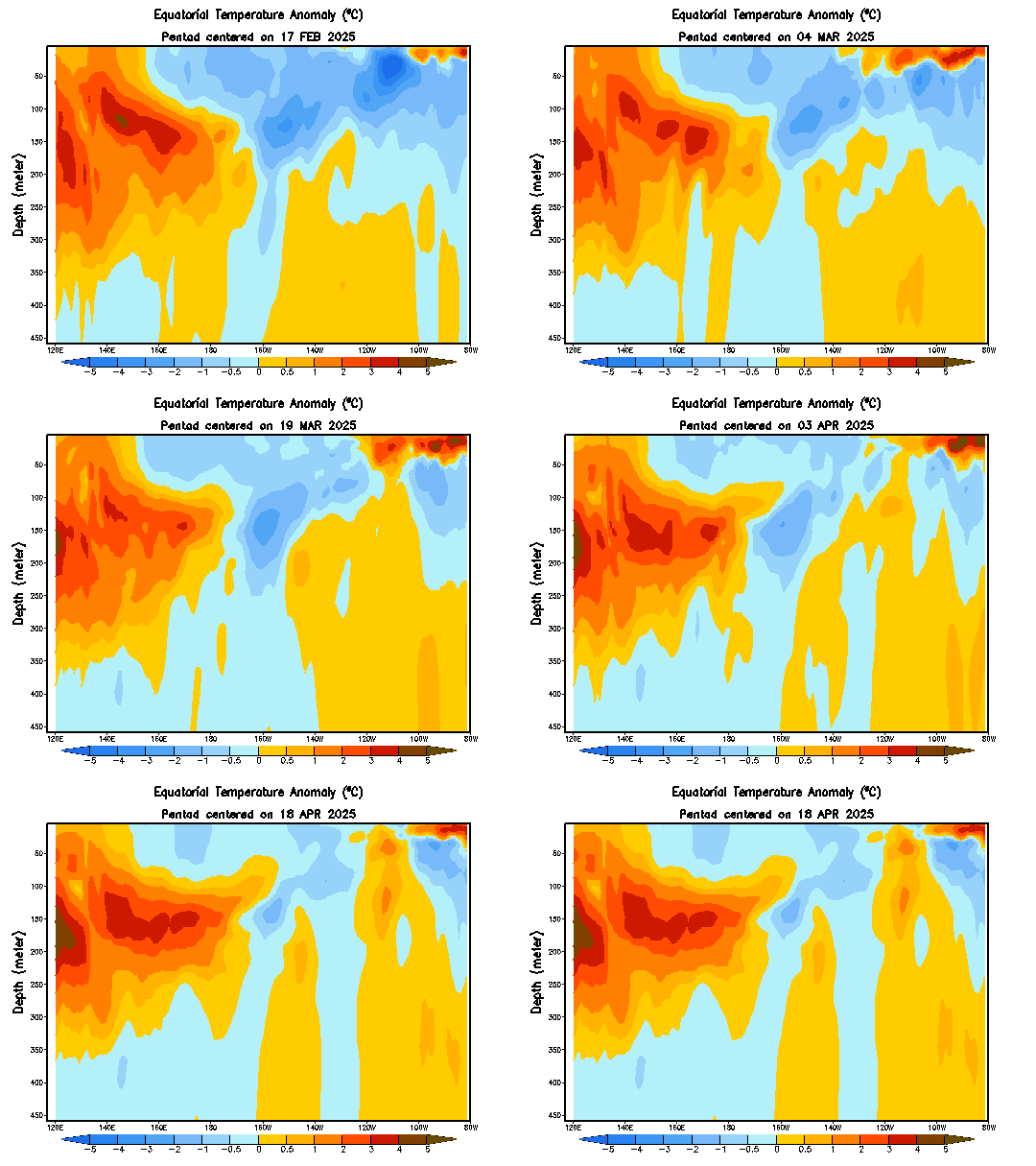
The upper ocean heat content is signaling we are going to move rapidly into El Nino conditions although most forecasts are calling for neutral conditions.
Source:
http://www.cpc.ncep.noaa.gov/products/analysis_monitoring/ocean/anim/wkxzteq_anm.gif
Atmospheric Angular Momentum has really turned negative recently (signaling La Nina), the Trade Winds have fallen off to nothing (signaling El Nino).
So overall, the north Pacific is offically schizophrenic right now.
Ian Holton (21:52:37) :
The cause of tropical warming events (and the relationship with global temperature) is the great issue of the moment because without an understanding of the mechanism we are in no position to assert that it does not change on decadal or 100 year or 1000 year time scales.
Predictions are just fine but what the prediction based on? What the ants are doing?
Jim Hughes (06:28:32) :
“And I disagree about your returning La Nina thoughts by years end. Not unless you think Cycle 24 is going to take off like a rocket. Because the deck is stacked for El Nino, or neutral at worse.”
What stacks the deck Jim?
SandyInDerby (13:45:41) :
The iceberg (11:24:24) :
Similar years might be 62-63 or 96-97.
I hope not 62-63 was the big freeze in the UK. See
http://en.wikipedia.org/wiki/1963_United_Kingdom_cold_wave
I read the link posted above by SandyInDerby, and I read a little further. . . Look at this quote (Wikipedia, emphasis mine) regarding the situation in the almost as cold winter of ‘46/47 : Note that the referenced “Labour Party” is akin to America’s Democrat Party today.
After reading the passages below, please tell me how this is somehow not frighteningly and chillingly (pun intended) similar to the present and forthcoming situation in America RIGHT NOW !
“The winter also had political ramifications and caused the public to lose faith in a Labour government who could not maintain food and electricity supplies. An example of this emerged when, at Mary Churchill’s wedding on 11 February, her father, Winston Churchill was cheered by the crowd but prime minister Clement Atlee was booed. Emmanuel Shinwell, unpopular with the public, was made a scapegoat and sacked from his ministerial position. Despite this, the winter is cited as a factor in Labour’s loss of a large number of seats to the Conservative Party led by Churchill in the 1950 election.
The effects of the winter came at a time of heavy government spending with 15% of the GDP being spent on the military and large expenditure on the new National Health Service and post-war reconstruction. This made the currency less stable and, coupled with the emergence of the dollar as the currency of choice for foreign reserves, led to the government slashing the Bretton Woods official exchange rate from $4.03 to $2.80. This was a milestone in Britain’s decline from superpower status. ”
With food crops being diverted worldwide to biofuels, and the biggest cost increases (and potentially shortages) in electricity (Cap’N Trade and NIMBY) about to be imposed by Congress or EPA, a couple of winters like ‘46/47 or ‘62/63, and you’re gonna see some changes alright. . . BIG TIME !
GW (09:59:00) :
For some reason, the emphasis I had added to the quote to explicitly highlight the points I wanted to get across did not copy into the post.
Someday I’ll need to learn how to properly do that………..
Erl Happ,
Thanks for the reply. As far as eastern that’s just the name so do not be fooled. And it’s probably the best weather-climate forum on the Internet and many of the posters are anything but inept for the most part. And numerous professionals within the long range weather forecasting field discuss things.
And some of these meteorologists work in the energy market sector where the cream of the crop work. So this is where cutting edge long forecasting techniques are discussed in regards to things like the ENSO, or MMW’s in the stratosphere. Or their cyclical nature etc….And I’d be more than happy to post some links to their prior forecasts or discussions.
BTW I originally asked you these questions because your name, along with your language (better?), also rang a bell. Now I remember. I recall you making comments to Ed Berry at his blog a while back. Right?
And I’m familiar with the solar-ENSO connection and I’ve had a very good record of forecasting the ENSO trends over the past 15 years by using it. And my forecasts have always gone on record with both the people within the field, and some news industry contacts.
So I look forward to seeing what happens during the winter of 2008-09.
Frank Mosher (12:50:14) : Piggy Bank almost broke…
http://www.bom.gov.au/bmrc/ocean/results/ocean_anals/SEQ_Equator/2009/May.gif
it already spent all its “wam pool” money beginning in 1998. Last downward breaking point cooling provoked shrinking of 2005 Sumatra’s tsunami?
http://walrus.wr.usgs.gov/tsunami/sumatra05/methods.html
Caleb (09:05:47) :
The fact that peruvian coast it is still a desert area where it does not rain shows that La Nina is by far more predominant than El Nino.
Now, as I said, we are having clear and sunny days, but as we approach winter time cooler nights, so, as i mentioned before, those sunny days may have caused that little warming of sea waters, during the delayed summer time we had.
There is an apparent contradiction here, because we were supposed to have more clouds due caused by the solar minimum according to Svensmark’s theory, but it would seem it works the other way around: clearer skies better night time convection.
I meant the winter of 2009-2010 above when talking to Erl Happ in regards to whether or not we see an El Nino or La Nina develop.
“So I’ll stand by what I said and I wasn’t being disrespectful.”
Beg your pardon. Perhaps the abrasiveness I perceived is merely cultural. A Yankee then?
“erlhapp (09:25:06) :
Stephen Wilde (06:58:35) :
How does this sit with you: “All fluctuation in surface temperature is ultimately a response to changing cloud cover.” Cloud presence depends upon the relative humidity of the air. Change the temperature of the air and cloud cover will change. Increase the ozone content of the air and the temperature of the air will increase.” ”
Hi Erl,
Not sure about the ozone point. I would have thought sun and oceans would have a more powerful effect.
Agreed that cloud cover will change with temperature. Whilst warming is in progress relative humidity declines so less cloud because warm air holds more water vapour and it takes a short time for the evaporative process to catch up. Vice versa for cooling.
I think that changes in the rate of ocean energy release will change global air temperatures and the amount of cloud will follow the temperature change.
I seem to differ with you and others on the relative influences of oceanic changes and changes in the air. I favour solar driven oceanic changes as the ultimate driver with the air circulation following and working to regain temperature equilibrium between sea and air.
I have to stick with that until there is empirical evidence one way or the other. All my work in this field depends on that relationship so if I’m wrong I’d like to be shown to be wrong as soon as possible so as not to waste too much of my life.
The clincher for me was the observation that the weather systems started to move latitudinally AFTER the SSTs started to change in the 1970s and around 2000.
I see no evidence that the air temperatures changed first and that the SSTs followed.
Latest NOAA SST map is in
http://www.osdpd.noaa.gov/PSB/EPS/SST/data/anomnight.5.14.2009.gif
If El-Nino is forming it looks more like it’d be taking its time to me.
PDO looks like it’s going to neutral with warming of Alaskan waters, but the bottom of the horseshoe shaped cool anomaly area has re-materialized somewhat, there’s also 2 or so tiny cool anomaly areas popping up just off of South America in one of the Nino zones
gary gulrud (10:49:01) :
“So I’ll stand by what I said and I wasn’t being disrespectful.”
Beg your pardon. Perhaps the abrasiveness I perceived is merely cultural. A Yankee then?
A yankee ? : ) ……..Yes.
To Caleb,
On why the ENSO region is not described as a node of the Thermohaline Ocean Circulation.
Thermohaline is a conjunction of two words which means “temperature” and “salinity”. The equatorial Pacific is the warmest (significant) ocean system there is and some of the least salty as well, so, in essence, it is the top, top of the overall ocean circulation or even almost isolated from the deep ocean circulation system. It really doesn’t get invited to the Thermohaline Ocean Circulation parties. All the action happens with colder, more salty water.
But there are a few significant ocean currents which flow into the ENSO region. The Peru-Humbolt Current is the biggest (which is partly related to the issues that you were talking about).
http://en.wikipedia.org/wiki/Humboldt_Current
There is also an upwelling coastal current along Peru where deeper ocean water (a few hundred metres only) wells up (and does so more strongly during La Ninas) and then there is the North Equatorial Counter Current (which flows west to east opposite to the ENSO region surface currents and then turns back into the ENSO region).
http://en.wikipedia.org/wiki/File:Ocean_surface_currents.jpg
So, the ENSO is not a node of the Thermohaline Ocean Circulation but it is one of the three most active regions where energy is being exchanged between the atmosphere and the oceans (along with the other two, the north Atlantic and the south Atlantic deep ocean sinking regions).
“I seem to differ with you and others on the relative influences of oceanic changes and changes in the air. I favour solar driven oceanic changes as the ultimate driver with the air circulation following and working to regain temperature equilibrium between sea and air.”
I don’t know how much is disagreement versus differing focus.
Erl’s ozone discussion is somewhat dependant on UV variability. The solar cycles tend to occur in groups with sunspots a lagging effect of solar activity or inactivity.
We have had no solar flaring for two years, i.e., reduced UV variability, unlike the 23 minimum, part of an active regime. Erl’s diagram locating El Nino’s near minimums has one such declining regime cycle, 20. Note a false upturn or two ahead of the indicated El Nino.
This time around cycle 24’s weakness is of a different order and we may be a year away from months above 10 in Wolf number. We may not get an official El Nino this time around at all and the current move neutral may not be the expected upturn.
Bill Illis (21:01:18)
“The Earth rotates east to west […]”
Better check this “fact”.
Out of curiosity, I just did some Google searches to (comparatively) see how many hits come up for the following phrases:
1. “the earth turns from west to east”
2. “the earth turns from east to west”
3. “the earth rotates west to east”
4. “the earth rotates east to west”
yikes
anna v (23:10:20) “This is sort of an inertia effect, as the air has not much cohesion to the ground, no?”
I recommend seeing Sidorenkov’s (2005) discussion about concentric Earth shells. [Note: Access to the paper is free – the link is posted at Paul Vaughan (20:33:47).]
–
anna v (23:10:20) “What about ocean currents. Water is not very stuck on the bottom either. Do they follow a similar pattern?”
It is called oceanic angular momentum (OAM). I cited a paper by Gross (2005) above. In it you will find a reference to his earlier work in which he related Earth’s Chandler wobble to OAM & AAM. There is a whole branch of the literature that addresses such interrelations. I have run some analyses on related time series and it is crystal clear that this body of literature is very important in the climate discussion. Hopefully some of the experts from that very interesting branch of research will start joining WUWT discussions.
This is interesting.
http://discover.itsc.uah.edu/amsutemps/execute.csh?amsutemps
Channel5 (the channel I think Roy Spencer said gives the closest match to official monthly UAH temps.), shows the latest day shown there being the third coldest on the map behind only 1999 and 2008 and below the average line.
I thought for sure the current warmup in SST’s would stem that slow trend downward by now, maybe the effect of the quiet sun is slowly kicking in or something (which right now has sunspots too small to see in the thumbnail on this site).
El Niño coming back? Just in time for Cap and Tax! WooHoo
No more Car Payment
No more mortgage payment
Free Health Care
Free Power from Solar and Wind
Millions of new high paying jobs
I think the “thermo-haline” circulation is somewhat overblown.
Do we have any measured physical evidence that the gulf stream or its kin have ever stopped circulating.
If we have any such observational data ,(not computer modelling) do the instances of ocean circulation stopping, coincide with the instances of stopping of the earth’s rotation. How often does the earth stop rotating; to stop the ocean from circulating?
Other than the earth stopping its rotation what other physical phenomenon would cause the oceans to stop circulating ?
Wake me with the answers.
George
Re: George E. Smith (15:10:16)
Some of the more interesting cases I’ve seen argued in the literature involve massive influxes of fresh (i.e. non-saline) water.
Steven Hill (14:58:24) :
No, that frankenstein
surely by NOAA created
from dark abyssal waters made
a phantom monster did originate
a false Nino, a Nino fake
No, a virginal Nina I do prefer
a natural, cool and handsome girl,
and no invented lie
will make her disappear
A sad and lonesome Sun
of her joy in need
will surely her dance, merrily, proceed.
The fake Nino won´t last a week
soon replaced by a Nina humble and meek
gary gulrud (12:42:53) :
Re UV.
Gary, I don’t think that there is a direct relationship between sunspot number and the power behind radiation in the very short wave spectrum. I would like to see data on this. Any sources?
I am also aware that very small solar cycles have in the past produced the most vigorous swings in the SOI and surface temperature, particularly on the downside. I think it is the QBO in solar activity that drives the system and it does so by shifting the atmosphere between the winter pole and the equator so affecting the strength of the vortex. The major dynamic seems to be the change in ozone content of the stratosphere rather than the strength of UV as such. So, you see there is a shift in my story. Mind you, once the ozone content is changed, change in UVB becomes important in determining the temperature swings in the upper troposphere.
The ‘enlightenment’ for me came with observation of marked cooling of the tropical stratosphere during the sudden stratospheric warming of January- February this year. Simultaneously there was a jump in sea surface temperature, especially about 30°S. you can see the dynamics if you compare pole with tropics at http://www.cpc.ncep.noaa.gov/products/stratosphere/strat-trop/
Jim Hughes (10:20:41) :
Yes Jim I certainly did comment on Ed Berry’s blog and I am very interested in any notions of what drives tropical warming events and would appreciate any pointers at all to discussions.
You seem pretty sure of an El Nino materializing late in this year but what is the rationale?
Adolfo Giurfa (10:21:01) :
That graphic of the ocean heat content down to 400 metres in a tiny latitude band across the Pacific has absolutely no predictive value in terms of what will happen to tropical SST. As I think you know, most of the volatility in cloud cover and radiation is away from the equator. It is the in-feed zones between 10 to 35° of latitude that determine the issue. The equator is where we see the output.
Yes, the piggy bank has very little warm water and very little cold water in the east or the west. If anything this should cause a re-think about the cause of the ENSO cycle in academia.
Adam from Kansas (11:39:09) :
Latest NOAA SST map is in
http://www.osdpd.noaa.gov/PSB/EPS/SST/data/anomnight.5.14.2009.gif
If El-Nino is forming it looks more like it’d be taking its time to me.
PDO looks like it’s going to neutral with warming of Alaskan waters, but the bottom of the horseshoe shaped cool anomaly area has re-materialized somewhat, there’s also 2 or so tiny cool anomaly areas popping up just off of South America in one of the Nino zones
Adam from Kansas,
I wouldn’t expect any formation, Region 3.4 wise, before late summer. Since this is not going to be a strong event, or at least the chances are extremely slim for this.
So this means that it will develop both later and slower. Because we would already be looking at much warmer SST’s if we were going to see a 1997-1998 type event.
Bill Illis,
You piqued my curiosity with the statement; “Also interesting is that the negative PDO seems to be moving back to neutral right now.”, as I have been watching the PDO as of late and hadn’t noticed any mention such as this. So I e-mailed Nathan Mantua at the University of Washington to see if there was yet an April 2009 update to his PDO index. He responded:
PDO index values for 2009
January -1.40
February -1.55
March -1.59
April -1.65
In other words, the PDO is still negative, and has been getting more so every month this year.
Cheers
Joseph,
If you watch this animation of the past two months, one can see that the April PDO average was still quite negative but things have changed over the past few weeks.
http://coralreefwatch.noaa.gov/satellite/current/crblrg_sstanom_2m.html