
Source: http://www.osdpd.noaa.gov/PSB/EPS/SST/data/anomnight.5.11.2009.gif

Bill Illis writes in comments:
The newest Ocean SST map shows the La Nina conditions have gone away and we are in slightly positive ENSO conditions.
Also interesting is that the negative PDO seems to be moving back to neutral right now. The cool SST conditions off of Alaska (which has been there for 3 years now) looks to be moderating as well.
From my perspective, the other interesting feature is how the recent La Ninas have loaded up cool SSTs in the Pacific off south-east Asia which will soon move into the Kuroshio currrent which will then flow across the north Pacific.
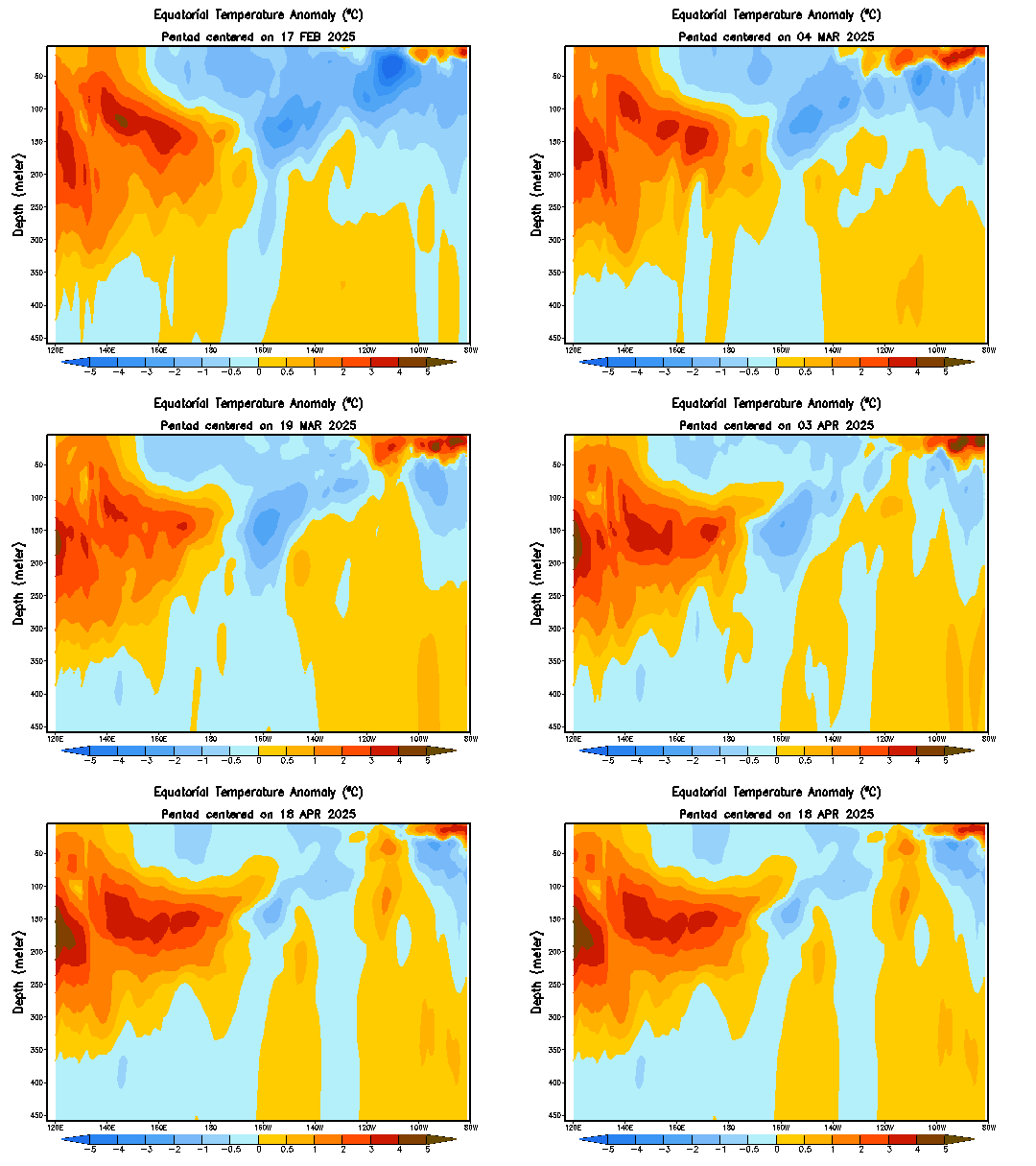
The upper ocean heat content is signaling we are going to move rapidly into El Nino conditions although most forecasts are calling for neutral conditions.
Source:
http://www.cpc.ncep.noaa.gov/products/analysis_monitoring/ocean/anim/wkxzteq_anm.gif
Atmospheric Angular Momentum has really turned negative recently (signaling La Nina), the Trade Winds have fallen off to nothing (signaling El Nino).
So overall, the north Pacific is offically schizophrenic right now.
Not unexpectedly, climate will oscillate. It’s been apparent from the early months this year, that no further drop into a more deeply negative phase is in the making. A rebound is underway that may extend for a year or two, if past patterns hold. Despite much anticipation here of an upcoming grand minimum, cycles do persist. 2012 should be a very telling year in the larger picture.
OT – Catlin pickup today at 1800.
The PDO area has done this to an extent before
http://www.osdpd.noaa.gov/PSB/EPS/SST/data/anomnight.12.8.2008.gif
Notice that SST anomalies were close to neutral off the immediate Alaskan coast and warmer water reached all the way to California’s coast in this graphic? The PDO must go up and down over the short term as well as having long term phases, if it’s like in late December the PDO will get cooler again.
Does anyone know what the lag time is between these conditions warming and the appearance on UAH?
This month thus far is quite cool on UAH daily temps – is this warming of the pacific reflected in those numbers?
In the last longterm -PDO phase, -PDO months outnumbered +PDO months about 2 to 1, and La Ninas outnumbered El Ninos about 2 to 1 as well.
Something else I’d like to add…I think a decent analog to this year might be 1951, when a weak El Nino developed over the summer, peaked in the fall, and then died during the winter.
Reading what the experts have to say; I tend to think that a weak El Nino or neutral conditions should be observed in the near future.
Adolfo Giurfa (10:10:52) :
“La Nina is not gone…She just went a few minutes to the toilet to arrange herself..”
I nominate for Quote of the week! (and prediction of the season)
John-
The lag time for UAH seems to be about 4-6 months, while for surface temps (GISS and HadCRU), it seems to be more like 3-5 months.
John, i too noticed the cool UAH numbers, so far this month, especially at 25,000 feet. IMHO, an El Nino is not likely in the near future, as the characteristic cool pool at 150m depth, 160-180e is not present. It was evident in every El Nino sinchttp://www.bom.gov.au/bmrc/ocean/results/ocean_anals/SEQ_Equator/2009/May.gife 1980……fm
http://www.bom.gov.au/bmrc/ocean/results/ocean_anals/SEQ_Equator/2009/May.gif
What is the the word “Oscillation” in ENSO and PDO means that people don’t understand? IT’S OSCILLATING!!!
I agree with Adolfo, nothing is clear about current ENSO/PDO movements. I was nonplussed with the failure of La Nina to assert herself last Nov. I also noted Erl’s prediction of movement toward El Nino by March end.
But as Frank Mosher has repeatedly noted, there is no warm water to generate an El Nino. In lieu of that, we’re in for neutral conditions, with an occasional quarter in El Nino range at most.
You mean some of the usual things seen during El-Ninos isn’t there right now? Oh my, has the Pacific lost its mind, giving us mixed signals and unable to make squat of whether it wants to bring us an El-Nino or not!?
If we end up having a schitzophrenic ENSO and PDO, all could break loose on what we thought we knew about these phases and the climate following that.
Yes, if our 30 year negative PDO becomes a two-year negative PDO, that will indeed be quite interesting, and AGWers can be relied on to suddenly find new respect for PDO-ology!
But then it really should take a couple years to determine that for sure.
The iceberg (11:24:24) :
Similar years might be 62-63 or 96-97.
I hope not 62-63 was the big freeze in the UK. See
http://en.wikipedia.org/wiki/1963_United_Kingdom_cold_wave
I was living on a remote farm in Scotland, and hardly managed 2 days a week at school because the road was blocked by snowdriftsfor days at a time.
Will anywhere be warm if it does repeat?
all this froth gravitates towards a basic understanding that is needed, is it :
( with respect to thermal balance )
sun drives atmosphere drives ocean OR
sun drives ocean drives atmosphere OR
sun drives ocean and atmosphere with ocean and atmosphere seeking equilibrium ?
yes, my presumption is that our star is the “engine” if you will, it alone is the source of what we are calling climate. i take a more thermodynamic view of all this, if you will.
i am tending to think that, with respect to history, the PDO will remain in/into its negative mode. remember, those who cannot remember history are doomed … 🙂
Off topic
But the BBC has just put out it’s report on the Catlin expedition which has ended
here’s the link
http://news.bbc.co.uk/1/hi/sci/tech/7897392.stm
You should look at the second video clip with is one of the most distorted pieces of journalist even for the BBC. It’s David Shukmans report on meeting the team after the expedition. Full of library pictures, sunny weather, nuclear submarines, surfacing at the pole etc. One could be forgiven for wanting a holiday on ice! Even shows one of the team in a survival suit swimming in the “thin ice” which looks to be less that 6 inches thick
Ludicrously distorted and a sham
Tony Berry
IMO as long as the sun continues its quiet streak it will be difficult for El Nino to reload. As things go in cycles and oscillations we may find this trend towards El Nino short lived with La Nina reloading and rebounding stronger than before.
I like using Unisys SST maps. Some discrepancies here and there from the NOAA map, but pretty close overall.
http://weather.unisys.com/surface/sst_anom.gif
Here is a looped map.
http://weather.unisys.com/archive/sst/sst_anom_loop.gif
steptoe fan (13:56:26)
“Froth” says it all.
Ocean and atmosphere can store, transport and release energy, but looking only at these to understand climate reminds me of the blind men trying to describe an elephant. An examination of climate needs to include the energy sources, which are variable.
Interesting side note, and may be due to some kind of PDO lag and/or Arctic jet stream loop, but record cold temps are being recorded all over Oregon in the higher plains, breaking records from the 40’s.
000
SXUS76 KPDT 131815
RERPDT
RECORD EVENT REPORT
NATIONAL WEATHER SERVICE PENDLETON OR
1120 AM PDT WED MAY 13 2009
…NEW DAILY RECORD LOW TEMPERATURES FOR MAY 11TH…
NOTE: STATIONS MARKED WITH * INDICATE THAT THE STATION REPORTS ONCE
PER DAY. FOR CONSISTENCY…THESE VALUES ARE CONSIDERED TO HAVE
OCCURRED ON THE DAY THE OBSERVATION WAS TAKEN BUT MAY HAVE ACTUALLY
OCCURRED (ESPECIALLY FOR MAXIMUM TEMPERATURE) ON THE PREVIOUS DAY.
STATION PREVIOUS NEW RECORDS
RECORD/YEAR RECORD BEGAN
*JOHN DAY(CITY), OR 28 / 1958 26 1953
*JOSEPH, OR 23 / 1943 23 (TIED) 1893
*LONG CREEK, OR 24 / 1964 23 1957
MEACHAM, OR 25 / 2006 25 (TIED) 1948
*MONUMENT 2, OR 29 / 1974 28 1961
*MORO, OR 29 / 1958 29 (TIED) 1928
PENDLETON(ARPT), OR 33 / 2006 33 (TIED) 1934
THE DALLES, OR 36 / 2006 36 (TIED) 1948
*SUNNYSIDE, WA 33 / 1974 33 (TIED) 1948
Pamela-lots of cold records around here(NE Oregon) have been broken or tied this spring.-Makes me think of the Early 1950’s when Barley was being considered as a cash crop by wheat growers….
(and as stated above,1951 was an El Nino year…)
Konrad (15:36:10) :
“An examination of climate needs to include the energy sources, which are variable.”
Never a truer word. The forces are complex and the turning points hard to pick.
gary gulrud (13:07:22) :
“Erl predicted El Nino by May”.
SST 20°N to 20°S has been on the increase since mid 2008. May is here and no El Nino. So, I want to adjust my breeches.
‘El Nino’ has a defined meaning in terms of ENSO 3.4 temperature and the SOI. A tropical warming event can begin from a low base and not reach defined levels in terms of ENSO 3.4 or the SOI. I want to focus on ‘warming events’. I prefer to keep the focus on the entire tropics 20°N to 20°S, rather than just the Pacific theater because of all the ‘oscillator’ garbage spoken about ENSO, as if the thing is generated in the ocean. That said there is nowhere that the forces driving tropical warming events are more manifest than off the coast of South America at 20-30°S latitude. There is also the difference in ocean areas between the hemispheres to consider. The same forces work in the NH off California, even more strongly but there is less ocean to influence. The ocean is the hot water bottle to use Stephen Wilde’s terminology.
Bill Illis has pointed out the clear relationship between the strength of the trade winds and sea surface temperature change in the Pacific. The strength of the trades depends upon the East west pressure differential.
Bob Tisdale rightly points out that the tropics is where the energy is garnered or not garnered.
Pressure in the west Pacific changes little. The increase in atmospheric pressure in the South East Pacific reached a high point in late 2008 (peak of La Nina), We have seen a swift fall in sea surface pressure up to May 2009 but that fall in pressure has stalled short of upper limit of the long term trend for rising pressure (diminishing potential for El Nino) that starts in 1978. If it renewed, I see a brief rise of temperature largely coming from northern hemisphere summer due to the drying of the atmosphere (La Nina is a precipitation event) .
Counter to that, de-seasonalized sea surface temperature is already falling off Chile and has been doing so for some months in line with an even more recent stalling of the fall in atmospheric pressure. The in-feed zone for ENSO 1+2 is cooling. In the past this in-feed zone has led the major changes in temperature in the equatorial region by about nine months.
The force behind this remorseless long term potential for reduced El Nino is the decrease in ozone content of the upper troposphere. Ozone drifts down from the stratosphere and the more strongly so as soon as 20hPa temperature begins to fall, thereby reducing convection in the Brewer Dobson circulation. The change in ozone content of the upper troposphere has implications for surface pressure because less heating aloft means less interference with the downdraft in the columns of air in the high pressure cells.
The pressure change in the south east Pacific is one indicator of the strength of the vortex that brings nitrogen oxides from the mesosphere mixing this compound that erodes ozone into the stratosphere. Less ozone in the stratosphere means that there is less feeding down into the upper troposphere when 20hPa temperature falls on the QBO time scale. The upper troposphere then becomes less reactive to UVB.
The QBO in the stratosphere is the pendulum that gives the timing to the change in sea surface temperature in the tropics. The correlation between temperature in the stratosphere (due to change in ozone content) and geomagnetic activity from the sun has been documented here: http://nora.nerc.ac.uk/5936/1/Luetal_2006JD007864_JGR_NORA.pdf
That reference is to cover off for the inevitable attack from Leif. There is plenty of other material that makes the same point and it goes back a long way in time.
I have also got to look out the window and see what is happening. The cloud that has dogged us for so long has disappeared. That is normal to some extent for this time of the year but it suggests that more sunlight will be reaching the ocean. However, when I look at the SST anomalies for 20-30°S they indicate cooling. So, I am going to stick my neck out again and say La Nina will renew, but when? Perhaps by end of year.
What makes me nervous is solar cycle 24 and the potential for change in geomagnetic activity and irradiance. Rapid change in the QBO is possible. Since 2000 it has been on about a 2 year time schedule as against the 27.1 month long term average. This prediction business is nerve wracking.
It seems also that post 2000 warming events have been led by changes in the stratosphere very much closer to the equator than in the past. As the ozone content of the stratosphere is reduced and its temperature falls the southern oscillation will swing less wildly.
The glass is not absolutely clear. Its still a puzzle.
Forgive my ignorance, what is the driving mechanisms for El Nino and La Nina?
I mean, I understand the principles of thermohaline circulation, but I don’t know what causes the El Nino/La Ninas.
Thanks in advance.
Ben
Bill,
Where are you getting your information to support the statement that “the negative PDO seems to be moving back to neutral right now”?