By David Wojick
In my last Wyoming wind power article I noted a National Audubon Society warning that the growing masses of wind farms could be “population sinks” for golden eagles. This means that many eagles will be attracted to them, to then be killed by them. See my article here.
Digging into the scientific literature I found that this is a well recognized wildlife management issue. It usually goes by the name “ecological trap.” Since being trapped means being killed I think ecological death trap is more appropriate.
In fact Wyoming wind power is a double death trap for golden eagles. First, as Audubon says, when the local eagles are killed this creates a sparsely populated area which other eagles will then come into. Eagles like most birds try to spread out, probably to maintain the local food supply for their hatchlings. These new eagles are then also killed and the cycle is repeated in a true death spiral.
In addition wind farms kill a lot of other birds as well as a huge number of bats. Golden eagles are scavengers so they are attracted by this abundant food supply. In fact being struck by cars while eating road kill is a major cause of golden eagle death.
Ecological death traps are not new science so the Federal and State Wyoming wildlife managers must know about them. To give you the flavor of the science, below are two quotes from a 2002 literature review article entitled “Ecological and evolutionary traps” available here.
“Deterministic models have shown that, as one might expect, when there are major differences in quality between habitats and population sizes are small, behavioral preferences for the habitats that yield no net reproduction (habitat ‘sinks’) can lead to population extinction. More surprisingly, this result appears to hold true even when patches of poor habitat represent a relatively small proportion of the entire landscape. Thus, alteration of only a fraction of the habitat in such a way that the decision-making rules of an organism no longer yield adaptive outcomes can result in the demise of the whole population if the preferences of individuals are strong enough.”
“Organisms often rely on environmental cues to make behavioral and life-history decisions. However, in environments that have been altered suddenly by humans, formerly reliable cues might no longer be associated with adaptive outcomes. In such cases, organisms can become ‘trapped’ by their evolutionary responses to the cues and experience reduced survival or reproduction. Ecological traps occur when organisms make poor habitat choices based on cues that correlated formerly with habitat quality. Ecological traps are part of a broader phenomenon, evolutionary traps, involving a dissociation between cues that organisms use to make any behavioral or life-history decision and outcomes normally associated with that decision. A trap can lead to extinction if a population falls below a critical size threshold before adaptation to the novel environment occurs. Conservation and management protocols must be designed in light of, rather than in spite of, the behavioral mechanisms and evolutionary history of populations and species to avoid ‘trapping’ them.”
Spacing out their nesting and scavenging for food are two deeply rooted survival instincts in golden eagles. Wind farms turn these survival skills into a death trap. Federal and State Wyoming wildlife and energy managers need to recognize this potentially catastrophic fact.
Wind power does more than kill the eagles that happen by; it repeatedly draws them in then kills them.
Time for this one:
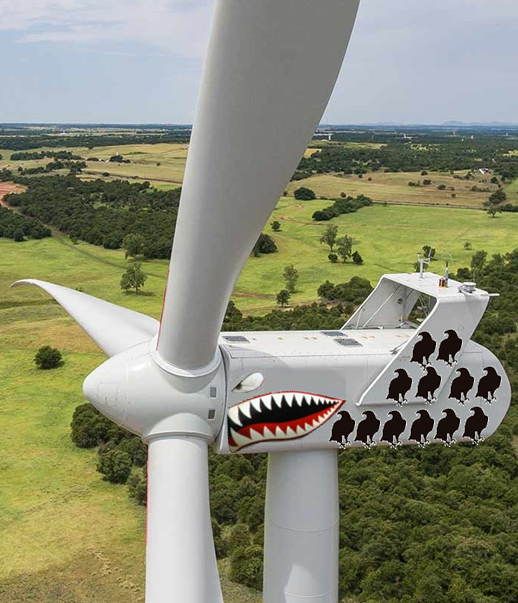
Perfect! Mind you this article is written about wind power death trapping eagles in Wyoming but it applies to lots of birds globally. Raptors for sure.
Disgusting, but true unfortunately!
The justification for wind farms et al is founded on a false premise.
GHE theory claims that without it Earth would become a -15 C ball of ice.
Just flat wrong.
GHE theory claims that Earth’s surface radiates “extra” energy as a BB which violates LoT 1.
Just flat wrong.
GHE = bogus & CAGW = scam.
BSME CU ‘78
[“The justification for wind farms et al is founded on a false premise.”]
Yes … but it’s made billions for the rich folk !!
Yes I put that wind turbine eagle killer image up every chance I get. But you know what? I’m skeptical about the number of eagles killed. I’m of the opinion that we should be seeing a lot of photographic evidence of the claimed slaughter. So I asked Google AI
Where is the photographic documentation for all the dead eagles that wind turbines are killing?
Photographic documentation of eagle fatalities at wind farms is not typically housed in a single, publicly accessible gallery. Instead, these records are distributed across various government, scientific, and private repositories:
1. Government and Regulatory Records
When a protected bird is found, wind farm operators are required to report it to federal and state agencies.
U.S. Fish and Wildlife Service (USFWS): Documentation, including photographs and incident reports, is often part of official investigations or permit compliance. While much of this data is kept confidential, some records have been made public through Freedom of Information Act (FOIA) requests or as part of criminal investigations.
National Fish and Wildlife Forensics Laboratory: Some remains are sent here for necropsy to confirm the cause of death. These official files often contain photographic evidence of the injuries.
2. Scientific Studies and Databases
Researchers frequently document carcasses to model mortality rates and develop deterrent technologies.
BioOne and USGS: Peer-reviewed journals, such as the Journal of Raptor Research, often include spatial distribution maps and, occasionally, photos of carcasses found during field studies.
Renew Database and AWWIC: Organizations like the Renewable Energy Wildlife Institute (REWI) and WEST, Inc. maintain extensive databases of post-construction fatality monitoring data. While these databases are comprehensive, they primarily focus on raw data and reports rather than public image galleries.
3. Media and Advocacy Groups
News Outlets: Organizations like Fox News Digital and the Associated Press have published photos obtained through investigations or leaked government documents.
Conservation Organizations: Groups such as the American Bird Conservancy and the American Eagle Foundation advocate for bird-smart wind energy and occasionally publish documentation to highlight the impact of poorly sited turbines.
4. Commercial Stock Imagery
Stock photo platforms like Adobe Stock contain a limited number of professionally captured images of bird mortality at energy sites for editorial use.
___________________________________________________________________
This line
News Outlets: Organizations like Fox News Digital and the Associated Press have
published photos obtained through investigations or leaked government documents.
Why would this sort of documentation need to be leaked?
“When a protected bird is found, wind farm operators are required to report it to federal and state agencies.”
I bet they don’t report all. They’ll need to report some or it’ll look questionable. Who is going to know if they cheat?
Very true. For that matter the Eagle-kill permits only require that at least 34% of the deaths are found and reported because the bodies can be thrown far away given blade speeds up to 200 mph or they can be eaten by scavengers.
The Fish and Wildlife Service issues wind farms permits to kill eagles. All kills found are supposed to be reported but these reports are deemed confidential by the FWS. Even FOIA requests are routinely denied. I discuss this in my report: “Time for the FWS to Stop Wind Power Eagle-Kill Permits”
http://www.cfact.org/wp-content/uploads/2025/06/Wojick-Eagle-Kill-Report-Final.pdf
They do not want the public to know how many eagles are killed and where. This must change.
“They do not want the public to know how many eagles are killed and where.”
________________________________________________________________
My confirmation bias tells me that’s a very probable and ugly truth.
Because they want to conceal the damage these worse-than-useless things do. There’s a gravy train for cronies to be protected.
same as above, My confirmation bias tells me that’s a very probable and ugly truth.
Steve, as I have commented here at WATTS before, at a line of windmills, just NE of Casper, Wyoming, around 2005, at first light on a Monday morning, I arrived at the site and found dead (mangled) Golden Eagle, some kind of Falcon, and two Buzzards along with almost a dozen other birds. Before 7:00 AM a company pickup arrived and two workers threw dead birds in the back, and went down the windmill line throwing more in. I referred to these guys as the “cleanup crew”. This appeared to me to be a system to destroy evidence, instead of some documentation.
Hmmm, there a place for a whistle blower in all of this
The numbers killed is one of those things that “we know we don’t know”.
True but the fact that the Feds refuse to release the reported kill data is a disgrace that must end.
“National Audubon Society warning that the growing masses of wind farms could be “population sinks” for golden eagles”
They just had to qualify the warning with a “could”.
Good article- you sound like a guy who is a serious outdoors-man. In the ’70s I was a member of the National and state Audubon. The National had a great magazine. The state chapter here in Wokeachusetts has many properties. Several years ago, the state F&W service started working on them and convinced them that some timber harvesting, even clearcuts, were good for birds- especially early succession species- so they bought it. For them, birds are more important that locking up the Great Satan carbon.
Cannot speak to Wyoming, but there is an older serious research study for Altamont Pass wind farms because golden eagle kills there were causing an observable population decline in the general area. A large number of golden eagles in that California area were netted and battery radio locator leg tagged. Over the 4 study years (before the batteries died), 54% of tagged golden eagle deaths were caused by the wind farms. The final report (available on line) also said this was probably a 30% undercount (that is a total ~84% turbine related deaths) because the turbine strikes also destroyed the radio locator tag based on the observed tagged dead eagle injuries.
Altamont is mostly older smaller so slower blade tip turbines, so the Wyoming situation could be pretty horrific.
Good data. There was a recent tagging study in SE Wyoming and I do not have the numbers but wind kills outnumbered all other human causes combined. Keeping all the kill data secret is incredible. That the Trump people have done nothing is absurd.
An acquaintance of mine who studies eagles mortality and migration in Wyoming puts the kill stats of Golden Eagles as 17% due to Bald Eagles, 46% as turbine strikes, and the balance being power line electrocutions, hunting, and automobile encounters combined. Of course, wind and solar cause the construction of more miles of high tension lines too.
All the wind farms in the US aren’t worth loosing one Golden Eagle.
Let me recommend my post, Explaining Wind Turbine Lethality.
Best to all,
w.,
One of the more pernicious lies told in this entire debate is the “cats kill more birds…” statement. Yes, it is a fact that cats kill many birds. However, cats never kill raptors and the other birds newly placed at risk of destruction by modern wind turbines which sweep an area from around 20meters above ground to 300m+. The small birds species covered by the Migratory Bird Treaty Act have become safe from wind turbine destruction by the increasing size of turbines, but species like Canada Goose, bats, eagles and other raptors, cranes, and so forth are more at risk.
I watched a large flight of Canada geese overhead in December heading south. Their path would have taken them through two permitted but as yet unbuilt wind plants — Boswell Springs and Rail Tie. Someday there will be an egregious destruction of these birds that might wake people up.
One of the more worthless agencies involved in the permitting of wind plants in this state is the Wyoming Industrial Siting Council. They always, as far as I know, take the assurances of the applicant over anyone in the public — even when that word has proved itself worthless in some cases. Moreover, they are not authorized to hire independent experts, but instead rely on State agencies for advice. But the State agencies are not independent — they are under the thumb of political people. So, the Council are most interested in distributing “impact” money to towns and counties. Very popular activity but the money is generally wasted.
[“They always, as far as I know, take the assurances of the applicant over anyone in the public — even when that word has proved itself worthless in some cases.”]
Brown paper envelopes ???
David,
Great minds thinking alike…
https://co2coalition.org/2026/04/07/eco-friendly-energy-slaughtering-wildlife/