by Dave Burton with a postscript by Anthony Watts
Biologist Paul Ehrlich died on Friday, March 13, 2026, at the age of 93.
His famous 1968 book, “The Population Bomb,” changed the world. He famously predicted that human “overpopulation” would soon outstrip food supplies, leading to catastrophic famines, and societal collapse. He predicted that hundreds of millions of people would starve to death in the 1970s and 1980s, that India would be unable to feed its population by 1980, and that major countries like England would no longer exist by the year 2000.
The New York Times tactfully wrote that, “his predictions proved premature.”
When Ehrlich wrote his book, in 1968, the world’s human population was between 3.5 and 3.6 billion people. Today it is over 8 billion. Yet famine deaths, which were common when Ehrlich wrote his book, have become rare, as population and CO2 levels have risen:

It’s mainly because crop yields have risen even faster than population:
https://ourworldindata.org/crop-yields

Several factors have contributed to that (surprising to Ehrlich!) improvement, but three of the most important factors are all thanks to fossil fuels:
- One important way that fossil fuels contribute to rising crop yields and save us from famines is by “CO2 fertilization.” CO2 emissions slowly raise the CO2 level in the atmosphere, which makes plants healthier, faster growing, and more productive.
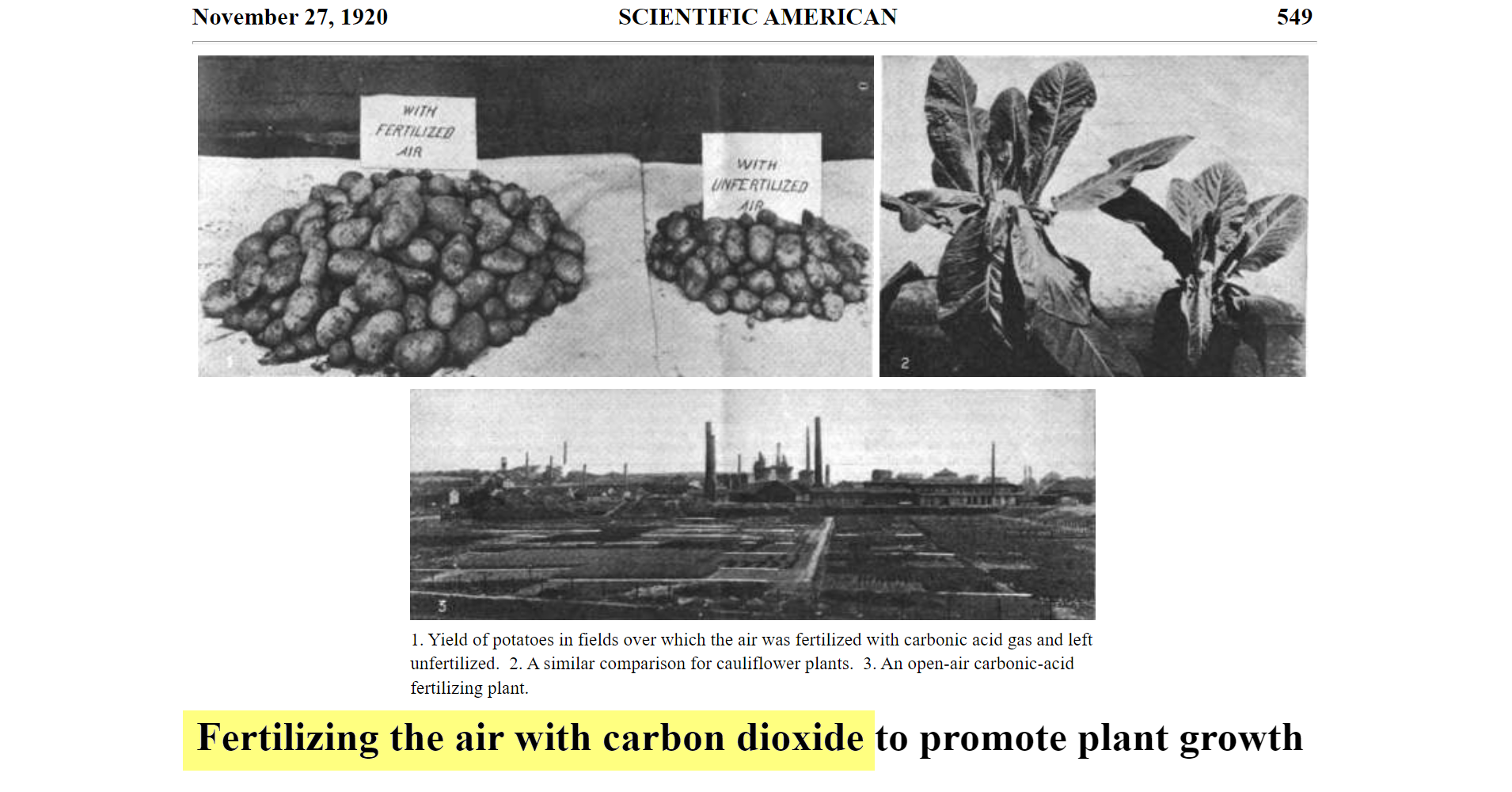
The large benefits of elevated CO2 for crops have been known to science (though perhaps not to Ehrlich) for more than a century. The benefits are so dramatic that in 1920 Scientific American called anthropogenic CO2 emissions “the precious air fertilizer.”
Gradenwitz A. (1920). “Carbonic Acid Gas to Fertilize the Air.” Scientific American, Nov 27, 1920. doi:10.1038/scientificamerican11271920-549

2. Elevated CO2 not only benefits crops by CO2 fertilization, it also improves water use efficiency & drought resilience of crops, through reduced stomatal conductance. Here are some papers about it:
De Souza, A.P. et al. (2015). “Changes in Whole-Plant Metabolism during the Grain-Filling Stage in Sorghum Grown under Elevated CO2 and Drought.” Plant Physiology, 169(3), Nov 2015, 1755–1765. https://doi.org/10.1104/pp.15.01054
Fitzgerald GJ, et al. (2016). “Elevated atmospheric [CO2] can dramatically increase wheat yields in semi-arid environments and buffer against heat waves.” Glob Chang Biol. 22(6), 2269-84. https://doi.org/10.1111/gcb.13263
Chun, J.A. et al. (2021). “Effect of elevated carbon dioxide and water stress on gas exchange and water use efficiency in corn.” Agricultural and Forest Meteorology, 151(3), 378–384, ISSN 0168-1923. https://doi.org/10.1016/j.agrformet.2010.11.015
EXCERPT: “There have been many studies on the interaction of CO2 and water on plant growth. Under elevated CO2, less water is used to produce each unit of dry matter by reducing stomatal conductance.”
Note that wheat is a C3 crop, but corn and sorghum are C4 crops. Both benefit, but C3 crops benefit more. (Most crops are C3.)
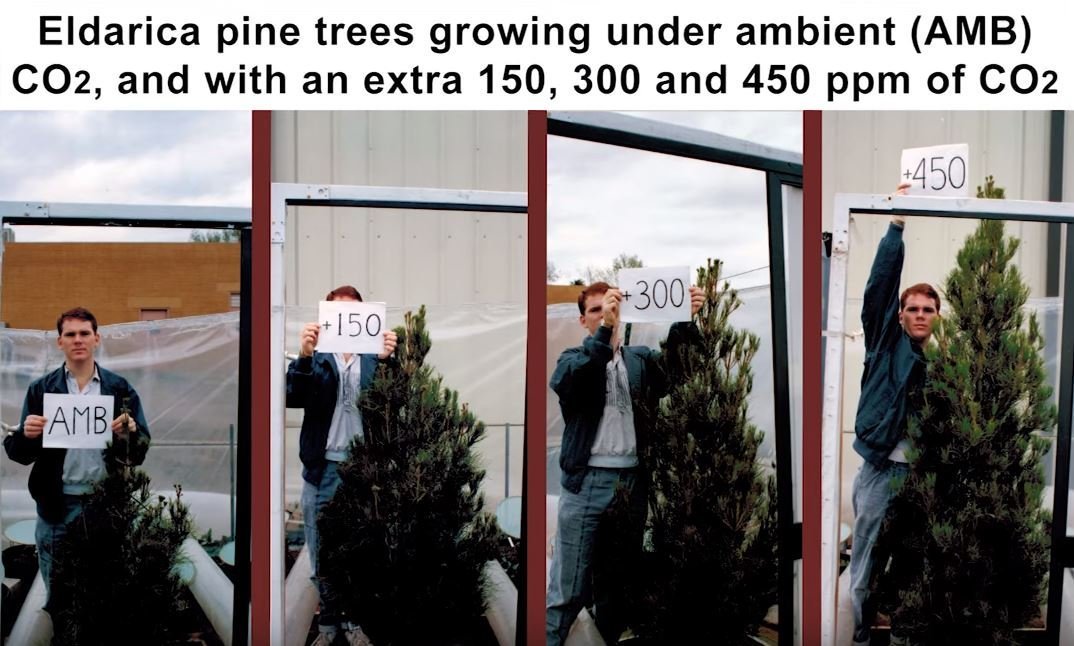
Trees are also C3 plants:
Idso & Kimball (1994). “Effects of atmospheric CO2 enrichment on biomass accumulation and distribution in Eldarica pine trees.” Journal of experimental botany. 1994 Nov., v. 45, no. 280 p.1669-1672. (preprint here)
https://sealevel.info/Eldarica_pine_trees_vs_CO2.jpg

3. The third way that fossil fuels save us from famines is by enabling the creation of synthetic nitrogen fertilizer, from fossil fuels (mostly natural gas), using the Nobel-winning Haber-Bosch process.
Manure, compost, and bird & bat guano can also provide fertilizer, but not nearly enough to feed the world. The Haber-Bosch process eliminated that agricultural bottleneck.
As a bonus, when nitrogen fertilizer is made from natural gas, the carbon is released as CO2, just as it is when the natural gas is burned for heat.
There are other factors which have also helped, but it’s mostly thanks to fossil fuels that you can afford to buy food for your family.
4. Agricultural mechanization is one of the other things which have helped… but that’s also powered by fossil fuels
5. Pesticides have also helped a lot… but they’re also mostly made from petrochemicals.
6. Improved hybrid & GMO crops have also helped a lot.
The people who are crusading against fossil fuels might not realize it, but they are campaigning for a world in which parents watch their children starve.

To understand a contentious, politicized issue like climate change, you need balanced information. I’m here to help:
https://sealevel.info/learnmore.html
That’s my resource list with:
● accurate introductory climatology info
● in-depth science BOTH from scientists who are worried about man-made climate change, and from scientists who are not.
● links to balanced debates between experts on BOTH sides of the issue
● info about climate impacts
● links to the best blogs on BOTH sides (and WUWT is top of the list, of course)
Postscript by Anthony Watts
Where to start? It is such a target rich environment.
Some WUWT posts worth revisiting:
Friday Funny: Paul Ehrlich Discredits the Peer Review Process
That post was in response to this (because peer review is perfect, ya know)…the hubris is off-the-scale.
Friday Funny – Paul Ehrlich’s review of Steyn’s book on Michael Mann’s work
Paul Ehrlich Claims Vindication for his Climate Catastrophe Prediction
SMH: Paul Ehrlich Got Almost Everything Wrong, but We Should have Listened to his Climate Warning
The social media platforms have been rife with commentary. Here are some examples:


And this says so much, with so few words:
To Mr. Ehrlich, wherever you are, I wish you exactly what you deserve.