by Dave Burton with a postscript by Anthony Watts
Biologist Paul Ehrlich died on Friday, March 13, 2026, at the age of 93.
His famous 1968 book, “The Population Bomb,” changed the world. He famously predicted that human “overpopulation” would soon outstrip food supplies, leading to catastrophic famines, and societal collapse. He predicted that hundreds of millions of people would starve to death in the 1970s and 1980s, that India would be unable to feed its population by 1980, and that major countries like England would no longer exist by the year 2000.
The New York Times tactfully wrote that, “his predictions proved premature.”
When Ehrlich wrote his book, in 1968, the world’s human population was between 3.5 and 3.6 billion people. Today it is over 8 billion. Yet famine deaths, which were common when Ehrlich wrote his book, have become rare, as population and CO2 levels have risen:

It’s mainly because crop yields have risen even faster than population:
https://ourworldindata.org/crop-yields

Several factors have contributed to that (surprising to Ehrlich!) improvement, but three of the most important factors are all thanks to fossil fuels:
- One important way that fossil fuels contribute to rising crop yields and save us from famines is by “CO2 fertilization.” CO2 emissions slowly raise the CO2 level in the atmosphere, which makes plants healthier, faster growing, and more productive.
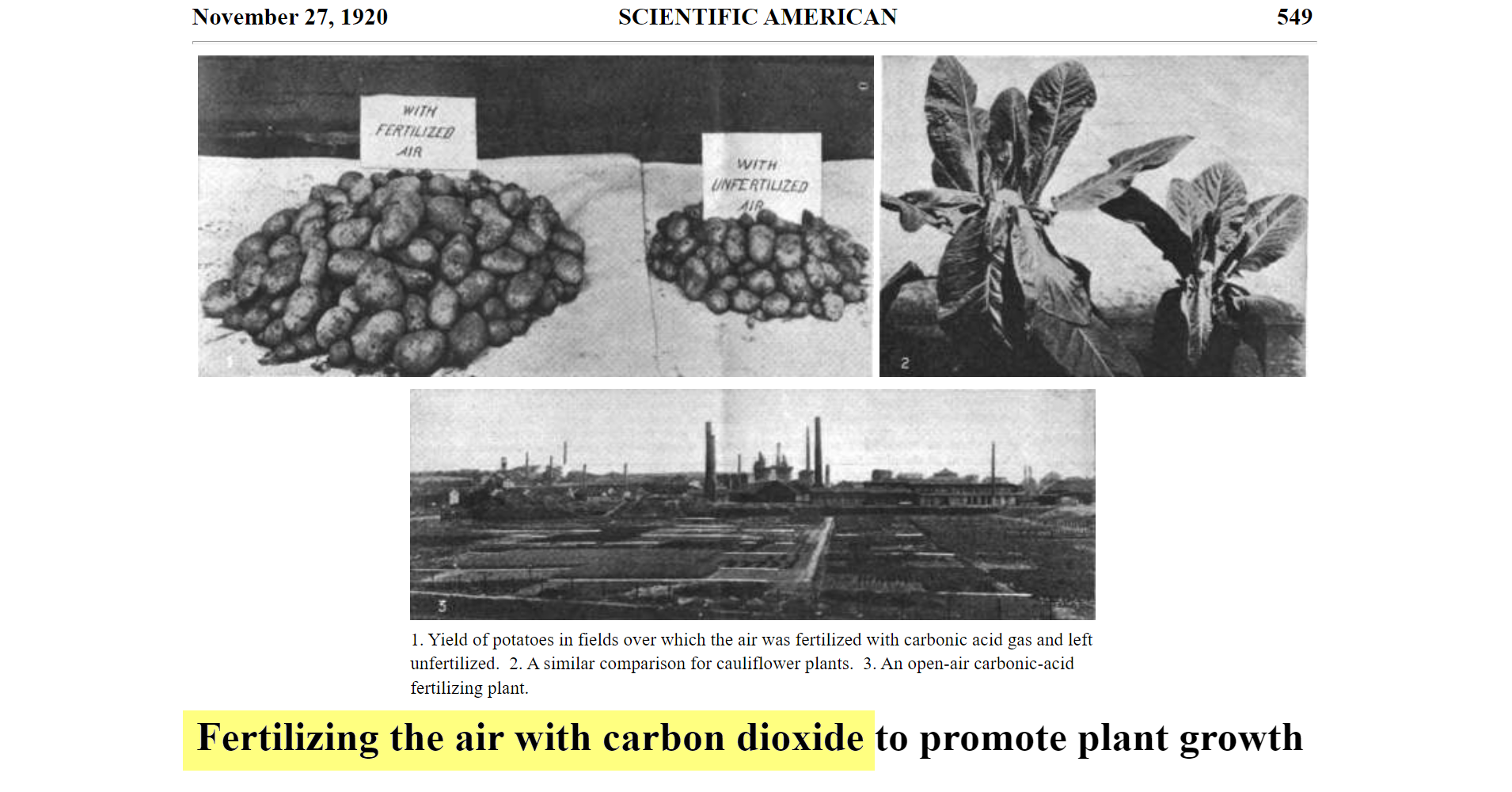
The large benefits of elevated CO2 for crops have been known to science (though perhaps not to Ehrlich) for more than a century. The benefits are so dramatic that in 1920 Scientific American called anthropogenic CO2 emissions “the precious air fertilizer.”
Gradenwitz A. (1920). “Carbonic Acid Gas to Fertilize the Air.” Scientific American, Nov 27, 1920. doi:10.1038/scientificamerican11271920-549

2. Elevated CO2 not only benefits crops by CO2 fertilization, it also improves water use efficiency & drought resilience of crops, through reduced stomatal conductance. Here are some papers about it:
De Souza, A.P. et al. (2015). “Changes in Whole-Plant Metabolism during the Grain-Filling Stage in Sorghum Grown under Elevated CO2 and Drought.” Plant Physiology, 169(3), Nov 2015, 1755–1765. https://doi.org/10.1104/pp.15.01054
Fitzgerald GJ, et al. (2016). “Elevated atmospheric [CO2] can dramatically increase wheat yields in semi-arid environments and buffer against heat waves.” Glob Chang Biol. 22(6), 2269-84. https://doi.org/10.1111/gcb.13263
Chun, J.A. et al. (2021). “Effect of elevated carbon dioxide and water stress on gas exchange and water use efficiency in corn.” Agricultural and Forest Meteorology, 151(3), 378–384, ISSN 0168-1923. https://doi.org/10.1016/j.agrformet.2010.11.015
EXCERPT: “There have been many studies on the interaction of CO2 and water on plant growth. Under elevated CO2, less water is used to produce each unit of dry matter by reducing stomatal conductance.”
Note that wheat is a C3 crop, but corn and sorghum are C4 crops. Both benefit, but C3 crops benefit more. (Most crops are C3.)
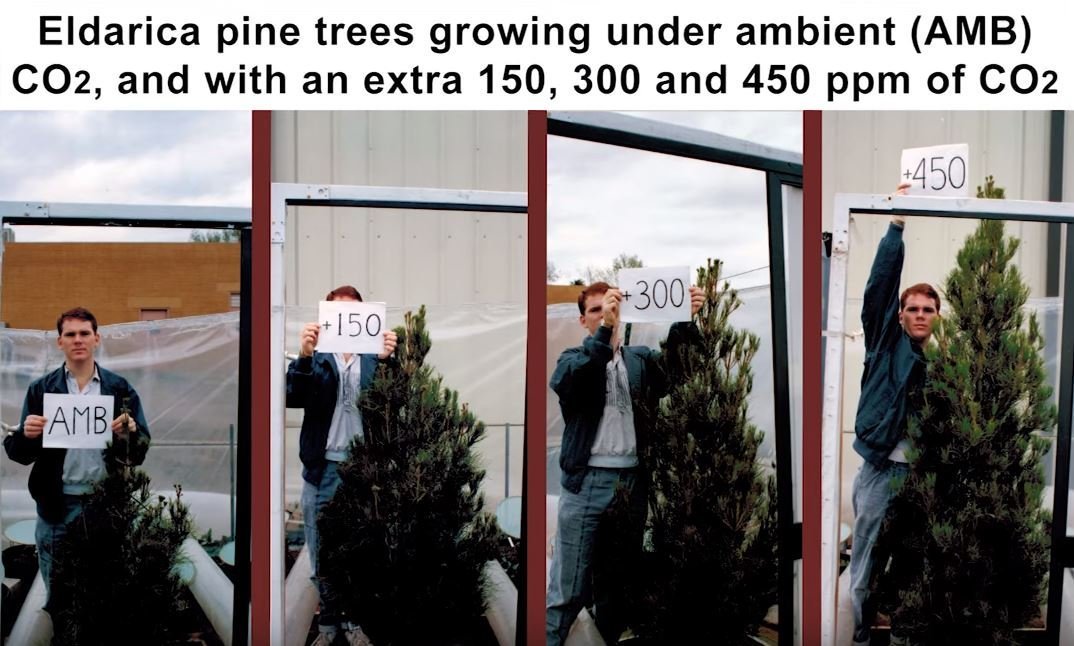
Trees are also C3 plants:
Idso & Kimball (1994). “Effects of atmospheric CO2 enrichment on biomass accumulation and distribution in Eldarica pine trees.” Journal of experimental botany. 1994 Nov., v. 45, no. 280 p.1669-1672. (preprint here)
https://sealevel.info/Eldarica_pine_trees_vs_CO2.jpg

3. The third way that fossil fuels save us from famines is by enabling the creation of synthetic nitrogen fertilizer, from fossil fuels (mostly natural gas), using the Nobel-winning Haber-Bosch process.
Manure, compost, and bird & bat guano can also provide fertilizer, but not nearly enough to feed the world. The Haber-Bosch process eliminated that agricultural bottleneck.
As a bonus, when nitrogen fertilizer is made from natural gas, the carbon is released as CO2, just as it is when the natural gas is burned for heat.
There are other factors which have also helped, but it’s mostly thanks to fossil fuels that you can afford to buy food for your family.
4. Agricultural mechanization is one of the other things which have helped… but that’s also powered by fossil fuels
5. Pesticides have also helped a lot… but they’re also mostly made from petrochemicals.
6. Improved hybrid & GMO crops have also helped a lot.
The people who are crusading against fossil fuels might not realize it, but they are campaigning for a world in which parents watch their children starve.

To understand a contentious, politicized issue like climate change, you need balanced information. I’m here to help:
https://sealevel.info/learnmore.html
That’s my resource list with:
● accurate introductory climatology info
● in-depth science BOTH from scientists who are worried about man-made climate change, and from scientists who are not.
● links to balanced debates between experts on BOTH sides of the issue
● info about climate impacts
● links to the best blogs on BOTH sides (and WUWT is top of the list, of course)
Postscript by Anthony Watts
Where to start? It is such a target rich environment.
Some WUWT posts worth revisiting:
Friday Funny: Paul Ehrlich Discredits the Peer Review Process
That post was in response to this (because peer review is perfect, ya know)…the hubris is off-the-scale.
Friday Funny – Paul Ehrlich’s review of Steyn’s book on Michael Mann’s work
Paul Ehrlich Claims Vindication for his Climate Catastrophe Prediction
SMH: Paul Ehrlich Got Almost Everything Wrong, but We Should have Listened to his Climate Warning
The social media platforms have been rife with commentary. Here are some examples:


And this says so much, with so few words:
To Mr. Ehrlich, wherever you are, I wish you exactly what you deserve.
Good article.
Ehrlich just forgot that it’s hard to make predictions, especially about the future.
But he knew how to be a serial liar and get (and keep) a great reputation that way.
He should be famous for the revolutionary achievement of replacing the scientific method with the political one.
Katharine Hayhoe should take notice of the fact that it doesn’t only apply to baseball. Speaking of failed prediction.
“He famously predicted….”
Prediction based on a linear continuation of current trends ain’t very smart. It may seem smart to people who aren’t smart.
Not a linear continuation. An exponential continuation.
Yes, exactly, All positive exponential curves approach (catastrophic) infinity when projected long enough forward in time . . . a simple mathematical fact that was, apparently, never really appreciated by Paul Ehrlich.
Is linear in logarithmic space.
Assuming that whatever is happening now, will continue forever is the way small minds think.
Yes, indeed. I am amused when some decries an issue and says, “We’ve got to fix this! It’s unsustainable!” If it is unsustainable, no one needs to do anything. It will stop, regardless.
And why his exclamations on famine, population, England, etc “proved premature” ejaculations.
The climate alarmists learned from Ehrlich to 1: Don’t make predictions in the near future that time may prove wrong. And 2: If you do get caught by time making a wrong prediction just move it further into to the future. The further you can move it the better.
__________________________________________________________________________
You failed to mention:
The Green Revolution was a mid-20th-century (1960s-70s), authorized by Norman Borlaug, that revolutionized agriculture in developing nations by introducing high-yielding varieties (HYVs) of wheat, rice, and corn. It aimed to alleviate hunger and reduce poverty, successfully averting mass starvation and increasing food production, but relied heavily on chemical fertilizers, pesticides, and intensive irrigation. From Google AI
At least a [Ctrl F] search on “Borlaug” came up 0/0 so I stopped reading right there.
Our good friends on the left are famous for ignoring pertinent facts. Imitating them isn’t a positive way to make your point. (I look forward to the down votes)
The Google link does show its bias with their “…but relied heavily on chemical fertilizers, pesticides, and intensive irrigation.” They don’t like chemical fertilizers but they love bullshit.
That was my reaction too. I did a “find Borlaug” search and got nada, nothing.
How could anyone write about how wrong Ehrlich was and not even mention “the father of the Green Revolution” Norman Borlaug?
Even the often biased Wikipedia does a decent job on crediting Borlaug and how wrong Ehrlich was even by the 1968 when Ehrlich was first getting started.
Well OK I decided to read a little further and I ran into this in giant bold letters:
Fertilizing the air with carbon dioxide to promote plant growth
For God’s sake, carbon dioxide is just important to plant growth as is water. It’s way more important than mere fertilizer. Sixth grade science teaches us about photosynthesis and chlorophyll:
Carbon Dioxide plus Water and Sunshine produces Simple Sugar and Oxygen.
CO2 fertilization is an expression I avoid. Nitrogen compounds are fertilizers. CO2 is simply plant food.
Scientific American chose the caption, 105½ years ago. I think it’s fine. It is certainly better than some of the drek that they publish these days.
They also called CO2 “the precious air fertilizer.” I like that.
Another way of saying the same thing is, “CO2 is plant food.” Which is right.
Any comment on this?:
https://www.pnas.org/doi/10.1073/pnas.2514628122
Overestimated natural biological nitrogen fixation translates to an exaggerated CO2 fertilization effect in Earth system models
Possibly a hat-tip for one of the knowledgeable readers here to comment on
I don’t have access to the paper, but the abstract says, “ESMs [Earth System Models] significantly underestimate agricultural BNF [Biological Nitrogen Fixation] [but] ESMs overestimate BNF in forests and grasslands… [so] ESMs could exaggerate plant carbon uptake as atmospheric CO2 concentration rises.”
If true, it sounds either like mostly good news, or else like a criticism of the ESMs as unrealistic.
If agricultural BNF is underestimated, it would mean that the benefits of elevated CO2 for agriculture will greater. But who uses ESMs to estimate agricultural effects, anyhow? We have agronomy studies for that, which are enormously more rigorous and grounded in reality than ESMs.
Higher CO2 is especially beneficial for legumes, like beans, peas & alfalfa, which fix their own nitrogen (via symbiotic bacteria), and which are grown for their protein content. (Some other plants, including sugarcane and alder trees, apparently also fix their own nitrogen via symbiotic bacteria.) So elevated CO2 helps mitigate protein shortages in poor countries. Here’s a paper about it:
Li Y, Yu Z, et. al. (2017) Elevated CO2 Increases Nitrogen Fixation at the Reproductive Phase Contributing to Various Yield Responses of Soybean Cultivars. Front. Plant Sci. 8:1546. https://doi.org/10.3389/fpls.2017.01546
If the predicted acceleration of natural carbon removal by the terrestrial biosphere has been overestimated, it means that global “greening” thanks to rising CO2 levels will be less than predicted.
https://www.youtube.com/watch?v=zOwHT8yS1XI
It would also mean that forests will benefit less than expected from rising CO2 levels, contrary to some other studies, like this one:
https://news.umich.edu/future-forests-may-soak-up-more-carbon-dioxide-than-previously-believed-helping-to-buffer-climate-change/
But it also means that when mankind someday transitions away from fossil fuels to mostly nuclear energy, and CO2 levels start to fall, they will fall a bit more slowly than expected, which will be a blessing for future generations.
OTOH, those things can be estimated from real data, compiled by real measurements, and real experimental studies. So this seems mostly like a criticism of the ESMs.
Try duckduckgo.com search lots of results
Exactly why I stopped using Google search. Google is still better for IT/Technology related queries and it’s hard to politicize them.
Technology related queries: such as climate change (WTGs and SVs and EVs, etc.)?
Of course all of that falls under political. 🙂
Steve wrote, “You failed to mention: The Green Revolution… authorized by Norman Borlaug… high-yielding varieties (HYVs) of wheat, rice, and corn… chemical fertilizers, pesticides, and intensive irrigation…”
I didn’t use Borlaug’s name, but I mentioned the rest, except for irrigation:
I googled up the exact paragraph. Am I wrong or is there a noun missing in the first sentence.
“The Green Revolution was a mid-20th-century (1960s-70s), authorized by Norman Borlaug, that revolutionized agriculture in developing nations by introducing high-yielding varieties (HYVs) of wheat, rice, and corn.”
I’m reading “mid-20th-century” as a descriptor for a ‘something’. In that case, some indication of what ‘something’ is should appear between the closing parenthesis and the coma.
What did this Norman Borlaug fellow authorize?
Yeah I think Google AI garbled it a bit. There’s clearly a word missing, and “authorized” is not the correct word, either.
Norman Borlaug was a Nobel-winning agronomist, and an architect of the “green revolution” to improve crop yields in developing countries, most famously through the development of improved grain cultivars.
Actually it’s not true that every Ehrlich prediction has been falsified; I can think of one that has come true, although much later than he claimed. He correctly predicted that there would come a time when you couldn’t go outside without a mask.
/sarc
Then he got Covid restrictions correct! /s
The most remarkable thing about Ehrlich is that he not only survived all of his desasters without a single scratch but he also got almost 100 years old in this world of permanent apocalypse.
There’s an old joke that can be adapted to Mr. Erlich. He finds a lamp on the beach, rubs it, and a genie appears offering to grant a wish. Erlich waxes on about his neighbor’s cow, listing several features that make life better for the neighbor. Finally the genie says, “ok, ok, I get it- you want a cow.” Erlich: “No, no, I want you to kill my neighbor’s cow.”
His kind continue to populate the earth and, at 93 yrs, he was not willing to swallow his own bs and go sooner.
All good communists eventually die. Bad ones too.
He is more of the guy who wishes for a Willie that can touch the ground
and the genie removes his legs in return.
While I’m at it: A search on “Borlaug on GMO”s:
Nobel laureate Norman Borlaug was a strong proponent of Genetically Modified Organisms (GMOs), viewing them as an essential, safe, and logical extension of the agricultural biotechnology he championed during the Green Revolution. He argued that GMOs are necessary for global food security, increased crop yields, and reducing chemical inputs.
He lived to 95 and was exceptionally productive. The following is a selection from Wikipedia about his career.
From 1942 to 1944, Borlaug was employed as a microbiologist at DuPont in Wilmington, Delaware. It was planned that he would lead research on industrial and agricultural bacteriocides, fungicides, and preservatives; following the December 7, 1941, attack on Pearl Harbor, Borlaug tried to enlist in the military, but was refused entry under wartime labor regulations, as his lab and personnel were tasked to conduct research for the United States armed forces. One of his first projects was to develop glue that could withstand the warm salt water of the South Pacific. The Imperial Japanese Navy largely controlled the seas around the island of Guadalcanal, and patrolled the sky and sea by day. The only way for U.S. forces to supply the troops stranded on the island was to approach at night by speedboat, and jettison boxes of canned food and other supplies into the surf to wash ashore. The problem was that the glue holding these containers together disintegrated in saltwater. Within weeks, Borlaug and his colleagues had developed an adhesive that resisted corrosion, allowing food and supplies to reach the stranded Marines. Other tasks included work with camouflage, canteen disinfectants, DDT to control malaria, and insulation for small electronics.[22]
Something is seriously wrong with our current society when it allows, even encourages, demonization of “chemical” as in the words used above, “increased crop yields and reducing chemical inputs”?
I am a Chemist by Science degree. Maybe I am too sensitive. Too often, I read educational material that in effect teaches “natural chemicals like mother’s milk are beautiful and essential” while “man-made chemicals like nitrogen fertilizer urea are evil and should be prevented from use”.
In reality, all materials are made of chemicals. Chemistry is the art of obtaining high benefit from chemicals through understanding how they interact. There is a very long, strong list of chemical discoveries of significant benefit to people with some so effective that we cannot imagine life without them. Try common salt, NaCl.
There is only harm from demonizing “chemicals”. Geoff S
Read in full context, when they talk about reducing chemical inputs, they are talking about saving money since the plants need fewer fertilizers, herbicides and insecticides.
They aren’t saying that “chemicals” are bad, but that they cost money that could be better spent elsewhere.
“The relationship between word sound (phonology) and meaning (semantics) is generally considered arbitrary, though sound symbolism (phonesthesia) suggests certain sounds inherently evoke specific meanings or sensations”
The problem is the three syllable staccato word “chemicals“. They might not be so easily demonized if we agreed to call them “foofs”.
“CO2? Oh that’s just a gassy foof.”
Same problem with coal and nuclear? Gotta ditch the hard ‘c’.
Foal and Fuffles?
Hmmm,
— as in the words “fossil fuels”
— as in the word “pharmaceuticals”
— as in the words “life-saving pharmaceuticals” and “life-extending pharmaceuticals”
— as in the words “anesthesia” and “analgesics”
— as in the word “vitamins”
— as in the words “life sustaining nutrients”
— as in the word “oxygen”
— as in the word “water”.
That is all.
You left out a few. No biggie.
However, one must remember back in that era, there was a major advertising campaign….
“Better living through chemistry’
That may have been an influence in the choice of words.
I am a biologist and of course they used to be the smartest of the sciences since we, previously anyway, had to take the others, physics, chemistry and geology. Whatever the reason with any of their previous reasonable science, the current biologist ‘advertisers’ somewhat like Ehrlich not only have carbon as a ‘demon’ but also nitrogen. It is also, at least aquatically, based on an ‘event attribute’ which produces too much like carbon. He was hung up on ‘carrying capacity’ which could be based on a number of limited ‘attributes,’ which has and could occur with humans, even space which someone calculated back when he discouraged babies. Wonder what courses these deniers and promoters had to take?
https://thebulletin.org/2026/03/a-clarinetist-a-high-school-student-and-four-climate-deniers-write-a-science-paper-with-a-little-help-from-ai/amp/
Borlaug’s two major green revolution innovations were semidwarf (shorter stem) and rust (fungus) resistant wheat. For those he received the Nobel peace prize in 1970. Ehrlich’s 1968 book was by definition gross negligence because he knew or should have known of these immense green revolution innovations long before he wrote the book.
Given Ehrlich’s refusal to recant even in the face of every prediction failing to occur, shows that his goal was to frighten the population in order to advance his goals, rather than to inform.
His greatest prediction was the one that counts ($$$$$$) and the returns to investment from marketing and promotion. He won’t admit that one either.
If the ultimate role of a scientist is to make the world a better place, he failed.
I did a bit of research in digitized historical newspapers for 1968-69 to see what was said about the book. I see the Sierra Club, environmental nut cases, sponsor its publication
Plant breeding, the effect of increased CO2 levels which interacts with water use, and nitrogen fertiliser are the main factors giving us increases in crop yields. The use of herbicides, insecticides and fungicides all help to prevent or reduce the loss of yields.
Great “postscript,” Anthony! Target-rich, indeed.
Here’s a compilation of Richard Hanania’s tweetstorm:
https://twitter-thread.com/t/2033660606499397841
I was somewhat surprised to learn that Ehrlich was against illegal immigration when he authored the Population Bomb. I wonder if he eventually changed his mind on that because of his politics.
The fact that Ehrlich’s book was peer reviewed, is just more evidence of how broken peer review has always been.
What’s funny is that Ehrlich uses the fact he believes he used “science” in his books is defense against all of his predictions being wrong.
Well then, may he rest in peace. If I were a believer, I would hope that his soul had risen into a serenity quite unlike the misanthropy and despair in which he must have lived for much of his life. Alas, my agnosticism leans more toward an anxious atheism. I doubt there is anything at all after life. I fear that Paul Ehrlich was, throughout his life, a fundamentally sad man. I would not have liked to carry that man’s heart in my chest. I am not by nature especially cheerful, nor do I overflow with unconditional love for my fellow man, but there are limits, in terms of pessimism, beyond which I could never go.
If our convictions kept us alive, Malthusians would make Methuselah look ridiculous when it comes to longevity.
“I refuse to die before witnessing the end of the world! I predicted it 800 years ago, and I assure you it’s going to happen! Soon, I hope. My back is starting to hurt…”
Fun relevant factoids.
The sharp decline in famine deaths in the 1970’s shown in the article’s first figure is directly attributable to Borlaug’s green revolution wheat being adopted globally.
The further sharp reduction in the 1980’s is directly attributable to Chinese scientist Yuan Longping, who—inspired by US success with hybrid maize (corn)—figured out how to commercially hybridize rice with a 30% improvement in yield across Asia.
Shows how inspired individuals really can change history. In medicine, Semmelweiss, Pasteur, and Fleming. In physics, Newton and Einstein. In chemistry, Lavoisier and Mendeleev. In biology, Mendel and Darwin. In geology, Hutton, Lyell, and Wegener. Pity how others can ruin it—like Michael Mann and Al Gore in ‘climate science’.
‘The further sharp reduction in the 1980’s is directly attributable to Chinese scientist Yuan Longping, who…’
I would also attribute a big part of Chinese famine reduction to the death of Mao in 1976.
Unfortunately there ‘s no shortage of doomsday cult members who still subscribe to Ehrlich’s alarmism and keep their fingers crossed that at least some of it will occur. They still haven’t noticed that there’s money to be made in addressing those potential problems, and that’s the reason that human ingenuity has been able to either solve them entirely or at least alleviate them. And that’s the reason that new agricultural techniques, new drugs and medications, new surgical techniques, new engineering and design features, and new transportation innovations have been coming on stream regularly during the past century-plus. These are reasons for human progress and population increases, not foolish retreats into pre-industrial eras to save the environment at the cost of declining living standards.
I don’t know what else Ehrlich has done, maybe he has done some good work. It was Ehrlich who opened my eyes to the fact that you don’t just believe someone because they are considered a scientist or some other expert or professional. I am glad to see he used the peer review process to prop up his work. It took me a little longer to suspect peer reviewed work. It is to the point now that I give no more weight to peer reviewed work than none peer reviewed work. That is a shame.
Bob,
One of the tasks of a proper scientist is to identify and call out pseudo-science of the likes of Paul Ehrlich’s efforts.
Of course, people are free to read what they wish. Those who choose to read drivel cannot easily be saved. It is frustrating when spectacularly good science receives rather less media attention than spectacularly poor stuff. The press is not doing a good job of promoting quality science.
In Australia, I know a number of people who could have had their good work in the mineral industries publicised favourably, but who seldom get a mention in the “Australian of the Year” and other similar awards. Geoff S
Paul Ehrlich will be missed . . . for the epic humor he provided over so very, very many years.
Next in line, his friend Michael E. Mann.
Good riddance much like the passing of Stalin and Adolf.
Too bad that there are too many morons including Mann who thinks Paul “Wrong” Ehrlich was a great man who was wrong in so many ways that he should have long been ago discredited.
He LOST a gigantic bet with Julian Simon where Ehrlich was 100% wrong on the 5 commodities he himself chose as the foundation of the bet this should have destroyed his reputation but alas the world has a lot of stupid people in it.
Simon–Ehrlich wager LINK
Unlike Mann, Ehrlich was man enough to pay up when he lost.
Many thanks for the observation and the link.
Knowledge and understanding impart an ability to make predictions that come true. The Simon-Erlich wager was a perfect test of the relative strength of Simon’s and Erlich’s very different understandings of the world, and the result was unambiguous.
Another thanks for the link. I also noted Erlich paid when he lost.
“If I’m always wrong so is science, since my work is always peer-reviewed” – Paul Ehrlich
This says a lot, he either wasn’t aware that the peer(pal)-review process is extremely unscientific and on top of that horribly corrupted, or was aware of that but did not care because his pals were in the driver’s seat. So many supposed “scientists” wouldn’t know science if they stubbed their toe on it.
From what I have seen of peer-review… it is mainly a spell and grammar check for journal publication.
The actual “content” is rarely properly checked.
For people who have not actually read it… It is more than half a bad dramatization, literally fiction nobody would publish starring invented characters from a pre-DEI liberal Utopia facing global disaster.
I do not mean “literally fiction” as insulting language… it was literally, literally fiction.
“that nobody would publish” is opinion. No way to bet on it. If you have not read, then no it is not worth your time to check whether you agree.
Carbonic acid – not CO2. It is CO2 and water vapour.
Technically, it is water, not water vapor. Just a nit.
Like all other eras, language is abused. It was “carbonic acid gas,” which was shortened to carbonic acid in common use.
Will Ehrlich in a hundred years time be considered as a 20th century Nostradamus or will he have been totally forgotten? Predicting the future is always tricky but I have a sneaking suspicion that it is the latter.
Nostradamus is another one people cite without reading. I was unable to plow through a translation that left me wondering whether anyone cared for the health of the translator. In the half-or-so I read, Nostradamus predicted nothing of note and much that seems highly unlikely.
only tears shed should be those of JOY – ditto when Strong karked it