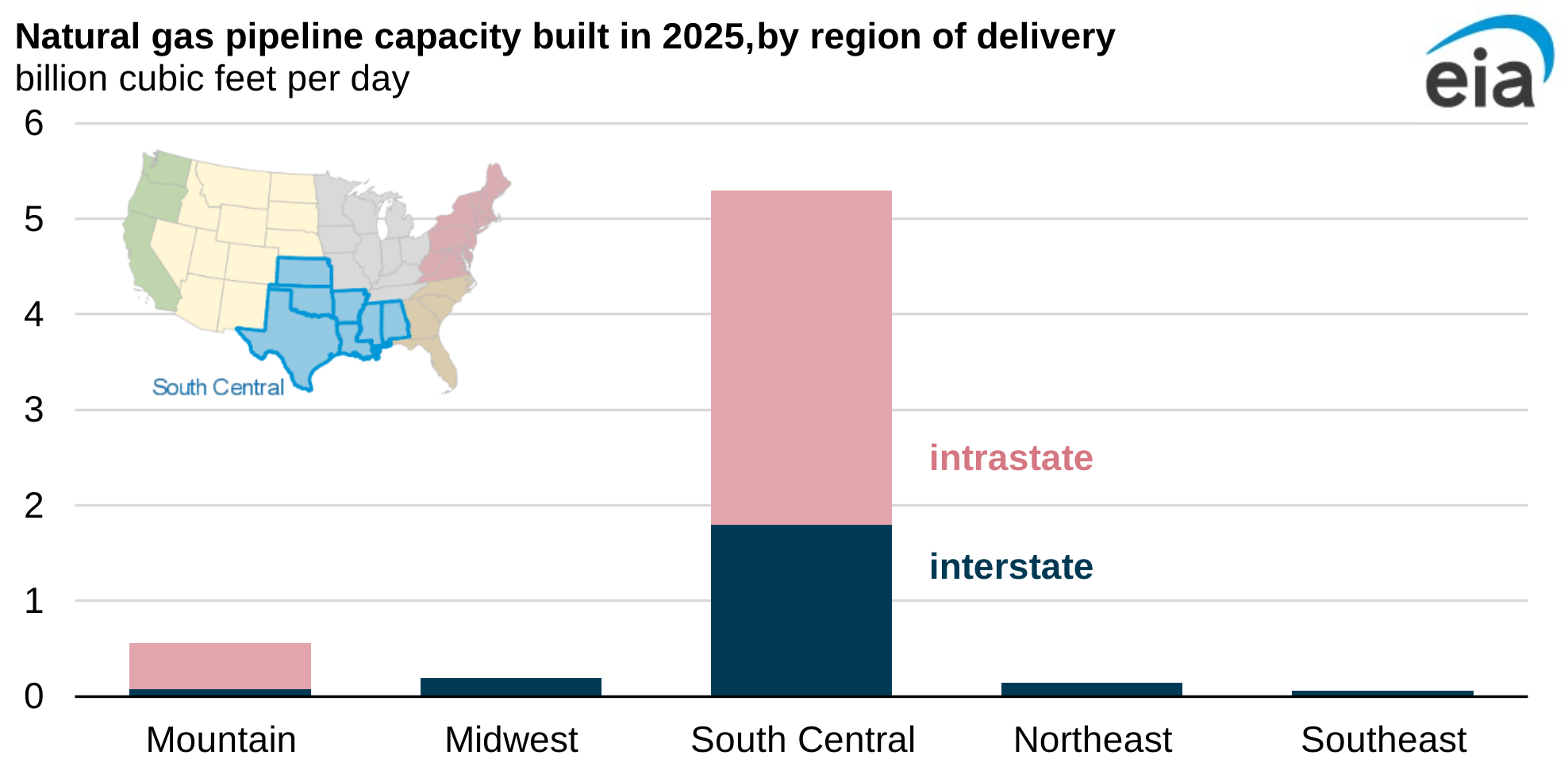
Natural gas pipeline projects completed in the United States in 2025 increased capacity by approximately 6.3 billion cubic feet per day (Bcf/d), according to our recently updated Natural Gas Pipeline Projects Tracker. A substantial portion, 85%, or 5.3 Bcf/d, of this new capacity is dedicated to delivering natural gas to the South Central region of the United States. This region includes the Gulf Coast, where much of the nation’s growing natural gas demand, particularly from liquefied natural gas (LNG), is concentrated. The new capacity primarily connects both new and existing supply sources to consumers in the region.
Approximately 65% of the total pipeline capacity built in 2025 consists of intrastate pipelines, continuing the recent trend of intrastate pipeline builds outpacing interstate capacity additions. These pipelines operate primarily within state lines and are therefore not subject to the jurisdiction of the Federal Energy Regulatory Commission (FERC).
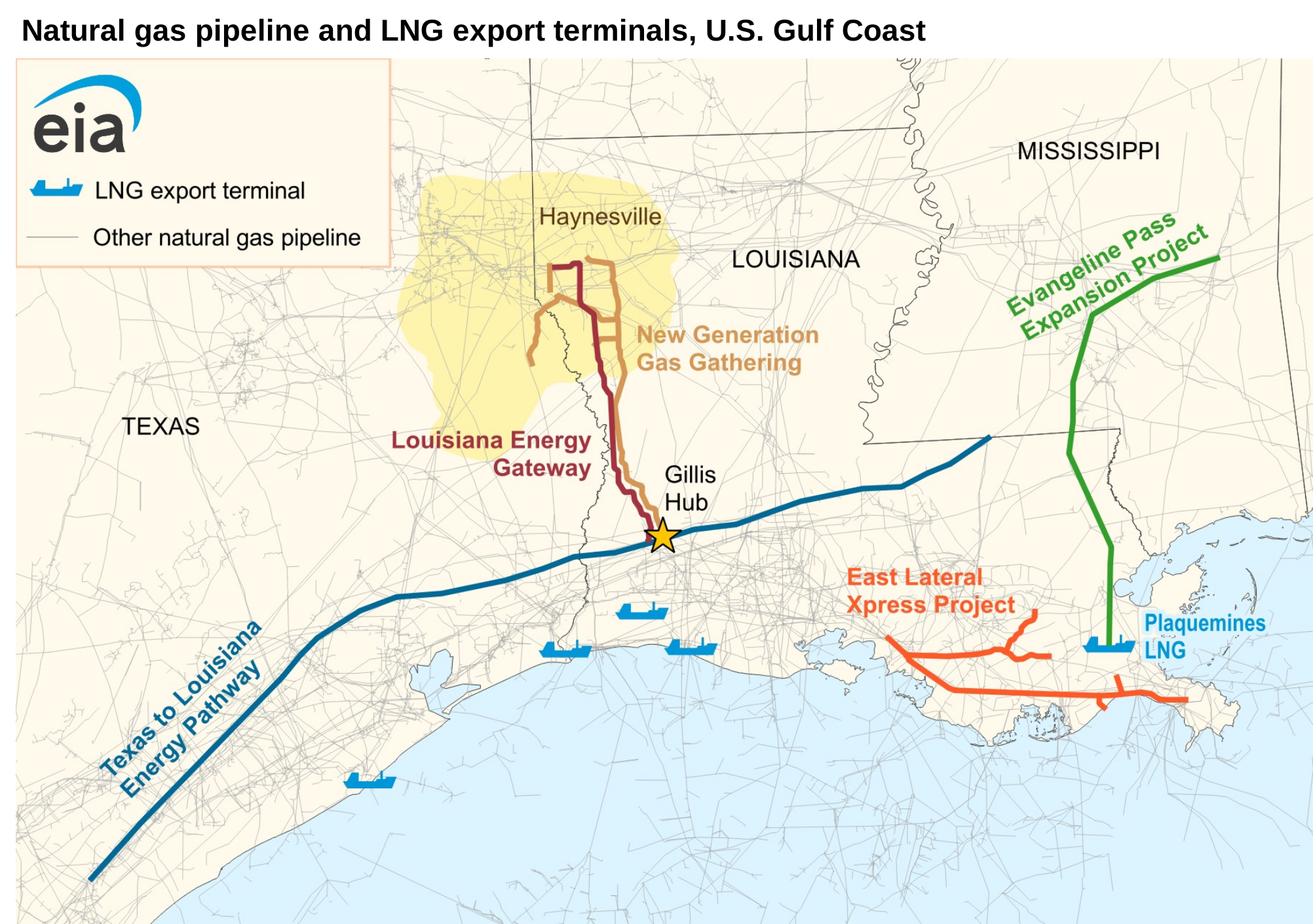
The new intrastate capacity built in 2025 largely functions as gathering systems, which are essential for transporting natural gas from producers into the wider transmission system. Two such projects completed in 2025 expanded pipeline capacity by a combined 3.5 Bcf/d to connect natural gas production from the natural gas-producing Haynesville formation to the Gillis Hub in southeastern Louisiana. The Louisiana Energy Gateway project added 1.8 Bcf/d, and the New Generation Gas Gathering system added 1.7 Bcf/d. Both were in service as of October 2025.
(The Center Square) – Domestic natural gas production is expected to increase by an average of 4.0 billion cubic feet per day, or 3.4%, in the next two years to 122.3 billion cubic feet per day, with more than two-thirds of the additional output produced in the Haynesville shale region of northwest Louisiana and northeast Texas.
Through the end of 2027, higher gas production will be driven primarily by rising demand for fuels to power data centers across the U.S. and by liquefied natural gas exports shipped from terminals in Louisiana and Texas, according to the U.S. Department of Energy’s updated February forecast.
Assessment of Undiscovered Oil and Gas Resources in the Haynesville Formation, U.S. Gulf Coast, 2016. (USGS)
The Haynesville shale plays are the hachured and dotted areas on the map below…
Assessment of Undiscovered Oil and Gas Resources in the Haynesville Formation, U.S. Gulf Coast, 2016. (USGS)
The Many Benefits of Catastrophic Sea Level Rise
The Haynesville Shale, which has also been referred to as the “lower Bossier,” is the basinal equivalent of the Cotton Valley Lime and pinnacle reef trend in East Texas that was deposited during the transgressive phase of SS2. These pinnacle reefs formed in response to the rising sea level as they were back-stepping onto Haynesville ramp carbonates; the carbonates were able to keep up with rising sea level until they were “drowned” by the fine-grained-sediment-dominated transgression. The top of the Haynesville Shale marks the maximum flooding surface as evidenced by maximum marine onlap on the shelf (e.g., Goldhammer, 1998). The Bossier shales (so-called “upper Bossier”) are characteristic of the highstand systems tract of SS2 reflecting a turn-around in sea level and increase in siliciclastic influence.
A marine transgression (catastrophic sea level rise), approximately 150 million years ago, led to the deposition of the Haynesville Shale, as well as the trapping mechanism for the Haynesville Shale and the stratigraphically equivalent Cotton Valley Lime pinnacle reef plays.
The hydrocarbons in the Haynesville Shale and Cotton Valley Lime were sourced from the Smackover and Haynesville Formations.
Mudstones within the Upper Jurassic Smackover and Haynesville Formations are sources of oil and gas in both conventional (Montgomery, 1993a, 1993b; Mancini and others, 2006) and continuous reservoirs (Hammes and others, 2011; Cicero and Steinhoff, 2013) throughout much of the assessment area.
Assessment of Undiscovered Oil and Gas Resources in the Haynesville Formation, U.S. Gulf Coast, 2016. (USGS)
The Smackover Formation is probably the most prolific source rock in the Gulf Coast/Gulf of Mexico America region. Depending on depositional environment, the Smackover is also a prolific oil & gas producer and the seal for the Norphlet Formation where it is productive. The Haynesville would be between the Bossier and Smackover Formations on the diagram below.
Left to right: Generalized cross section along northern GOM GOA region (Galloway et al., 2009), depositional phases are numbered. Relative sea level (Miller et al., 2005), atmospheric CO2 (Berner & Kothavala, 2001) and temperature anomalies (Royer et al., 2004). Click for image. The Haynesville is between the Bossier and the Smackover to the east of the Cotton Valley.
The next four displays are from Cicero & Steinhoff, 2013, depicting the sequence stratigraphy and depositional environments of the Haynesville and Bossier shales.
Map of wells, seismic surveys and cross-sections used in study.
Cross-section B-B’. West is toward the left. The curve on the right represents sea level, rising sea level is toward the left.
This is interpreted seismic profile A-A’, running from north (left) to south (right), just west of the Texas-Louisiana state line.
Figure 3b. Integrated seismic and sequence stratigraphy of dip-oriented seismic line A-A’. Supersequence boundaries indicated in red (SSB), higher-order (3rd+) sequence boundaries with dashed black lines (SB), maximum flooding surfaces (mfs) in green, and transgressive surfaces (TS) pertaining to supersequences in blue. Onlap and downlap indicated with the use of arrows. Dashed vertical lines indicate approximate basement faulting. Modified from Cicero et al. (2010).
The following is a depositional environment (paleogeography) map of the Bossier Shale (~150 million years ago):
“You see the story yet?”
You see the story yet? It’s all pretty much here. In a language you can’t yet understand, but it’s here. A tale of upheaval and battles won and lost. Gothic tales of sweeping change, peaceful times, and then great trauma again. And it all connects to our little friend. That’s what we are, we geologists. Storytellers. Interpreters, actually. That’s what you gentlemen are going to become. And how does this relate to the moon? From 240,000 miles away you have to give the most complete possible description of what you’re seeing. Not just which rocks you plan to bring back but their context. That and knowing which ones to pick up in the first place is what might separate you guys from those little robots. You know, the ones some jaded souls think should have your job. You see, you have to become our eyes and ears out there. And for you to do that, you first have to learn the language of this little rock here.
HBO’s 1998 From the Earth to the Moon miniseries was a sort of follow-on to the great movie Apollo 13… It’s a must see for space program fanatics. I particularly like this episode because my childhood interest in the space program led me toward the sciences and ultimately geology. Future Apollo 17 astronaut Harrison “Jack” Schmitt recruited his former field geology professor to train the Apollo 15 lunar module team and their backup crew how to become field geologists. It reminds me of why I love geology so much. I’ve also had the great honor of meeting Dr. Schmitt at the 2011 American Association of Petroleum Geologists convention in Houston. Shaking hands with someone who not only walked on the Moon, but also got to throw a rock hammer farther than any geologist ever has before or since, was pretty fracking cool… And so is geology!
References
Berner, R.A. and Z. Kothavala, 2001. GEOCARB III: A Revised Model of Atmospheric CO2 over Phanerozoic Time, American Journal of Science, v.301, pp.182-204, February 2001.
Cicero, Andrea D. and Ingo Steinhoff, 2013, Sequence stratigraphy and depositional environments of the Haynesville and Bossier Shales, East Texas and North Louisiana, in U. Hammes and J. Gale, eds., Geology of the Haynesville Gas Shale in East Texas and West Louisiana, U.S.A.: AAPG Memoir 105, p. 25–46.
Galloway, William. (2008). “Chapter 15 Depositional Evolution of the Gulf of Mexico Sedimentary Basin”. Volume 5: Ed. Andrew D. Miall, The Sedimentary Basins of the United States and Canada., ISBN: 978-0-444-50425-8, Elsevier B.V., pp. 505-549.
Galloway, William E., et al. “Gulf of Mexico.” GEO ExPro, 2009, www.geoexpro.com/articles/2009/03/gulf-of-mexico.
Hammes, Ursula and Ray Eastwood, Harry Rowe, Robert Reed. (2009). Addressing Conventional Parameters in Unconventional Shale-Gas Systems: Depositional Environment, Petrography, Geochemistry, and Petrophysics of the Haynesville Shale. 10.5724/gcs.09.29.0181.
Miller, Kenneth & Kominz, Michelle & V Browning, James & Wright, James & Mountain, Gregory & E Katz, Miriam & J Sugarman, Peter & Cramer, Benjamin & Christie-Blick, Nicholas & Pekar, S. (2005). “The Phanerozoic Record of Global Sea-Level Change”. Science (New York, N.Y.). 310. 1293-8. 10.1126/science.1116412.
Ramirez, Thaimar, James Klein, Ron Bonnie, James Howard. (2011). Comparative Study of Formation Evaluation Methods for Unconventional Shale Gas Reservoirs: Application to the Haynesville Shale (Texas). Society of Petroleum Engineers – SPE Americas Unconventional Gas Conference 2011, UGC 2011. 10.2118/144062-MS.
Thanks David.
Looks like gas and oil will be plentiful long after I’m gone!
Some of the names of the formations are intriguing. Smackover, Louann Salt, and Sligo make me wonder what the driller/geologists were drinking or where they were from. There is a small town in western Pennsylvania named Sligo (named after an Irish town) 8 miles from my hometown. That area of Ireland is where my grandmother was raised.
The web claims Sligo is the anglicisation of the Irish name Sligeach, meaning “abounding in shells” or “shelly place”. Thus the question: Is the Sligo Formation abounding in shells or did someone relate to one of the towns?