Essay by Eric Worrall
The question – who pays for the solar power which has to be discarded?
Australia is awash with solar power. Like flooding rain, experts say we can’t store it all
Story by energy reporter Daniel Mercer
…
The number of homes and businesses with a solar installation clicked past 4 million — barely 20 years since there was practically none anywhere in the country.
…
But all of this solar is prompting some hard questions, and gnashing of teeth, for one, simple reason — there is, at times, too much solar power in Australia’s electricity systems to handle.
To deal with this abundance, experts say Australia needs to come to terms what appears a counter-intuitive argument.
It needs to accept that much of this solar will have to be wasted — or spilled — sometimes.
…
“The minimum demand problem typically happens in the middle of the day on weekend days when you have a lot of solar output but maybe not a lot of demand,” Dr Wonhas said.
“At that time, the electricity grid effectively becomes a little bit unstable.
…
Read more: https://www.msn.com/en-au/money/markets/australia-is-awash-with-solar-power-like-flooding-rain-experts-say-we-can-t-store-it-all/ar-AA1ucYf6?ocid=finance-verthp-feeds
The author goes on to waffle about all the wonderful investment in batteries, which even in the most optimistic growth forecasts at best will cover a few minutes of national energy storage.
My question stands. Someone has to lose.
Will the cost of unwanted solar be passed to the owners of rooftop solar installations? Will they sometimes have to live with having their power bill benefit slashed, live with their rooftop systems not offsetting their power bills as much as they thought?
How would the curtailing of expected revenue impact those fancy “no cost solar” contracts many low income householders signed, in which repayments are supposed to be charged to the grid buyback income? Do the contracts have a small print clause which makes homeowners liable for servicing the debt out of their own pocket, if solar revenues drop below an expected threshold?
Or will the cost of unwanted solar be loaded onto everyone elses energy bills, including the bills of poor people who live in high-rise apartments, who have no means of getting a foot in the door of the solar electricity bill rigging game?
Or will the Aussie government sell out the grandkids to the international banking cartel, by borrowing hundreds of billions of dollars to purchase additional battery storage capacity to soak up all that excess solar energy on the odd occasions it is generated, in the hope the stored power can be used before the batteries lose their charge?
Who is paying for those conventional generators which are being squeezed out of the market, but still have to be kept on standby, for those occasions when both solar and wind fail for a prolonged period of time? Like what happened in June this year, in the middle of our Southern Hemisphere winter?
Just how unstable will the grid become on a sunny day? Or an overcast and windless day? Or a bitterly cold windless night? Aussies are still adding rooftop solar every day, squeezing out reliable fossil fuel powered generators, making it more expensive all the time to keep such generators on standby.
Someone has to lose – and nobody is saying who.
I guess we Aussies are about to find out. My big gasoline generator is ready for action. I think I’m going to need it.
And so we segue seamlessly from wailing about energy poverty to energy over-abundance.
I suspect not. My guess is that if it could be economically stored, then used when needed, it still would be unable to meet all demand, but it would be, with that aspect met — economically reasonable storage — a little less ridiculous.
Reasonably stored energy? Coal and hydrocarbons.
How can it be economically stored, if capital costs are $500/kWh, delivered as AC, 2024 pricing?
1) Here is an example of a Tesla system in Australia, which will be the largest, by far.
Utility-scale, battery system pricing usually is not made public, but for this system it was.
Neoen, in western Australia, has just turned on its 219 MW/ 877 MWh Tesla Megapack battery, the largest in western Australia.
Ultimately, it will be a 560 MW/2,240 MWh battery system, $1,100,000,000/2,240,000 kWh = $491/kWh, delivered as AC, late 2024 pricing.
BTW. Smaller capacity systems will cost much more than $500/kWh
That system stores midday solar and delivers it during the peak hours of late afternoon/early evening. It has about a 20% loss, A-to-Z basis.
If it had a throughput of 40% of rating, the cost adder of any electricity passing through it would be about 35 c/kWh, on top of the cost/kWh of the electricity fed into it. See below Excluded costs/kWh.
2) Here is an example of a much smaller system at $575/kWh, delivered as AC, 2023 pricing
Example of Turnkey Cost of Large-Scale, Megapack Battery System, 2023 pricing
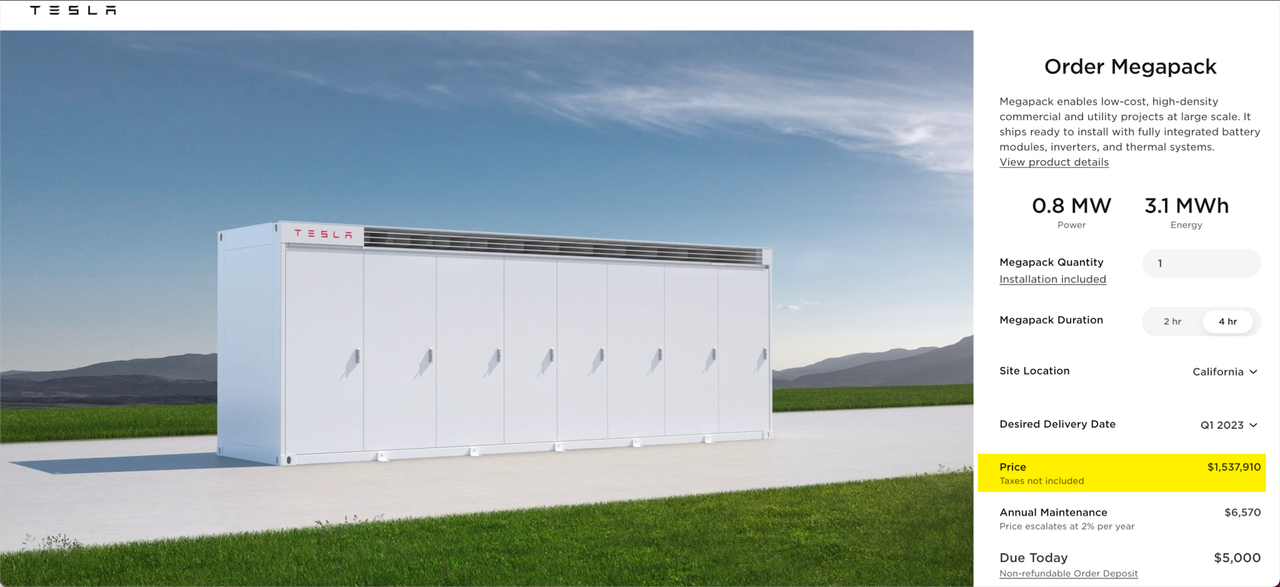 ?itok=lxTa2SlF
The system consists of 50 Megapack 2, rated 45.3 MW/181.9 MWh, 4-h energy delivery
Power = 50 Megapacks x 0.979 MW x 0.926, Tesla design factor = 45.3 MW
Energy = 50 Megapacks x 3.916 MWh x 0.929, Tesla design factor = 181.9 MWh
Estimate of supply by Tesla, $90 million, or $495/kWh. See URL
Estimate of supply by Others, $14.5 million, or $80/kWh
All-in, turnkey cost about $575/kWh; 2023 pricing
https://www.tesla.com/megapack/design
https://www.zerohedge.com/commodities/tesla-hikes-megapack-prices-commodity-inflation-soars
Annual Cost of Megapack Battery Systems; 2023 pricing
Assume a system rated 45.3 MW/181.9 MWh, and an all-in turnkey cost of $104.5 million, per Example 2
Amortize bank loan for 50% of $104.5 million at 6.5%/y for 15 years, $5.484 million/y
Pay Owner return of 50% of $104.5 million at 10%/y for 15 years, $6.765 million/y (10% due to high inflation)
Lifetime (Bank + Owner) payments 15 x (5.484 + 6.765) = $183.7 million
Assume battery daily usage for 15 years at 10%, and loss factor = 1/(0.9 *0.9)
Battery lifetime output = 15 y x 365 d/y x 181.9 MWh x 0.1, usage x 1000 kWh/MWh = 99,590,250 kWh to HV grid; 122,950,926 kWh from HV grid; 233,606,676 kWh loss
(Bank + Owner) payments, $183.7 million / 99,590,250 kWh = 184.5 c/kWh
Less 50% subsidies (ITC, depreciation in 5 years, deduction of interest on borrowed funds) is 92.3c/kWh
At 10% usage, (Bank + Owner) cost, 92.3 c/kWh
At 40% usage, (Bank + Owner) cost, 23.1 c/kWh
Excluded costs/kWh: 1) O&M; 2) system aging, 1.5%/y, 3) 19% HV grid-to-HV grid loss, 3) grid extension/reinforcement to connect battery systems, 5) downtime of parts of the system, 6) decommissioning in year 15, i.e., disassembly, reprocessing and storing at hazardous waste sites. The excluded costs add at least 15 c/kWh
For a lot more, see URL
https://www.windtaskforce.org/profiles/blogs/battery-system-capital-costs-losses-and-aging
Rick, does the Neon cost include future costs, such as agreements to increase takeoff cost, maintenance, site remediation?
The Neon system Owners released only the capital costs, which most Owners do not.
Thanks. And I’m presuming that the costs are in AUD? That’s still under half the cost I was using, based on another comment about the same battery system. Which now shows on the AEMO WA website BTW, though not contributing much, usually less than 4%.
US $
Its such a little word, only two letters “if”, but it makes all the difference in the meaning.
https://www.bimblesolar.com/DYNESS-DL5.0C
£899 for a 5kWh battery. Just saying.
And of course increasing each year, despite the renewables folks saying that lithium battery prices are still going down.
No, not of course increasing each year… My Pylontech US5000 batteries cost £1,900 two years ago, now they are £1,095. And solar panels have dropped a huge amount in the last two years too. So no. Wrong again.
You are talking about a toy, not a grid-scale system operating 24/7/365. Just saying
Only difference between grid scale and this “toy” is number of units. Use 10000 of them and you have grid scale…
This toy is developed to be used 24/7 and could last 10+ years.
You know very little about utility grade systems
I spent 40 years designing them
But the expense of doing that borders on the unrealistic. The real answer is simply to stop paying the generator companies when the wind doesn’t blow or the sun doesn’t shine
And during the night? You forgot about that. Most energy usage is not during the times when the Sun shines brightly. There’s too much energy when nobody needs it.
I hate to break it to you, but at most latitudes, the sun doesn’t shine during the night.
Seriously? Can you read? Apparently not!
My thought exactly, unable to discern the meaning of a sentence.
I did run to Google to check “Most energy usage is not during the times when the Sun shines brightly.”
People in USA seem to use most electric power 7am to 9pm where I live. There’s a peak when people get home from work when the sun is low. “most energy” use seems to happen during daylight not in the dark. Correct understanding would need graphs of average hourly use vs average hourly generation broken out by source. It can get super complicated. My main purpose was to answer “do people use more energy in the dark”. The answer I found was no, people don’t use more energy in the dark. Yes they use energy in the dark, especially before bedtime, but if I were in charge of deciding whether to shut it down during either day or night then the world would need wool blankets for bedtime until I had a pointed conversation with whoever decided to shut it down ever.
Hardly when “nobody” needs it. I use more electricity during the summer than the winter, because I run two air conditioners non-stop on hot Summer days. Also, industry needs plenty of electricity, and lots of factories only run during the day.
No, the “abundance” occurs during periods of low demand when nobody wants the energy.
There is a natural solution coming with electric vehicles. For example, car parks could install charging points and offer a guaranteed minimum supply rate with “excess grid energy dependent” bonus making charging during sunny days better value. The smart meter behind it could manage that easily enough.
Home charging too.
Yes. I think there is probably a lot of resistance to EVs on the basis that people live in flats and cant charge their vehicles easily and I think that’s a very understandable position. If and when most car parks offer charging then they can charge when they’re working. That’ll help for many.
Nick lives in central Victoria..
… an EV other than the equivalent of local shopping cart, would be totally useless to him.
Betting he has a diesel or petrol SUV or 4×4 ute, or big V8 sedan…
… just like most country people use.
My resistance to BEVs is based on lifespan.
I regularly see cars from the mid to late 90s on the road, I still see cars from the 1960s from time to time, I occasionally see cars from the 1920s/1930s that are still on the road.
So the question I have is, how many of today’s BEVs are going to be on the road 20 years from now? How about 40 years, 60 years, maybe even 100 years from now?
My guess is zero.
How many horses do you see being used for transport today?
IMO in 20 years full self driving will be the norm. In 40 years it’ll be ubiquitous and the original BEVs and ICE vehicles will be little more than museum pieces and not in practical use.
Objectively, there are many better technologies than horses, which is why they are no longer in economic use today.
It is also clear that the same argument does not apply to BEVs over ICE vehicles, in fact the reverse applies.
In any event, you miss the fundamental point, with an ICE you have a virtually unlimited useful life, with a BEV the life is capped at the life of the battery, which is likely to be little more than 10 years.
So, absent government diktat, we’ll still see ICE vehicles from the 1960s on the roads in the 2060s, but I’ll wager that all of today’s BEVs will have become paper-clips long before then.
Full self driving vehicles ought to be similarly displacing as cars were to horses. Some ICE vehicles might be made as full self driving but the majority will probably be BEVs.
Its incredibly difficult to see the future from where we sit.
Its incredibly difficult to believe people in the future wont care about driving when we love to drive today.
It would have been inconceivable to horse owners that their beloved, faithful, reliable horses would disappear too.
Nothing about self-driving cars makes batteries a better technology than ICE, and self-driving is every bit as compatible with ICE as it is with BEV.
Which is why there are likely to be some full self driving ICE cars until electric cars eventually take over completely. But they’ll make all previous cars irrelevant and that was your concern about longevity of today’s BEVs.
The basic problem remains, BEVs are inherently life limited by the batteries, which makes them inferior to ICE vehicles, and whether they have a human or a computer at the wheel makes no difference either way.
Also, we’ve been working on SD for about 20 years or so, and it’s still many years away, and today’s generation of new drivers are still going to be on the road 50 years from now, so we’re a very long way from existing technology, including that dating back the 1960s, being obsolete.
BEVs are simply not very good, that’s why most buyers don’t want them, and imagining some kind of self-driving future doesn’t change that.
You probably want to update your knowledge here. It’s happening and is much closer than you think.
It would be hilarious if you two work at the same company.
Opposing points of view as an advertisement strategy? Great idea. I’ll put it forward at the next shareholders meeting.
Which are replaceable and your argument comes from a point of view that the battery costs will never be low enough to be economically replaceable.
EV’s came before petrol cars up to and around 1900. They failed then with issues that mirror in some ways todays EV issues. Also at the time the ease of use and storage of energy dense petrol killed them off.
Ooh good point. I’d gotten those conflated.
There are about as many horses in America as ever—-but most are used for sport and recreation.
I occasionally use an EV for sport—-a golf cart. Otherwise I choose a gas-powered car and I will not vote for any politician who tries to take that away from me.
I dont blame you. I generally support “carrot approaches” to change but wouldn’t support a “stick approach”
Having said that our government basically banned incandescent bulbs at one point and now that the population has switched over, incandescent bulbs are coming back into the market but nowhere near the same usage as previously. They’re specialty items now, too inefficient to ever become mainstream again.
Was that good? In principle, no. In practice, probably.
I wonder which horses they were. Farmers couldn’t get rid of draught horses quickly enough.
Stock horses have persisted, because they are extremely useful for working with sheep and cattle. Even they have been partially replaced by farm motorcycles and quad bikes.
Reality was that it took a long time from their inception for tractors to become cheap and reliable enough to replace horses.
Bigger enterprises with more horses could afford to replace them much earlier on.
There were quite a few contractors with steam traction engines and threshers, especially in the UK.
Smaller farms, especially with only 1 team, needed to wait longer. Generally, it was when used tractors became available.
I remember in 1990 people said online retail would destroy brick-and-mortar retail. I said “makes sense”. In 2010, brick-and-mortar retail was still winning. What people said would happen in 1990 is starting to happen 30 years later.
I don’t remember hearing about full self driving until about 2010. If the adoption curve for cars is the same as the adoption curve for a typical Amazon purchase then I’d expect to notice “lots of” full self driving in 2060ish.
You effectively said that it took 34 years from 1990 to get to online purchases today. On the same curve that’s 2048, not the 2060s. So 24 years away.
Of course in 1990 the internet was barely a public thing at all, let alone a retail displacing technology.
By comparison full self driving today is a real product for Waymo and a bunch of Chinese companies in China. And becoming very real for Tesla.
Or your next battery fire, which ever comes first.
They’ll be rusting Hulks in junk Yards
So, you’d trust your life and the lives of those around you to Artificial Stupidity?
I’m guessing you’re not a fan of dashcam videos where you can see a wealth of human inattention and stupidity. Would you hang on to that idea if self driving cars were statistically safer? What if they were statistically much safer?
If they were statistically much safer than me, then that would be a plus.
Would you opt to stay home and sit in the closet, rather than leaving the closet, if I could show you that it was statistically safer for you?
What if it were statistically much much safer?
They’re not really the same comparison though are they. Would I sit at home in a closet if I was plugged in to some sort of virtual world like The Matrix? Yeah, maybe.
Nobody sez they are the same.
Someone seems to think though, that safety is the one overriding parameter.
Well the question was directed at me but appears to apply to someone else’s safety concerns.
I’ve been driving over 60 mph when power steering (and brakes!) died with a battery/alternator combo. If the odds of occurrence are sufficiently low and the consequences of occurrence ore sufficiently workable, then yes.
https://blackout-news.de/aktuelles/flaute-bei-e-autos-ford-schickt-koelner-beschaeftigte-in-kurzarbeit/
I’m afraid its in German, maybe Google translate. It ain’t happening, and it ain’t going to happen in the UK either. The UK government at the moment is in very difficult talks with manufacturers, the crunch is happening already, its either revise the program or get ready for plant closures.
When the cutoff date was a long way out, no-one really paid attention. When its close enough that they are having to ration ICE sales or else pay huge fines on every one over quota that they sell, well, it clarifies minds.
What we are about to see is the outbreak of war in the UK Labour Party over net zero. Automobiles will be the first battle in this war. And Miliband will lose, when the unions turn on him.
Horses are are not in predominant use because they are less efficient than the alternative; horses have not been outlawed or regulated into oblivion. (Although, by choice, they are still used by a certain population in Pennsylvania)
how many of days snow do you have where you live? Do you think those that have 30 days of snow should just stay home when the self driving cars can’t safely operate.
Self driving cars are only good during optimum conditions. Your fantasy would require significant & oppressive regulation.
Too fast. If people are driving 1995 Corollas today, why would they not drive 2025 Corollas in 2054? (It’s the kind of vehicle one drives for economic reasons)
Today there are businesses that rebuild tired and broken battery packs for BEVs and they are far less expensive than the OEM. What really takes a hit with BEVs is the suspension due to the weight of the cars. Electric motor longevity isn’t an issue so far but with all that torque there should be serious bearing wear.
Idle. Agree. Most vehicle purchases are for used vehicles. What is the market clearing price for a 12 year old BEV that will almost certainly require a battery replacement in 3 years, more or less? Scrap value. 20 year old BEV’s on the road is “wildly optimistic”, 15 year max seems more likely
If and when …, when they’re working.
That will help for
manythose that can get by with inconsistent service.Do you have wind/solar home charging available 24/7, …
… when you need it for the EV that you don’t own… Hypocrite Nick ??
Or do you RELY TOTALLY on the solid synchronicity of the brown coal power stations for reliability of supply.
Nick doesn’t need solar panels.
He can run a cable directedly from his place to the 16MW hydro generator at Lake William Hovell, which is just a stone’s throw from Moyhu.
https://www.g-mwater.com.au/water-operations/storages/ovens/lakewilliamhovell
I’m still waiting to see Nick’s reaction when they start installing a heap of wind turbines on the hills around Moyhu. 😉
He’ll join the cargo cult that worships windmills.
I hear they’re having difficulties finding virgins to strap to the blades though 🙂
I suspect he will be a NIMBY hypocrite, like he is with everything else.
This is just a proposal to make intermittent supply dispatchable by adding battery storage. Doesn’t matter if its in the form of home or grid batteries, it cannot be done. Read the Royal Society report. In the UK you would need terawatt hours of storage. Cannot be done.
Actually doing it with home storage is worse than trying it with grid level. Think about all the circuitry involved in having the storage two way. Think about the millions of installations its going to take. None of the auto battery chargers, for instance, are two-way at present. And even then you will not get to scale of storage needed. Its a hopeless idea, completely impractical and unaffordable.
But people keep on gesturing to it, without any numbers, as if it was some kind of practical and novel solution. It is not.
Hey, maybe I am wrong. Just show some numbers. How many households, how much total battery storage, how much per household, how much it will cost…. Lets see it.
I’ve done a bit of modelling, for the UK, using publicly available generation numbers for wind/solar, which shows how ridiculously large the storage requirement is.
If you put a constant load of 9GW against the UK’s average wind/solar generation of 11GW, then you need 7TWh of storage to meet that demand, for wind/solar to meet all UK demand would therefore require perhaps x4 that storage, so 25 – 30 TWh.
Those numbers are based on the last couple of years or so, others have suggested more like 100TWh for an exceptionally low wind year.
To put the numbers in some context, global annual battery production is ~ 2.5TWh, so we’re looking at perhaps x10 that amount for one mid-sized country, and that’s ignoring the fact that there are other uses for the batteries.
In monetary terms, battery storage costs ~ $300,000/MWh, so x1,000 per GWh and x1,000 again for a cool $300 billion for 1 TWh storage, and we need at least 25 of those, so $7.5 trillion dollars, or perhaps x3 the entire UK annual GDP.
So it’s impossible, both technically and economically.
People used to say that about the cost of solar cells but their price has dropped so low, they’re barely mentioned these days.
Battery prices will similarly drop over time. My guess is that Sodium based batteries will win the day for grid storage but there is a very long way to go before that happens because the world is focussed on Lithium.
I see no evidence to support your claim, in fact, due to limitations on natural resources, quite the opposite may be true.
Even if battery prices were to drop by a wholly unrealistic 90%, the $750+ billion plus that it would cost for the UK is still totally unaffordable.
I’m afraid that you’re starting to read like a script from The Jetsons, magic new technologies will emerge to make wind/solar/net-zero viable, but strangely they still haven’t turned up 60 years later.
You mean you’ve not looked for evidence?
Here is the price of Solar Cells and (Lithium) batteries over time. Batteries will drop to economic levels too.
Again, IMO Sodium will be the base for grid connected batteries and there will be no resource issues with that.
You know that there are limits to economies of scale, right?
The cost of batteries is plateauing, absent a miracle, the costs are not going to drop to the sort of level that would make grid scale storage remotely feasible.
This is sourced from people working as experts in the industry.
Edit:
It’s noteworthy that Ritchie uses data to 2018, now 6 years ago, I’d like to see that updated to 2023.
Statista wants a subscription but it does offer some numbers for you.
And they’re well below the $181 from 2018 in the graph from 2018
Further significant price reduction for Li-ion batteries is not likely.
One of the reasons, probably the major one, the cost of any product must include the cost of energy to produce it. Green transition does not help in this regard either: current prices are based on low energy costs of Chinese coal and nuclear.
Another reason for batteries not to become much cheaper is the need to invest more if their safety. To make Li-ion batteries less of a fire hazard, more sophisticated manufacturing methods with diligent QC are required. Manufacturers of cheapest batteries cut corners, but this backfires.
My reply was intended for TimTheToolMan who suggested that battery prices will drop over time.
They still can reduced, but only marginally. Scarcity of resources like copper, energy intensive nature of manufacturing and need to invest in their safety will limit further price drops.
I disagree and only time will prove one of us right.
From this Bloomberg report we have
I love when someone quotes numbers that can be verified….. My entrepreneurial businessman gut tells me that wind and solar as the principal source of electricity generation is a complete failure…Someone needs to publish the numbers far and wide to dispel the false prophets.
On home batteries
“Home battery systems surpassed 250,000 by the end of 2023, accounting for more than 2700 MW hours of capacity. While this number may seem high, around 3.7 million Australian homes have rooftop solar units installed, meaning less than one in 14 households with solar units have home battery systems installed.”
The ones without home batteries are smart, because they know that they would never pay off the system with a battery during the battery’s short lifetime.
I have battery system for two and half years. Still working they have around 800 cycles on them and they already paid off. Their price was 1500Eur for 5kWh 2.5 year ago and system saved me already 1550Eur. Still working, lifetime of Lifepo4 batteries is around 2000-4000 cycles, 15 years.
System is saving me 75% of my yearly electricity consumption. During summer I have perks like hot tub heating for free and AC for free.
Most people park at work during the day, when the sun might be shining and park at home overnight, when the sun is never shining.
That is why the gods gave us the weekend. But enlightened employers could help out too.
You are obviously totally oblivious to logical or rational thought process.
Why should employers have to set up charging stations for virtue-seeking morons?
Did they need to set up petrol bowsers??
Do I understand correctly that your gods meant EV owners stay at home on weekends? (Not that I mind if they do, let them get what they paid for.)
Home charging is done during the night. Not possible to charge one’s car at home and be somewhere else at the same time. To use daytime home charging one would have to use the car every other day or have two cars, one to charge, one to drive.
Surely the point is no-one needs to do that rubbish now… we havent had to worry about managing power in….I dunno…a 100 years? why would the average person go back to the dark ages..? 21st century demands convenient reliable 24/7 cheap energy.
renewables can never offer that.
Are you planning that every parking spot (now designated with paint stripes) will have a high current charging port to be used only when rates are low? Or are you planning that everyone will be driving around the parking lot during working hours looking for the few ports that are available? This would be a real boon for the copper thieves if you chose the former.
I’m expecting the numbers of charge ports will increase about in line with the ability of the charge port owners to be able to profit from them. That in turn will align with the numbers of EVs out there and that’s continuing to increase despite what the EV haters here want.
There is no real profit in chargers. Take away the subsidies and there will be zero (0) chargers constructed without mandates … and you know this.
(Of course, I could be wrong and you could simply show how much you have invested in charging tech & how much profit you have made & how much you intend to make)
Getting the infrastructure off the ground is a Government role when its a Government strategy. But already subsidies are reducing as EV ownership increases.
It’d be better if the strategy was based around ongoing replacement of fossil fuels and not reduction in CO2 emissions because funds could be better targeted.
What strategy? If you end goal is simply to eliminate fossil fuels the best action would be to simply ban them … but that won’t work either.
… funds could be better targeted.
… the theft would be more efficient and direct.
(and the rate of EV ownership is decreasing as subsidies are reducing.)
The end goal should be to transition away from fossil fuels in a timely manner and avoid energy shortages as they deplete.
The government’s end goal might be a bit different. Their end goal includes reducing emissions and that’s a mistake IMO.
Or the real “natural solution: gas powered cars.
Eric,
It’s a situation we’ve always had. Demand is peaky, and we alays have enough generators to cover the peak, and then some. So what happens in the quiet times? Some can’t get bids accepted.
The only difference is that FF generators will generally not bid if they can’t cover fuel costs. Solar don’t have fuel costs. That is a benefit.
“we always have enough generators to cover the peak,”
But if another coal fired power station or two close… WE WON’T !!
Solar has mandates, and erratic supply behaviour.
Solar CANNOT EXIST without adequate stability
Solar has MASSIVE grid implementation costs because it ALWAYS needs reliable back-up supply.
Solar promotes slavery.
All solar panels should be on house roofs and other building roofs, used at the point of implementation, and excess electricity (if needed – look up what MPPT is!) sent to neighbouring properties which need it.
and a heart specialist on site to ensure that aortas are functioning as required?
(aorta do this, aorta do that . . . )
The issue with both wind and solar is not the peakiness of demand. Its that wind and solar supply does not match demand and is uncontrollable. This is the key difference between wind and solar and conventional. You perpetually try and evade this issue, but its the decisive point, its the reason why net zero in generation is impossible for an industrialized society.
Demand is reasonably predictable, so if you have a controllable, ie dispatchable, generation technology, you can schedule your production to meet the peaks.
Wind and solar you cannot. The practical implication of this has been visible in the UK in the last week or two. But it was visible earlier also, in March of this year.
Take a look at
http://www.gridwatch.co.uk/wind
http://www.gridwatch.co.uk/Ccgt
And explain how you would have got through the low wind episodes without gas. Look at today, as an example. Right now gas is supplying just over 50% of 39GW of demand.
The current government intends having no gas to speak of in 2030. By then almost all the nuclear will have closed. So you need to explain, if you think the plan is possible, what will happen in January 2030 at 4pm in the middle of a ten day calm. Demand will be about 50GW. Solar will be doing nothing. 90GW of wind, which is what they plan, will be doing 10GW or under.
How are you going to supply? Or are you just going to turn off the lights?
N-Z is in fact perfectly possible, so long as you’re willing to embrace nuclear, the problem is that the eco-zealots have spent the last 25 years rejecting the one technology that could deliver what they want, and have tried to force unreliable technologies on us instead.
True…but presumes the Left actually is in favor of prosperous, happy human life. They are not. Their emotions are about tearing down the happy, successful people they resent.
Nuclear works for everything that can be electrified.
But not everything can be. It is very likely that all things that can be electrified account for less than half total energy consumption.
Think of heavy machinery for construction or mining, large trucks, ships, aviation etc. Basically, think of everything not connected to grid and not able to use batteries.
And forget hydrogen, it is a dead end.
Too small energy content per volume, huge hazard for storage and transport.
Yes, though even then the agenda of electrifying everything would have problems. But at least you would be trying to do it with a reliable electricity supply. Trying to do it with intermittent generation is mad, there is no way to make it work.
That the Left is still working to close down nuclear is proof that they do not believe in or really care about the climate alarmism they promote.
The Left is about using political power to control humans and to tear down the happy successful people they resent.
They refuse to consider the obvious benefits of a warmer climate with longer growing seasons and rising CO2 helping plant life all over the world to thrive.
The IEA lists 6 phases of Variable Renewable Energy from Phase 1 “no significant impact at the system level” to Phase 6 “Secure electricity supply almost exclusively from VRE”
“It is important to note that in the context of achieving net zero emissions, we do not see Phase 6 systems as the target to aim for to decarbonise the power system but a niche phase for smaller systems (eg islands) with extremely high or absolute take up of VRE”
IEA ‘Integrating Solar and Wind’ (Sept 2024)
How are you going to supply? Or are you just going to turn off the lights?
And answer came there none….
“Its that wind and solar supply does not match demand and is uncontrollable. This is the key difference between wind and solar and conventional.”
Effort has always been required to match supply and demand. Demand fluctuates, and that is just as difficult as supply. Nuclear cannot respond to fluctuation in demand. Coal did it with dificulty. But we managed.
Solar fluctuation is predictable. In a grid the size of Britain, wind doesn’t change suddenly. For now and some time to come, gas will be the flexible response system, as it would be without W&S.But we can work to displace gas. One option is much better interconnectors, covering well the whole of Europe. Another is hydro, pumped or otherwise.
“Solar fluctuation is predictable”
WRONG.
Clouds are unpredictable
“wind doesn’t change suddenly.”
WRONG !
The UK is tiny. All it takes is the wrong type of weather front, and wind stops over the whole country.
“Another is hydro, pumped or otherwise.”
WRONG !!!!!
Ordinary hydro is weather dependent and requires the right terrain.
Pumped hydro requires regular large excess of wind or solar, which doesn’t exist, and the right terrain.
——
Are you deliberately LYING or just basically pig-ignorant !
Nick, are you arguing householders should take the hit?
That’s exactly what they are saying, and its ridiculous. You need the same amount of battery storage, whether its grid based or distributed among houses. If its not affordable or practical on a grid basis, neither is it when distributed to homes.
Wrong.
https://www.bimblesolar.com/DYNESS-DL5.0C
5kWh battery for £899. Much cheaper at cost. You won’t need more than 15kWh for the average three bedroom house. I know, because I’ve actually got 15kWh of batteries, and I know how long they last
Not sure what is wrong, or what the point is. Are you saying that the intermittency of wind can be overcome by less battery storage if it is installed on a house by house basis than if its grid storage? Why?
Installed on a premise by premise basis for business and industry as well? And somehow you need less if its done like that?
Eric, what is “the hit”? From time to time they may not be able to make some money selling to the grid?
Many possible solutions, as happens when you have too much of a good thing. Simplest probably is to ration – take turns in an equitable way. Anyway, you said just above that “no-one wants it”. And it’s true that in these circumstances the price is low, indeed possibly negative. The home solar contracts probably don’t reflect market price directly, but they will.
“is to ration”
Thanks Nick .. for showing the way forward…. NOT.
Your socks must be so tasty !!
Wrong, solar slaver.
Show me the free energy from the sun, then explain why it’s so expensive.
Solar is >4 times more costly than FF generation regardless of fuel costs.
Solar capacity factor is just over 25% so takes about 4 times nameplate to generate the same usable energy as FF generation.
Solar also drops to around 10% in Winter and at higher latitudes so would require 10 times nameplate (overcapacity in summer) to equal FF nameplate.
On Optimum days Solar only produces within 90% of nameplate from 10am until 2pm…4 hours a day while FF generates 24/7/365 and generally isn’t affected by Clouds or Time of Day/Night or Foul Weather.
Solar requires expensive storage to allow its Time Of Day specific generation to be usable at evening peak.
FF doesn’t care about Time Of Day
FF doesn’t care about Clouds
FF doesn’t care about foul weather
FF doesn’t care about Seasonal Solar Elevation
FF is available On Demand without expensive, potentially explosive storage
Then there’s the simple fact that Solar panels don’t last as long as FF generation Plants do. They’ll need to be replaced 3-4 times offered over the lifespan of Gas or Coal generation facility. As well as after every damaging Hail Storm which could occur annually.
Solar output decreases with increased solar panel temperature
No abundance occurs: 1) at night, 2) on cloudy/foggy days, 3) when panels covered with snow and ice.
Solar is a grossly expensive, non-functional cripple on a 24/7/365 grid
High Costs/kWh of Offshore Wind Foisted onto a Gullible Public
Forcing utilities to pay 15 c/kWh, wholesale, after 50% subsidies, for electricity from fixed offshore wind systems, and
forcing utilities to pay 18 c/kWh, wholesale, after 50% subsidies, for electricity from floating offshore wind systems
is suicidal economic insanity.
.
Excluded costs, at a future 30% wind/solar penetration on the grid, the current UK level:
.
– Onshore grid expansion/reinforcement, about 2 c/kWh
– Traditional plants counteracting wind/solar variable output, on a less than minute-by-minute basis, 24/7/365, about 2 c/kWh
– Traditional plants providing electricity during 1) low-wind, and 2) high-wind periods, when rotors are locked in place, and 3) low solar conditions, about 2 c/kWh
– Wind and solar electricity that could have been produced, if not curtailed, about 1 c/kWh
– Disassembly at sea, reprocessing and storing at hazardous waste sites, about 2 c/kWh
https://www.windtaskforce.org/profiles/blogs/hunga-tonga-volcanic-eruption
https://www.windtaskforce.org/profiles/blogs/natural-forces-cause-periodic-global-warming
.
The insanity and environmental damage it all is off the charts.
No wonder Europe’s near-zero, real-growth economy is in such big do-do
At least Europe achieved Net Zero in something thanks to renewables.
Net Zero Economic Growth
Europe achieved economic GDP stagnation
Ah, it’s Eric, the author. Would you like to do a follow up article, after you’ve actually looked inside a solar inverter, read the manual, set up solar panels, and adjusted the inverter settings, and actually USED one? There is no “excess energy” produced by solar panels. How can you not know this, and then write an entire article based on a fantasy? You aren’t helping the cause.
With so-called “renewables” energy poverty and energy over-abundance are not mutually exclusive.
What we need is energy grid stability.
“Renewables” alone will never achieve grid stability.
And Nick totally misses the whole understanding of the post.
Way to go Nick !!
Oh, did you ever find any human causation of the dip in the Antarctic sea ice?
Or are you still totally avoiding the issue that there is none.
There are probably going to be both in the UK in the next five years. There already is fuel poverty, some of which is caused by the fact that the renewable subsidy tax is partly loaded onto home electricity bills.
But there is also over-abundance, because generation from wind and solar does not match demand, and this leads to constraint payments for over abundance.
Its actually very simple. If you insist on producing electricity when it cannot be used, and not producing it at periods of high demand, the result will be shortages, high prices, fuel poverty, and huge constraint payments. Its not a rational energy strategy.
Solar panels do not produce energy “when it cannot be used”, Eric Worrall doesn’t understand the basics of how solar inverters work…
Solar panels produce power, at near nameplate, between 10am and 2pm.
Peak demand is generally sometime between 5pm and 8pm after solar drops to Zero.
Solar produces power only when it is low demand…when it isn’t generally needed.
Solar is really only good for recharging storage during mid day when solar reaches peak generation and back-up isn’t necessary … AND running calculators.
Solar systems never produce more than 80% to 82% of name plate at midday, because of system losses, but they require support of traditional power plants to fill in the electricity needed to meet demand, especially at night, and on cloudy/foggy days, and when panels are covered with snow and ice
As shown above, batteries are far from an economic option.
Solar system easily produces more than 100% of name plate during cold windy sunny days with few clouds. I already saw 4000W from my 3270Wp system.
solar panels can indeed output more than their maximum rated power under certain conditions. Several factors, including temperature, irradiance, and environmental conditions, can contribute to this phenomenon.
•
“Solar panels are rated at specific conditions of irradiance (sunlight), temperature, and airmass, often called ‘STC’ or Standard Test Conditions. Those don’t represent the maximum potential output of the solar panel – just a standard that the industry has adopted to let you fairly compare different brands and models.” Read more
•
“If the light is stronger, let’s say you are up a mountain on a crisp, clear day or the temperature is lower then the panel (unlikely in the real world) will produce more power than the rated maximum.” Read more
•
“There is also an interesting effect called the ‘edge-of-cloud’, or sometimes ‘cloud edge’ effect, where you can get spikes in power output well above the rated power … [due to] a natural concentration and/or reflection of sunlight at the edge of clouds, which causes a brief spike in irradiance.” Read more
•
“I got the very best power rating from my pair of 45 watt solar panels when camping in the high desert, and it snowed! … Snow on the RV roof, and the panels tilted to get the maximum voltage, and also the reflected light from the snow, it all added up to a much higher than normal amps going into the battery pack.” Read more
Wind however does. And both wind and solar fail to produce when there is demand. The problem, and you can see it in the last couple of weeks in the UK, is that demand is fairly predictable. You have conventional or nuclear, and you can plan operations to raise generation to meet it. All you can do with wind is pray. And in a UK winter, for solar, plan on doing without.
You really can have, and the UK already has it, and its going to get worse, a combination of a shortage of power to meet demand, and a surplus of generation when there is less demand.
And this will and does produce something else: a combination of fuel poverty, when subsidies are paid to renewable generators from a tax on electricity bills, plus high constraint payments to those same operators because they are producing when it cannot be used.
They raise the price of power to subsidize the generators, then pay them not to produce.
It is a mad way to plan a country’s energy. Anyone proposing something like this in private industry would be fired immediately.
we don’t like forest fires either
Deftly ignoring the main point of the article.
No Nick. The issue is electricity production that is incapable of following demand. At times too much production. At other times too little production.
This isn’t true for solar or battery supplies. You can use a battery to supply energy to a load and it won’t oversupply. You can add as many batteries as you like in parallel and it won’t oversupply.
It’s only supplies like rotating mass generators that have trouble following loads.
That depends on what the meaning of oversupply is. A battery can discharge into a dead short very rapidly.
Are we talking AC generators here, or DC dynamos? Just like batteries or solar panels, they produce what they produce. Car dynamos used to have a cut-out which would go open circuit when the battery voltage reached a pre-set threshold.
Alternator circuits could either go open circuit, or dump to earth via a Zener diode.
Actually, the generators themselves don’t have trouble following loads, beyond their inertia. Their motive force is the issue – gas turbines can react quite quickly, while steam turbines have quite a bit of latency in heating the working fluid.
A dead short isn’t a load in this context. In that case internal resistance of the battery limits current.
Yes. This is a reasonable explanation of why its true that “rotating mass generators [that] have trouble following loads”. Hydro is arguably the best of them all as the load can be followed as quickly as the valve can be opened/closed.
Many people here think inertia is necessary for stable power supply. Its actually the grid’s achilles heel.
That’s an interesting one. Hydro is certainly the quickest to start, but the power output of gas turbines and reciprocating motors can probably be varied much more quickly by varying the amount of fuel they receive.
The biggest problem with steam turbines is the thermal inertia of the working fluid. If the system is designed to have the power throttled back (probably by reducing the volume of steam being fed to the turbine), the boilers still need to maintain temperature and pressure. Water has a very high heat capacity.
I don’t think that’s right. High inertia is needed to maintain the correct frequency.
The amount of power driving the generator armature(s) is varied to keep the angular velocity constant.
That just takes the limiting factor from being an external load to an internal load 🙂
In most cases, something vaporises before long, letting the system go open circuit.
Consider a hypothetical grid where between every generator and the grid itself, existed a battery and electronics to set frequency based on a common source. For example world time.
In principle, the generator charges the battery and the battery is simultaneously discharging into the grid. No need for inertia at all.
Now we’re getting back to efficiency, and the efficiency of that system would be abysmal.
Yes, there are means other than rotational inertia to synchronise frequency, but that doesn’t support your thesis that [rotational] inertia is the grid’s achilles heel.
Come to think of it, there have been a number of contributions over the years from engineers in the large scale generation and supply fields. Apparently, large reactive loads can affect phasing, so quite a lot of rotational or synthetic inertia is required.
I dont know about “abysmal” but it would be less for sure but at least it supports non dispatchable energy sources much better.
What does inertia do that electronics cant do in that scenario? This is a fringe case at any rate and could be put behind its own isolating battery.
The hypothetical grid relies on batteries being cheap enough to be viable and we’re not there yet.
As far as I know the AC -> DC -> AC conversion efficiency is around 80%, just through the transformers or switched mode power supplies.
Round trip efficiency of the battery charging and discharging is similar. That gives around 65% all up.
If you already have rotating inertia, just synchronise the phases of the generators. That can be against a master clock or a master signal.
In fact, that’s how it’s currently done.
The AC -> DC -> AC and battery charging / discharging is extra complication for no benefit.
The electronics provide what is called synthetic inertia.
Umm, no. Think about a big induction furnace or a rolling mill.
On a domestic scale, how about a stick welder or 3 phase air compressor.
The South Australian electricity grid currently uses this approach.
The main purpose of batteries or pumped hydro on a wind/solar dominated electricity grid is to cover shortfalls. These can be localised short-term deficits, or wind droughts in winter.
As far as I know the AC -> DC -> AC conversion efficiency is around 80%, just through the transformers or switched mode power supplies.
More like 85-90% today but here is a reference that suggests it could be much higher. If we were to go down that path, research would definitely improve the efficiencies.
https://onlinelibrary.wiley.com/doi/full/10.1002/tee.23728
Regarding…
And what do you think a stick welder does to the grid phase that is better managed by inertia over electronics?
Agreed. And I’d say South Australia has more non-dispatchable energy than anywhere else in Australia. Their strategy is the poor man’s version of what I’m proposing.
That’s pretty impressive. About 95% each way. I was working on the older 90% rule of thumb.
Not converting at all is even more efficient, though.
It’s six of one an a half dozen of the other. From what I’ve read, the terminology for the electronic approach is “synthetic inertia”. The rotating armatures provide inertia without any additional devices needed.
A large part of their strategy seems to be to piggyback on Victoria 🙂
I should be more explicit about this. Charging a battery and using the battery to power the grid definitely adds real inefficiencies.
But on the plus side, the generator can run at precisely its maximum efficiency all the time. That could be a considerable benefit over inefficient load following and FCAS costs.
It’s not the generator efficiency which matters so much as its power source running in its most fuel efficient range.
The 3-tier design was done for precisely that reason. In most cases, this was large-scale steam turbines running in their optimum efficiency range 24x7x365.25, supplemented by more expensive smaller scale (CCGT or hydro) systems for the shoulders, and more expensive tiddlers (OCGT, reciprocating, or hydro) for rapid response in peaks
There aren’t any FCAS costs with sufficient synchronised rotational inertia – it comes with the territory.
Inefficient load following is a factor because more and more of the unpredictable rotating inertia, and predictable part-time electricity sources are being incrementally added, and taking priority over the earlier generations of generators.
Overall, the conversion inefficiencies would be more trouble than they’re worth. Some process which can handle intermittency should be preferable. Taking a stab at this, resistance hot water systems and pumping water could be candidates. Even battery charging, but Lithium-based battery chemistries are rather fussy about charging.
Which is fine if the smaller scale generation is dispatchable. My proposed strategy has every generator running in its optimum efficiency range 24×7. And in the case of non-dispatchable sources, running anywhere from not at all to full output invisibly to the grid.
Maintaining frequency is an expensive service. FCAS typically costs about 2.5% of the total cost of the grid generation.
In my proposed solution where frequency is set by say the world clock, and every supply is dispatchable, there is no need for FCAS in its current form at all.
Snowy 2 seems great in principle but its costing a fortune!
Yeah, that’s how it was designed.
It’s just that you’re over-complicating it. Leave the big baseload rotating generators alone; just synchronise their phases. Just put some big sinks in place to soak up any excess. That can be any load which can handle intermittency.
Do something with the random supplies.
2.5% is a lot less than 10%
The storage is quite limited, too. In theory, it could complement solar quite well.
Efficiencies need to improve for sure but its not impossible to be comparable. Battery prices need to come down. There are a lot of ducks that need to align for renewables to be practical at large scales.
Ultimately I would see the grid to be mostly powered by battery backed solar and wind with enough rotating inertia sources to make up for any potential “over time” deficiency.
Reality is that dream is a very long way off.
I dont think I’d describe is as “quite limited”
From https://www.snowyhydro.com.au/snowy-20/about/
Indeed – that is about 2 weeks of storage. Certainly ample for diurnal, and for most windlessness.
Unfortunately, the output is limited. It’s roughly equivalent to 3 units at Eraring
It looks impressive, but 2,200 MW is around 10% of peak demand – https://www.aer.gov.au/industry/registers/charts/annual-generation-capacity-and-peak-demand-nem
350 GWh is around 16 hours consumption on the east coast grid. See https://aemo.com.au/energy-systems/electricity/national-electricity-market-nem/nem-forecasting-and-planning/forecasting-and-planning-data/nem-electricity-demand-forecasts/2017-electricity-forecasting-insights/summary-forecasts/annual-consumption-overview
My post seems to have gone into the aether, so here goes again.
The big numbers look impressive, but 2.2 GW is only 10% of demand on the east coast grid – https://www.aer.gov.au/industry/registers/charts/annual-generation-capacity-and-peak-demand-nem
350 GWh of storage is around 16 – 18 hours of east coast grid demand. – https://aemo.com.au/energy-systems/electricity/national-electricity-market-nem/nem-forecasting-and-planning/forecasting-and-planning-data/nem-electricity-demand-forecasts/2017-electricity-forecasting-insights/summary-forecasts/maximum-and-minimum-demand
“16 – 18 hours of east coast grid demand”
The relevant figure is the 175 hrs at 2.2 GW, because it can’t deplete any faster. The 10% may seem small, but it isn’t storage limited. And it is sustainable for a greater fraction of the time. Snowy 1 can produce 4 GW, so between them about 30% of demand. But S1 only averages about 500 MW through the year, which is presumably the river flow. S1 has huge storage. S2 is not limited by river flow.
Both figures are relevant. The limiting factor is really the output, which I think is a factor of the tunnel and the capacity of the river downstream. and possibly the lower storage.
Yeah, S2 isn’t limited by the upper storage because it’s pumped storage, but the output isn’t all that spectacular. If we had another 9 of them…
If it had a much higher output, it would be far more useful as a complement to solar.
Compared to any existing battery installation, its enormous. The largest installation in the world appears to be…
Regarding
I’d support it but it feels like its about as far away as cheap batteries.
That would be fusion 🙂
China and India are building new nuclear power stations hand over fist.
The pebble bed reactors seem remarkably safe and effective, especially Canada’s successor to Candu.
So only 50 years away. Nice.
Nuclear power finally seems to have been let out of the naughty corner, so that could add some spice to the conversations.
Ignoring supply and demand leads to problems.
No, we don’t, because the author of this article doesn’t understand how solar inverters work… There is no “excess energy” produced by solar panels, the INVERTERS control how much electricity solar panels produce, at all times.
Except it is not over abundance, that’s a lie. it’s something produced that is unusable at the time and cannot be stored for a later date at any sort of reasonable economic cost. “Over abundance” would mean having the solar energy created left over at the end of the day, ready to be used tomorrow and we know that is a grid impossibility.
It isn’t “produced”. Solar inverters only take as much power from solar panels as their load requires. There is no “excess energy” to be got rid of. There is POTENTIAL excess energy, but since it never comes into existence, because the solar inverters never take more from solar panels than they can put into their loads, it doesn’t matter.
steve can you help me understand something?
I’m certain you are not saying that the PV cells stop converting light into electricity (yes vastly oversimplified I know). So wouldn’t that mean that the panels are “producing” electricity, regardless of what the inverter is doing?
What happens to that electricity then? I’m missing that part.
It’s something like charging a capacitor or battery. The solar panels have an open circuit voltage, and once that’s reached, the system is in equilibrium.
In an open circuit, there isn’t any external electron flow, so no current flow.
Solar panels have around 20% efficiency of transferring light to electric energy. If you are not taking this electric energy, they are 20% hotter. 100% of solar is converted to heat. When they are under load only 80% of solar is converted to heat.
Thank you for that, Peter.
I don’t see the problem so much as a cost factor. Where does the excess energy go? It will affect the voltage on the grid and eventually cause the system to shut down if it can’t dispose of the energy. Once the utilities have backed off all their generators no one controls the grid; its voltage and frequency. It is wild west time on the grid.
There is no “excess energy”. You don’t understand how Maximum Power Point Tracking (MPPT) and solar inverters work. They only take as much electricity from the solar panels as is required for the LOAD – otherwise all solar inverters would immediately overheat and burn out… Duh. I have 12kW of solar panels. On a Summer day, my 15kWh of batteries are all charged by 10-11am (they normally don’t go down below 50% during a Summer night). Therefore, according to the badly thought through logic, from all the commenters on here, my solar panels would just continue producing 12kW of electricity, this would go into the inverters, and then they would blow up, if I wasn’t using 12kW of electricity in my house. Don’t any of you try to LEARN about things before you start arguing about them? There is no “excess energy” from solar panels.
Does your single-building experience hold true for utility-scale operations, where standing back-up is required to stabilise supply distribution constantly?
Look, remote mines and cattle stations have been using solar and wind for decades as supplementary supply sources for the diesel generators that keep their banks of batteries charged.
So yes, this arrangement works ok in limited-area, known-consumption, controllable distribution situations (like yours), but utility-scale experience already demonstrates to us that it just doesn’t hold hold up in utility-scale conditions.
Note – there is NOT ONE country, state, province, region, city, county, town, village anywhere in the world that has demonstrated successfully provided constant, non-intermittent, reliable electricity for its population solely from wind + solar + batteries, after some 30+ years of talking about it and trying it.
Why is that?
In other words, you can’t be bothered to find out how solar inverters actually work… Commercial solar farms use solar inverters that work exactly the same as domestic ones – they all use Maximum Power Point Tracking. The solar inverter continually controls how much electricity it takes from the panels. Please explain how, when I turn off the input from my solar inverters to my house, via the consumer unit, on a sunny day, the inverters don’t blow up because you believe there is 12kW coming from my solar panels still?
Cleary Steve, your unique knowledge and expertise has not yet been discovered by grid operators all around the world.
You only have to show them where they’re going wrong / what they’ve been missing.
What the world needs to hear from you is the answer to the question I posed above –
there is NOT ONE country, state, province, region, city, county, town, village anywhere in the world that has demonstrated successfully provided constant, non-intermittent, reliable electricity for its population solely from wind + solar + batteries, after some 30+ years of talking about it and trying it.
Why is that?
I never said commercial solar is going to work with the national grid. I am merely correcting ALL of you, including Eric Worrall, because you don’t understand the basics of how solar inverters work. And none of you will ever address anything I’ve said about them, because then you would have to admit you were wrong. Is that the position you want to take?
Mr. jones: You played whack-a-mole all through the night??!! Your “solar panels don’t create excess” because of inverters is not even wrong (a great scientific term I learned at this site). All you did was get in the way while Mr. Stokes and some EV enthusiast toolman were trying to hang themselves.
Then –
Now –
Solar panels produce electricity as long as the sun shines on the panel that’s why, when you are installing them you must cover the panel until it’s hooked up to the controller and battery. The controller sheds the excess power which is why your inverter does not blow up. The controller usually sheds the excess power as heat, it cannot “turn off” the power flow from the panel.
This will go down in history as a classic response from someone who hasn’t got a clue what they’re talking about. “The controller sheds the excess power” – LOL! I have 12kW of solar panels – where exactly is there a heatsink big enough, in my two inverters, to shed 12kW for three or four hours on a Summer’s day? You don’t own a solar system, so you have no Idea how inverters work, and, like the author of this article, you have invented a non-existent problem… Solar panels do not operate like wind turbines. You are all embarrassing yourselves here. Don’t believe me, try LEARNING something about MPPT and solar inverters.
https://m.youtube.com/watch?v=9dNukdwBfoQ&pp=ygUOaG93IG1wcHQgd29ya3M%3D
Watch the video and learn. My solar inverters constantly change how much power they are taking from my solar panels, via MPPT (or rather, the same circuitry which they use to get the maximum power from the panels when it is needed, is also used to control how much power is produced by the panels, when less is needed than they are currently capable of giving out.
I know all of this because I actually built my own solar system, and I religiously watch how much power the panels are producing, so I know how they, and more importantly, the inverters, work.
Mr. jones: You didn’t have to say it, we knew you were religious about it. Your enthusiasm is clearly faith-based, not science-based.
I set my system for nil export as I chose not to be paid for export saving 50% on system cost. Instead I direct the surplus into charging a battery and heating hot water. UK ridiculously high electricity costs make this economical. In the Netherlands the grid code software in the inverters allows the grid controller to reduce grid tied inverter outputs by increasing the grid frequency. This starts curtailing output at 50.2hz and is nil at 52hz.
It’s for events such as these that the peasants learn to code and change the system settings so the the 52Hz limits doesn’t apply.
Imagine the black market opportunities for anyone that can reprogram the inverter to guarantee a continued income, even if the grid doesn’t want the power.
How could this end badly…. Hang on, South Australia should make this scenario a reality this summer, just wait and see.
Wholesale electricity feed-in prices now frequently go negative during the middle of the day, in other words people with rooftop solar have to pay the grid to take their power. I think I am right in saying that most people with rooftop solar panels can’t turn them off, so if they can’t or don’t run air conditioning or just something during the day then they or their supplier has to pay. If their supplier pays it ends up just the same anyway because the supplier will average prices out so that they get reimbursed. Things are not good down under, and there’s no sign I can see of it getting any better. Hopefully the government gets thrown out in next year’s election, but it will take the new lot a while to turn things around – particularly if the government poison-pills it (yes that’s a very anti-social thing to do, but these people really are that anti-social).
This website REALLY needs an FAQ on how solar inverters work, what MPPT is, as you’re all labouring under the misapprehension that solar panels give out their full rated power, all the time, and that solar inverters apparently don’t CONTROL how much electricity comes from the solar panels into the loads! Unbelievable. Haven’t you thought this through? (Obviously not). I have 12kW of solar panels. On a sunny Summer day, my inverters can output 10kW to my batteries and my house. Once my batteries are charged, and I’m not using 10kW of electricity in my house, do you seriously think that any inverters are taking 10kW of electricity from the solar panels, even though there is nowhere for it to go?
Your house is not representative of a utility-scale electricity grid.
I see that you didn’t answer my question. It applies to commercial solar farms in exactly the same way. So you’re suggesting that a megawatt solar farm is always somehow taking the maximum amount of electricity from its solar panels, even when there is insufficient load on the grid to use it all, and thus thousands of kW of energy has to be magically got rid of? How? By heatsinks? Please show us all some photos of these heatsinks. LOL. I’ll make it easier for you. Please show me the heatsinks on a 5kW solar inverter that can dissipate 5kW for several hours… LOL. You could have easily found all of this out for yourselves by spending five minutes on the internet, but you’d rather set up strawmen arguments.
Interesting that you think the solar panels actually stop producing electricity, while the sun is still shining on them.
Words fail me. The solar inverters CONTROL how much electricity is taken from the panels at ALL times. That means, if my panels COULD produce 12kW of power because it’s a sunny day, that doesn’t mean the inverters LET them. The inverters constantly adjust the power point tracking. If I have fully charged batteries, and turn off my consumer unit to do electrical work on my house, what do you think the inverters do? Continue trying to take 12kW from my solar panels when there is nowhere for it to go? If I unplug the solar panels from my inverters, so there is an open circuit, do you still think they are producing 12kW, with no circuit for it to go through? Do you even understand the basics of electricity?
This is just unbelievable. So if you disconnect the cables from the solar panel string, do the panels still produce any electricity? If so, how? The circuit is open. If I have a battery connected to a load, and I disconnect it from the load, so the circuit is open, does the battery still somehow magically give out electricity? How can all of you not understand the basics of how solar inverters work?
And you don’t really understand how your system works.
LOL. Please elaborate. What is Maximum Power Point Tracking? What is Power Point Tracking? So you’re convinced that my two, relatively small solar inverters, somehow get rid of 10kW of heat, for hours on end, on a sunny afternoon, when my batteries are fully charged, and my house is only using 500W of electricity? How? Do you even know what the inside of a domestic solar inverter looks like? LOL.
https://www.perplexity.ai/search/maximum-power-point-tracking-a-NOLIkQbKSrGWdg3132okkQ
According to perplexity the inverter disconnects, and there is a small amount of heat to dissipate which causes the temp of the panels to rise by a tolerable amount. I am not clear, from perplexity, that this has anything to do with MPPT however.
NEVER assume that folks on this site are not qualified and don’t know what they are talking about.
The very premise of this article shows that the author doesn’t understand the basics of solar power, and neither do the editors of this site. There is no “excess energy” from solar panels. If you actually owned some, you would know this.
I see my comment has been downvoted to -5. Why? Because it’s wrong? No, because it contradicts your DOGMA. Please explain how it’s wrong. None of you own solar panels and solar inverters, you have no idea how they work, just laughable.
Mr. jones: As I said, we can’t tell you you are wrong because you are not even that close. I don’t own them, but I can read. You do own them, but you can’t think.
With all of this excess electricity washing around one would expect the residents of SA to have some of the cheapest electricity in the world. What does it actually cost them to take a KWH from their grid?
Peak rates are now 50c a kWhr which would be 32.5c US at present ($1AUD =$0.65 USD) and daily charge would be minm $1-$1.50 AUD depending on plan and retail feed-in is only 3-4c now. While large commercial solar farms cop negative rates households don’t but the push is on with smart meters to shut off rooftop solar in the glut times as well as a service charge for feeding into the grid that commercial cops.
Thanks – 25p in UK money, so only slightly cheaper than in the U.K. where it is really hurting industry and the average earner.
Yes but here in mid afternoon with energy mix you can see 65% of the NEM grid is generating from fossil fuels (48% coal) and that can reach 85% once the sun goes down-
AEMO | NEM data dashboard
Never mind the climate changers ooh and aah over solar and wind output percentage on a perfect weather Sunday with low demand.
I think I am at about 12c US.
Hydro power to my utility. They had to acquire ownership of some solar & wind for a while, until the recertification of the dams allowed them to be ‘green’ again (this non-green designation until re-certification of hydro facilities was put in place to force predominantly hydro utilities to get into wind and solar through the percentage mandate). They dumped the wind as soon as they could.
Even at $0.12 they are wasting money on a lot green crap (over-market contracts with bio-fuel generator, etc).
So, your rates seem a bit ridiculous.
My question stands. Someone has to lose.
Everyone eventually loses with a silly mandated fallacy of composition problem that should have been obvious from the start. It’s true early adopters dumping fickle electrons on the communal grid pluck some juicy low hanging fruit but in the long run as consumers we all need dispatchable electrons at the correct voltage and frequency.
I personally think Solar panels on rooftops can be a good thing. But only for home usage, when your investment pays itself back. You don’t have to be an Einstein to know that when every home puts solar panels for powering 10 homes you will have enormous overproduction. Some ideas are good but only work on a small scale. Like car scharing, great for people who need a car occasionally but when everyone does it, there need to be the exact same amount of cars as now and they will be parked too most of the time.
In Belgium they had green certificates to encourage solar panels, so a lot did install solar panels and received certificates which was worth money, for putting electricity on the network. That created a hole of billions to pay by all taxpayers. Even when the electricity was wasted. The had to cancel the certificates. Who profited from it? Mostly rich people and corporation with large solar fields.
Are politicians just dumb, or evil and will they do anything to get what they want.
Heating your hope with burning money will be cheaper at one point.
No house will have solar panels for powering 10 homes… Roof space compared to the square footage of the house means this isn’t possible, looking at the total output for one year. During the Summer months, you will easily be able to produce far more electricity than you need, (on sunny days), but still not more than two or three times your normal usage.
“…roof space compared to the square footage of the house means this isn’t possible.”
Why won’t this be possible in the future.
As stated by so many … battery tech will allow for cheap and efficient storage because the technology will continue to improve. Don’t you see the solar tech improving the same as the battery tech?
I see solar panel efficiency improving to a certain extent – maybe 30% over the next ten years, maybe somehow 40% (i.e. only DOUBLE the current average efficiency of solar panels) after twenty years or more, and then it will plateau. I have 12kW of panels and I have loads of POTENTIAL excess energy in the Summer months, but in the Winter the output is reduced to a fifth of what it was in the Summer, and isn’t even enough to power my house most days. See? I admit that solar panels are pretty useless for four months of the year.
Um, no. This won’t happen.
Mr. M: Go back up string where Mr. jones said the future is so hard to see. Followed by about a hundred comments where he sees it for us. He’s got Kamala’s joy for solar.
“Even when the electricity was wasted.”
How can electricity be “wasted”? Where does it go, if it isn’t used, without burning something out? ~WTF?
The controller converts it to heat and is dissipated, i.e. wasted.
Lol. You keep saying this, but unfortunately for you, it isn’t how solar inverters work … They use Power Point Tracking, and constantly control how much power is taken from the solar panels. Just so embarrassing. Why didn’t you learn about this, before continually making up nonsense? Solar panels are not like wind turbines, which do indeed have to have resistance heaters to dissipate excess energy…
So you’re saying that my inverter shed, which has two 5kW inverters in it, on a Summer afternoon, when I am out and my house’s background use of electricity is 300W, is somehow being heated with 10kW of electricity, all afternoon? You do know how hot a 3kW oven gets, right? How come my inverter shed isn’t at 200C on a Summer afternoon? Just laughable. Go and do some RESEARCH, learn how solar inverters work, look at the size of their heatsinks, and come back when you understand how it all works.
Electro-chemical capacitors (also called super-capacitors, but are not to be confused with the more commonly known EDLC, or electro-double layer capacitors which are also dubbed super-capacitors) now have an energy density that exceeds that of lead-based batteries. And they return approximately 90% of the energy that was used to charge them up, whereas batteries are much less efficient. They can go through 100,000 or more charge/discharge cycles. Further, they can be charged and discharged quickly. Their biggest drawback is that they only work to about -20C, whereas lead batteries work down to much colder temperatures.
But for grid power storage, they can be ideal. They can be housed in buildings that keep the ambient temperature well above their minimum operating temperature range. And buildings are not limited in storage space compared to a car or truck, so their energy density (which is still below that of lithium-ion batteries) is not a key factor in their use for this application.
Precisely – solar power is a miracle of modern technology. This doesn’t mean I agree with the Net Zero insanity. But solar panels themselves are like magic.
LarryPTL, could you provide a ballpark estimate of the future cost per megawatt-hour of energy storage when using grid-scale versions of these electro-chemical capacitors. With emphasis here on ‘grid-scale’ and on ‘megawatt-hours’.
Why do I ask?
In my personal opinion, there is a need to install approximately 3,600,000 Megawatt-hours of energy storage in Washington State to firm up the US Northwest’s current plans for a mostly renewable regional grid system, one which employs a combination of new-build wind and solar for supplying most, if not all, of the region’s future growth in its electric power needs.
Hard not to enjoy the image of Aussies gnashing their teeth over Solar energy waste—-after the Greens oh so morally lecture the rest of us about Saving the Planet.
This is embarrassing for Wattsupwiththat.com – again. MPPT. Maximum Power Point Tracking. All solar inverters use MPPT to track the maximum amount of energy that can be got from solar panels – only IF there is a load that requires it.
So if everything is turned off in my house, and my solar batteries are fully charged, and my background electricity use is 300W, then that’s all my inverters take from the solar panels, using MPPT… There IS no ‘unwanted’ solar, it doesn’t exist.
It exists only in the minds of people who don’t have solar panels, and don’t understand how inverters work… which is embarrassing for this website. You are putting up strawman arguments, and then shooting them down.
I totally agree that ‘climate change’ is a massive lie, there is no man-made global warming happening, CO2 does not cause warming of the Earth, and so on. But I still have solar panels, precisely because the idiots in power are pushing ‘Net Zero’ on the U.K. population, and power cuts are highly likely in the near future.
I will be using my 15kWh of battery storage to store Economy 7 electricity, to be used during the day on bad solar days. And yes – most of November, December, January and February is ‘bad solar days’. But the rest of the year, I can turn on anything I want in my house without paying for it. That means air conditioners running at full blast during the worst months of the year, which might cost me £10 a day if I was paying for the electricity.
But you ALL need to learn what MPPT is, and how solar inverters work, because you keep posting up these strawman articles, and everybody in the comments shows that they don’t understand the basics of solar power systems.
If no energy is leaving the solar pane because of zero load, then it surely is going to heat up.
Would this do damage in the short term? Unlikely as the manufacturers surely build them with this in mind. Would it reduce the lifespan of the panel if this was a very regular thing i.e. because of regular oversupply in the overall system? Almost certainly, again adding significant cost to solar energy systems.
Unbelievable. The solar panels is not GENERATING electricity when there is zero load. Do you not understand what an electric CIRCUIT is? An open circuit means no electricity can flow. Surely you understand how a switch works. So no, solar panels are not generating anything if there is zero load. I explained it over and over already on this thread. I have 12kW of solar panels. My two inverters give out 5kW each, so the maximum they can take from the solar panels is 10kW. After my batteries are charged in the morning, on a Summer’s day, the inverters stop taking as much as they can from the solar panels, and then they only take as much as my house load requires. They constantly change the power point tracking, so as to only take precisely the amount of electricity from the solar panels that my house is using at any given time. I know, I watch it all on Solar Assistant on my PC. I can turn on a kettle and see the solar output go from 500W to 3,500W. None of you actually have a solar system, so you don’t understand the very basics of it, and are tilting at windmills…
Just laughable.
“An open circuit means no electricity can flow.” Tell us, Mr. jones, what happens when electricity is generated but has nowhere to flow? You seem to think that electricity simply goes away when the circuit is open.
You are too stupid for words.
“You are too stupid for words.”
Steve knows what he is talking about. You don’t. If you want to stop an AA cell delivering power, you just open the circuit. Current goes to zero and nothing happens. An illuminated silicon solar cell is a voltage source, like the AA cell, but with a voltage of about 0.5V.
Mr. Stokes: As many have pointed out, and you well know, a battery does not generate electricity. My comment specified “generated electricity.” Who’s too stupid now?
If an AA cell does not generate electricity, then what is the use of it?
The point is that batteries, rechargeable or not, are like illuminated solar cells. They are basically voltage sources. They have a maximum voltage, reached when no current flows. On open circuit, they revert to that voltage and supply no power.
They are, actually, at least until they reach open circuit voltage. There is negligible electrical power involved in an open circuit, though there will be some dissipation absent perfect insulation.
You blokes seem to be arguing from different definitions of “electricity”
That’s correct, but it doesn’t mean no electricity is generated.
Not quite. Our old friends “efficiency” and “losses” come into play. Inverter efficiency is typically around 90%, so that 10kW output from the 12kW input will also have around 1kW loss.
I don’t know how your home solar system is configured, but typically the solar panels are either in series or parallel (20V open circuit), then feed into the MPPT solar controller (typically 12V or 24V output) which in turn is an input to the inverter. At a guess, the MPPT controller feeds into the battery bank, and the inverter is fed from the batteries.
There is some energy dissipation at each of these stages, along with resistance losses.
How much do you want to put on that? 🙂
Well there isn’t nearly enough pushback on those that don’t know by those that do. Arguing efficiencies is an entirely different idea to arguing excess energy being pushed into the grid.
The best you can hope for in flame wars is a Pyrrhic victory, but sometimes the “corrections” need to be corrected.
Certainly in the eastern Australian grid, rooftop solar is uncontrolled and excess power is pushed onto the grid. That seems not to be the case in other areas.
Islanded systems are a different matter. Steve appears to have been discussing an islanded system.
How do batteries suck up excess power unless they are kept empty.
You can’t simply dump excess power. It is called current for a reason.
Forget the batteries. Why not use the excess electricity to convert carbon dioxide to hydrocarbons, which are storable and dispatchable? I know the process is not very efficient, but it does not have to be since the energy would otherwise just be wasted.
(depending on perspective)
*Because carbon is bad.
*Because it currently costs more than nature made hydrocarbons, even with the free (left-over) electricity.
Regardless of those that want to manage others (through over regulation of certain aspects of the economy, hydrocarbons will be made, rather than collected, when it is more efficient to make the hydrocarbons.
The POTENTIAL excess electricity should be used, I agree with you, for something – I would suggest steel manufacturing, something like that, or providing heat for kilns, etc. But ideally these solar systems would be actually on the roofs of the factories which need them.
Solar inverters will instantly switch from taking 90% of their electricity from the grid, and 10% from solar panels attached to them, to taking 10% from the grid, and 90% from the solar panels, or 0% from the grid, and 100% from the solar panels. It’s all instant and automatic, you don’t have to do a thing. I know, because that’s exactly what my solar inverters do all the time, day and night. They also charge my 15kWh of batteries, and take electricity from the batteries if needed (i.e. at night, or if the solar panels’ maximum output isn’t sufficient to meet the load in my house), and instantly switch to grid power if the batteries either can’t produce sufficient for the load in my house, or are ’empty’. (They never actually become empty, the BMS (Battery Management System) only allows them to get down to about 10% full, then it stops supplying electricity from them, until they have been charged up a bit.)
It’s all automatic, I don’t have to do a thing, just watch how much power the panels are producing, look at the temperature of the batteries, and that’s it, all on my Android phone, or my PC, using Solar Assistant.
Word salad.
No, not word salad. He is making perfect sense. However the question to ask is perhaps a little different. If you allow for what is in effect turning off the generating function of the panels because neither batteries nor the grid can accommodate it, what does this do to the capacity factor?
There are two problems with both wind and solar, one that they fail to generate when there is demand, two that they generate when there is none. So when you’re estimating capacity utilization you have to take account of both. Its not just the downtime because of calms or night that lower capacity utilization. Its also when either is stood down because generation is excessive.
Intermittently available free energy? reverse geothermal cooling systems?
What broke geothermal is rock is a really good insulator. Fracking helps a little but at those pressures everything is soluble in anything, so your working fluid keeps silting up the fractures.
What would happen if the grid simply didn’t accept excess power from roof top type generators? It is a mistake for grids to be forced to buy from those they don’t want to buy from.
While super caps are good for short-duration, low-energy storage, copping a reaction from a failed lithium battery would be nothing compared to being there when an extra-large super cap goes up. No thanks.
Supercaps terrify me. If you store 1Gw for a day in a city scale supercap you are one dielectric failure from the instantaneous release of 86400 seconds x 1000000000 watts = 8.6 x10^14 joules of energy – more energy than was released by the bomb which destroyed Hiroshima.
There is no “excess energy” to be got rid of. Solar inverters constantly control how much electricity they take from solar panels, using Power Point Tracking. If I disconnect the cable from 10kW of working solar panels, do they somehow continue to produce 10kW of electricity, even though the circuit is now open? That’s what some geniuses on here are saying. “But… but… the sun is shining on the panels, they MUST be producing electricity, even when they aren’t connected to anything…”
What Happens if a Solar Panel is Not Connected? – Energy Theory
So rolling smart meter throttling of rooftop solar panels particularly at midday peak duck curve is dangerous and can lunch or shorten the life of rooftop solar panels? Why aren’t they telling us? Now I can fire up my petrol genny and it idles fine with no load but I’m not going to poke some bare metal probes in my hands into the output socket to rev it up for longevity.
I’m really sorry to have to tell you, but that website is incorrect. Just laughable. How do the panels “continue to produce electricity” when the circuit is open? Do you not understand that electricity has to FLOW THROUGH WIRES? Duh. Unbelievable. The person who wrote that website is an idiot, and is simply incorrect. Just go and ask an electrician. God help us.
From your genius website: “Without a load connection, no electric current will flow across the circuit. Although the panel will still receive abundant sunlight, the produced electric energy will not be used effectively.”
Duh – it contradicts what it just said. It says “no electric current will flow across the circuit” (which is correct), then it says “the produced electric energy will not be used effectively”. WHAT “produced electric energy”? There is no electric current flowing across the circuit! My God!
“In the absence of a load, the energy absorbed by the solar panel gets converted into heat and the excess heat energy can cause the temperature of the panel to rise.”
The HEAT energy from the sun does indeed get absorbed by the panel, but it isn’t ELECTRIC energy, since the circuit is open… And solar panels getting hot is NOTHING to do with the presence or absence of a load, it makes no difference whatsoever. It’s two different things. I believe that the wavelength of light that causes anything (including solar panels) to heat up, is different from the wavelength of light that solar panels absorb and turn into electricity.
“The solar panels will continue to produce DC electricity, but without an inverter, there is no way you can convert the DC power to AC. So, the energy will accumulate within the panels or overheat the entire system.”
“the energy will accumulate within the panels”? How? As ‘magic electricity’? WTF?
This ENTIRE webpage is incorrect, it’s laughable, and it’s from a pro solar website…
To demonstrate ignorance, make four comments in a row rather than express yourself once.
Pretty much the definition of a rant.
He’s frustrated and yes that article is rubbish. Excess heat means the solar panels warm up in the sun as you’d expect. The author is very confused thinking it’s to do with electricity generation but is not. It’s just solar panels in the sun and not a fire risk at all. If there’s a fire it’ll be a controller fault.
Yep.
Actually, a comment above by Peter K regarding solar panels being cooler when they are converting light to electricity and a current is flowing is quite pertinent.
You don’t understand diode current-voltage curves.