Roger Caiazza
The Bulletin of the Geological Survey of Finland “publishes the results of scientific research that is thematically or geographically connected to Finnish or Fennoscandian geology.” Bulletin 416 Special Issue publishes two articles by Simon P. Michaux that are of interest to anyone concerned about challenges of the transition away from fossil fuels.
The Preface to the Bulletin explains the purpose of the report:
The two contributions published in this Special Issue of the Bulletin of the Geological Survey of Finland highlight that a successful transition to renewable energy requires a comprehensive raw materials strategy that considers both the upstream metal demands and the downstream infrastructure needs. In technological and innovation space, exploring alternative battery chemistries, improving recycling rates, and developing more resource-efficient technologies will be crucial to mitigating the strain imposed on metal supply chains.
The earlier work of the sole author of these two papers has been widely quoted, debated, and criticized in the media and amongst policy makers and academic audiences in the past few years. The premises, process, and conclusions of these studies have questioned the validity of some of the basic assumptions underlying the current energy and natural resource policy, but have still, largely mistakenly, been taken as a statement in favor of the status quo. On the contrary, these contributions are intended as the beginning of a discourse and attempt to bring alternative, often overlooked, views into the discussion about the basic assumptions underlying the material requirements of the energy transition. Out of necessity, they make simplifications in recognizing and mapping out the scale of some key challenges in the raw materials sector that need to be overcome if the energy transition is to be realized. Calculations and estimations need to be refined and, naturally, in addition to raw materials production and the material transition, other crucial aspects such as technology and infrastructure development, workforce requirements, land use changes, and societal impacts, among others, also need to be considered.
Nevertheless, the challenges related to the complex and interconnected nature of the problem should not be taken as a cause to halt the development and innovation needed to overcome it. Further research, policy interventions, and international collaboration are all essential in securing sustainable supply chains, promoting responsible sourcing practices, and ensuring a just and equitable green and digital transition for everyone.
Scope of the Replacement System
The reference to the first article is:
Michaux, S. P. 2024. Scope of the replacement system to globally phase out fossil fuels. Geological Survey of Finland, Bulletin 416, 5–172, 50 figures, 51 tables and 10 annexes.
The Abstract states:
The task to phase out fossil fuels is now at hand. Most studies and publications to date focus on why fossil fuels should be phased out. This study presents the physical requirements in terms of required non-fossil fuel industrial capacity, to completely phase out fossil fuels, and maintain the existing industrial ecosystem. The existing industrial ecosystem dependency on fossil fuels was mapped by fuel (oil, gas, and coal) and by industrial application. Data were collected globally for fossil fuel consumption, physical activity, and industrial actions for the year 2018.
The estimated sum total of extra annual capacity of non-fossil fuel power generation to phase out fossil fuels completely, and maintain the existing industrial ecosystem, at a global scale is 48,939.8 TWh.
A discussion on the needed size of the stationary power storage buffer to manage intermittent energy supply from wind and solar was conducted. Pumped hydro, hydrogen, biofuels and ammonia were all examined as options in this paper. This study uses four stationary power buffer capacities: 6 hours, 48 hours + 10%, 28 days and 12 weeks. This power buffer is assumed to be supplied through the use of large battery banks (in line with strategic policy expectations).
An estimate is presented for the total quantity of metals required to manufacture a single generation of renewable technology units (EV’s, solar panels, wind turbines, etc.) sufficient to replace energy technologies based on combustion of fossil fuels. This estimate was derived by assembling the number of units needed against the estimated metal content for individual battery chemistries, wind turbines, solar panels, and electric vehicles. The majority of the metals needed were to resource the construction of stationary power storage to act as a buffer for wind and solar power generation.
It was shown that both 2019 global mine production, 2022 global reserve estimates, 2022 mineral resources, and estimates of undersea resources, were manifestly inadequate for meeting projected demand for copper, lithium, nickel, cobalt, graphite, and vanadium.
The analysis takes a bottom-up approach to determine what is needed for global fossil fuel replacement. For example, Michaux estimates how many vehicles were used for transport by class and the miles traveled to estimate how much fossil fuel was used and the energy needed for replacement. He proposes non-fossil fuel technology as replacements. The work estimates “the quantity of electrical energy required to charge the batteries of a complete EV system” and “the quantity of electrical energy to manufacture the required hydrogen for a complete H2 Cell system” as an alternative. Estimates for “electrical energy generation, building heating with gas and steel manufacture with coal” were also determined. The analysis found that:
The estimated sum total of extra annual capacity of non-fossil fuel power generation to phase out fossil fuels completely, and maintain the existing industrial ecosystem, at a global scale is 48,939.8 TWh. This builds upon an existing 9,528.7 TWh of non-fossil fuel electrical energy generation annual capacity. If a non-fossil fuel energy mix was used (based on an IEA prediction for 2050, IRENA 2022) was assumed, then this translates into an extra 796,709 new non-fossil fuel power plants will need to be constructed and commissioned. A discussion on the needed size of the stationary power storage buffer to manage intermittent energy supply from wind and solar was conducted. Four calculations of the size of the power buffer were done (6 hours, 48 hours, 28 days and 12 weeks). Pumped hydro, hydrogen, biofuels, battery banks and ammonia were all examined as options in this paper.
Given that Michaux is trying to estimate global energy use it is understandable that there are many simplifying assumptions. For the intended purpose I do not think any of my observations would change the general results, i.e., I believe the estimates are close enough for results that are the right order of magnitude. My primary interest is the electric sector. Section 14: Performance of existing fleet of electricity generation power stations estimates the availability and power production in Table 36. In Table 38 the assumptions and estimated number of power stations needed to replace fossil-fired power stations are listed. In the following table I combined data from both tables.
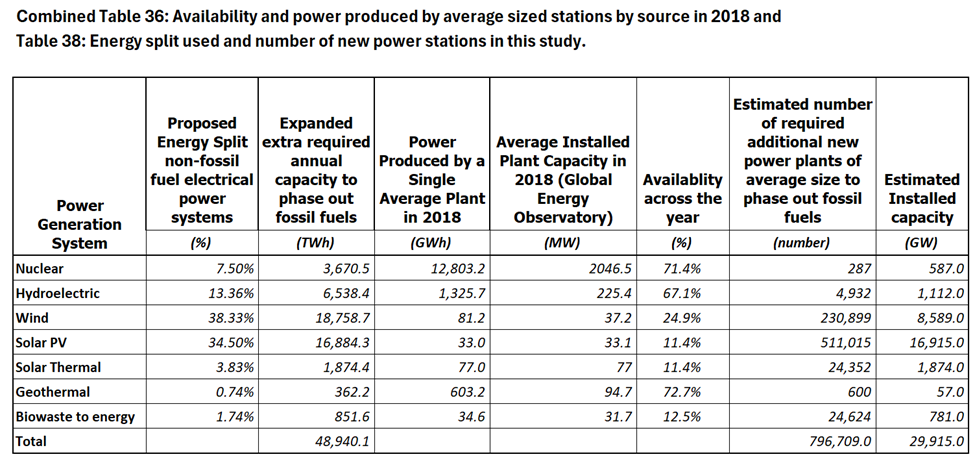
I have a few observations about these results. Michaux had to estimate the energy split between the power systems. Solar thermal is included, which I think is a niche system suitable only for deserts. Back calculating from the total energy requirement, he estimated the energy needed for each generation type. The average installed plant capacity was from a reference and used to estimate the power produced by an average plant of each type. The availability across the year parameter is close enough to capacity factor that they are interchangeable. I think nuclear availability is low. I am sure that wind and solar advocates would argue that the availabilities used are also low. The result is a conservative estimate of the number of new power plants needed.
I did not see a distinction between onshore and offshore wind in this article, but the second article described below states:
This study projects that 1.3 million wind turbines (each one assumed to be a 6.6 MW (Megawatt capacity) will need to be operational as part of the task to completely phase out fossil fuels. Onshore units will account for 70% of this number, corresponding to 910,000 wind turbines. Offshore units will account for 30%, requiring 390,429 wind turbines.
In my opinion it would have been better to split onshore and offshore wind into two categories because the availabilities will differ.
The analysis also calculates the size of the power buffer needed to back up the predicted generation resources which is a particular interest of mine. I will postpone a discussion of that for another post. For the purposes of this article note that the report includes an exhaustive analysis of energy storage requirements and potential technologies to provide the necessary storage.
The first article estimates the energy necessary for the transition which was used in the second article to determine the materials resources needed for the transition. The article notes that a massive number of new facilities will be required and that a “large wind and solar power systems would need to be internally self-sufficient and need a buffer for stable operation”. Despite the caveat that the author did not intend to support the status quo reality intervenes. Michaux notes: “If there are technical issues in storing the needed quantity of power for the needed time period, then it is concluded that wind and solar power generation systems are not practical as the primary energy source for the next industrial era after fossil fuel based technology.”
Quantity of Metals Required
The second article was referenced:
Michaux, S. P. 2024. Quantity of metals required to manufacture one generation of renewable technology units to phase out fossil fuel. Geological Survey of Finland, Bulletin 416, 173–293, 38 figures, 60 tables and 2 annexes.
The abstract states:
An estimate is presented for the total quantity of raw materials required to manufacture a single generation of renewable technology units (solar panels, wind turbines, etc.) sufficient to replace energy technologies based on combustion of fossil fuels. This estimate was derived by assembling the number of units needed against the estimated metal con- tent for individual battery chemistries, wind turbines, solar panels, and electric vehicles. The majority of the metals needed were to resource the construction of stationary power storage to act as a buffer for wind and solar power generation.
This study uses four stationary power buffer capacities as modelled in a previous study: 6 hours, 48 hours + 10%, 28 days and 12 weeks. This power buffer is assumed to be supplied through the use of large battery banks (in line with strategic policy expectations). Metal quantities were calculated for all four capacities and compared with mining production, mineral reserves, mineral resources, and known under sea resources. It was also assessed whether recycling could deliver this metal quantity by comparing calculations against the sum total mined metal between 1990 and 2023. The quantity of metal mined over the last 34 years was inadequate, which means recycling cannot deliver the needed capacity, and the mining of minerals would have to be the primary source of metals for at least the first generation of non-fossil fuel technology. If a metal has not yet been mined, then that metal cannot be recycled.
There are two highlights in the following: the quantity of metals available is “manifestly inadequate” and technological scaling up issues mean wind and solar “may not be viable as the primary energy source” for the transition:
It was shown that both 2019 global mine production, 2022 global reserve estimates, 2022 mineral resources, and estimates of undersea resources, were manifestly inadequate for meeting projected demand for copper, lithium, nickel, cobalt, graphite, and vanadium. Comprehensive analysis of these calculations suggest that lithium-ion battery chemistry (on its own) is not a viable option for upscaling to meet anticipated global market demand. This then implies that battery banks would not be viable as a power buffer for wind and solar in the quantities needed. As previous work had shown that pumped hydro storage and hydrogen storage face logistical issues in scale up, the belief of strategic policy makers was that battery banks were the solution. As all of these technologies face scale up issues, wind and solar may not be viable as the primary energy source to support the next generation of industrialization.
Consequently, the development of alternative battery chemistries is recommended. The calculated shortfall in copper and nickel production was also of concern, as both metals are vital to the existing economy and there is no known viable substitute or alternative for either commodity. Another alternative would be to develop an entirely new form of electrical power generation that did not need such heavy resource supply in construction or operation.
The calculations in the first article provided the number of generating resources needed provided. This article determined how many metals would be required for each resource based on those numbers. For anyone wanting to evaluate material requirements for wind, solar, and battery equipment the analysis provides a lot of documentation. Also note that Michaux included metals needed for doubling the current nuclear energy capacity, additional hydropower, and more geothermal.
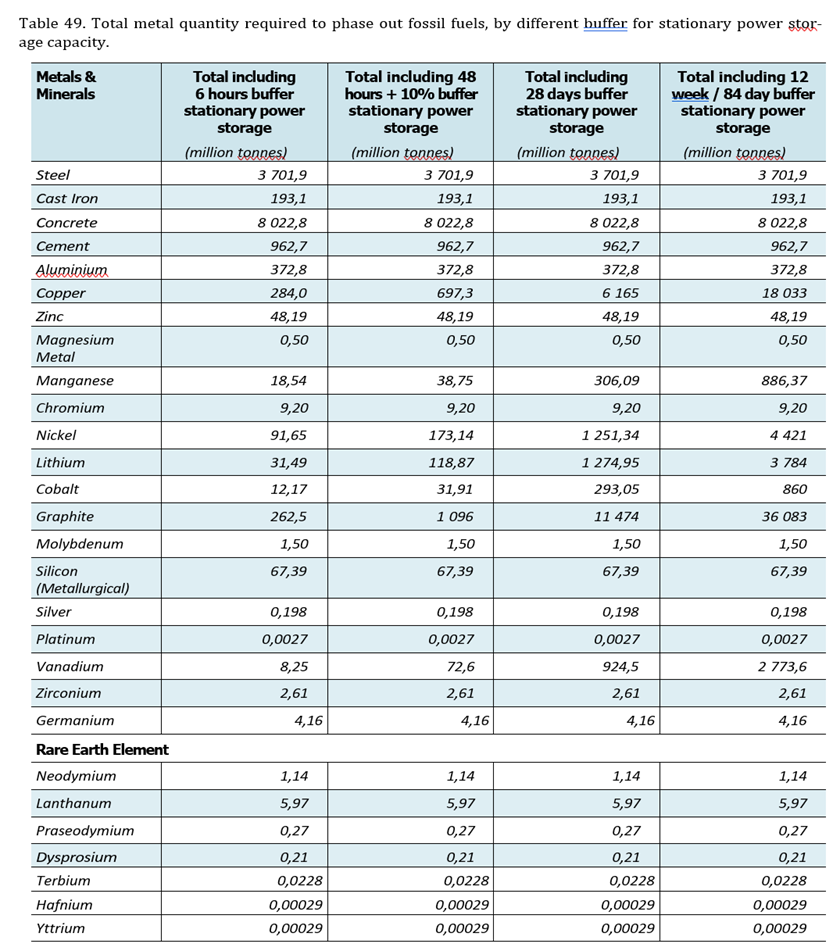
In an analogous process Michaux calculated the number of zero-emission “technology units” needed to replace fossil fuels in industry and transportation. Electric vehicles are an example of a technology unit. Fuel cell vehicles are also included. Table 49 from the article is the sum of all metal from all parts of this study into one quantity by metal (split into the four different power buffer storage capacities).
Source: Published in Geological Survey of Finland Bulletin 416
Conclusion
This is an ambitious analysis that covers the entire global energy system. As such there are bound to be oversights and limitations as well as interpretative assumptions that could be issues. In my opinion, however, the approach and assumptions are reasonable and should give a reasonable estimate of the metals needed. The mass of metals available is another challenge but I think there is better historical data available. Comparing the metals needed to the metals available leads to the inescapable conclusion that the dreams of replacing fossil fuels will be unable to overcome reality.
Roger Caiazza blogs on New York energy and environmental issues at Pragmatic Environmentalist of New York. This represents his opinion and not the opinion of any of his previous employers or any other company with which he has been associated.
Tldr
For those that don’t recognise the acronym, it means “I have the attention span of a goldfish”
Isn’t modern education so grand !! 😉
I do not appreciate your belittling my goldfish.
🤣
And as The Green Blob also opposes mining, any additional materials are even more unavailable.
Take the US and copper. The two largest remaining untapped copper (plus other) deposits are Pebble in Alaska and Boundary Waters in Minnesota. Both have been ‘permanently’ halted by US environmentalists. Copper is both essential and strategic— so now we rely on Chile.
I know it isn’t realistic but would it not be interesting if most of the non-US resources were tied up by “keep it in the ground” religion? It might start out with “solidarity” and jubilation but eventually the followers would have to confront the consequences.
Awhile back, I recall a doc on the TV that the Pebble Creek copper-gold mine project was rejected by the EPA because it was a threat to largest sockeye salmon run in the northern Pacific and to the livelihood of First Nation peoples.
To access the inland mine, the mining company Northern Destiny (?) proposed constructing a 100 mile long road along Pebble Creek from the coast to the mine site. The Company claimed that copper-gold ore body was the largest in North America and was worth many billions of dollars.
If Trump’s EPA lifts the moratorium on the mine, the protests by
the First Nation peoples, who are heavily armed, and the environmentalists would most likely became very violent.
You overlooked Kennecott mining in Utah
A discussion on the needed size of the stationary power storage buffer to manage intermittent energy supply from wind and solar was conducted.
______________________________________________________________________________
Wind & Solar? This is all directed at reducing CO2 emissions from the electrical grid. Recently, someone here at WUWT pointed out that the anthropogenic emissions from the “grid” is but a small fraction of the total anthropogenic emissions. What it amounts to, is that the grid is an easy target. All the rest of the anthropogenic emissions not so much.. The grid is the low hanging fruit, and it’s on it’s way to costing trillions. And it’s all for nothing except that it’s an obvious power grab. If the power grab is successful, it will be: “The Climate Crisis? What Climate Crisis” just like “Global Cooling” it will be claimed that it never happened.
Awful big Buffer. Solar is only available 4-6 hours a day (4 hours of nameplate(ish) and 2 hours of ramping up and down). That will require a 20 hour
dailynightly buffer.And wind is only available 40% of the year so would need 219 days a year of “Buffer” usage.
Some years ago, as a personal followup to ebook Gaia’s Limits (which delt with water, food, fossil fuels, and biofuels relative to projected human population), I did back of the envelope calculations for major renewable materials given warmunist projections for renewables. Concluded there were real future cost problems with copper and nickel even assuming recycling, and likely future absolute availability constraints for lithium and cobalt—again assuming what was then possible with recycling. Surprisingly, no foreseeable issues with ‘rare earths’ metals (difficult to recycle), which are not actually geologically rare, only expensive to process in an environmentally responsible way—which is how China keeps its stranglehold.
There is a fundamental error in extrapolating capacity factors for wind and solar from existing levels. Once the penetration exceeds the unconstrained capacity factor, the achieved capacity factor declines as the economic offloading increases.
I operate a cost minimised off-grid solar system at 37S. The solar panels achieve a capacity factor of 3.9% in conjunction with a 50 hour battery.
It is obvious from the metrics table that there is no allowing for declining capacity factors. That alone makes the study naive.
Putting out studuies that give a hint that a transition to wind and solar is physically possible is ridiculous.
The most important factor in a wind driven energy system is to understand the resource. Show me any calculation that estimates how much wind energy can be extracted before it has dire consequences on land productivity and availability of drinking water. We can make some vague estimates on the amount of wind energy in the climate but I have never seen an estimate on how long it took to create that energy.
Agree. Put differently and more simply, all the ‘best’ capacity factor locations for renewables were used first. Every addition must by definition be worse.
AKA in general economic terms ‘declining marginal returns to scale’. An almost ironclad economic rule with very few exceptions (like beta v. vhs video tape standards).
Is why there are NO more electronic standards wars. Everybody knows in advance there can only be one winner in the ‘standards exception to the general rule’, so no point in having a fight. Just sit down and agree to something.
(Fun insider fastball from when I was head of strategy at MOT—in order to ‘sit down and agree’ each involved corporation MUST pre commit to contribute ‘free’ [technically ‘fair and reasonable terms’] any relevant IPR.)
It is clear wind, solar, batteries and EVs are not a substitute for fossil fuel, nuclear and ICE transportation. Time to move on.
Hey, maybe in 10 years or so, they’ll crack Cold Fusion…or not!
Researched this for several years. Never was, never will be ‘cold fusion’. The phenomenon is technically LENR, a direct consequence of the weak force explained by Widom-Larsen paper (working in reverse, same as creates neutron stars). Problem is, it can be reliably scaled to 2x energy out to in, unreliably to 4x, when a minimum 7-10x in is needed for reliable economic energy out. So interesting physics, but an energy dead end.
Unless their Ultimate Plan is to either Ration Power the Hoi Polloi or reduce population to do so.
Perplexity AI does not support reducing population:
I doubt it has read Bulletin 416 yet!
population reduction is the part they dont say out loud
‘they’ have reduced the birth rate to below replacement, so their goal now is to run out the clock
population reduction by attrition
planned since the 60s, known since the 90s
The Population Bomb… published in the 60s.
Compensating for the tldr comment offered above,
The technologies are not available, and no specific technology is proposed. Batteries (buffers, or storage) are imagined to be generators, without the need to charge or maintain charge, and to discharge without losses. Charge time is not mentioned.
The combined table 36/38 also contains what seem to be bad assumptions: overbuilding of intermittent power generattion does not make up for lack of wind or sunlight. Availability of wind, for instance, does not increase with the increase in the number of power stations. Watt-hours cannot be substituted with watt capacity, as the authors seem to do, and the availability*capacity does not seem to be equal to the delivered GWh of electricity The definition or means of calculating “Availability per year” seems to change between intermittent energy sources and the others. Availability for intermittents does not indicate watt-hours generated. It does not seem so obvious that “availability across the year parameter is close enough to capacity factor that they are interchangeable,” but rather is apparently a serious miscalculation.
The assumption that existing energy storage or EVs are emissions free is also easily proven to be fallacious. All these real things require fossil fuels for their manufacture, operation, and maintenance, as do their raw materials. EVs require tires, lubricants, coolants, and other materials that can only be produced from petroleum, coal, and natural gas. Wind turbines and PV panels are much the same, and won’t be CO2 free without replacement of the entire logistics chain for their supply The only difference being that the emissions happen in someone else’s back yard.
Waste-to-energy has more than once been demonstrated as not CO2 emissions free. Carbon-neutral arguments for burning bagasse and wood are not generally accepted, and all other waste-to-fuel methods that I’m aware of emit at least CO2 as a byproduct.
If we agree that magic isn’t real, then the report is great. I submit that it may reach an incomplete conclusion by faulty means. Is it good to be in agreement with a deeply flawed argument?
Perhaps this article is “Critical Resources for Dummies” or for politicians, but it seems to be missing a couple of cogs.
The answer is blowing in the wind…
Trying to estimate global demand that way is crazy. We use 100m bbls of oil per day, which would increase at around 3% pa if the world keeps going as is, a bit more if developing countries get developed. There are equivalent numbers for gas and coal, and for current nuclear. Those are the numbers to meet. Then there are other considerations, such as whether all those fossil fuel uses really can be replaced – aviation for example.
More sensible, of course, would be not to replace fossil fuels for net zero purposes, but to work towards the best energy combinations over time, bearing in mind that we can’t see the future so we need to ensure plenty of flexibility.
…and perhaps the best method for determining the best combinations is free market. The opposite of some sort of authoritarian or theocratic decree.
Harold the Old Organic Chemist Say:
ATTN: Roger and Everyone!
RE: CO2 Does Not Cause Warming of Air!
Shown in the graphic (See below) are plots of temperatures of the air at the Furnace Creek weather station in Death Valley from 1922 to 2001. In 1922 the concentration
of CO2 was 303 ppmv (i.e., 0.595 g of CO2/cu. m. of air) and by 2001, it had increased to 371 ppmv ( i.e.,0.729 g of CO2/cu. m. of air), but there was no corresponding increase in the temperatures of the dry air over the time interval of 79 years at this arid desert site. The reason for no temperature increase is quite simple: There is too little CO2 in the air.
Presently, the concentration at the MLO in Hawaii is 422 ppmv in dry air. One cubic meter of this air has 0.829 g of CO2 and a mass of 1.29 kg at STP.
On the basis of the empirical data from this remote field site, I have concluded that CO2 does not cause warming of air and by extension no global warming. Thus there is no need to transition away from fossil fuels. The heavy industries, the heavy transportation systems, and chemical process industries will always use enormous amounts of fossil fuels. What are these people thinking?
NB: The graphic was obtained from the late John Daly’s website:
“Still Waiting For Greenhouse” available at: http://www.John-Daly.com. From the homepage, scroll down to the end and click on the tab: “Station Temperature Data”. On the World Map click on a area to access temperature data from weather stations therein.
Not only is the access to these rarer minerals problematic..
.. but the processing of them requires large amounts of often very toxic chemicals.
But that s “environmentally sound”, so long as it meets a “net-zero” meme.
Looking at the image it hit me (but unfortunately for all of you, not hard enough)
Every huge mine (hole in the ground) where we dig out rare earth save the planet resources (lithium etc) we back fill with carbon! we get what we need for all those batteries and diopium tetroxadine for solar panels, and the evil carbon is put in prison!
Oh, and my cousin has a company that will ensure all this happens.
win-win!
Let’s see–with degrees in Geology and Mining Engineering, a career that went through base metal exploration, industrial mineral exploration, a stint with the GSC during post-graduate research, and then mine geology leading to a position as a Mine Manager—looks like my future is set. ‘I chose wisely’.
May some common sense prevail so I don’t have to come out of retirement; I’m too busy.
May some common sense prevail
It did, a week ago.
There is a problem with the Table 36 figures.
The Proposed Energy Split non-fossil fuel percentages total 100%.
The reason this is a problem is that you only get the possibility of this 100% between 10am and 2pm.
So from 3pm until 9am you only have the possibility of 65.5% of your potential demand met by the remainder sources and the likelihood of less than 50% with actual capacity factors.
Simon Michaux’ detailed studies, with Mark Mills’ astute 5 minute presentations, leave little room for the intermittent renewable energy paradigm to succeed.
“The estimated sum total of extra.. blah, blah … is 48,939.8 TWh”
To 6 significant figures no less. 🙂
Let us fantasize that the world is about to come to it’s senses and forget the CO2 is evil/net zero BS…
We, or at least our grandchildren, will still have to contend with the fact that survival for humans has long passed the point where fang & claw matters, but now depends on jobs, which depend on an efficient economic environment which depends on cheap, readily available energy…..and that is supplied now and for a decadal scaled future on fossil fuels…
….but fossil fuels are a finite resource. Because wishful thinking is not a plan, and with no economically viable, physically efficient alternate source of energy production seems to be forthcoming, as this article points out, perhaps our efforts should be directed at finding the optimum mix of FF/nuclear/wind/solar/geothermal/hydro to prolong the life of our FF supply.
But someday, it will be depleted. The alternatives won’t suffice, and it’s gunna get ugly. Carrying capacity depends on resources. Falling levels of resources means falling carrying capacity. That law will never be repealed.
It’s not certain that ‘fossil’ fuels are completely non-renewable (deep hot biosphere and geothermal energy may be continually renewing a part), and we’ve only tapped a small portion of the available resources. For over a 100 years we were only getting the oil that was literally bursting up through the ground in gushers – it’s like declaring a can of pop empty because it isn’t spraying cola everywhere. Fracking has helped a bit (like shaking the can of pop), but we are still only accessing about 30-50% of what we know about. And even these resources we have had 50+ years of supply of for 150 years (i.e. the rate of new reserves has exceeded consumption).
Coal and natural gas we have hundreds of years of – even without discovering new resources.
Our grandchildren’s grandchildren MIGHT have to worry about it – but hopefully fission will continue to develop (and get rid of its silly stigma) and fusion will finally become feasible and economic sometime in the next 100-200 years.
This is exactly what free markets do best and governments have invariably demonstrated that they never get it right because there is never a “right” solution. The best solution is never static. Free markets are nimble and favour the most economic outcome at some point in time.
There is a already a longer term future with nuclear fission to get all the available energy from the existing mined uranium and uranium waste.
G
Just did a quick estimate. Assumed turbine requires area of 500 foot radius, allowing 1,000 feet between turbines, gets approx. 18 acres/turbine. multiplied by 910,000 turbines gets 16,407,537.39 acres (how’s that for sigfigs), or 25,636.78 sq. mi.
If this area were completely covered with turbines at the 1,000-ft spacing, it would require an area larger than the state of West Virginia. Doubt many Mountaineers are going to put up with that.
You’re going to need quite a large amount of diesel to dig up that much earth. If you cut back on normal cars, reducing demand for gasoline, you cut back on the production of gasoline, which leads to less production of diesel. And jet. And marine fuel oil. More electric car – less fuel to dig up the earth to manufacture electric cars. California is about to go through this train wreck.
Yet another nail in the renewable coffin.
Eventually people will realise that when they have no access to cost effective fossil fuels they will have to deploy nuclear power.
How the hell can you have an estimate with 6 significant digit precision? An estimate!