From the Cliff Mass Weather Blog
Cliff Mass
There is an apparent contradiction regarding wildfires and climate in the western U.S. that few have talked about. Wildfire acreage has been low even though the summer has been warm and dry for most of the region.
This year was one of the most benign wildfire years in a long time for the entire West Coast. Plotting the wildfire acreage over California since 1987 (see below) shows that the 2022 acreage burned has been quite low, similar to the situation 30 years ago.

And the same has been true for Washington State (below, from 2002 to now). The wildfire acreage this year was very modest…similar to 20 years ago.
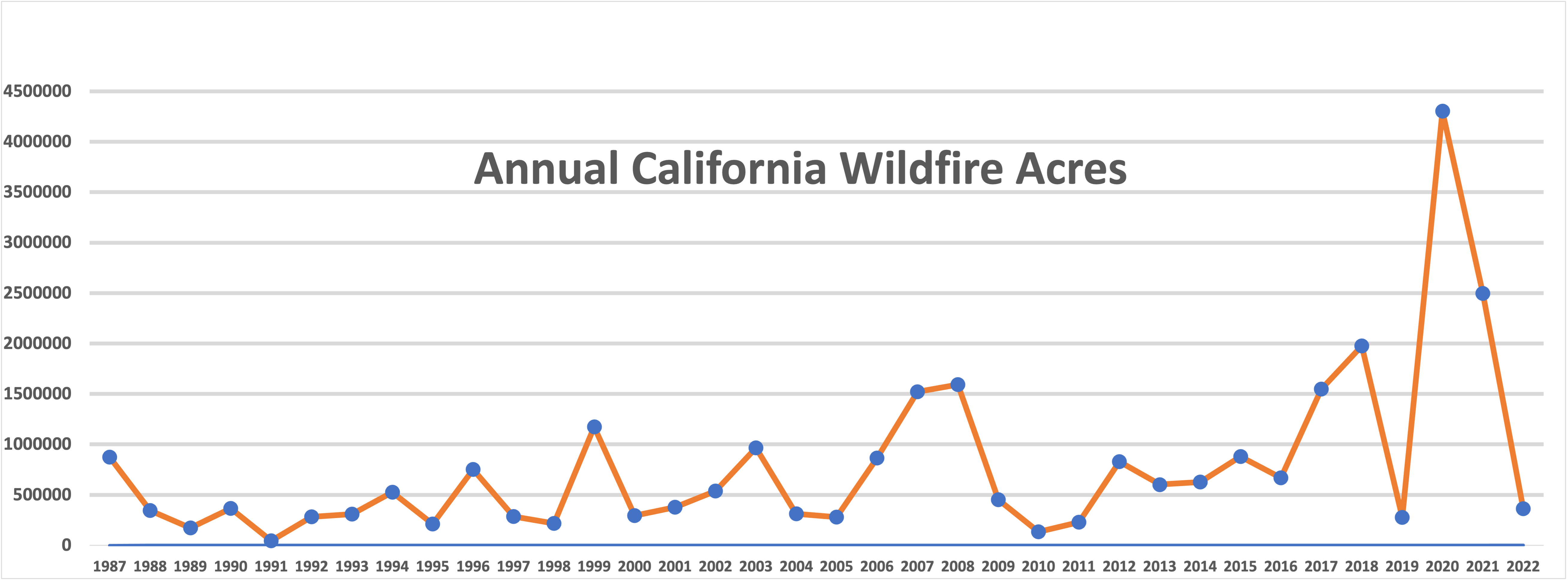


The interesting thing is that this low-fire area situation occurred even though the west coast states have been warmer and drier than normal.
Consider the difference of this summer’s (June 1-October 15) temperature from normal (1990-2010 mean)–see below. Warmer than normal for the entire coast! You would expect more fires–right?


What about precipitation and drought? Well, folks like to look at the NOAA Drought Monitor, whose November 1 graphic showed terrible drought over California and eastern Oregon, and modest drought over the rest.
You would think this would encourage bountiful wildfire!
But it didn’t.


How could this be?
It turns out that wildfire occurrence is much more complicated than the simple relationship between wildfires, temperature, and precipitation portrayed in some media and by some politicians.
Let’s confirm this by plotting the average temperatures, precipitation and wildfire acreage over Washington from 2002 to this year (below).
2022 had the warmest summer (June through October) for the entire period by far.


And this summer was much drier than normal… the driest summer in 15 years!


But yet the wildfire acreage was very low….. again, how can this be?
The Connection Between Wildfire and Weather/Climate is More Complicated Than Often Portrayed
The connection between climate and wildfires is far more nuanced than some folks suggest. And that means the connection between global warming and wildfires is not as definitive as often claimed.
For example, strong winds are an essential component for initiating and spreading wildfires. And strong easterly winds (such as the winds that spread the recent Bolt Fire near Skykomish) are particularly important for wildfire on the western side of regional terrain barriers.
The lack of strong easterly winds this summer and fall helped keep down the fires this year. And recent research suggests that global warming may REDUCE such winds for the entire West Coast, reducing fire initiation and spread. You won’t hear about that in the Seattle Times.


Most West Coast fires are initiated by humans, with poorly maintained electrical infrastructure being a major contributor. Substantial recent efforts have been given to trimming trees near power lines, hardening electrical infrastructure, and de-energizing powerlines when strong winds are forecast. This seems to be helping.
Warmer temperatures and drier conditions do not necessarily increase fire risk significantly. The West Coast has a Mediterranean climate with very dry summers. Even a normal summer allows surface fuels (such as grasses and other light vegetation) to be dry enough to burn. Once you cross the thresholds of dryness, being a bit drier makes little difference.
And there are many other factors modulating wildfire area other than weather and climate. For example, poor forest management and suppression of fires for 75 years produced forests primed for a catastrophic fire. Invasive flammable grasses have increased fire threats, as have increased human ignitions. New “let it burn” directives are increasing fire. On the other hand, once there is a fire, the area is less likely to burn for a while.
In short, the relationship of wildfire area to weather or climate is complex with many other important–if not MORE important….factors other than climate.
The Latest Forecast in My New Podcast: Dry, La Nina Conditions Ahead
Some major podcast servers:


Like the podcast? Support on Patreon


I am surprised you haven’t been “fired” yet…🤣🤣🤣
Keep up being honest and keeping the feet of the climate screamers close to the fire!
Mediterranean climates get dry enough to burn in a fairly wet year. Bad wildlands management is the major issue, which is reportedly not getting worse. Until the activist NGOs lose their ability to interfere with any prudent management scheme, it will never be good.
Fuel growth increases in wet years, deceases in dry years. It may take several years for a fuel load to accumulate to the point that a catastrophic fire will occur.
The graphs back you up – the acres burned oscillate with a period of a few years, enough time for the grass and such to return and build up.
Each and every year we hear one of two predictions. If it was wet, more fuel grew making this year extremely bad for fires. If it was dry, fuel moisture is low making this year extremely bad for fires.
You forgot the inevitable “caused by climate change” bullshit.
Fire needs fuel, oxygen and source of ignition. The likely drop in Western US fires this year is lack of fuel. Firstly the fires of the last few years have been huge although not necessarily record breaking in terms of area burnt. Secondly they have occurred where people live – most fires are ignited by people – and along with property, they have destroyed large areas of understory and loose litter in areas that are most likely to be ignited. Thirdly the last one or two summers have been dry and this reduces the amount of regrowth and generation of readily combustible materials. In previous years when management of fuel loads was undertaken the amount of fires is much reduced, so the reduced number of fires of recent years can be attributed primarily to reduced fuel loads.
The most recent large fires probably developed in areas where fuel loads were critical i.e. fuel loads so large that they can NOT be extinguished. CSIRO in Australia found that if fuel loads exceeded 20 tonnes/hectare (~0.4 lbs/ft2) then is is impossible to put them out: it is not possible to apply sufficient water to cool the fuel below ignition temperature or to suffocate the fire by depriving it of oxygen. A recent survey also found that in temperate rain forest this level of fuel generation occurs within 4 or 5 years and can sometimes occur in 2 years. So without adequate management of fuel loads by regular low level burns it is easily possible to initiate unstoppable fires. Incidentally large fires can generate fire tornados which add to their unstoppability.
For thousands of years the aboriginal peoples of Australia practiced fire management in Australia’s very fire susceptible country by using cool burns. Cool burns were undertaken in winter and after rain so that the damage to fauna was minimised and done regularly so that the fuel loads did not reach the critical levels. Cool burns produced open savannah grasslands in the inland parts of Australia and actually improved the productivity of the country for the fauna and provided more easily available food for people.
It is possible to manage fire in susceptible regions but this must be done constantly so that fuel loads are contained below critical levels. So it seems to me that while there are other factors such as winds and dry conditions that contribute to fire intensity, no fires burn where there is no fuel, so fuel management is the most important factor to their prevention. Of course tell that to the greenies and they immediately drag some inconspicuous species and claim then to be endangered, forgetting that this species may have been there for centuries and that often it can shelter from the fire or just run away.
tmatsci,
With due respect, you do not have any idea what Australian aborigines did with fire management for thousands of years, No records exist. You are simply repeating unsubstantaited myth. Geoff S
Geoff S,
When someone says “With due respect” you know that there’s no rspect involved. I’ve no idea who’s right but please drop the “With due respect”
Good summary tmatsci. I suspect these La Niña years are building up tremendous amounts of fuel and when the inevitable drought return, unless control burns and fuel load reductions are continued, then there will be another black year.
As for aboriginal fire culture, I think the historical record of fire stick use and the park-like forests that existed around Botany Bay, for example, are moderate inference of a strong fire culture by Aboriginal Australians. Also, my understanding is that the geological record does support increased fires after the arrival of human beings on the continent.
Still, I suppose it has become part of the ‘Nobel Savage’ mythos and ‘being in balance with nature’ absurdity. Pre-Colombian Indians did a lot of burning too – it is an effective way to manage large areas in a pre-bulldozer world – and it leaves the balance of nature decidedly on the human side of the scale.
”Fire needs fuel, oxygen and source of ignition.”
You missed out the most important ingredient, wind. Most fires are controllable, unless there is excessive wind. As Cliff said, there was a lack of wind this year which resulted in less area burnt. Simple fire science.
But why do something intelligent like managing fuel loads when you can blame it all on The Boogeyman For Adults (aka “climate change”) and thereby continually demand more subservience from the population in order to “save” it from said Boogeyman.
No matter how much “emissions” are reduced, they can just keep pointing to the latest wildfire and bleat that “we haven’t done enough,” which thereby provides the excuse for ever more stringent “rules” (and, of course, more “taxes” be they openly identified as such or not) to “save” us from said Boogyman.
Most wildfires are man-made and no environmental factors explain the frequency of the fires. Think about PYROTERRORISM and Google it.
Or better yet use a different search engine.
Yes, Eco-Fascists lighting fires knowing their media enablers will instantly blame them on “climate change” is a definite problem.
Ironically it is the Eco-Loons fighting tooth and nail against responsible logging, controlled burns and clearing of brush and dead material (and trimming of trees near power lines) that have made fires a much bigger problem than they would otherwise be. It’s NOT “climate change.”
Indigenous cold burning is a curious mixture of true, somewhat true and complete myth.
Cold burning is lots of very small burning for fuel reduction. Though they had multiple reasons for burning the underbrush. Every ones job was to start a small fire in the undergrowth. These days only a few qualified people are authorised to reduce the fuel load by burning. Ergo: we burn / fuel reduce of larger areas for efficiency of man power. Larger areas burn warmer. Also burning after rain is nonsense, it just makes smoke
I wonder if one of the reasons for the Aboriginal burning was to decrease the number of nasty snakes and spiders that Aus is blessed with.
Some of Australia’s deadly snakes are faster over flat ground than humans.
I think one reason that the aborigines in Australia would have started fires would have been survival. South East Australia is very fire prone due to the prolific growth due to a favourable climate. One of the worst fires in Victorias history was in 1851 when about 1/4 of Victoria burnt in one day, many of the fires only halted by the coast. I suspect the aborigines learnt very early on that burning the grasslands and forest before the worst of the fire weather meant wild fires ignited by natural means, provided them with a safe refuge, in fact “stay on the black” is drummed into firefighters of today even with all the modern technology available to them now.
Whether it was fully understood or not, all it would take would be strong cultural traditions to keep it going. Also, there would have been immediate rewards from the wildlife flushed and cooked in the fires and that would probably have reinforced the cultural traditions. Black Kites (aka ‘firehawks’) have learned this, and probably from watching people.
If some of the wildlife were unable to escape such a fire, then perhaps so too any humans similarly caught in it’s path. Like the present day, some lessons have to be learnt again by each new generation.
I have another theory. The aborigines used to always carry fire with them from camp to camp because it has been suggested they didn’t know how to make fire. It is a fair bet some of those smouldering embers escaped in their travel.
It’s ridiculous to keep connecting wildfire acres burned to slight changes in the global average temperature. Up to 90% of these forest fires are manmade, not natural. A slight increase in the average temperature, mainly during the colder months of the year, is not logically connected to acres burned.
Is there a season where the fuel is dry and prone to fires? If so, then how could already dry fuel be made any drier by a slight increase in the temperature?
Is there less rainfall during the fire season due to climate cange? In general, global rainfall has increased in response to global warming, not decreased. That generalization may not apply to local weather.
Acres burned data is meaningless without a theory that connects it with global warming. I’d bet acres burned have a lot more to do with forest maintenance.
Yes, lack of forest maintenance is a big factor, but low humidity and consistently strong winds are the driving force for large fires.
And in a “milder” climate from “global warming,” since tropics to poles AND day to night temperature differentials should SHRINK, based on the WAY the Earth warms (most “warming” aka upward change in AVERAGE temperature is higher nighttime LOW temperatures, little change in the tropics with most temperature increases occurring in the polar regions and higher latitudes), means the likelihood is LESS consistently strong winds, not more, and higher humidity, not lower.
So “climate change” should IMPROVE things from a fire perspective. Just as WARMING of the climate is an IMPROVEMENT from pretty much ANY perspective.
Just like their revered “Grandfather of Global Warming,” Svante Arrhenius, said -but they willfully ignore – he said IF humans could manage to warm the climate by adding CO2 to the atmosphere, that we would thereby IMPROVE the climate.
That’s the part he was most correct about, and of course that’s the part they disregard.
NASA claims water vapor in the atmosphere is increasing as the troposphere warms. Rainfall is also increasing. Perhaps these trens do NOT apply to areas vulnerable to wildfires, but I doubt it.
YMMV but to my mind/eye, and your own figures/graphs here show that there were lots of fires in the last 2 years so….
Thus, is not fair comment to suggest that burning stuff, by whatever means (protective burning or wildfire) is not a good idea as doing so appears to create deserts?
History suggests that deserts are not = self-repairing features (e.g. Australia, Fertile Crescent, Gobi, SoCal, Mediterranean & Nth Africa)
Worse, much worse, no matter how much water and/or CO2 you throw at them, or how many Sputniks you fly, they still don’t return to verdant lushness.
Or grow any Sugar.
Maybe try building a few Hugelkulturs instead instead of Computer-Models & Emporial Wardrobes 🙂
does new mexicos’ biggest wild fire ever count ?even tho it was started by the US forest service
“For example, poor forest management and suppression of fires for 75 years produced forests primed for a catastrophic fire.”
Good forestry (it’s not all good of course) is a great thing- I’ve been doing it for 50 years- but all that time, here in Massachusetts, there have been people trying to stop all tree cutting- long before the climate cult. Of course they live in wood homes with wood furniture and paper products.
I often wonder about whether putting out small fires as soon as they start actually makes the probability of an uncontrollable in the future much greater than had it been left to burn in a controlled way.
I bas this on no scientific study (but will happily take any grant money available) only on personal observation. On the Grouse Moors of Scotland there used to be spring heather burns of strips of heather. But some estates gradually reduced the burns as fewer people went into rural jobs, In my childhood in 11950s nd 1960s there were two wildfires. The first set fire to the peat and burnt for a couple of months, perhaps longer. The second burnt for 24 hours. What was common to both was a human started them, accidentlly, and the burnt area was limited by some of the strips from the previous two or three yeqrs which created fire breaks. The net result of both was large areas that didn;t need another burn for decades and were clearly defined every snowfall.
I have long held the view that we do more damage to the environment by putting out natural fires then if they were left to burn out themselves. However with settlement we have no choice but to protect lives and infrastructure. Almost Sophies’ choice.
Of course the “lives and infrastructure” would be much more easy to protect if the idiot politicians got the building codes right, aka build in a manner that recognizes the risk, in the “wildcard interface.”
Homes but of steel reinforced concrete, inclusive of roofs, and with long overhangs to keep exterior walls and their penetrations distant from any fire would not burn and their owners would be able to safely shelter in place.
More expensive? Only in the short term.
WILDLAND
Effing autouncorrect
It would be interesting to plot wild fire incidents/acreage burned relative to gas prices. The logic being, when fuel costs are high trippers are less evident thus man caused wild fires from camp fires and casual ignition goes down.
if I recall, several of the fires in Australia were deliberate arson rather than accidental human caused. Same in Kalifornia. These would not correlate with your otherwise reasonable hypothesis.
In NE California this past spring, there was quite a bit of precipitation later during that period, and I have noticed over the decades that late spring rain/snow is associated with decreased fires in this neck of the woods.
A Former University Professor set four Wildfires in the Eastern District of California. Not funny at all.
The New York Times
Probably an Eco-Nazi trying to feed more “climate” propaganda.
Does it reverse correlate with the number of jailed arsonists ?
Well actually local forest fire outbreaks correlate well with a week of local “dry weather”beforehand….but that’s probably too obvious for media hype….
”Arson fires may account for over 20% of all human-caused wildland fires, and up to 70% or more fires in some jurisdictions. The actual number is unclear as arsons fires may not be recognized as such and be classified as another cause, undetermined, or unknown for some time before a pattern develops. ”
Source: National Interagency Fire Center
Propaganda is the correct term to use.
I agree with Mr. Mass that wildfire occurrence is much more complicated than the media and politicians say.
Before commenting, a bit about me. I live in Central and Eastern Oregon. I am a trained wildland firefighter, for what it’s worth. I’m also the secretary of a Rangeland Fire Protection Association in the high desert sagebrush steppe country of Harney County in southeast Oregon, as well as a member of the Harney County Wildfire Collaborative. The RFPA is composed of cattle ranchers also trained in firefighting; we have our own fire trucks, water tenders, dozers, and the like.
I also live in the middle of the “exceptional drought” blob in the middle of Oregon. This home is about 50 miles northeast of this year’s Cedar Creek Fire near Willamette Pass in the Oregon Cascades, about 100 miles due north of last year’s Bootleg Fire, and about 50 miles east of 2020’s Holiday Farm fire.
This year in Eastern and Central Oregon, following a very dry spring, we had a lot of June rains. This produced abundant fine fuels, i.e., principally invasive cheat grass, that then dried out in the very hot and dry summer Mr. Mass described. We were very fearful of devastating grassland fires because of that.
They didn’t occur, despite the abundance of fuel and high temperatures. Why?
The main reason appears to be that the typical monsoon track from the southwest didn’t hit the most vulnerable areas. They skipped both to the east, causing some moderate rangeland fires in Malheur County and some considerable forest fires in Wallowa County in far northeast Oregon, and to the west, causing the aforementioned Cedar Creek Fire.
Cedar Creek and Holiday Farm were uncontrollable burns that could have been prevented or mitigated with proper forest practices, but the forests were “locked up” thanks to the Spotted Owl controversy, the Clinton-era “roadless” policy, and the “preserve nature in the snapshot I love” version of environmentalism that prevails here in the west. There were some strong east winds that furthered Cedar Creek’s growth, but they were late in its development and mostly served to pour smoke into the Willamette Valley from Eugene to Portland.
In Eastern Oregon we recognize that fire is a natural thing, but conflagrations are not. We’ve got all sorts of tools, including cattle, that can help with fuels management, but it’s gonna take a lot of time. There’s a lot more nuance involved here, which is not particularly germane to the topic at hand.
So, the track taken by summer thunderstorms, and whether they are accompanied by rain, is also a major factor. Mr. Mass didn’t mention this factor, as the focus of his excellent article was elsewhere.
I’m adding this comment simply to help with further understanding of our fire situation here in the West.
All the best, ….
Wildfires are down?
Gas prices are up?
Seems they are in an inverse relationship, not unusual since many wildfires are ignited by outright arson.
Now it is expensive to drive around looking for locations safe from prying eyes.
It would be nice to see ALL the data available being presented, as opposed to starting in 1987.
Since much more acreage burned in the past, which underscores the notion that today’s wildfires are nothing “new,” nothing “special,” and are NOT “caused by ‘climate change'” either.