From NOT A LOT OF PEOPLE KNOW THAT
By Paul Homewood
Amid the hysteria over the coming heatwave, the Mail reminds us all about the really roasting summer of 1976:

Wildfires have raged, speed restrictions have been imposed on some railway lines and hospitals have already declared ‘critical incidents’.
The hot weather in Britain this summer is set to peak next week, when the mercury could top 39C (102F) in London.
The current non-stop sunshine has evoked memories of the summer of 1976, when there were 15 consecutive days that saw temperatures of 89.6F (32C) somewhere in the UK.
Overall, there were ten weeks of blazing heat that saw widespread drought, mass standpipe use, and even the pausing of the murder trial of the notorious ‘Black Panther’, after a woman suffering from ‘heat exhaustion’ collapsed.
During a First Division football match between Manchester City and Aston Villa, City player collectively lost four stone in weight, prompting the team’s captain to call for an end to ‘summer soccer’.
At that year’s Wimbledon tennis championships, umpires were allowed to remove their jackets for the first time in living memory, whilst major roads were littered with broken-down cars that had overheated.
The extreme weather also caused an increase in the number of 999 callouts to domestic disturbances, as tempers buckled due to the heat.
The summer of 1976 was caused in part by very hot air that had originated in the Mediterranean. The warm weather and lack of rain began on June 23 and did not abate for more than a month.
The highest temperature recorded in the summer was on July 3, when the mercury hit 96.6F (35.9C) in Cheltenham. The average maximum daily temperature was 67.8F (19.9C).
At the Wimbledon championships, where Bjorn Borg would go on to win the first of his five titles and a young Sue Barker made it to the quarter-finals, 400 people were treated for ‘exposure to the sun’ in a single day.
The conditions were what prompted officials to relax the strict dress code for umpires for the first time since the tournament began nearly 100 years earlier.
The trial of kidnapper Donald Nielson, who was nicknamed the Black Panther and was accused of murdering a 17-year-old woman, had to be suspended at Oxford Crown Court when a woman in the public gallery fainted
In the House of Commons, bar staff walked out in protest when officials refused to allow a similar relaxation in costume rules that would have allowed them to remove their traditional green jackets.
Above them, the Big Ben clock on what is now named the Elizabeth Tower suffered what was its only major breakdown due to metal fatigue caused by the heat. It took three weeks for the clock to be fixed.
Elsewhere, dozens of people desperately dived into the water of Trafalgar Square’s fountains in an attempt to cool off.
As well as the weight loss seen in the football match between Manchester City and Aston Villa, the Metropolitan Police dealt with 600 more daily calls to domestic disturbances than normal.
As the drought worsened, a strict hosepipe ban was imposed in most places and residents were encouraged to alert the authorities if their neighbours used any water unnecessarily.
Showers instead of baths were encouraged, with the latter only allowed if there was no more than 5inches of water in the tub.
The drought was worsened by the fact that there had been a lack of rainfall the previous summer, meaning reservoirs and rivers were already low.
The lack of water prompted fires to break out. As well as blazes in Essex and Yorkshire, 300 residents in an old people’s home in the New Forest had to be evacuated when a wild fire took hold nearby.
Farmers struggled too as thousands of acres of crops failed, prompting concerns that there would be huge increases in the price of food.
Street traders in London’s Hyde Park were slammed for charging the grossly inflated price of 40p for a bottle of Coca-Cola, even though they were costing 22p in the Dorchester Hotel across the road.
The weather also caused problems for couples, prompting a newspaper to give them advice on how to keep cool in the bedroom.
The drought became so severe that the then Labour government, led by James Callaghan, considered getting water by tanker from Norway.
Legislation – the Drought Act of 1976 – was passed in rapid time to both impose a nationwide hosepipe ban and to grant the government emergency powers that allowed them to reduce or turn off water supplies to industry.
The then sports minister, Dennis Howell, was made the new minister for drought.
In Wales, the mains water supply was switched off for up to 17 hours a day.
Each standpipe – an outdoor tap installed on streets – that people had to use was shared between 20 homes.
By late August, there were only 90 days’ of water supply left in London. In Leeds, the figure was 80.
It prompted t-shirt manufacturers to start selling clothes bearing the slogan: ‘Save Water – Bath With A Friend’.
Thanks to the dry reservoirs and sections of rivers, fish died in their thousands, whilst birds died of botulism – a disease caused by stagnant, de-oxygenated water.
The heat also caused an invasion of ladybirds, with their numbers so high that they were often unavoidably crushed underfoot.
The heat on stricken trains on the London Underground became so severe that people took to smashing train windows.
The trial of kidnapper Donald Nielson, who was nicknamed the Black Panther and was accused of murdering a 17-year-old woman, had to be suspended at Oxford Crown Court when a woman in the public gallery feinted.
However, a week after Mr Howell’s appointment in late August as minister for drought, the rain finally arrived and the hottest and driest days of Britain’s most famous summer were finally at an end. It had been the worst drought in England in 250 years.
The hot weather of the past few weeks has prompted many Britons to draw on their memories of the summer of 1976.
On Twitter, one wrote: ‘I’m a survivor of the summer of 1976. What a time to be alive. It was amazing. I was 15 and the No government as I remember instructed me in how to behave.’
Another said: ‘I have no idea how so many of us got through summer of 1976, unscathed. We didn’t have social media to try to frighten the life out of us.’
A third wrote: ‘A few hot days in July and they’re trying to pretend this weather is somehow unusual. Anyone else remember the summer of 1976, when we had comparable temperatures to now, except it went on for more than two months rather than the usual week or two? This is *not* an emergency!’
Their comments came as Downing Street called the week’s second Cobra meeting on the heatwave, with temperatures set to rise up to 39C (102F) from Monday.
Cabinet Office Minister Kit Malthouse chaired the meeting of the Cobra (Cabinet Office Briefing Rooms) civil contingencies committee, just three days after the first crisis meeting was held on Monday.
Rivers are at 30 per cent of normal levels, farmers are using a third more water and Britons have been told to take shorter showers after the lowest rainfall in more than a quarter of a century in parts of the UK.
Farmers warned today of a ‘significant challenge’ posed by the extremely dry weather as they try to keep crops fully watered in the face of rising fuel, electricity and fertiliser costs during the heatwave gripping Britain.
East Anglia is particularly parched this summer after it saw just two thirds of its normal rainfall in the first half of 2022, making it the region’s driest six-month period since 1996 and the 11th driest since records began in 1836.
What’s this I hear about mad dogs and Englishmen?
Out in Spain for a ‘hot’ Holiday …
Do any other Brits recall that, a couple of before it all started, a county cricket match was stopped by snow in Buxton, Derbyshire?
“The most significant June snowfall in recent memory was on 2 June 1975, when snow fell in many parts of the country. The Essex and Kent cricket match in Colchester was interrupted, while the match between Derbyshire and Lancashire at Buxton was called off after 2.5cm (1in) of snow settled on the outfield”
Yes that on June 1st or 2nd in 1975.
We also had about a inch of snow here in North Lincolnshire at the same time.
l remember playing and walking around in it as a child. We had a blast of cold Arctic air that caused snow during the night. While during the morning the weather was clear and sunny with a very deep blue sky. The snow lasted until around early afternoon.
“Anyone else remember the summer of 1976, when we had comparable temperatures to now, except it went on for more than two months rather than the usual week or two? This is *not* an emergency!’”
I remember it well. I was growing my hair long at school and it went a more sun-bleached blonde than it ever has before or since.
The Met Office has been promising us a heatwave since Spring and it still hasn’t arrived yet in Central England. May and June were [pretty damp squibs.
Today is pleasantly warm and sunny, but not at all oppressive. A perfect English summer day. A bit like what Seattle seemed to get for three months of the year when I lived there. One week here is generally the most you’ll get. I’m usually jonesing for cloud and rain after four days.
Just to put things into a British ‘frame’. Nobody here is more than a ‘quick trip’ to the nearest Beach so don’t feel too sorry for us.
(sorry Kansas)
For ‘Phill in California’ …
We may see mid 30’s for two days in your old home town and I fully intend to spend it on the river, After the ‘apocalypse’ (Wed) we return to BST. (British S**t Temps).
The other long hot summer that seems to have been overlooked and that came close to matching 1976 is the summer of 2018. Where we enjoyed spell warm fine weather from May to July, but unlike 1976 the weather broke down during August which was rather cool and wet.
This IS the climatologically hottest time of year in the Northern Hemisphere.
On the last NCEP ensemble model below for global 850 temperatures late this weekend(1 mile up), you can see the isolated positive (hot) anomaly over this spot.
https://www.psl.noaa.gov/map/images/ens/ens.html#nh
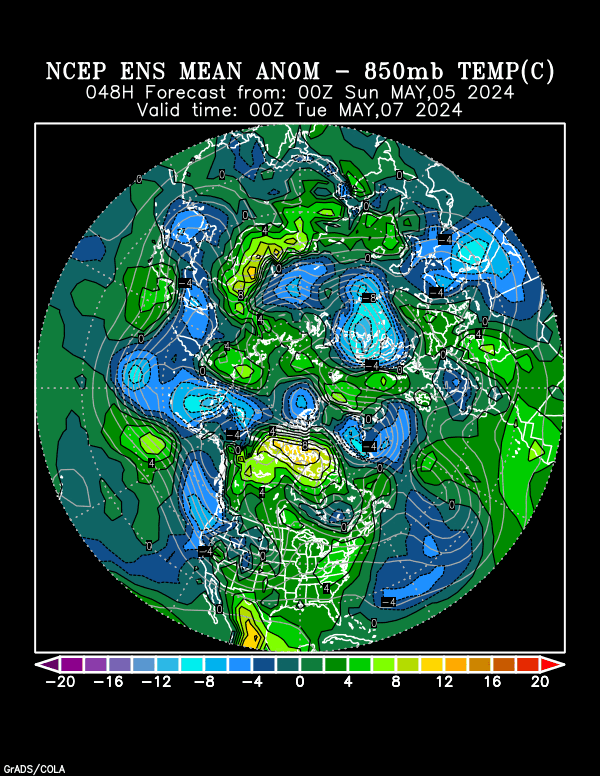
There are 2 other hot spots on the planet. A very small one over the N.Pole and a HUGE one in the US, from the West Coast to the Plains to S. Canada, (from the weather pattern in the US caused by the cool water anomaly in the E/C tropical Pacific/La Nina).
These warm/cold anomalies(extremes) are on the map 365 days a year, often much greater than this one, especially in Winter, almost entirely from weather patterns.
Since this is exactly the hottest time of year, any such positive weather anomalies on the planet have a great chance to be the “hottest ever”.
When you superimpose +0.9 Deg. C of global warming from increasing CO2 on top of that, it contributes a potential +2 deg. F warmer than the world 100 years ago based on all other things being held constant.
However, despite most of the atmosphere still responding like it always has, the sensationalizing today is several orders of magnitude more amplified than a century ago and the technological tools to do it with are a million times more powerful.
https://www.marketforum.com/forum/topic/87177/
This is what the UK looks like on a global map, under that hot spot above:
Here it is!
”When you superimpose +0.9 Deg. C of global warming from increasing CO2 on top of that,”
But why would you do that?
Have to laugh at the ‘warnings’.
I have my window open, that passes for AC here in The UK.
I hear children playing and some ‘local park’ based music event.
We’re all going to die, apparently, before the return of s**t British weather in a day or two.
Ahh 1976, CO2 levels were safely at 330ppm! All was good.
I started a new job as a rep.(salesman) in May 1976. My new company car DIDN’T have air conditioning. I was expected and did wear a suit (2 piece) plus collar and tie.
My car had an internal as well as external thermometer. It’s maximum was 52 degrees centigrade. Every day for a month it hit 52 centigrade about 9.30am and didn’t decrease until after 7pm.
I survived with windows open and a very soggy shirt and pants. The jacket I took off whist travelling.
It was a great relief when the rains came.
After those experiences the current “project fear” on hot weather makes me wonder how soft and wimpish we have become.
It’s not just that heat waves will happen regardless of fossil fuel use, records will be broken somewhere. They are short records, there is the UHI effect and you never know where the ice-cream van will be parked. Cold records also get broken “Alice Springs freezes through longest streak of sub-zero days on record”
Is any of it evidence of global warming? The only thing that makes the GHE scary is the feedback of greater absolute humidity, and that should mean that record maximum temperatures are irrelevant. Only when you stick your head out the window and don’t see frost are you seeing climate change in action.
I remember living outside Fulda Germany in 1976. this was our second tour in Deutschland. It was the hottest time anyone there could remember. Temps in the low 90’s as measured on my porch in Kerzell.
My family, having moved over from Arizona actually broke out shorts for 2 weeks, not because we needed to, but because it was a novelty for us there.
I should note we moved back to Tucson in about 2 years later and I have a picture of a snowman I made (about a foot and a half tall) the first winter back because about an 1″ of snow actually stuck for a day or so.
Weather is weather,
Ignorance of data is no excuse. During the hot weather in 76, the highest temp recorded was just over 37 degrees for a short time. It was dry, but nowhere near as hot as forecast for the UK. There is a major difference between 37.5 in a dry period, and 40c in a humid one.
well ,even in the 90es it was exrtremely hot in the UK. i was at RAF Fairford in July 1997 and there were 37°C.
Then I have been there again in 2019 in the same period (mid July) and there were 20°C….
I turned 21 earlier that year and remember it well. It was glorious. Spent all of it between Kircudbright and Kincardine, Scotland. The sweltering heat and drought stayed with us from early May until almost the end of September.
The summer of 75 was also very warm, and there was no shortage of summer heatwaves in the 60s in SW Scotland.
A quick search shows that the summer of 1911 was also extremely warm: “For 80 years, the summer of 1911 held the record as the hottest in the UK after temperatures peaked at 36.7C on August 9 in Raunds in Northamptonshire.” (wiki). The Co2 level in 1911 was 301ppm.
Going back more than 400 years the summer of 1540 appears to have been remarkably warm throughout Europe, at the end of what was one of the warmest/driest decades of the past 500 years, apparently (https://cp.copernicus.org/preprints/cp-2020-92/cp-2020-92.pdf and many other sources, probably linked on here many times before). .
I’m open to the possibility that rising Co2 levels MAY raise global temperatures slightly and slowly, but the case is far from proven imv. “Climate change” is a meaningless phrase to my mind because it’s clear that climate change is an ongoing and evolving thing, possibly within limits (WE’s “stabilisers”) but possibly not.
The day that climate stops changing will be a very strange one indeed.
I was working on high reliability semi conductors. Don Cumino was taking humidity readings with his football rattle and temperature reading every day. humidity was a record 8% and the max temperature at 90° for long periods
Well, the forecast for Climageddon has been made. Now I’m waiting to read about the actual results and if there were any survivors in the UK.
This comment thread is aging. I hope that someone will post the actual results of the forecast heat wave, perhaps in a follow-up, stand-alone post here on WUWT.
–
–
Just a note about forecasts, revised forecasts, and actuals. Where I am here in the US, the 10-day forecast on Friday, July 15th was for low to mid 90s(F) for this week. As of this morning, July 18th, the forecast for this week is for low 80s(F). That’s roughly a ten-degree difference!
It seems the cooler air from the North will push down farther and the warm air won’t reach us. But who knows? We’ve yet to see the actuals and the warm air might just win out.
Temperatures peaked this afternoon at 37degC at Bedford (north of London) at 4pm, needed to reach 37.8 to break the local record. Nobody died.
As a glider pilot 1976 was a paradise, basically it didn’t rain from the end of May to the beginning of September, the ground dried out as the temperatures went up and the dew point went down with cumulus cloudbase reaching 10,000ft plus above the ground, Texas style. Goldheight in a blue thermal 😯
As for Griff, like every single employee of the Guardian, he wasn’t born in 1976 and we all know that if you didn’t see it it never happened.
The BBC predicted 41°C as today’s high temp.
They changed that prediction to 40°C at 7:02 this morning.
I have the screen caps.
BBC 11:04 am update changed the 40°C prediction to 38°C…
BBC 12:05 pm update changed the 38°C prediction to 39°C…
BBC 1:01 pm update changed the 39°C prediction to 38°C…
BBC 1:59 pm update still predicting 38°C…
BBC 2:01 pm update still predicting 38°C…
BBC 2:58 pm update still predicting 38°C…
BBC 4:00 pm update changed the 38°C prediction to 37°C…
As of now the BBC has lowered the predicted high for today from 41°C (105.8°F) to 37°C (98.6°F)
so the BBC has missed todays high by 7.2°F or 4°C …
As all the changes are happening at the BBC, my cheap, little Dark Sky Weather App has been maintaining the high will be 36°C (96.8°F) hmmm not a record high…
Maybe the BBC should put the Dark Sky weather app on their phones and laptops…
Here’s a link to a poem about this two day heatwave:
https://classicalpoets.org/2022/07/17/on-the-uk-heatwave-keep-calm-and-carry-on-by-susan-jarvis-bryant/#/
@Gras Albert and Mike Bryant -Thanks for the the reports. Much appreciated as I suspected the heatwave might not live up to the hype.
That BBC circus with the updates was a hoot! It reminds me of blindfolded kids at a birthday party swinging a bat at a piñata. 🤣 🤣
And thanks for the link to that poem, Mike.
Paul Homewood: sub-editor says fencers feint, women faint…
It’s good that WUWT reminded us of this, and it could have added more by referring to the excessive heat and droughts of the 1930s in North America. Another thing the alarmists don’t like mentioning is the evidence that extreme cold is far more deadly than extreme heat. In fact, studies by the US National Weather Service, Britain’s The Lancet medical journal, the Centers for Disease Control, The American Council on Science and Health, among others, claim that extreme cold is responsible worldwide for twenty times as many deaths as extreme heat. Furthermore, extended periods of below normal temperatures, as experienced during the Little Ice Age (c.1300-1850), was the cause of economic and cultural stagnation as well as frequent famines due to reduced growing seasons. Naturally the climate activists carefully avoid referring to such facts.
What WUWT does not mention is that most (if not all) of the hottest days in the UK took place within the last 20 years or so. The previous daily record was from 2019.
And still cold-related deaths outnumber heat-related deaths by twenty times!! Bring on the heat.
A group from Utrecht Uni have found that rising temperatures in the Netherlands is due to changes in wind direction, not CO2, much as they tried to implicate it!
Temperatures above 40 °C were recorded for the first time ever in the UK, today… 40.2 °C and still climbing…
Already over 4 degrees higher than degrees higher than 1976’s hottest (35.9 at Cheltenham on 3rd July)
Before you and Mr. Barraclough panic, make yourselves a nice tea, consider whether you’d rather repeat the ‘76 heat wave or the one that just ended, and calmly read this article:
https://wattsupwiththat.com/2022/07/19/the-heatwave-green-hysteria-is-out-of-control/
At Heathrow, an ever-expanding, manmade concrete desert, with massive airconditioned terminal buildings, and giant portable paraffin heaters blasting heat everywhere. Essentially meaningless temperature record.
The record of 40.3 degrees was set at a small town in Lincolnshire, with Heathrow, Kew gardens, St. James’s Park and Northolt (all west London), and another small town near the Lincolnshire/Yorkshire border also hitting 40 degrees. The highest temperatures were remarkably widesspread
Over 20 different locations exceeded the previous record. Definitely an interesting day’s weather, whatever slant you want to put on it
Why didn’t Heathrow set a record in 1976 then. Perhaps it was just a single grass runway, with the occasional Tiger Moth taking off back then?
According to Fox News a record has been set at Heathrow and also at Charlwood. Hmmm…. Heathrow AIRPORT and Charlwood which abuts Gatwick AIRPORT… just sayin’
Yesterday’s CET Maximum set a new daily record.
And the 19th July maximum was 2.5°C warmer.