From Dr. Roy Spencer’s Weather Blog
June 17th, 2022 by Roy W. Spencer, Ph. D.
…But the price per mile of EVs energy use is cheaper for the time being ($2 per gallon of gas equivalent)
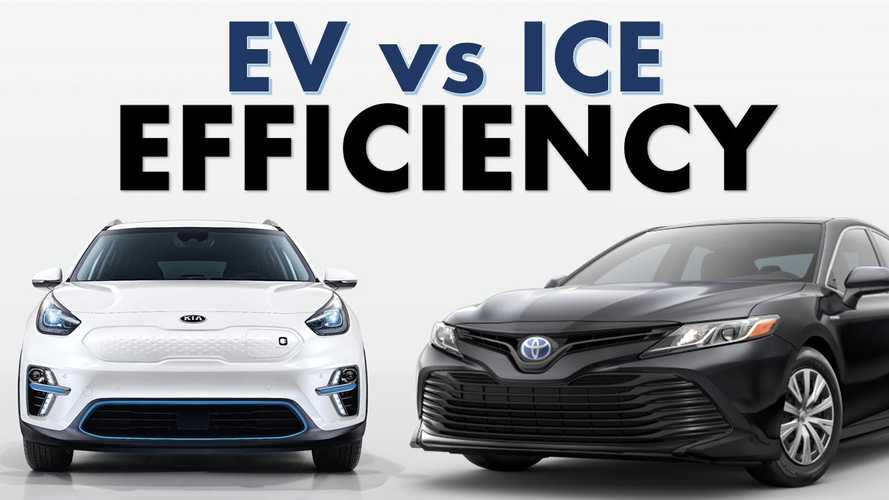
Photo credit: Insideevs.com.
Most of the electricity generated in the U.S. continues to come from fossil fuels (61% in 2021). This is not likely to change much in the future as electricity demand is increasing faster than renewables (20% of total in 2020 and 20.1% of total in 2021) can close the gap versus fossil fuels. Given that fact, it is interesting to ask the question:
Which uses fossil fuels more efficiently, an EV or ICE (internal combustion engine) vehicle?
Most of what you will read about EVs versus ICE vehicles discuss how EVs are more efficient at converting the energy they carry into motion (e.g. here, and here , and here, and here, etc.) but this is only part of the equation. The generation, transmission, and battery storage of electricity is very inefficient compared to the refining and transport of gasoline, and those inefficiencies each year add up to more than all of the gasoline consumed in the U.S.
EV Energy Usage per Mile
The average energy consumption of an EV vehicle is about 0.35 kWh per mile. At the U.S. average electricity price of $0.145 per kWh in June 2022, and assuming the 2021 average new car fuel economy of 39 mpg, this makes the ICE-equivalent fuel price of an EV $1.98 per gallon of gasoline. With the U.S. average price of gas now over $5.00 a gallon, this by itself (ignoring the many other considerations, discussed below) makes the EV attractive for month-to-month savings on fuel purchases.
But since most of this electricity still comes from fossil fuels, we must factor in the efficiency with which electricity is generated and transmitted and stored in the EV’s battery. This is how we can answer the question, Which uses fossil fuels more efficiently, an EV or ICE (internal combustion engine) vehicle?
The generation of electricity is pretty inefficient with efficiencies ranging 33% from coal and 42% from natural gas. As we continue to transition away from coal to natural gas, I will use the 42% number. Next, at least 6.5% is lost in transmission and distribution. Finally, 12% of the electricity is lost in charging of the EV battery. Taken together, these losses add up to the 0.35 kWh per mile energy efficiency of an EV increasing to 1.0 kWh per mile in terms of fossil energy being used.
ICE Energy Usage per Mile
How does the internal combustion engine stack up against the EV in terms of efficiency of fossil fueled energy use?
A gallon of gas contains 33.7 kWh of energy. But like the generation of electricity, it takes energy to extract that gallon of gas from petroleum. However, the refining process is very energy efficient (about 90%), so it takes (33.7/0.9=) 37.44 kWh of energy to obtain that 33.7 kWh of energy is a gallon of gas. At the 39 mpg gas mileage of 2021 cars, this gives an energy economy number of 0.96 kWh per mile driven, which is just below the 1.0 kWh fossil fuel energy usage of an EV. With advertised fuel economy of 48 to 60 mpg, hybrid vehicles (which are gasoline powered) would thus have an advantage over EVs.
Other Considerations
Of course, the main reason EVs are being pushed on the American people (through subsidies and stringent CAFE standards) is the reduction in CO2 emissions that will occur, assuming more of our electricity comes from non-fossil fuel sources in the future. I personally have no interest in owning one because I want the flexibility of travelling long distances in a single day.
There is also the issue of the large amount of additional natural resources, and associated pollution, required to make millions of EV batteries.
Furthermore, the electrical grid will need to be expanded to provide the increase in electricity needed. This greater electricity demand, along with the high cost of wind and solar energy, might well make the fuel cost advantage of the EV disappear in the coming years.
Finally, a portion of the true price of a new EV is hidden through subsides (which the taxpayer pays for) and high CAFE fuel economy regulations, which require auto manufacturers not meeting the standard to pay companies like Tesla, a cost which is passed on to the consumer through higher prices on ICE cars and (especially) trucks.
Marginal fuel economy and the environmental footprint of the rare earth elements are nothing short of catastrophic.
After they finish trying to replace the gas tax with an EV equivalent, they will cost more.
Can you not read. The analysis was very clear. Per mile. You can quibble over a few percent here or there, but that’s the reality whether you like it or not. If it weren’t for subsidies it would be a huge money loser life of vehicle. With subsidies you’re just paying it other ways whether you realize it or not is your problem.
Why do I get the feeling an EV purchase is coming from a lobbyist and on a par with a used car salesman for level of information disclosure? One other reason I’m reluctant is what the lobbyists did to my wallet in the previous case of making the case for HVAC system coolants to save the ozone layer. I distinctly recall the lobbyist line “it only costs pennies more” when in fact they were leaving out the full story that comes later from HVAC system salesmen and repairmen with regards to the system cost differences stemming from pressure differences and design issues of the coil. Return of the scum
I’m going to join an EV car club as an observer rather than a car owner. Maybe I can get some real answers while sorting through the rich toy issues there.
Not only that Roy, but all tyres are a potential source of carcinogenic Dibenzopyrenes. Since EVs are significantly heavier than ICEs, they wear down tyres quicker thus releasing carcinogens into the environment.
Eco-friendly, they are not
If I had an EV I could not go fishing at my favored stream in AZ it about 130 from my house, With AC I could not make the round trip since there is no charging station along the trip and if I charge in Payson I would spend more time charging than fishing.
Carry extra batteries in the trunk????
You could consider a PHEV.
What is your favorite stream? Asking for a friend who also lives in AZ and likes to fish and is always looking for a new spot to try.
For my particular circumstances charging my PHEV is more cost effective when gasoline is > $1.50/gal. At 100,000 miles I estimated that I’ve saved $3000 (or $0.03/mile) when factoring in capital cost, tax credit, maintenance, fuel, etc. relative to the ICE-only version of the same vehicle with the same options. With gasoline being well above $4/gal my accumulated cost savings is rapidly increasing now. That’s not bad especially considering I have no range limitations like would be the case with a pure EV. I realize everyone’s situation is different. I happen to live in a part of the country were electricity is relatively cheap.
There are hybrids that don’t need to be charged. Why buy one that does need to be charged? What am I missing?
It is a lot cheaper for me to charge than to use gasoline.
For short trips you could run solely on electric. Say you work under 10 miles from home. Round trip can be handled by most plug-in hybrids. Get home and plug it in for the night to do the same thing the next day.
But for longer trips the ICE kicks in and extends your range, getting the benefit of quick refuels.
And, hey, you get the bonus of annoying everyone with not only adding to the strip mining for lithium, cobalt, and rare earths and adding load to the electric grid, but also burning evil fossil fuels.
Full disclosure: my (not plug-in) Prius v meets two of those goals 😀 But I buy used, so the strip mining was already done…
Thanks for the explanations. I think I get it now. 🙂
Let us suppose that I have an electric vehicle and I only charge it at my residence. Is it charged with 110 or 220 I have no idea. What is the equivalent electricity use compared to household appliances? Would it be the same as an electric range or electric dryer or electric heat/air conditioning? Surely it is more than using my toaster. How much is my power bill going to go up if I always charge my car at home?
If you are in the United States you have 240v service. It is sometimes referred to as a split-phase system because the neutral wire is center tapped on the transfer providing 120v from leg-to-neutral. 110 and 220 are not voltages in use in the US generally speaking.
Anyway, you can charge on either 120v or 240v though most EVSE’s only support 240v. The amp draw depends on the charger in the vehicle. It would be common for most high capacity EVs to use a 50-amp EVSE on 240v which means given the 80% load via the NEC code would provide 40 amps or 40 * 240 = 9.6 kW charging rate.
Your power bill in this case would go up by 9.6 kW * X hours * Y $/kWH where X is the number of hours you charge in a month and Y is the electric rate.
And once more than a few people on the block has them start replacing all the utility infrastructure to support the load, all the way back to the source, all costs that will be picked up by taxpayers.
Ev owners are free riders, and as always once there is enough uptake the reckoning comes
Houses may have 240V service, but it isn’t available in the garage. You have to hire an electrician to provide the additional plug in the garage. Or preferably outside the garage to keep your insurance company and local fire department happy.
Many people have 240v service in their garages. If you don’t already it is legal to add it as long as it complies with the version of the NEC your local code authority is currently using. Insurance and fire departments don’t care if you have 240v outlets. Most homes in the US have at least one already.
Over my life I’ve been in hundreds of homes, only one or two had 240V drop to the garage and its always the dryer connection. In other words, you have to unplug the dryer if you want to charge your car.
I never said or even implied that it would be illegal to add a 240 service to your garage. Why don’t you try responding to the argument I actually made?
The fire department doesn’t care if you have 240V service in your garage, however they do care if you try to charge your electric car in the garage.
Maybe it is different in different regions. Where I live the fire department does not care. Insurance companies prefer the use of a garage regardless whether you have an EV or not here due to the frequency of hailstorms. In fact I get a small discount just for having a garage.
Just make sure your life insurance is up to date.
Give us Bob’s a break. 110 and 220 are vernacular terms. We know better….
EV’s are really what should be called “Remote Pollution Devices”. And the Pollution (or GHG emissions) is really dependent on the Grid Average GHG emissions for power generation which varies significantly. In CA it is low, but in many other locations it is not. As Dr. Spencer indicates.
What bothers me more is the enormous amount of mining necessary to produce both batteries and highly efficient electric motors (rare earth elements). There is both an environmental impact and ever escalating costs for obtaining these needed elements to make EV’s work.
“In CA it is low”
Really? Does that include the FF generated electricity Cali imports from other states. I doubt it if the numbers you use are from ANY Cali government entity.
“But since most of this electricity still comes from fossil fuels, we must factor in the efficiency with which electricity is generated and transmitted and stored in the EV’s battery.”
Why? According to Roy, the basic arithmetic to the consumer is
“this makes the ICE-equivalent fuel price of an EV $1.98 per gallon of gasoline. With the U.S. average price of gas now over $5.00 a gallon,”
If the EV process uses hydrocarbon so much less efficiently than just putting it in your tank, who is paying for the difference? Not the consumer, evidently.
Progressive prices. Shared responsibility.
1) Electricity prices don’t include road use taxes.
2) Current gas prices include quite a few devices by you alarmists to increase the cost.
3) You aren’t including any of the many subsidies enjoyed by EV users.
4) There is a big difference between cost and price. Perhaps you never got that far in your math classes?
C’mon Nick…trolling today. Grab another blanket dude.
RY my mom? She keeps her house at 27C.
As seen in the photo, the ‘fuel’ filler does have a smaller ‘pipe’ though!
I like using 2007 as a baseline for electricity generation. It may seem arbitrary, but that was the year that electricity growth basically stopped (4,157 Billion kWh in 2007 vs 4,116 Billion kWh in 2021). Generation from renewables has roughly doubled in that time with wind/solar going from roughly 0% of generation to 10% of generation.
I’m not sure that I would say “generation is growing faster than renewables.” While that may be true globally it is not true in the US for any time frame larger than 1 year and smaller than 30 years.
Good article.
Any thoughts on other vehicle types?
Trucks
Planes
Construction equipment.
Ships
“The generation of electricity is pretty inefficient with efficiencies ranging 33% from coal and 42% from natural gas.”
More like 60% for a modern CCGT installation.
Nuclear “efficiency” is poor compared to all of that, but given the fact the only attempt at small nuclear motor is the Russian cruise missile (nuke planes have been tried once), the comparison never comes into play.
Overall, I’m not a fan of electric cars. Roy Spencer’s analysis looks very good.
I think they’re fun to drive, due to good acceleration and fast response to the accelerator.
But I regard them as expensive toys rather than fully practical vehicles for all applications.
The big, big problem is the batteries. They are dirty, almost impossible to recycle, prone to catching fire, require absolutely massive mining operations. There arfe ethical problems linked to child labour. EV drivers seem to be dominated by charging their cars and also by a constant search for the next charging point while out on the road. If EV numbers do increase massively as governments want, they will probably get a lot more expensive due to limited supplies of essential metals sych as lithium and cobalt.
One thought occurred. I believe that batteries get significantly less efficient with age. Probably the manufacturer’s data is for brand new cars. So it would be interesting to see how both EV’s and ICE’s lose efficiency over their lifetimes. That could be a significant part of the equation.
Chris
The IEA has recently said that the price of lithium has increased by almost 750% since January 2021 and it foresees worldwide shortages of both lithium and cobalt as early as 2025.
What EV fans will do to convince others that the EV transition is good for all …
“One person who needs no convincing is keen caravanner, Keith Blackburn from Canberra, who has become something of a pioneer in electric vehicle van towing.
The Canberra Times reports that Keith was an early convert to EVs and took delivery of a Tesla Model 3 long range model back in 2019, the same year that Scott Morrison declared that electric vehicles would ‘ruin the weekend’.
Canberra Times extract;
“Determined to prove the one-time PM wrong, Keith set out to show his Tesla could take him on decent length trips … and that the van could come too!
While his Model 3 was factory-rated to tow one tonne, Tesla didn’t offer a towbar so Keith tracked down a US company, Stealth Hitches, which did. The Canberra Times reports that the national Tesla owners club, which was keen to support Keith’s quest, had it uprated and compliant to tow the full 1000kg.
The next challenge was finding a caravan which fell well under the Tesla’s tow rating and provided a safety margin. Keith settled on a unique teardrop-shaped design from Canada called the Alto, which weighed in at 766kg. It boasts a lightweight sandwich-type construction with electric actuators to raise and lower the roof so that under tow it has far less wind resistance than a normal van. However, once on site, the roof can quickly be raised to a conventional height.
When not towing, Keith’s dual motor Tesla long range usually has a range of around 500km.
In order to test the capabilities of his new set-up, Keith towed his van from the South Coast of NSW, up the Clyde Mountain, and back to Canberra … all on a single battery charge.
“My calculations on the net rise and fall in the highway from the coast to home indicated that, with regenerative power to assist, the journey was achievable without a recharge,” the retired statistician to the Canberra Times. “It was always going to be touch and go, but I knew that if I got really low on battery, there were recharge stations at Braidwood and Bungendore as a back-up.”
Keith safely made the trip with an indicated range of just seven kilometres left after the 198-kilometre journey.”
Hmmm
We have a Tesla. Great car, but:
– we charge at night (using 100% natural gas, likely)
– a trip from CA to AZ cost about $55 in supercharger fees, one way. Cheaper than gas (especially Biden prices) but probably not much savings vs a hybrid
– charging at a Supercharger adds about an hour or more extra to our trips to AZ.
– range is constrained by speed and limits on trying to stay between 20-80% charge levels.
– however far I need to go I multiply by 1.3 to be sure I have that much charge / range as I never get 100% of stated range
– non-Tesla charging is slow. Chargepoint at work only adds 15-20 miles each hour.
– we added solar at home to help offset charging costs (net Metering)
– how apartment dwellers would easily charge their cars is going to be a huge issue
Again, great car. Comfortable, quiet, and fast. But it I don’t believe it will save the planet or work well for most people who can’t charge at home or work.
The MPG to use for comparing an EV to a conventional vehicle’s MPG is the EV’s MPGE times the combined generation, transmission and distribution efficiency of providing the electricity that is used to charge the EV. A typical figure for combined generation, transmission and distribution efficiency for providing electricity from fossil fuels is 35%.
I just stumbled on this gem:
https://www.legrand.fr/pro/catalogue/41514-74-kw-32-a/borne-monophasee-metal-avec-protection-dc-greenup-premium-2-vehicules-electriques-modes-2-et-3-74kw-32a
They sell you a glorified (communicating over IP, remote controlled) mono 230 V 32 A socket, for only 5001€ without taxes.
To charge a car with 7.4 kW power.
Or 67 euro cent for each watt of power.
But you can manage that huuuuuge power source in mode 3!
I also found this non Wifi capable, non smartphone manageable, non “smart” device:
https://www.bellflowsystems.co.uk/wall-mount-diesel-dispenser-cabinet-diesel-transfer-pump-kit.html
For €303.27 (excl. taxes), and assuming the appropriate tank is available of course, you get a distributor of 1 liter of diesel fuel per second.
This source gives energy content for many liquid fuels. (It’s in French but since it’s mostly chemistry.)
https://www.douane.gouv.fr/sites/default/files/uploads/files/2020-08/Annexes_circulaire_TIRIB.pdf
It agrees with many other sources I checked: “le gazole” in French (diesel) gives at least 32 MJ per liter.
So the dispenser sends each second an amount of combustible sufficient to produce 32 MJ of heat from a chemical reaction. Of course we are discussing cars here, not heaters, so I won’t end up with that value.
Diesel motors have higher efficiency than “super”/regular gas motors; highest cited figure is 40% but let’s say for practical use on the roads (frequent changes of power) it’s close to 20%.
We end up with 6.4 MJ of usable motive energy per second of tank refilling.
For an electric car, the efficiency of the motor is much higher: a car maker gives an estimate of 90%.
For simplicity, as precision won’t be needed here, let’s neglect all the electric system conversion losses and battery losses. Let’s say heating won’t be needed.
So assuming no energy wasted during charging, that’s 6 660 J of more charge for each second for the 5001 € plug.
Compared to 6 400 000 J for the diesel pump: the 303 € pump procures 960 times more usable (mechanical) energy for a given refilling time than the 5001 € socket.
(That’s NOT 960% more. That’s times 96000%, or 95900% more.)
I’m fully aware that many simpler, cheaper, more “cost efficient” options exist, from this simple 16 A normal plug adapter device: “Evse Car Charger Type 1 J1772 Eu Wall Socket”
If you want to trust your electric safety on something called “Dirtypigs“, it will cost only 339 €, for a power rating of 3.6 kW, that’s 9 euro cent per watt, a much better deal than the 67 euro cent for each watt of power of the smartphone controlled communicating socket by very respected brand Legrand.
To clear up the confusion, mode 3 can refer to two very different things:
The high end mode 3 sockets can do the second, while the cheaper ones only do the first.
39 miles per US gallon for 2021 cars? Come on! The biggest selling vehicle in the US is the Ford F-150. I’m averaging 0.2 kWh per mile with my plug-in hybrid. On average, an electric motor is four times more efficient than an ICE.