
Ongoing La Niña, above-average Atlantic temperatures set the stage for busy season ahead
May 24, 2022
Forecasters at NOAA’s Climate Prediction Center, a division of the National Weather Service, are predicting above-average hurricane activity this year — which would make it the seventh consecutive above-average hurricane season. NOAA’s outlook for the 2022 Atlantic hurricane season, which extends from June 1 to November 30, predicts a 65% chance of an above-normal season, a 25% chance of a near-normal season and a 10% chance of a below-normal season.
For the 2022 hurricane season, NOAA is forecasting a likely range of 14 to 21 named storms (winds of 39 mph or higher), of which 6 to 10 could become hurricanes (winds of 74 mph or higher), including 3 to 6 major hurricanes (category 3, 4 or 5; with winds of 111 mph or higher). NOAA provides these ranges with a 70% confidence.

“Early preparation and understanding your risk is key to being hurricane resilient and climate-ready,” said Secretary of Commerce Gina M. Raimondo. “Throughout the hurricane season, NOAA experts will work around-the-clock to provide early and accurate forecasts and warnings that communities in the path of storms can depend on to stay informed.”
The increased activity anticipated this hurricane season is attributed to several climate factors, including the ongoing La Niña that is likely to persist throughout the hurricane season, warmer-than-average sea surface temperatures in the Atlantic Ocean and Caribbean Sea, weaker tropical Atlantic trade winds and an enhanced west African monsoon. An enhanced west African monsoon supports stronger African Easterly Waves, which seed many of the strongest and longest lived hurricanes during most seasons. The way in which climate change impacts the strength and frequency of tropical cyclones is a continuous area of study for NOAA scientists.

“As we reflect on another potentially busy hurricane season, past storms — such as Superstorm Sandy, which devastated the New York metro area ten years ago —remind us that the impact of one storm can be felt for years,” said NOAA Administrator Rick Spinrad, Ph.D. “Since Sandy, NOAA’s forecasting accuracy has continued to improve, allowing us to better predict the impacts of major hurricanes to lives and livelihoods.”
Additionally, NOAA has enhanced the following products and services this hurricane season:
- To improve the understanding and prediction of how hurricanes intensify, NOAA’s Atlantic Oceanographic and Meteorological Lab and Pacific Marine Environmental Lab will operate five Saildrone uncrewed surface vehicles during the peak of the 2022 hurricane season and coordinate for the first time with uncrewed ocean gliders, small aircraft drone systems, and NOAA Hurricane Hunter aircraft to measure the ocean, atmosphere and areas where they meet.
- The Hurricane Weather Research and Forecast Modeling System and Hurricanes in a Multi-scale Ocean-coupled Non-hydrostatic model, which have shown significant skill improvements in terms of storm track and intensity forecasts, have been successfully transitioned to the newest version of the Weather and Climate Operational Supercomputing System, allowing for uninterrupted operational forecasts.
- The Excessive Rainfall Outlook (ERO) has been experimentally extended from three to five days of lead time, giving more notice of rainfall-related flash flooding risks from tropical storms and hurricanes. The ERO forecasts and maps the probability of intense rainfall that could lead to flash flooding within 25 miles of a given point.
- In June, NOAA will enhance an experimental graphic that depicts the Peak Storm Surge Forecast when storm surge watches or warnings are in effect. Upgrades include an updated disclaimer and color coding that illustrates the peak storm surge inundation forecast at the coast. This tool is currently only available in the Atlantic basin.
“Hurricane Ida spanned nine states, demonstrating that anyone can be in the direct path of a hurricane and in danger from the remnants of a storm system,” said FEMA Administrator Deanne Criswell. “It’s important for everyone to understand their risk and take proactive steps to get ready now by visiting Ready.gov and Listo.gov for preparedness tips, and by downloading the FEMA App to make sure you are receiving emergency alerts in real-time.”
NOAA’s outlook is for overall seasonal activity and is not a landfall forecast. In addition to the Atlantic seasonal outlook, NOAA has also issued seasonal hurricane outlooks for the eastern Pacific and central Pacific hurricane basins. NOAA’s Climate Prediction Center will update the 2022 Atlantic seasonal outlook in early August, just prior to the historical peak of the season.
Climate, weather, and water affect all life on our ocean planet. NOAA’s mission is to understand and predict our changing environment, from the deep sea to outer space, and to manage and conserve America’s coastal and marine resources. See how NOAA science, services, and stewardship benefit your community: Visit noaa.gov for our latest news and features, and join us on social media.
Lovely. Haven’t been in US since 1982 and I’m going to N Carolina in June to attend my son’s wedding. Bring a raincoat.
I’d be a lot more worried if I was coming to NC in September. Odds are you’ll be fine.
Aren’t you afraid of the ultra-MAGAs tfn?
Do they get fired when they are wrong again?
”NOAA Predicts Above-Normal 2022 Atlantic Hurricane Season”
Does that mean it is going to get colder?
It only takes 1 major Hurricane to make landfall for a catastrophe and news headlines.
This can happen in a below normal Hurricane system as well.
So playing with a marked deck whenever and wherever a Hurricane hits land.
–
The obverse to the reasoning used is, while yes, La Nina conditions persist they are merely reflective of a cooler overall world. Since Global temperature is falling not going up at the moment The Atlantic will be slightly less warm than recently [still hotter than usual] and the science says that above usual temperatures tend to produce more hurricanes of the lower categories.
–
Does that mean it is going to get colder?
Yes.
Due no doubt to global warming the world is currently getting colder.
first of all, they’re corrupt politicized liars shilling for man-caused global warming interests.
second, who cares what they think? when they’re wrong we still treat them like experts.
third, these bozos decided to start naming mere storms about 20 years ago (prior it was hurricanes only) so now they can BS us by saying this one and that one are ‘record breaking.’
you want names? I’ll give you names: Ah-Chit, Bilbo, Chewing Gum, Darkie, Eggplant, Fungool, Grunties, Hurricane, Ironman, Jack-Chit, Kilroy, Lucky Strike, Moose Breath, NooKeyLar, Orenthal, Pizza, Fa-Q, Rub-a-Dub, Squeaky, Tea, Underwear, Vinegar, Whitey, Xebec, Yuck, Zardoz.
those are much better.
They seem to be so confident in the max figure that they only list 21 names. Let’s hope they don’t need more.
If they couldn’t find Quentin and Ursula in their names lexicon, how will they fare with X, Y, Z names?
There are some doozies here: https://www.familyeducation.com/baby-names/first-name
Xerxes, Ygraine, Zachariah. I’m keen to help!
I found this
https://www.cpc.ncep.noaa.gov/products/outlooks/hurricane-archive.shtml
Looking back to 2010 I see only one season where they predicted below average, 2015
Most were above average with the rest near average
All the ones predicted to be average the next highest probability is above average, below average being the loser who gets picked last for the team.
Looks like prediction bias. That’s why they started counting rainstorms, to make the data fit
In the context of repeat La Niña events, the April average anomaly was noticeably stronger than any of the other 8 second-year La Niñas.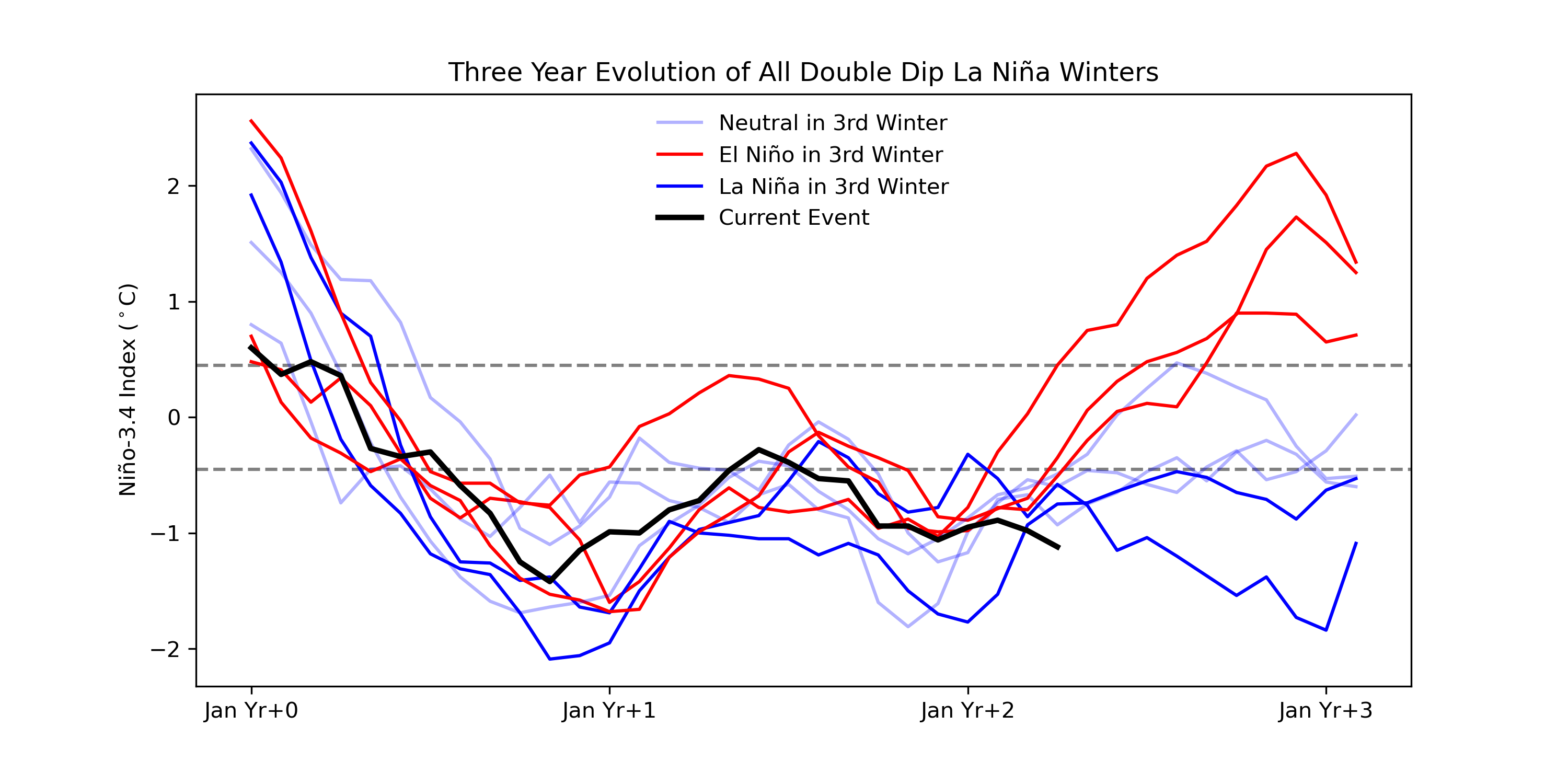
During La Niña, the even-warmer west Pacific and even-cooler east Pacific act to strengthen the Walker circulation. In April, both the trade winds and upper-level winds were stronger than average. Along with the April 2022 pattern of more rain than average in the western Pacific and less in the central/eastern Pacific, we have ample confirmation that La Niña conditions are still going strong.
https://www.climate.gov/news-features/blogs/enso/may-2022-enso-update-piece-cake
Stream current pressure in the western US favors tropical storms in the eastern US.
Severe thunderstorms in Texas.
How confident should we be that it won’t start as early as last year?
Can anybody tell me how many NOAA predictions have been accurate?
Mumbles provided the data in a post earlier in this thread.
Severe thunderstorms across the southern US are entering from the Gulf of Mexico.
A cooling climate can increase Atlantic hurricanes. I argued this during the 12 year drought in land falling hurricanes. The contrast in temperatures between the Atlantic tropical and north Atlantic air masses is an important factor. Of course the tropical Atlantic does have to be warm enough. Look at the scary North Atlantic cold water extent on the Unisys map
But will the hurricanes be allowed to pick their preferred pronouns since they don’t get to choose their names?
The current circulation over North America could lead to flooding in the eastern US.
From the article: ““As we reflect on another potentially busy hurricane season, past storms — such as Superstorm Sandy, which devastated the New York metro area ten years ago —remind us that the impact of one storm can be felt for years,” said NOAA Administrator Rick Spinrad, Ph.D.”
“Superstorm Sandy” was not one storm but two hurricane-strength storms, Sandy and a Noreaster, which combined over New York. Shouldn’t the NOAA Administartor know details like that?
Severe thunderstorms in Alabama and northern Florida threaten flooding.
I am 70 % certain that the months of June, July and August will be hotter than the month of May here in the USA.
They will be hot in the west and very wet in the eastern US.
“NOAA’s outlook is for overall seasonal activity and is not a landfall forecast”
So much for a forecast that has any practical meaning…