Guest Post by Willis Eschenbach
Well, it seems like climate alarmists have noticed that all their hysterical screeching about carbon dioxide (CO2) isn’t having the desired effect. So they’re turning to a new villain, methane (CH4). Here’s Nature, which used to be a serious scientific journal, moaning that methane is “soaring” to new heights.

Figure 1. Page from Nature magazine, original here.
Now, anyone who knows me knows what I did after seeing that—I went and got the data to see what’s going on. We have data from a couple of sources—modern measurements, and ice cores. The Nature article only showed the change since 1984, but I always start with a long overview to give context to the data. Here’s the change in atmospheric methane since 1750.

Figure 2. Changes in airborne methane since 1750. Ice core data to 1980, modern measurements from 1984 onwards
Now, there are a couple of puzzles in this data. First, nobody knows the cause for the slowdown in methane rise that started about 1985 and ended around 2005.
Next, nobody knows why the rise started again. From the Nature article:
The growth of methane emissions slowed around the turn of the millennium, but began a rapid and mysterious uptick around 2007. The spike has caused many researchers to worry that global warming is creating a feedback mechanism that will cause ever more methane to be released, making it even harder to rein in rising temperatures.
“Methane levels are growing dangerously fast,” says Euan Nisbet, an Earth scientist at Royal Holloway, University of London, in Egham, UK. The emissions, which seem to have accelerated in the past few years, are a major threat to the world’s goal of limiting global warming to 1.5–2 °C over pre-industrial temperatures, he says.
YIKES!! WORRIED RESEARCHERS! LEVELS GROWING DANGEROUSLY FAST! FEEDBACK MECHANISM!
(In passing, can I say how bored I am by scientists and researchers who are “worried”? Near as I can tell, these guys sit up nights looking for things to be worried about, and when they seize on something, they try to convince us that we all should be worried about it too … but I digress.)
In any case, just how fast are the methane levels rising? To investigate that, here’s a graph of the five-year “trailing trend”. This is the trend of the change over the five years previous to each year of record.

Figure 3. Changes in the five-year trailing trends of the rise in atmospheric methane.
Call me crazy, but I’m not seeing what the “worried researcher” described as methane levels “growing dangerously fast” … they’re only growing a third as fast as they were in 1985.
My conclusion?
I’m not going to be concerned until such time as the trend starts getting up somewhere around the 1985 levels.
My best to everyone, whether you’re worried or not …
w.
MY USUAL: When you comment PLEASE quote the exact words you are discussing. I can defend my own words and I’m happy to do so. But I can’t defend your interpretation of my words.
DATA:
One third of our methane comes from growing rice and another third from domestic animals, mostly in poor countries.
https://www.cfact.org/2021/11/04/cop-26-methane-madness/
When does the great slaughtering of western-grown animals begin….for the cause and the children?
Canada is doing our part, we slaughtered 600,000 chickens in the fraser valley during the november flood.
In attention to flood control caused this, so “we” did this, yes.
Let us start with the dogs that bark constantly, especially at night. Of course, it is the dog’s owners that are really responsible, so maybe they should go together.
Watch out for the dog that doesn’t bark, a tell tale sign, as Sherlock Holmes noted
Reminds me of the old tale:-
Man and wife trying to sleep whilst dog next door barks and barks.
“Ruddy dog will drive me mad. Every night, bark , bark, bark”.
“Don’t moan at me, do something about it.”
Next day, talking to neighbour “That’s a fine dog! I wish I had a dog like that.
Would you think of selling me that dog for £500?”
Money changes hands and dog goes next door to new home.”
That night “Bark, bark, bark”.
Old fellow starts laughing.
Wife:- “What the hell are you laughing at?”
“Ha ha ha. Now we’ll see how he likes it!”
That tale has as much to do with the terrors of Methane, as the genius psyentists’s modelling has to do with reality.
Imagine the squeals if we told them to go sort out some termites to compensate.
Been tried. Didn’t work well for the Xhosa. I don’t expect much different results with the CO2 pandemic.
https://www.ozy.com/true-and-stories/the-cattle-massacre-that-haunts-south-africa/88717/
https://www.siyabona.com/eastern-cape-xhosa-cattle-killing.html
Just get rid of the cattle in India and Brazil and you will halve the number of cattle in the world, although I think the Indians would have something to say about that as the cow is sacred to Hindus.
In the US about 60 million buffalo were killed off in the 1800s and mostly replaced by cattle, so no overall change there.
Let’s nuke ’em, that will fix the problem.
There’s no CO 2 in nuclear fallout.
But there is in the fires caused from heat during the initial blast
Heat precedes the blast wave.
Nukes are much overrated.
Methane’s estimated mean half-life in Earth’s atmosphere is 9.1 years, according to IPCC in 2013. How that figure was estimated, I don’t know. Nowadays higher linger times are bandied about.
CO2’s half-life is usually given as over a century, but I’m dubious.
CO2 is mostly gone in 6 years or so. About 25% of the total atmospheric CO2 content is replaced every year by the great flux. Those long times are actually the speculative estimate of how total CO2 would reduce if our emissions stopped. Nothing to do with residence time, but often confused with it.
Yes, IPCC is confused about a lot of things.
I disagree! The UNIPCC isn’t at all confused, it has an agenda & is determined to see it through, a One-World globul guvment, un-elected, un-democratic, un-accountable, & un-sackable!!! We had a cracker of a slimy Socialist politician called Peter Mandelson who tried to convince us that we are/were living in a “post-democratic” World. Being a true Socialist he only consorted with millionaires & enjoyed the trappings of their wealth & life-styles!!! We’ve heard all the slimy claims before up to & including the “temporary” suspension of democracy to fight Climate Change!!! However, being a cynical old git I view the word “temporary” with deep suspicion. I note that when the Earth’s climate changed in the past, early Humans didn’t bother “fighting” change, they adapted to it & amazingly, we’re still here, go figure!!!
Methane molecules continually bumping into Oxygen molecules.
Yielding CO2, H20 and loads of energy.
Yet it takes 6 years for this to happen?
Call me skeptical….
CO2 half-life is around 10 years, judging from the bomb spike data.
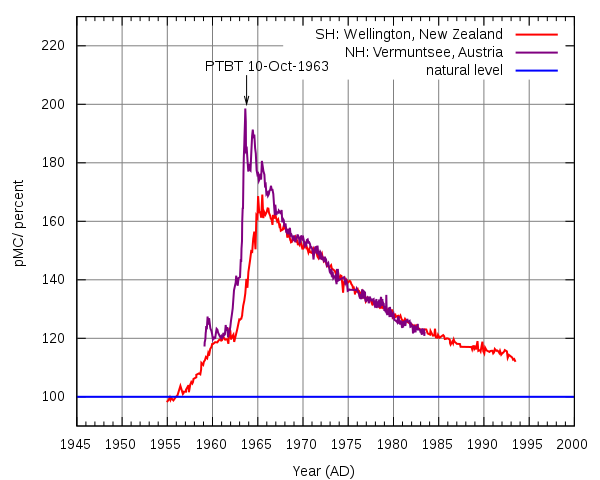
Thanks, Mike. You need to distinguish between atmospheric residence time and pulse decay time.
Residence time is how long a given CO2 molecule stays aloft in the atmosphere. As you show above, that has a half-life on the order of 8-10 years.
Pulse decay time, on the other hand, is how long it takes for a pulse of CO2 added to the atmosphere to decay back to the previous atmospheric CO2 level. That has a half-life on the order of 30-40 years or so.
Regards,
w.
Pulse decay time. 5400 Mt is in the atmosphere. 600 Mt is added in a year, but on the same date next year, the atmosphere has only 5420 Mt before new 600 Mt next year are added – Out of 6000 Mt at a given moment only 5420 will be in the atmosphere next year on the same date, if nothing more is added. Decay per year is 9.7 percent. Half life is then appox 7 years
Bjarne, the extra uptake of CO2 doesn’t depend of the yearly addition of CO2, but of the extra CO2 pressure in the atmosphere compared to the equilibrium CO2 level for the current average ocean surface temperature, which is about 295 ppmv.
The real CO2 pressure is 415 μatm (~ppmv), that is 120 μatm above equilibrium. The uptake has a linear relationship with the pressure difference between atmosphere and oceans (and water in the plant leaves). For a linear decay rate the decay rate to 1/e (37%) of the initial pulse is easy to calculate:
tau = cause / effect
In 1959: 25 ppmv extra CO2 in the atmosphere, sink rate 0.5 ppmv/year, tau = 50 years, half life time 34.7 years
In 1988: 60 ppmv extra, 1.13 ppmv/year, tau = 53 years, half life time 36.8 years
In 2012: 110 ppmv / 2.15 ppmv/year, tau = 51.2 years or a half life time of 35.5 years.
Looks very linear to me, widely within the borders of accuracy of the emission inventories and natural sink capacity variability…
The amount present in the atmosphere plays no role at all for the decay rate, only the CO2 partial pressure does, but it does for the residence time.
The residence time in the case of huge bidirectional seasonal flows is quite small (around 4 years), but that doesn’t change the amount of CO2 in the atmosphere, it is all exchange, not change and near all caused by temperature changes.
I should have mentioned that the gas is methane, not CO2 which does not decay
This is simply not true. It does have a reasonably short half-life largely due to biological processes and ocean solubility.
Both CO2 and methane “decay” with a ~5-year half-life, which means that they are both rather short-lived in the real world.
Mass of 1 ppm CH4 is 2800 Mt
Concentration: 1.9 ppm (approx 5400 Mt)
emission, one year: 0.24 ppm (600 Mt)
Increas, one year: 0.007 ppm (20 Mt)
What is wrong?
Charles, both the biosphere and the oceans don’t increase their uptake instantly at the same rate as a CO2 increase in the atmosphere…
Most natural processes are temperature controlled: diurnal, seasonal, multi-year and multi-millennia… The largest CO2 fluxes are seasonal and bidirectional: from the oceans to the biosphere in spring/summer and reverse in fall/winter. That are huge flows which give the short residence time of 4-5 years.
That says nothing about how an extra shot CO2 into the atmosphere behaves.
For the biosphere an increase of 10% CO2 in the atmosphere may give 5% more growth over many years and for the ocean surface waters that is only 1% more uptake with a half life of less than a year, due to the limited buffer capacity of the oceans for CO2 (still 10 times than for fresh water).
The main sink is in the deep oceans, but that has a limited exchange rate with the atmosphere via the sinks near the poles and the upwellings near the equator…
The average decay rate of the current CO2 level above equilibrium is measured and is around 50 years.
If you mean the chemical decay, of course that is right…
Anyhow, interestig read
FE
Added Co2 to the atmosphere is in a way “forced” because of the anthropogenic component, however many of the sinks are also “forced” as in plant and algae’s sequestration, so I am not so sure your comments are as cut and dry as you make them out to be.
bob, the net sink rate of every year can be calculated from two known variables: how much is emitted by humans (from sales taxes) and how much the increase in the atmosphere is. The net difference is what nature has absorbed or added.
In the past 60+ years it was near always more absorption than addition, with only a few El Niño years borderline.
The net absorption is all natural (there are not much human made sinks), that gives the sink rate for the extra CO2 pressure of any given year in the past and if that is a linear process (which is the case, at least for the ocean waters), the e-fold decay rate is an easy formula…
FE
Can you and/or Willis explain something to me? each year there is a rise and fall in the Mauna Loa readings (10 to 15 PPM), I believe they correspond with the the norther winter/summer cycle. One thing that puzzles me why is the transition so abrupt? the slopes in both direction seem to be pretty steady and the transition from rise to fall is very sharp and from fall to rise appears to go dead stop for a short time and then launch off at a steep rise. .
Not sure if I’d call the transitions “abrupt” …
In any case, it’s the transition from carbon source to carbon sink, seems like that would be fairly fast.
w.
Just seems to me that since the transition in the north is from is 2 to 3 months in both the spring and fall that the transition would be longer. the graph you posted has source transition as remarkably quick looks like maybe 3 weeks at the most. Was just curious.
Bob, de transitions over the seasons are huge, according to the IPCC:
In spring/summer:
60 PgC absorbed by new leaves and further growth of plants.
50 PgC released by the warming ocean surface.
In fall/winterL
60 PgC released by fallen leaves and all year round rotting/eaten plants
50 PgC absorbed by the cooling ocean surface.
The difference of 10 PgC is the amplitude of the net seasonal change you can see in the MLO (and other NH) data. That is about 5 ppmv amplitude.
The NH is mainly land and the extra tropical forests are largely deciduous wood, which has a strong uptake in spring, that gives the fast drop. Release of CO2 has a peak in fall from fallen leaves, but is more widespread over a year, even mid-winter under a snow deck…
For the oceans the release/uptake is directly proportional to the water temperature.
In the SH, oceans and land are more or less in equilibrium for releases/uptake and there is hardly any seasonal amplitude.
That vegetation is the main cause of the amplitude can be seen in the δ13C variation over the seasons: if the main cause is vegetation then CO2 and δ13C are changing in opposite directions, if the oceans are the main cause, the changes are in parallel…
Bob,
I agree with you about the ‘abruptness’ of the switch between the spring/summer reduction in atmospheric CO2 and the increase during autumn/winter (and vice versa). Generally, at Mauna Loa the drop is about 6 ppmv each year and the increase is about 8 ppmv (with variations largely due to ENSO/Pinatubo), hence the long term increase of about 2 ppmv per year. However, to get a better understanding of what is happening at Mauna Loa, which is at a latitude of close to 20degN, I recommend focussing initially further north as the evidence points to the Boreal forests (approx 50degN to 70degN) being a key driver of the seasonal cycle in the Northern Hemisphere. I don’t have time to go into further detail right now, but would strongly recommend you take a look at the video available here:
https://gml.noaa.gov/dv/iadv/graph.php?code=MLO&program=ccgg&type=lg
Watch how the CO2 levels increase/decrease first at these higher latitudes which then ‘pull up’ and ‘pull down’ the values further south, with only a minor affect into the Southern Hemisphere.
If a pulse decay takes 30-40 years – does that mean any effort to “stop the rise” will have no real effect on temperatures for a generation even if the CAGW panic mongers are right?
I think the point that both WE and FE are making is that the pulse decay is irrelevant to CO2 concentration in the atmosphere, its simply source vs sinks. Is some how the sinks are larger than the source then concertation will decrease, right now its the opposite. There is a temperature component but its minor.
Does it really matter? We aren’t concerned which CO2 molecules are in the atmosphere. As long as the ocean outgasses to make up for the ones that decay, we will be even.
I dare say that the half-life will be adjusted to produce the worst possible outcomes for the planet. Curious how throughout Human history fear has been used to create conditions for manipulation & control, & still used today in a Human society that’s never been better educated & enlightened in said Human history, so I take such claims with a pinch of salt!!! However, I’m just a cynical 64 year old grumpy old man, & enjoying it!!!
This was a mistake of honesty on the part of the IPCC because they had not realized that they could demonize methane for their purposes. I bet they claim longer times now.
Study averages place methane at about 5 years for half-life. The IPCC was claiming 100–500 years for CO2, but NASA did not want to be outdone and claimed 1000 years for CO2. This is so political that it turns a scientists’s stomach.
Burning methane to make electricity is why the US met Kyoto enission reduction goals, unlike those industrial nations that signed the accords.
If methane is a much more potent greenhouse gas than CO2, and of course burning CH4 converts it to CO2, then gas-fired power might be by far the best for the climate!
The methane comes from decomposing grass.. Be it on the field or in the cow’s stomach makes no difference. The ICCP has been misrepresenting methane vs. livestock data since the beginning. Right now there’s another “natural phenomenon” coming up: Gates, Vanguard, Blackrock and co. want to sell us lab meat, so meat from livestock must go…
Actual studies of methane release by the biomass of melting permafrost has shown that, when the life wakes up, it quickly becomes a carbon sink as it craves carbon for growth and does NOT just sit there and rot.
Another thing not often mentioned is that the half-life of methane and CO2 in the atmosphere is only about 5 years. NASA would like to claim the it’s 1000 years for CO2, trying to pretend that most of the CO2 from the last 1000 years is still in the atmosphere (and it’s then all our fault). There are quite a number of studies on CO2 half-life, with an average around 5 years. Methane data indicates the same thing.
A 5-year half-life means that these gases turnover quite quickly and do NOT accumulate in the atmosphere. That makes the warmist arguments very weak and thus meaningless.
Charles, turnover or residence time indeed is 4-5 years, but that has nothing to do with the removal time of an extra injection of CO2, whatever the source, that needs some 50 years (far below the 1000 years of the IPCC).
Compare it to the difference between turnover time of goods (thus capital) through a factory and the financial gain (or loss…) the same factory makes…
Thanks, Ferdinand. I get tired of repeating this.
w.
How would we know? With 2/3 of the surface area being oceans and all? Permafrost dew?
Once again, a doom laden load of crap from ‘scientists’ who are ‘seeing’ things that aren’t there. It’s a good job there are scientists like Willis who can provide the actual truth.
When methane is no longer the bad boy, what other gases should we expect to hit the headlines?
Water vapor?
Let’s see them ban that.
no more hot steamy showers!
No more hydrogen powered cars !
No more laughing gas!
Well, be honest it is a deadly substance, apparently if you breath enough of it in its solid form, it can be fatal!!! 😉
PS I recommend to those you may not have seen it, go on You Tube & hunt down Penn & Teller’s petition for banning Dihydrogen-Monoxide, it’s staggering how many young people (mostly) were only too willing to sign it!!!
O2.
Very dangerous oxidant – should be banned immediately 🙂
Anything synthetic, i.e. man-made.
Oxygen.
A carbon-based life-form decrying the existence of carbon beggars belief.
All living things are pollution.
And then they came for my carbon …..
The worshipers of death are a large cult.
with the equivalent of Jesuits
I’ll be honest, as I’ve gotten older my methane contribution has definitely increased.
Ditto
Tritto
Quadritto
and Quintitto
Eating lots of cabbage sprouts beans and ognions will cause a methane global climate catastrphe! 🙂
The vegans did it.
Methane madness?
Pythagoras died because of an aversion to beans. He was being pursued by a crazed mob of democrats [that’s little d not big D] and was caught on the edge of a field of beans. Apart from geometry Pythagoras and his followers came up with theories about why people should have nothing to do with beans. Adhering to his principles he would not cross the bean field and was beaten to death by the democrats [little d not big D].
Once you are 60, never assume it’s just methane.
With the benefit of practising control, I reckon I have become marginally more tuneful as well.
They can switch the claimed cause all they want but it won’t help them sell their scam any more effectively.
You underestimate politicians and other group thinkers.
and the sheeple
Too much methane? Excuse me . . . .
Did you hear about the teacher who would not toot (pass gas) in public? He was strictly a private tutor.
Solution: Butt plugs and crack pipes for all!
That’s in the Brandon Health Care initiative, at least the crack pipes are.
Its been noted here before that scientology alarmism states methane is 85x more greenhousy than CO2.
But 1.9ppm x 85 is only 161.5ppm vs CO2 current 420ppm which means its still 2.6X less greenhousy than CO2?
So if CO2 is nothing what is CH4?
Am i a denier?
It is not just the concentration and the absorption properties, but how the absorption curves overlap with the other gasses already in the atmosphere.
Methane overlaps nearly completely with existing atmospheric components.
I think that 80x crap is just more made up warmista malarkey.
Their perfect record of being wrong about absolutely everything is intact.
So, it would appear that a bit of extra methane just might have some measurable impact on a planet like Mars, with essentially no suspended water vapor to cover the same IR absorption as you have for methane? On planet Earth, however, where we *do* have plenty of water vapor, the expectation should be *zero* impact from adding a bit of methane!
The challenge to alarmists then should be “show us where you’ve actually measured the impact of methane on the Earth’s atmosphere (say, I, plaintively, not expecting a reasonable answer from educated idiots).
Were they being objective, they would report methane in the same units as CO2. The fact that they move the decimal point to make the CH4 number look bigger means they are more interested in stampeding the sheep.
Of course! Methane is 1,900,000 parts per trillion!! And everybody knows that nearly 2 million of anything is scary!
Yes
But I mean by just taking them at their word, it’s still nothing.
Methane is 85 times more powerful than a similar MASS of CO2. By 2100 methane is on course to increase about 0.5 ppm. A similar mass of CO2 would be about 0.2 ppm. So if CO2 increases from 420 to 420.2 ppm, how much would that run up temperature? Then multiply that by 85. It comes to less than 0.1 degrees Celsius.
Willis, I am worried that global warming is going to change the smell of the methane I produce.
Any chance you could write a paper to allay my concerns?
The increased smell of snow is going to overwhelm the increased smell of whatever is in your intestinal gas, at least according to the other post by WaPo here this morning
The methane part doesn’t smell at all, of course. It’s all that hydrogen sulfide and various organic compounds released by bacteria in the human digestive system that smells, or stinks rather.
But snow is a thing of the past. Our children will not know what snow is. Hence smell of snow will not outsmell what comes from human orifices.
Blame the dog.
My heeler/border collie cross runs away when she pass gas. My Chihuahua doesn’t even twitch when he does it.
Your big dog has more brain mass.
Whoa! the current atmospheric methane content is 1,900 parts per billion? That’s about 2 parts per million. Two parts per million might be enough gold to make a gold mine, but that amount flying around in the atmosphere, mixing it up with water vapor, CO2, unicorn farts, etc, shirley can’t be significant? Willis reveals reality again!
There is an interesting jump in CH4 levels of around 200ppb between the 1980 (core) and 1984 measurements databases. I didn’t see in the metadata when the core samples were extracted. I wonder what the discrepancy between measurements would be if a new top portion core was gathered and compared with measurements?
Since snow became a thing of yesteryear circa 2000, there is no new top to core for a sample. Unfortunately, we must rely on the models for sole source of ‘data’ on this topic.
Climate Change causes everything else bad, so it must be causing CH4 levels to increase. And since Climate Change causes everything bad, it must also be causing CO2.
I wonder if people actually read these “findings” anymore or even care when a “guess what else AGW is doing now” article appears.
It takes one thousand parts per billion to equal 1 part per million.
That is why I am not and will not be worried about this, even if we do once again have 1985 levels of increase.
The data in figure 3 looks very much like there was a measurement artifact at some point.
Pull my finger
Maybe we should “flare” the problem at its source
LOL
“I’m not going to be concerned until such time as the trend starts getting up somewhere around the 1985 levels.”
Not me. I’m not concerned now and won’t be later. Warmer Is Better. Embrace Life.
This past Sunday I watched a PBS documentary on methane in the Arctic. The concern was that the permafrost seems to be melting allowing methane to escape from deep underground. Further, as the melting occurs the buried vegetation will rot and vast unknown amounts of methane will be produced.
The scientists interviewed said that this issue is not covered in climate models.
I guess the science isn’t settled.
A few studies have reported that the growth in methane eating bacteria is so fast with warming that thawing tundra appears to be a more a methane sink than source.
and those scientists don’t bother to think about how much CO2 will be sequestered by the new forests that will develop up there- along with the nice increase in wildlife populations
The permafrost line has moved from the US-Canada border to the Arctic circle in the last 80 centuries….seems beneficial so far….
They downplayed it, but CO2 is produced along with CH4.
https://www.science.org/doi/10.1126/science.aac4971
Some observations drawn from a methane post here about 8 years ago, provided also in the commentary to the previous methane post by Homewood: ‘Methane: the irrelevant greenhouse gas’, post by Dr Tom Sheahan 4/11/2014.
In the lab, methane has 84x the GHE of CO2. But in the lab, the data is from a long tube of dry air plus only the one test gas.
In fact, the methane absorption bands almost perfectly overlap water vapor, while CO2 does not. That means that in the real world atmosphere, methane has almost NO GHE because it is almost completely ‘blocked’ by water vapor. So however much is in the atmosphere matters not at all until it exceeds water vapor, which averages about 2%. Never gonna happen. Ever.
Methane concern (in forms including this, melting permafrost, and leaky wells) is just more scientific illiteracy, which the warmunists have in abundance. Other examples include AR4 ocean acidification (ignored buffering), coral bleaching (expelling then repopulating with other symbionts within about a year NOT a problem), and disappearing summer Arctic sea ice threatening polar bears (Polly’s do about 85% of their annual caloric intake on spring ice during the seal whelping season).
Double methane in Modtran to 3.8 ppm from 1.9 ppm, which means twice as many rice paddies, termites, cow pastures, leaky pipelines…etc..and you only get 0.17 C increase…
True.
But on the other hand, using MODTRAN if you double the CO2 you only get a 1°C temperature rise.
According to the prevailing theory, in both cases, these results jacked way up by subsequent feedbacks.
For CO2, it’s supposed to be cloud and water vapor feedback … yeah, right.
For methane, it has to do with the fact that methane decomposes into CO2 and H20:
CH4 + 2 O2 –> CO2 + 2 H20
Both CO2 and H2O are greenhouse gases, so their effect is then added to the original effect of the methane as calculated by MODTRAN.
w.
Which means that each methane molecule would produce one molecule of CO2 and 2 of H2O, therefore never more than 2 and 4 ppm respectively. Hardly relevant, it seems to me.
Anything we can measure nowadays can be a candidate for source of worry. Life was easier when witches were the obvious problem.
easier for whom?
Not for the so called witches.
But the warlocks had fun.
Now look here, the English justice system of yore was a very fair & balanced legal system! The ladies concerned were given ample time to confess their obvious mortal links with beelzebub when tethered to the ducking stool, but if they refused to confess, they were dried out on a very nice bonfire, so were clearly treated with courtesy & respect!!! Sarc off!!!
This confirms the Earth and it’s atmosphere are in constant change as are worry warts.
Well, if it was not the CO2 gas that is warming the earth, then it won’t be the CH4 either….
https://breadonthewater.co.za/2021/11/25/an-inconvenient-truth/
They are trying to justify a ban on fracking when some global wormers are starting to consider methane a transition energy source. The rise in emission rates is natural as there is more anaerobic decomposition of all kinds of biological material both on land and in the sea.
CH is Pure Cane Sugar, and the brown stuff is PERFECT for chocolate chip cookies.
Seriously, this is like Food Network 101 stuff here…
California-Hawaii cane sugar and Utah-Idaho beet sugar. Those were the days!
It may be best to allow all of the charlatans to jump on board the CH4 bus before debunking it. It is useful to have incontrovertible evidence of someones incompetence and dishonesty during less obvious debates.
Even the 1985 rate of change of 23 ppd/yr is meaningless. Ch 4 is approximately 0.0002% of the atmosphere and it is impossible for that small amount gas to impact the climate especially if you consider it readily interacts with O2 to create water vapour.