
Worldwide restrictions during the COVID-19 pandemic caused huge reductions in travel and other economic activities, resulting in lower emissions. Seen here, almost-empty highways in Colombia during the pandemic. Credits: International Monetary Fund
Earth’s atmosphere reacted in surprising ways to the lowering of emissions during the pandemic, showing how closely climate warming and air pollution are linked.
The COVID-19 pandemic and resulting limitations on travel and other economic sectors by countries around the globe drastically decreased air pollution and greenhouse gas emissions within just a few weeks. That sudden change gave scientists an unprecedented view of results that would take regulations years to achieve.
A comprehensive new survey of the effects of the pandemic on the atmosphere, using satellite data from NASA and other international space agencies, reveals some unexpected findings. The study also offers insights into addressing the dual threats of climate warming and air pollution. “We’re past the point where we can think of these as two separate problems,” said Joshua Laughner, lead author of the new study and a postdoctoral fellow at Caltech in Pasadena, California. “To understand what is driving changes to the atmosphere, we must consider how air quality and climate influence each other.”
Published Nov. 9 in the Proceedings of the National Academy of Sciences, the paper grew from a workshop sponsored by Caltech’s W.M. Keck Institute for Space Studies, led by scientists at that institution and at the Jet Propulsion Laboratory in Southern California, which is managed by Caltech. Participants from about 20 U.S. and international universities, federal and state agencies, and laboratories pinpointed four atmospheric components for in-depth study: the two most important greenhouse gases, carbon dioxide and methane; and two air pollutants, nitrogen oxides and microscopic nitrate particles.
Carbon Dioxide
The most surprising result, the authors noted, is that while carbon dioxide (CO2) emissions fell by 5.4% in 2020, the amount of CO2 in the atmosphere continued to grow at about the same rate as in preceding years. “During previous socioeconomic disruptions, like the 1973 oil shortage, you could immediately see a change in the growth rate of CO2,” said David Schimel, head of JPL’s carbon group and a co-author of the study. “We all expected to see it this time, too.”
Using data from NASA’s Orbiting Carbon Observatory-2 satellite launched in 2014 and the NASA Goddard Earth Observing System atmospheric model, the researchers identified several reasons for this result. First, while the 5.4% drop in emissions was significant, the growth in atmospheric concentrations was within the normal range of year-to-year variation caused by natural processes. Also, the ocean didn’t absorb as much CO2 from the atmosphere as it has in recent years – probably in an unexpectedly rapid response to the reduced pressure of CO2 in the air at the ocean’s surface.
Air Pollutants and Methane
Nitrogen oxides (NOx) in the presence of sunlight can react with other atmospheric compounds to create ozone, a danger to human, animal, and plant health. That’s by no means their only reaction, however. “NOx chemistry is this incredibly complicated ball of yarn, where you tug on one part and five other parts change,” said Laughner.
As reported earlier, COVID-related drops in NOx quickly led to a global reduction in ozone. The new study used satellite measurements of a variety of pollutants to uncover a less-positive effect of limiting NOx. That pollutant reacts to form a short-lived molecule called the hydroxyl radical, which plays an important role in breaking down long-lived gases in the atmosphere. By reducing NOx emissions – as beneficial as that was in cleaning up air pollution – the pandemic also limited the atmosphere’s ability to cleanse itself of another important greenhouse gas: methane.
Molecule for molecule, methane is far more effective than CO2 at trapping heat in the atmosphere. Estimates of how much methane emissions dropped during the pandemic are uncertain because some human causes, such as poor maintenance of oilfield infrastructure, are not well documented, but one study calculated that the reduction was 10%.
However, as with CO2, the drop in emissions didn’t decrease the concentration of methane in the atmosphere. Instead, methane grew by 0.3% in the past year – a faster rate than at any other time in the last decade. With less NOx, there was less hydroxyl radical to scrub methane away, so it stayed in the atmosphere longer.
Lessons From the Pandemic
The study took a step back to ask what the pandemic could teach about how a lower-emissions future might look and how the world might get there.
Notably, emissions returned to near-pre-pandemic levels by the latter part of 2020, despite reduced activity in many sectors of the economy. The authors reason that this rebound in emissions was probably necessary for businesses and individuals to maintain even limited economic productivity, using the worldwide energy infrastructure that exists today. “This suggests that reducing activity in these industrial and residential sectors is not practical in the short term” as a means of cutting emissions, the study noted. “Reducing these sectors’ emissions permanently will require their transition to low-carbon-emitting technology.”
Why weren’t the reasons that atmospheric CO2 concentration continued to increase during the pandemic not operable during the 1973 oil embargo? The1973-74 embargo happened during a northern hemisphere winter which would have minimized CO2 removal by plants.
The 1973 oil embargo was not a total cutoff of oil. You could still fill your gasoline tank up and drive, you just had to pay more for the gasoline, and sometimes had to get in line for gasoline, but they started having people with a license plate that ended in an even number come in on certain days, and everyone else came in to fill up on another day, so that helped reduce the lines at gasoline stations.
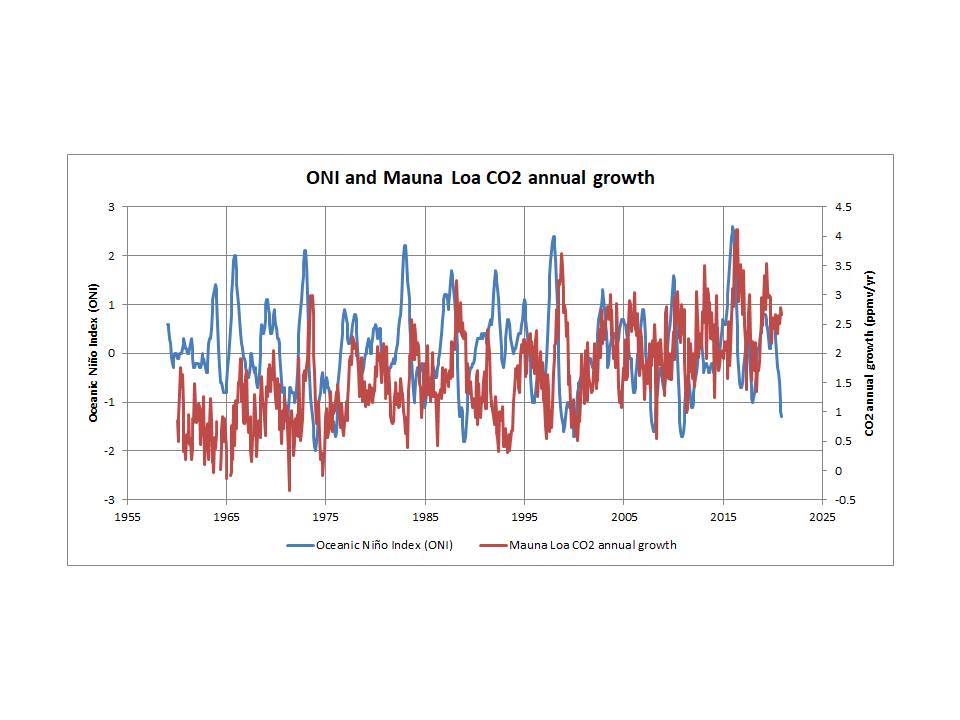
Other estimates are that the average for the year was 7-10% lower, with reduction of over 18% in April 2020. Actually, the growth curve for 2020 was almost identical to 2019. That suggests that something else is driving the CO2 response. Indeed, the CO2 growth during the hot El Nino year, 2016, was much higher than any others.
In the 1970s people were concerned about an impending Ice Age, not warming!
More probably because 2020 was about as warm as usual.
https://wattsupwiththat.com/2021/06/11/contribution-of-anthropogenic-co2-emissions-to-changes-in-atmospheric-concentrations/
ADDENDUM
Just what are they saying? That reduced partial pressure caused an immediate compensation through outgassing? There is no evidence of a reduced pressure just as there is no evidence of decrease in the concentration! This is hand waving without benefit of empirical evidence.
Assuming, for the sake of argument that the conjecture is correct, doesn’t that imply that any reductions in emissions, or major sequestration efforts, will result in a feedback that will cancel the hoped for response? Then what is the point of the demands for sacrifices?
The choir needs to all get on the same page.
That damned volcano is rumbling again. Science, schmience, throw in another virgin; it worked the last umpteenth times.
Clyde,
As I noted above, “There was a strong El Niño in 1972-73 followed by three years of La Niña events.” This led to a high rate of CO2 growth followed immediately by a much reduced rate. So, there was a decline in growth rate in 1973, but it was entirely consistent with ENSO driving the inter-annual CO2 growth rate.
Simple query.
There is a good track platform for observation of CO2 concentration and emissions, like Mauna Loa and NASA’s OCO2.
Any such for methane or NOx??
Does any one know, how could CO2 atmospheric variation can actually rationally and sensibly be compared with methane and NOx atmospheric variation, in consideration of the Covid lockdown period?
According to observations, the famous lockdown had a zero point zero effect on the atmospheric CO2.
What kind of hat produces the 0.3% figure for atmospheric methane concentration… or for same unquantified figure for the NXo concentration!?
cheers
As Brian said before, this is probably the best confirmation, with a real world experience, that human emitted CO2 is negligible in the global cycle of this gas. Other pollutant gases, only emitted by humans, showed a clear decrease in the most industrialized areas. CO2 did not and continued to increase globally. I cannot remember of any forced global and large scale experiment, such as this one, at the level or bigger than the CO2 reductions aimed by IPCC, that wasn’t even noticed in the Keeling curve. At least we can apply the scientific method in this one. Aiming to reduce the emissions by X to avoid a temperature increase of Y in the end of the century, claimed by the IPCC, not only is a perversion of the scientific method as it is voodoo science.
These scientists never learn do they? They’ve still got to carry on with their decarbonisation plans.
This article appears to be saying that a 5.4% reduction in emissions made no difference to the atmospheric concentration of CO2.
Since it is said to be the atmospheric concentration of CO2 that is responsible for the dreaded global
warmingheating, and reducing emissions BY 5.4% didn’t affect the concentration one jot or tittle, then WHY THE HECK ARE WE SUPPOSED TO KEEP REDUCING EMISSIONS TO “NET ZERO”?If this article is to be believed in its totality, it has just proved that human use of fossil fuels does not affect the global climate.
Anyone see a fault in my logic?
Yes, you are right,
but you missing the point… the drastic measures like the 2020 lockdown may work, and according to these “guys” can and should work,
even if not directly due to CO2 net zero approach aim, and the anthropogenic CO2 emissions reduction.
NOx emissions and others like that, which happen to be effected too by such self destructive draconian measures, can have a considerable cooling effect and therefore assist and help in keeping within the target of 1.5C range… even when in the same time have already thwarted and overturned all the “brilliant” achievement to date, of the famous World saving Kyoto protocol, about the ozone and the ozone hole…
Thus the intelligente and all knowing among us proclaim.
Two birds with one stone… for not saying three birds with one stone, this time around… a new new.
cheers
“Also, the ocean didn’t absorb as much CO2 from the atmosphere as it has in recent years – probably in an unexpectedly rapid response to the reduced pressure of CO2 in the air at the ocean’s surface”.
How the heck did they establish this?
They needed some excuse and that was the best they were able to come up with. Too bad they didn’t think it through before opening their mouth.
Interesting how little the science is settled. Also, the most important greenhouse gas is water vapor, not CO2.
The alarmists say the science is settled in an effort to shut everyone else up.
The science of climate change is certainly not settled.
“Molecule for molecule, methane is far more effective than CO2 at trapping heat in the atmosphere. “
First off, the half-life of CO2 and methane in the atmosphere is about 5 years, so they turnover relatively quickly.
Second, methane may be 20 times the greenhouse gas (ignoring the fact that such gases cannot heat the climate), but it is at 1.8 ppm compared to CO2’s 400 ppm, less than 1/200th of CO2. This makes methane a meaningless item to worry about at 1/10th the “effect” (not) of CO2.
As no gas at any concentration can warm the climate, this is all poppycock.
In addition, methane from the oil and gas industries is a non-issue as it is their goal to capture ALL the methane in order to sell it to customers. Tightening up methane regulations is truly stupid and just makes the product more expensive to us. Just another virtue-signaling action from Hiden’ Biden.
In many places a great deal of methane is still burned at its exit from the ground (flaring) because it is too difficult and expensive to do anything else with it.
Maybe not. A cloudless sky over a low-humidity desert at night permits a large amount of thermal radiation from Earth’s local surface whereas a cloudy, high humidity sky at night over a tropical tropical island significantly reduces outgoing radiation.
Assuming the same daytime peak temperature of, say, 80 deg-F in both locations and no weather fronts to disrupt the diurnal temperature swings, one can wear a T-shirt throughout the night on the tropical island and feel very comfortable . . . I dare anyone to attempt that same thing during a night in a desert.
Water vapor may not “warm the climate”, but it sure as hell reduces cold weather during nighttimes.
This:
Plus THIS:
Sounds an awful lot like an admission that human “emissions” are not the driver of atmospheric CO2 level increases, eh?
Then the tell-tale indication that (as usual) this is more bullshit substituting for fact:
The model told them what…they programmed into the model. OBJECTION! Facts not in evidence!
Then there’s THIS whopper:
So, (1) we are now measuring how much CO2 is absorbed by the ocean?! The whole thing?! What a crock of shit! (2) They measured a “reduced pressure of CO2 in the air at the ocean’s surface?!” The whole thing?! Another crock of shit! (3) CO2 “pressure” at the ocean’s surface goes DOWN even as CO2 levels continue to rise?! Another crock of shit!
AKA this is what happens when you think your “model” is producing “data” or “facts.”
Then, of course, the usual “methane boogyman:”
1.8 parts PER BILLION. Methane is meaningless as a “greenhouse gas.”
0.3% times essentially nothing equals basically still nothing.
I’ll give you an equally meaningless “fact:”
Pound for pound, an ant is stronger than a linebacker.
The likelihood that the ant will offer meaningful help in moving your couch is just as meaningful as the likelihood that atmospheric methane will have any effect on the Earth’s temperature that you can measure, EVER.
That should be parts per MILLION. However, it is only about 1:200, not a significant factor even considering its claimed extra strength.
”I’ll give you an equally meaningless “fact:”
Pound for pound, an ant is stronger than a linebacker.”
Ha ha. I love it. I must remember that one next time someone tells me we have to stop cows farting etc.
Excellent comment, AGW.
“During previous socioeconomic disruptions, like the 1973 oil shortage, you could immediately see a change in the growth rate of CO2,”
That lasted from October 1973 to March 1974. ESRL shows a drop in the rate of change from 1973.62 to 2973.7 of half a ppm per month, from 0.48 to -0.8. It is negative until 1974.12 when it’s 0.73 ppm per month.
It’s early to start and finish. Its not lost in the noise of measuring global CO2 from the side of a volcano when NASA are confident that modern satellites can measure to the nearest ppm. The rate of change closely follows the NH SST. No, it’s not Henry’s law, it’s Clowns Law.
“First, while the 5.4% drop in emissions was significant, the growth in atmospheric concentrations was within the normal range of year-to-year variation caused by natural processes. Also, the ocean didn’t absorb as much CO2 from the atmosphere as it has in recent years – probably in an unexpectedly rapid response to the reduced pressure of CO2 in the air at the ocean’s surface.”
Others have picked up on this, but surely the major implication is that if CO2 emissions are reduced because of the Paris Agreement, then the ocean will quickly replace it all. So cutting emissions is a waste of time effort and money because it won’t change the amount of CO2 in the atmosphere.
Mike Jonas,
You say,
Yes, that is true if one accepts the basic assumption of the AGW-scare which is that
the recent rise in atmospheric CO2 concentration results from the anthropogenic CO2 emissions overloading the natural ‘sinks’ that sequester CO2 from the air. The annual increase of atmospheric CO2 concentration is the residual of the seasonal variation because the overloaded sinks cannot absorb all the anthropogenic CO2.
However, observations indicate that the assumption is wrong.
I explain this in my above post in reply to Anders Rasmussen where I link to a paper that explains my understanding of the matter which can be read at
https://edberry.com/blog/climate/climate-physics/limits-to-carbon-dioxide-concentation/
As I also say in that reply to Anders Rasmussen,
I, Harde and Salby each independently concluded that the recent rise in atmospheric CO2 concentration is most likely a response to the altered equilibrium state of the carbon cycle induced by the intermittent rise in global temperature from the depths of the Little Ice Age that has been happening for ~300years.
However, as my linked paper explains, if one accepts the improbable possibility that the total CO2 emission of a year alters the equilibrium state of the entire carbon cycle then the anthropogenic CO2 emission could hypothetically be causing the recent rise in atmospheric CO2 concentration.
This unlikely possibility adds importance to the breakthrough in understanding made by Ed Berry – that I and all others failed to make – which quantifies the natural and anthropogenic contributions to the recent rise in atmospheric CO2.
Berry explains this in a preprint of a paper which he has posted on his blog,
Please note that the smooth curve in annual rise of atmospheric CO2 concentration is because it takes decades for the carbon cycle to adjust to changes equilibrium so the smooth rise is the rate at which the cycle is adjusting to change(s) that happened decades ago.
Richard
No, the curve is smooth because ‘outliers’ are removed from the raw data and then the seasonal changes are removed with averaging. The 1998 and 2016 El Nino warming events can be seen the same year they happen.
https://wattsupwiththat.com/2021/06/11/contribution-of-anthropogenic-co2-emissions-to-changes-in-atmospheric-concentrations/
Clyde Spencer,
You claim,
No, that is not true. Please look at e.g. the Mauna Loa data.
https://gml.noaa.gov/ccgg/trends/
The monthly data for atmospheric CO2 concentration show the seasonal variation; i.e. the monthly averages of atmospheric CO2 are up and down like a fiddler’s elbow. The annual rise in atmospheric CO2 concentration is the residual of the seasonal variation: i.e. the annual rise in atmospheric CO2 is the difference between the CO2 at the start and end of the year.
The time series of annual data is smooth because there is small difference between the values of adjacent values of annual rises: it is NOT because the data is smoothed.
Richard
Compare your linked curve to this one to see what I mean about smoothing; the trend is a form of smoothing:
Not including water vapour as the key GHG makes the study results much less certain?
I am not buying any of this BS. Just stick to the facts NASA. You expected a drop in CO2 and it did not happen. Thanks for the information, now try getting that SLS off the ground.
“What shall happen, did not happen… in this case.”
According to observations.
NASA is arguing, reasoning and protesting against a Null Hypothesis condition concerning the given.
“Thou” doth protests a lot, irrationally, against scientific method and reality!
🙂
cheers
whiten,
None of modern physics would exist if the response to the Michelson and Morley experiment had been to arm-wave away the failure to observe what was expected would be observed.
You are saying NASA is conflating a statistical null hypothesis with the scientific Null Hypothesis as an excuse for rejecting the scientific method.
If you are right we have returned to pre-Enlightenment thinking.
Richard
Richard.
I am not sure, but I think you seem to conflate and conflict the Null Hypothesis with Occam’s Razor method when it comes to observations… on your comment to me.
Observation data that shows at some point in time the absence of what expected to be there
(when means to check and detect acquired), falls under cancellation, Occam’s razor.
Usually when that is a clear and quite a strong condition, it collapses a theory or hypothesis or a theorem… as same as falsification…
or
otherwise further supports the Null hypothesis.
If not careful, it is quite easy to conflate and also conflict the meaning of Null Hypothesis condition with a Falsification one.
For example, if paleoclimate data showed a clear non correlation of Climate with Milankovitch Cycles, that will fall under Occam’s Razor, and not Null Hypothesis.
A missing, an absence of correlation in this case,does not mean “what shall happen did not happen” as per nullification.
Affirmative observed failure or success of M. Cycles to cause Global dimming, happens to be the Null Hypothesis for that theory.
No much gain thus far, either positive or negative, for the M. Cycles theory from Null Hypothesis.
Affirmative observed Global dimming outside the proposed means of M. Cycles theory of climate, happens to be the falsification condition for that theory.
Null Hypothesis does not prove or collapse a theory or hypothesis, it simply impacts its value, by increasing it or decreasing it… significantly at times.
Good enough to render a theory or hypothesis or a scientific stand point as non valid for dictating policy, either political or scientific or economical, at any scale, when it impacts it negatively.
As I said:
“NASA is arguing, reasoning and protesting against a Null Hypothesis condition concerning the given.”
(by actually first accepting the value of the observations in question, which do uphold the Null Hypothesis condition as per the given.)
Maybe you should have chosen “lack” versus “failure” as a word or concept… for better clarity.
Thank you for your reply and interest.
Sorry if my reply to you may come across as “dry” or something like that.
Your interest and effort appreciated, never the less.
🙂
cheers
whiten,
You demonstrate that my understanding of your error is correct when you reply to me.
I conflate nothing. The error is yours : you are making the mistake of thinking the scientific Null Hypothesis is chosen as though it were a null hypothesis of the kind used in statistical analyses.
The Null Hypothesis is a basis of the scientific method and it derives from the principle of parsimony (sometimes called ‘Occam’s Razor’). It is the basis of all experimentation, observation, deduction and inference: it says this
When the behaviour of a system is not observed to have changed then it has to be assumed the behaviour of the system has not changed.
Please note that the Null Hypothesis is an empirical challenge.
Something may exist but be too small for its effects to be observed. In such a case the only valid scientific assumption is that the ‘something’ has no discernible effect.
As I said, that “only valid scientific assumption” is why the Michelson and Morley Experiment began all modern physics: an expected observation of the luminiferous ether was not obtained and so the scientific conclusion was that a discernible luminiferous ether does not exist
Similarly, the scientific method decrees that the expected observation of change to the anthropogenic CO2 emission on atmospheric CO2 rise has not happened and, therefore, the scientific conclusion is that the anthropogenic CO2 emission is not the direct cause of rise in the atmospheric CO2 concentration .
This is the ONLY valid scientific conclusion because in science empirical observation trumps theory,
(In pseudoscience theory trumps empirical observation).
Richard
Richard.
Please, consider… I am not trying to belittle you.
And I maybe prone to error too, as anyone else.
I appreciate your effort.
Consider this if you can,
Who was there first in historical chronology, of human knowledge and human science; Fermat or Null!
cheers
I think, wrongly or not, that you have a real strong argumentative point forwarded.
Intricate in value.
I very much appreciate that.
Thank you Richard.
cheers
Nice music…
“Whitney Houston – I Have Nothing (Official HD Video)”
cheers
Ok, the other thing there… Richard.
Null Hypothesis is not Occam’s Razor…
…get it as it is… if you can!
cheers
whiten,
Please do not misquote me. I said the Null Hypothesis is not Occam’s Razor…
I wrote saying to you,
Being “derived from” is not the same as “is”;
e.g. an omelette is not an egg.
And I stated the Null Hypothesis.
Richard
whiten,
Please be assured that I cannot be belittled by any anonymous internet troll.
And I don’t fall for trying to answer silly questions;
e.g. a question that asks me to date work of “Null” but does not state who is meant by “Null” and does not reference what “Null” published.
Richard
Richard,
really sorry we got in a bad foot here.
Did not mean or intend that,
but maybe due to misunderstanding on my part, when I thought you were trying to make a point that actually the concept and the condition of Null Hypothesis did not apply in this case, but instead was more like Occam’s Razor…
and in the same time you misquoted me. (without being straight forward in your first comment to me)
….
“Please be assured that I cannot be belittled by any anonymous internet troll.”
Mirror much there!
My question which you addressed as silly was a very simple way to say that concepts essential to science and scientific research have always being there since like forever.
The null hypothesis, occam’s razor and falsification as methods and concepts, have being there used in science, engineering and scientific research like forever, before modern science, Industrial Revolution and Internet and Wikipedia… and even before Fermat too,
or Leonardo Da Vinci.
I mentioned Fermat, as an example,
as to me,
the “Fermat’s last Theorem” is a piece of scientific art work, on proposition and demonstration of the scientific method, where the three above mentioned concept and conditions of the scientific method, are recognized,
and also must apply… regardless how addressed or approached or named at present.
Richard, at least you should give some merit to this internet troll here, reading you correctly about Occam’s Razor from the very first reply of you, where you did not mentioned it at all, but still must have intend it… yes? 🙂
(by the way, it was not a wrong approach in your part though)
Still, I am really sorry that this “conversation” of ours got to be kinda of not friendly one.
And I really appreciate our engagement here, and your effort…
cheers
Everybody,
I trust that all impartial onlookers will recognise I have provided all required refutations of the ‘gaslighting’ from the anonymous internet troll posting as ‘whiten’.
I write now to say I will not waste any more time on the troll but I will address any reasonable points others choose to make in response to what I have written.
Richard
If you are right we have returned to pre-Enlightenment thinking.
Richard, we have. And not just with regard to climate.
It’s clear this is the case as witches are now being sought by leaders to execute in order to maintain their pre-defined static conditions.
Good, practical advice, John.
Once again, when all they have is a politically driven lie they just scream it louder.
Not measured. All estimates and models.
Actual scientific chemical measurement (i.e., chemical assay) of the percentage of CO2 in the atmosphere passing over NOAA’s Mauna Loa observatory is performed on approximately a daily basis.
FACT.