
[Update 10/4/21 9:40 am Pacific Time. I received an email from Dr. Steven Koonin, one of the authors. He wanted me to insert this statement-charles]
I am a co-author of this paper, which summarizes twenty years of earthshine observations to measure albedo changes. The paper speaks for itself. If you take the time to read it (it is open access), I think you’ll find it appropriately circumspect about what we measured, with what uncertainties, and the implications of what we found. However, I am in no way responsible for how the paper is cast by the general media, or even the AGU press release. Such is the state of today’s “climate communications”.
Steve Koonin
There’s a new study published in Geophysical Letters Called: Earth’s Albedo 1998–2017 as Measured From Earthshine
Here’s a description from the Weather Channel
The climate change crisis has cropped up with a vengeance in the last few years, and its ramifications have been unimaginable, extreme and life-changing. Now, a new study claims that climate change has dimmed our planet—literally!
According to the study, the Earth’s brightness has decreased as a result of warming ocean waters. Now you’re probably wondering, “how do you even measure something like that?” But researchers have their ways. They use the Earth’s reflectance or ‘albedo’, which they calculate using something known as the ‘earthshine’, to keep track of, well, the Earth’s shine.
While gazing at the crescent moon immediately after sunset or before sunrise, you may notice that aside from the dazzling crescent, the rest of the moon appears as a dark but faintly glowy disc. The light that bounces off the Earth gives the unlit part of a crescent moon a pale glow, which is referred to as earthshine.
The study indicates that our home planet now reflects almost half a watt less light per square metre than it did 20 years ago, with the majority of the decrease occurring in the last three years of earthshine data. This equates to a 0.5% reduction in the Earth’s reflectance.
Researchers investigated the Earth’s ‘albedo’ by studying earthshine at the Big Bear Solar Observatory in California between 1998 and 2017—that’s over 1,500 nights of data. They could determine how much light is reflected by the planet thanks to this analysis.

Here is the abstract and plain language summary from the paper
Abstract
The reflectance of the Earth is a fundamental climate parameter that we measured from Big Bear Solar Observatory between 1998 and 2017 by observing the earthshine using modern photometric techniques to precisely determine daily, monthly, seasonal, yearly and decadal changes in terrestrial albedo from earthshine. We find the inter-annual fluctuations in albedo to be global, while the large variations in albedo within individual nights and seasonal wanderings tend to average out over each year. We measure a gradual, but climatologically significant 0.5 decline in the global albedo over the two decades of data. We found no correlation between the changes in the terrestrial albedo and measures of solar activity. The inter-annual pattern of earthshine fluctuations are in good agreement with those measured by CERES (data began in 2001) even though the satellite observations are sensitive to retroflected light while earthshine is sensitive to wide-angle reflectivity. The CERES decline is about twice that of earthshine.
Plain Language Summary
The net sunlight reaching the Earth’s climate system depends on the solar irradiance and the Earth’s reflectance (albedo). We have observed earthshine from Big Bear Solar Observatory to measure the terrestrial albedo. For earthshine we measure the sunlight reflected from Earth to the dark part of the lunar face and back to the nighttime observer, yielding an instantaneous large-scale reflectance of the Earth. In these relative measurements, we also observe the sunlit, bright part of the lunar face.
We report here reflectance data (monthly, seasonal and annual) covering two decades, 1998–2017. The albedo shows a decline corresponding to a net climate forcing of about 0.5 . We find no correlation between measures of solar cycle variations and the albedo variations. The first precise satellite measures of terrestrial albedo came with CERES. CERES global albedo data (2001-) show a decrease in forcing that is about twice that of earthshine measurements. The evolutionary changes in albedo motivate continuing earthshine observations as a complement to absolute satellite measurements, especially since earthshine and CERES measurements are sensitive to distinctly different parts of the angular reflectivity. The recent drop in albedo is attributed to a warming of the eastern pacific, which is measured to reduce low-lying cloud cover and, thereby, the albedo.
The full paper can be found here.
H/T Gregory W
I stopped reading this fanatical at “The climate change crisis…”
absolutely no point to reading any further. When a so called scientist refers to climate change as a crisis he/she exposes themselves as a political scientist.
[QUOTE FROM ARTICLE]”Researchers investigated the Earth’s ‘albedo’ by studying earthshine at the Big Bear Solar Observatory in California between 1998 and 2017—that’s over 1,500 nights of data.” [END QUOTE]
Nineteen years of nights (1998 through the same date in 2017) is a total of 6,940 nights (including 5 leap days), so did they only quote data from less than 22% of the nights during that period? Could some of this data have been cherry-picked to demonstrate a trend?
If they were only taking data on crescent moons over California, then there would be two possible scenarios:
(1) A crescent moon rising shortly before sunrise in the east (waning crescent)
(2) A crescent moon setting shortly before sunset in the west (waxing crescent).
For scenario (1) above, most of the reflected sunlight would be reflecting from continental North America to the east, and the albedo of land tends to fluctuate seasonally (high albedo during snow cover, low albedo when vegetation is active during spring and summer).
For scenario (2) above, most of the reflected sunlight would come from the Pacific Ocean to the west, where the albedo would not fluctuate much seasonally (does warm water reflect sunlight more or less than cool water?).
Did the researchers distinguish between “earthshine” for waning crescent moons rising in the east before sunrise, and for waxing crescent mons setting in the west after sunset?
Wouldn’t it have been better to take readings on a new moon, with no contamination from reflected sunlight from the moon at all? Why did you think a crescent moon would be more useful?
I’m puzzled by this. Albedo is a ratio; so where does the Watts/sq.m come from? Could it be something to do with the sun?
Blaming the oceans seems counter intuitive to me; for one would expect cooler oceans to reduce radiation levels. Perhaps it is a bit of both which leaves everything very much in the air.
Never mind there are always other grants out there to keep us going.
Read the original article. However, basically they are obtaining the 0.5 W/m^2 forcing from multiplying the apparent albedo (unitless ratio) with the solar flux (W/m^2).
Charles, try this:
The total effective TOA insolation for the hemisphere of Earth exposed to the Sun is stated be “roughly” 340.3 W/m^2 when averaged over a full year (see: en.wikipedia.org/wiki/Solar_irradiance).
If Earth’s albedo varied by 1.8 W/m^2 over the 18-year period given in the the above article’s anomaly graph . . . from a high of +0.7 W/m^2 to a low of -1.1 W/m^2 as indicated by the blue dots representing the CERES-measured annual albedo anomalies . . . then that is equivalent to a 1.8/340.3 = 1.76% total variation, assuming the zero-anomaly point is 0.3*340.3 W/m^2 = 102.1 W/m^2 reflected on long term average.
Distilling this further, the conclusion is the CERES folks are claiming their total measurement loop for determining Earth’s albedo is stable to better than 1.76%/18 = 0.098% per year (that is, all of the indicated data variation is real and without any contribution from, say, instrument accuracy drift over time).
I simply ain’t buying what they (or, similarly, the Earthshine measurement folks) are selling.
The most startling thing is that people actually read this sh**.
One would have to bounce a known wavelength (or wavelengths) of laser off the moon and simultaneously measure that intensity versus the Earthshine intensity to know if the change were due to surface and cloud reflectivity or just dust and aerosols in the atmosphere.
It actually would not surprise me if reflectivity has dropped, given the increase in coal burning with inadequate filtration over the same period of time in China, India, and developing nations. The soot from that could easily be changing reflectivity of any permanent snow/ice pack. Also the aerosols created would scatter and reduce visible light leaving the planet.
This assumes that any changes for sunlight variability have already been accounted for.
Measuring the light reflected back from the moon is just another proxy. It isn’t a direct measurement so as in any proxy there are a lot of variables. Therefore while curious it isn’t proof of anything.
I wonder if they measured many different wavelengths of light if that might help identify where the missing light had gone? For example, I expect more of the Earthshine will be green light than in the past. More blue and reds (visible) will be gone becoming plant materials. This is expected when the Earth starts greening up and becoming more compatible with plant life.
If the system is 100% hydrogen there are issues. Among them are hydrogen odorization, so people can smell leaks is difficult, small leaks are hard to detect, and hydrogen burns with an almost invisible flame. Additionally, hydrogen does not exist on earth as a free gas. This means it takes more energy to produce than it provides. Politicians are more than willing to waste other peoples’ money on projects in hopes of eliminating an non-existent problem.
Are you absolutely sure that you posted this to the correct article?
I wonder how mistakes like that happen.
”The study indicates that our home planet now reflects almost half a watt less light per square metre than it did 20 years ago,….”
”According to the study, the Earth’s brightness has decreased as a result of warming ocean waters.”
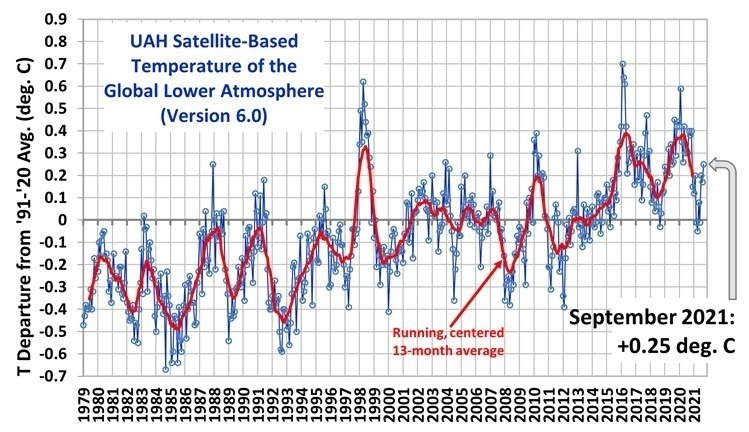
Huh? The GAT in 2000 was exactly the same as it was in 2019 – where their graph ends
Guys, I fully understand that on any day an earthshine measurement might be off by several percentage. But these measurements were done continuously for two decades. What makes you think that a one-day error can be systematic over a 20-year timespan? Highly unlikely.
I believe that it is probable, from this data, that they are measuring a real reduction in the albedo of the Earth, albeit a small amount, even over a 20-year period. And it could definitely be coming from some significant percentage of the Earth’s surface waters warming a little bit on net and therefore pumping more water vapor into the air. This would also be consistent with the observed increase in global precipitation over the last 20, if not 120, years. More water coming down can only be possible if more water went up beforehand. The water budget of the Earth is well-documented and we don’t get additions or subtractions to it except for highly, well-characterized inputs and outputs,
Don’t have a hissy fit. This ABSOLUTELY DOES NOT PROVE that the increasing Carbon Dioxide in the air has ANYTHING to do with this slight surface-water warming, nor does it prove that that slight warming represents a net negative impact on our environment. They can be right about this fact of decreasing albedo and yet be spectacularly wrong about all the rest of the mindless hysteria they are peddling. No need to get worked up if they are right on this little issue.
David Solan
Actually, I wasn’t going to have a ‘hissy fit’ as you so eloquently put it; I was merely going to point out that there has been no discernable trend increase in precipitation over the last 20 or more years. Even the IPCC admits they have low confidence in any increases, which tallies with most regions around the world showing no increase. So, with that in mind, there’s no increase in atmospheric water vapour either unless someone changed the laws of physics so what goes up doesn’t come down?
The real problem is that there are multiple potential explanations that, individually or in aggregate, could explain the decline. However, not invoking Chamberlain’s Method of Multiple Working Hypotheses, they neither acknowledge or formally reject the alternatives. In their mind, it is CO2 all the way down.
In an unrelated story, janitor Ollie Bigowitz replaced the aging fluorescent bulb in the porch light near the detector with a brighter LED bulb 3 years ago.
“It’s sure helped us when we need to check our equipment at night,” astronomer Halley Tosis says. “The difference is like night and day.”
I would like to see optical spectroscopic data of incoming and outgoing radiation to back up their argument.
Well, visible light may have diminished slightly, but what about infra red? Do they include that?
1. Why are there no error bars around the most recent years and 2. It looks to me like any trend is not statistically significant to 2 sigma.
I am told that the increased CO2 levels in the atmosphere are greening the earth. I am also told that more trees decrease albedo. Could the observed decrease in the earth’s albedo not be due to the greening?
global warming predictions include increased rainfall due to warming, how can that be if there are less clouds?