Posted by Teo Blašković on July 30, 2021 at 17:29 UTC

A fierce cold snap brought rare snow, icy rain, and strong winds to parts of southern Brazil on July 29 and 30, 2021. The event comes after several waves of destructive frost since mid-June.
According to weather specialists at Somar Meteorologia, at least 40 cities in the southern state of Rio Grande do Sul saw ice while 30 got snow, including Pelotas, São Francisco de Paula, Gramado, Carlos Barbosa, Bagé, Herval, Piratini, Caxias do Sul, Marau, and Farroupilha.
Meteorologists say the strange phenomenon in Brazil is happening all the more often, especially in areas that are between 900 and 1 900 meters (2 900 and 6 200 feet) above sea level.
‘I am 62 years old and had never seen the snow, you know? To see nature’s beauty is something indescribable,’ said truck driver Iodor Goncalves Marques in Cambara do Sul, a municipality of Rio Grande do Sul state, speaking to TV Globo network 2/5 pic.twitter.com/1aTE0TXFX1— Reuters Science News (@ReutersScience) July 30, 2021
After hitting Rio Grande do Sul, polar air continued moving upwards toward the Sao Paolo metropolis and Minas Gerais — states known for their vast agricultural fields.
After several waves of destructive frost since mid-June, farmers fear that what’s left of essential export crops will suffer yet more damage.
According to Marco Antonio dos Santos from weather consultancy firm Rural Clima, international prices for coffee and sugar have already soared due to unusually cold weather in Brazil.
The last time a blizzard hit Brazil was back in 1957 when 1.3 m (4.3 feet) of snow fell in the state of Santa Catarina.
The public is not aware that a there is a geomagnetic excursion (suddenly the magnetic field strength drops in specific regions of the earth) that started in 1997. The geomagnetic field changes of increased in speed since the start of the change.
The geomagnetic field protects the earth from super high speed (energy) particles which are mostly protons.
This super high speed particles are incorrectly called Galactic Cosmic Rays (GCR) as the it was assumed initially that they were a ‘ray’ and the dumb name stuck. The super high energy GCR makes ions and free charge in the atmosphere. This creates clouds and changes climate.
These new geomagnetic poles …. like the new geomagnetic ‘pole’ that has moved and will stay over the South American continent create a ‘polar’ like vortex by changing the jet stream.
The South Atlantic geomagnetic ‘anomaly is a region where the strength of the geomagnetic field has dropped by 2/3. The South Atlantic geomagnetic anomaly should called the South American geomagnetic anal which is now centered over South America.
The field geomagnetic field strength over South America, is less than a third of its normal strength, as compared to other locations on the earth, same latitude as shown in this picture, which is taken from the paper link to, “The South Atlantic Anomaly: The Key for a Possible Geomagnetic Reversal”.
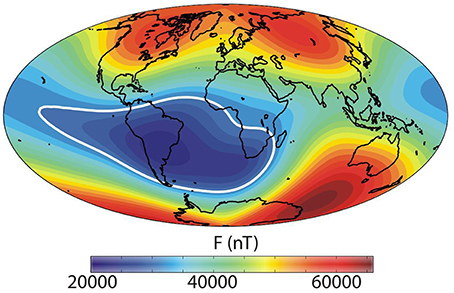
The above picture is from this paper.
https://www.frontiersin.org/articles/10.3389/feart.2016.00040/full
The authors of the South Atlantic Geomagnetic anomaly paper appear to (pretend that they do not) know about about cyclic geomagnetic excursions, which occur in less than decade.
These cyclic geomagnetic excursions were discovered about 10 years ago. Geomagnetic excursions interestingly, occur just before extreme cooling events.
And oddly enough, the extreme cooling periods, like the YD abrupt cooling period occur immediately after the Dansgaard-Oescgher warming periods.
The D-O warming period are short warming periods that last either 20 years or 30 years, after which there is cooling and sometimes geomagnetic excursions which cause abrupt cooling events that last for a long time.
he D-O warming periods occur during the interglacial period and glacial period. They occur with a periodicity of 400 years and 1200 years.
Starting in about 1997, the geomagnetic field of the earth which was decaying at 5% per century, changed and is now decaying at 5% per decade. Ten times faster.
A decay rate of 5% per decade is a geomagnetic excursion that is happening now and which is affecting ‘climate’ now.
http://news.yahoo.com/earths-magnetic-field-weakening-10-times-faster-now-121247349.html
“Earth’s Magnetic Field Is Weakening 10 Times Faster Now
…Previously, researchers estimated the field was weakening about 5 percent per century, but the new data revealed the field is actually weakening at 5 percent per decade, or 10 times faster than thought.”
During periods of weak solar wind, definitely the geomagnetic field has a strong influence on the circulation in the upper troposphere.