Guest post by Rud Istvan
A few days ago, I posted another Lindzen Bode ECS reconciliation. It should have been controversial, stimulating many comments because of the divergence to higher climate models and also to Monckton’s often here posted much lower estimates. It was only mildly so, most about my penetration f/(1-f) versus Bode 1/(1-f) one phrase in one sentence goof, which did not affect the post’s conclusions since it only used Lindzen’s correct curve posted here decade ago.
Recently, Dr. Wentworth posted a ‘mathematical proof ‘ that the GHE must exist, even though misnamed (because real greenhouses retard local convective cooling, while greenhouse gases retard radiative cooling to space). This misnomer is no different than the equivalent ocean acidification misnomer we are also forced to live with in popular discourse. Warmunists long ago picked their definitional terms of debate, and WUWT skeptics are mostly stuck with them. Definitional quibbling may satisfy some, but probably isn’t an effective tactic.
I was very surprised at the number of negative comments at WUWT (now well over 600) to this rigorous post with an obviously verifiable conclusion. They spanned the gamut from epistemological (really a proof, or something else?), to the old Venus/Mars ‘analogies’, to the new ignores convection (true, but convention only moves heat around in the atmosphere; it cannot not make it go away like radiation to space does), to even the very old gravitational density heating canard (ignoring that since Earths atmosphere got densified (aka ‘pumped up’) by gravitational consolidation about 4.5 billions years ago, unlike a newly pressurized bicycle tire it has had a LONG time to cool back down). I chose not to name names; this possible guest post is only a general rebuke.
The surprisingly controversial post’s conclusion is also easily personally verified by simple observation. Tyndall proved in 1859 that both CO2 and H2O were GHG, while N2 and O2 are not. So a personal experiment can be conduced in any desert (mine was a summer day in the Mohave outside Palm Springs during a boring conference). The dry desert heats up a lot from insolation during the day, and cools down a lot at night thanks to desert low specific humidity, so not much GHG except well-mixed CO2, and therefore not much GHE at night. Burrr!
There are only two even semi-rational (but still erroneous) arguments why the CO2 GHE might not exist despite Tyndall’s experimental GHG evidence.
- The CO2 window overlaps the H2O window. Note, this does not say the GHE does not exist; only that CO2 ‘cannot’ be a contributor so IPCC is wrong. This assertion is frequently found on the internet in graphical form, but erroneously portrayed for two reasons (both errors are present in negative WUWT comments). The usual stuff omits radiation intensity; and while some windows do overlap, others don’t. Fine IR scale matters. The actual overlaps/windows plus their radiative intensities were provided in essay Sensitive Uncertainty in ebook Blowing Smoke. The essay’s illustration is reproduced below. Forgive the unfortunate insolation extra zero K typo, which I just caught myself. Absorption is a metric of the degree of a gas GHE effect at some frequency (wavelength), from 0 (none) to 100% (full).

Reality has to do with radiation intensity and window ‘shoulders’.
- GHG are saturated, so can have not have any further effect. This misunderstands saturation, since it depends on the effective radiative level (ERL). As CO2 increases, the ERL rises unconstrained, since CO2 is unaffected by the lapse rate, while H2O is and so decreases. This also reduces their mid troposphere’s overlapping radiative windows. More CO2 raises the ERL. As Callendar’s 1938 curve reproduced below (from Climate Audit) first showed, the GHE never saturates.

Also note that over the region of Callendar’s curve of present interest, the curve is approximately linear, which is why in my comment to UAH’s most recent report, I did not bother to make the log correction correctly suggested in subsequent comments to my back of the envelope implied 1.7C ECS fraction that Roy’s new update nicely implicitly brackets. ‘Good enough for government work’.
To summarize without any math, the GHE exists. It experimentally must, and easily provably does. The GHE issues are how much when (ECS), not if. Any ‘skeptical’ arguments to the contrary are fairly easily rebutted, as done here.
CO2 does not cause any warming what so ever. The only reason this isn’t obvious is scientists, for whatever reason, do not understand temperature change over any time frame is a sum of energy gained and energy lost.
Because of this, a temperature time series consisting of average temperatures at a set time interval is a cumulative sum of net energy gain from an initial temperature. Using such a time series as is for cause and effect analysis with other variables is almost guaranteed to result in spurious relationships. A correct analysis of temperature over time should start with differencing the data.
This is really not a controversial assertion. Spurious relationships are very common and there is a wealth of published literature which covers this. However, this is also an intuitive result if you consider this rather simple question. Is it warming or cooling? The follow up question then becomes why is it warming or why is it cooling.
If you want to see a real world example of this I have a graph from an analysis of ENSO and the AMO at the link below. The data shows the rate of temperature change by month smoothed by centered 23 month averages. It is clear there are cycles of warming and cooling. It is also clear there has been no increase in either since 1950.
https://drive.google.com/file/d/1fbPffigEzc7LOb47hWl8lyA7hnatrt7F/view?usp=sharing
I missed the attach photo button.
Hey, that looks familiar!
Long time old friend!
How are things down on the possum ranch?
Rud Istvan, thank you for this essay.
. “Tyndall proved in 1859 that both CO2 and H2O were GHG, while N2 and O2 are not “
Tyndall didn’t actually prove it. In his experiment, radiation passed through a vessel with gas and hit a thermopile (a sensitive element of some modern infrared spectrometers). Tyndall showed that some gases absorb infrared radiation, while others do not, but it does not follow from his experiment that the absorption of infrared radiation is associated with the absorption of heat, that is, with a change in the gas temperature. By the way, for air that was not purified from water vapor and carbon dioxide impurities, Tyndall noted a zero deflection of the galvanometer, that is, his device was naturally less sensitive than modern spectrometers.
“ So a personal experiment can be conduced in any desert (mine was a summer day in the Mohave outside Palm Springs during a boring conference). The dry desert heats up a lot from insolation during the day, and cools down a lot at night thanks to desert low specific humidity, so not much GHG except well-mixed CO2, and therefore not much GHE at night “.
Yes, in a dry desert specific humidity (relative humidity) is low, but what about concentration of water vapor? Let’s see an example. In a desert on a summer day the air temperature can reach 40 oC with relative humidity of 25%. From the experimental data on the temperature dependence of the water vapor pressure, it follows that at 40 °C the water vapor pressure at saturation is 55.3 Torr and, therefore, at 25% relative humidity it will be 13.8 Torr. Since the concentration for a gas can be defined as the ratio of the partial pressure to the total pressure, the concentration of water vapor in this case will be 13.8/760 = 0.0182, or 1.82 %. This concentration of water vapor corresponds to 100% relative humidity at 16 °C. For comparison: sometimes in Paris temperature is of 1 o C, relative humidity 95%, atmospheric pressure 744 Torr. These conditions correspond to H2 O concentration of 0.63%, that is 3 times less than in a chosen example for desert.
There is a simple physical explanation for the difference between day and night temperature in a desert without the “greenhouse effect”. Sand has a low thermal conductivity and heat capacity, so during the day a relatively small amount of sand heats up to a relatively high temperature. The release of heat at night occurs quickly, in accordance with Newton’s law of cooling: the cooling rate is proportional to the difference in temperature between the body and the environment. The absence of vegetation and clouds also contributes to the accelerated release of heat.
Alexander,
Your example of ’40 degrees C (or 104 F) and 25 relative humidity is VERY HUMID, and not what i would consider as a ‘dry desert. 104 F and 25% relative humidity equates to a dew point of 62 degrees (that is quite humid to most people).
I live in the Phoenix AZ area. In May, when dew points are quite low (often in the 20s F), it is not uncommon to see daily temperature swings of over 30 F (fyi the ‘average’ May high and low is 95/68 degrees F, which still a 27 degree swing). N
Now in August, we get the ‘monsoon season’ when due points get up to the high 50s/low 60s F. The ‘average’ August high and low are 104/83 F, a 21 degree swing. Why the difference? The additional water vapor in the air is absorbing more of the outgoing longwave radiation, which it then can re-radiate in all directions, some of which is returned to earth. This is simply ‘slowing down the loss of energy’ to space, which results in it being ‘warmer THAN IT WOULD HAVE BEEN’ without the water vapor there.
The ‘bolded words’ above is also something that I often see getting LOST when talking about the greenhouse effect (not always, but quite often). We hear the term ‘it WARMS’ the surface of the earth. I MUCH prefer the description, ” it results in the surface being warmer THAN IT WOULD HAVE BEEN without the ‘greenhouse effect’ “. This is the ‘bottom line’ to me of the ‘greenhouse effect’ does. To me, it is that simple.
Martin, you say: “Your example of 40 degrees C (or 104 F) and 25 relative humidity is VERY HUMID “.
O’kay, let’s take another example. Your examples do not fully correspond to the issue under discussion, since it was not about the difference in average monthly temperatures, but the reasons for the difference between day and night temperatures in deserts.
Let’s take the least possible value in the Mojav desert of 10% (https://sciencing.com/humidity-mojave-desert-19526.html) and the same temperature of 400C. Even in this case the concentration of water vapor will be 55.3 x 0.10/760 = 0.0073 = 0.73 % . (more than in Paris in winter). In your opinion, this is not enough for the manifestation of the greenhouse effect?
«The additional water vapor in the air is absorbing more of the outgoing longwave radiation, which it then can re-radiate in all directions, some of which is returned to earth. This is simply ‘slowing down the loss of energy’ to space, which results in it being ‘warmer THAN IT WOULD HAVE BEEN’ without the water vapor there».
Let’s check your statement with an example. At about the same latitude as your city Phoenix (33.4 0N) is Charleston, South Carolina (32.7 0N). Air humidity in Charleston is significantly higher than in Phoenix (average annual precipitation in 1985-2015 is 23.7// and 1.5// ,respectively). One would expect the greenhouse effect of water vapor to have a higher average temperature over this 30-year period in Charleston, right? In fact, averaging the maximum and minimum monthly average temperatures on the site https://www.timeanddate.com/weather/usa/ gives the average temperature for Charleston 66.5 0F, for Phoenix 75.3 0F. In addition, Phoenix is located higher above sea level than Charleston. I don’t know how to explain this based on the greenhouse effect, do you?
holy cow, really ? the nature of temperature highs and lows in different geographic locations is much more dependant on weather systems coming through than any amount of water vapor in the air.
My comment was for a GIVEN geographic location, and then comparing ‘higher humidity’ to ‘lower humidity’. Trying to compare temperatures in different geography with different weather patterns and claiming it is or isn’t demonstrating the ‘greenhouse affect’ is just plain ignorant.
Comparing temperatures across geographic locations is exactly what the IPCC does to calculate the global average temperature and prove the greenhouse effect.
For over half the year, Charleston has a significant number of days with the winds coming from a cold direction, as cells of high pressure move down from Canada and across the US.
During the high Sun season, Charleston is temperature limited by marine influence and the presence of high humidity, which raises the specific heat of the air.
Phoenix has very dry air, which has low specific heat.
Charleston has significant cloudiness on a large number of days, and Phoenix does not.
There may also be differences in the amount of UHI affecting the two numbers.
In Winter when the wind is from the west or north, Charleston has dry air too. Cold dry air, from continental polar areas.
So there is no direct comparison using a yearly average.
There are too many other variables.
Looking at a range of cities at around that same latitude, starting at San Diego, and then east to Phoenix, then Carlsbad, then Dallas, then Shreveport, and finally Charleston, average temps are 64F, 76F, 62F, 68F, 66F, and 67F.
Carlsbad has about the same annual average dewpoint as Phoenix (although it gets a lot more rain), but is the coldest of the bunch on an annual average basis.
San Diego gets less than 3″ of rain a year, and is second coldest.
I was looking at the rainfall listed on time and date website for Charleston, and knew immediately the numbers are way off.
There is no place east of the Mississippi river that only gets 20 some inches of precip a year.
30″- 40″ is about as little as can be found in the east on an annual average basis. And that is mostly in the Upper Midwest region.
The actual number for Charleston is 54 inches per year.
Anyway, there are too many variables to use yearly averages to try to intuit something like the radiative properties of the atmosphere by looking at two cities.
Actually, looks like a small piece of Michigan gets under 30″ a year.
Average annual precip for Phoenix listed on that site is way off as well.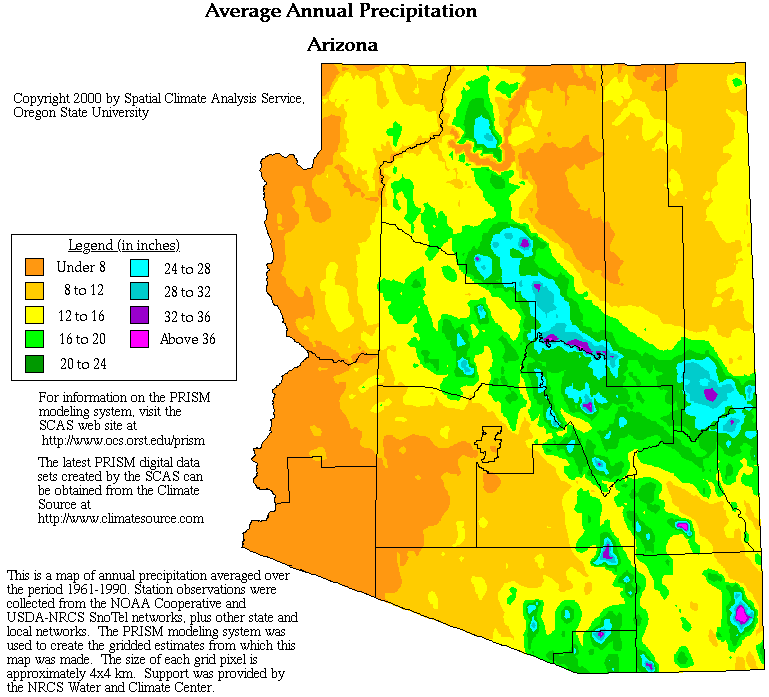
The actual number is over 8″/year, and some nearby places have several times that much:
So maybe Carlsbad does not get much different rain that Phoenix.
Checking real data (not sure why that site is so bad on rainfall, it is mostly a good site), I see Carlsbad gets about 13″ a year:
So Carlsbad NM, still the desert, about the same latitude, colder than other cities on that latitude, even ones that get a lot of cold Winter weather. Hmmm…
Carlsbad almost the same highs in Summer, larger range of daily temps, A little cooler in the low Sun months, and even larger range of temps. Coldest month, near 60 by day, under 30°F at night.
“This is simply ‘slowing down the loss of energy’ to space, which results in it being ‘warmer THAN IT WOULD HAVE BEEN’ without the water vapor there.”
“Slowing down the loss of energy to space” is the way I think of it.
Aleksandr Zhitomirskiy,
–
“Tyndall showed that some gases absorb infrared radiation, while others do not, but it does not follow from his experiment that the absorption of infrared radiation is associated with the absorption of heat, that is, with a change in the gas temperature.”
–
I have read many statements,
This one leaves me in awe!
–
It is so, so wrong but absolutely correct,
–
What a shame he did not put a thermometer in the flasks to confirm it for you.
If you believe that in fact Tyndall’s experiment proves the special role of H2O and CO2 in the greenhouse effect, take a look at this link: https://www.academia.edu/12043014/Reinterpreting_and_Augmenting_John_Tyndall_s_1859_Greenhouse_Gas_Experiment_with_Thermoelectric_Theory_and_Raman_Spectroscopy
As for thermometers in flasks, I hope you are aware of Anthony Watts’s experiment: https://wattsupwiththat.com/gore-and-bill-nye-fail-at-doing-a-simple-co2-experiment/
“If you believe that in fact Tyndall’s experiment proves the special role of H2O and CO2 in the greenhouse effect,”
Yes.
to the new “ignores convection” (true, but convention only moves heat around in the atmosphere; it cannot not make it go away like radiation to space does)
Sad to see Rud the latest skeptic POW trudging through the mud joining a line of retro-lukewarmers, under the sneering gaze of warmista camp guards.
You nicely articulate some fallacies and straw men. Let’s look just at radiation and convection. The central conjuring trick of AGW is to brazenly assert that only radiative movement of heat is important. Convection is usually not mentioned at all e.g. in Bob Wentworth’s post. If it is, as here, it is only dismissively, “convection moves heat around but only radiation can exchange heat with space”. That is the clever deceptive half-truth central to AGW. Here’s why it is false.
Heat exchange between the earth on one hand and sun and space on the other, is by radiation only. True.
However the clever part of the trick (turn and prestige) is to falsely extend this “radiation only” argument to the atmosphere where it does not apply.
What determines earth’s IR radiation to space is the temperature of the effective radiative level (ERL). The trick is then to imply that only radiation can move heat to the ERL. But radiation probably moves less than 1% of heat to the ERL. Convection does the rest. Convection moves the majority of vertical as well as horizontal heat transfer in the atmosphere. Once that heat is moved by convection to the ERL it can be radiated as IR to space. So just because energy is radiated to space as IR it doesn’t mean that convection was not involved and can be dismissed. Heat is moved to the ERL by convection from whence it is radiated to space as thermal IR.
Cause-effect inversion is a big part of the AGW conjuring trick. Matter is not hot only because of IR. IR is emitted because matter is hot. Thus measured increase downwelling IR is trumpeted as proof of CO2 trapping heat. Nonsense. It’s just the trivial consequence of the atmosphere getting warmer during a cycle of natural climate change.
Similar to what I was going to say.
Basically, the radiation to space is dependant on the temperature difference.
If X Kelvin difference loses heat at Rate_X then X+1 Kelvin difference loses heat at Rate_X+1. Crucially we know Rate_X+1 > Rate_X. We know that if there is a part of the world than is hotter than another then more heat is lost there.
The above statement cannot be true. Increased convection moving heat to the poles must increase the rate of loss of heat to space.
When I read your comment, Hatter, your uptick was -2. That’s thanks to all the WE groupies and cheerleaders on WUWT who don’t understand radiative physics and think putting a steel shell around power source increases the output of the power source. It is now -1 for the time being. 🙂
Well I returned the favour – brought you back to even par 😁
The claim is not that it will increase the output of the power source, but that it will increase the temperature. Two entirely different things.
While I think the data would show ERL moves more than 1% of heat to the ERL, I’m happy to stipulate that convection moves a large fraction of the heat.
Even if convection moved 99% of heat to the ERL… that wouldn’t change the conclusion that increasing GHG concentrations are likely to lead to surface warming.
What determines the height of the ERL? It’s largely the level at which the atmosphere above that level is transparent to LW radiation. Consequently, the higher the concentration of GHGs in the atmosphere, the higher the ERL will be.
The temperature of the ERL has a comparatively fixed value, the temperature of the ERL is what is needed to radiation the right amount of radiation to space.
Raising the ERL means that the lapse rate temperature difference with the surface will increase. Thus increasing GHG levels increase the height of the ERL which in turn increases the temperature of the surface.
Doesn’t matter if all the heat were delivered by convection.
Everyone that I know of agrees that “IR is emitted because matter is hot.”
That’s entirely consistent with the story that heat is being “trapped.” Heat trapping raises the temperatures which increases downwelling IR.
There is no “cause-effect inversion” involved in any of this.
If you’re perceiving those, I suspect you’re misunderstanding what others are saying.
“The central conjuring trick of AGW is to brazenly assert that only radiative movement of heat is important. False.
Heat exchange between the earth on one hand and sun and space on the other, is by radiation only. True.”
–
One should stop there.
The concept of an ERL is pseudoscience in the first place.
Rud,
This is one of the many ‘settled’ misunderstandings regarding feedback that broke climate science:
“versus Bode 1/(1-f)”
The gain equation g = 1/(1-f) is only representative of a linear feedback amplifier when the open loop gain is 1 since the proper equation is g = 1/(1/G – f), where G is the open loop gain, f is the fraction of the output returned to the input and g is the closed loop gain. In Schlesinger’s sloppy derivation of this equation, he assumed that G=1 in one place in which cancelled out the G he assumed was an arbitrary value that converts W/m^2 into degrees in another. The specific error was conflating the feedback factor, which is G*f with the feedback fraction which is f, while ignoring the REQUIREMENT that each of G, f, g and G*f must be dimensionless ratios per Bode’s assumption of strict linearity that was applied in order to simplify the analysis. NO EXCEPTIONS. Note that when an audio amplifier starts to distort and go non linear, Bode’s arithmetic no longer applies!
Per Bode, the sensitivity is a dimensionless ratio comparing two quantities with different dimensions and does so by calculating the ratio of the percnt change in g per the percentage change in something else. W/m^2 per degree is a nonsense metric with no linear physical correspondence to reality as required by linear feedback analysis and the first paragraph in Bode’s book restricts his analysis to strictly linear amplifiers.
The misuse and misapplication of feedback analysis to the climate system is a pox on all legitimate science and has horribly confused many on both sides. Feedback analysis is somewhat counter intuitive and when I taught this as a TA in graduate school at Cornell, it was definitely the most difficult of all the topics for many of the students to grasp.
The proper derivation of the gain equation is as follows:
For a gain block whose open loop gain is G, the output, O is equal to the input, I, plus a fraction of the output times G.
O = (I + f*O)*G
Divide both sides by I and recognize that O/I = g
O/I = (1 + f*O/I)*G
g = (1 + f*g)*G
Solve for g.
g*(1 – fG) = G
g = G/(1 – f*G)
g = 1(1/G – f)
If this isn’t convincing enough, then just apply dimensional analysis to see how broken the climate feedback model is. You can’t take a fraction of an output temperature or temperature change and add this to an input whose units are W/m^2. In fact, there was no reason for Schlesinger to derive his own gain equation, as Bode already provided one. The only purpose of Schlesinger’s derivation was to provide bogus support for the idea that G can have arbitrary dimensions.
Another way to look at the error is that Schlesinger implied that the dimensionless fraction of the output returned to the input was f/G, rather than f, where G was the open loop gain that converted W/m^2 into a temperature change. When you multiply this around the loop, the G cancels for the feedback term, but not the forcing, so in effect, the open loop gain can only equally affect both the W/m^2 of input forcing and the equivalent W/m^2 of feedback added to that input when G is a dimensionless 1 which contradicts his assumption that G can have dimensions.
Another way is to consider that the steady state relationship between W/m^2 and temperature is given exclusivly by the Stefan-Boltzmann Law. Schlesinger’s feedback analysis was an attempt to either change the 4 in the T^4 into something else or to modify the Stefan-Boltzmann constant, both of which are otherwise immutable.
Climate feedback analysis is so obviously wrong so many ways, it’s an embarrassment to all legitimate science that these errors have been allowed to persist for so long as ‘settled’ science. That Roe repeated these errors in his paper nearly word for word doesn’t change the fact that Bode’s feedback analysis was horribly misapplied to the climate system.
The units for ECS, W/m2/K, have always seemed very strange to me.
Yes, a presumed linear relationship that has no foundation in the laws of physics.
Never can understand why many dispute the obvious that CO2 absorbs OLWIR, but only in small sections of the IR window,
In high resolution charts CO2 and Water Vapor overlap very little, thus not much effect on each other’s absorption rate of IR.
“As CO2 increases, the ERL rises unconstrained, since CO2 is unaffected by the lapse rate, while H2O is and so decreases. This also reduces their mid troposphere’s overlapping radiative windows.”
They hardly overlap at all as Phil shows in the 7 year old article where Phil posted High Resolution charts
Phil’s comment link
“….Also such a low resolution spectrum such as the one in the OP is totally misleading, since as George points out it gives the illusion of overlap where there is none!
Here’s high resolution spectrum showing the two gases, the top one being water, the much sparser lines of which give very little overlap with CO2.
http://i302.photobucket.com/albums/nn107/Sprintstar400/H2OCO2.gif
Here’s a spectrum through the atmosphere with the GHGs progressively remove starting with water, which is at a very low concentration higher in the atmosphere where the radiation to space actually takes place.
http://i302.photobucket.com/albums/nn107/Sprintstar400/Atmos.gif
George E. Smith comment Phil refers to.
=======
The two charts works from Phil’s comment.
It is interesting to see the high-resolution absorption spectral lines. However, the coarse-resolution wavelength-axis precludes verifying your claim “the much sparser lines of which give very little overlap with CO2.”
As I pointed out in another comment, mixing gases together produces different IR-absorbance spectra than just adding their individually measured spectrum due to collisions.
Reality is just not that simple.
“Reality is just not that simple.”
Isn’t that the truth!
“to even the very old gravitational density heating canard (ignoring that since Earths atmosphere got densified (aka ‘pumped up’) by gravitational consolidation about 4.5 billions years ago, unlike a newly pressurized bicycle tire it has had a LONG time to cool back down). I chose not to name names; this possible guest post is only a general rebuke.”
Canard.
Yes, the overall compression component has been discharged to space long long ago.
But regardless, heat is constantly being introduced into the atmosphere and released from the atmosphere. Regardless of there being green house gasses or not.
I think all gasses follow the boyles law, do they not? Something about a relationship between the number of molecules, the temperature, the volume and the pressure…
As the gas interacts with the surface, it picks up energy or releases energy through conduction depending on which is warmer.
As it picks up energy, boyles law indicates it will rise through the atmosphere, convection, carrying this newly acquired energy higher into the atmosphere.
Without green house gases, the only place for the atmosphere to lose energy is conduction back into the planet or the very slow process of gaseous black body radiation.
So the argument that without green house gases a planet surface cannot be higher than it’s black body temperature is not true.
” Neptune reaches temperatures of up to 7273 K (7000 °C; 12632 °F), which is comparable to the surface of the Sun. The huge temperature differences between Neptune’s center and its surface create huge wind storms, which can reach as high as 2,100 km/hour, making them the fastest in the Solar System.”
I am thinking Neptune has had 4.5 billion years to cool just like the earth. It gets almost no energy from the sun at its distance. But even so, it has a very high surface temperature at its core. How does that happen? Are there little blue men down there churning out ever more methane and CO2?
I posed a question on the other thread that I do not think anyone addressed.
Imagine an earth sized planet that is a perfect black body with no atmosphere that is 93,000,000 miles from a star exactly like our sun which rotates 1 time every 24 hours. What would the surface temperature be for that planet?
Now imagine the same situation, but the planet has a massive atmosphere that is made up entirely of gaseous nitrogen with no condensation into liquid form. Will it have the same surface temperature as the one above?
Edit… Apparently nitrogen can be liquified at 2 atmospheres, so change nitrogen above to helium.
Nobody wants to talk about Neptune as it does not fit their paradigm.
They also do not want to talk about Uranus either.
https://hockeyschtick.blogspot.com/2014/11/how-can-uranus-have-storms-hot-enough.html
Apparently, nobody wants to talk about planets after Nikolov and Zeller anymore.
NASA has been recording the weather on Mars for over 20 years. I wonder what they have found? Any Hockey Sticks on Mars? It’s probably too short a time period to show a good trend, and it’s probably warming, or was until the Sun decided to calm down.
If I recall correctly the process of creating the hockey stick created them out of any random set of numbers.
Yeah, they could do that for Mars, too. 🙂
Didn’t it show that it has the same global warming that we have at the same time?
Yes, I believe all the planets are showing signs of warming during the active phase of the Sun. It will be interesting to see what happens if the Sun is a little less active.
We would need about 60 years of data to really be able to understand what was going on.
Round and round we go again. No conclusions are ever drawn, nobody changes their mind, nobody offers real proof of anything. Surely, for an issue that is so important, somebody can prove that GHG’s produce a GH effect. If not, then surely somebody can prove that it doesn’t? For something that effects how we will be living in the future, surely it can’t be decided based on opinion?
Never fear, it has been proven. You can lean a horse’s arse to truth, but you can’t make him think.
Welcome to government funded “science.”
It does trouble me that there are so many obviously bright, well-educated people who can’t agree on how to apply and interpret the laws and facts of science! I’m reluctant to jump in here because is has been several decades since I took the basic physics courses and I’m pretty rusty.
I have drawn conclusions, and have learned enough to be able to decide certain specific questions.
The word “proof” has certain connotations that can be seen as unscientific.
But regarding specific assertions and questions, much evidence is presented.
Yeah, it’s amazing that with all the hot air rushing about, you’d think the debate would concern itself with more than just 1% of the atmosphere!
I guess I’m slow but someone remind me again, how does 99% – the great bulk of the atmosphere – warm or cool given its IR transparency?
Might I suggest that direct contact/conduction between GHGs with the surrounding air*, transfers that energy – both in and out – and this is the real Atmospheric Effect AE^.
There is no necessity to explain the average temperature of the Earth, in my opinion it is around -23C anyway! Which would explain why the equator is 32C on average and the Antarctic -55C!
No need to thank me, it was my pleasure 😉
^(A
GHE)*Nitrogen and Oxygen and those with the surface also.
“… the old Venus/Mars ‘analogies’…”
That aside for a second, this quote from Dr. James Hansen is a favorite:
IPCC AR4 Chapter 8 Page 631:
In the idealised situation that the climate response to a doubling of atmospheric CO2 consisted of a uniform temperature change only, with no feedbacks operating (but allowing for the enhanced radiative cooling resulting from the temperature increase), the global warming from GCMs would be around 1.2°C (Hansen et al., 1984; Bony et al., 2006).
People shouldn’t disagree with that for all the reasons Wentworth and others have posted here at Watts Up With That.
But the great Venus vs. Mars argument forces the Climate Crusaders to point out that there are other factors on Venus and Mars besides CO2 that cause those “melts lead, snows dry ice” extremes to occur. Well, gee whizz, aren’t there other factors here on Earth that cause variations in temperature besides CO2?
But arguing over CO2 and the green house effect is really buying into the alarmists propaganda. All they have to do is discredit the opposition by proving that CO2 should cause some warming. They can then get away with exaggerating the effects of the warming with impunity.
To deny CO2’s warming capability in an attempt to rebut CliSciFi high ECSs is cutting off your nose to spite your face.
Dave, read the Hansen quote from my post. I said, “People shouldn’t disagree with that for all the reasons Wentworth and others have posted here at Watts Up With That.”
Noses and faces aside, you need to learn to read the entire post before you go off half cocked.
You said: “But arguing over CO2 and the green house effect is really buying into the alarmists propaganda. All they have to do is discredit the opposition by proving that CO2 should cause some warming. They can then get away with exaggerating the effects of the warming with impunity.”
I said: “To deny CO2’s warming capability in an attempt to rebut CliSciFi high ECSs is cutting off your nose to spite your face.”
Explain yourself. I can’t.
I think perhaps he was agreeing with you, Steve.
I think maybe you’re right. To quote a famous movie line, “What we have got here is a failure to communicate.”
“But arguing over CO2 and the green house effect is really buying into the alarmists propaganda. “
They are called lukewarmers.
Lukewarmers give warmers the credibility they don’t deserve.
If something is true, you don’t do yourself a favor by denying that truth.
Another lesson to learn in life is, “Don’t hit the tar baby!”
I for one read what you actually said, Steve, and I made a comment in a similar vein, albeit one that had far less of an economy of words, the other day.
I think I read that one and liked it, but searching on your name doesn’t turn it up.
I have not found any way to find comments either, even ones made only a few days ago, except by just opening up threads and scrolling through.
Which is not easy when there are many threads, and some are over 700 comments long.
It would be handy if we could click on a name and get a list of all comments made by that person.
Exactly, emphasis on the “should“. The Wentworth essay was a typical warmist preamble to “soften up” skeptics because they are vulnerable to real science. It’s the old bait and switch gambit.
While that may be true, there is no point in declaring someone is wrong, until they say something that is wrong.
That is how science works.
Everyone agrees on the things that are correct, and disagree on the things that are not.
Science does not work by deciding things based on personalities, or disbelieving things because of political side-choosing.
We discuss the merits of ideas, not who holds those ideas, in order to determine what may be true, and to discern those things from what is clearly false, and from what is not in evidence.
Save the lecture on how one should or shouldn’t behave in an informal setting like this. I have been following this topic since long before this site had its beginning. I’m very familiar with nearly every tactic warmers and lukewarmers use to wear down real science.
Except we were discussing a thing they DO, even when what they say might be factual.
Nonsense. If you believe that you’re discussing the wrong subject.
Are you sure you’re commenting on a climate science topic? Nothing could be further from the truth. AGW (previously known as “Global Cooling”) has been 100% political from the outset. The entire dog and pony show was conceived of by super wealthy, Marxist leaning social engineers. The science is just a smoke screen for the goal of the redistribution of wealth and power globally.
Evidence? There IS no empirical evidence supporting any aspect of AGW. “Climate change” is no more than an equivocal tautology to baffle the ignorant. Don’t be so naive.
Every time I see “tautology” I have to look it up, and I think the same thing, “So what?”
“The entire dog and pony show was conceived of by super wealthy, Marxist leaning social engineers.”
Maurice Strong & Roger Revelle is who I come up with on that statement.
Well ,at least Roger Revelle recanted his earlier stance on CO2 warming. Gore thought of himself as Revelle’s protege until he retired from Harvard and the AGW debate was heating up. Gore had Revelle cancelled as a doddering old fool inflicted by dementia. Strong was evil personified … and the go to name to counter all the warmunists who use the fallacy, “he was funded by big oil or the fossil fuel industry”. Maurice Strong, and advocate for eugenics, was one of the world’s most successful oil magnates and 1st President of Petro-Can, the father of the UN’s Agenda 21 and author of the Oil for food scam (among other nastiness).
Rud,
Thank you for posting this gentle “comment rebuke”. It’s my opinion that Dr. Wentworth has demonstrated that he is a person of high quality in presenting and defending his ideas in the face of what is probably the greatest onslaught of ad hominem bile I’ve ever seen on this blog.
Full disclosure, I consider myself a technically educated (engineering and economics) skeptic of CAGW in that the demonstrated benefits of fossil fuels to human (and Nature’s) welfare vastly outweigh any of the proposed downsides, all of which have no scientific basis once the junk science of data tampering and GCM error propagation are exposed. As to AGW, I would be termed a “luke warmer” because I had enough grounding in thermodynamics and fluid mechanics back in the day to find the arguments of working scientists, past and present, in this camp to be altogether persuasive.
Referring back to Dr. Wentworth’s post, while I am in agreement with the existence of the GHE, I am skeptical that he has offered a “mathematical proof” of same for two reasons. First, such a proof would have heretofore been “discovered” and published in chapter 1 of every climate, earth science, meteorology and radiative heat transfer textbook published in the last 20 years, or so. NB – I realize I’m committing a logical fallacy here (appeal to ignorance), but so be it. The second point is that I was uncomfortable with Dr. Wentworth’s invocation of Holder’s (alternatively Jensen’s) inequality. Yes, T^4 is a convex function, meaning the fourth power of the “average” T is less than or equal to the average of the T^4’s, but then by definition the same also holds true of LHS of the equation, i.e., the fluxes. While I haven’t got my head entirely around this, I think his substitution looks like an unintended “change in numeraire”, an issue that one sometimes finds in finance where a false arbitrage is posited to exist, e.g., Siegel’s Paradox. While I may be totally incorrect on this, I would have found his proof much more convincing if, having invoked Holder’s inequality, Dr. Wentworth had proceeded to support his conclusion using total surface and TOA emissions, rather than the areal fluxes.
Thanks again.
NB?
NM,
Just noting (well) that I was aware that that particular premise could be construed to be a logical fallacy.
I would be surprised if the argument isn’t known. I personally learned (or re-learned) about Holder’s inequality in the context of reading papers about calculating planetary temperatures (e.g., this one).
My guess is that those who know the argument likely believe that it probably wouldn’t change the mind of anyone who isn’t already convinced. And, they may well be right in that assessment.
I have a hard time seeing how there could be a problem. But, if you think you’ve identified something, let me know and I’ll try to take a look at it.
Hmmm. I could have reported “total surface and TOA emissions” instead of “areal fluxes”, but it would have been exactly the same underlying data, since they are the same information, normalized differently.
I actually agree that the argument might be more intuitively convincing when expressed in terms of total emissions. I started out thinking in those terms, then realized that the “area-based averages” were mathematically equivalent.
Maybe using averaged area fluxes was a poor presentation choice, in terms of the ability of the argument to convince people. But, mathematically, there’s no difference.
Thanks.
Dr. Wentworth,
Thank you for responding and providing the link to the 2008 paper by Arthur Smith. I will take a look, as it looks very interesting and appears to have been undertaken in direct response to G&T’s premise that the planetary GHE doesn’t exist. I noted the paper is archived on Cornell University’s physics site, but couldn’t tell if it has otherwise been published and / or peer reviewed – not that the latter means much in this era of politicized science.
Thanks again.
It’s possible Smith’s paper wasn’t published as a formal journal publication. I can’t find a different citation than the one for xariv.org.
For what it’s worth, I did a critique of Gerlich and Tscheuschner’s paper which some people seem to enjoy.
Rud,
Microsoft ‘Spell Wreck’ strikes again:
“(true, but convention only moves heat around in the atmosphere; …”
Working outside and enjoying all this beautiful GHE happening today! Y’all enjoy your stimulating mathematical discussion, I am heading back out to pump some more Evil CO2 into the beauteous atmosphere, and lets not forget the trace elements from charring beef and chicken and pork.
Make sure you have your mask 🤓
Elmo bandana is always close to hand. No virusi would dare pass through that!
The global average temperature at the Earth’s surface ( not the lower troposphere) depends only on the amount of solar energy that reaches the Earth’s surface. Only the oceans are able to accumulate solar energy and are temperature regulators near the Earth’s surface.
It is just not that simple:
https://agupubs.onlinelibrary.wiley.com/doi/full/10.1029/2012GL051409
https://www.nature.com/articles/2091341a0
https://link.springer.com/chapter/10.1007/978-94-010-0025-3_16
N2 and O2 can act as greenhouse gases due to collisions. Especially in dry air.
And that does not even touches the additional modes in IR spectrum of N2 and O2 not detectable by IR-spectrometers but only by Raman spectrometry:
https://www.ipm.fraunhofer.de/content/dam/ipm/en/PDFs/product-information/GP/SPA/raman_spectroscopy_gases.pdf
Raman modes could also explain the short wave absorption which seem to happen in this experimental setup:
https://www.omicsonline.org/open-access/a-novel-investigation-about-the-thermal-behaviour-of-gases-under-theinfluence-of-irradiation-a-further-argument-against-the-greenh-2157-7617-1000393.pdf
The calculated absorption properties of the gases used there is too small to be picked up by IR-spectrometry, hence would be simply overlooked.
Bottom lines:
The latter happens all the time.
This is all not to say that CO2 is not a greenhouse gas.
It is just to point out that measuring IR-spectra of pure gases with only one equipment and deducting the whole picture of how the energy budget of the atmosphere and the planet is generated by radiation alone might be just way too simple.
Rud Istvan
Thanks for clear perspective.
PS Please correct. N2 & O2 ARE greenhouse gases though much weaker than H2O and CO2.
Höpfner M, Milz M, Buehler S, Orphal J, Stiller G. The natural greenhouse effect of atmospheric oxygen (O2) and nitrogen (N2). Geophysical research letters. 2012 May 28;39(10). https://agupubs.onlinelibrary.wiley.com/doi/pdf/10.1029/2012GL051409
“The effect of collision-induced absorption by molecular oxygen (O2) and nitrogen (N2) on the outgoing longwave radiation (OLR) of the Earth’s atmosphere has been quantified. We have found that on global average under clear-sky conditions the OLR is reduced due to O2 by 0.11 W/m2 and due to N2 by 0.17 W/m2. Together this amounts to 15% of the OLR-reduction caused by CH4 at present atmospheric concentrations. Over Antarctica the combined effect of O2 and N2 increases on average to about 38% of CH4 with single values reaching up to 80%. This is explained by less interference of H2O spectral bands on the absorption features of O2 and N2 for dry atmospheric conditions.”
There is no doubt that there is a greenhouse effect, if by that you mean greenhouse gases absorb and emit infrared radiation. Heat loss to space from the top of the atmosphere (TOA) is exclusively by radiation and no amount of additional CO2 will change the TOA temperature. It is going to be somewhere around 255K, depending on insolation, albedo, and emissivity – none of which additional CO2 has any impact.
What is wrong with this physicist analysis is that he assumes that only radiation transfer matters within the atmosphere. The only way additional CO2 will impact earth’s surface temperature is by increasing the radiative thermal resistance through the atmosphere, which it no doubt will. But heat transfer through the atmosphere is by radiation and convection in parallel. Both contribute to transferring the 163 W/m2 (approximate average) absorbed at earth’s surface to the TOA. Because most of the heat absorbed at the surface is transferred by convection, the increased resistance to thermal transfer by radiation is diluted by a factor of 2 to 3.
The importance of convection in earth’s energy balance can be seen in an analogous problem. Consider a 3-meter-deep pool of clear water with a dark bottom being heated by direct sunlight. Like the Earth, it consists of a solar-heated horizontal surface under a “greenhouse” fluid, with heat rejected on top. Heat rejection from the pool occurs at the pool surface driven primarily by convection, while heat rejection from the TOA is by radiation. Because of the greenhouse effect, we would expect both the pool and Earth’s atmosphere to create or enhance temperature gradients, where it is warmer at the bottom and cooler towards the top. However, our experience shows that an outdoor swimming pool does no such thing, even when left undisturbed. Temperature distributions in solar-heated swimming pools and ponds are mostly uniform and if anything, warmer towards the top. The reason, of course, is convective mixing in the pool. When water is heated at the bottom it becomes less dense, thus creating buoyancy, which naturally drives mixing. Similarly, when air is heated at Earth’s surface it becomes less dense, also creating buoyancy. In addition, water evaporation and condensation further enhance convection and combined with spatial and temporal variations, and Earth’s rotation and scale, create a wide range of chaotic convective mixing called weather.
Now consider a 3-meter-deep pool of clear water with a dark bottom heated by direct sunlight, but with salt introduced at the bottom. Eventually the salt dissolves, and if not disturbed, creates a salt gradient with a high concentration at the bottom, which decreases to nearly fresh water at the top. The salt gradient causes a density gradient that stifles the natural buoyancy of the solar-heated water at the bottom. The result is the suppression of convection, heat transfer is limited to radiation and conduction through the water. Such solar ponds exist, both natural and manmade, and in fact achieve temperatures of up to 90oC at the bottom and a very steep lapse rate with near ambient temperatures at the surface. Although the solar heated pool case is vastly different than Earth’s atmosphere, it clearly shows the importance of convection in regulating surface temperature. It also shows that lapse rate is affected by heat transfer. If we could suppress convection in Earth’s atmosphere the average surface temperatures of the earth would be at least 40C. Convection, not radiation, is, therefore, the primary heat transfer mechanism between Earth’s surface and the top of the atmosphere and is why adding additional CO2 has a minimal impact on earth’s surface temperature.
My analysis did not assume that.
It determined a constraint that could be calculated by considering radiation, but which is independent of other heat transfer mechanisms.
What I offered a bit analogous to saying “energy will be conserved” in a complex system (without talking about all the detailed, complex processes going on in that system).
I didn’t explicitly talk about other phenomena in the atmosphere. But, that doesn’t mean the result isn’t valid, even in the presence of those phenomena.
It’s useful to analyze the system in terms of thermal resistance, I wonder if you’ve left out an essential piece of that analysis.
The system includes the following thermal resistances or conductivities (inverse of thermal resistance) (crudely):
I’m wondering if your analysis takes into account R4 being a significant factor in the thermal resistance of the system as a whole?
* * *
(The following might be superfluous and not help much, but I’ll include it just because I wrote it out.)
The total thermal resistivity in this simplified model is:
R = 1/[1/R1 + 1/[1/(1/R2 + 1/R3) + R4]
Or, the total thermal conductivity is:
C = C1 + 1/[1/(C2 + C3) + 1/C4]
The latter is slightly simpler to examine.
What would happen if we assume the convective thermal conductivity, C3, is much larger than the radiative conductivities, so that C3 ≫ C2, C4?
You’d end up with
C ≈ C1 + C4
(This is unrealistically high, but…)
Now, what happens as you increase GHG concentrations? The “atmospheric window” will tighten up, and C1 will be reduced. C4 will increase. So, energy headed from space will divert from going directly to space (via C1) and instead, more will go via the atmosphere (via C4).
However, radiating energy from the surface (via C1) ought to generally be more efficient than radiating from the atmosphere (via C4) because (a) the emissivity of the surface is higher than the emissivity of the atmosphere, and (b) the temperature of the atmosphere is lower than that of the surface.
Those arguments aren’t quantitative enough to establish anything.
But, I suspect that if one worked through a more complete thermal model, one would discover that the impact of very efficient convective heat transfer doesn’t dilute the increased resistance to radiative energy loss as much as you might expect.
I still have yet to here anything that says what the temperature of the atmosphere would be with out any GHE gases. It would warm by convention, would it be exactly the same temperature as the surface and if so would it be so all the way to the TAO with out radiative gases. How would it cool otherwise?
Given the massive pollution that has been occurring in China for decades, and with it the release of tremendous amounts of Greenhouse gases, is the average surface temperature in China significantly higher than anywhere else on Earth? Has their surface temperature risen much faster than other parts of the Earth?
As I pointed our in the original, we have seen a 40% increase in CO2 in our atmosphere in about the past 100 or so years. Tell me how this has affected earth’s temperature. Keep in mind that some 6,000 years ago during what has often been referred to as the “climate optimum” by those who have studied it, earth was warmer than it is today, and CO2 levels were lower than they are today.
Rud,
I agree with your overall conclusion: there is no scientifically-credible doubt that the “greenhouse effect”—as physicist describe certain gases having the ability to absorb LWIR from Earth’s surface whereas nitrogen and oxygen do not have this ability—exists in Earth’s atmosphere.
However, I take issue with your specific conclusion as to the inability of CO2 to become “saturated” with respect to affecting ECS.
Not only do I think that Wijngaarden and Happer “nailed it” scientifically in their paper discussing CO2 being nearly saturated wrt to being a GHG (preprint available via link in David Wojick report at https://wattsupwiththat.com/2020/10/26/study-suggests-no-more-co2-warming/ ), but the curve of the Callendar [1938] surface temperature model you reference near the very end of your article was based on only 50 years worth of measured atmospheric temperature increase and was assumed to be caused only by a increase in anthropogenic CO2 emissions.
Callendar did not establish that other causes of atmospheric surface temperature increases may have been predominate factors over those fifty years (e.g., changes in cloud coverage, changes in average global humidity level (not available in 1938), progressive UHI-induced measurement errors, etc.).
Moreover, Callendar [1938] did not even attempt to ascertain if the GHE could become saturated.
Rud, you might read the 600+ comments more carefully, as many of them were not about the existence or not of the GHE (mine for example). Among other things, the science of the GHE is far from settled, despite your time in the desert.
Also relevant to your post, neither ECS nor CS exist, because CO2 alone does not determine temperature. There are therefore no such numbers. These are names without physical meaning.
When it comes to climate science, simplification is falsification. That is the general point of all these comments taken together. Thus I rebuke your rebuke.
You hit the nail on the head. For the most part whether the GHE is real or not is a kind of straw man. It’s a classic example of over simplification. Such arguments are often intended to move the reader into saying, “well, I can’t argue with that, the “science” must be settled.”
I think you guys are missing the point somewhat.
For one thing, it is not a straw man, because it is exactly the topic that was already being discussed.
The point is not to settle any questions except the one narrow issue described: Is CO2 a radiative gas, or is it not?
Ditto H2O, although there is seemingly less disagreement regarding that gas.
Did you read what I wrote? Did you understand the exchange? There is no debate, given their definition of GHG, that both CO2 and its massively bigger brother, water vapour are greenhouse gases. This issue is two fold: the importance of the GHE in warming … and the importance of CO2 in the GHE. Focusing ad nauseam on what the GHE is and if the hypothetical model is valid is both a straw man and a red herring.
The only critical issue is: how important is the GHE and is there a human signal hidden somewhere in all that scientific bloviating.The average person has been overwhelmed by pseudo science and the dissenting experts have been silenced with political censorship.
“The only critical issue is: how important is the GHE and is there a human signal hidden somewhere in all that scientific bloviating.”
I think that boils it down to the essentials.
There is so much we still don’t know about how the atmosphere works.
That’s why I fall back on the evidence. The evidence presented by the regional surface temperature charts from all over the world that demonstrate CO2 is not the control knob of the Earth’s temperatures, because the regional charts show it was just as warm in the Early Twentieth Century, with less CO2 in the air, as it is today with more CO2 in the air.
Within recorded history (the regional charts) we have seen temperatures cool while CO2 increases. North America has been in a cooling trend since the 1930’s, despite all the CO2 added to the atmosphere since that time.
I don’t know what combination of things in the atmosphere is causing this result, but that is the result. Temperatures are not following CO2 in the instrument record.
My observations completely. Add that to the cooling trend from the Holocene Thermal Optimum to the present and it’s pretty obvious we need to fear cooling more than warming. Little wonder the IPCC wanted to disappear the MWP and the LIA so they could sell AGW more easily.
“Also relevant to your post, neither ECS nor CS exist, because CO2 alone does not determine temperature. There are therefore no such numbers. These are names without physical meaning.”
Yes, that’s a question that needs answering.
OMG1! “.. The dry desert heats up a lot from insolation during the day ..” What is sunlight??
OMG2!! “.. but convention only moves heat around in the atmosphere ..”
The atmosphere warms up by the surface, the surface is heated by the sun.
Temperature potential in the Troposphere is dicatate by pressure, mass and gravity, lack of moist heats the surface up faster, like in the desert. The same low level of moist makes the desert cool faster at night, it also makes the temperature lower.
You see the opposite in the rain forest, the rain forest warms up slower, it doesn’t become as warm as the desert, it also stay warm during the night.
It’s called latent heat.
People who has been on islands for example in Greece has probably noticed how the wind tends to pick up a lot during sunny, warm days. The reason is – as the island gets baked by the sun, the warm surface air on the island starts to ascend (warm air rises, still?) – that is called Convection.
Colder air from the oceans around the island rush in to replace the air that are rising, that phenomenom is called advection.
The warm air that is rising is rising in an atmosphere that loses pressure and mass in addition to atmopheric expansion with altitude (temperature falls by around 0,65 C./100 m.)
The clouds are the result of convection. All measurable energy (heat) below the cloud cover is transported up to the clouds by convection. Radiative energy (LWIR) losses from the atmosphere is done above most of the cloud cover (6 – 8 km.)
If convection didn’t transport energy (heat) we wouldn’t have clouds.
I leave the rest for others to comment on.
RL posted: “Radiative energy (LWIR) losses from the atmosphere is done above most of the cloud cover (6 – 8 km.)”
I disagree.
All components of Earth’s atmosphere (mostly N2 and O2) radiate LWIR thermal energy isotropically due to their inherent temperatures. Most of this radiation happens within the lower half-mass of the atmosphere (that is, below 6 km). As stated by Wikipedia (https://en.wikipedia.org/wiki/Earth%27s_energy_budget ): “The atmosphere thins with altitude, and at roughly 5–6 kilometres, the concentration of greenhouse gases in the overlying atmosphere is so thin that heat can escape to space.”
Isotropic radiation means that about half of such atmospheric radiation is directed toward Earth’s land and ocean surfaces.
So, most radiative energy (LWIR) losses from the atmosphere to Earth’s surface and to deep space occur below 6 km.
No! Because of the density of the lower part of the atmosphere, molecules are pressed close together, radiation doesn’t radiate very far, on average less than 20 cm. before being absorbed, mostly by water vapor. That is the reason CO2 is irrelevant, convection does all transportation of energy (heat).
About you not agreeing?? Well, I do not think that will change the reality.
Roald,
I recommend that, at your earliest convenience, you communicate this needed correction to Wikipedia.
We are in agreement that reality matters.
Wikipedia has been corrupted by “green” activists, I do not use Wikipedia and I do not put any confidence into anything about the climate in Wikipedia, ref.: Climategate II
OK, Roald. Then contact NASA instead, for they have this verbatim statement:
“At an altitude of roughly 5-6 kilometers, the concentration of greenhouse gases in the overlying atmosphere is so small that heat can radiate freely to space.”
at this webpage:
https://earthobservatory.nasa.gov/features/EnergyBalance
You know you can’t trust NASA either, they counterfeit science, thinks the earth is flat, they say the power of sunshine is too weak to warm up the atmosphere and they adjust historical, previously published temperature data and hide data that is inconvenient for the AGW narrative, ref.: Tony Heller (Real Climate Science).
That is at best misleading, the atmosphere above 5-6 km. (actually 6-8 km.) is so thin (low pressure because of less mass and increased distances between atoms because of the expansion of the atmosphere), regardless of composition of the atmosphere at that altitude, energy (heat) can radiate freely to space.
But that is not the issue. What they claim is that increase level of C02 will trap energy (heat) in the atmosphere (Troposphere) when the reality is – that is impossible, if it was possible, it would have happened – all the time – and the world would have been too warm for life – all the time!
Like ice is always cold, fire is always warm etc.
Also, historically and geologically, CO2 has always followed temperature, why would it suddenly change when crooks needed money and power?
We’re definitely done here. Bye.
Iran sure is having a lot of accidents lately.
(Next to) No original thought and what there is, is a Train-Wreck
Re: The desert example>
Next:
Next:
Next:
Rud,
I agree with your discussion, but you omit an important detail.
The degree of greenhouse warming depends on the degree by which the flux of relevant IR wavelengths are retarded in their emission to space. This in turn depends on the temperature of their emission, which depends on the altitude where that emission occurs (the emission height).
We know that water vapor often condenses at lower altitudes and can be at quite low concentrations at greater altitudes. Thus, the H2O space emission height is sometimes at much lower altitude and higher temperature (greater IR flux emission) than is CO2.
An IR photon does not distinguish between the gas involved in its absorption or emission, either H20 or CO2 will suffice across much of the broad 15 micron band.
Thus, an IR emitted from H2O at a lower emission height will sometimes be absorbed at higher altitude by CO2. In such cases, the IR emitted to space by that CO2 is less than if the space-emitted IR derived from H2O, and thus CO2 controls the amount of warming that results.
So, although H2O and CO2 do overlap some in the IR range they absorb, the IR actually emitted to space often drives from CO2 and has a lower flux, even if H2O earlier (at lower altitude) absorbed and emitted IR of that wavelength.
Agree. Thought I covered it sufficiently in the opening to the ERL/saturation discussion. Perhaps was too cryptic.
“Tyndall proved in 1859 that both CO2 and H2O were GHG, while N2 and O2 are not.”
No. Tyndall discovered the thermoelectric gases. O2 and N2 do not transduce electricity at any temperature with thermopiles and the like.
Black body curves and also produced by thermoelectics.
To observe N2 and O2 (and the Raman active IR spectra lines/modes of CO2, H2O, CH4,etc) we need to use laser-based Raman spectrometers.
I recently conducted an experiment that refutes the use of thermoelectrics in radiation theory: CO2 is transparent to IR, as is silica (glass); germanium is non-transparent as is water. http://www.fractalnomics.com/2021/05/refuting-greenhouse-theory-experiment.html
Below is my augmented Raman thermoelectric IR atmosphere. Raman is the real IR detector: it will end the greenhouse debate. O2 and N2 absorb and emit as they should.
Blair,
Tyndall is often misquoted and misunderstood by people who have either not read, or not comprehended, his publications.
Tyndall pointed out that gases which absorbed IR resulted in less energy reaching the thermopile, and its temperature fell as a result. For some gases, the absorption was so strong that blocking the radiation completely with a brass plate made no difference to the radiation reaching the thermopile.
For anyone asking why the energy absorbed by the gas was not then reemitted to the thermopile undiminished, Tyndall explained, and provided examples, with accompanying illustration for easier understanding.
Although you are no doubt aware of these things, others might not be.
As a final note, people sometimes overlook the fact that Tyndall measured relative absorption of CO2, water vapour, etc., against dry air. For example, at a particular pressure, he found that CO2 absorbed 972 times as much IR as dry air. People sometimes overlook the fact that there is more than 972 times as much dry air as CO2, absorbing more IR in total than the CO2.
Tyndall’s experiments indicated that about 35% of the Sun’s radiation (which is mainly IR), does not reach the surface. So much for the GHE and its “blanket” properties. Keeps us cool during the day. Good thing.
The thermopile inside a pyrgeometer is underneath a black absorber that converts IR radiation to heat.
“They spanned the gamut from epistemological (really a proof, or something else?), to the old Venus/Mars ‘analogies’, to the new ignores convection (true, but convention only moves heat around in the atmosphere; it cannot not make it go away like radiation to space does),…”
Heat isn’t loss to space from convection, but convection could be involve more heat radiated to space [or less heat radiate to space].
The craziness is atmosphere losses most/all heat, but it’s surfaces, not gases with radiate most energy into space. If land surface is hotter, the most heat is lost to space. Gases may glow but they passing the intensity of heat from surface below them.
If you spread more heat around a sphere, the large area of spherical area radiates heat to space.
I think craziness is related to being in an Ice Age, and idiots are concerned about this frozen hell getting warmer.