Reposted from Pierre Gosselin’s NoTricksZone
By P Gosselin on 15. November 2020
Last year Germany’s Potsdam Institute (PIK) boasted that it had a superior El Niño one-year forecasting model, claiming 80% certainty. Today, a year later, its forecast emerges totally wrong and the prestigious institute is left humiliated.

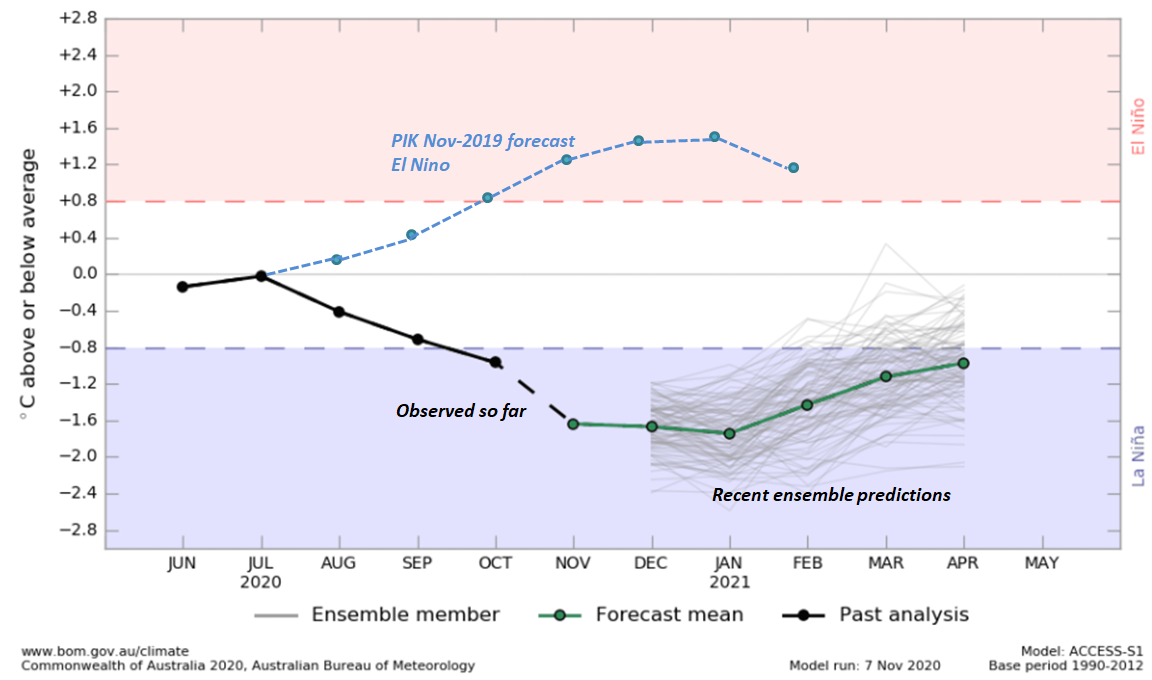
In 2019, Germany’s Potsdam Climate Institute (PIK) boasted that it had a superior El Niño forecasting model, claiming one year in advance and with 80% certainty, there would be an El Niño event late in 2020 (upper curve is just an El Niño illustration). But the PIK model forecast flopped totally. The opposite has in fact emerged. Chart source: BOM (with additions).
One year ago, together with researchers of the Justus Liebig University Giessen (JLU), and Bar-Ilan University in Ramat Gan in Israel, Germany’s alarmist yet highly regarded Potsdam Institute for Climate Research (PIK) boldly declared in a press release there would “probably be another ‘El Niño’ by the end of 2020.”
PIK even boasted forecast model superiority
The PIK November 2019 press release bragged that its team of researchers had developed a new, far better model – which they said was capable of forecasting a late 2020 El Niño event a year in advance: “The prediction models commonly used do not yet see any signs of this,” the PIK press release wrote.
The PIK press release then called the early forecasting model approach “groundbreaking”, claiming it was based on a “novel algorithm” developed by its team. Their forecast relied “on a network analysis of air temperatures in the Pacific region and which correctly predicted the last two ‘El Niño’ events more than a year in advance.”
The results were even published in a journal:
https://arxiv.org/abs/1910.14642
“Conventional methods are unable to make a reliable ‘El Niño’ forecast more than six months in advance. With our method, we have roughly doubled the previous warning time,” stressed JLU physicist Armin Bunde, who initiated the development of the algorithm together with his former PhD student Josef Ludescher.
John Schellnhuber: “80% certainty”…”pretty significant”
Prof. Hans-Joachim (John) Schellnhuber, Director Emeritus of PIK, explained: “This clever combination of measured data and mathematics gives us unique insights – and we make these available to the people affected.” He pointed out that, of course, the prediction method did not offer one hundred percent certainty: “The probability of ‘El Niño’ coming in 2020 is around 80 percent. But that’s pretty significant.”
The 20% uncertainty ends up humiliating PIK physicists
Using data from the past and with the help of of their algorithm, the PIK scientists said El Niño events could then be “accurately predicted the year before”.
Today, one year later, in November 2020, we see that the opposite is in fact occurring, see chart above. Now the equatorial Pacific is entering a La Niña event instead of the almost certain El Niño claimed earlier by the now embarrassed PIK researchers.
Can’t even get one climate component over a single year right
The PIK’s “high certainty” forecast misses totally and so underscores the risks and pitfalls of being overconfident when it comes to still poorly understood complex systems.
And if scientists struggle predicting just one single regional component of the entire climate for just one year, then imagine what the reliability of their complete climate system predictions going out decades has to be. GIGO!
Time for “prediction would have been right if not for climate weirding due to man made global warming.”
Exactly. They’ll just say we’ve screwed it up SO much that it’s unpredictable. Never mind that it’s never been predictable.
They need lots more money to improve their model.
and their salaries… Private yachts are a good insurance against sea-level rise…
they were just on the wrong trend at the wrong time
just more climate expertise via wishful thinking
it will be swept under the carpet and never spoken of among the climate elite
Is it not up to us to keep the memory alive? An annual party, perhaps? It took a certain bravery for PIK to make such a risky prediction*. Let us celebrate that bravery and the bravery of all scientists who make definite predictions, ones with a minimum of weasel words. Hoch!
El Nino predictions are tricksy. I compare El Ninos/La Ninas to the pendulum in a grandfather’s clock, ticking back and forth with precise periodicity, except that there’s a mouse in the clock that likes to go for rides on the pendulum. As the mouse climbs up and down, according to his whim, the swings become quasiperiodic.
Part of this, as I understand it, is that the triggering of the El Nino condition is caused by “the trade winds slackening.” The cause of the slackening was a bit mysterious**, last I checked, but when slackening takes place, sloshing*** happens, letting hot water move from the western Pacific eastward most of the way to South America.****
Insert these tildes above as needed: ~ ~ ~ ~ ~ ~ ~ ~ ~ ~
* Granted, they didn’t know how risky it was.
** I think it has something to do with falling water temperature west of South America, and rising viscosity, surface tension, and density, especially viscosity, which rises 29% between 20C and 10C. (Assuming Newtonian behavior.)
*** Ich bin ein Slosher.
**** Here there be plankton.
Two El Ninos exceeding the ONI index value of 2.0 (very strong), namely 1998-99 and 2015-16, have been commonly called super El Ninos. I have found that in both cases the SW radiation value anomaly (based on the CERES data) was responsible for just a little bit more than 50 % of the temperature increase. According to my literature survey, this phenomenon was not identified before. I could not find out if there is a certain mechanism behind this coincidence. Probably not, because during the strong El Nino 2010 the SW anomaly was negative, and this might be the reason that it never developed into the super El Nino.
I submitted my research article to seven well-known magazines, and it was not accepted to be published. In one case a reviewer claimed that my observation was a well-known phenomenon in climate science, and he/she gave a reference to a publication. I carefully read this reference article but there was not a word about this issue.
The real reason for rejections was a special feature in my article, which was not commented on at all, strange enough. I know from experience that it is impossible to get accepted in the major climate journals that there is no positive water feedback. I had used the climate sensitivity parameter value of 0.27 K/(W/m2) instead of 0.5 K/(W/m2) which is the IPCC value. If you do that, your paper is busted.
My model-calculated temperature values follow very nicely the observed temperature values. And by the way, these simulations show that the SW anomaly is the reason for the high-temperature readings after the El Nino 2015-16. The reason is not anthropogenic.
More details and the reference to the original research paper:
https://www.climatexam.com/single-post/greenhouse-gases-did-not-cause-the-end-of-the-pause
It is very interesting to see a one-year forecast from PIK, because their main climate guru (Mr. Rahmstorf) has stated publicly (in ZDF (German state TV), that climate models don’t work even on a 10-15-20 years time horizont:
“Aber diese Klimamodelle sind nicht in der Lage, auf 10, oder 15 oder 20 Jahre Prognosen über den Klimaverlauf zu machen. Das ist in der Wissenschaft allgemein anerkannt”: https://www.youtube.com/watch?v=JfojG2lGAtA. Nevertheless Mr. Rahmstorf provides in the meantime forecasts for 280(!!!) years (for 2300). And such persons position themselves as “scientists”. PIK has made in this case a strategic error, because a one-year forecast could be checked/validated very easily after one year (like the famous 5-years forecast of Al Gore in 2008 regarding the disappearance of the Arctic ice). Mr. Rahmstorf strategy with the forecast on a 280 years basis would be much better, because who of us will be alive in 2300 to validate his forecast?
It is very interesting to see a one-year forecast from PIK, because their main climate guru (Mr. Rahmstorf) has stated publicly (in ZDF (German state TV), that climate models don’t work even on a 10-15-20 years time horizont
Mr. Rahmstorf could have stopped at “don’t work”.
The best laid schemes o’ mice an’ men / Gang aft a-gley.
Or in cruder terms:
Nature is the wench you can’t bargain with despite how many letters you have after name.
Plenty of climate scientists, including Mr Schellnhuber himself, have got the formula right. All you have to is issue dire prognostications, heavily larded with weasel-words e.g. might, could, probably, likely, etc.
Also, it’s important to keep the date of the impending disaster near enough to be scary, but remote enough to avoid imperilling one’s credibility or career.
This was a mistake not to be repeated and a useful lesson for anyone else considering making definite predictions.
In Australia, when we have many months of bushfires (aka forest fires / wild fires), you know that the weather is more likely to soon turn wetter & cooler. You see a seasonal low in the ice coverage in Antarctica and you see it rebound to a seasonal high soon after. There is a fallacy that the climate has an equilibrium, but it can never find it. All weather & therefore climates are driven by unbalance driving the movement of wind, temperature, tides & moisture. Pressure affects temperature, temperature affects pressure. The inputs are constantly changing & outputs that feed into the next. The cycles of sun, earth’s tilt, earth’s wobbles, moon cycles, planet cycles all impact our climate far more than what humans could achieve. Negative feedbacks abound but it will typically overshoot or the situation changes. The tipping points for el nino la nina & other indicators has been impossible to predict, unable to create long range forecasts (They start talking about them about 3 to 6 months after events & the data were collected).
The past is still a poor predictor of the future when limited to our technology & understanding. The computing capacity to properly model the earth’s climate would require cm scale grid analysis requiring more computing power than the top500 super computers to run 24hrs to properly model a single day on earth. We pretend to be god’s to understand all the mysteries and know the future. We should submit to a higher authority and accept our human limitations.
The Ludescher et. al. article said “We like to note that our algorithm only can warn of the El Ni˜no event next year but not forecast its strength and duration” (First submitted 31 Oct 2019, Pub Feb 2020)
https://arxiv.org/abs/1910.14642
But they also forecast in the article that 2021 should be the warmest year evah! I believe they are also going to get that prediction hugely wrong. Niña years are always colder than their non-Niña preceding and following years.
Well, they can always fall back on the “but there’s more energy in the atmosphere than ever before” position.
Didn’t some climate prophet once claimed something like :
“Climate models can’t be wrong, thus there must be a problem with the data.”
?
They should have asked me. I predicted the 2020 Niña in 2018 based on Leamon & McIntosh research:
“we should expect a La Niña when solar activity increases in late 2020 to 2021.”
https://wattsupwiththat.com/2018/07/05/solar-minimum-and-enso-prediction/
And did my own research on the issue confirming the prediction in 2019:
“With some uncertainty due to the irregularity of the 11-yr solar cycle, a La Niña can be projected for phase V, by mid-2020.”
https://judithcurry.com/2019/09/01/enso-predictions-based-on-solar-activity/
Meanwhile the PIK model was predicting the opposite.
Solar effect on climate rules over models.
El Niño Forecast Revisited by Dr Theodor Landscheidt
Solar Forcing of El Niño and La Niña Authors: Landscheidt, T., SAO/NASA Astrophysics Data System (ADS)
Papers by Dr Theodor Landscheidt
He was an outstanding scientist
La Niña will continue to develop as the solar wind increases, which is still very weak.

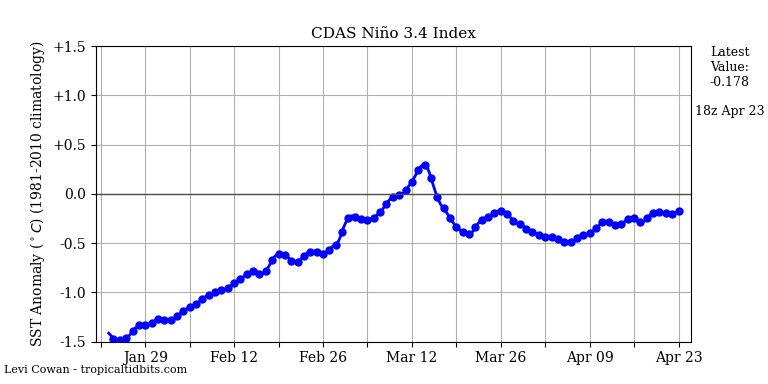
This is shown in the galactic radiation diagram.
From 20 November La Niña will strengthen again.
https://earth.nullschool.net/#2020/11/21/0000Z/wind/isobaric/700hPa/orthographic=-150.40,1.92,469
http://www.bom.gov.au/archive/oceanography/ocean_anals/IDYOC007/IDYOC007.202011.gif
The strength of La Niña depends on the magnetic activity of the Sun, which equalizes the level of ozone (diamagnetic) in the lower stratosphere in the polar vortex.

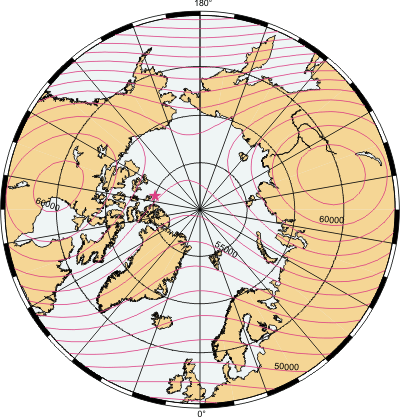
During periods of low solar activity, ozone distribution is consistent with the geomagnetic field at high latitudes.
“Diamagnetic materials are repelled by a magnetic field; an applied magnetic field creates an induced magnetic field in them in the opposite direction, causing a repulsive force.”
Accumulation of ozone in certain areas causes blockages in the circulation of jet streams in the stratosphere and troposphere.
edwardt November 9, 2020 at 8:52 am
I dont think it is pseudorandom, nor cancels to zero. It has a bimodal length between solar min el ninos similar to the sun (~10.4/12.1 yrs). https://app.photobucket.com/u/etregembo/p/2cb3bc3a-9910-4876-93e9-97bdfe23235f
Sorry.
This graph perfectly illustrates that La Niña is perfectly in sync with the 22-year magnetic cycle of the Sun.
Interesting, but there are standards for formatting graphs.
From the press release:
Josef Ludescher, who now works at PIK, emphasizes: “We also predicted the absence of another ‘El Niño’ in 2019 at the end of last year. Only since July have the official forecasts agreed with our forecast.”
So what does that mean, did they just get lucky?
Even a broken clock tells the right time twice a day sort of thing.
Serves them right for deviating from the climate standard 97% ™
Obviously someone had swapped their model with the Covid 19 predictor used by the UK government. It would explain why both were useless. Do I have a testable hypothesis here?
The moral of the story: Never make predictions for the next year. Make predictions for the next century and nobody will disprove you.
indeed, by the time somebody could disprove you, your predictions will be long forgotten. and even if they aren’t, you’ll be long dead anyway, so won’t have to “face the music” for getting them wrong.
Maybe their “solution” to the problem will be to say “we never said that!” The German press will be instructed to remove any related documents. And big tech will be happy to lend a helping hand…
“This clever combination of measured data and mathematics gives us unique insights”
LOL. Measured data + “mathematics” = fit. And you can get all sorts of crazy good hindcasting results with fits and you can even fool yourself into thinking you’re not fitting. But you are.
GCMs also do this. And the people behind them think exactly the same things.
If you look at all of the models they all turn into basically linear equations just a few years out from the present, y = mx + b.
The only difference between them is the value of “m”, the slope of the line.The truly sad thing is how badly the models guess at the value of “m”.
All this taxpayer money to generate linear equations.
All they need to do is employ the cli sci trick of using their numbers upside down, then they’d have a near-perfect prediction.
Being Humiliatingly wrong won’t stop them from making ever more “certain” predictions for the next year, and the next and the next. Never has in the past, no reason to expect it will now.
Actually, like Paul Erlich and too many to count, these complete and utter failures are resume enhancements according to Rush.
They should have gotten with Mosher before they said anything, as an English major he could have helped them wordsmith it to make it look correct?
Given the poor grammatical and spelling quality of the drive-by English Major’s posts (not to mention the shear incoherence of some of them), I highly doubt it.
They vary in quality. Some are fine. Some are less fine. I’m not sure what could explain this variation. He’s good to have around, however, and there are far worse people to consult. He has an eye for sloppy science.
He may once have had an eye for sloppy science. That eye seems to have gone a bit blind since he started collecting a paycheck in support of sloppy science.
…the prestigious institute is left humiliated.
Is it, though?
Such a thing only happens if they are held to account for their failures. I haven’t seen that happen yet.
They should talk to Mann. It looks like they have their dataset upside-down.
That’s what I thought: change + to – and it looks pretty good.
Not only that the picadists claim tax money, the taxes that we consumers have to pay for eco taxes, CO2, taxes, taxes and road tolls are missing from the income of the population. A huge loss for all taxpayers!
Warmists predict El Niño every year.
Every year!
It’s synonymous with Christmas for them.
As soon as we’re into 2021 it will start again.