Guest “Now that’s funny right there!” by David Middleton
OCTOBER 23, 2020
Utility-scale battery storage costs decreased nearly 70% between 2015 and 2018The average energy capacity cost of utility-scale battery storage in the United States has rapidly decreased from $2,152 per kilowatthour (kWh) in 2015 to $625/kWh in 2018. Battery storage systems store electricity produced by generators or pulled directly from the electric power grid and redistribute the power later as needed. At the end of 2018, the United States had 869 megawatts (MW) of installed battery power capacity (the maximum amount of power a battery can provide at a given moment) and 1,236 megawatthours (MWh) of battery energy capacity (the total amount of energy that can be stored by a battery).
Battery storage costs vary by region and application.
[…]
California had the most installed battery capacity of any state in 2019. The average battery storage cost in California was $1,522/kWh. About two-thirds of battery storage capacity in California is used for frequency regulation. Batteries in the state also provide energy-oriented services, including ancillary services, black start services, and easing transmission congestion.
According to EIA data, the United States added 152 MW of battery storage capacity in 2019 and added an additional 301 MW in 2020 through July 2020. EIA also collects data on planned future battery capacity additions. Based on planned capacity additions data reported to EIA by developers and power plant owners as of July 2020, EIA expects battery storage to increase by more than 6,900 MW in the next few years. About 2,300 MW of the 6,900 MW of planned battery storage capacity was reported to EIA between April and June 2020. Large battery storage systems are increasingly paired with renewable energy power plants to increase grid reliability and resilience.
Principal contributors: Sara Hoff, Alexander Mey
US EIA
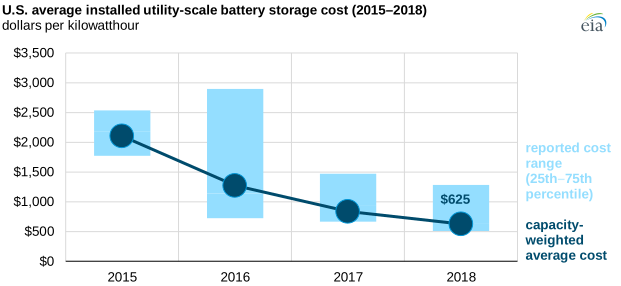
Note: Only includes capacity with available cost data. Puerto Rico is excluded.
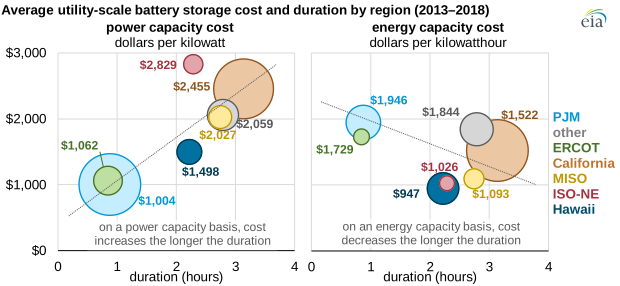
Note: Size of circle indicates battery storage capacity. Regions are regional transmission organizations (RTOs), independent system operators (ISOs), and states. California includes both CAISO and LDWP. Other defined as states not in RTOs/ISOs. NYISO/SWPP excluded to protect respondents’ confidential information.
According to the EIA’s most recent Levelized Cost of Electricity (LCOE), solar PV is down to $0.037/kWh ($0.029 with tax credit). Since Sun doesn’t shine at night, the cost of solar power at night is now down to $625.037/kWh.
The LCOE of natural gas combined cycle is $0.036/kWh 24/7/365.

Addendum
In light of some of the comments…
- Clearly, Larry the Cable Guy isn’t as universally recognized as I thought.
- The $625/kWh is the capacity cost of the battery storage system.
- The price would be amortized over the life of the battery storage system.
- If the battery storage system lasted 10 years (3,650 cycles) the cost of nighttime solar power would drop all the way to $0.207/kWh versus $0.036/kWh for natural gas combined cycle, depending on natural gas prices.
Here is a question for Rick Will, who is known by those who follow the many comments made on Jo Nova’s blog to be a citizen of Oz.
It would seem that Australia is a near ideal place to prove conclusively that wind and solar backed by grid-scale batteries can quickly and successfully replace coal and natural gas as the primary source of electricity for a modern technological society.
The definition of ‘successfully replace’ is that the great majority of the citizens of Australia would accept whatever impacts on their lifestyles and their personal economic circumstances that a quick transition into mostly wind and solar would produce.
Here is the question: If the target is 80% renewables by the year 2035, what factors are preventing a relatively quick transition of Australia’s power grid to mostly wind and solar?
The fact that rooftop solar and wind now have to be carefully factored into the supply calculation by aemo and the generators, means solar and wind are already significant generators. What would be your expectation of relatively fast?
My question to Rick Will sets a target of 80% renewables by 2035 for Australia. That is my expectation for ‘relatively fast’. The comparison standard would be stated in terms of megawatt-hours produced and consumed. Rooftop solar and wind would be a component of that 80% figure.
Most people will ACCEPT a great deal that they hate because the only way to remove the problem is by spilling their blood. Sometimes this eventually leads to an uprising but such tyrannies sometimes endure for centuries.
Plus, people ACCEPT a great deal of what they hate because constant propaganda makes them believe the real problem is elsewhere.
The largest disadvantage of batteries (besides cost, pollution, child labor, etc…) is their slow charging rate. High speed flywheels and ultra-capacitors allow the braking energy of electric vehicles to be recovered as electricity, not heat and brake dust. And cost?
“The target retail price of the FESS is $150-250 per kWh, compared to $1000 per kWh for leading lithium-ion battery providers. The product will be optimized for charge times of 40 seconds or less for integration into the transportation market, with efficiency exceeding 90%. Drawdown times for the FESS will be approximately 12 hours, compared to months for chemical batteries.”
(from) http://american-maglev.com/fess#:~:text=The%20target%20retail%20price%20of,%2C%20with%20efficiency%20exceeding%2090%25.
So, you’re saying if I get a battery for $625, I can run my pond pump (1000 watts) for an hour? I’m going to need a generator to charge the battery to run the pump when the power goes out. Or I could save the money on the battery.
But yeah, frequency regulation is a special use.
I have two 3KVA UPS systems in my basement for computer and network gear. They take eight 12V batteries in two 48V strings each. According to the monitor, with battery charge at 100% and 9.7% load (nowhere near 1000W) the remaining runtime is 7 minutes. A replacement string of 8 batteries can be had for $110 today. So my $220 worth of batteries in both units will support a combined load of 4.8 Amps at 122 Volts for 7 minutes. Probably half that long to run your pond pump.
What kind of pond do you have that uses a 1000W pump? I don’t think my 1/2 HP pool pump pulls that much regularly.
I am still waiting to have someone prove that enough solar and wind energy is realistically available to keep all the batteries charged which would be needed to supply all of our energy needs, keeping in mind that the solar panels take up land space needed for other purposes; likewise with the windmills.
I have a document in my possession which shows that it doesn’t work.
We get it. Slave labor is cool.
In other news, 15 $ per hour is absolute minimum. Or is it 15000 $?
And they still only last 15 to 20 years.
Let’s not forget that they have be cooled in the summer and heated in the winter if you want them to last that long.
At current rates of production it will take between 5000 and 10,000 years to build enough batteries to supply the entire country for 15 minutes at night when the wind stops blowing.
Don’t confuse ‘cost’ and ‘price’. Cost must be ‘margined-up’ to pay for depreciation, Overhead, and expected profit margin to stay in business. Usually businesses ‘margin-up’ 2x to provide a gross margin of 50%. In a commodity business (without high capital costs and overhead) the margin expectation may be lower – 35-40%.
So,.. ‘cost’ per kWh should be estimated on ‘price’ per kWh to keep the venture self sustaining.