Guest “geological perspective” by David Middleton
CRYOSPHERE RESEARCH UPDATE
Unprecedented ice loss is predicted for Greenland Ice Sheet
30 Sep 2020Over the next eighty years global warming is set to melt enough ice from the Greenland Ice Sheet to reverse 4000 years of cumulative ice growth – with rates of ice-loss more than quadruple even the fastest melt rates during the past 12,000 years. These stark conclusions come from new simulations which, for the first time, put current and projected future rates of ice-loss into context; comparing them directly with historical rates of ice-loss. These latest results are consistent with previous research that shows that if we continue our current high trajectory of greenhouse gas emissions we can expect Greenland to become ice-free in as little as 1000 years.
[…]
But as their simulation ventured into the future they discovered that the rate of ice-loss is likely to dwarf anything seen in the past. Under a high-emissions “business as usual” scenario Briner and his colleagues show that ice loss could reach an eye-watering 35,900 billion tonnes per century by 2100, whilst under a low-emissions scenario it is likely to rise to around 8800 billion tonnes per century. “It was a shocking to me to see that even with low emissions the pace of ice loss is going to be faster than it was during the warmest period in the past,” says Briner, whose findings are published in Nature.
[…]
Physics World
A read-only copy of the paper is available for viewing… Nature.
Basically, RCP8.5 melts all of Greenland’s ice within 1,000 years.
Is anyone else picking up a “been there, done that” vibe?
Perspective
This section adapted from The Insignificance of Greenland’s Ice Mass Loss in Five Easy Charts…
I downloaded the Kobashi et al., 2017 climate reconstruction from NOAA and plotted it to evaluate the context of recent climate change in central Greenland.


The inescapable conclusion is that if there ever was a climate “crisis,” it was during the Little Ice Age… It was FRACKING cold back then!
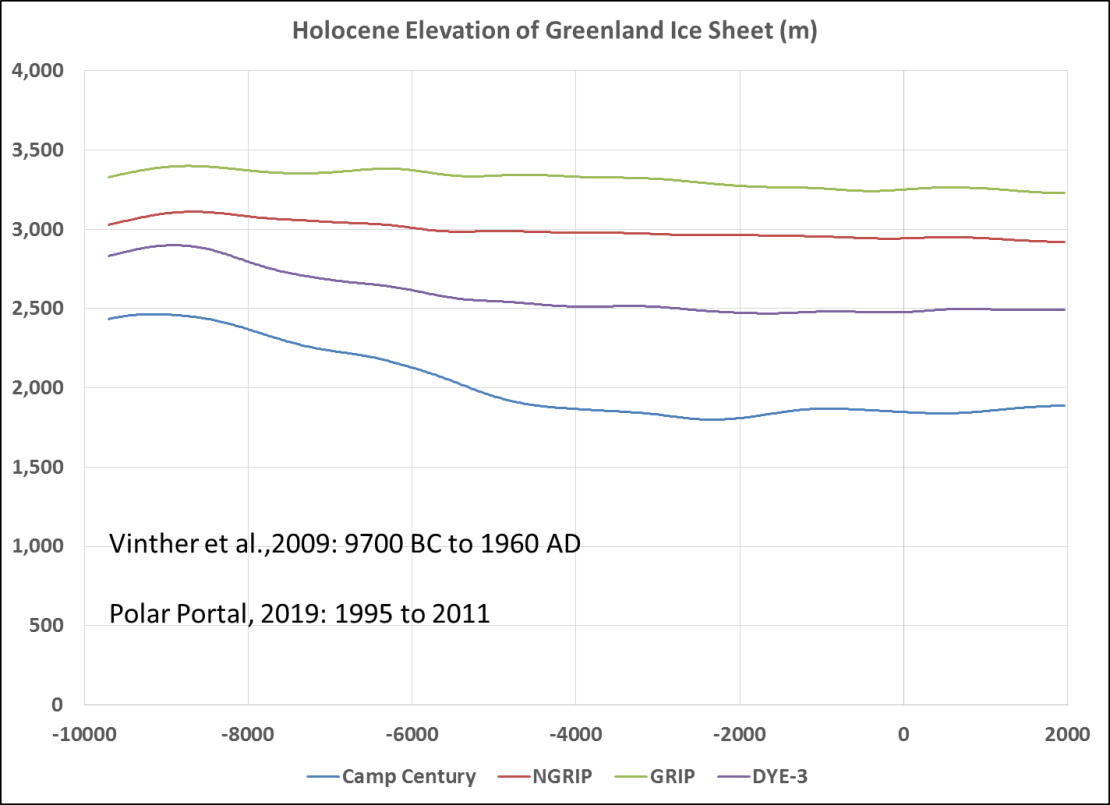
How does the recent melting compare to the rest of the Holocene? Short answer: “Same as it ever was”. Vinther et al., 2009 reconstructed the elevations of four ice core sites over the Holocene. There has been very little change in elevation of the two interior ice core sites (NGRIP and GRIP), while the two outboard sites (Camp Century and DYE3) have lost 546 and 342 m of ice respectively.

Vinther’s elevation reconstruction runs from 11,700 to 40 years before the year 2000. So the most recent year is 1960.
Based on the mass balance estimates from Mouginot, there was very little net change from 1960 to 1995, the starting year for Polar Portal’s elevation change maps. I enlarged the elevation change maps and posted the ice core locations on them.

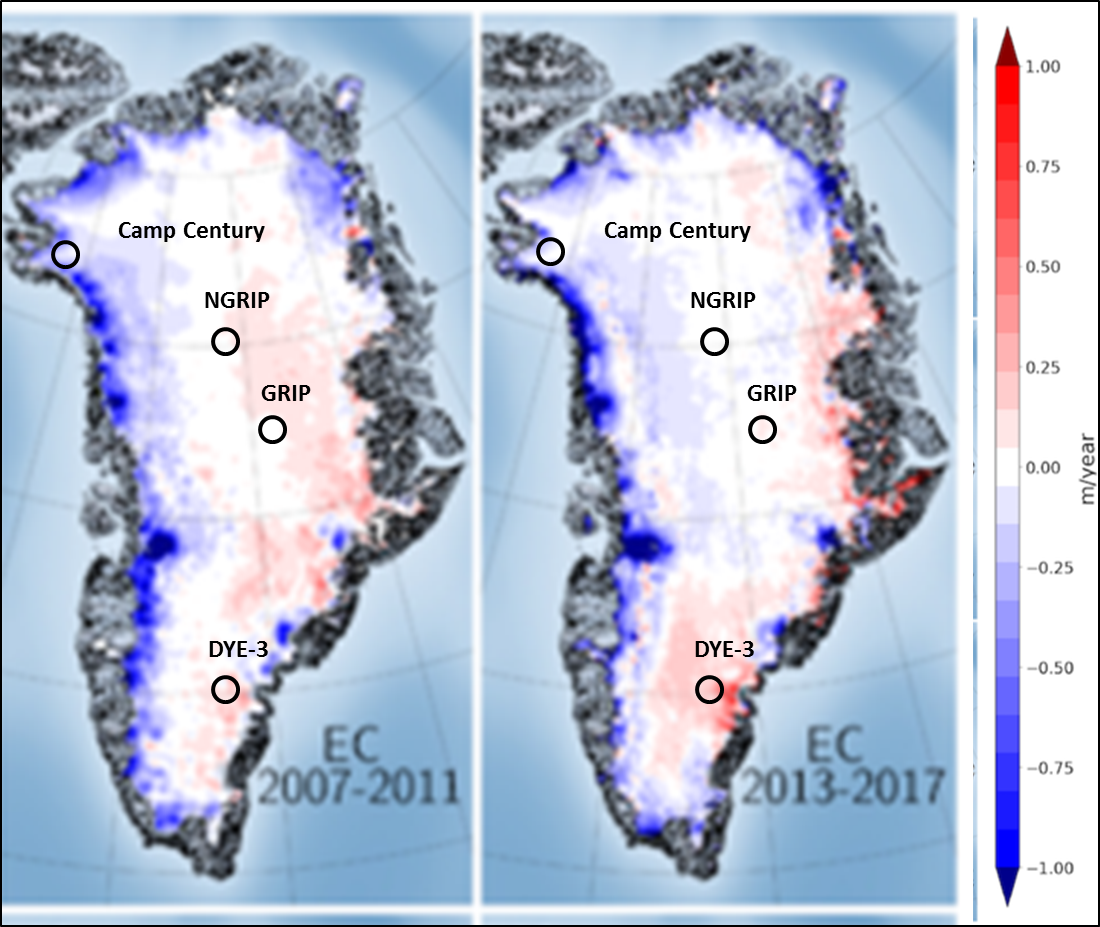
The scale is in meters per year. Note that there has been very little change in ice elevation at these locations. Using my Mark I eyeball, I estimated the annual changes in elevation from 1995-2017.
Using the 2009 elevations provided by Vinther, I calculated the elevations of the four locations from 11,700 years ago up to 2017.

But, but, the Greenland ice sheet is still shrinking! When it all melts, sea level will rise by 7 meters!!!
We petroleum geologists are obsessed with calculating volumes of oil and gas reservoirs and we spend a lot of time making things called “isopach maps” and running “volumetrics“. Fortunately for me, Eric Gaba – Wikimedia Commons user: Sting made an isopach map of the Greenland ice sheet.


Almost all of the recent thinning is in the outboard areas of the ice sheet (“Same as it ever was”). I downloaded a high-resolution copy of the isopach map and digitized the contours using NeuraMap volumetric analysis software. The area and volume of the isopach map were inline with estimates in USGS Professional Paper 1386–A, Table 2, page A77.
- Area: 1,736,095 km2
- Volume: 2,600,000 km3
I used the 10 m contour as the 0 contour. The area of the 0 m contour was very close to the USGS area.
| Contours (m) | km2 | Acres |
| 3,200 | 888 | 219,434 |
| 3,000 | 49,381 | 12,202,209 |
| 3,000 | 896.1 | 221,429 |
| 2,500 | 364,162 | 89,986,345 |
| 2,000 | 723,269 | 178,723,576 |
| 2,000 | 5,395 | 1,333,230 |
| 2,000 | 9,186 | 2,269,815 |
| 1,500 | 1,065,247 | 263,228,385 |
| 1,000 | 1,347,485 | 332,970,919 |
| – | 1,737,393 | 429,319,196 |
The volume was a little higher than the USGS estimate; but well within the range of other recent estimates. The USGS cites a 1954 reference for this number and also cites Bamber et al., 2011, which puts the volume at 2,900,000 km3. Bamber has subsequently upped his estimate to 2,960,000 km3.
| Volumes | km3 |
| Method | In situ |
| Trapezoid | 2,980,626 |
| Pyramid | 2,953,938 |
| TrapPyra | 2,961,940 |
| Simpson | 2,844,332 |
| 3/8Rule | 2,725,668 |
| VerticalSlice | 2,979,256 |
| Step | 2,456,431 |
| Average | 2,843,170 |
As can be seen, estimates for the volume of the Greenland ice sheet vary widely and the methods of volumetric calculation yield a pretty wide range of results… Yet modern climate “scientists” can detect 0.015% annual changes in its mass… Go figure!
This is what happens if I drop the 1,000 m contour by 10 m:
| Volumes | km3 | |
| Method | Lose 10 m | |
| Trapezoid | 2,977,601 | 99.90% |
| Pyramid | 2,950,926 | 99.90% |
| TrapPyra | 2,958,915 | 99.90% |
| Simpson | 2,844,332 | 100.00% |
| 3/8Rule | 2,725,668 | 100.00% |
| VerticalSlice | 2,976,230 | 99.90% |
| Step | 2,453,891 | 99.90% |
| Average | 2,841,080 | 99.93% |
99.93% of the Greenland ice sheet doesn’t melt and/or calve into the ocean. The USGS paper states that if the entire ice sheet were to melt, sea level would rise by 6.5 meters. In the highly unlikely scenario above, sea level would rise by a whopping 4.8 mm.
- 6.5 m * 0.07% = 0.00478 m
What happens if I drop the 1,000 m contour by 100 m?
| Volumes | km3 | |
| Method | Lose 100 m | |
| Trapezoid | 2,947,019 | 98.87% |
| Pyramid | 2,920,467 | 98.87% |
| TrapPyra | 2,928,333 | 98.87% |
| Simpson | 2,844,332 | 100.00% |
| 3/8Rule | 2,725,668 | 100.00% |
| VerticalSlice | 2,945,636 | 98.87% |
| Step | 2,428,207 | 98.85% |
| Average | 2,819,952 | 99.18% |
- 6.5 m * 0.82% = 0.0531m
That’s just over 2 inches of sea level rise.

RCP8.5: Junk Science on steroids
If you review their paper in Nature, you’ll see that the nightmare scenarios are all ginned up with the RCP8.5 model scenario, the one where Doctor Evil melts the icecaps with a space “laser.”
This section adapted from: U.S. Climate Resilience Tool Kit: Greenland Stays Frozen in 2100… Even Under RCP8.5
I stumbled across something very useful yesterday on Climate-Dot-Gov’s U.S. Climate Resilience Tool Kit page.
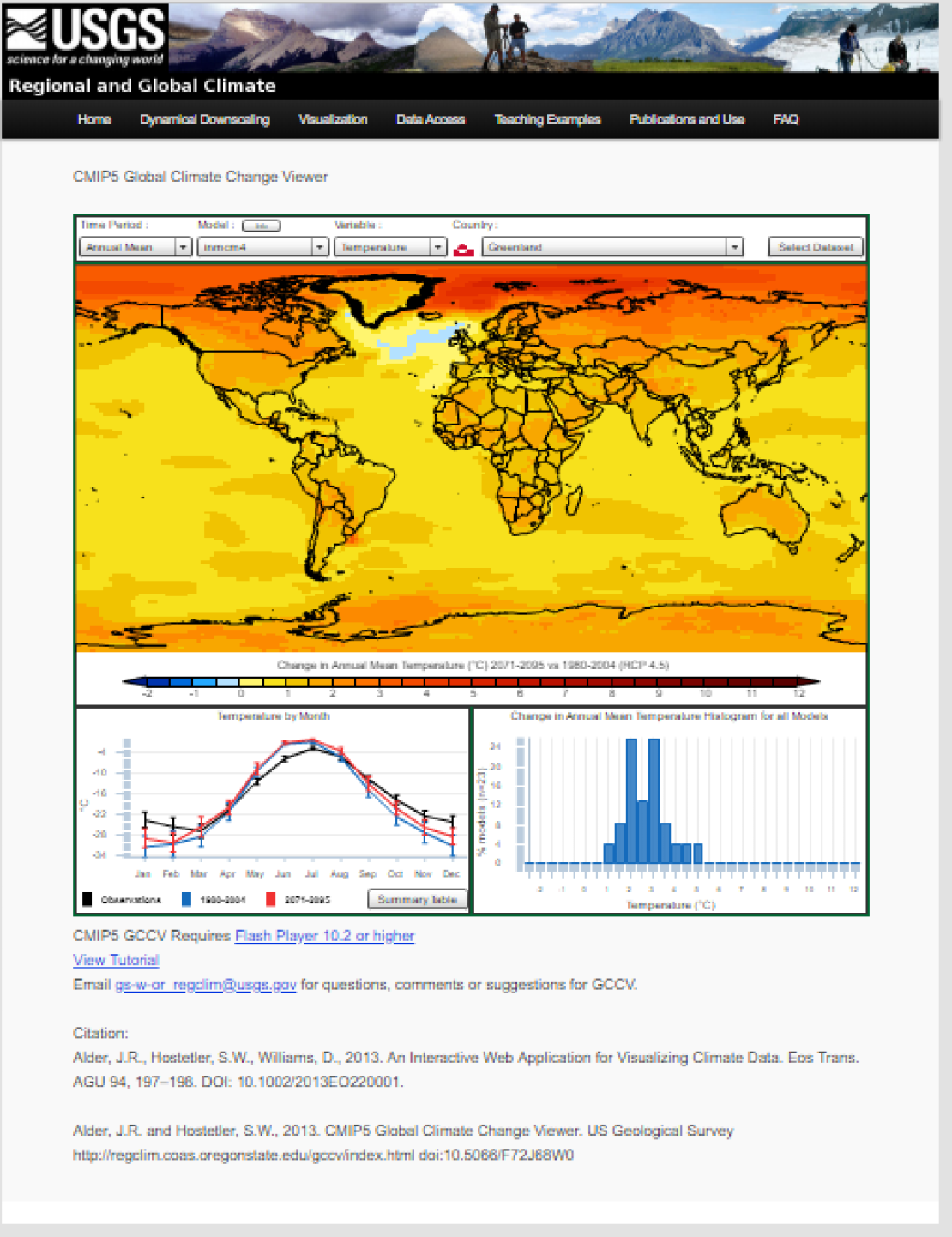
The widget generates CMIP5 or PMIP3 model outputs for specific countries and a temperature change map of the world. You can also spit out plots of each model. And these outputs display the actual temperature ranges rather than anomalies.
Since Greenland is such a great climatic playground, I started playing around with it.
Greenland Stays Frozen in an RCP8.5 Bad Science Fiction Nightmare
The first thing I did was to hit Greenland with RCP8.5.

While the histogram indicates a 5.1 °C rise in the average annual surface temperature. It’s thought that the Sangamonian (Eeemian) interglacial was at least 5 °C warmer than today and Greenland retained much of its ice. However, most of that 5.1 °C rise appears to be in winter and the average July temperature is projected to still be below freezing, only 2-3 °C warmer than the 1980-2004 mean.
Andy May’s brilliant analysis of NCA4 featured this image:

Andy noted the following:
INM-CN4 is labeled and it, alone, is tracking the observations with enough accuracy, yet it does not predict dangerous temperatures in the future or any significant human influence on climate.
This drew some standard ad hominem and/or unsupported dismissals of Dr. Christy’s work and derision of INM-CM4. So I downloaded UAH 6.0 and HadCRUT4 and plotted 5-yr running means at the same scale as Dr. Christy’s 2016 plot.

UAH 6.0 generally plots within 0.1 °C of the average of 3 satellite datasets, closest to INM-CM4. HadCRUT4 plots well-below the model-mean closest to the only model that runs hotter than INM-CM4. Note that there’s not a lot of difference between HadCRUT4 and UAH 6.0. (0.1-0.2 °C is not a lot of difference).
Here are the RCP8.5 and RCP 4.5 outputs for INM-CM4 in Greenland:

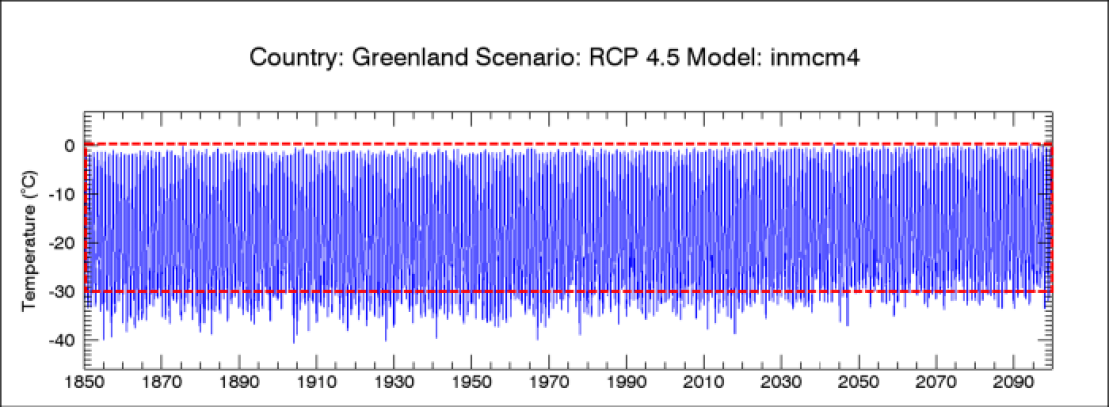
Both models indicate that Greenland won’t be significantly warmer in 2100 than it was in 1850. Almost all of the warming comes from an increase in the minimum temperatures.
1850 was very cold by Holocene standards.

Where is Inigo Montoya when you need him?
Tipping Points: “You keep using that [phrase], I do not think it means what you think it means”
The Physics World article closes with this…
Previous research has suggested that we have already passed the point of no return for the Greenland Ice Sheet, with no hope of preventing a complete meltdown, but Briner and his colleagues are not convinced that this tipping point has passed. “It is clear that we are now committed to a lot of ice loss through this century, but our simulation shows that if we follow a low-emissions pathway the rate of ice-loss may slow as we approach 2100. It is possible to leave future generations with a healthy Greenland Ice Sheet,” he says. Lenton concurs and thinks there is still time to act. “Even if tipping points have been passed, because the ice sheet dynamics are relatively slow, it is possible to ‘overshoot’ an ice sheet tipping point temporarily and still recover the situation. That of course requires bringing greenhouse gas levels down, which is going to require deliberate greenhouse gas removal on top of stopping greenhouse gas emissions.”
Physics World
There you have it… The bear will always remain just out of sight in the woods.
Added Bonus
A couple of weeks ago a massive chunk of ice – equivalent in size to the Caribbean island of Montserrat – broke away from north-east Greenland.
Physics World
- Montserrat 102 km2 (39 sq mi)
- Manhattan 59 km2 (23 sq mi)
Montserrat ~ 2 Mahattans
Adapted from: 2012: The Year Greenland Melted (AKA Alarmists Gone Wild) and Manhattan-sized Icebergs!
Manhattan-sized Icebergs are insignificant relative to Greenland-sized ice sheets.
- Manhattan: 34 square miles.
- Greenland ice sheet: 660,235 square miles.
Manhattan = 0.005% of Greenland ice sheet. 99.995% of the Greenland ice sheet did not participate in this event.
If one Manhattan-sized chunk of ice calved into the ocean every year and there was no snow accumulation in Greenland for 1,000 years, Greenland would lose 5% of its ice sheet. A little perspective on Manhattan-sized chunks of ice…

(Wikipedia and Google Earth)
Discover more from Watts Up With That?
Subscribe to get the latest posts sent to your email.
” It’s thought that the Sangamonian (Eeemian) interglacial was at least 5 °C warmer than today and Greenland retained much of its ice. “
If anything more as a matter of fact, here are the relevant proxy data from the Eemian of Greenland that I know of:
Site: NEEM, Lat: 77.45 Proxy: Oxygen Isotopes. Temperature rise: 8 degrees
Reference: NEEM Community Members 2013. Eemian interglacial reconstructed from a Greenland folded ice core. Nature 493:489-494.
Site: Thule, Lat 76.50 Proxy: Pollen, Insects. Temperature Rise: 4 degrees (warmest month)
Reference: Bennike O, Böcher J. Early Weichselian interstadial land biotas at Thule, northwest Greenland. Boreas. 1992;21:111–118.
Site: NGRIP, Lat: 75.10 Proxy: Oxygen Isotopes. Temperature rise: 5 degrees
Reference: North Greenland Ice Core Project Members. 2004. High-resolution record of Northern Hemisphere climate extending into the last interglacial period. Nature 431 : 147 – 151.
Site: GISP2, Lat: 72.57 Proxy: Oxygen Isotopes. Temperature rise: 6 degrees
Reference: Yau, A. M. et al 2016. Reconstructing the last interglacial at Summit, Greenland: Insights from GISP2. PNAS http://www.pnas.org/cgi/doi/10.1073/pnas.1524766113
Site: GRIP, Lat: 72.57 Proxy: Oxygen Isotopes. Temperature rise: 5 degrees
Reference: Johnsen SJ, Dahl-Jensen D, Gundestrup N, Steffensen JP, Clausen HB, Miller H, Masson-Delmotte V, Sveinbjörnsdottir AE, White J. 2001. Oxygen isotope and palaeotemperature records from six Greenland ice-core stations: Camp Century, Dye-3, GRIP, GISP2, Renland and NorthGRIP Journal of Quaternary Science 16 : 299 -307.
Site: Renland, Lat: 71.30 Proxy: Oxygen Isotopes. Temperature rise: 5 degrees
Reference: Johnsen SJ, Dahl-Jensen D, Gundestrup N, Steffensen JP, Clausen HB, Miller H, Masson-Delmotte V, Sveinbjörnsdottir AE, White J. 2001. Oxygen isotope and palaeotemperature records from six Greenland ice-core stations: Camp Century, Dye-3, GRIP, GISP2, Renland and NorthGRIP Journal of Quaternary Science 16 : 299 -307.
Site: Jameson land, Lat: 70.50
Proxy: Plants. Temperature rise: 5 degrees (warmest month)
Reference: Bennike O, Böcher J (1994) Land biotas of the last interglacial/glacial cycle on Jameson Land, East Greenland. Boreas 23:479–487
Proxy: Insects. Temperature rise: 6-11 degrees (warmest month)
Reference: Böcher, J. (2012). Interglacial insects and their possible survival in Greenland during the last glacial stage. Boreas, 41(4), 644–659. doi:10.1111/j.1502-3885.2012.00251.x
Proxy: Mollusces, Forams. Temperature rise: 3 degrees (SST, warmest month)
Reference: Funder, S., Hjort, C., Landvik, J.Y., Nam, S.I., Reeh, N., Stein, R., 1998. History of a stable ice margin—East Greenland during the Middle and Upper Pleistocene. Quaternary Science Reviews 17, 77–125.
Site: Pakitsoq, Disko Bay, Lat: 69.44 Proxy: Oxygen Isotopes. Temperature rise: 4 degrees
Reference: Reeh, N., Oeter, H., Letreguilly, A., Miller, H., and Hubberten, H.-W. (1991). A new detailed ice-age oxygen-18 record from the ice sheet margin in central west Greenland. Global and Planetary Change 90, 373-383.
Unfortunately no data from southern Greenland.
So it would seem that the annual temperature was at least 5 degrees warmer, than now, particularly in North Greenland, that winter temperatures probably rose more than summer temperatures, and temperatures on land more than SST.
“The widget generates CMIP5 or PMIP3”
So we have Chimp and Pimp. Even a misreading of the acronyms gives you a good idea if the usefulness of the models.
Well, all very interesting, but it’s much simpler than all of that.
What’s with all the billions & billions?
Just a big number to impress the science illiterate reporters and proles?
Appropriate scientific short hand would use Giga-tonnes, Gt, which amounts to the same thang. Also a km^3 of water.
The land mass of Greenland is covered by 2.6 to 2.8 MILLION Gts of ice and snow.
8,800 Gt is 0.326%!!
35,900 Gt is 1.33%!!!!
BFD.
Nick
All this feigned concern for “billions of tons” of ice loss, and simultaneously, apparently “billions of tons” of ocean water are consumed by subduction.
https://scitechdaily.com/each-year-billions-of-tons-of-ocean-water-falls-into-the-deep-earth-lower-mantle-where-it-has-extraordinary-oxidation-power/
It’s a race between post modern ‘journalism’ and climate science to alarm and extrapolate the worst case scenario without full explanation of that scenario and its construction.
Anthony: I’m a PhD Environmental Science & Engineering, MS,BS Chemist. I don’t study graphs from the raw data shown in the NOAA report. I do a more advanced process of statistics and mathematical data fits that is a method proven in chemistry to study chemical reactions giving clearer view of the situation. If you are interested, we can join, and I can show you the method used in data of brainwaves and EKG’s, which I used to study better sleep disorders and onset of diabetes, heart disease. We would need to access the raw NOAA data that build the graphs. I believe it can help us improve understanding the data. This is a method that I developed and haven’t published yet. My email: [redacted by AW] Thanks
A great post, David! In your comments, there is a figure which seems to show an accelerated ice loss between 2002 and 2017, which would amount to about -0.13% in 15 years, or 0.0087% per year. Even if that ice loss were to continue indefinitely, it would take about 11,500 years to completely melt Greenland’s ice cap.
Of course, this assumes there is no future Little Ice Age between now and the year 13,520 which would reverse the trend. There was a warm period during the Roman Empire, followed by a cooling, then another Medieval Warm Period, followed by a cooling. Two cooling trends in the last 2,000 years, so it is likely there will be several cooling trends in the next 11,500 years!
When we hear alarming reports that “an iceberg the size of Manhattan calved into the sea”, these events are observed in summer, when there is daylight nearly all the time (or some very short nights, depending on latitude). But those who observe these summer calvings are not there all winter, when repeated blizzards dump more snow on the ice cap, mostly in darkness. Just because there is no one around to watch the snow doesn’t mean it didn’t fall.
The snowfall is likely heaviest along the east coast of Greenland, since the Gulf Stream brings enough warm water northward to keep the ocean to the east mostly ice-free for most of the winter, while mainland Greenland is bitterly cold without any sunlight, and the high altitude of the ice sheet. Storms tend to track just off the east cost of Greenland in autumn and winter due to the sharp temperature difference between the ocean and land (similar to the nor’easters along the Atlantic coast of the United States), with an ample supply of moisture from the open ocean to generate snow over the land.
clever title, but why are only “Greenland is doomed” headlines sarcastically offered – over and over – when there is no science over the years showing the opposite? (i.e., that Greenland has stabilized or is growing over terms more than a year)
just curious. I would seem biased unless there is a good reason. 🙂
If 4000 years of ice accumulation has been reversed, to whom do we credit the saving of the world from a glacial periord? Coal miners, oil drillers, Henry Ford? Or all of them?
Or of course, none, as it both ups and downs are natural variations.
If my slide rule can be trusted it takes 360 billion tons of melted ice to raise sea level one millimeter.
So nothing to worry about !
Cheers
Mike
Someone please help me out; seriously.
See FIGURE 1 of the paper.
In Fig 1, from about 9000 BC to about 7000 BC (roughly 2000 years ) the temperature record shows warming of about 12 C over that time period.
Can anyone please explain what caused that warming?????
A similar, but smaller warming magnitude occurred from about about 4500BC to about 2500 BC (roughly 2000 years); the temperature record shows about a 4 C warming over this period.
Can anyone please explain what caused this warming??
I assume that volcanic activity caused periods of cooling; but does not the cooling affects of volcanic activity cease after a few years; say, 2 to 5 years as the dust / debris falls out of the atmosphere thus once again allowing “normal” sunlight to reach the earth’s surface?
So what caused the several periods of cooling shown in FIG 1. that lasted from 1000 to 2000 years??
And once again, for the nth time, what caused the Medieval Warm Period?
Look forward to a response; any response.
I seem to recall that RCP8.5 is basically impossible as there are not enough reserves of fossil fuel to consume at RCP8.5 growth rates for another 80 years.
It took a while to assemble the idea that CO2 categorically does not have a role to play in climate and sea level changes.
Many a model has been destroyed by the drill or euphemistically called ‘the rotary lie detector’. The climate change sea level change argument, in my view, cannot get past the results from three deep ice core holes in Greenland Dye 3, GRIP and GISP2.
The drilling stats are as follows:
Hole Elevation (m) Total Depth (m)
GRIP 3200 3028.8
GISP 2 3208 3055
Dye 3 2479 2035
Each of these core holes reaches basement with GRIP finishing just below current sea level and the other two slightly above.
Work done the bottom of GRIP and Dye 3 in terms of microbiology indicate that a temperate climate consisting of conifer forests existed some 450,000 years ago and stretching back another 400,000 years.
(Willerslev E et al; Ancient Biomolecules from Deep Ice Cores Reveal a Forested
Southern Greenland Science. 2007 July 6; 317(5834): 111–114. doi:10.1126/science.1141758.)
The climate was about to enter the next glacial period. However, sea level was then 100 metres below the current position. Miller KG et al, The Phanerozoic Record of Global Sea-Level Change. Science 25 November 2005: Vol. 310. no. 5752, pp. 1293 – 1298 DOI: 10.1126/science.1116412.
The CO2 level from Vostok was about 290 ppm at the same time i.e. 450,000 years BP when ice began to accumulate onshore Greenland: http://www.ncdc.noaa.gov/paleo/indexice.html.
Ice accumulation continues to the present day unhindered and unchanged through sea level changes; CO2 variations, 4 glacial periods and 4 Milankovitch cycles. At the peak of each of the cycles temperatures in excess of freezing were evident. Both the Arctic and indeed the Antarctic the rate of accumulation of ice continued without a break and at the same periodic rate with no evidence of melting when temperatures were at their peak. There were changes to finer points of ice stratigraphy but nothing to stop the inexorable rate of accumulation.
From your blog you do not appear to have drawn the distinction between the unbroken record of ice accumulation of at elast 430,000 years in both the Arctic and Antarctic and thaqt of the ‘temporary’ ice adavances and retreats associated with the glacial and interglacial periods.
The intriguing aspect of all of this is that from 450,000 years the climate in permanent ice areas in both Greenland and Antarctica remained constantly increasing.
Another curious fact is that the sea level rose some 100 metres when there was no ice to begin with from Greenland and there was no evidence of melting of the permanent ice from Antarctica.
The outstanding questions are where did the water come from to enable the oceans to rise 100 metres and also what caused the ice to begin to accumulate in Greenland and continue for some 450,000 years without a break at both ends of the Earth?
I enjoy your blogs.
Shriek.
Run for the hills.