By University of California Davis May 6, 2020
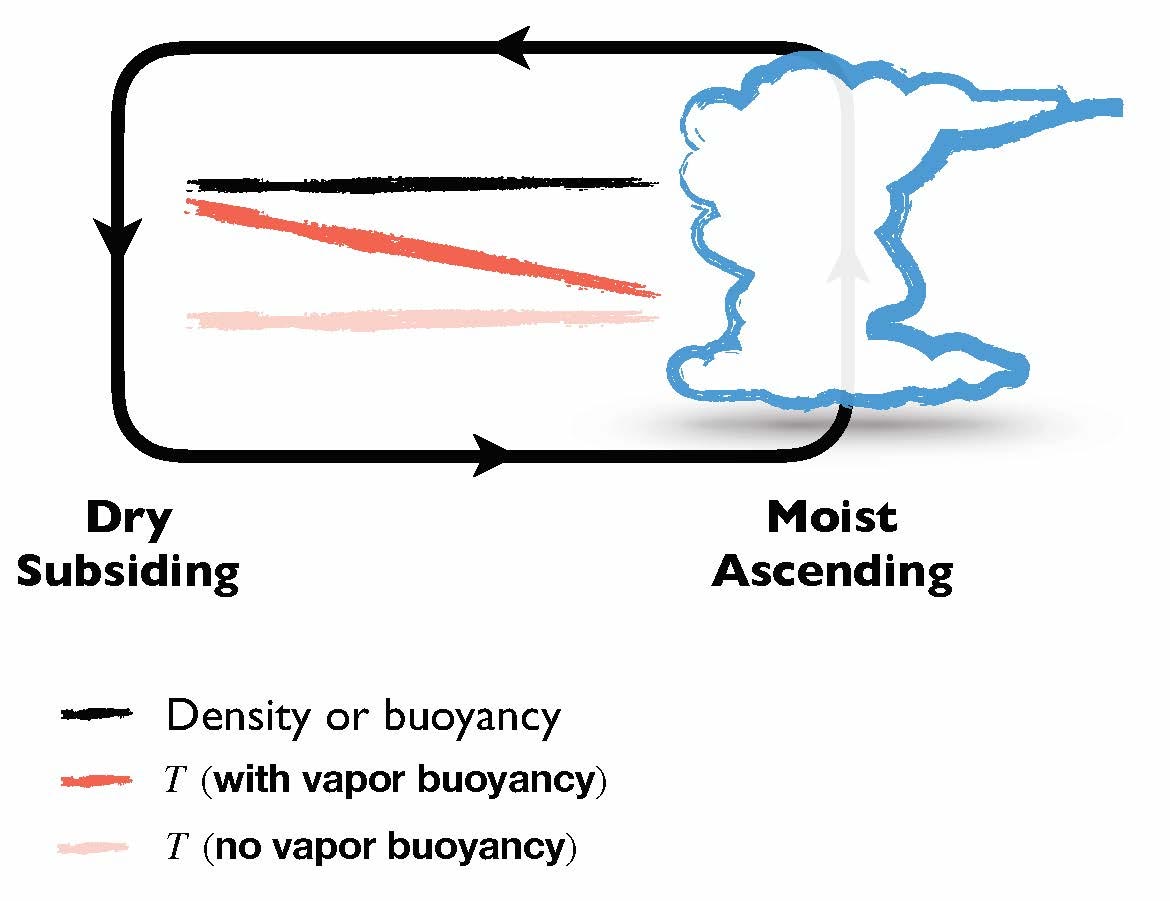
The lightness of water vapor buffers climate warming in the tropics.
Conventional knowledge has it that warm air rises while cold air sinks. But a study from the University of California, Davis, found that in the tropical atmosphere, cold air rises due to an overlooked effect — the lightness of water vapor. This effect helps to stabilize tropical climates and buffer some of the impacts of a warming climate.
The study, published today (May 6, 2020) in the journal Science Advances, is among the first to show the profound implications water vapor buoyancy has on Earth’s climate and energy balance.
The study found that the lightness of water vapor increases Earth’s thermal emission by about 1-3 watts per square meter over the tropics. That value compares with the amount of energy captured by doubling carbon dioxide in the atmosphere.
“It’s well-known that water vapor is an important greenhouse gas that warms the planet,” said senior author Da Yang, an assistant professor of atmospheric sciences at UC Davis and a joint faculty scientist with Lawrence Berkeley National Laboratory. “But on the other hand, water vapor has a buoyancy effect which helps release the heat of the atmosphere to space and reduce the degree of warming. Without this lightness of water vapor, the climate warming would be even worse.”
Humid air is lighter than dry air under the same temperature and pressure conditions. This is called the vapor buoyancy effect. This study discovered this effect allows cold, humid air to rise, forming clouds and thunderstorms in Earth’s tropics. Meanwhile, warm, dry air sinks in clear skies. Earth’s atmosphere then emits more energy to space than it otherwise would without vapor buoyancy.
Here is the abstract from the paper which can be found here.
Abstract
Moist air is lighter than dry air at the same temperature, pressure, and volume because the molecular weight of water is less than that of dry air. We call this the vapor buoyancy effect. Although this effect is well documented, its impact on Earth’s climate has been overlooked. Here, we show that the lightness of water vapor helps to stabilize tropical climate by increasing the outgoing longwave radiation (OLR). In the tropical atmosphere, buoyancy is horizontally uniform. Then, the vapor buoyancy in the moist regions must be balanced by warmer temperatures in the dry regions of the tropical atmosphere. These higher temperatures increase tropical OLR. This radiative effect increases with warming, leading to a negative climate feedback. At a near present-day surface temperature, vapor buoyancy is responsible for a radiative effect of 1 W/m2 and a negative climate feedback of about 0.15 W/m2 per kelvin.
HT/Clyde Spencer
We need to dehydrate our economy.
Hydro distancing
It would very interesting to examine the Russian model, to see if it handles this concept in a more realistic manner – or at all , for that matter. Could explain why it is the only model that seems to be able to reflect reality.
This super-revalidates that any models that don’t include evaporation tanks are failures.
Quick Reference: 80°F is 45.45 watts
@ur momisugly * Smart Rock* Remember that the “”models”” also assume homogenious pressure, density, mass and specific heat per cubic volume.
Since you are working with a model, there is no reason to limit yourselves to the laws of physics, particularly if you remove the restriction that your model does not have to conform to reality.
Heat can flow from cold bodies to hot bodies. Time can flow backwards. Water can flow uphill. You can travel faster than the speed of light.
Climate Models are by construction psychotic.
I loved Willis’ posts about clouds and water temps. I even made a javascript app to take the graphs and extract the data and then use a polynomial regression to graph the relationship. I tried 3rd, 4th, and 5th order to find a function that best describes the relationship. I love this stuff and it was a blast making an app to see what the function would look like to describe. I have no idea which order to use for an accurate and appropriate function since I’m just a dumb carpenter, but I love learning and using programming as the substrate to facilitate my learning of climate science and the math underlying it.
Similar to the idiotic notion that warm water in the oceans sinks and the heat is being stored in the deep ocean (where there is little temperature data). Warm air rises, warm water rises, where is this cold air (in the tropics) coming from? Tropics tend to not have a great deal of cool air, the climate is , well,warm and tropical. I have come to the conclusion that the only way for people to become this ignorant and dumb is to work hard and study for years at an institution of higher learning.
The paper investigates what happens to water vapour after it’s in the air. Other papers have studied how the water molecules got there and the movement of energy. If you think of a process from A->B->C->D, this paper just deals with process B.
With the same number of molecules before and after, take a N2 or O2 and replace it with H2O reduces the weight. My questions would be, (1) does the water molecule move by itself up through the column of air? or (2) what conditions does the whole air pocket move together?
It’s very complex going from the 1 square metre at sea level has several square metres at the outer surface of the atmosphere. Potential kinetic energy increases with height. Measured temperature decreases when pressure is decreased. Does that mean the energy of a molecule doesn’t change when pressure decreases but the energy per volume decreases so our understanding of temperature in Kelvins is not an accurate unit to measure energy per volume? As soon as you’ve measured it, it has moved (it’s like trying to solve quantum maths).
Sufficiently accurate climate models (maintain +/- 0.5C for 100 years) would use more than all the weather/climate supercomputers in the world and take 1 day to model 1 day. Currently we have long term guesses of long term averages. But the answer could be 42 something 🙂
That was never coventional knowledge. That’s crappy high school teaching. Should have always been taught that less dense air rises. Heating a pocket of air so that it expands is just one of the reasons a pocket of air becomes less dense. Even saying humid air is less dense is wrong. Condensation not only warms the air, thereby expanding it, but also reduces the amount of molecules in the air.
But it’s not just the fault of teachers.
https://www.nssl.noaa.gov/education/svrwx101/thunderstorms/faq/
The the evaporation at the surface that increases the moisture in the air at the surface also cools the surface that has a larger negative feedback effect that the models also ignore. In addition, when the added water vapor condenses after rising and cooling, the latent heat so released warms the air at that level as clouds form increasing the heat radiated to space, causing additional negative feedback.
Moist air contains liquid nanodroplets of H2O.
Moist air is, therefore, always heavier than drier air.
Uplift as we see in storms is a result of vortice activity above.
There is no such thing as convection. This was a myth people adopted in the nineteenth century by way of a rough analogy to a pot boiling on a stove.
This analogy did get one thing right, and that is the involvement of water. However it is not its phase change characteristics (which themselves have been fictionalized by the convection model) that matter. It’s its structural properties that are expressed under shear conditions–specifically and most significanlty, wind shear conditions
Vortices deliver the low pressure, cold winds of storms.
Cold air rises because it is literally being sucked into vortices above.
Vortices provide the structural component of the atmosphere, without which weather is inexplicable.
CD,
I have to say you are thinking outside the box …… way out.
Boy Oh Boy.
Have I got a bone to pick with a few school teachers who fed me falsehoods 75 years ago.
But wouldn’t all that CO2 in the air make it heavy again?
Philo
Da Yang is described as: senior author Da Yang, an assistant professor of atmospheric sciences at UC Davis and a joint faculty scientist with Lawrence Berkeley National Laboratory”
https://www.yang-climate-group.org/resume states:
2008 – 2014 Ph.D. (Adviser: Prof. Andrew Ingersoll)
Environmental Science and Engineering, California Institute of Technology
2004 – 2008 B.S.
Physics and Atmospheric Science, Peking University
From which I infer he is native Chinese, born about 1986, lived in the US for the last twelve years. ie does not have English as his first language.
However – given that he is working at California Institute of Technology – I would expect he has access to fellow workers who are native English language speakers, and who know enough about the subject matter to qualify as peer reviewers.
I don’t know anything about the way CIT operates, but I would hope that it has a mechanism to prevent an author getting a work reviewed by three mates who know damn-all or who can’t speak the language any better than the author, and then just publishing !
Unfortunately that does not seem to be the case.
OldCynic
Before I retired, I was asked to review some articles written by Chinese authors. The grammar was so poor I could not get through the papers or really understand the details. I declined any further reviews.
The amount of “dissolved” water vapor in air (0-15% depending on pressure and temperature) is too small to really have an important effect on air density. The main effect comes from unstable air: when the moist air column rises, it expands which cools the air down till water starts to condense (forms the cloud base). Then the condensation heat of the water is released which heats the air mass and causes it to rise even further (formation of thunderheads). For sure, this effect has a significant contribution for heat transfer from the surface to the upper troposphere. The effect of CO2 is probably negligible in comparison.
Eric Vieira May 11, 2020 at 3:37 am
how does the warm air mass radiate to the void?
o2 n2 do not radiate significantly
the o2 n2 molecules have to transfer energy (contact) to ghgs to be able to radiate to space – at high altitudes h20o vapour will be in short supply leaving the other ghgs to do the transfer.
Clouds will radiate as a near black body but co2 and other ghgs will be there to absorb the energy at certain wavelengths. giving a up/down radiation pattern. Clouds will also be very cold and so will be able to radiate less than the ground could,
Clouds at night are a very good blanket for the earth.
If you ignore meteorological propaganda and you take a scientific approach you will immediately come to the realization that there is no such thing as vapor buoyancy and buoyancy plays no role whatsoever in weather.
The correct way to approach any scientific subject is to substantiate your assumptions. This involves empirical testing, which is something meteorology refuses to do. So all we get from meteorology and meteorologists propaganda that is repeated so often it looks like science to outsiders. But that is all meteorologists care about.
The public treats meteorologists like priests who can do no wrong. And the public is extremely gullible and really only wants to be told a good story so that they don’t have to deal with the complexities that have nothing at all to do with buoyancy.
When it comes to understanding the physics of storms and weather, all meteorologists are con artists and tbe public is the mark. Getting you to pretend like you understand what actually makes no sense is their only goal.
All meteorologists (including Anthony Watts) continually walk on egg shells to avoid saying anything that will interrupt the perception that they understand what actually doesn’t make sense.
Greenhouse Goofiness
https://anchor.fm/james-mcginn/episodes/Greenhouse-Goofiness-edrn8n
Claudius Denk / Genius
If you ignore meteorological propaganda and you take a scientific approach you will immediately come to the realization that there is no such thing as vapor buoyancy and buoyancy plays no role whatsoever in weather.
The correct way to approach any scientific subject is to substantiate your assumptions. This involves empirical testing, which is something meteorology refuses to do. So all we get from meteorology and meteorologists propaganda that is repeated so often it looks like science to outsiders. But that is all meteorologists care about.
The public treats meteorologists like priests who can do no wrong. And the public is extremely gullible and really only wants to be told a good story so that they don’t have to deal with the complexities that have nothing at all to do with buoyancy.
When it comes to understanding the physics of storms and weather, all meteorologists are con artists and tbe public is the mark. Getting you to pretend like you understand what actually makes no sense is their only goal.
All meteorologists (including Anthony Watts) continually walk on egg shells to avoid saying anything that will interrupt the perception that they understand what actually doesn’t make sense.
Greenhouse Goofiness
https://anchor.fm/james-mcginn/episodes/Greenhouse-Goofiness-edrn8n
Claudius Denk / Genius
All meteorologists are frauds who pretend like they understand storms and weather just like climatologists pretend to understand the climate. There is no difference between an Anthony Watt and Michael Mann other than the point of focus of their propaganda. The meteorology’s convection model of storms is equally as fraudulent as climatology’s CO2 forcing. In both cases the only purpose of the narrative is to keep the public confused so that they will surrender and just accept the consensus.
James
Have you considered a career as a motivational speaker? I think you would do well at things like “How to win friends and influence people.”
Clyde:
James
Have you considered a career as a motivational speaker? I think you would do well at things like “How to win friends and influence people.”
James:
I don’t think that’s where my talents lie.
Ignorance About Water Begets Ignorance About Storms
https://anchor.fm/james-mcginn/episodes/Ignorance-About-Water-Begets-Ignorance-About-Storms-ea4fmi
James McGinn / Genius
President, Solving Tornadoes
Suppose you had a globe made from a perfect reflector (zero emmission), at 80F in outer space, and you wanted to cool it. Which method would cool it quicker:
a. Give it an atmosphere of N2.
b. Give it an atmosphere of CO2.
Water vapor, being a great emitter of IR, and given the fantastic surface area of clouds, cools the Earth.
Clyde:
Have you considered a career as a motivational speaker?
James:
Did you know that there is zero empirical evidence that moist air is lighter than drier air?
Did you that dry layer capping is based on physical principles that have never been detected?
Did you know that latent heat has never been detected?
Do you consider the convection model of storms to be genuine science or just conversation intended to create the illusion of science?
James
You said, without qualification, “… there is zero empirical evidence that moist air is lighter than drier air”.
Have you looked in the CRC Handbook of Chemistry and Physics? You may not find it in the recent editions, but the older books have formulas and tables for calculating the density of dry and moist air.
James
See https://wattsupwiththat.com/2020/05/10/cold-air-rises-how-wrong-are-our-global-climate-models/#comment-2990778
Clyde:
James
See https://wattsupwiththat.com/2020/05/10/cold-air-rises-how-wrong-are-our-global-climate-models/#comment-2990778
James:
Clyde, there’s your error. You assumed that the H2O in moist air is gaseous. It isn’t. It’s comprised of nanodroplets of unknown size–not genuinely gaseous H2O.
The correct particle size for application of Avogadro’s law is not 18. It is 18 x X, with X being somewhere between 10 and 1000.
Moist air is always heavier than drier air. So moist air can’t be ascribed as a source of the energy or uplift of storms by way of buoyancy or convection.
But this is okay since we already know that the source of the energy of storms is differential air pressure. So we don’t need invoke special energetic properties in H2O (ie. “latent heat”.)
It is the structural properties of H2O that only get expressed under wind shear conditions that is the wild card in all this (and without which weather is an unsolvable puzzle).
James McGinn / Genius
The Central Confusion of Water Science
https://anchor.fm/james-mcginn/episodes/The-Central-Confusion-of-Water-Science-edrnr2
James
You said, “You assumed that the H2O in moist air is gaseous.”
As I’m sure the observers did who developed the formulas from empirical observations — the same formulas that ended up in the CRC handbook. The calculations result in moist air of differing dew points having less density than dry air.
Clyde:
As I’m sure the observers did who developed the formulas from empirical observations — the same formulas that ended up in the CRC handbook.
James:
Clyde, there is really no such thing as an empirical observation. Empiricism involves reproducible experimental evidence. Can you point me to an experiment that I can do myself that will demonstrate that the moisture in clear, moist air is genuinely gaseous and not just small nanodroplets? Obviously you can’t.
Clyde:
The calculations result in moist air of differing dew points having less density than dry air.
James:
Nonsense. Moist air is always denser/heavier than drier air, all other factors being the same.
Ignorance About Water Begets Ignorance About Storms
https://anchor.fm/james-mcginn/episodes/Ignorance-About-Water-Begets-Ignorance-About-Storms-ea4fmi
James McGinn / Genius
http://go.vaisala.com/humiditycalculator/5.0/
Before condensation happens the air must be “oversaturated”.
Jürgen:
http://go.vaisala.com/humiditycalculator/5.0/
Before condensation happens the air must be “oversaturated”.
James:
Condensation and evaporation are continuous processes. Neither ever stops. Droplets in the atmosphere (there is no gaseous H2O in the atmosphere) are under constant bombardment from air molecules (moving very fast–literally hundreds of miles per hour) which breaks them down into smaller droplets. At one and the same time, they are constantly recombining to form larger droplets. Conditions (temp, pressure and other minor factors) will favor one process over the other. When conditions favor condensation (lower temperature and lower pressure) allowing recombination to flourish, droplets begin to become big enough to see and heavy enough to fall out of the sky as precipitation.
Much of Science Involves Models That Have Been Dumbed-Down to Pander to the Public
https://anchor.fm/james-mcginn/episodes/Much-of-Science-Involves-Models-That-Have-Been-Dumbed-Down-to-Pander-to-the-Public-e9c1vd
James McGinn / Genius
Hi James McGinn! – the self-proclaimed Genius
Obviously you have some confused meteorological background!
I had given you the best model available these days: http://go.vaisala.com/humiditycalculator/5.0/
This is the calculation sheet for density of air. Density differences are driving the atmosphere.
You are not aware of the correct influence of water. In air there are always free water molecules as you pointed out yourself.
Rising “hot” air has not droplets. The equilibrium is far in the range of individual molecules.
Before condensation happens the air must be “oversaturated”.
Best condensation nucleus are biological spores. But this need already about 1K lower saturation temperature.
Humid air – at the same temperature and pressure – has a lower density compared to dry air!
Calculate the difference using the given calculation sheet by Vaisala. This company is the supplier for humidity measuring devices in sounding ballopons.
Being a Chemical Engineer I have some knowledge about evaporation and condensation.
Regards Juergen
Juergen.michele@jade-hs.de
PS:
Check this link for:
An engineer’s note to the community of meteorologists April 15th,
2013 Supplemented: August 17th, 2017: Back to the roots
and
Some nonsense about humid air (clouds) from Scientific American:
https://de.quora.com/Why-do-clouds-float
https://www.scientificamerican.com/article/why-do-clouds-float-when/
Some Nonsense from Scientific American
https://www.scientificamerican.c…
Pop popcorn in a microwave in a sealed bag and explain why the bag balloons.
Jürgen: Hi James McGinn! – the self-proclaimed Genius
James: Hi Jurgen. I am also the self-proclaimed world’s #1 expert on H2O. See the link below.
Jürgen: Obviously you have some confused meteorological background!
James: I think of myself as more of a theoretical physicist. I do my best to sidestep your confused religion.
Jürgen: I had given you the best model available these days: http://go.vaisala.com/humiditycalculator/5.0/
James: It’s wrong. See other posts in this thread where I describe the correct way to calculate the density/weight of moist air. (You might also do a googlel search using the phrase “Isaac Newton was a human being.”)
Jürgen: This is the calculation sheet for density of air. Density differences are driving the atmosphere.
James: Differential pressure is the force underlying atmospheric flow. Water is involved with atmospheric flow (winds) but meteorology has mischaracterized its role as being the source of the energy. Water is not the source of the energy of storms. As I stated above, the source of the energy of storms is differential pressure. Water’s role is structural. It is the surface tension properties of H2O that are maximized on wind shear boundaries to produce a plasma that is the basis of the sheath of vortices, with vortices being the proximate mechanism that channels and focuses the flow into streams and storms.
Jürgen: Humid air – at the same temperature and pressure – has a lower density compared to dry air!
James: Humid air is always denser/heavier than drier air, all other factors being the same. Buoyancy plays no role in atmospheric flow (winds).
Jurgen, listen to this:
The Central Confusion of Water Science
https://anchor.fm/james-mcginn/episodes/The-Central-Confusion-of-Water-Science-edrnr2
James McGinn / Genius
I give up and surrender to the self –proclaimed Genius James McGinn.
Jürgen:
I give up and surrender to the self –proclaimed Genius James McGinn.
James:
Don’t fret Jurgen. This is science. Open mindedness is not a sin. Ignore the pretenders who suggest otherwise, they are delusional
Wizard of Oz and the Discovery of Atmospheric Plasma
https://www.youtube.com/watch?v=pl-GOPq8aA0
James McGinn / Genius
Soon We Will Stop Hurricanes
https://anchor.fm/james-mcginn/episodes/Soon-We-Will-Stop-Hurricanes-e9g5fn
Scio nescio.
Salviati: …Now you see how easy it is to understand.
Sagredo: So are all truths, once they are discovered; the point is in being able to discover them.
— Galileo Galilei
WHAT GOES UP: Storm Theory: What meteorologists believe but won’t debate, discuss, or even doubt
https://www.amazon.com/WHAT-GOES-meteorologists-Tornadoes-Atmosphere-ebook/dp/B00KY7EGSG/ref=sr_1_1?dchild=1&keywords=James+McGinn+Solving+Tornadoes&qid=1589907809&sr=8-1
James McGinn / Genius
President, Solving Tornadoes
Clyde:
James,
See https://wattsupwiththat.com/2020/05/10/cold-air-rises-how-wrong-are-our-global-climate-models/#comment-2990778
James:
Clyde,
There’s your error. You assumed that the H2O in moist air is gaseous. It isn’t. It’s comprised of nanodroplets of unknown size–not genuinely gaseous H2O.
The correct particle size for application of Avogadro’s law is not 18. It is 18 x X, with X being somewhere between 10 and 1000.
Moist air is always heavier than drier air. So moist air can’t be ascribed as a source of the energy or uplift of storms by way of buoyancy or convection.
But this is okay since we already know that the source of the energy of storms is differential air pressure. So we don’t need invoke special energetic properties in H2O (ie. “latent heat”.)
It is the structural properties of H2O that only get expressed under wind shear conditions that is the wild card in all this (and without which weather is an unsolvable puzzle).
James McGinn / Genius
Clyde, I’m not talking about coorelations or conjectures. I’m talking about a controlled experiment where this specific question/issue was investigated–rigorously.
On many days at Hawaii’s Mauna Loa Observatory (11,200 feet/3.4 km), warm air from below pushes the cool, dry air above it even higher as it rises to the station by mid-morning. I’ve measured and photographed this phenomenon many times. You can feel the cool air on your cheeks before it’s replaced by warm air from below. Cumulus clouds arrive with the warm, moist air and are soon dancing about over MLO.
I’m happy for the authors at UC Davis in keeping their job with the right sentences to stay politically correct. You need that kind of protection when countering Soviet, Vatican, Mullahs, or Climate Crusade leaders and their models. You would not want to fall out of windows as in Russia.