By University of California Davis May 6, 2020
The lightness of water vapor buffers climate warming in the tropics.
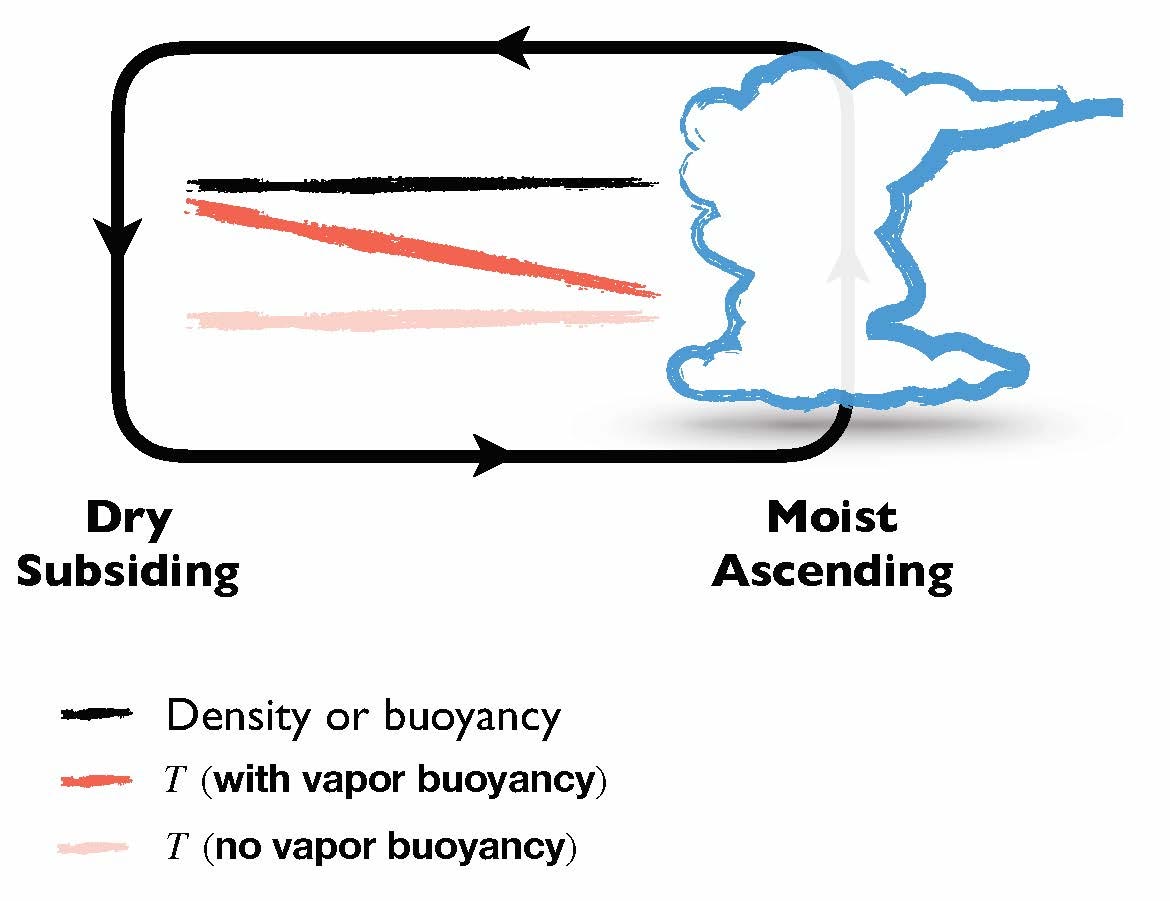
Conventional knowledge has it that warm air rises while cold air sinks. But a study from the University of California, Davis, found that in the tropical atmosphere, cold air rises due to an overlooked effect — the lightness of water vapor. This effect helps to stabilize tropical climates and buffer some of the impacts of a warming climate.
The study, published today (May 6, 2020) in the journal Science Advances, is among the first to show the profound implications water vapor buoyancy has on Earth’s climate and energy balance.
The study found that the lightness of water vapor increases Earth’s thermal emission by about 1-3 watts per square meter over the tropics. That value compares with the amount of energy captured by doubling carbon dioxide in the atmosphere.
“It’s well-known that water vapor is an important greenhouse gas that warms the planet,” said senior author Da Yang, an assistant professor of atmospheric sciences at UC Davis and a joint faculty scientist with Lawrence Berkeley National Laboratory. “But on the other hand, water vapor has a buoyancy effect which helps release the heat of the atmosphere to space and reduce the degree of warming. Without this lightness of water vapor, the climate warming would be even worse.”
Humid air is lighter than dry air under the same temperature and pressure conditions. This is called the vapor buoyancy effect. This study discovered this effect allows cold, humid air to rise, forming clouds and thunderstorms in Earth’s tropics. Meanwhile, warm, dry air sinks in clear skies. Earth’s atmosphere then emits more energy to space than it otherwise would without vapor buoyancy.
Here is the abstract from the paper which can be found here.
Abstract
Moist air is lighter than dry air at the same temperature, pressure, and volume because the molecular weight of water is less than that of dry air. We call this the vapor buoyancy effect. Although this effect is well documented, its impact on Earth’s climate has been overlooked. Here, we show that the lightness of water vapor helps to stabilize tropical climate by increasing the outgoing longwave radiation (OLR). In the tropical atmosphere, buoyancy is horizontally uniform. Then, the vapor buoyancy in the moist regions must be balanced by warmer temperatures in the dry regions of the tropical atmosphere. These higher temperatures increase tropical OLR. This radiative effect increases with warming, leading to a negative climate feedback. At a near present-day surface temperature, vapor buoyancy is responsible for a radiative effect of 1 W/m2 and a negative climate feedback of about 0.15 W/m2 per kelvin.
HT/Clyde Spencer
Cold humid air… except cold air isn’t humid. Ask Antarctica.
It’s always relative 😀
I prefer absolute.
I absolutely do not prefer some relatives.
My relatives prefer Absolut.
In Soviet Russia, Absolut prefer relatives.
No, this study did not discover that. It’s basic meteorology. How tropical storms work and what causes the column of moist air to rise is well understood in principal.
Willis Eschenbach has been saying for years here, how tropical storms act as regulation mechanism for surface temperature and I don’t think he claims to have invented the idea.
It seems the only thing which may be new here is someone ran a computer model to estimate a magnitude for the effect and then dressed it up as global warming would be even worse if we lived on another planet.
They modified a climate model by NCAR to include an effect of water vapor buoyancy. It is models all the way down.
When I read article first person I thought of was Willis.
Despite the useless PR from Davis, written as usual by a media studies freshman undergrad, the paper looks like a good attempt to fill the gap in computer models by actually modelling thunderstorms at high spacial resolution.
This may reduce some of the “parameter” guessing and single ‘lapse rate’ going on in models which cannot model the processes which are the most important factors of climate and just make them to fit expected results.
Sadly they only use a 2D model. Maybe someone can find them some CPU time to do the same thing in 3D.
Exactly! Willis described this effect in his article along with the Hadley Cells as thermostat of the earth.
And Whack!
“…Without this lightness of water vapor, the climate warming would be even worse.”
no “real” science without reference to the dogma!
Thank God we live on the water planet and not on Mars!
Greg
The important points are that they provide a quantitative estimate of the related effects and note that the current GCMs do not take this into account.
Greg
From the full article, “Contemporary cloud-resolving and general circulation models have the physics necessary to simulate the vapor buoyancy feedback.” What is necessary is for the modelers to explicitly incorporate this observation and assess how it affects their outputs.
So why didn’t the NCAR model include “buoyancy” aka density already? I mean when you are modelling a convection/advection in a mixture of gases you need to know things like mass and density right off the bat.
You know a model based on “basic physics” kinda needs to take account of basic physical properties.
Dr William Gray pointed out long ago that any warming induced evaporation would enhance convection across the planet. His conclusion was this would be a negative feedback on the CO2 greenhouse effect cutting it by at least half. Of course, a big part of this is the lightness of water vapor.
When I’ve explained this to climate alarmists they always deny it. Now what are they going to do?
Put out a paper where they find that its worse than we thought.
Old habits die hard.
So, air current has nothing to do with moist air movement.
Greg
You asked, “So why didn’t the NCAR model include “buoyancy” aka density already?” I have no idea. You need to ask that question of the modelers.
My relatives say that a lot. 🙂
And them climate models can’t model clouds…go figure…
Cold air can be humid. Spend some time in a dry environment at 0F then go to a humid environment at 20F and tell me which one is more uncomfortable. (hint: though 20F warmer, it’ll “feel” much more uncomfortable and you’ll swear the cold goes straight through your jacket and into your bones.)
That’s because you are losing heat more rapidly.
Yep. Had that exact effect or similar when, during my Post-doc in Edmonton, Alberta I went back for Christmas and New year in London. Bone-chilling indeed.
philincalifornia
Mark Twain famously said that the coldest Winter he had ever experienced was a Summer in San Francisco. The cold fog that rolls in from the Pacific can be uncomfortable.
Indeed. In fact you can spot the Canadians and Brit tourists in the summer. Locals are wearing warm jackets whereas they’re enjoying the San Francisco fog in shorts and t-shirts.
Or a Giants game at Candlestick-back in the day.. Top row..
This is a joke, right?
Hi Clyde!
I use this comment connection to send you a comment I just had posted to James McGinn …
Regards Jürgen
Jürgen Michele
Your comment is awaiting moderation.
May 17, 2020 at 12:56 am
Hi James McGinn! – the self-proclaimed Genius
Obviously you have some confused meteorological background!
I had given you the best model available these days: http://go.vaisala.com/humiditycalculator/5.0/
This is the calculation sheet for density of air. Density differences are driving the atmosphere.
You are not aware of the correct influence of water. In air there are always free water molecules as you pointed out yourself.
Rising “hot” air has not droplets. The equilibrium is far in the range of individual molecules.
Before condensation happens the air must be “oversaturated”.
Best condensation nucleus are biological spores. But this need already about 1K lower saturation temperature.
Humid air – at the same temperature and pressure – has a lower density compared to dry air!
Calculate the difference using the given calculation sheet by Vaisala. This company is the supplier for humidity measuring devices in sounding ballopons.
Being a Chemical Engineer I have some knowledge about evaporation and condensation.
Regards Juergen
Juergen.michele@jade-hs.de
PS:
Check this link for:
An engineer’s note to the community of meteorologists April 15th,
2013 Supplemented: August 17th, 2017: Back to the roots
and
Some nonsense about humid air (clouds) from Scientific American:
https://de.quora.com/Why-do-clouds-float
https://www.scientificamerican.com/article/why-do-clouds-float-when/
Some Nonsense from Scientific American
https://www.scientificamerican.c…
Jurgen: I had given you the best model available these days: http://go.vaisala.com/humiditycalculator/5.0/
James: In my opinion, the “best model available” can be found at this link:
Isaac Newton was a human being
http://www.thunderbolts.info/forum/phpBB3/viewtopic.php?f=8&t=16306
As you can see it is very different from your model.
Jurgen: This is the calculation sheet for density of air.
James: This is worthless/misleading if you do not know for certain that the moisture that is suspended in the atmosphere is genuinely gaseous.
Jurgen: Density differences are driving the atmosphere.
James: There is little drama in the density differences. The magnitude of flow that is actually observed in the atmosphere is orders of magnitude greater than what can be explained by density differences. Differential pressure is the driving force, the energy of atmospheric flow. Structural capabilities—vortices—are the means by which the flow of the atmosphere is isolated from friction to achieve some very high wind speeds. The emergence of these structural capabilities is the result of the surface tension properties of H2O being maximally expressed on wind shear boundaries.
Jurgen: Being a Chemical Engineer I have some knowledge about evaporation and condensation.
James: Being a scientist I am well aware of how easy it is too fool oneself into believing one understands what in actuality one just believes.
James McGinn / Genius
Correcting Common Misconceptions About Energy in the Atmosphere
https://anchor.fm/james-mcginn/episodes/Correcting-Common-Misconceptions-About-Energy-in-the-Atmosphere-e9moua
To James McGinn the self-proclaimed Genius!
You are the greatest fool on earth! Calling others names: morons etc.
You recycle only your own claims and running in circles …
In Germany we have a saying: Du siehst den Splitter in des anderen Auge – aber nicht den Balken vor dem eigenen Kopf!
Translated: You see the splinter in your neighbor’s eye, but not the wooden beam in front of your head …
Also you do not look into what other people are telling you.
You are not Newton and not Einstein – but you are also not a scientist!
You claim to be a physicist: physicist are generally educated and specialized only in one field.
“Physicists now nothing about every thing”
You don’t check “your science”
“James: Being a scientist I am well aware of how easy it is too fool oneself into believing one understands what in actuality one just believes.” ???
“In God we trust – others bring data”!!!
Where is your patent – or even patent proposal?
I realize how you earn some money: it is the internet and your Google Book, where naïve humans may pay one Dollar for that nonsense. I will not waste my time anymore to communicate to you – but tell my friends about your nonsense.
Humid air is lighter compared to dry air!
Density differences are driving weather and climate. A fluid mechanics professor is telling that!
Jurgen: To James McGinn the self-proclaimed Genius!
James: That’s me!!!
Jurgen: You are the greatest fool on earth! Calling others names: morons etc.
You recycle only your own claims and running in circles …
James: LOL. The tendency to recycle claims (and absolute refusal to challenge these claims with empirical methods) is the reason millions of millions of pretentious morons believe the absurd convection model. All you morons know how to do is parrot back each other’s stupidity. All you got is group think.
Jurgen: In Germany we have a saying: Du siehst den Splitter in des anderen Auge – aber nicht den Balken vor dem eigenen Kopf!
James: Science involves facts. Not slogans.
Jurgen: Translated: You see the splinter in your neighbor’s eye, but not the wooden beam in front of your head … Also you do not look into what other people are telling you.
James: I already know what you morons will say. Science pretenders are extremely predictable and common. They/you far outnumber real scientists, like myself. You won’t actually discuss the details of what you believe because these details would reveal that you don’t really understand it. You just believe it.
Jurgen: You are not Newton and not Einstein
James: Newton and Einstein were not me either.
Jurgen: – but you are also not a scientist!
James: You got nothing, you lazy ass.
Jurgen: You claim to be a physicist: physicist are generally educated and specialized only in one field. “Physicists now nothing about every thing” You don’t check “your science”“James: Being a scientist I am well aware of how easy it is too fool oneself into believing one understands what in actuality one just believes.” ???“In God we trust – others bring data”!!! Where is your patent – or even patent proposal?
James: Where is yours?
Jurgen: I realize how you earn some money: it is the internet and your Google Book, where naïve humans may pay one Dollar for that nonsense. I will not waste my time anymore to communicate to you – but tell my friends about your nonsense. Humid air is lighter compared to dry air!
James: It’s heavier.
Jurgen: Density differences are driving weather and climate. A fluid mechanics professor is telling that!
James: Why would I take your word on this? Show us the freeking proof. You can’t. You can’t because it doesn’t freeking exist. All we have is a bunch of consensus-based morons mindlessly repeating a vague narrative and agreeing to agree.
Jurgen, listen to this:
Meteorologists Slyly Refuse to Discuss Storm Theory
https://anchor.fm/james-mcginn/episodes/Meteorologists-Slyly-Refuse-to-Discuss-Storm-Theory-edslkh
James McGinn / Genius
President, Solving Tornadoes
Jeremiah
Definitely! When I was working in the ice tunnel in the Greenland glacier, the temperature was 27 F and it was bone chilling because the RH was high. There were hoar frost crystals the size of my hand, a foot thick on the ceiling, and exposed ice all around. The breathing from the survey crew added to the RH.
So, at higher temps the opposite is true? 80 F and high humidity is more uncomfortable than 90 F and low humidity? Your sweat evaporates more easily in low humidity and cools your body, no?
Pretty much. It’s all about the body’s thermal balance. Is it trying to retain heat or reject heat?
Exactly. More humid air is usually more unpleasant than dry air of same temperature. This is regardless of temperature.
Humidity is not felt only around 23C (73F) where heat loss of human body is equal of energy created by metabolism.
Too dry air can be unpleasant too, because of drying skin, lungs and airways.
Yes
It reads better if you replace “cold” with “cooler” and “warm” with “warmer”.
The North Pacific begs to differ. Ever been to Seattle? I don’t recommend going there anymore. Go to Astoria and visit Lewis and Clark State Park.
Did you actually read the article? It’s water vapor which rises.
Warming would be even worse? Worse than what? That there has been warming and that this is a bad thing seems to be a given. In fact what warming there has been has been, not excessive at all, and mostly beneficial. So in what way could being even more beneficial be described as worse?
“the climate warming would be even worse.”
.barf
without Earth’s water vapor-laden atmosphere, we wouldn’t be here to care.
I’d think that Willis would find this an interesting variable to his theories on tropical Pacific thermostat.
This is apparent over water in still conditions where the molecules from the water surface evaporate into dry air the water loses the latent heat of vaporization the cooled water descends to be replaced by ambient temperature water while the humid air rises away from the water surface to be replaced by drier ambient temperature air and the cycle continues.
Excerpted from above published article:
“DUH”, …. what is the name of the effect that allows warm, humid air to rise, forming clouds and thunderstorms?
Yeah this is quite a funny paper. Next they will discover clouds.
Why not first the sun ?
“DUH”, …. what is the name of the effect that allows warm, humid air to rise, forming clouds and thunderstorms”
It’s called moist convection, and is driven by the release of the LH of condensation within a rising column of moist air as it cools/expands.
Different thing.
Anthony Banton – May 10, 2020 at 10:44 am
So, it is called the “vapor buoyancy effect” if it allows cold, humid air to rise, forming clouds and thunderstorms in Earth’s tropics.
But it is called the “moist convection effect” if it allows warm, humid air to rise, forming clouds and thunderstorms in Earth’s tropics.
So tell me, Anthony, …… at what temperature does that rising humid air mass “switch” between being designated “cold” verses being ”warm”, ……. or being designated “warm” verses being ”cold”?
Is there an actual “temperature” that the warm/cold switch occurs …. or is it just a “feeling” temp?
Curious minds would like to know.
Can someone help me understand why the variable “Volume” is needed to define part of the way colder air is lighter?
PV=nRT and wet and dry adiabats.
Can you get dry adiabats at the wet market in Wuhan?
… and a case of Corona??? I prefer the lite version, less symptoms.
In vino veritash.
Or in other words PV/nR determines what T is. What three things are not used when describing “warming” by CAGW proponents. P,V, and n. All three of which directly influence T. Instead all three are assumed to be constant even while they say n is changing(i.e. adding CO2). Things that make you go hmmm.
If there is cold air rising due to water vapor in the tropics would that explain the lack of the tropospheric hotspot that the models predict?
High wet-bulb temps are here and we will not survive, according to this report:
https://www.sciencenews.org/article/climate-deadly-extreme-temperature-predictions-already-here?utm_source=Editors_Picks&utm_medium=email&utm_campaign=editorspicks051020
Well, Australians seem to survive just fine. Elderly in Florida and Arizona seem to survive just fine. Africans seem to survive just fine, despite no air conditioning and limited water, food, shelter, and clothing. While I prefer dry and under 100F, I have played tennis and golf above 100F in humid environments. I’m sure I can toughen up a bit if this warming ever happens. 90% of Canadians live within 100 miles of the US border because it’s too damn cold up north. I’m sure they’d like it if things warm up a bit.
Don’t underestimate the stupidity of Canadian Liberals.
Rick K – that’s always puzzled me. Why would the climate change cult be so strong on what Patrick Moore calls the coldest country on earth? Why would exist there at all?
I always pictured Canadians as very practical, sensible people but I’ve seen placard waving crowds of them protesting for more action on climate change – proof that commonsense just ain’t that common.
In Canada the media has been taken in by CAGW as well as the politicians. In the media you rarely see a skeptic article. Three political parties, Liberals, NDP, and Greens hijacked the last election campaign to “climate emergency” and ignored the deficits by the Liberals. The Conservatives know the truth but are afraid to use it.
Result is the public is misinformed. The CAGW have also got control of most of our institutions here.
People DO NOT CHECK what they hear.
uhmm…more like a lot – had snow for 5 minutes yesterday in Niagara Falls, chickens were annoyed
According to Mike Moore we live close to the USA border as a prelude to invasion😀😀
Jeremiah, we would indeed appreciate some warmth
For all the global warming folks
Get ready for the next ice age
Number of consecutive days fall to spring where the daily high in Calgary did not exceed 20C (according to Environment and Climate Change Canada)
2019-2020: 219 days
2018-2019: 185 days
2017-2018: 179 days
2016-2017: 176 days
2015-2017: 163 days
2014-2015: 158 days
Increased by almost 2 months
Hit 20.1c April 30 and might not again until end of May. So if you change statement to 20.1c we might hit 250?
Snowing right now
No wonder I have issues growing tomatoes last few years
No heat
The northernmost point of 35 US States is farther north than the southernmost point in Canada.
Canada is South of Detroit. At least Six states are further north than Maine it might be eight Michigan and Wisconsin may edge outMaine too.
Rub it in
I remember seeing a sign at Pt Pelee that said something like “beyond this sign you are further south than the northern border of California”.
Don’t forget that as a species, our natural habitat is Ethiopia/Sudan, ie a circa 35/36 degC climate (circa a little less than 100degF). We are only able to inhabit outside our natural habitat by adapting ourselves with clothes (animal skins of old), erecting buildings (caves of old) and fitting them with central heating (fires of old).
A warmer planet would obviously suit us as a species.
richard
We didn’t just get off the boat. You are giving today’s temperatures, not the temperatures of when Homo sapiens evolved. During the Pleistocene, the Sahara was composed of lakes and rivers with the variety of animals now found only outside the Sahara.
Perhaps it’s waving that makes cold air rising.
Also outside the tropics. In the summertime on the western plains the cooler but moist air from the Gulf of Mexico encounters hot but dry air from the desert Southwest producing a dry line. This is the locus of often violent thunderstorms. A similar situation occurs in southwestern Europe, where the dry line is classified as a “cold front”, and probably many other places.
See e.g. Carlson, 1968, Conditions for the Occurrence of Severe Local Storms, Tellus, XX,2,p.203-227.
Tomorrow, such a cold front will cross Germany tomorrow, with snow even in lower regions and a drop of temperatures around 20k
High pressure systems are dry and low pressure systems are wet. Meteorology 101.
“in the tropical atmosphere, cold air rises due to an overlooked effect — the lightness of water vapor. This effect helps to stabilize tropical climates and buffer some of the impacts of a warming climate.”
Or is it just the ye olde heat transfer due to the tropics creating a lot of water vapor that absorbs latent heat and carries it to the higher latitudes by air circulation where the water vapor condenses and gives up the latent heat?
Come on now, that just sounds like science.
Chaamjamal:
ye olde heat transfer due to the tropics creating a lot of water vapor that absorbs latent heat and carries it to the higher latitudes by air circulation where the water vapor condenses and gives up the latent heat?
Stephen Skinner:
Come on now, that just sounds like science.
James McGinn:
It’s not science. There is no empirical verification of “latent heat.” It’s just something that was once conjectured. And then it just got grandfathered into the prevailing narrative. It’s science fiction.
James McGinn / Genius
Bingo. The paper authors are scared more water means more radiative heat retained, while ignoring the huge transfer upward by convection and latency. More heat in means faster water cycle and shedding to space.
Ron
I’m afraid that you either didn’t read the article, or didn’t understand it if you did. They specifically point out that the water vapor buoyancy effect leads to greater cooling in the dry, descending part of the cell. That is the opposite of your criticism.
Yes, I have a problem with them saying the cold air rises. Either they are simply talking about water vapor rising, or they are suggesting that the rising water vapor carries N2 and O2 along with it. I seriously doubt the later. So boiled down, they are just restating your second paragraph.
later=latter.
So, this effect has been documented for a long tine. Are they saying it isn’t in the GCM ensemble?
Jean
They said that explicitly: “Contemporary cloud-resolving and general circulation models have the physics necessary to simulate the vapor buoyancy feedback.” However, the effect isn’t implemented.
You might try reading at least the discussion section of the full paper.
Jean
From the abstract above, “Although this effect is well documented, its impact on Earth’s climate has been overlooked.”
Evaporation absorbs energy (heat) at a constant temperature. The “vapor buoyancy effect” causes this air to rise. As it rises, it expands and cools. It cools further by conduction and radiation until the vapor condenses, releasing the energy that it carried. The liquid (or solid) water returns to the earth to begin the cycle again. This cycle “is well documented, ” but “its impact on Earth’s climate has been overlooked.” My God! Billions of $’s on “climate models” and this effect has been “overlooked”. “Say, it ain’t so, Joe!”
As the liquid water returns to earth, it absorbs CO² and dissolves it in the ocean.
Natural acidity of unpolluted rainwater actually has a pH of about 5.6 (acidic) and is distilled and fresh. That must affect shallow corals when a foot of cooler rain dumps after a big storm. Lot’s of variables going on, including minor changing sea levels due to El Nino and La Nina cycling.
What is the compound that hits the water?
H2O + CO2 = ?????? (H2CO3 +++)
Does it only absorb CO2 or is nitrogen and oxygen also absorbed?
As can be seen, I am no chemist just an interested observer
The rainwater will be at equilibrium with the surrounding atmosphere, so it will be saturated with both N2 and O2. Similarly, the CO2 in the water will be at equilibrium with that gas in the air. Since rainwater, unlike terrestrial water, is free of buffering ions such as carbonate or silicate, the small concentration of CO2 will render it slightly acidic.
Much of that precipitation is revaporized by friction on its way down and it creates wind – more energy retention.
“ Without this lightness of water vapor, the climate warming would be even worse.”
I do wish scientists, or those who purport to be scientists, would stop making value judgments. “Climate warming” would certainly be greater but it is not for Da Yang, speaking in his capacity as an atmospheric scientist, to make any judgment as to whether that is good or bad or in what context it might or might not be “worse”. These are emotional/ethical/moral-type opinions not FACTS which is what science is supposed to concern itself with.
Yeah that’s general science 101, never use qualitative language.
So the more water vapor the more cooling? So much for positive feedback.
Sounds like the first thing you learn in meteorology 101 to me.
Indeed so. It’s the basis of Hadley cell formation. This is a dumb paper.
Bingo! Hi Nick. I wondered who would be the first to bring up Hadley cells on this thread. Turns out it was you.
Stay safe and healthy, all.
Bob
It’s science, Nick. It’s only dumb IF the models include this factor. If you think they do, please prove it. Give us the relevant lines of code.
Here you go. Cam 5 documentation, sec 3.1.8
” 3.1.8 Adjustment of pressure to include change in mass of water vapor”
Thanks, Nick. But there’s still some slop in the algorithm:
1001 “Note that this correction as implemented makes a small change to the water vapor as well.
1002 The pressure correction could be formulated to leave the water vapor unchanged.”
Wet air rises at the equator. Precipitation happens. Dry air descends on the tropics. By the time the air gets back to the surface its temperature is higher than it was when it rose from the equator.
As far as I can tell, the above is uncontroversial and not newsworthy.
Wait a minute, I thought “the science is settled!”, now we have just recognized an important heat release mechanism? By the way, humid air being less dense is why pilots include humidity in density altitude calculations, to know if their airplane flies when it reaches the end of the runway (actually they monitor the airspeed at the decision point). Stay sane and safe.
I have always been puzzled about humid air being less dense and therefore produce less lift in flying things. Just seems it should be heavier. Just about everything else gets heavier when water is added.
Density of air at 20 C and 1 atmosphere 1.00 [defined]
Density of water vapour at 20C and 1 atmosphere 0.62
Humid air at 20c will be less dense than dry air
Hi Greg!!
Please have a look at my comments on this link.
Juergen Michele
Meteorologists use a kind of argot! – potential temperatures
The best density calculator is from Vaisala: http://go.vaisala.com/humiditycalculator/5.0/
This company supplies humidity measuring devices to air soundings …
Density altitude includes humidity effects, and the results can be startling, provided you are doing something that exposes the difference. I have flown the same model airplane at least once a month every month for twenty years. Flying in 90F 90% humidity summer air, the plane is sluggish, has stall speeds above 20 mph, requires 200 ft of runway for takeoff, and cannot sustain a climb-out angle above 40 degrees. Flying in 0F 50% humidity, the plane is snappy, stall speed is just above 10 mph, the plane leaves the ground in 20 ft, and the plane has unlimited vertical performance (accelerates going straight up.) Same exact aeroplane.
The wing generates lift by accelerating air molecules downward in sufficient quantity each second that the change in momentum of the air molecules outweighs gravity, literally. (Bernoulli didn’t know crap about airplanes.) As the air gets warmer and less dense, there are fewer air molecules available, so in order to encounter enough of them per second to overcome gravity, you have to fly faster. As lighter water molecules replace heavier oxygen and nitrogen, again the air is less dense, which requires even more speed to generate the same lift.
On the other hand, the engine is a simple air pump. The propulsive force is expanding nitrogen, which is heated by using the oxygen to burn nitromethane. In cold dense air, each stroke of the piston ingests more nitrogen to heat, and more oxygen to burn. As the air warms and gets less dense, there is less nitrogen to heat and less oxygen to burn. The same thing happens as humidity goes up, as the water vapor displaces both nitrogen and oxygen.
So, let’s recap. Warm air requires more speed and hence more power to generate the same lift required to fly as in cold air. But the engine produces less power per stroke in warm air as there are fewer molecules available to burn and heat to run the air pump. Water vapor does the same by displacing the heavier molecules needed to hold up the wing and the oxygen needed to burn the fuel. Or in crude equation form +heat or +humidity => +speed, but +heat or +humidity => -engine power. When the density altitude gets high enough, the engine no longer produces enough power for the plane to fly.
Thomas Edwardson: The wing generates lift by accelerating air molecules downward in sufficient quantity each second that the change in momentum of the air molecules outweighs gravity, literally.
James McGinn: I agree. Both the top of the wing and the bottom of the wing do this, in different ways. The air molecues miss the top of the wing and fall behind it. On the bottom of the wing the air molecule bounce off the surface downward.
TE: As lighter water molecules replace heavier oxygen and nitrogen, again the air is less dense,
JMcG: There are no lighter water molecules in earth’s atmosphere. You are the victim of a very popular myth. Steam (monomolecular H2O) does not exist at the low temperatures of earth’s atmosphere. All water in the atmosphere in the form of droplet, some so small the air appears invisible/dry. Consequently moist air is ALWAYS heavier/denser than drier air, all other factors being the same.
Because of the surface tension properties of H2O, nanodroplets when they are very small are hard. And, as such, they have a low heat capacity. But as they get higher and the pressure/temperature goes down the combine into larger, more liquidy droplets that have a higher heat capacity.
It is the high heat capacity of the more liquidy droplets in saturated air that reduces aerodynamic lift. (Reduction of lift in aircraft has nothing whatsover to do with density differences. This notion is just a pseudoscientific myth.)
TE: So, let’s recap. Warm air requires more speed and hence more power to generate the same lift required to fly as in cold air.
JMcG: This is wrong. The temperature of the air is not the significant factor as regards reduction of lift in moist air. The most significant factor is the size and quantity of energy absorbing, liquidy H2O droplets therein. For more detail read this:
The Real Reason Moist Air Reduces Aerodynamic Lift
http://www.thunderbolts.info/forum/phpBB3/viewtopic.php?f=10&t=16652
Kobe Died Because of Hubris
How Kobe Bryant and Linus Pauling Are Connected By Tragedy
https://anchor.fm/james-mcginn/episodes/Kobe-Died-Because-of-Hubris-eautj6
James McGinn / Genius
Is this a case of making up rules to make something fit a dogma a bit like making the Earth the centre of the Solar System pre Copernicus?
Atomic weights of some atmospheric components
Nitrogen = 14
Oxygen = 16
Water = 18
Any glider pilot will tell you that unstable hot air will rise and on particular days it will do so at a staggering rate to form CBs. That creates a drop on pressure at the base and over a wide area pulling air in and down, irrispective of whether that surrounding air is warm or not. Pressure is a stronger force than the imbalance caused be temperature differences. What have I missued?
N2 = 28
O2 = 32
….. not that this matters when climate sensitivity has never been measured to be anything distinct from zero.
N2 = 28
O2 = 32
0.8 x 28 + 0.2 x 32 = 28.8 (approximate molecular weight of dry air.)
Adding 18 molecular weight water vapor to the mix does lower the MW of humid air. Of course the max % that is normally reached is about 4% H2O so the effect is fairly small and easily over powered by density differences that result from temperature difference.
Finally, someone who can calculate a MW. Well done.
I checked. If I get my sums right, the density difference caused by 4.0% water is equivalent to a ~10 degree rise in temperature. (I based it on a temp of 300K, which is close to room temp.) This looks really substantial.
Truth to tell, this whole “Cold Air Rises” theme makes me dizzy. Sit on a beach in the tropics and watch the air pick up moisture and head up into the clouds. (Clouds, how about that?)
True, the air does not warm up (maybe it does), but it is certainly warmer than at 5, 000 ft, or 10,000 feet, where it ends up going.
Bonus Points:
Calculate the upward force of a 1.0 km cube of air going from 2.0% water to 3% water.
Now we know what powers thunderstorms.
philincalifornia May 10, 2020 at 8:41 am
Rick C PE May 10, 2020 at 8:45 am
TonyL May 10, 2020 at 9:36 am
Thank you. I’ve learnt something new and see my error. Surely then the weight is insignificant as the only way all the different elements would settle out based on weight would be in a completely still atmosphere at a steady temperature with no weather, maybe a flat earth somewhere?. There was some study done a few decades ago where air samples were taken at altitude. It was noticed how much heavier than air particles there were including small spiders. It was in the National Geographic when it used to be informative.
Either way, the diagram on the actual article implies that the rising air going into the clouds is becuase it is moist and not becuase of warm unstable air. The descending air is warmer because it is dryer and based on the Dry Adiabatic Lapse Rate it will be warmer than the original rising air, therefore the rising air is not cooler as such. The rising air is still warmer compared to its immediate surroundings. In addition the force of the rising air will suck anything reasonably light enough but must be replaced so there will be sinking air somewhere. How would these researchers explain Cloud Streets?
Actually the components are N2 and O2. Their respective molecular weights are 28 and 32.
N (At. Wt. 14) doesn’t exist at any significant concentration in the atmosphere. Ditto, O (At. Wt. 16).
Nitrogen and oxygen go around in pairs, so the MOLECULAR weights are 28 and 32 respectively.
In other words, just one more pie e of evidence to suggest the universe was created with intelligent design instead of accidental reverse entropy.
IMO The problem with what we quantify is we quantify the WRONG METRIC . Dr John Cahir from PSU has been saying this since I was in college, that its WET BULB TEMPERATATURES and SATURATION MIXING RATIOS that need to be quantified as the real climate metrics. . Increased water vapor may cool temperatures to the wet bulb when the air is saturdated, but those wet bulb temperatures are also coming up. This means the base temperatures are rising you can see that plainly in the tendency for nightime lows to be higher than the daytime maxes vs normal in warm patterns. But that would be expected since the warmer it is, the harder it is to get warmer, That is why forecasts for increases in temperatures in the tropics of up to 7 degrees are likely out to lunch. Its one thing to warm the arctic in its cold season, quite another to try that in the tropics , which if you look at the temperatures since 2005 in the winter season you can plainly see where a huge amount of the warming is coming from, In areas where the wet bulb is impacted more by WV. Increased water vapor makes a huge difference in temperatures in colder drier areas. Think about a cloudy vs clear night and then think about what goes on in the arctic if there is more moisture. The air is more unstable, Pressures are lower, the air more mixed, All these things conribute to make it “look much warmer” If you look at Saturation mixing ratios you can see that the increase of just .1 gram/kg at -40 correlates to a rise to-30. But as you keep going up the ladder, it takes more and more. But do we bother to quantify what the real measure of WV is? Same thing even where temperatures are near frezing and its nothing, One of the reasons ( besides melting which takes heat out of the air) we see no increase in temperatures in the arctic summers is that the increase in WV while large enough to affect the coldest times of the year does not the warmer times. But its that cooling? No? Why? Wait for the next cold PDO for a couple of years, With naturally higher wet bulbs and base temperatures, if we dry you get hotter summers. The base Wet bulb temps of the nation has likely risen but I suspect about half of what the temperature we use is, I understand the authors premise here but again, while it is limiting heat when its moist, but the wet bulb is higher The problem with the AGW community is they know darn well if we were looking at wet bulbs , the increase, which is most assuredly occurring in low levels, is not nearly as “alarming” as what they can do with the total average. Finally the big thing that is exposing them is the DRYING over the tropics above the level of non divergence. It may be that overall, there is a natural balancing act going on that as humans just looking at what could be the wrong metric over what is a snapshot of time and with virtually nothing to compare it too, conclusions are reached that do not take into account other factors, Why is the climate community not doing WV/ Wet bulb studies, Fat chance cause the results would not look nearly as alarming but I dont think it would mean cooling. One more thing. the fact that its raining more in many places is a sign that as we go up in the atmosphere that “warming” cant be outpacing the low levels. again my main thrust here is my Quixotic journey( I realize I am chasing windmills with the climate community) to push the idea that we should be quantifying wet bulbs for a the true climate metric, I may be biased. Just like I loved Dr Gray and use him as a base line for ideas, Dr John Cahir is the same kind of giant to me. Fat chance people pushing AGW would even consider it Peace be upon all of you and stay well This study though, focused on WV is a huge step in the right direction,
Mr. Bastardi, I understand you wrote this in one fell swoop and the writing is difficult to understand for me; can you point to a well edited version of your thoughts, thankyou.
Well over the years I have done that. Some of the edited items on weatherbell are better. When I write, I talk so I apologize for not being clear. Her is something I wrote which will make the WV arguments a bit more clear, at least the way I seem them, which of course is up for debate
https://www.cfact.org/2019/06/10/some-reasons-to-be-skeptical-about-climate-alarm/
JB – Just some paragraphs would help.
https://www.cfact.org/2019/06/10/some-reasons-to-be-skeptical-about-climate-alarm/
charts are on there that may make my point which btw I know is debatable, One of the things that makes me a skeptic is that things I was taught about natural climate change back in the 1970s are happening in front of my eyes. So why are they all of a sudden wrong, and the new kid on the block, co2 is crowned King?
“… the warmer it is, the harder it is to get warmer.”
That’s the old (T₁⁴ – T₀⁴) factor, dumping heat to outer space by the fourth power.
Willis has done excellent work on this subject over the years and it’s nice to see scientists catching up with him on this phenomenon and studying how warming SSTs increase equatorial cloud formation, which increase cloud albedo, and also the huge amount of water-vapor phase shift energy that is blown out to space from TOA.
Willis’ hypothesis certainly helps explains why the “equatorial hot spot” built into all climate models never occurred.
Thermostat as Willis has seen in real life.
Starts at noon and grows just to cool the equatorial belt. It rains a lot at afternoon.
SAMURAI: were that they are catching up, but I’ve been telling Willis for some time that researchers will eventually steal his stuff for making ‘discoveries’.
That water vapor is lighter than air and has a big effect on temperatures should be one of the earliest of climate phenomena recognized by climate scientists! I’m not even sure that the full effect of evaporation and convection of the moist air created is even fully appreciated by these researchers.
The open oceans have a maximum temperature they can attain of 31C. As the surface water is being heated by the sun, evaporation increases until, at ~31, the cooling effect of the evaporation is in equilibrium with the sun’s insolation impinging on the surface skin of water.
Massive voumes of water vapour evolve and rise quickly, the sensible heat (31C) and latent heat of evaporation in this moist air pushes through the lower atmospheric layers (chimney-like) to the upper troposhere/ lower stratosphere where it is able to release its heat more directly to space. This volume is also replaced at the surface with a down draft of cooler air-Willis’s cloud development that reflects insolation followed by thunderstorms. So there is a lot going on here. The modest offering below doesnt capture the lion’s share of the phenomenon.
“But on the other hand, water vapor has a buoyancy effect which helps release the heat of the atmosphere to space and reduce the degree of warming. Without this lightness of water vapor, the climate warming would be even worse.”
“How Wrong Are Our Global Climate Models?”
They are not even wrong. A dart board, a ouija board, or chicken bones would be more accurate.
The rainwater will be at equilibrium with the surrounding atmosphere, so it will be saturated with both N2 and O2. Similarly, the CO2 in the water will be at equilibrium with that gas in the air. Since rainwater, unlike terrestrial water, is free of buffering ions such as carbonate or silicate, the small concentration of CO2 will render it slightly acidic.
Are the authors of this paper on a rescue mission, preparing the get-out clause for the failure of the Warmista’s warming?
Without this lightness of water vapor, the climate warming would be even worse
It would have been as bad as we said but for this effect.
One wonders when people will start to say “‘old on a minute, ‘aven’t you been telling us that the science is settled?”
Without this lightness of water vapor, the climate warming would be even worse.”
“This is why we were wrong!”
Yes Robert of Ottawa,
“Without this lightness of water vapor, the climate warming would be even worse”
If it were worse, then it must be better now!
“in the tropical atmosphere, cold air rises due to an overlooked effect — the lightness of water vapor. ”
Climate modelers have ‘overlooked’ many things about the climate. The climate crisis will fade away as more and more ‘scientists’ from the crisis narrative ‘discover’ what the skeptics have been saying all along, claim the discovery as their own and accept the accolades from their peers.
“All hail Casiodorus Rex, Dragonslayer!”
Study? This seems subject to empirical experiment.