New study first to demonstrate that the balance between soil water and energy input into an ecosystem determines whether its plant growth is limited by precipitation or by temperature
Columbia University School of Engineering and Applied ScienceShare Print E-Mail

Credit shallyvenugopal/Pixabay
New York, NY–April 13, 2020–Photosynthesis on Earth is regulated by plant phenology–how plant life cycles interact with the climate–and environmental conditions, both of which changed substantially in recent decades. Unlike early-season photosynthesis which is mostly driven by warming temperatures or the onset of the wet season, late-season photosynthesis can be limited by several factors, such as plant life cycle and radiation, and its underlying mechanisms are less understood. Late-season photosynthesis on land contributes greatly to annual total carbon fixation and is sensitive to climate. Scientists generally agree that temperature limitation on late-season photosynthesis will alleviate with warming but the effects of water availability are highly uncertain.
A new Columbia Engineering study shows that increased water stress–higher frequency of drought due to higher temperatures, is going to constrain the phenological cycle: in effect, by shutting down photosynthesis, it will generate a lower carbon uptake at the end of the season, thus contributing to increased global warming. The researchers used both remote sensing data and in-situ observations to analyze the temperature and water limitations on the end of photosynthesis date. They found that water limitation on late-season photosynthesis is regulated by both soil water and mean annual temperature. Earth system models have predicted warming and soil drying over most of the land surface by 2100, and so it is clear that water availability will become increasingly important as a limiting factor for late-season photosynthesis and carbon uptake.
“We wanted to understand what the driving factor of plant photosynthesis is during the late growing season, and how it will change in the future,” says Pierre Gentine, associate professor of earth and environmental engineering and affiliated with the Earth Institute, who led the study published today in Proceedings of National Academy of Sciences. “Our study is a very good example of how advances in remote sensing technologies can be used to solve long-lasting questions like this one.”
The team used both machine learning and remote sensing to generate a new dataset for mapping global plant photosynthesis. They found a contrasting spatial pattern of temperature and water limitations on photosynthesis at the end of the growing season. The threshold separating these was determined by the balance between energy availability and soil water supply. Precipitation and temperature had important yet opposite impacts on the end of the growing season photosynthesis for ecosystems at different locations: if plant photosynthesis in some areas is limited by precipitation (positive relationship with precipitation), temperature is likely to have a negative effect, and vice versa.
“We are the first to show that the balance between soil water and energy input into the ecosystem determines whether the system is limited by precipitation or by temperature,” says the study’s lead author Yao Zhang, a former postdoc research scientist with Gentine and now a postdoc scholar at Lawrence Berkeley National Laboratory. “As temperature limitation diminishes, more soil water is needed to support increased vegetation activity, especially during the late growing season. CMIP5 models project future warming and drying especially during late season, both of which should further expand the regions with limited water, causing large variations and potential decreases in photosynthesis.”
###
This study was a collaboration of Columbia Engineering, Columbia’s Earth Institute, Lamont Doherty Earth Observatory, and NASA Jet proportion laboratory. The researchers are now using their dataset to better understand the lagged effect of precipitation and how to get early warning signals for drought.
About the Study
The study is titled: “Large and projected strengthening moisture limitation on end-of-season photosynthesis.”
Authors are: Yao Zhanga,b,*, Nicholas Parazooc, A. Park Williamsd, Sha Zhoua,d,e, Pierre Gentinea,e,*
aDepartment of Earth and Environmental Engineering, Columbia Engineering
bClimate and Ecosystem Sciences Division, Lawrence Berkeley National Laboratory
cCalifornia Institute of Technology, Jet Propulsion Laboratory
dLamont-Doherty Earth Observatory of Columbia University
eEarth Institute, Columbia University
The study was supported by NASA Advanced Information Systems Technology (AIST) #NASA NNH16ZDA001N-AIST, NASA ROSES Terrestrial hydrology #NNH17ZDA00IN-THP and NOAA MAPP #NA17OAR4310127.
The authors declare no financial or other conflicts of interest.
LINKS:
Paper: http://www.pnas.org/cgi/doi/10.1073/pnas.1914436117
DOI: 10.1073/pnas.1914436117
http://engineering.columbia.edu/
https://www.pnas.org/
https://engineering.columbia.edu/faculty/pierre-gentine
https://eee.columbia.edu/
http://ei.columbia.edu/
Global warming. Aren’t we against that sort of thing round here ?
Let’s see if this year brings THREE CONSECUTIVE YEARS OF ONE-MONTH-LATE CROP PLANTING across the Great Plains of North America.
THE REAL CLIMATE CRISIS IS NOT GLOBAL WARMING, IT IS COOLING, AND IT MAY HAVE ALREADY STARTED
By Allan M.R. MacRae and Joseph D’Aleo, October 27, 2019
https://wattsupwiththat.com/2019/10/27/the-real-climate-crisis-is-not-global-warming-it-is-cooling-and-it-may-have-already-started/
Summary and Conclusions
It is notable that crop planting has occurred one month later-than-usual in the North-central growing areas of North America in both 2018 and 2019. While warm summer weather saved the 2018 crop, in 2019 the Northern corn and soybean harvests were devastated by a cold summer and early cold weather. In 2019, there were many more record U.S. all-time daily low temperatures than record highs. These events may just be weather, not climate, or they could be the early indicators of global cooling.
The freeze last fall came so early the leaves didn’t get a chance to change color, and many remain on the trees today. I just got around to raking up last fall’s leaves now that the snow is gone. Even the oak trees produced no acorns. Not many squirrels nor chipmunks out and about now. Thought we might have an early spring, but at 11° F this am, everything growing is now dead.
We saw that here in Alberta (Canada) aswell. Late spring and early winter. Spring 2020 hasn’t even started yet. It was snowing outside my home office window 10 minutes ago.
Snow again tonight here in calgary but I have lived here since 97 and have seen snow in all 12 months, with those 1 foot dumps in late May being the worst, hammering all the new plants.
April is our snowiest month so nothing unusual to date
As a calgary gardener I can attest to change, used to quit raining in June and dry out, I would have to use tap water when the barrels empty. Last few years I’ve had trouble getting tomato crops off due to wet and cold, very interested to see how this year goes as always
It is not unusual for oak trees to ‘skip fruiting’ a year, or two. Then producing, communally, a bountiful harvest.
Acorns are generally well developed during summer with the final fleshing and size achieved during Fall.
It is normal for oak trees to “hold” onto their leaves into winter long after other leaves have fallen.
Though usually oak trees release their leaves soon after severe cold spells pass through. A December/January without oak trees full of leaves would be unusual. In my area, during January oak leaves begin to fall.
In my woods, beech trees hold their old leaves well into Spring.
How much global greening do CMIP5 models project?
“The team used both machine learning and remote sensing to generate a new dataset for mapping global plant photosynthesis.”
I find this mystifying. How does one use machine learning to “generate” a dataset? In any case, wouldn’t it be more accurate to say “collecting” or “gathering” data?
“machine learning to “generate” a dataset? “
How? Why?
A brief rundown of methods/packages/ideas to generate synthetic data for self-driven data science projects and deep diving into machine learning methods.
…
While many high-quality real-life datasets are available on the web
https://towardsdatascience.com/synthetic-data-generation-a-must-have-skill-for-new-data-scientists-915896c0c1ae
Google, Facebook etc is where it’s from
“machine learning” and “AI” are the new trendy terms you have to use to get your proposal approved. In reality it usually just means computer scripting. Sometimes it means well written computer code that has variables that change as the program runs (like all computer code).
With the modern usage of these terms, my collage project in 1997 used AI to decode morse code, learning how each operator varied.
I hope they didn’t spend too much money (Bwhahahahaaaaaa!) finding out something any old half smart gardener, farmer or Agricultural Scientist could have told them over a 15 minute cup of tea
“A new Columbia Engineering study shows that increased water stress–higher frequency of drought due to higher temperatures, is going to constrain the phenological cycle: in effect, by shutting down photosynthesis, it will generate a lower carbon uptake at the end of the season, thus contributing to increased global warming.”
Yes of course, when the soil runs low on water plants shut down the stomata and in the long run develop smaller leaves but also NASA data show a greening of the earth. The net result of these dynamics depends not on whether there will be droughts and not whether plants close stomata in dry soil, but whether there will be enough droughts to overcome the greening of the earth effect. It is noted that this paper is from Columbia University, a known climate activist. This university ceased to be center of learning some time ago and is now a center of climate activism. Pls see
https://tambonthongchai.com/2020/03/28/columbia-climate/
And… “Today’s scientists have substituted mathematics for experiments, and they wander off through equation after equation, and eventually build a structure which has no relation to reality.” Nikola Tesla
I really doubt whether they will have spoken to any old gardeners about plants and trees and the myriad varieties of these along with all their particular responses to water and soil PH. Skillful gardeners are able to grow a variety of flora suited to different climate types all in a climate like the UK. The soil type, aspect, whether in shade or sun and how much or how little water all play a part plant cultivation. When it’s hot and we have drought (as in 1976) hydration is essential.
GreatTesla q;uote, I’ve added it to my file.
https://en.wikiquote.org/wiki/Nikola_Tesla
Thanks for the link. I was particularly taken by this CU Town Hall suggestion: “Create a Climate Café to involve students, faculty, staff and the public in the climate conversation.”
I sincerely hope that all coffee served there would be dairy-free. Wouldn’t want any hypocrisy, now.
And coffee free since production and transportation uses evil fossil fuels
Plants will need sufficient water to make use of additional atmospheric carbon dioxide (ie. sequester this horrible, poisonous stuff safely away) as winter approaches in northern climates, for more carbon dioxide means less rainfall…
Excuse me while I yawn a bit.
More atmospheric CO2 delivering less rainfall is, of course, as yet unproven.
The recent greening of the Earth seems to point in a different direction.
The American northeast is getting higher levels of precipitation in recent years- especially in the summer. The only downside to this- as I see it- is much higher pollen levels- which aren’t good for my sinuses. But it’s great for my garden.
“increased water stress–higher frequency of drought due to higher temperatures”
Last time I checked, warmer means wetter – more evaporation from the oceans. This can be verified by getting on a plane in San Diego and exiting the airport in Miami. When your glasses fog up … QED.
Well damn, thank you for reminding me that I need to water my houseplants.
Increased carbon dioxide in air makes plants more drought resistant. They need less stomata opening to get the CO2 they need so less water is lost through transpiration. That’s the story here that these clowns have tried to dance around. Thinking no-one would notice.
The title of the article needs to change, here’s a better one:
“Anthropogenic CO2 reduces water consumption with photosynthesis increasing drought resistance and lengthening the season of photosynthesis in terrestrial ecosystems.”
Yes, but demonising anthropogenic carbon dioxide emissions reduces peer-review scrutiny and lengthens the funding periods in academic ivory towers.
Agreed – they even managed to get it published without using a colon in the title.
Clearly little peer review was applied here when the most important part of the title was missing.
(In case you don’t get the gag, a study once found that the most common feature of an academic paper that was published was the presence of a colon in its title.)
Ken Irwin April 14, 2020 at 3:52 am
In this case that would mean something to do with the Large Intestine?
Yes, but wasn’t there a recent study that said that flooding was getting more frequent because plants were holding less water due to the transpiration thing? Perhaps they meant dry floods? Or wet droughts? I dunno, climate science is so hard. 🙁
oops, forgot the link..
https://wattsupwiththat.com/2019/10/24/plant-physiology-will-be-major-contributor-to-future-river-flooding/
Hi Phil Salmon, – Transpiration response to elevated CO2 (eCO2) is not a linear plant function without reference to water availability (precipitation or irrigation). I frequently see WUWT eCO2 comments which merit nuance, so the following may be of interest.
For example in a semi-arid grassland environment experiencing average (or above average) rainfall eCO2 reduced transpiration (evapo-transpiration). Yet late in the season under that same paradigm (adequate precipitation for grassland) eCO2 increased evapo-transpiration.
Thus, in the context of when moisture is adequate actual late season evapo-transpiration (at least in semi-arid grassland) is a function of the extent a plant has grown leaf area which is still actively performing photosynthesis that is the “… strongest driver of evapo-transpiration” & less about eCO2 late in the season.
So what did warming without eCO2 do in this paradigm (adequate water in semi-arid grassland)? Well early in the season warming increased transpiration & late in the season warming decreased transpiration.
Which is to say warming & eCO2 have opposite seasonal effects when water is not an issue; each exerting their respective effects differently depending on how much photosynthetically active leaf area the plants has at different times in their growing period. As per: “Seasonal contrasting responses to evapotranspiration to warming & elevated CO2 in a semiarid grassland.”
The original story was that increased CO2 caused increased temperatures which would increase the size and rate of the water cycle and cause more rain not less. Increased CO2 also means that plants need less water in their growth process. The greening of the Earth is measurable and evident and shows that plants like what is going on with CO2. In this light, the article and its title make no sense at all.
Indeed!
What goes up must come down. If water is evaporated from the surface of the Earth, it must fall eventually.
Thus Willis’ “emergent phenomena” thunderstorms, which cool the area….
The Cradle of Civilization is often cited as the Tigris-Euphrates Valley, in what is now Iraq (used to be Persia). It’s hotter than hell, but a river runs through it. Humans figured out how to get the water into areas cultivated, presto, the Cradle of Civilization. Somehow the CAGW crowd thinks humans are now clueless and helpless and victims of SUV’s driving around, and we cannot adapt to 2 deg C possible temperature change in Alberta, Canada? Where a lot of wheat is produced? An interesting study would be to find out who pays for non-sensical studies at Columbia (maybe one of their famous alumni-Barry O?). Sheesh, Anyone of us could find an environment anywhere on current or future earth to do whatever it is we want to do. Stay sane and safe.
Excerpt from article:
And just how much “global warming” is being generated by the current occurring “wintertime” (Oct to May) 6 ppm average increase in atmospheric CO2 as defined by the MLR and/or Keeling Curve Graph?
Does anyone know how those geniuses measure that “wintertime” global warming that has been “steady & consistently” occurring for the past 63 consecutive years?
That sounds like a positive feedback. So, since it has been warmer many times during the life of the planet, is there any evidence that has ever happened.
Even during the holocene it has been warmer than it is now. What happened then? The Sahara desert was lush and not at all like the desert it now is. link
PhD – knows more and more about less and less until she knows everything about nothing at all. That’s a problem because it deprives them of context and allows them to come to conclusions that most other educated people would find risible.
WNC, past 150 yrs: +~2F ave T ave annual , +~12 inches ave annual precip…the green machine doing fine….and strangest of all the balsam fir appear to be moving…down…the mtn.
These guys should study what chain saws do to photosynthesis and CO2 sequestration, those are numbers that might be relevant.
Look at the rainfall on Earth during the last ice age, Deserts were much larger than they are now, Contrary to alarmists’ projections, deserts should shrink during a warming period.
http://www.seafriends.org.nz/issues/global/lastglacial.gif
Indeed the warmest period of the Holocene 8,000 to 6,000 years bp the African Sahel and much of the Sahara Desert saw much higher rainfall levels and were verdant grasslands, compared to the dryness of the last 3,000 years of a slowly cooling Holocene.
Increased green plant cover in Northern zones traps sunlight. Open tundra, deserts, and recently-burned areas reflect visible light energy before it becomes heat, particularly in the winter when snow is on the ground. ref: Monahan, Patrick, “Europe’s trees have been warming the planet”, Science, Feb 2016 “The conifers are worse for the climate because they absorb more light with their dark color, trapping heat that would otherwise be reflected back into space. They also release less cooling water into the atmosphere through evaporation. Together, these two factors were to blame for 0.08°C of the region’s warming.”
https://www.sciencemag.org/news/2016/02/europe-s-trees-have-been-warming-planet
Why does this study exist?
I remember the first thing in how to write a scientific paper 101: DO YOUR RESEARCH, particularly look for stuff OUTSIDE OF YOUR FIELD too. Which means, did this particular department bother to look through the literature outside their field?
So big surprise, plants need water late in the growing season, but I love the, “to uptake the carbon”…so what exactly are they saying with that statement? Oh we are going to starve the plants but want them to uptake the excess carbon at the same time.
Caveat, I skimmed the article, didn’t really read it, so if my comments are say….off..that’s why. I am turned off by people claiming they’ve “discovered” something new that has already been studied extensively in botany, biology, and agriculture.
well some crops need water in the heading period but when theyre done creating the seeds/fruits more waters not an issue, its a libility lodging n fungal n moulds etc.
pity these bozoz dont get out into a real world sometime
Not only that but cash crop harvest comes when sunlight is fading reducing drying. Most farmers would like to see rain stop in fall. The grains can dry along with fields. Most folks don’t even know that farmers are whacked if their grains contain too much moisture because storage folks must use energy to artificially dry them.
And more water (rain) in late summer and autumn is a detriment to “seed dispersal” which most plants depend upon for reproduction. Now “wind” is great for dispersal …… but not so much “water”, unless it is an aquatic plant.
And we should wish to attempt to chill down our ice-age having planet because why?
Climate science discovers biology. “It’s like there’s a whole world out there!”
Captain Obvious reaches new heights of banality in “We are the first to show that the balance between soil water and energy input into the ecosystem determines whether the system is limited by precipitation or by temperature,” This is engineering speak for the most obvious relationship in agriculture which Og first observed in 12000BCE. Engineers should not think about living things as the result is invariably a foetid mass of decaying tissue. The arrogance and ignorance are remarkable even for the death throes of the age of science.
More piffle to justify their ‘research’ and erode the difference between weather and climate.
“As temperature limitation diminishes, more soil water is needed to support increased vegetation activity, especially during the late growing season. CMIP5 models project future warming and drying especially during late season, both of which should further expand the regions with limited water, causing large variations and potential decreases in photosynthesis.”
When will these idiots learn nature and life play scant heed to computer models and their prognosis about the future. That’s because the basics of the computer programs are not just in error but are fundamentally wrong.
A new Columbia Engineering study shows that increased water stress–higher frequency of drought due to higher temperatures, is going to constrain the phenological cycle: in effect, by shutting down photosynthesis, it will generate a lower carbon uptake at the end of the season, thus contributing to increased global warming.
increased water stress–higher frequency of drought due to higher temperatures
Really? Higher frequency of drought to do higher temperatures. The people who wrote this need to examine the empirical records, for example:
Contiguous U.S. Precipitation
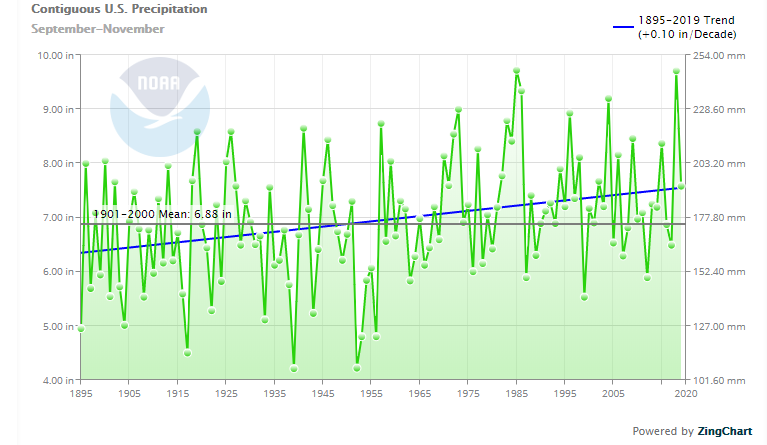
September – October 1895-2019 Trend
Source NOAA Climate at a Glance
“Models project future warming and drying, especially during late season, both of which should further expand the water-limited regions, causing large variations and potential decreases in photosynthesis.”
WHAT models project future warming and drying? The climate models project *average global temperature” not “average global precipitation”.
This study on global precip:
https://journals.ametsoc.org/doi/full/10.1175/JCLI-D-12-00502.1
says
” For example, Alexander et al. (2006) used gridded precipitation data based on 5948 stations globally and found that precipitation changes exhibited a widespread and significant increase.”
go here: https://www.researchgate.net/publication/272352548_Global_trends_in_extreme_precipitation_Climate_models_versus_observations
“Annual-maximum daily precipitation (Rx1day) has increased faster in the observations than in most of the CMIP5 models. On a global scale, the observational annual-maximum daily precipitation has increased by an average of 5.73 mm over the last 110 years, or 8.5 % in relative terms. ”
It would appear that this study *assumes* increased drying in the future and you know what they say about “assume”.
The finale sentence of the authors’ Abstract is the “tell” to the lie, that is their 3rd person voice, and their use of “should” and “potential” as quibbling qualifiers.
“Models project future warming and drying, especially during late season, both of which should further expand the water-limited regions, causing large variations and potential decreases in photosynthesis.
This is an example of what Andy May called a few days ago in his long post, “Bad Acting” by climate pseudoscientists. It’s not even good acting.
A “good actor” climate scientist, ones who actually knew how to play the role of scientists and take responsibility for their claims/work would have written the Abstract as thus:
– “Based on our model projections, we conclude future warming and drying, especially during late season, both will further expand water-limited regions, causing large variations in and decreases of photosynthesis.”
That final sentence structured in that way,
(1) they talk to the reader in first person,
(2) they take credit for what they are found via their models (flawed or not), and
(3) eliminates the mealy-mouthed quibbling word “potential.” The model didn’t output “potential,”they did it to CYA, because they couldn’t bring themselves to admit to the reader massive statistical uncertainty that was certainly present.
this PNAS article is simply bad acting masquerade of science. They they CAN’T even take credit (as in, 1st person) for their work and their supposed intellectual exercise (modeling) that they present. This is bad acting by pseudoscientists. But then it is Columbia U, the heartbeat of the United States’ Climate Lysenkoism..
Noooo…..increase the temperature 1 degree at surface and there is 7% more driving force for water to evaporate into the air…..the moist air rises….makes clouds, makes MORE rain….and even with the indisputable vapor pressure correlation, local conditions make enough signal noise that the effect is difficult to quantify.
They simply discount the increased precipitation part of climate change tropospheric warming and simply focus on warmer air temps = faster drying soils. They claim that the warmer soil temp, thus drying, is of greater consequence than more precipitation from global warming.
Of course that “model projection” is not supported by what we know of the HTO and Sahara desert and the African Sahel during that warmest 4 kyr period (9,000-5,000 yrs bp) of the Holocene. Both were wetter and much greener than today.
That is they deceive by telling a half truth. Lies by omission are the standard fare for climate pseudoscientists.
Greater green growth from higher nighttme temperatures shades the soil and lessens evaporation and drying. Have any of these scientists ever left the concrete jungle?
This is the kind of false-alternative shit-post lies the warmists use.
“Precipitation will be essential for plants to counteract environmental destruction.”
“Precipitation will be essential for plants to counteract global starvation.”
“Precipitation will be essential for plants to counteract peak oil.”
“Precipitation will be essential for plants to counteract soil erosion.”
“Precipitation will be essential for plants to counteract ground level wind erosion.”
“Precipitation will be essential for plants to counteract soil compaction.”
“Precipitation will be essential for plants to counteract desertification.”
“Precipitation will be essential for plants to counteract destruction of The Great Barrier reef.”
“Precipitation will be essential for plants to counteract wildfires.”
“Precipitation will be essential for plants to counteract seeing your neighbor’s granny nekkid.”
“Precipitation will be essential for plants to counteract hearing the neighbors’ kids satanic music.”
It goes on and on…
“Precipitation will be essential for plants to counteract insolation of the ground.”
“Precipitation will be essential for plants to counteract discarded masks from clogging fences.”
“Precipitation will be essential for plants to counteract ugly bad brickwork on McMansions.”
“Precipitation will be essential for plants to counteract people driving off the side of the road in bad conditions.”
“Precipitation will be essential for plants to counteract blowing snow.”
“Precipitation will be essential for plants to counteract decreases in the rat population.”
“Precipitation will be essential for plants to counteract losses in the accessory medicine market.”
“Precipitation will be essential for plants to counteract bee population.”
It is literally the single most inane, transparent, benign and universal greenist ‘the first is true, so must be what follows’.
In fact, it is SO generic that “Precipitation is essential for plants.” is the entire statement.
Maybe we should employ all the easily gullible warmists to go outside and yell at the clouds to rain and lay in the sunlight from dawn to dusk to stop the heat generating insolation of the ground that makes CO2 double the wattage of a sunbeam…
Back in the 3rd grade we were taught that rain comes from clouds which come from evaporation from the oceans. The Earth’s surface is 5/6 water. The oceans are where the rain originates, according to Miss Nancy, my 3rd grade teacher.
Of course, she might have been wrong. But if she was right, then a warmer globe (which includes the oceans) would lead to more evaporation and hence more rain.
As I understand it, rainfall has increased 7% over the last 2 decades. At least that’s what some “expert” said somewhere. Or maybe it was a scenario from the IPCC. It’s hard to measure because most rain falls back into the oceans. In any case, increased rainfall comports with Miss Nancy’s theory.
Back when it was a lot warmer, such as the Holocene Climatic Optimum or the Miocene, evidence suggests that there was a lot more rain. Deserts of today were green back then. Crocodiles and hippos lived in the Sahara, which had lakes. Must have been more rain.
Warmer Is Better. It rains more. Plants flourish. Biological productivity goes up. That’s a good thing. Miss Nancy said so.
I refer WUWT readers here to the authors’ figure S19 if you want a real hoot.
The paper is pay-walled, but the Supplement is not.
https://www.pnas.org/content/pnas/suppl/2020/04/09/1914436117.DCSupplemental/pnas.1914436117.sapp.pdf
The Supplement indicates the Authors used two Representative Concentration Pathways in CMIP5 ensemble to conduct their analysis. They compared the RCP4.5 (medium-low mitigation, very low emission baseline) scenario with the RCP8.5 emissions scenario, the unrealistic “let’s increase coal usage 10x-fold” Business-As-Usual scenario.
Their Fig S19B. shows RCP8.5 and the soil moisture, but then figure S19C. they show “The difference between predicted changes (considering both MAT and PSSM changes) and summation of MAT and PSSM contributions and is shown in (C).” There is
Figure S19C is basically a flat line all the why out to 2090. It’s no wonder they buried that result in the last Supplemental figure, and then the arreal coverage changes after 2090 are shown in S18 for each of the CMIP5 model projections. Absolute complete junk science to think we know anything at all about 2090-2100 precip and soil moisture from a bunch of computer models with zero sk1ll.
Of course, we know which of those two scenarios showed the major impacts, and which one showed no- to very little impacts.
Which again highlights the only reason the IPCC climate scam even has the RCP 8.5 scenario, so climate pseudoscientists can use it for rent-seeking.
If the models don’t handle clouds properly (and they don’t), how can they properly handle precipitation?
“We are the first to show that the balance between soil water and energy input into the ecosystem determines whether the system is limited by precipitation or by temperature,”
It should properly say:
“We are the first (other than farmers, horticulturalists, foresters, anyone with a garden and anyone outside of academia with eyes, ears and a brain) to show that the balance between soil water and energy input into the ecosystem determines whether the system is limited by precipitation or by temperature,”
Alternatively:
“We are definitely not the first to state the blindingly obvious while trying to make it sound as if we’ve done something clever”
Or more concisely still:
“We are climate scientists”
““We are the first to show that the balance between soil water and energy input into the ecosystem determines whether the system is limited by precipitation or by temperature,”
Every minless study that comes out of the clime syndicate these days is “…the first to show…” some so-what result attributed to a climate model. No botanists were disturbed in this study. Checkout what Dr Sherwood Idso, author of over 500 papers and books on plants CO2 and water since 1967, starting with the US Dept of Agric to presently prof at U Arizona at Phoenix, has to offer in comparison to this pallid study:
https://youtu.be/YYsjhz7DT1s
There is no mention in the “engineering” study at Columbia that the increasing CO2 makes plants less demanding of water and that on average, the atmos takes on more water with warming.