Ph.D. student extracts world-first centuries long seasonal record of El Niños from coral cores
University of New South Wales

Melbourne: Australian scientists have developed an innovative method using cores drilled from coral to produce a world first 400-year long seasonal record of El Niño events, a record that many in the field had described as impossible to extract.
The record published today in Nature Geoscience detects different types of El Niño and shows the nature of El Niño events has changed in recent decades.
This understanding of El Niño events is vital because they produce extreme weather across the globe with particularly profound effects on precipitation and temperature extremes in Australia, South East Asia and the Americas.
The 400-year record revealed a clear change in El Niño types, with an increase of Central Pacific El Niño activity in the late 20th Century and suggested future changes to the strength of Eastern Pacific El Niños.
“We are seeing more El Niños forming in the central Pacific Ocean in recent decades, which is unusual across the past 400 years,” said lead author Dr Mandy Freund.
“There are even some early hints that the much stronger Eastern Pacific El Niños, like those that occurred in 1997/98 and 2015/16 may be growing in intensity.”
This extraordinary result was teased out of information about past climate from coral cores spanning the Pacific Ocean, as part of Dr Freund’s PhD research at the University of Melbourne and the Centre of Excellence for Climate Extremes. It was made possible because coral cores – like tree rings – have centuries-long growth patterns and contain isotopes that can tell us a lot about the climate of the past. However, until now, they had not been used to detect the different types of El Niño events.
This meant El Niño researchers were constrained by what they could say about El Niño behaviour because the instrumental record was too short and it was hard to judge whether recent decadal changes were exceptional.
“By understanding the past, we are better equipped to understand the future, especially in the context of climate change,” said Dr Freund.
“Prior to this research, we did not know how frequently different types of El Niño occurred in past centuries. Now we do,” said co-author from the Centre of Excellence for Climate Extremes Dr Ben Henley.
The key to unlocking the El Niño record was the understanding that coral records contained enough information to identify seasonal changes in the tropical Pacific Ocean. However, using coral records to reconstruct El Niño history at a seasonal timescale had never been done before and many people working in the field considered it impossible.
It was only after Dr Freund took her innovative approach to a team of climate scientists and coral experts: Dr Ben Henley, Prof David Karoly, Assoc Prof Helen Mcgregor, Assoc Prof Nerilie Abram, and Dr Dietmar Dommenget that they were able to proceed with the idea.
While the approach was considered challenging, leading Australian experts on past corals, Dr Mcgregor and Assoc Prof Abram, said that, while the approach might be unconventional, it was worth a shot.
After carefully refining the technique to reconstruct the signature of El Niño in space and time using new machine learning techniques, the scientists were able to compare recent coral results with the instrumental record. Dr Freund found a strong agreement between the coral cores and recorded events. This confirmation allowed the team to extend the record back in time.
Dr Freund and her team found there has been an unprecedented increase in the number of El Niños forming in the Central Pacific over the past 30 years, compared to all 30 year periods in the past 400 years.
At the same time, the stronger Eastern Pacific El Niños were the most intense El Niño events ever recorded, according to both the 100-year long instrumental record and the 400-year long coral record.
As a result, Australian researchers have produced a world-first seasonal El Niño record extending 400 years and a new methodology that will likely be the basis for future climate research.
It took three years of hard work to achieve the result and now Dr Freund and her team are excited to see how this work can be built upon.
“The El Niño phenomenon is one of the most important features of global climate, and changes to its behaviour have very serious implications for weather patterns and extreme events around the world,” said Dr Henley.
And that centuries-long record opens a door not just to past changes but changes to El Niños in the future as well.
“This gives us an opportunity to more accurately explore how global warming may change El Niños and what this means for future weather and climate extremes,” said Dr Henley.
“Having a better understanding of how different types of El Niños have affected us in the past and present, will mean we are more able to model, predict and plan for future El Niños and their wide-ranging impacts,” said Dr Freund.
###
Oh goody, the record goes back to the Little Ice Age which was a fairly nasty time to be a subsistence farmer and extends to the present where famine is just about unheard of, and guess what the weather has changed! Obviously it’s evil to prosper.
That is the point of all this–to make it evil to prosper. Unless you get your EnviroState issued prosperity license and pay the associated taxes.
in triplicate and No Carbon Paper
The point is come up with more speculative claims about the future which MSM will report as established, and few more “it’s worse than we thought”s and a few “in recent decades”.
But would you really expect objective science form a university body which chooses to call itself:”
the Centre of Excellence for Climate Extremes ”
Their aim is to find climate extremes and they declare themselves to be excellent at it before they even raised the money to buy the desks. The self-promoting hubris is stunning.
Clearly they will never find any non-extreme climate, it’s not within their remit.
As with all good press releases at Eureka they fail to provide a link to the paper or even give its title or a DOI.
After some chasing I did manage to find the paywalled paper in question:
So the big scientific news is not that for the first time they have managed to get a 400y proxy of El Nino, it is the obligatory “unprecedented change” in recent decades. More “excellence” to be expected soon no doubt for the ever excellent “Center of Excellence of Climate Extremism”.
That’s not the only research involving coral fossils as proxies going back centuries
This one here comes to a different conclusions from Palmyra Is, also the central Pacific
El Niño/Southern Oscillation and tropical Pacific climate during the last millennium
The most intense ENSO activity within the reconstruction occurred during the mid-seventeenth century. Taken together, the coral data imply that the majority of ENSO variability over the last millennium may have arisen from dynamics internal to the ENSO system itself.”
https://www.nature.com/articles/nature01779
It pays to check their claim for ‘originality’ . Be interesting to see if they cite the 2014 paper
Maybe the wrong link, if in error it’s 2003 paper
https://www.nature.com/articles/nature01779
All that is waived if you’re a card carrying leftist….
Ljh May 7, 2019 at 2:06 am
… extends to the present where famine is just about unheard of,…
————————-
famine unheard of!!!!! which penthouse in megacity do you live in. the word is famine rich:
e.g.
The Horn of Africa region is suffering from a severe drought which has caused crops to fail and cattle to die. On top of this crisis, the region has now been hit by the worst flooding in 30 years. 13 million of people are facing acute food and water shortages in Ethiopia, Kenya and Somalia, and are in urgent need of emergency assistance.
South Sudan is in the midst of a catastrophic humanitarian crisis driven by over four years of brutal civil war. Harvests in late 2017 were poor or non-existent for many. Trade and local markets have been disrupted and food stock has depleted. Over 7.1 million people – half the country’s population – are facing extreme and deadly hunger.
In Yemen, years of devastating airstrikes, shelling and fighting on the ground have driven millions of people from their homes and left millions more in need of emergency food, struggling to survive. An estimated 17 million people – 60 percent of the population – are suffering from food insecurity and malnutrition, including 8 million on the brink of famine.
2 of the 3 “famines” that you have listed are directly caused by war….not exactly “climate” related…though the Climatists™ are trying to push the narrative that CAGW is causing more wars…
Not only that, but notice how places that aren’t exactly great for agriculture, like the Australian Outback, Mojave Desert, the Negev and so on, DON’T have this problem. But then, it must be our fault that the Third World is, well, the Third World.
Africa needs more Po-Taters and fewer Dic-Taters
whatever the cause, it is ridiculous to state :” where famine is just about unheard of”
Most of these famines are caused by war and the wars are caused by very much increased populations – mainly because of food aid and improved farming methods taught by western scientists who go to these countries via Aid programs.
Whatever is done has consequences – and not always the expected ones.
There’s a famine developing in Mozambique right now due to Cyclone Idai and Cyclone Kenneth in March and April, which both destroyed food crops over a large area before harvesting occurred. And what was stored was destroyed by floods, with few seeds available either. There were 1.7 million people being sustained by the World Food Program in Mozambique even before the first cyclone even struck due to a preceding severe drought.
Natural famines are very much still with us, and possible, as is widespread chronic malnutrition.
ghalfrunt
I support Eric H on this one, but I add that causing the “crops to fail and cattle to die” has also been greatly exacerbated by the provision of AK47’s to the herdsmen who have taken to killing their neighbours and stealing their cattle. All three events have been made far worse by not just a lack of cooperation but outright warfare and religious intolerance on a scale not seen in 900 years.
War is bad for children and other living things.
The drought in Kenya and north of there, is cyclical, and also El Nino-influenced. There are Metonic cycle influences on the whole eastern side of Africa, long enough in duration for each generation to forget what happened before. Each time there is drought or flood, the words “unprecedented, this is the new normal” are heard. Consider the ignorance spouted in California on this matter.
If the Big Powers were not agitating for control of Mecca and Oil (the other point of adoration) conditions would be far better.
Not all that long ago in geological terms, the Sahara was grassland – within the span of human building history. Why? Because it rained there . Rivers that are dry water courses ran continuously. Then the world cooled, and the rains stopped. NW Kenya became a desert some of the time, grassland at others. The Sahel ebbs back and forth with a ~60 year cycle.
Hopefully the research into El Nino history will point to some new ideas and understandings. The record is only half the length of an ocean turnover cycle (800 years). The well-known 800 delay between temperature rise and CO2 rise may be visible in the El Nino record when the method is pursued deeper into the reefs.
Thanks for these insights.
Famine, not due to a world shortage of food, but by the inability to distribute it to where it is needed.
If you want more food, then you want more CO2 in the atmosphere!
We have not yet reached the optimum level of CO2 for the most important cereal grain crops in the world – wheat, maize (corn), and rice.
Further, increasing CO2 will also make these crops more drought resistant at the margins.
Ethiopia. I saw some of the worst food waste in my life to the point I felt uncomfortable seeing such waste.
Is this food wastage a cultural issue or due to lack of available refrigeration?
Not sure. However, you don’t go crying to the world “We are starving” one minute and then the next throw a lot of it away!
Obviously, anything that is the worst in 30 years, must have been caused by CO2. /sarc
I am a doctor in a third world country. Forty years ago I saw plenty of kwashiokor cases; 60% of the children of subsistence farmers had stunted growth. Now obesity is a problem and the rural poor have moved to town where they access better services and better food distribution.
So is it a drought or a flood in the horn of Africa?
It is a Flood of Drought…
The Horn is simply Awash in Drought
ghalfrunt
perhaps you would like to check the population of Ethiopia at the time of live aid and the population today. the increase is simply staggering. To save you the time it was 40 million in 1985 and 105 million now.
Don’t you think that might have something to do with any famine problems? The countries you mention would have to have the best and most consistent climate in the world to support the burgeoning numbers
8 million on the brink of famine.
=======
The world is on the brink of perfecting fusion power.
Exactly – even though the record doesnt extend back to the last warm period the result, of course, is unprecedented. Perhaps El Ninos are part of the warm cycle of the oceans and it is a standard occurrence, without extending back to the medieval warm period it is anything but ‘unprecedented’ more ‘we just dont know’
Plus of course, any sensible person knows that the last little ice age was a cooling disaster – with famine killing 100s of thousands in Europe alone. Between then and now when did the ‘normal’ temperature return – please clearly define that before telling us we are approaching a tipping point. IMHO we havent reached the climatic temperature optimum yet – as shown by the greening of the planet – and there is plenty of room on the plus side of that before the temperature becomes dangerous.
I am just wondering if this is one of those “studies” where the conclusions were written first and the rest was just an exercise in confirmation bias.
A certain tree ring core springs to mind
Where’s Bob Tisdale!
Hi Mario. I’m proofreading a new book that I hope to publish very soon…within a week.
Regards,
Bob
I will buy your book Bob. I thought of you when I went to Galapagos… I recall telling a lot of people that the worlds weather starts here in many ways… my understanding from reading your book gave me an appreciation for at least part of the complex mini climate phenomenon that upwells from the Ecuadorian region.
Look forward to reading it Bob.
and Dr Easterbrook!
This Easterbrook?
https://wattsupwiththat.com/2014/02/06/on-don-easterbrooks-updated-projection/
It would be wonderfull to see the original data and see if it may be replicated.
Congratulations to the team.
Since ENSO is a global climate driver and coral reefs have been around for millions of years the work could be extended to look at the last 10,000 years and tease out climate patterns.
Perhaps some of the money promised for the GBR would not go astray in such a usefull endeavour.
Yes. Since we are most likely still recovering from the Little Ice Age it makes sense that the El Niños are increasing in both timing and strength. But, I don’t think the 400 year history is really going to tell us much other than ‘Yes, the world is warming’ until it can somehow be carried back to the beginning of the Medieval Warm period. Until then I see this study as providing plenty of grist for the CAGW mill.
This is very interesting, not least as recent ENSO cycles have, on balance, released significant amounts of heat from the oceans into the atmosphere – to the great excitement of AGW alarmists. One problem, however, mirroring the issue of trying to use tree rings (which result from several influences) to recreate palaeo-temperatures: there may be some correlation but how exactly can coral growth structures tell the researchers not only the strength of El Ninos but also their geographic origin? We all know that very large El Ninos can cause coral to stop growing altogether in certain locations, but the timing of regrowth is surely variable and this analysis seems to claim so much more than just an indication of when coral growth stopped.
Call me cynical…
Ian, I had similar view of all this. Also I assume the 100 year instrument data they used was land based not from the Central Pacific. I am more than cynical. Before believing this study has merit I would like to see methods and materials in detail. Once upon a time I use to manage a few coral biologists so I am familiar with similar techniques. Also, how do they know whether past supposedly ENSO events were actually that and not some other phenomena.
It’s worse than they thought?
It sounds like they had a fairly open mind to the results and were more interested in an accurate record than making assumptions about it.
Keep in perspective her participation in findings like this.
Nor should one overlook that she has participated and been coauthor on several projects with David Karoly, Joelle Gergis, Barbara Stenni and Eric Steig; including work on Pages2K.
e.g. From Steve McIntyre’s excellent ClimateAudit.org site; PAGES2K (2017): Antarctic Proxies:
and
and
One shouldn’t expect this apple to fall far from the tree.
Sixth mass extinction don’t you know.
https://twitter.com/JamesGDyke/status/1125707713676234752?ref_src=twsrc%5Etfw%7Ctwcamp%5Eembeddedtimeline%7Ctwterm%5Eprofile%3AGSI_Exeter%7Ctwcon%5Etimelinechrome&ref_url=https%3A%2F%2Flovelockcentenary.info%2F
Hard to see it…
Per WIKI the
not sogreat andimpotentpowerfulIn the 1900′ there werw a grand total of 29 mammalian extinctions…AND
In the 2000’S there have been ……………………………………………………. 3
29 in the 20th century and 3 in the first 20% of the 21st.
Looks like the “Great Mass Extinction of the 21st century” didn’t receive it’s invitation to the party.
yeah the 29 in a century and most of that time there was little preservation of anything, and still low,
the claims of a million ??????whatevers going extinct in less time is ludicrous but they manage to say it with serious tones and a straight face.
amazing.
and now in Aus we have figurez interfering with elections..and labor n greens wanting to make the hell our rural lives are now with insane regs even harder.
It is a shame that this article does not provide any data or graphs so that we could see with our own eyes how much stronger El Nino activity has been in the last 30 years than in previous times.
The article is at https://www.nature.com/articles/s41561-019-0353-3 . While it is paywalled, the link to supplementary information goes to a 40 page .pdf. The last page compares the shift in EP (Eastern Pacific) to CP (Central Pacific).
Take a look and see if you can find some data on El Nino strengths, I don’t have enough time this AM to do it on my own.
https://www.ncdc.noaa.gov/paleo-search/study/26270
Center for Excellence for Climate Extremes.
That name says it all. Pathetic.
Imagine. A 4 year college grad spent three years of work, including course work, and made a ground breaking discovery in the complicated field of climate science, and proved all the experts wrong. How did she even find the time to defend her thesis?
Shades of Michael Mann, 1998.
It is actually rather comical from a strict science point of view.
So you measuring the rate of isotopes in the coral for which you have no real controls.
– We have no idea of ocean conditions changes over the 400 year period
– We have no idea if the coral have developed resilience or changes over the 400 year period
– We have no real measurements on the atmospheric conditions over the reef
– We have no real idea of any predatory or adverse reef changes over the 400 year period
Forgive me if I am a little bit wary that you may just be drawing an elephant from data points.
Yes but you don’t understand, they’re using modern
magicmethods of AI to ‘tune’ their resultsto their wishes.“This gives us an opportunity to more accurately explore how global warming may change El Niños ….”
Stop right there, the science is not settled on that issue.
The interesting thing in this connection is that they actually do acknowledge that Climate Models are useless for modelling ENSO:
“Alternatively, this difference could be related to the difficulties representing the full range of ENSO diversity and variability in climate models36. Large uncertainties in the tropical response to climate change may arise from a poorly constrained mean state, manifested by a pronounced Pacific cold
tongue bias37, a doubled intertropical convergence zone38 and diverging dynamical responses39. “
Are there really scientists studying this stuff who think climate never changed before industrial CO2 came along? Are they lobbying for a static climate? They’d better get the Earth to stop rotating, revolving around the sun, and get rid of the moon. That’s the only way you’ll get climate to be even close to unchanging.
Chicken…egg…which caused which. Don’t know yet. Would have to study more than just one Warming Period.
What that means is that they went looking for something to confirm their pre-existing bias… and are interpreting the data accordingly.
especially if its the change in el ninos that is causing the globe to warm
Boom! Unless the tail is wagging the dog…
A few notes on the actual paper.
1. It seems clear that the coral cores do catch ENSO events.
2. It seems equally clear that they can’t distinguish the magnitude of Ninos – the 1982/83 and 1997/98 Ninos are both weak in the coral record.
3. The “unprecedented” change in the proportion of Eastern Pacific/Central Pacific (Modoki) Ninos is a classic case of “Mike’s Nature Trick”. The shift to the hockey-stickish part of the curve occurs at the exact point where the record shifts from “coral” to “historical” records.
Mote tried this in the Keys about a decade ago…
..and actually partnered with FIU to teach coral paleoclimatology
..ran into exactly the same problem as tree rings
You can core the same coral all over the place….and each one will be different
+1
Breathless Headline: CORALS DIE DUE TO GLOBAL WARMING (And NOT due to being drilled full of little holes by biased scientists looking for “The One Core to Rule Them All”)
…they also figured out if they didn’t plug the holes….algae invaded the coral and killed it
Thank, tty.
When I read “Machine Learning” my red flags started waving. If they are mixing coral proxies with instrumental records, instead of using one to validate the other, then those red flags are big.
It could work, but we need details of method.
I was a skeptic of using Machine Learning in petroleum geophysical interpretation. Then I saw Insight Geophysical’s Paradise system. The key aha moment was realizing that you can process the same cube of 3D seismic a hundred different ways, far too many for a human mind to employ. They take that 100 attribute hypercube, PCA it to the most significant 10, then map the 10 Into 64 clusters. Then a geophysicist try’s to make stratigraphic sense of how the clusters correlate to lithologic boundaries. A lot of detail under the hood.
So Machine Learning can work. But I want to see how it was done.
Yeah, machine learning to analyze millions of data points. When you need it to analyze 400 data points, that’s suspicious.
“2. It seems equally clear that they can’t distinguish the magnitude of Ninos – the 1982/83 and 1997/98 Ninos are both weak in the coral record.”
Oh, boy! What conclusions can be drawn then?
I think you’re right.
I started reading with genuine interest, but by BS alarms starting sounding off. 400 years worth of coral ring isotope data, literally 400 growth rings, needs “new machine learning techniques” to interpret them? *Cough BS
And I thought coral was endangered?????
It is, by untreated sewage, dynamite fishing, trampling by tourists, bulldozing for coastal reclamation etc.
Don’t forget about sunscreen, tty.
The healthiest reefs are either the least accessible or only recently discovered in places no one thought to look for coral reefs before.
Just wait, someone will study them into an early grave
“This extraordinary result was teased out of information about past climate…”
Translation: “We tortured the data until it gave us the “answers” we wanted”.
1 Interesting this has hit the media in the middle of an Australian Federalelection campaign in which ‘climate change’ is very much a polarising issue.
2 Davily Karoly was involved – sorry, they just lost me.
3 Is it an El Nino signal in the ores or just some other trace variation?
And in Canada, CBC replaced the first 20 min of the ‘World at 6’ with an extinction rant while the polls were still open for the Ladysmith federal bi-election. Don’t know if that contributed to getting a second Green in federal parliament.
One can but hope that some of the taxpayers money falsely obtained by the James Cook University in the name of a dying GBR, can now go to the Melbourne University, who while a long way from the bulk of the GBR, appear to have done some truly remarkable research.
MJE VK5ELL
I can’t believe they injured coral.
Hold on, this claims – surprise, surprise – that things are changing in the very recent past and things are different than in the now allegedly established longer past. Anything ring any alarm bells here?
All the usual politically correct terms cropping up, increasing intensity, etc etc. Good career move for PhD student but I am being cynical, based on experience of all those “here is the latest killer evidence” claims. And of course we do know about the El Ninos of the 19th Century which historical evidence tells us were as powerful as more recent times.
“Having a better understanding of how different types of El Niños have affected us in the past and present, will mean we are more able to model, predict and plan for future…”
Stopped right here… Sigh.
In the period of low solar activity, jet stream hinders the development of the full El Niño.
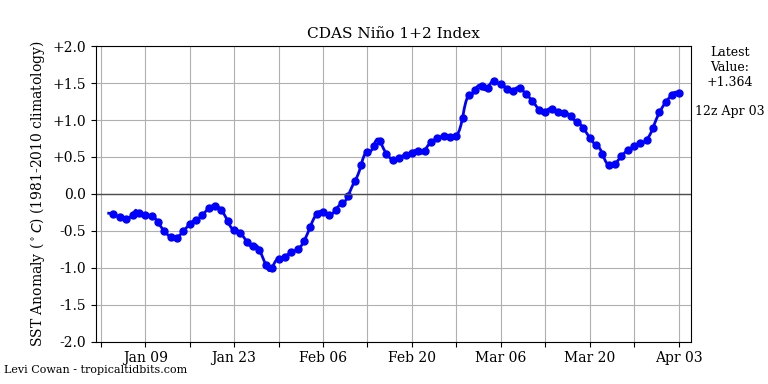
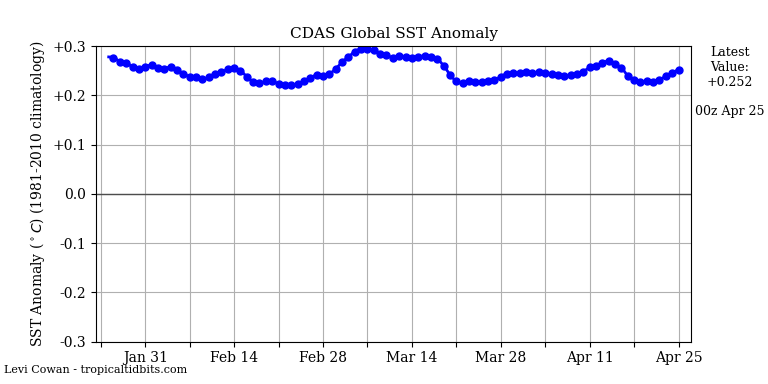
http://www.bom.gov.au/archive/oceanography/ocean_anals/IDYOC007/IDYOC007.201905.gif
http://www.bom.gov.au/archive/oceanography/ocean_anals/IDYOC002/IDYOC002.201905.gif
In 2016, full El Niño developed only after the increase in the magnetic activity of the Sun in 2015.
http://wso.stanford.edu/gifs/Dipall.gif
Wake me up when they publish the data.
Tell me who is peer reviewing.
Get the results replicated, perhaps if Prof Peter Ridd is not offered/does not take up his previous position he might be interested.
However, it has to be said, full marks for new methodology.
Yes, let’s see a true blind replicate. Of course, this would be atypical since the desired result was obtained, so it’s settled.
I like your proposal. this is how methods are supported and verified.
The methodology of using machine learning to extract the data needs to be looked at very carefully. Its all too easy to use ML to automate P-value mining.
Having read it, to summarize, they found absolutely no solid evidence of anything in their research and make spurious suggestions about the future that any data they have, does not support. These guesstimates always go in one direction of course.
Take value, extrapolate into the future in one direction, job done.
There is absolutely no use at all for the results of this research other than to attempt to portray El Ninos are now “unusual and the new norm”.
Do they cite this paper from 2003 using coral fossils from Palmyra as proxies ?
https://www.nature.com/articles/nature01779
It is clear by just looking at GAT’s since (barely acceptable) global records began (~1940) that almost all recent atmospheric warming is stepwise and related to ENSO events. Subtract out ENSO and the rest is mostly noise.
Hopefully, ENSO patterns can be coaxed out of this new coral record back through (at least) the last 2 warming periods. (though I expect temporal resolution will be problematic…assuming there are no annual layers or other good temporal markers as in ice cores). THEN we should be able to tease out the chickens from the eggs. So far on this first pass, they looked for eggs….AND FOUND AN UNPRECEDENTED EGG…but only going back to the LIA.
At least 2 warm periods (preferably 3) would need to be studied before declaring anything to be unprecedented (by definition)…unless one was really making a political statement instead of a scientific statement.
Recognizing statements reflecting tribal bias FROM THIS TRIBE is easy. Being a respected member of this (big government well paid socialist scientist) tribe requires these declarations. And the correct words, like “unprecedented” have to be used.
We need now to know about El Ninos during the Mediaeval Warm Period.
Likely they would be similar to the recent pattern.
Yeah, this has all the signs of a political rush to press.
Why add to the speculation in this field and blog? From https://www.nature.com/articles/s41561-019-0353-3 is this hard data:
Publication history
Received
01 December 2017
Accepted
15 March 2019
Published
06 May 2019
Need to hold the hype here. 30 years is too small a time period to make any predictions about trends and this time period is all captured in the modern era data collection. The level of confidence of pre-measurement era proxy data is probably very low and needs additional proxy confirmation from a different source for validation.
Serge, you are right. Climate cycles last for hundreds of years. Thirty years is way too short to draw conclusions about climate, and is misleading, but it’s a professional lifetime.
That’s a big red flag that they don’t actually understand what they’re doing. Machine learning is, by its very nature, inscrutable. link
Science relies on folks being able to justify their methods. “Because the computer said so” doesn’t cut it.
All immaterial.. the study is a minority of data and thus wrong.