By P Gosselin
No global warming this year, and likely next year as well
The NASA/GMAO ENSO forecasts remain consistent with the August 2025 forecasts, with La Niña conditions developing in the equatorial Pacific in the relevant Nino region 3.4 in the NH summer of 2025.

Hat-tip: Snow Fan

Source: NASA/GMAO ENSO forecasts
Alarmists will likely shift their focus to the coming hurricane season, or whatever hot days occurring around the globe – or maybe this coming September’s Arctic sea ice extent (if it melts enough).
Earth is liable to cool for six more years. It cooled for seven years after 2016 Super El Niño, so likely will do so again after the post-Tongan eruption peak warmth in April 2024.
It might have continued to cool for more than 7 years if the Hunga Tonga eruption had not happened.
Most likely until the next super El Niño, if even then. A period comparable to that between SENs of 1997-98 and 2015-16 would be reasonable.
Keep in mind also, we just passed the peak of the grand solar maximum.
It will cool as we approach the next solar minimum.
How much? How fast?
Stay tunned to this channel as the situation develops.
The ENSO forecast is giving strange signals.
https://iri.columbia.edu/our-expertise/climate/forecasts/enso/current/
We went from a strong El Nino to a La Nina. It then went back to neutral, but the early July prediction was that it was more likely to move back into another La Nina.
I don’t recall that pattern in recent history.
Any further commentary by our ENSO experts would be appreciated.
Although they pretend, no one knows what causes ENSO so no one can predict what it will do and when it will do it. They can watch and measure what is happening, sure, but not much more than that. One thing is certain though, it has something to do with carbon 🙂
Uh, a slight correction. “No one can predict” must have a couple more words to make much sense. Obviously anyone can predict. I think what you meant was no one can make a prediction anyone should have confidence in.
What has it to do with “carbon.
What do you mean with “carbon” (C)?
Seams you are on the dead-end-street.
I’m pretty sure the reference to carbon was tongue in cheek
“Seams you are”
What does this have to do with sewing?
Sewing the seeds of discontent.
English is likely not Krishna’s first language.
Doesn’t one usually sow seeds?
“We went from a strong El Nino to a La Nina. It then went back to neutral, but the early July prediction was that it was more likely to move back into another La Nina.
I don’t recall that pattern in recent history.”
I remember it happening recently, from 2016-2018:
https://origin.cpc.ncep.noaa.gov/products/analysis_monitoring/ensostuff/ONI_v5.php
Thanks, I had not seen that excellent data source before. (Bookmarked now!)
Turns out I was doubly wrong – we did not officially reach a La Nina condition after the 2023-2024 El Nino.
Watching the WUWT meter, there were wild swings over the past 12 months.
How can la Nina be continuing when there is no la Niña at the moment?
https://www.cpc.ncep.noaa.gov/products/analysis_monitoring/lanina/enso_evolution-status-fcsts-web.pdf
Really neutral?
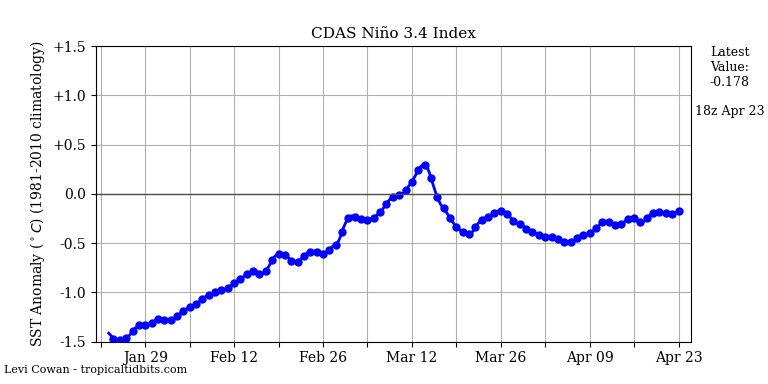
-0.482 is still not below -0.5 threshold, and ENSO conditions are not the same thing as the accepted definition of ENSO state.
I agree, and it is not only ENSO neutral, but this past winter is classified as an ENSO neutral year, as can be clearly seen in NOAA’s table by the absence of blue colored trimesters.
https://origin.cpc.ncep.noaa.gov/products/analysis_monitoring/ensostuff/ONI_v5.php
Lots of people mistake La Niña conditions (–0.5°C) and La Niña event (a minimum of 5 consecutive overlapping 3-month periods at –0.5°C)
While a La Nina would produce a short cooling period, the bigger question is when will the AMO phase change occur. We are currently at 30 years for the warm phase. If the next cool phase comes in during the Trump administration, there will be no hiding it.
There would likely be an initial cooling of around 0.3 C during the transition. If it were to happen during a La Nina, many would just think it was a stronger ENSO event. However, it should also lead to an increase in Arctic sea ice which will be a clear sign the transition is occurring.
It might be more than La Nina, in Australia somewhere, they had snow, quite heavy snow, for the first time since records began. India has also seen record cold and snowfall.
The base that the US built in Greenland in 1959 is now under 100 meters of ice.
Someone is telling porkies…
The depth of the base means nothing. That’s just how glaciers work. At the head of the glacier, where the base was located. Snow falls, burying things. The snow compacts and moves down.
The weight of the overlaying ice squeezes ice out from the bottom.
The plane, and the snow/ice around it, sank. The glacier is not 100 meters taller.
I didn’t hear just how heavy it was, but the location was the New England Tableland, in the northern part of New South Wales, part of the Great Dividing Range.
(Wikipedia has it as “Northern Tablelands” I did a “ctrl/f” for ‘weather’ – nothing.)
It snows in the New England region every few years, and even up into the higher country in southern Queensland a bit less often. It’s a known phenomenon.
I remember us going on holidays to the Gold Coast in the late 1960s and having to stay in Glen Innes overnight. We were shivering even with the electric blankets turned up full bore, and it was 42 degrees F when we got away the next morning. We had all our warm clothes on, and the locals were walking around in shorts and singlets.
“I remember…”
Stirred my memories. April, 1970, the wife and I drove up the coast, Brisbane to Cairns, and back via Longreach. A handwritten ‘diary/trip log’ which I later typed up, and still later typed again for a computer file. Just checked it. In Cairns we noted ‘cold overnight’. We’d spent 1969 in Singapore.
Singapore felt pretty hot and muggy when we had stopovers there about this time of year on our big trip to the UK and Europe.
I remember the temperatures in the UK summer when we arrived being similar to our Sydney winter when we left a couple of days before, and just as windy.
It’s quite remarkable how the body acclimatises. We did a bucket list trip to cowboy country in late September and early October a few years back, and did a lot of bush walks in National Parks there before the piece de resistance walk down to the bottom of the Grand Canyon and back. It was in the high 90s F (high 30s C), but didn’t seem too bad. Taking lots of water helps 🙂
p.s. Tombstone was a great place to visit, in a touristy sort of way.
D’oh! I forgot the most important part. That was between Christmas and New Year. The minimum at home would have been low 70s F or higher.
Christmas in the 1940’s. An ‘English-style’ Christmas style dinner cooked on a wood-burning stove. By the 60’s, a slice of watermelon on the beach at Kirra. Much more comfortable.
Hugh Lunn (“Over the Top With Jim”) is on Substack. His articles bring back memories. He accuses me of ‘following him around’, from Annerley to Singapore/Indonesia. “Ye Olde Times” being stirred up.
I was in Hawaii in December a few years back.
The locals were wearing winter parkas as the temperature had dipped to +75 F.
It really depends on acclimation, what is perceived as hot or cold.
Looking at Ryan Maue’s site (climatlas.com), the first 8 days of August looks remarkably cool. Even almost the entire African continent is below normal. If it weren’t for the large area of warm mid Pacific ocean water, the globe would be cold. And my guess is the Pacific water heat is caused by abnormally high underwater volcanic activity.
The upcoming next year or two will be very interesting on what happens. No one has a clue, even AI.
Do you have any idea how much energy would be required to heat up the Pacific? It is a lot more than could be provided by abnormally high volcanic activity. Especially since such activity has not been detected or observed by anyone.
The Pacific has more than one undersea volcano and more than one volcanic vents.
So, certainly no event recently, but constant low level heating that may or may not have increased in recent times.
Just exploring alternatives, as any engineer would.
I welcome the cooling but it was 118° here Thursday and the ENSO meter to the right on this page has been stuck at neutral for a long, long time.
Some might find this interesting. Extensive info to wade through. Wish it were updated more frequently.
https://www.severe-weather.eu/
The top article is two months old:
“Large scale Stratospheric wind shift could trigger a Colder, Snowier Winter 2025/2026”
I fear catastrophic runaway global cooling. For which there is precedent.
move towards the equator then. Fears allayed.
The globe isn’t cooling. Your ignorance is caused by your laziness and lack of want to learn
ROAR
ROAR
ROAR
So goes an Appeal to Authority by one who is not an authority, nor even credible.
Would that constitute a double logic fallacy?
Curious minds want to know.