Note: I normally don’t publish anything related to the ideas of Nikolov and Zeller, for three reasons: 1) It’s just wrong, 2) It invariably descends into a shouting match. 3) These two guys published a paper under fake names to fool the peer-review process, which is a professional no-no.
But, here we are. I thought this was important to share. – Anthony
Giving Credit to Willis Eschenbach (originally published at drroyspencer.com)
by Roy W. Spencer, Ph. D.
The non-greenhouse theory of Nikolov (and now Zeller-Nikolov) continues to live on, most recently in this article I’ve been asked about on social media.
In short, it is the theory that there really isn’t a so-called “greenhouse effect”, and that the excess planetary surface temperatures on Earth, Venus, and other planets above the Stefan-Boltzmann (SB) temperature calculated from the rate of absorbed solar radiation is due to compressional heating by the atmosphere.
This is a popular alternative explanation that I am often asked about. Of course, if there is no “greenhouse effect”, we don’t have to worry about increasing CO2 in the atmosphere and all of the global warmmongers can go home.
I have posted on this blog many times over the years all of the evidences I can think of to show there really is a greenhouse effect, but it is never enough to change the minds of those who have already convinced themselves that planetary surface temperatures are only a function of (1) absorbed sunlight and (2) atmospheric pressure, as Zeller and Nikolov claim.
I’ve always had the nagging suspicion there was a simpler proof that the Zeller-Nikolov theory was wrong, but I could never put my finger on it. My co-worker, Danny Braswell (a PhD computational physicist) and I have joked over the years that we tend to make problems too difficult… we’ve spent days working a problem when the simple solution was staring us in the face all along.
Enter citizen scientist Willis Eschenbach, a frequent contributor at Wattsupwiththat.com, who back in 2012 posted there a “proof” that Nikolov was wrong. The simplicity of the proof makes it powerful, indeed. I don’t know why I did not notice it at the time. My apologies to Willis.
Basically, the proof starts with the simplified case of the average planetary temperature without an atmosphere, which can be calculated using a single equation (the Stefan-Boltzmann equation). Conceptually, in the absence of an atmosphere, sunlight will heat the surface and the temperature will rise until the rate of emitted infrared radiation from the surface to outer space equals the rate of absorbed solar energy. (To be accurate, one needs to take into account the fact the planet is rotating and spherical, the rate of heat conduction into the sub-surface, and you also need to know the planet’s albedo (solar reflectivity) and infrared emissivity).
The SB equation always results in a surface temperature that is too cold compared to surface temperatures when an atmosphere is present, and greenhouse theory is traditionally invoked to explain the difference.
Significantly, Willis pointed out that if atmospheric pressure is instead what raises the temperature above the S-B value, as the Zeller-Nikolov theory claims, the rate of energy loss by infrared radiation will then go up (for the same reason a hotter fire feels hotter on your skin at a distance). But now the energy loss by the surface is greater than the energy gained, and energy is no longer conserved. Thus, warming cannot occur from increasing pressure alone.
In other words, without the inclusion of the greenhouse effect (which has downward IR emission by the atmosphere reducing the net loss of IR by the surface), the atmospheric pressure hypothesis of Zeller-Nikolov cannot explain surface temperatures above the Stefan-Boltzmann value without violation of the fundamental 1st Law of Thermodynamics: Conservation of Energy.
This is a simple and elegant proof that radiation from the atmosphere does indeed warm the surface above the S-B value. This will be my first go-to argument from now on when asked about the no-greenhouse theory.
I like to give credit where credit is due, and Willis provided a valuable contribution here.
(For those who are not so scientifically inclined, I still like the use of a simple hand-held IR thermometer to demonstrate that the cold atmosphere can actually cause a warmer surface to become warmer still [and, no, the 2nd Law of Thermodynamics is not violated]).
Why is the Grand Canyon substantially warmer at the bottom than at ground level, if it isn’t compression, or weight of atmosphere.
Is it just as much warmer at night than during the day?
I’m gonna offer up a simplified non-proof.
1) If I create a static system (consistent/uniform external energy source, no night/day), and add some surrounding mass that doesn’t in any way react with the incoming or outgoing energy sources (so it’s completely static dealio over time).
2) ((Energy-in)-(Energy-retained)=(Energy-out))
3) By definition; (Energy-retained) = 0
4) Therefore it is obvious that there cannot be temperature change of the original mass surface.
5) THEREFORE the premise that, atmospheric mass/distribution is a significant input parameter into system temperature variation (for a system that has variable/non-uniform external source), is wrong.
So Don, increase energy in via sun or tilt,.
And all 3 increase simultaneously in proportion.
2) ((Energy-in)-(Energy-retained)=(Energy-out))
And the opposite when less energy in.
Back radiative thermalisation would be free energy and would have to show up in energy out eventually ?.
So that is a ‘its the sun silly’ and only the sun.
I formerly worked with high pressure systems which generated great quantities of heat, and, so, for N-Z to claim fourteen pounds of air pressure per square inch creates the heat profile of the earth, is to admit they are clueless about the effects thereof.
NZ are not claiming that. “Pressure by itself is not a source of energy! Instead, it enhances (amplifies) the energy supplied by an external source such as the Sun through density-dependent rates of molecular collision.”
—Nikolov and Zeller
https://www.researchgate.net/publication/309651389_Unified_Theory_of_Climate_-_Expanding_the_Concept_of_Atmospheric_Greenhouse_Effect_Using_Thermodynamic_Principles_Implications_for_Predicting_Future_Climate_Change
Get on board the density train and you’ll be heading in the right direction.
Don132
This brings up something I’ve wondered about for awhile. The answer is probably simple enough but I just haven’t seen it.
The sun heats the surface and, directly or indirectly, the surface air. In summer it gets very hot, from a human perspective. I understand hot air cooling as it rises It expands because the space available increases. The temperature thus drops even though the air does not loose heat energy, the energy just becomes less concentrated. The air get very cold at a high enough altitude, but still retains most of its original energy. However, high altitude per se doesn’t prevent high temperatures. Air can get very hot, even plasma hot, when lightning passes through it. It is just a matter of energy concentration per volume of air, no?
In the summer temperatures here are often over 100°F and sometimes reach 110 and higher. In the winter, like now, the very same sun, only coming from a low southern angle, manages a barely adequate 60°F on good days. My understanding is that much of the solar energy is being absorbed or reflected away by the greater amount of air it has to travel through to reach the surface in winter, thus there is less heating because there is less energy delivered to the surface.
Over many years I’ve spent many days hiking in the mountains. I generally prefer 6000 feet +. In addition to enjoying walking through unpeopled spaces, seeing continuously changing aspects of terrain and local life, I like to get up there in the summer to get away from the high valley temperatures. Here is where my understanding fails.
The sunshine passes through less atmosphere at high altitudes. The shorter, more energetic wavelength are definitely more intense as shown by the greater tendency to burn the skin. However, even in protected spots (but open to the sun), on very still days, the temperature is much lower than at lower altitudes.
+++ There seems to be no intrinsic bar to the atmosphere heating, the energy input is actually higher than on the valley floor, no doubt the local air also cools adiabatically as it raised to still higher altitudes, but why does that greater solar energy input produce so much less immediate local heating? +++
There is another question about adiabatic heating and cooling. Air cools as it rises. Some energy can be lost at higher altitudes, especially as water vapor condenses. However, adiabatic heating is very common. All over the world the hot, usually dry, winds falling from higher altitudes have picturesque local names and lore about their effects on plants, animals, and people. Due to the heat energy they carry, surface temperatures raise considerably.
This is a heat energy storage/recycling mechanism. Incoming solar heats the air, it rises, cooling without losing all that energy. Sometimes it comes back down later, compressing and regaining much if its original temperature. No energy is added by this process, but stored energy is redistributed, making the surface warmer.
While the mechanism is quite different than radiation absorption and re-emission, it seems to me to have some similar results. No additional energy is created in either case but surface warming occurs from each. How long, on average, is IR prevented from radiating away into space by greenhouse absorption and remission? I’ve seen calculations, based on various assumptions, that come out to about 2 milliseconds per average for an IR photon to ones that add up to a fair number of hours. However, the subject is rarely approached.
+++ Is anything specific actually known? Does the greenhouse effect retain energy longer than adiabatic cycling? For a given time period, does the greenhouse effect retain more energy than adiabatic cycling? By what ratio? +++
Andy
Adiabatic cycling of atmospheric mass causes the greenhouse effect.
To distinguish it from the incorrect radiative version I call it the mass induced greenhouse effect.
The non-greenhouse theory of Nikolov (and now Zeller-Nikolov) is the theory that there really isn’t a so-called “greenhouse effect”, and that the excess planetary surface temperatures on Earth, Venus, and other planets above the Stefan-Boltzmann (SB) temperature calculated from the rate of absorbed solar radiation is due to compressional heating by the atmosphere.
1) It’s just wrong.
–
The just wrong bit wrong is the claim that there is no GHG effect.
Otherwise, despite protestations there is the scientific fact that temperature and pressure are interlinked by many scientific formulae and practically for most substances in their solid liquid and gaseous states.
The guys may be zealots, but they are scientists with lots of knowledge and maths at their disposal.
Just like the AGW guys, they are not nongs.
So what did they get wrong?
Just the bit about GHG having no effect.
The hot Venusian surface is not a case of runaway GHG, Unlike Earth’s atmosphere which is heated from the surface below, the Venusian atmosphere is heated from the clouds above which are thermally disconnected from the surface unlike the clouds of Earth which are tightly coupled to the oceans comprising 3/4 of the surface.
Discounting the idea that Venus is hot owing to the PVT profile of the atmosphere between the clouds in direct equilibrium with the Sun and the planets solid surface is what leads people to conclude that the only other possibility is a runaway GHG effect, which is otherwise impossible, as this requires the infinite, implicit source of Joules to power the gain, which the climate system lacks. This is not the Sun, as the Sun is the forcing input and can’t be the implicit power supply as well. If anyone thinks otherwise, then they definitely don’t understand feedback theory upon which climate ‘feedback’ depends.
Venus and Earth operate in completely different ways. The effects of GHG’s and clouds set the temperature the Earth’s surface will achieve from the available solar input. Nikolov-Zeller is a far better explanation for the temperature of the solid surface of Venus than applying how Earth works to Venus. The crucial piece missing is identifying what is directly heated by the Sun and then how the temperatures of everything else must follow.
Yes insolation seems to be left out in these discussions.
The important question is: “What is heating what?”
On Earth, the Sun heats the surface which heats the atmosphere. On Venus, the Sun heats the clouds which heat the atmosphere which heats the surface.
Earth clouds, unlike Venusian clouds, are tightly thermodynamically coupled to the surface via the water cycle, thus absorption of solar energy by Earth clouds is a proxy for absorption of solar energy by the surface.
All of the concern about the dynamics of the atmosphere are moot, relative to the ECS. All that the dynamics of the atmosphere does is redistribute existing energy. The atmosphere does not create energy of of thin air, which is what the IPCC requires it to do in order to support its absurdly high ECS.
On Earth, the Sun heats the surface which heats the atmosphere. On Venus, the Sun heats the clouds which heat the atmosphere which heats the surface.
Actualy most of the spectrum from the sun never reaches the surface of Earth, but is absorbed by the atmosphere. That already heats the atmosphere. So it is wrong to say that only the surface heats the atmosphere.
Quote doesnt seem to work, first sentence was a quote.
“Actualy most of the spectrum from the sun never reaches the surface of Earth”
Not really. This misconception comes from Trenberth’s defective representation of the planets average energy balance. Only the water in clouds absorbs any significant amount of solar energy and since Earth clouds are tightly coupled to the oceans on short time scales by the hydro cycle, absorption by Earth clouds is a proxy for absorption by Earth’s surface when considering averages over a few weeks or longer. In contrast, the Venusian clouds are a completely independent thermodynamic system from the solid surface below.
the excess planetary surface temperatures on Earth, Venus, and other planets above the Stefan-Boltzmann (SB) temperature calculated from the rate of absorbed solar radiation is due to compressional heating by the atmosphere.
Facts.
The sun, if it condensed from debris, is incredibly hot in part due to the gravitational pressure compressing its elements.
The earth also has a molten core, due to pressure [and radiation] which of course works better at higher temperatures and gets hotter the deeper one goes
The atmosphere closer to the earth surface contains far more energy than the diluted layers further out.
The sea is not frozen solid at depth where there is very little energy input.
Willis himself was able to do a simple calculation that approximated the temperatures.
–
The theory is not totally wrong.
The point is that the composition of the atmosphere is vitally important to their calculations.
An earth without CO2 in the atmosphere would still be warm due to the GHG effect of H2O.
just a few degrees cooler.
An earth with only Nitrogen and Oxygen to the same pressure as currently would be colder but still much warmer than the moon. The heat in the atmosphere would come from conduction from the earth surface followed by massive convection as the surface temperature in the sunlight would be massive.
More energy would hit the earth without the clouds to reflect it.
This temperature can be determined by albedo and atmospheric pressure.
Why not???
–
Now if the claim is that all 3 examples at 1 atmosphere of pressure but different gases, must have the same temperature the theory is wrong.
Recognizing that the actual atmospheric makeup is more important than just the pressure itself and can modify it substantially is all they have to do to make their variation of physics totally mainstream.
There is nothing new in it. Just a recognition of basic physics principles.
“the excess planetary surface temperatures on Earth, Venus, and other planets above the Stefan-Boltzmann (SB) temperature calculated from the rate of absorbed solar radiation is due to compressional heating by the atmosphere.”
There is no warming in excess of the SB temperature when Earth considered a gray body whose temperature is that of the surface (288K) and whose emissions are that of the planet (equivalent emissivity = 0.62). The sensitivity of this gray body is a little less than the ideal SB sensitivity of 0.3C per W/m^2 at 255K, where the sensitivity of a black (e = 1) or gray (e != 1) body is given exactly by, 1/(4*e*o*T^3), where for Earth, T = 288K and e = 0.62.
The logical flaw in your argument arises from the logical flaw in the IPCC’s pseudo-science, which is that the sensitivity is not amplified by feedback, but that the feedback power in W/m^2 is amplified by a sensitivity expressed as a dimensionless power gain of g = 1.62 = 1/e = 1/0.62. They tend to count the effect twice, first as 3.7 W/m^2 of equivalent forcing from doubling CO2 which is then applied incorrectly to a system with a sensitivity claimed to be increased by incremental CO2.
We have the solar system data and the Gas Laws. It should suffice, and it shall. Happy New Year from New Zealand. Brett
In none of the above comments has anyone commented directly on the proposition put forward in my linked article so here it is for easy access and comments are invited:
“i) Start with a rocky planet surrounded by a non-radiative atmosphere such as 100% Nitrogen with no convection.
Assume that there is no rotation to confuse matters, ignore equator to pole energy transfers and provide illumination to one side from a nearby sun.
On the illuminated side the sun heats the surface beneath the gaseous atmosphere and, since surface heating is uneven, gas density differentials arise in the horizontal plane so that warmer, less dense, Nitrogen starts to rise above colder, denser, Nitrogen that flows in beneath and convective overturning of the atmosphere has begun.
After a while, the entire illuminated side consists of less dense warm rising Nitrogen and the entire dark side consists of descending, denser and colder Nitrogen.
The Nitrogen on the illuminated side, being non-radiative, heats only by conduction from surface to air and cannot assist cooling of the surface by radiating to space.
There will be a lapse rate slope whereby the air becomes cooler with height due to expansion (via the Gas Laws) as it rises along the line of decreasing density with height. That density gradient is created by the pull of gravity on the individual molecules of the Nitrogen atmosphere.
At the top of the rising column the colder denser Nitrogen is pushed aside by the warmer more buoyant and less dense Nitrogen coming up from below and it then flows, at a high level, across to the dark side of the planet where descent occurs back towards the surface.
During the descent there is warming by compression as the Nitrogen moves back down to the surface and then the Nitrogen flows along the surface back to the base of the rising column on the illuminated side whereupon the cycle repeats.
Thus we have a very simplified climate system without radiative gases consisting of one large low pressure cell on the illuminated side and one large high pressure cell on the dark side.
ii) The thermal consequences of convective overturning.
On the illuminated side, conduction is absorbing energy from the surface the temperature of which as observed from space initially appears to drop below the figure predicted by the S-B equation. Instead of being radiated straight out to space a portion of the kinetic energy at the surface is being diverted into conduction and convection. Assume sufficient insolation to give a surface temperature of 255K without an atmosphere and 33K absorbed from the surface into the atmosphere by conduction. The surface temperature appears to drop to 222K when observed from space. Those figures are illustrative only since there is dispute about the actual numbers for the scale of the so called greenhouse effect.
On the dark side the descending Nitrogen warms as it falls to the surface and when it reaches the surface the cold surface will rapidly pull some of that initially conducted energy (obtained from the illuminated side) out of the descending Nitrogen so that the surface and the Nitrogen in contact with it will become warmer than it otherwise would have been, namely by 33K.
One can see how effectively a cold, solid surface will draw heat from the atmospheric gases by noting the development of radiation fog above cold surfaces on Earth. The cold surface quickly reduces the ground level atmospheric temperature to a point below the dew point.
That less cold Nitrogen then flows via advection across the surface back to the illuminated side which is then being supplied with Nitrogen at the surface which is 33K warmer than it otherwise would have been.
That describes the first convective overturning cycle only.
The key point at that stage is that, as soon as the first cycle completes, the second convective cycle does not need to take any further energy from incoming solar radiation because the necessary energy is being advected in by winds from the unlit side. The full effect of continuing insolation can then be experienced once more.
ADDITIONALLY the air moving horizontally from the dark side to the illuminated side is 33K warmer than it otherwise would have been so the average temperature for the whole sphere actually rises to 288K
Since that 33K flowing across from the dark side goes straight up again via conduction to fuel the next convective overturning cycle and therefore does not radiate out to space, the view from space would still show a radiating temperature for the planet of 255K just as it would have done if there were no atmosphere at all.
In that scenario both sides of the planet’s surface are 33K warmer than they otherwise would have been, the view from space satisfies the S-B equation and radiation in from space equals radiation out to space. Radiative capability within the atmosphere not required.”
In that scenario you would get turbulence.
Not just rising bright side, falling dark side.
Turbulence is the territory of chaos, where it starts getting interesting for me!
Spontaneous nonlinear pattern formation to export entropy, etc… 😁
“At the top of the rising column the colder denser Nitrogen is pushed aside by the warmer more buoyant and less dense Nitrogen coming up from below ”
Colder but less dense Nitrogen, If it is at the top it may well be very cold but it cannot be very dense until it descends to the surface.
–
“Assume sufficient insolation to give a surface temperature of 255K without an atmosphere and 33K absorbed from the surface into the atmosphere by conduction.”
Stop
If you are trying to replicate an earth situation with a nitrogen atmosphere at earth pressure you cannot get 33K absorbed by the atmosphere from the surface, you need water vapour and CO2 to do this.
–
” The surface temperature appears to drop to 222K when observed from space”
No, no, no.
Energy in equals energy out. 255K is what is seen from space,[trust me].
The actual earth surface temperature would be somewhat higher given an atmosphere is present.
This should be true for all non GHG atmospheres without reflective clouds Just like the GHG effect but a lot weaker it would reflect the energy given back to the ground by the warm surface air. The atmosphere raises the effective emission level which means that air or land below that level can be warmer than the land would be if it did not have an atmosphere [maybe].
That equation should read Energy in = Energy heating up the radiative stuff + energy out
–
“ADDITIONALLY the air moving horizontally from the dark side to the illuminated side is 33K warmer than it otherwise would have been so the average temperature for the whole sphere actually rises to 288K”.
The air on the heated side can be up to 127 degrees Celsius hotter [like the moon surface] and goes out as well as up. The air moving from the dark side is still quite cold, It might get down to – 140 C [moon -153C]. Most of the air coming in will be extremely cold, not at all 33K warmer possibly only 10 K, maybe less as it is mainly heated by the sun as it approaches the upgoing column.
–
You state
“The surface temperature appears to drop to 222K when observed from space.””
then
” the view from space would still show a radiating temperature for the planet of 255K just as it would have done if there were no atmosphere at all.”
–
“Since that 33K flowing across from the dark side”
There is no 33K flowing from the dark side. It is cool because most of it has radiated to space.
one comment must be wrong.
–
The planets temp is 255K [from space]. The surface temp is higher due to the atmosphere, both NK and Spencer will grant you that.
The cold side is really cold, atmosphere or not, just like the moon. All the energy being added comes on the light side from the sun.
angech
i The air at the top of the column being less buoyant will always be pushed aside by more buoyant air coming up from below. Basic meteorology.
ii One does not need water vapour or CO2 for conduction from surface to air to take place. I only use 33k for illustrative purposes since I am aware that there are disputes about the size of the greenhouse effect (whether induced by radiation or by atmospheric mass)
iii The Earth only ‘appeared’ to drop below 255k during the formation of the atmosphere. The surface remained at 255k as per S-B but during the formation process some of the outgoing radiation was diverted to conduction. You cannot have the same unit of surface energy being in two places at once due to conservation of energy principles.
iv The 33k figure is for illustrative purposes only as explained above. The point is simply that due to descending air warming by compression the air flowing back to the base of rising columns is warmer than it would have been under the terms of the S-B equation and that is the mass induced greenhouse effect.
v You have wrongly conflated two separate comments of mine about the temperature as viewed from space so no need for me to address that.
Have a happy New Year Stephen
I’m amazed the reviewers failed to recognise “Volokin and Rellez” as the inverse of Nikolov and Zeller.
There people must be humourless, imaginationless dullards, in addition to being biased and corrupt – the thing that forced Z&N to change their names.
I wonder if anyone would raise an eyebrow, be it ever so slightly, if a paper were submitted by an author called
“Silliw H Cabnesse”?
I like the name Silliw in the circumstances 🙂
My rule of thumb is that when someone starts making fun of my looks, my clothing, my age, my hair, or my name … it means I’ve won the debate.
w.
Sense of humour failure on your part rather than an indication of winning. 🙂
Anyway. it is not about winning, it is about truth seeking and I note that you have not directly addressed my description of the mechanical processes involved in the mass induced greenhouse effect.
S_M: Mars is irrelevant anyway because it is below 0.1bar. Still the CO2 has no effect. Tough! Brett
“Silliw H. Cabnehcse”
Catchy, but it would “fool the pal-review [I mean, ‘peer review’] process”.
Alan Tomalty December 31, 2018 at 11:41 pm
I would consider that earth’s atmosphere acts like a continuous pump. The atmosphere expands and contracts. Whether gravity does this or not, I wouldn’t conjecture because no one understands or understood gravity (not even Einstein, but that is a topic for another day). However DWIR does exist as even Ned Nikolov is forced to admit or why would cloudy nights be warmer than non cloudy nights. WILLIS Could you please put your thinking cap on to try to destroy Thayer Watkins conclusions about cloudy nights ? I took Thayer’s conclusions and figured out the maximum effect of CO2 from that.
http://applet-magic.com/cloudblanket.htm
The following is my calculations given that Thayer is correct in his.
********************************************************************************
Clouds overwhelm the Downward Infrared Radiation (DWIR) produced by CO2. At night with and without clouds, the temperature difference can be as much as 11C. The amount of warming provided by DWIR from CO2 is negligible but is a real quantity. We give this as the average amount of DWIR due to CO2 and H2O or some other cause of the DWIR. Now we can convert it to a temperature increase and call this Tcdiox.The pyrgeometers assume emission coeff of 1 for CO2. CO2 is NOT a blackbody. Clouds contribute 85% of the DWIR. GHG’s contribute 15%. See the analysis in link. The IR that hits clouds does not get absorbed. Instead it gets reflected. When IR gets absorbed by GHG’s it gets reemitted either on its own or via collisions with N2 and O2. In both cases, the emitted IR is weaker than the absorbed IR. Don’t forget that the IR from reradiated CO2 is emitted in all directions. Therefore a little less than 50% of the absorbed IR by the CO2 gets reemitted downward to the earth surface. Since CO2 is not transitory like clouds or water vapour, it remains well mixed at all times. Therefore since the earth is always giving off IR (probably a maximum at 5 pm everyday), the so called greenhouse effect (not really but the term is always used) is always present and there will always be some backward downward IR from the atmosphere.
When there isn’t clouds, there is still DWIR which causes a slight warming. We have an indication of what this is because of the measured temperature increase of 0.65 from 1950 to 2018. This slight warming is for reasons other than just clouds, therefore it is happening all the time. Therefore in a particular night that has the maximum effect , you have 11 C + Tcdiox. We can put a number to Tcdiox. It may change over the years as CO2 increases in the atmosphere. At the present time with 409 ppm CO2, the global temperature is now 0.65 C higher than it was in 1950, the year when mankind started to put significant amounts of CO2 into the air. So at a maximum Tcdiox = 0.65C. We don’t know the exact cause of Tcdiox whether it is all H2O caused or both H2O and CO2 or the sun or something else but we do know the rate of warming. This analysis will assume that CO2 and H2O are the only possible causes. That assumption will pacify the alarmists because they say there is no other cause worth mentioning. They like to forget about water vapour but in any average local temperature calculation you can’t forget about water vapour unless it is a desert.
A proper calculation of the mean physical temperature of a spherical body requires an explicit integration of the Stefan-Boltzmann equation over the entire planet surface. This means first taking the 4th root of the absorbed solar flux at every point on the planet and then doing the same thing for the outgoing flux at Top of atmosphere from each of these points that you measured from the solar side and subtract each point flux and then turn each point result into a temperature field and then average the resulting temperature field across the entire globe. This gets around the Holder inequality problem when calculating temperatures from fluxes on a global spherical body. However in this analysis we are simply taking averages applied to one local situation because we are not after the exact effect of CO2 but only its maximum effect.
In any case Tcdiox represents the real temperature increase over last 68 years. You have to add Tcdiox to the overall temp difference of 11 to get the maximum temperature difference of clouds, H2O and CO2 . So the maximum effect of any temperature changes caused by clouds, water vapour, or CO2 on a cloudy night is 11.65C. We will ignore methane and any other GHG except water vapour.
So from the above URL link clouds represent 85% of the total temperature effect , so clouds have a maximum temperature effect of .85 * 11.65 C = 9.90 C. That leaves 1.75 C for the water vapour and CO2. CO2 will have relatively more of an effect in deserts than it will in wet areas but still can never go beyond this 1.75 C . Since the desert areas are 33% of 30% (land vs oceans) = 10% of earth’s surface , then the CO2 has a maximum effect of 10% of 1.75 + 90% of Twet. We define Twet as the CO2 temperature effect of over all the world’s oceans and the non desert areas of land. There is an argument for less IR being radiated from the world’s oceans than from land but we will ignore that for the purpose of maximizing the effect of CO2 to keep the alarmists happy for now. So CO2 has a maximum effect of 0.175 C + (.9 * Twet).
So all we have to do is calculate Twet.
Reflected IR from clouds is not weaker. Water vapour is in the air and in clouds. Even without clouds, water vapour is in the air. No one knows the ratio of the amount of water vapour that has now condensed to water/ice in the clouds compared to the total amount of water vapour/H2O in the atmosphere but the ratio can’t be very large. Even though clouds cover on average 60 % of the lower layers of the troposhere, since the troposphere is approximately 8.14 x 10^18 m^3 in volume, the total cloud volume in relation must be small. Certainly not more than 5%. H2O is a GHG. Water vapour outnumbers CO2 by a factor of 50 to 1 assuming 2% water vapour. So of the original 15% contribution by GHG’s of the DWIR, we have .15 x .02 =0.003 or 0.3% to account for CO2. Now we have to apply an adjustment factor to account for the fact that some water vapour at any one time is condensed into the clouds. So add 5% onto the 0.003 and we get 0.00315 or 0.315 % CO2 therefore contributes 0.315 % of the DWIR in non deserts. We will neglect the fact that the IR emitted downward from the CO2 is a little weaker than the IR that is reflected by the clouds. Since, as in the above, a cloudy night can make the temperature 11C warmer than a clear sky night, CO2 or Twet contributes a maximum of 0.00315 * 1.75 C = 0.0055 C.
Therfore Since Twet = 0.0055 C we have in the above equation CO2 max effect = 0.175 C + (.9 * 0.0055 C ) = ~ 0.18 C. As I said before; this will increase as the level of CO2 increases, but we have had 68 years of heavy fossil fuel burning and this is the absolute maximum of the effect of CO2 on global temperature.
So how would any average global temperature increase by 7C or even 2C, if the maximum temperature warming effect of CO2 today from DWIR is only 0.18 C? This means that the effect of clouds = 85%, the effect of water vapour = 13.5 % and the effect of CO2 = 1.5%.
Sure, if we quadruple the CO2 in the air which at the present rate of increase would take 278 years, we would increase the effect of CO2 (if it is a linear effect) to 4 X 0.18C = 0.72 C Whoopedy doo!!!!!!!!!!!!!!!!!!!!!!!!!!
————————-
Thanks Alan, you have restored my confidence in scientists’ ability to not only investigate, but explain their reasoning.
So many wrongs it isn’t worth dealing with this but as an indication how bad your logic is lets just highlight this classic funny
You do get the IR emission is there constantly and on both the light and dark side of the earth, both sides have a temperature … rethink it all 🙂
“Whether gravity does this or not, I wouldn’t conjecture because no one understands or understood gravity (not even Einstein, but that is a topic for another day). ”
What an incredible statement, rather like Macron’s Jupitererian remarks! Royal aspirations, what?
Reminds me of the Master of the Mint Isaac Newton’s “hypothesis non fingo” sleight of hand all the while pushing absolute space.
Arbitrary pair-wise reduction in flatland, while claiming no conjecture is purely and simply magic, Newton’s actual specialty (Keynes’ biography). This alchemy turns up in economics and look at the chaos that ensues, rather like the climate model chaos, except it destroys an economy.
The satellites clearly show that both the solar radiation absorption and the emissivity of the oceans is the largest.
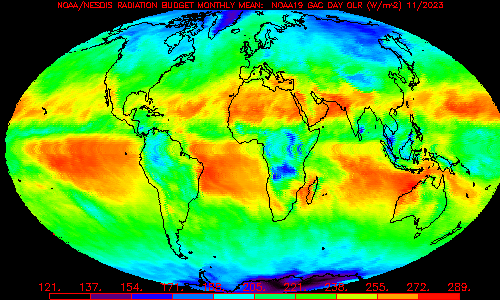
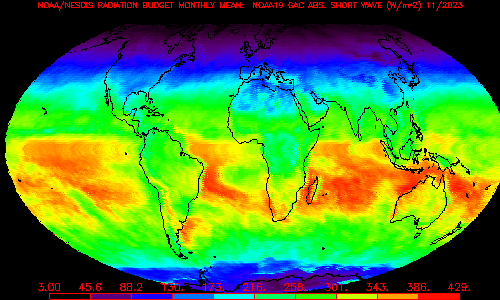

Water vapor plays a decisive role in changes in temperature on land.
Ren
Do you have an IR image of the earth 🌍 ?
I use this data.
https://www.ospo.noaa.gov/Products/atmosphere/rad_budget.html
Bingo, we have a winner: Water vapor. We don’t have a closed atmosphere like a closed greenhouse causing an greenhouse effect. We have a greenhouse with a vent window opened atmosphere. Yuma Az and Shreveport, La are about the same size city and situated along the same latitude. Yuma’s daytime highs are about 15 degrees (f) higher than Shreveport but their night time lows are about the same. Why? Both have the same amount of CO2. I believe Shreveport has a more efficient “swamp cooler” (greenhouse vent window) effect.
It works without water vapour – see above.
Water vapour helps facilitate energy transfers via its phase changes and due to water vapour being lighter than air.
Thus where water vapour is present the vigour of convective overturning declines and the surface temperature remains unchanged.
In fact that is the effect of ALL radiative material in an atmosphere. The more downward radiation there is the less vigorous convective overturning will be.
The most vigorous convection occurs in a non radiative atmosphere so that upward convected energy is returned back to the surface to be radiated out to space fast enough to maintain hydrostatic equilibrium.
Strange how Saturn generates twice as much heat through “internal processes” than it recieves through solar irradiation, and that we believe its core is hotter than the surface of the sun.
Also strange that we teach kids that if Jupiter were 80 times more massive (more static pressure) it would ignite into a star.
Convection and friction of highly compressed gases only generate heat on gaseous planets, not on Venus, apparently.
Ktm
‘…friction of highly compressed gases…’
Accordingly there are layers of atmosphere on Venus travelling at hugely differing speeds. Along with the depth and corresponding depth of Venus’ atmosphere, heat from friction cannot be ruled out. Considering Venus is one of the most reflective bodies in the solar system then the surface of Venus is shielded from some of the sun’s heat radiation?
The Venusian surface is nearly completely shielded from solar energy and at a constant temperature. This is much like the 75% of the Earth’s solid surface beneath the oceans, which is also completely shielded from solar energy, is also at a constant temperature independent of day/night or seasons and dictated by the pressure/density/temperature profile of water.
If gravity was driving atmospheric heat, wouldn’t Jupiter be hotter than Venus?
The interior of Jupiter is much hotter than the surface of Venus.
No one knows exactly how hot, but it might be about 24,000°C near Jupiter’s core.
Ktm January 1, 2019 at 4:38 am
Ktm, there are very, very different physical processes at play on Saturn, Venus, and Jupiter.
SOURCE
Best regards,
w.
At its core, Neptune is estimated to be 7000 °C:
https://www.universetoday.com/21669/temperature-of-neptune/
Something apparently keeps Uranus’ internal heat from reaching its atmospheric surface, making it colder than its near twin Neptune, despite being much closer to the Sun.
Speculation includes some effect from whatever caused Uranus to rotate on its “side”.
Slightly off topic. Years ago , I read a speculation that Earth was x% warmer during the Mesozoic era because the atmosphere was about 10% thicker. I remembered the equation, PV =nRT,
Plugged in P=1.1, and was immediately stuck. What was to keep V from being reduced by 1/1.1, leaving T constant? Or from increasing to 2/1.1 DOUBLING T? That equation alone, without a greenhouse effect factor, told me nothing.
The Mesozoic was warmer mostly thanks to submarine volcanism associated with the formation of the Atlantic Ocean.
The SB temperature for the earth suggests it should be -33C.
The lapse rate as detailed in the ‘US Standard Atmosphere’ has a surface temp of ~ +15C, and ~ -50C at the top of the troposphere.
A range in temperature of ~ 65C.
Since convection moves warm/cold parcels of are and effectively makes the surface warmer and the top of the troposphere cooler, lets say it splits it 50 50.
The SB temp -33C and the temperature range above 65C divided by 2 for the rise and sink of air come out approximately equal.
SB correct, standard atmosphere correct, lapse rate correct, no contraction.
The final unknown is what fundamentally causes the lapse rate?
SR.
SR
The lapse rate marks the changing balance between radiation and conduction as one descends through the mass of an atmosphere.
The deeper you go the more conduction there is relative to radiation and the hotter it gets.
GHGs distort the lapse rate slope one way in ascending air but an equal and opposite way in descending air so that the resulting convective adjustments neutralise any thermal imbalances from radiative material:
https://www.newclimatemodel.com/neutralising-radiative-imbalances-within-convecting-atmospheres/
Actually, according to experiments done by the Connollys, GHGs do not distort the lapse rate, and the infrared cooling models used in GCMs are therefore incorrect. https://globalwarmingsolved.com/2013/11/summary-the-physics-of-the-earths-atmosphere-papers-1-3/
Don132
Alan
N & Z have accurately reported their observations.
Those observations are by no means unique.
I have supplemented those observations by describing in simple terms the relevant mechanism.
That description does appear to be unique and no contributor here or elsewhere has yet been able to set out a valid objection to my description.
Anthony, Willis and Roy will no doubt continue to disagree but I commend Anthony for allowing a continuing discussion.
Don
The Connollys need to invent the pervection concept because they do not realise that the lapse rate distortion arising within rising columns of air is fully offset by the lapse rate distortion arising within descending columns of air.
My simpler description negates the need for the pervection concept.
Greenhouse gases CAUSE a [lapse] rate. Without them, there would be no net lapse rate. The daytime positive lapse rate would be offset by a nighttime negative lapse rate, leaving AVERAGE lapse rate of zero.
Alan
There would still be a lapse rate in a non radiative atmosphere due to the decline in density withy height
Stephen Wilde January 2, 2019 at 1:37 am
Not true, Stephen. See here for a proof.
w.
Hello Willis.
That alleged ‘proof” deals only with an isolated column which limits free convective overturning and thus is not applicable to an atmosphere around a sphere illuminated on one side.
You can see how daft the idea is by considering the total energy content of a gas molecule at the boundary of space. It would be at the same temperature as the surface AND have a full load of potential energy attributable to its height off the surface. Surface molecules would only have kinetic energy and no potential energy. Such an unbalanced total energy profile would prevent hydrostatic equilibrium because at all points in the vertical column the upward pressure gradient force would be in excess of the downward force of gravity and the atmosphere could not be retained.
I have often been surprised by that author’s blind spots given his eminence.
Without greenhouse gases, there would reach a point where there was NO convective overturning, since temperatures would ultimately reach the same temperature all the way up.
Alan
Convection cannot cease or be prevented because uneven surface heating will always create density differentials in the horizontal plane.
A fall in temperature with height cannot cease or be prevented because the density gradient created by gravity causes conversion of kinetic energy (heat) to potential energy (not heat) during the expansion of rising gases with height.
Stephen Wilde January 2, 2019 at 3:13 am Edit
So you agree that the proof is correct for the situation it describes. Also, the air in the isolated column is free to overturn convectively …
Now you seem to be saying that the proof is NOT correct. Which one is it?
Since you haven’t identified any “blind spots”, I fear that’s just handwaving.
w.
Willis
The scenario described works on its own terms but is not a suitable substitute for the real atmosphere due to the expansion constraints provided by the sides of the isolated column.
That is why it is flawed and my comments are consistent.
Lack of water vapor in the west of the US. Temperature in degrees C.

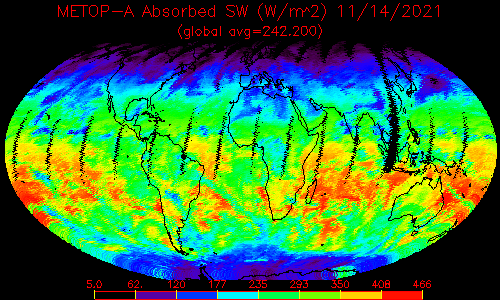
Thank you to Willis, Roy and Anthony.
I hope for more of this, and less politics and ideology. Things do seem to be heading in the right direction on that front.
But if we take the model proposed by Ellis then how do we go from non- atmospheric to atmospheric conditions? First the blackbody would have to warm up until its temperature reached equilibrium with the incoming solar energy. But before it does so it must turn some of its mass into gasses which form an initial low atmosphere. (Assuming that these gases are all non-greenhouse gases for arguments’ sake.). Energy is required to raise and expand the gases that are being held back by gravitational forces. This energy is in excess of the energy required to raise the temperature of the non-atmospheric blackbody to equilibrium. Eventually as the atmospheric expansion reaches its maximum the entire planetary/atmospheric system reaches energy equilibrium with the incoming solar energy at a value of the blackbody + energy required to inflate the atmosphere against gravitational opposition. This value is the difference between blackbody and energy required to maintain atmospheric pressure. This would be the fully inflated bicycle tyre analogy. The system is emitting energy as fast as it is gaining it as a whole (including atmosphere).
However the solar energy does not hit the system uniformly. We have a rotating body. So we get temperature differentials and thus rising and cooling/falling and warming gasses. Also we have a tyre that has a leak that is equal to the incoming energy + the tyres non-leakiness.
Basically if you agree that without gravity the atmosphere would evaporate then you have to agree that if the sun went out the atmosphere would collapse. The energy from the shining of the sun and the gravitational forces act in opposition to one another. An atmosphere assumes both. (And that some equilibrium has been reached between these opposing forces.). If you accept that this is what it is for a planet to have an atmosphere then you have to think that this equilibrium is greater than the planet’s blackbody equilibrium alone. This follows because an atmosphere includes gravitational forces + solar energy by definition. The equilibrium of the planetary/atmospheric system includes the gravitational energy necessary to hold the system at equilibrium. Thus the energy of the system is raised above the value of a simple non atmospheric planet.
Martin,
Correct.
I do hope that Anthony, Willis and Roy take the point after due consideration 🙂
Those who seem to want to argue that pressure means little may not realize that if they lie down right where there are, right now, then the pressure on top of them would be equal to about 20 grand pianos and would kill them, just as it can crush a railroad tanker (Google it.) Luckily for us and deep-sea fish, the pressure is equalized. Look out the window: you’ll looking at about 20 grand pianos per square meter of pressure. It’s invisible.
Willis’ argument is fatally flawed because it excludes the energy absorbed by the atmosphere through conduction/convection, which effectively increases total energy in. If the surface radiates more than the surface takes in, it’s because it’s also radiating what the atmosphere takes in via the surface (in other words “the surface” has a larger mass that just the physical surface of the planet.) There cannot be any violation of any physical law in this.
It makes no sense to say that a surface cannot warm an atmosphere through conduction/convection, which in essence is what Willis and others are saying.
The basis of the NZ/Stephen Wilde theory is simple and elegant. For the life of me I can’t see why it’s so hard to see.
Don132
“… has a larger mass tha(n) just the physical surface of the planet”
Energy absorbed = surface plus atmosphere, since the atmosphere is conducting and convecting with the surface: the body absorbing energy includes the atmosphere. It is would be unphysical if the atmosphere didn’t conduct with the surface of the imaginary planet surrounded by many suns.
Therefore, energy out must also = surface plus atmosphere.
There is no contradiction.
Don132
Correct.
There are some who are now ‘getting it’.
N & Z set out observations that many others have alluded to.
I have provided the specific mechanism.
AGW theory is dead in the water having excluded non radiative energy transfers between surface and atmospheric mass.
If a denser gas gets hotter than a less dense one, due to ‘amplification’ , there must be a trivial experiment that can prove/disprove this.
This makes it good science, something that can be falsified
Dr Spencer makes the following statement:
“The SB equation always results in a surface temperature that is too cold compared to surface temperatures when an atmosphere is present, and greenhouse theory is traditionally invoked to explain the difference.”
True, but how rigorously has this been challenged? Also, the greenhouse theory is full of other claims, many of them dubious. For example, it warms by down welling photon emission, but it is clear that there is a much higher probability that the energy in the atmosphere is dissipated via collisions than via photon emission.
It is not clear how this down welling IR warms our planet which is 72% water because IR cannot penetrate water and can only warm the surface molecules causing evaporation.
Glib explanations become sound science if we are not careful. Am I correct in thinking that when we introduce the atmosphere in the above mind experiment, we introduce the oceans too? But then in our eagerness to find a role for CO2, we ignore our water planet.
Could it be that the massive heat capacity of the oceans provides a storage radiator effect and buffer action, providing heat which remains on our planet beyond the timescales of the atmospheric radiation balance? That heat is topped up daily by solar short wave radiation but the opacity of water to IR radiation provides the thermal lag.
The GH effect may exist, but heat effectively trapped in our oceans does the same job but on a more massive scale. Who needs greenhouse gases?
SC
You make a good point which is mirrored in my oceanic ‘Hot Water Bottle Effect’
However, the energy that the oceans are able to hold is constrained by atmospheric pressure on the ocean surface since atmospheric pressure determines the energy cost of the phase change from liquid water to gaseous water vapour.
Thus in the end what matters most is the weight of atmospheric mass which determines how much solar energy comes to be stored as an energy reservoir within the atmosphere as potential energy which is not heat and which does not radiate but yet is capable of making the surface temperature higher than the S-B prediction beneath regions of descending air and ultimately as per my description the entire planetary surface.
A number of contributors to this thread have got the point and I recommend that Anthony, Roy, and Willis carefully reconsider their positions.
Oh goody, look, another “scientific” argument in favor of CO2 being the driver of climate.
“But now the energy loss by the surface is greater than the energy gained, and energy is no longer conserved. Thus, warming cannot occur from increasing pressure alone.”
Your entire argument looks at the Earth and boils it down to physical surface and solar radiation input. How extremely scientific of you!
How can you prove this? Show the equations. Prove what you claim, do not be the IPCC and other propagandist loses.
You ignore that the atmosphere picks up energy as it blows past heated earth, conduction. The warmed air rises, convection, moving the heat energy upwards and allowing new air to absorb energy from the surface. A process which is constant and ongoing.
This activity of conduction/convection moves the effective Stephen-Boltzmann temperature line up through the atmosphere.
The radiation active (greenhouse for morons) molecules may have some effect, but they also act to cool as they allow the atmosphere to lose energy that it otherwise would not be able to get rid of.
Looking at the evidence, I would put my money on atmospheric pressure, through conduction/convection as the greater driver of the higher than calculated Stephen-Boltzmann near earth temperatures.
How is the search for climate sensitivity to CO2 going? have you narrowed it down over the last 40 years even a tiny bit?
In winter, the troposphere mass over the winter hemisphere is falling.
http://ds.data.jma.go.jp/tcc/tcc/products/clisys/STRAT/gif/zt_nh.gif
http://ds.data.jma.go.jp/tcc/tcc/products/clisys/STRAT/gif/zt_sh.gif
astonerii January 1, 2019 at 10:42 am
Say what??? This is NOT an argument in favor of CO2. It is an argument, actually a proof, that N&Z’s hypothesis is wrong. It has nothing, zero, zip, nada, to do with CO2.
w.
“Say what??? This is NOT an argument in favor of CO2. It is an argument, actually a proof, that N&Z’s hypothesis is wrong. It has nothing, zero, zip, nada, to do with CO2.”
Where does the BONUS 33C temperature come from then?
You just hand waved away what I think many people would intuitively be able to see as a cause of additional warmth.
AStonerII, I didn’t “hand wave away” anything regarding CO2 or the “BONUS 33C temperature”, because I SAID NOTHING ABOUT EITHER ONE!! Those are totally separate questions.
Best of the New Year to you,
w.
Anthony,
“I still like the use of a simple hand-held IR thermometer to demonstrate that the cold atmosphere can actually cause a warmer surface to become warmer still [and, no, the 2nd Law of Thermodynamics is not violated])”
Two comments on this quote:
1. The temperature of the thermopile in the IR meter does not increase when it is pointed at a colder object. The thermopile has two ‘ends’, one of which has the observation light focused on it and the other end does not. The end of the thermopile exposed to the observation will usually read a different temperature result than the unexposed other end of the thermopile. The delta in temperature between the ‘observing’ end and the ‘unobserving’ end induces a tiny electric current which drives the temperature display, according to the calibration of the meter. The temperature of the observation can be above or below the original temperature of the exposed end of the thermopile. If it is above, the thermopile end will increase in temperature. If it is below, the temperature will decrease. In either case, the current induced is due to the delta in temperature between the two ‘ends’ of the thermopile, not due to an increase in temperature of the exposed ‘end’.
So, I believe that you are mistaken when you say that an IR meter demonstrates that a colder atmosphere can increase the temperature of an already warmer object.
The intuitive thought experiment that demonstrates this error is the ice cubes paradox. If a colder object can indeed further increase the temperature of a warmer object, how many ice cubes do you have to surround a pot of water with to make it boil? The answer is obvious … no amount of extra ice cubes will make the pot boil … or even increase its temperature at all.
2. Your ‘demonstrate’ link in the final paragraph of your post points to the Roy Spencer post ‘Direct Evidence of Earth’s Greenhouse Effect’ which shows the difference in temperature observed when pointing an IR meter at a cloud compared to pointing it at open sky. This difference observed is then erroneously described as the ‘greenhouse effect’.
A visible cloud is water droplets, not water vapor. Water vapor is invisible. The extra heat you measure when you point the meter at a cloud is the latent heat being released as the water vapor condenses into those water droplets. That is not the greenhouse effect.
Best regards
Water vapor is a surface temperature controller. In the summer, the lack of water vapor in the air increases the surface temperature, in winter the opposite.
Meanwhile, the surface temperature of the ocean drops again.
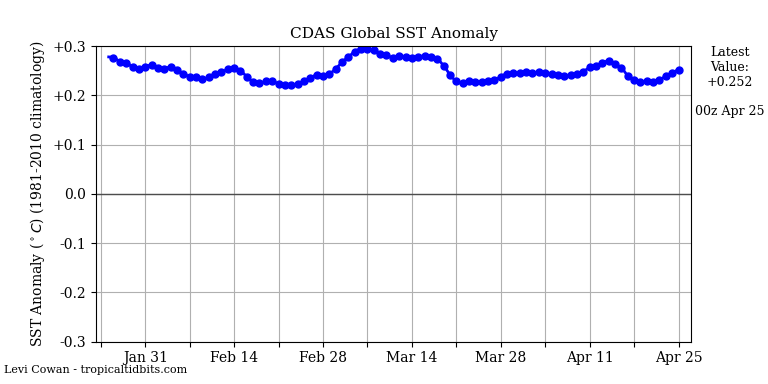
Hypothesis, Conclusions and Data here :
GH Hypothesis v. NZ
Conclusions
Planets
They get mars wrong
Ned effectively tosses out all the modern studies, and validates against a narrow set of IR measurements
made in the late 60s and early 70s, and even there he misrepresents the data
https://link.springer.com/article/10.1007/s11214-017-0360-x
https://wattsupwiththat.com/2010/05/06/hyperventilating-on-venus/
https://wattsupwiththat.com/2010/05/08/venus-envy/
Pv= nrt