[update, reference sheet is now linked at the bottom of post]
By Angus McFarlane,
There was an overwhelming scientific consensus in the 1970s that the Earth was headinginto a period of significant cooling. The possibility of anthropogenic warming was relegated to a minority of the papers in the peer-reviewed literature.
Introduction
Whether or not there was a global cooling consensus in the 1970s is important in climate science because, if there were a cooling consensus (which subsequently proved to be wrong) then it would question the legitimacy of consensus in science. In particular, the validity of the 93% consensus on global warming alleged by Cook et al (2103) would be implausible. That is, if consensus climate scientists were wrong in the 1970s then they could be wrong now.
Purpose of Review
It is not the purpose of this review to question the rights or wrongs of the methodology of the 93% consensus. For-and-against arguments are presented in several peer-reviewed papers and non-peer-reviewed weblogs. The purpose of this review is to establish if there were a consensus in the 1970s and, if so, was this consensus cooling or warming?
In their 2008 paper, The Myth of the 1970s Global Cooling Scientific Consensus, Peterson, Connolley and Fleck (hereinafter PCF-08) state that, “There was no scientific consensus in the 1970s that the Earth was headed into an imminent ice age. Indeed, the possibility of anthropogenic warming dominated the peer-reviewed literature even then.” This conclusion intrigued me because, when I was growing up in the early 1970s, it was my perception that global cooling dominated the climate narrative. My interest was further piqued by allegations of “cover-up” and “skulduggery” in 2016 in NoTricksZone and Breitbart.
Therefore, I present a review that examines the accuracy of the PCF-08 claim that 1970s global cooling consensus was a myth. This review concentrates on the results from the data in the peer-reviewed climate science literature published in the 1970s, i.e., using similar sources to those used by PCF-08.
Review of PCF-08 Cooling Myth Paper
The case for the 1970s cooling consensus being a myth relies solely on PCF-08. They state that,”…the following pervasive myth arose: there was a consensus among climate scientists of the 1970s that either global cooling or a full-fledged ice age was imminent…A review of the climate science literature from 1965 to 1979 shows this myth to be false. The myth’s basis lies in a selective misreading of the texts both by some members of the media at the time and by some observers today. In fact, emphasis on greenhouse warming dominated the scientific literature even then.” [Emphasis added].
PCF-08 reached their conclusion by conducting a literature review of the electronic archives of the American Meteorological Society, Nature and the scholarly journal archive Journal Storage (JSTOR). The search period was from 1965 to 1979 and the search terms used were “global warming”, “global cooling” and a variety of “other less directly relevant” search terms. Additionally, PCF-08 evaluated references mentioned in the searched papers and references mentioned in various history-of-science documents.
In total, PCF-08 reviewed 71 papers and their survey found 7 cooling papers, 20 neutral papers and 44 warming papers. Their results are shown in their Figure 1.
A cursory examination of Figure 1 indicates that there is a 62% warming consensus if we use all the data and this consensus increases to 86% pro-warming, if we were to ignore the neutral papers (as was done in the 93% consensus). Therefore, the Figure 1 data seems to prove the contention in PCF-08 that 1970s global cooling was a myth.
However, I find it difficult to believe that the 1970s media “selectively misread” the scientific consensus of the day and promoted a non-existent cooling scare. Therefore, I present an alternative to the PCF-08 analysis below.
Methodology of this Review
In this review, I use an identical methodology to PCF-08, i.e., I examine peer-reviewed scientific journals. Non-peer-reviewed newspaper and magazine articles are not used. A significantly larger number of papers are presented in the current review than were used in PCF-08.
The PCF-08 database of articles is used but this is extended to examine more literature. Note that examining all of the scientific literature would have been beyond my resources. However, my literature survey was facilitated by the work of Kenneth Richard in 2016 (hereinafter, KR-16) at NoTricksZone, in which he has assembled a large database of sceptical peer-reviewed literature.
Some people may wish to ignore the KR-16 database as being from a so-called “climate denier” blog. However, almost all of the papers in KR-16 are from peer-reviewed literature and consequently it is a valid database. It is also worth noting that 16 of the papers used in the KR-16 database are also contained in the PCF-08 database.
The combined PCF-08 and KR-16 databases form the benchmark database for the current review. It was intended to significantly extend the benchmark database but, on searching the relevant journals, only 2 additional papers were found and these were added to form the database for this review.
It should be noted that KR-16 states that there were over 285 cooling papers. However, many of these papers were deleted from the current review as not being relevant. For example, several papers were either outside the 1965-1979 reference period or they emphasise the minor role of CO2 but do not consider climate trends.
I agree with PCF-08 that no literature search can be 100% complete. I also agree that a literature search offers a reasonable test of the hypothesis that there was a scientific consensus in the 1970s. I reiterate that the resulting database used in this review is significantly larger than that used by PCF-08 and consequently it should offer a more accurate test of the scientific consensus in the 1970s.
Most of the papers in the review database acknowledge the global cooling from the 1940s to the 1970s (typically 0.3 °C global cooling). Therefore, deciding between cooling, neutral or warming was relatively straightforward in most cases; namely did the paper expect the climate regime during the 1940s-1960s period to either to continue from the date that the paper was published, or did it expect a different climate regime in the medium-to-long-term?
Notwithstanding the straightforward test described above, some of the papers make contradictory statements and are thus more difficult to classify. Consequently, their classification can include an element of subjectivity. Fortunately, there are very few papers in this category and consequently an inappropriate classification does not materially affect the overall results.
The test criteria are summarised in Table 1.
| Classification | Test of Classification of Papers | Typical Examples from Papers |
| Cooling | Cooling expected to either continue or initiate | Kukla & Kukla (1972)
“…the prognosis is for a long-lasting global cooling more severe than any experienced hitherto by civilized mankind.” |
| Neutral | Either non-committal on future climate change or expects warming or cooling to be equally possible | Sellers (1969)
“The major conclusions that removing the arctic ice cap would have less effect on climate than previously suggested, that a decrease of the solar constant by 2-5% would be sufficient, to initiate another ice age, and that man’s increasing industrial activities may eventually lead to the elimination of the ice caps and to a climate about 14C warmer than today…” |
| Warming | Warming expected to either continue or initiate | Manabe & Weatherald (1967)
“According to our estimate, a doubling of the CO, content in the atmosphere has the effect of raising the temperature of the atmosphere (whose relative humidity is fixed) by about 2C.” |
Table 1: Summary of Classification System for Papers
The search terms “global cooling” and “global warming” used by PCF-08 are used in this review but they have been expanded to include “cool”, “warm”, “aerosol” and “ice-age” because these, more general terms, return a larger number of relevant papers. Additional search terms such as “deterioration”, “detrimental” and “severe” have also been included. These would fit into the PCF-08 category of “other less directly relevant” search terms.
Several of the papers in the database are concerned about the effects of aerosol cooling and they state that this effect dominates the effect of the newly emerging CO2-warming science. Indeed, a few papers warn of CO2 cooling.
However, PCF-08 do not include any papers that refer to aerosol cooling by a future fleet of supersonic aircraft (SST’s) but several papers in the 1970s assumed an SST fleet of 500 aircraft. This seems incongruous now but, to show that this number of aircraft is not unrealistic; Emirates Airlines currently have a fleet of 244 (non-supersonic) aircraft and 262 more on order. Therefore, I have included papers that refer to the effects of aerosols from supersonic aircraft and other human activities. Of course, supersonic travel was killed-off by the mid-1970s oil crisis.
Furthermore, a number of PCF-08 and KR-16 papers were re-classified (from cooling, neutral or warming) as summarised Table 2.
| Reference | Original | Amended |
| Sellers (1969) | Warming | Neutral |
| Benton (1970) | Warming | Neutral |
| Rasool and Schneider (1972) | Neutral | Cooling |
| Machta (1972) | Warming | Neutral |
| FCSTICAS (1974) | Warming | Cooling |
| National Academy of Sciences (1975) | Neutral | Cooling |
| Thompson, 1975 | Warming | Neutral |
| Shaw (1976) | Neutral | Cooling |
| Bryson and Dittberner (1977) | Neutral | Cooling |
| Barrett, 1978 | Neutral | Cooling |
| Ohring and Adler (1978) | Warming | Neutral |
| Stuiver (1978) | Warming | Neutral |
| Sagan et al. (1979) | Neutral | Cooling |
| Choudhury and Kukla, 1979 | Neutral | Cooling |
| a. Amended Classifications to PCF-08 | ||
| Reference | Original | Amended |
| Budyko, 1969 | Cooling | Warming |
| Benton (1970) | Cooling | Neutral |
| Mitchell, 1970 | Cooling | Neutral |
| Mitchell (1971) | Cooling | Warming |
| Richmond, 1972 | Cooling | Neutral |
| Denton and Karlén, 1973 | Cooling | Warming |
| Schneider and Dickinson, 1974 | Cooling | Neutral |
| Moran, 1974 | Cooling | Neutral |
| Ellsaesser, 1975 | Cooling | Neutral |
| Thompson, 1975 | Cooling | Neutral |
| Gates, 1976 | Cooling | Neutral |
| Zirin et al., 1976 | Cooling | Neutral |
| Bach, 1976 | Cooling | Warming |
| Norwine, 1977 | Cooling | Warming |
| Paterson, 1977 | Cooling | Neutral |
| Schneider, 1978 | Cooling | Warming |
| b. Amended Classifications to KR-16 |
Table 2: Amendments to Classification of Papers in Database
Two examples of the amendments to the classification of the papers in the database are explained below:
1. The Benton (1970) paper is classified as “Cooling” in KR-16 but the paper states that, “In the period from 1880 to 1940, the mean temperature of the earth increased about 0.60C; from 1940 to 1970, it decreased by 0.3-0.4°C…The present rate of increase of 0.7 ppm per year [of CO2] would therefore (if extrapolated to 2000 A.D.) result in a warming of about 0.60C – a very substantial change…The drop in the earth’s temperature since 1940 has been paralleled by a substantial increase in natural volcanism. The effect of such volcanic activity is probably greater than the effect of manmade pollutants… it is essential that scientists understand thoroughly the dynamics of climate.” [Emphasis added]. Consequently, this paper is re-classified as neutral in this review. Not the “Cooling” classification in KR-16 and not the “Warming” the classification in PCF-08).
2. The Sagan et al. (1979) paper is classified as “Neutral” in PCF-08 but the paper states that, “Observations show that since 1940 the global mean temperature has declined by -0.2 K…Extrapolation of present rates of change of land use suggests a further decline of -1 K in the global temperature by the end of the next century, at least partially compensating for the increase in global temperature through the carbon dioxide greenhouse effect, anticipated from the continued burning of fossil fuels.” [Emphasis added]. Therefore, this paper is re-classified as cooling in this review (conforming to the KR-16 classification).
Results from Review & Discussion
The review database contains a total 190 relevant papers, which is 2.7 times the size of the PCF-08 database. Of the 190 papers in the review database, 162 full papers/books and 25 abstracts were reviewed (abstracts were used when the full papers were either pay-walled or could not be sourced). Furthermore, 4 warming papers from PCF-08 were not reviewed because they could not be sourced. Therefore, the PCF-08 classification was used for these papers in this review.
The results from the review are summarised in Figure 2.
It is evident from Figure 2 that, for the 1965-1979 reference period used by PCF-08, the number of cooling papers significantly outnumbers the number of warming papers. It is also apparent that there are two distinct sub-periods contained within the reference period, namely:
1. The 1968-1976 period when cooling papers greatly outnumber the warming papers (85% to 15%), if we ignore the neutral papers (as was done in the Cook et al (2103). The 85% to 15% majority is an overwhelming cooling consensus. Additionally, this is probably the period when the 1970s “global cooling consensus” originated because cooling was clearly an established scientific consensus – not the myth that PCF-08 contend.
2. The 1977-1979 period when warming papers slightly outnumber the cooling papers (52% to 48%) – a warming majority but not a consensus.
The following observations are also worth noting from Figure 2 for the 1965-1979 reference period:
1. Of the 190 papers in the database, the respective number of papers are 86 cooling, 58 neutral and 46 warming. In percentage terms, this equates to 45% cooling papers, 31% neutral papers and 24% warming papers, if we use all of the data.
2. The cooling consensus increases to 65% compared with 35% warming – a considerable cooling consensus, if we ignore the neutral papers (as was done in the Cook et al (2103).
3. The total number of cooling papers is always greater than or equal to the number of warming papers throughout the entire reference period.
Although not presented in Figure 2, it is worth noting that 30 papers refer to the possibility of a New Ice-Age or the return to the “Little Ace-Age” (although they sometimes they used the term “Climate Catastrophic Cooling”). Timescales for the New Ice Age vary from a few decades, through a century or two, to several millennia. The 30 “New Ice Age” papers are not insignificant when compared with the 46 warming papers.
Conclusions
A review of the climate science literature of the 1965-1979 period is presented and it is shown that there was an overwhelming scientific consensus for climate cooling (typically, 65% for the whole period) but greatly outnumbering the warming papers by more than 5-to-1 during the 1968-1976 period, when there were 85% cooling papers compared with 15% warming.
It is evident that the conclusion of the PCF-08 paper, The Myth of the 1970s Global Cooling Scientific Consensus, is incorrect. The current review shows the opposite conclusion to be more accurate. Namely, the 1970s global cooling consensus was not a myth – the overwhelming scientific consensus was for climate cooling.
It appears that the PCF-08 authors have committed the transgression of which they accuse others; namely, “selectively misreading the texts” of the climate science literature from 1965 to 1979. The PCF-08 authors appear to have done this by neglecting the large number of peer-reviewed papers that were pro-cooling.
I find it very surprising that PCF-08 only uncovered 7 cooling papers and did not uncover the 86 cooling papers in major scientific journals, such as, Journal of American Meteorological Society, Nature, Science, Quaternary Research and similar scientific papers that they reviewed. For example, PCF-08 only found 1 paper in Quaternary Research, namely the warming paper by Mitchell (1976), however, this review found 19 additional papers in that journal, comprising 15 cooling, 3 neutral and 1 warming.
I can only suggest that the authors of PCF-08 concentrated on finding warming papers instead of conducting the impartial “rigorous literature review” that they profess.
If the current climate science debate were more neutral, the PCF-08 paper would either be withdrawn or subjected to a detailed corrigendum to correct its obvious inaccuracies.
Afterword
I reiterate that no literature survey can be 100% complete. Therefore, if you uncover additional references then please send them to me in the comments. It would make this review much better if we could significantly increase the number of relevant references.
Additionally, if you disagree with the classification of some of the references then please let me know why you disagree and I will consider appropriate amendments. Your comments on classification would certainly increase the veracity of the review by providing an independent assessment of my classifications.
References
The references used in this review and their classification are included in the spreadsheet here:
References-Global Cooling Consensus.xlsx
If you remember the 1960s then you weren’t there.
What? You mean this is about the 1970s?
I’ll get my coat.
Many years ago when Connolley first came up with this stupid claim I spent a few minutes on google scholar and found some papers that had somehow escaped his notice in his supposedly thorough review of the literature.
I posted some of them on his blog. I wonder if that exchange is still there. In one case all he could say is “we didn’t look at Geology journals”.
His attempt to re-write history was one of the first things that alerted me to the problems with climate science (he was a climate scientist in those days).
Is there some turnaround. A big picture of a polar bear on the front page of the Dutch paper “De Telegraaf”. Now the paper admits, after years of denying, that the polar bears are thriving and growing in number. All these contradicting discussions about iceage, global warming, polar bears, hurricanes, drought, rain, etc, are only confusing. Why to have confidence in global warming policies.
We also have a large cooling in Eurasia during solar minimum.

The meteorological winter starts on December 1.
https://journals.ametsoc.org/doi/pdf/10.1175/2008BAMS2370.1
“THE MYTH OF THE 1970s
GLOBAL COOLING SCIENTIFIC
CONSENSUS ”
“There was no scientific consensus in the 1970s that the Earth was headed into an
imminent ice age. Indeed, the possibility of anthropogenic warming dominated
the peer-reviewed literature even then. ”
“Despite active efforts to answer these questions,
the following pervasive myth arose: there was a
consensus among climate scientists of the 1970s that
either global cooling or a full-fledged ice age was
imminent (see the “Perpetuating the myth” sidebar).
A review of the climate science literature from 1965
to 1979 shows this myth to be false. The myths basis
lies in a selective misreading of the texts both by
some members of the media at the time and by some
observers today. In fact, emphasis on greenhouse
warming dominated the scientific literature even
then. The research enterprise that grew in response
to the questions articulated by Bryson and others,
while considering the forces responsible for cooling,
quickly converged on the view that greenhouse
warming was likely to dominate on time scales that
would be significant to human societies (Charney
et al. 1979). However, perhaps more important than
demonstrating that the global cooling myth is wrong,
this review shows the remarkable way in which the
individual threads of climate science of the time—
each group of researchers pursuing their own set of
questions—was quickly woven into the integrated
tapestry that created the basis for climate science as
we know it today. “
Even if every man ignites a bonfire, the Sun will decide about temperature changes. Ancient civilizations already knew about it.
What’s the point of your post, Anthony? You just quoted part of the erroneous report, but had no comment, so I was just wondering.
Do you dispute that there was a Global Cooling consensus in the 1960’s-70’s?
I lived during that era, and read every scientific publication available (just about) and I can guarantee you that the majority of the thinking was that we might be heading into another iceage. There’s no doubt about it. The scientific publications are still available. They can be checked.
“Do you dispute that there was a Global Cooling consensus in the 1960’s-70’s?”
Yes – as does the paper I linked to and posted.
“I lived during that era, and read every scientific publication available (just about) and I can guarantee you that the majority of the thinking was that we might be heading into another iceage. ”
And so did I (live through it)
Was 16 in 1970 and had an interest in weather, such that I subsequently joined the UKMO in 1974 and served 32 years
I remember media reports and documentaries/books concerning coming cold.
However that is NOT the same as a consensus on the science.
It is just the media exploiting a nice sensationalist meme.
So you read the sum of the papers published at the time?
If not, I’d suggest that therefore you most certainly cannot “guarantee” me any such thing.
And Tom, (re your comment below) – while I’m at it could you please link to a graph showing that the 1930’s was warmer than present.
Thanks.
Anthony wrote: “I remember media reports and documentaries/books concerning coming cold.
However that is NOT the same as a consensus on the science.
It is just the media exploiting a nice sensationalist meme.”
That’s a distinction without a difference, as far as I’m concerned. Global Cooling was definitely the meme for the Media. We can quibble about each scientific study, but I think the evidence for that is there were more studies about global cooling than global warming during this period of time and this WUWT article and the comments provide ample evidence of such. Where do you think the Media got all their Global Cooling material. It wasn’t out of thin air, they got it from scientists.
Anthony wrote: “So you read the sum of the papers published at the time? If not, I’d suggest that therefore you most certainly cannot “guarantee” me any such thing”
I read quite a few of them. I read all the science media at the time and all the newspapers and saw all the television programs (no internet then). I can’t believe anyone who lived through that era missed it, especially someone like you who is interested in the Earth’s weather. But I guess that’s possible.
I
Anthony wrote: “And Tom, (re your comment below) – while I’m at it could you please link to a graph showing that the 1930’s was warmer than present.”
Why, yes I can, Anthony.
Here’s the Hansen 1999 US surface temperatue chart which shows 1934 as being 0.5C warmer than 1998, and that makes 1934, 0.4C warmer than 2016, going by the UAH satellite chart.
Thanks for asking.
Sure do wish the commenting software could be fixed so these charts would show up in the post rather than having to click on them. This worked even before the big software upgrade, but since the software shot craps, the images won’t appear in the posts anymore. A real handicap to commenting.
and the UAH satellite chart:
http://www.drroyspencer.com/wp-content/uploads/UAH_LT_1979_thru_October_2018_v6.jpg
And of course, you will bring up that the US surface temperature chart is only a small percentage of the whole Earth and does not represent the rest of the world when it comes to global temperatures.
But you would be wrong if you made that claim. If you do make that claim, then I will provide you with charts from around the world that show the same temperature profile as the Hansen US surface temperature chart, i.e., that the 1930’s was as warm or warmer than subsequent years. Let me know if you want to see those charts. They blow the Hockey Stick “hotter and hotter” lie out of the water, imho.
“Let me know if you want to see those charts. They blow the Hockey Stick “hotter and hotter” lie out of the water,”
Alarmists never take me up on this offer. I wonder why.
I think I’ll post some of the charts I have in a later post. Force them to look at the truth, as it were. 🙂
If Spock said it, it must be true.
The next big scare con -sense-us.
will be :-0 the climate is not doing anything.
Back in the early 70’s not only was there fear of global cooling but also there was the 1973 energy crisis and followed by talk of peak oil etc etc. It was also the start of my scepticism about futurology. Fusion is still 50 years away, glaciers will melt whenever, all new cars will be electric by 2040, blardy, blardy, blaah. I heard on the radio this morning that we only have 12 years to stop climate catastrophe. And as for AI, sorry it’s just faster processors, memory and comms, but it’s not Intelligence.
I had a book in the 1970s, which I wish I still had copy, which showed icebergs being towed from the arctic to supply San Francisco with water, moon travel and bases by the 1990s, and who knows what else. It was hilarious.
How big does a majority have to be to become a consensus? Does ‘consensus’ have any meaning in a scientific context?
My strong recollection of the 1960’s in the UK is that the media told us that we were in danger of freezing to death in the future. At the time I was not interested in climate issues so I did not read any professional literature.
I earned my degree in geology (Earth Science) in frigid Connecticut during That 70’s Climate Science Show. This was very real…
Griff is correct that a 1977 TIME magazine cover did not predict “another ice age.” The prediction (sort of a prediction) was from a 1974 TIME magazine article…
The full text of the article can be accessed through Steve Goddard’s Real Science.
There’s also Newsweek…
Dan Gainor compiled a great timeline of media alarmism (both warming and cooling) in his Fire and Ice essay.
While the 1977 TIME cover was a fake, this 1975 magazine cover and article were very real…
Energy and Climate: Studies in Geophysics was a 1977 National Academies publication. It featured what appears to be the same temperature graph, clearly demonstrating a mid-20th century cooling trend…
The mid-20th Century cooling trend is clearly present in the instrumental record, at least in the northern hemisphere…
According to the models Gorebal Warming saved us from The Ice Age Cometh…
So, why are the warmunists so obsessed with denying this? Is the mid-20th century cooling period so “inconvenient” that it has to be erased from history like the Medieval Warm Period?
“This was very real…”
It’s all so thin. You’ve had to pad it out with the Science news cover repeated four times. And the one article each from Time and Newsweek in a decade. How can a consensus that was so very real have left such a faint mark?
And then there is the padding with plots of temperature with a downtrend. the claim isn’t that people showed graphs went up and down. The claim is that there was a consensus that scientists were predicting imminent and major cooling.
About as thin as your grasp on reality, Nick. Oh why must the faithful always lead the charge into destruction, in the same name of misanthropy?
You religionists are all the same- always blaming humanity and never actually capable of critical thinking, lest you question the narrative and risk ex communication
I like that Science News cover… There’s also this July 1976 classic…
https://www.nytimes.com/1976/07/18/archives/the-genesis-strategy-a-chilling-prospect.html
Stephen Schneider, a young climatologist at the National Center for Atmospheric Research, also makes an appearance in this classic…
https://youtu.be/L_861us8D9M
“There’s also this July 1976 classic…”
Yes, but what is it saying? Schneider is very worried about food security in the face of climate instability. And there is a passage where he gives the statistics of recent ups and downs.
But here is a sceptic listing the same book as “An Old Failed Prediction of Global Warming”. It quotes parts like this:
“There are various estimates of the response of globally averaged surface temperatures to a doubling of CO2 from a out 300 ppm to six hundred ppm by volume – a value projected to occur by about the years 2025 to 2040. State-of-the-art climate models unequivocally predict that such a doubling of CO2 would raise the surface temperature of the earth. Although these predictions vary considerably, probably the best order of magnitude estimate that can be made today is for a surface warming by some 1.5 to 3oK globally and that the temperature increase in the polar regions might well be amplified severalfold. But there is far less agreement over the magnitude and location of tghe warming than over the fact that CO2 will warm. Projection of the CO2 increase, granted the continuation of present trends to the year 2000, suggests, as said earlier, an increase in CO2 concentrations of about 20 to 25 percent, a change corresponding to an approximately 1 deg K global surface temperature rise (plus the assumed amplification at the poles.”
And the same with his appearance in the video. All that happens there is that the narrator puts to him things that might be done to alleviate cooling, and he says, no, that is a bad idea. We don’t know that it will cool, and the cure might be worse than the disease.
I think the key to all this is the section that Phil. quoted from the summary in Lamb’s book from the period:
“It is to be noted here that there is no necessary contradiction between
forecast expectations of (a) some renewed (or continuation of) slight cooling
of world climate for a few decades to come, e.g., from volcanic or solar
activity variations: (b) an abrupt warming due to the effect of increasing
carbon dioxide, lasting some centuries until fossil fuels are exhausted and
a while thereafter; and this followed in turn by (c) a glaciation lasting
(like the previous ones) for many thousands of years.”
He’s right, there is no contradiction. It is still agreed that
1. There was a cooling trend in the NH at the time
2. There was a general expectation of AGW
3. Interglacials come to an end.
What is happening here is that KR and Angus pick up on any paper that makes reference to 1 or 3 and say that this is an example of scientists predicting cooling, which they later switched to warming.
I suggest one avenue of research would be to get the indexes for all issues of Science News and compare the number of articles about Global Cooling with those about Global Warming.
Science News is a weekly magazine that covers all news related to science issues, so you have 52 issues per year with about a dozen topics per issue, which is a lot to chose from.
I was a subscriber to Science News all during the period of discussion and can say without hesitation that the Global Cooling meme was the meme of the time.
I recall when Global Cooling and Human-Caused Global Cooling was first proposed, or rather, when I first became aware that it had been proposed, that it seemed to make sense to me, and so I didn’t reject the notion out of hand, and I kept waiting for the proponents of Global Cooling to provide some definitive evidence, and I waited and I waited and it never came, and I became very frustrated with reading a bunch of claims that were never backed up by any actual evidence. Just claim after claim.
Then in the early 1980’s the Global Warming meme became the prominent one mentioned, and it was the same as the Global Cooling meme: lots of claims but no actual evidence to demonstrate these claims were true. By this time I was pretty jaded on this “human-caused” climate subject.
And with the Global Warming meme, things really started to get out of hand and Science News carried one AGW and CAGW story after another, again with not one ounce of evidence, to the point that I got tired of getting angry every time I would see these unjustified headlines in Science News so I cancelled my subscription, along with my subscription to Scientific American and National Geography, for the same reason. I didn’t see why I should pay to be fed BS (Bad Science).
Yes, check out Science News’ indexes for some insight into the thougts of the time.
Global cooling was also the weather of the time… 😎
Hot or cold
In reality it makes little difference thanks to the ‘heads you lose tails I win ‘ approach used in climate science, not matter what happens this will be held up as proof of ‘climate doom ‘
Once again you need to think about religion approaches such challenges to understand how climate ‘science ‘ deals with this issue , there no point in looking at how other sciences deal with it .
The idea that by empirical means you can ‘win the argument ‘ is an odd one given its not an argument based on empirical data in the first place.
The US government of 1976 naturally enough had a long look at the scientific consensus of the time and produced a 500 page tome concerning it.
A Primer On Climatic Variation And Change Prepared For The Subcommittee On The Environment And The Atmosphere Of The Committee On Science And Technology U.S. House Of Representatives Ninety-Fourth Congress’.
Congressional Research Service: 1976, A Primer on Climatic Variation and Change, U.S. Government Printing Office, Washington.
https://ia801702.us.archive.org/4/items/pronclimatic00libr/pronclimatic00libr.pdf
A document which opens with
Quote
PERSPECTIVE A growing fraction of current evidence suggests that the world may be entering a new climate regime. Amid recent expressions of concern that the Earth may be on the verge of entering a new ice age, a potential serious problem for mankind is perceived. However, this concern has been voiced by many, both within scientific circles, and through the mass media without the qualifications appropriate to any such venture into the realm of the predictability of climate.
Impact of Climatic Change If present global cooling trends continue for several more decades, high latitude areas such as Canada, the U.S.S.R. and northern China would experience shorter growing seasons and a drop in output. Helmut Landsberg, a climatologist at the University of Maryland, estimates that a drop in average temperature of 2 degrees centigrade in the region above “ij The degree month value is the sum of the mean monthly temperatures in excess of 32 degrees Fahrenheit. CRS -14 the 40 degree parallel would completely eliminate wheat and corn production in major regions of Canada. A decrease of 1 degree Centigrade in the mean annual temperature in Iceland has already reduced the number of degree days by 2 7 percent –a reduction in the growing season of 2 weeks. In addition to shorter growing seasons from a cooling trend, there would be broad bands of excess and deficit rainfall in the middle latitudes. Europe can expect to be cooler and wetter. The western regions of the U.S. wheat belt- -from Montana to Colorado –would experience increased wheat crop failures. The northern Great Plains would experience a 14-18 day reduction in growing season, but the southern plains would gain in crop yields due to increased rainfall. In general the existing crop belts of the U.S. would shift southward. Overall U.S. agricultural production would be unaffected or perhaps slightly increased. The monsoon rain belt would also shift southward causing these rains to fall into the oceans rather than the traditionally fertile areas of sub- saharan Afri«ca, India, Japan and south China. Production of rice would be seriously affected in the warm lands below 30 degree latitude. Impacts on Agricultural Trade Climatic changes of the order just described would drastically affect the capability of nations to feed their people and the availability of food from traditional exporting nations.
And goes on to say on page 28
Quote
Although it is almost unanimously held that the Earth is presently in a phase of climatic change, theories as to the future course and rate of the change vary considerably. Today, most experts agree that the Earth is in a cooling phase. Proceeding from that observation, the following scenarios for the future are commonly predicted: 1) that Earth is slowly (ever thousands of years) entering into a new ice age; 2) that Earth will rapidly (within 100 years or slighly more) enter in- to a new ice age wherein much the planet will be locked in glaciers; 3) that the present cooling trend is only a minor aberration due to cyclic sunspot activity and is not necessarily a harbinger of a new ice age; 4) that man’s activities (release of CO2, heat, and other substances into the world’s weather machinery) will forestall the onset of a scheduled ice age; and 5) that man’s activities will accelerate the ice age process
They also say
Quote
However, there are also some experts who hold that, contrary to the above, the earth is in a long-term warming phase. Proceeding from that theory, the following scenarios for the future are commonly predicted: 1) that the Earth is slowly (over thousands of years) emerging from the last ice age; 2) that presently, more areas of the world are warming than are cooling; 3) that cooling over the past three decades is but a minor regression in a longer-term warming phase; 4) that man’s activities will precipitate either a slow or fast warming process; and 5) that so significant is man’s impact on the weather, that a major warming trend will soon melt the ice caps triggering a global increase in sea level.
IFIAS. Status Report of the IFIAS Special Project: The Impact on Man of Climate Changes. 10 Oct. 1975, 16 p.
And on page 29
Quote
Although the most popular theory appears to support a global cooling trend, it is almost unanimously agreed by most experts that any climatic o change, even one resulting in a change of as little as + 1 C will have a profound effect on global human health and welfare.
And on page 33
Quote
By far the most popular theory today is that the Earth is undergoing a cooling trend. Just how rapid this trend will be, and therefore, what its impact will be on man is the subject of much speculation. In any event it is widely held that the world climate was unusually stable be- tween 1890 and 1945, but that since 1950, began taking a turn for the worse.
According to Professor Hubert H. Lamb of the Climatic Research Unit in Great Britain, “The decline of prevailing temperatures since about 1945 appears to be the longest continued downward trend since temperature records began,
And on page 41
Quote
Kaplan, I.E. The Threat of A New Ice Age and Some Possible Defences. Science Forum, No. 2, 1975, 7-10.
And the press of course amped all of this up to the max as they always do. It is an undeniable absurdity to claim there was no cooling scare – and yet the warmunards do precisely that. Which is how we can know that what we are dealing with here is quasi-religious dogma having no connection with the world of science whatsoever.
” It is an undeniable absurdity to claim there was no cooling scare – and yet the warmunards do precisely that.”
That’s right and those excerpts you provided summed up the whole subject beautifully.
There were a lot of Human-Caused Global Cooling proponents and a few Human-Caused Global Warmg proponents during that time period, and after the temperatures started warming again in the late 1970’s, the percentage of Human-Caused Global Warming proponents increased by leaps and bounds and the Human-Caused Global Cooling proponents disappeared because their speculations were shown to be wrong.
https://www.ncbi.nlm.nih.gov/pubmed/17841800
Science. 1976 Aug 6;193(4252):447-53.
Global cooling?
Damon PE, Kunen SM.
A reasonable article (ripe cherries for either side included)
https://www.nytimes.com/1975/05/21/archives/scientists-ask-why-world-climate-is-changing-major-cooling-may-be-a.html
Archives | 1975
Scientists Ask Why World Climate Is Changing
By WALTER SULLIVANMAY 21, 1975
One for the warmists
https://www.nytimes.com/1975/08/14/archives/warming-trend-seen-in-climate-two-articles-counter-view-that-cold.html
Archives | 1975
WARMING TREND SEEN IN CLIMATE
By WALTER SULLIVANAUG. 14, 1975
one for the coolists
http://www.denisdutton.com/cooling_world.htm
The Cooling World
Newsweek, April 28, 1975
either take your cherry to pick
https://journals.ametsoc.org/doi/10.1175/1520-0469%281971%29028%3C1513%3ACCATC%3E2.0.CO%3B2
Cirrus Clouds and the Climate
Stephen K. Cox
Department of Atmospheric Sciences, Colorado State University, Fort Collins
Add to Favorites Track Citation Download Citation Email
https://doi.org/10.1175/1520-0469(1971)0282.0.CO;2
Received: 19 February 1971
When the distribution of papers is plotted by year of publication, the cooling category is more common from 1970 through 1975 by a wide margin. After that the numbers are about equal. Before 1970 the number of papers in either category is small so it’s hard to say which was predominant. The trends are quite obvious about cooling being the early concensus, then yielding its lead.
I think you are correct and you summed it up very well, Gary.
The changeover from Global Cooling to Global Warming took place in the late 1970’s, when the temperatures started to rise instead of fall, and as the temeratures continued to rise year after year, the human-caused Global Warming narrative got stronger and stronger to the point that now many climate scientists think *all* the current warming from 1979 is caused by human-derived CO2.
The 1930’s were hotter that subsequent years by about 0.5C (1998) and 0.4C (2016) so the notion that additional energy is required to reach current temperature levels is silly. The Earth reached higher temperatures in the 1930’s when CO2 was not a factor, so the current warming could just be more of the same natural variability. If even part of the warming is natural, then the current ECS estimates are toast and are much lower than currently claimed, since they are based on all the current warmth being from CO2.
David asked above why Alarmists were so bent on rewriting the Global Cooling meme history and I think it is because if they acknowledge the cooling, then they have to talk about where that cooling originated. That cooling originated from the hottest decade since that time: The 1930’s.
The Keepers of the Climate Data manipulated the temperature record to erase the high temperatures of the 1930’s, so they want to avoid talking about that subject and Global Cooling brings it to mind.
“The 1930’s were hotter that subsequent years by about 0.5C (1998) and 0.4C (2016)…….. ”
No they weren’t ….
https://encrypted-tbn0.gstatic.com/images?q=tbn:ANd9GcQIcMCkrRPZjOPD-pSX9tQnJua2_F2LM3_0-NtVICpsQwddVEwn
are those post adjustment, post hide the decline?
Gary, cooling predominated throughout the entire period as shown in the attached image that was supposed to be included in the original post.
I likewise remember the announcements of cooling from teachers, media and the like during the period. I recall nothing about warming. That of course is anecdotal.
I think the takeaway from this is that such assessments are invariably subjective and that scientists are no more informed to make any pronouncements about the future than they were 50 years ago. The old wise saying in science “I don’t know” would seem to be the only honest consensus.
Another list
http://www.wmconnolley.org.uk/sci/iceage/
Was an imminent Ice Age predicted in the ’70’s? No
I was messing around with R, and made this graphic where Cooling = -1 and Warming = 1.
http://127.0.0.1:15159/graphics/plot_zoom_png?width=1144&height=677
Your link is local, sir.
Sorry. Even I couldn’t see it! I hope this works better.
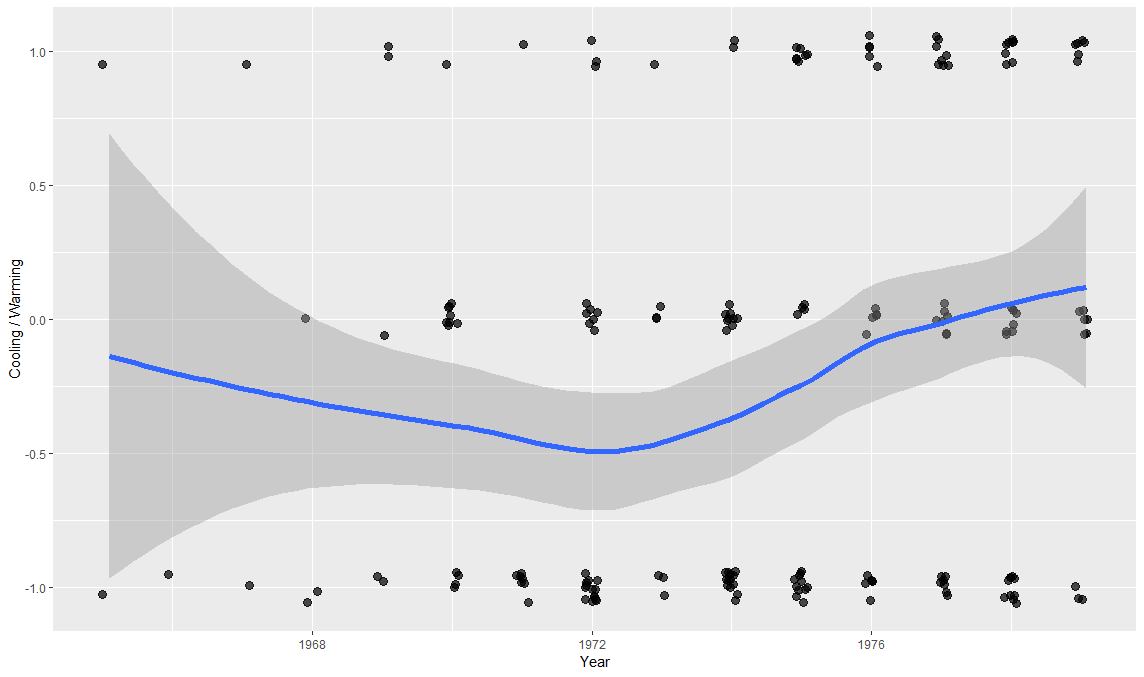
Of course, I’d prefer the actual graph here instead of the URL. A Google search has not helped. Been a long time since I tried to post an image to WordPress. Apologies. Any tips?
Stoat by name Stoat by nature.
Some years ago, I started to look at the original papers cited in PCF-08. Of the first six papers I could find from their “warming” list, I found none that actually stated in any form that they thought the earth would warm. I gave up in disgust.
I realized that their methodology was ridiculous for the purpose they stated. If a scientist got a grant in the 1970s to examine the possible effects of increased CO2, PCF-08 would automatically count it as a “warming” paper, even if it reached no conclusion that these effects were dominant.
PCF-08 is useful as propaganda, but not as science (or even meta-science).
Why doesn’t ever discuss the mechanism by which co2 was going to induce a new ice age.
A gradual cooling atmosphere wicking surface T, an ever decreasing long term equilibrium state.
Because more co2 radiating heat to space speeds up cooling of the atmospheric layer, and thag plays out all way down through a speeded up sensible flow of heat.