Guest Post by Willis Eschenbach [See update at the end]
There’s a new entry in the competition for the top spot in the “Climate Change Ruins Everything” competition. This is the claim that “Severe climate events could cause shortages in the global beer supply”, as discussed here on WUWT.
YIKES! If true, that is more serious than sea level rise … they explain the danger as follows:
The study warns that increasingly widespread and severe drought and heat may cause substantial decreases in barley yields worldwide, affecting the supply used to make beer, and ultimately resulting in “dramatic” falls in beer consumption and rises in beer prices.
So I figured that I should take a look at “barley yields worldwide”. I mean, if increasing heat causes “substantial decreases” in barley yields, we should see it in the record.
I went to one of my favorite datasets, the FAOSTAT database maintained by the Food and Agricultural Organization. It has production, yield, and area harvested for most crops since 1961. Here is their record of the barley yield over that period.

Since the global average temperature has increased over the period, I gotta say that it hasn’t had any visible effect on the global barley yield.
Is there a correlation between global barley yield and global temperature? To check that, I detrended both datasets to remove the long-term trend. This revealed that there is no statistically significant relationship between global temperature and global barley yield (p-value = 0.16).
However, I figured that this lack of correlation might be a result of the fact that I’m looking at the whole globe. So I repeated the analysis using the temperature and yield data for just the United States. In this case, it turns out that in the US there is indeed a negative correlation between temperature and barley yield. For every degree of US warming, the US barley yield drops by 266 kg per hectare (p-value = 0.01).
So it seems that they are right—barley yield does in fact go down with increasing temperature.
But how much difference does this make in practice?
To see that, I calculated just how much difference the change in US temperature made in the US barley yield. It turns out that the temperature rise in the US since 1961 decreased the US barley yield in 2012 (last year of the Berkeley Earth temperature data) by about 470 kg per hectare … and since the 2012 US barley yield was 6,251 kg/hectare, the warming in the US reduced the barley yield by about six percent.
Here’s the actual change in US barley yield (yellow/black), and what it would have been if there had been no temperature rise (red/black).

My term for that kind of result is that it is a “difference that makes no difference”. Six percent is far less than the annual variation in US barley yields from year to year.
In other words … the great beer panic of 2018 is just another in the long line of the alarmist “sky is falling” scare stories about the eeevil effects of “climate change”. So if you are of a mind, you are welcome to drink some beer to celebrate the good news … we’re not gonna run out of barley.
[UPDATE] Tom McClellan has graciously pointed me to the following interesting analysis:
Consider also that barley is only one input into beer making. Here are some fast facts:
A barrel of beer is 31 gallons. It takes about 75 to 120 pounds of barley to make that much beer, depending on the type of beer that is being made. A bushel of barley right now costs around $5, and it contains about 48 pounds of barley.
So let’s say that the barrel of beer takes 2 bushels, or about $10 worth of barley for that 31 gallon barrel. With 128 ounces per gallon, there are 331 12-ounce beers per barrel. So the wholesale cost of the barley in your bottle of beer amounts to about 3 cents.
The current federal excise tax on a barrel of beer is $18. Add to that your state and local sin taxes, plus sales tax at the register, and the amount of taxes dwarfs the cost of the barley. So the price of barley could triple, and it still would not exceed just the taxes on the beer.
But where global warming could become a factor in the cost of beer is if some genius politician suddenly realizes that drinking beer makes people burp, thus causing us to become enhanced point-source emitters of CO2, and then slaps an additional carbon tax on beer. That is a more reasonable risk factor for beer pricing than barley costs.
My very best to you all,
w.
PS—When you comment, please quote the exact words that you are referring to so that we can all understand just what you are discussing.
Could you show us the yield curve for the US over time, similar to the global curve you posted? Most crop yields are rising everywhere for multiple reasons. I would expect US barley yields to be rising also.
Soy and Corn yields have increased dramatically over the last 30 years. Barley is a secondary, at best, crop and is grown on more marginal land as it is a low demand crop. One could say that barley is suffering a double whammy, farmers are growing it on more marginal/less suitable land due its lack of profitability vs corn/soy and that it doesn’t get the genetic advancements that corn and soy have gotten because it is a less valuable crop. Both of which could easily explain why it isn’t showing the yield gains of corn, soy, wheat, rice, cotton.
https://ycharts.com/indicators/us_barley_price
And its price fell 20% over the past 4 years. My guess is some of the better land was put to better use.
Yes, winter wheat replaced both winter and spring barley in the UK because it gave a higher yield and more profit.
Barley was grown as a disease break drop in a rotation with grass, legumes and oilseed rape (canola) but did not make as much profit per acre.
A variety of barley called Golden Promise is still grown especially in Scotland. As it’s malting quality makes it very popular with whisky distillers.
New varieties of barley have been bred that give higher yields, but the feed varieties tend to yield more than the malting varieties, so it depends on what the maltsters are prepared to pay that determines a farmer’s choice of variety to grow.
No doubt if the supply of barley decreases the value will go up and farmers will adjust their rotation and grow a larger acreage of barley.
Off topic, graffiti on a pub washroom wall, ‘You don’t buy our beer, you just hire it.’
Another point with barley is that it ripens earlier than wheat, so tends to avoid the summer droughts.
There you go again, letting facts get in the way of a good scare story.
“In this case, it turns out that in the US there is indeed a negative correlation between temperature and barley yield. For every degree of US warming, the US barley yield drops by 2.7 kg per hectare (p-value = 0.01).”
You have to go see what the authors of that Nature Plants paper hid in their supplemental information (link here):
https://static-content.springer.com/esm/art%3A10.1038%2Fs41477-018-0263-1/MediaObjects/41477_2018_263_MOESM1_ESM.pdf
Goto section 3.3 of the SI, page 23.
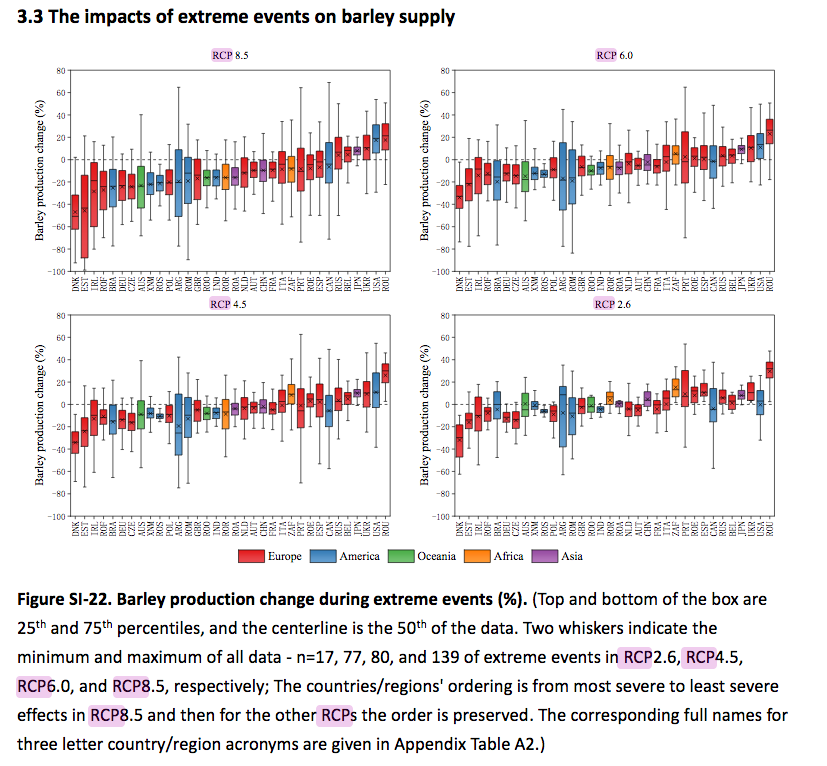
(or)
Their barley production %change by RCP by country results graph is here:
They analyzed all 4 RCP scenarios in CMIP5 into their economic and production model. Even in RCP2.6 (the most optimistic), they show severe declines in production across many smaller countries like Ireland and Denmark. With some of the big producers like US and Ukraine going up in all four scenarios, even in RCP 8.5, aka the So-Stupid-It-Burns Scenario. Canada is mixed bag of no significant change in any scenario. Even Japan and Romainia they show barley production apparently goes up in all 4 scenarios.
Meanwhile in “poor” Denmark’s and Ireland’s barley production will go down no matter what happens according to this study.
No wonder they buried these results in the SI.
I would also argue that yield per acre (or hectare) is hardly the correct metric to consider, as long as it is not in any steep decline and remains flat or rising. The simple year to year variations in land area under production for any given food crop by country/region and then global are enough to analyze whether there is indeed a problem (or not).
And then if that is not enough, the price/bushel of barley (adjusted to constant dollars to acount for inflation) is an even better metric of whether there is a problem under global warming of the last 60 years.
Here is the Barley Monthly Price – US Dollars per Metric Ton for the last 30 years:
https://www.indexmundi.com/commodities/?commodity=barley&months=360
and here is a graph of which countries produce how much:
https://www.indexmundi.com/agriculture/?commodity=barley&graph=production
Russia is the single largest country producer of barley. ANd then referring back to the Nature Plants paper, one can see the those authors showed no significant change for Russian barley production in any emissions scenario.
And then going back to that
Those numbers do not appear to be adjusted for inflation, which means that in real terms, prices are likely near an historic low point.
No?
Try comparing the commodity to something like gold:
https://www.indexmundi.com/commodities/?commodity=barley&months=360&commodity=gold
Willis,
It’s possible the farmers have planted something OTHER than barley just
to rotate their field crops…
However, if the barley harvest goes down but the demand for barley (and
beer) stays the same, the price of the grain will go up.
If the bushel price of barley goes up, then more barley will be planted,
harvested, and turned into beer.
The price of beer may go up a bit, but no shortage can be assumed.
Along these same lines – If the farmers plant fewer hectares of barley, production (yield) will necessarily decrease. If they make less per hectare with barley than they can make on the same land, with the same effort, by planting something else they will plant (and sell) less barley. If the price goes up, they will plant more. They are not planting barley to make beer, they are planting it to run their businesses.
Suppose ‘climate change’ is increased by more CO2 and that CO2 causes the barley to grow faster and better – and easier for the farmer. The price will likely fall due to increased supply and some farmers will make less. The next year the farmer will probably plant something else or plant fewer hectares.
ANY analysis needs to take into account the Law of Supply and Demand.
nws: On the money. My uncle who was a very successful farmer said his secret was simple. Find out what everyone else is planting and plant something else.
Like most finished products, I suspect that the cost of grain is insignificant in terms of the final cost of beer.
Especially when you look at the price of it in various forms…bottled, in cans by the sixpack, by the case, in quarts, or the bargain basement world of fresh from the tap out of a keg…the best and cheapest way to buy and enjoy it.
Although not a habitual drinker, I’ve developed a fondness for Sam Adams’ Summer Pale Ale. Maybe I’ll pick up a 6-pack on the way home and celebrate this non-event.
Say, w., do they list barley production by country (like Greenland), going back to 1000 AD?
The last severe climate event that ruined beer supply, as far as I know, was the Little Ice Age putting all the breweries in Greenland out of business some 700 or 800 years ago. It also put the brewers, their families, their friends, and all of their little settlements out of business, too.
The millennial Greenlander Vikings grew their own barley for beer back in 1000 AD, but activity ceased as the climate chilled. In recent years their descendants retuned to live with the other locals there, and in the current millennium they’ve resumed brewing:
http://breweryimmiaq.com/start-eng/
Thanks to fossil fuel heated houses, Vikings can once again live in Greenland, but they still can’t grow barley. That they import from Denmark.
But they do use local water:
https://www.anadventurousworld.com/greenland-beer/
Dr. Keen –
🙂 🙂 🙂
Local water is what makes Kentucky bourbon so good. High hardness and 0 iron.
Disclaimer: While I was born and raised in Kentucky, I rarely drink bourbon. But in the absence of beer ….
Let us always use 0 at the origin of the ordinate, do not use 3000 as the lowest value on the “y” axis.
That is the traditional way to graph things. I agree it is instructive to also
look at the graphs in other ways (such as you suggested). But, when one
does the calculation of slope or percent change, that takes care of any
problems due to the graph being misleading (or incomplete).
There is also this site which covers world crop production as well. Pick any crop and country.
https://www.indexmundi.com/agriculture/?country=au&commodity=corn&graph=production
Uhhh … a decrease in demand does not lead to a rise in prices.
Besides, “Then let them drink wine!”
(Or a good Kentucky bourbon.)
Bourbon requires corn (maize).
Scotch however relies on barley mash, ie in effect, it’s distilled beer.
Canadian is rye.
Science has finally came up with a reason that will energize the deplorables and cause to fight climate change. In the past it would have been aimed at tobacco. “Chew tabacco, chew tobacco, spit.”
If I’m not mistaken, Budweiser uses rice.
(Maybe I’m just remembering an old commercial.)
Barley is not needed to make beer.
It’s needed to make good beer. 🙂
The mash for Bud is about 30% rice. Max.
Well they did claim (citation needed) that ‘Climate Change would ruin Soy’ and too many people cheered in happiness.
Worse Panic Attack our Social Elite ever tried to launch.
From 1959 to 2017 atmospheric CO2 increased from 315.97 PPM to 406.55, an increase of 28%.
ftp://aftp.cmdl.noaa.gov/products/trends/co2/co2_annmean_mlo.txt
During that same time frame US barley yield increased from 28.3 bushels per acre to 72.6 bushels per acre, an increase of 150%, According to the US Department of Agriculture
http://usda.mannlib.cornell.edu/usda/current/htrcp/htrcp-04-12-2018.pdf
Nuff said?
Estimated barley CO2 sensitivity is 5.36 bushels/acre/ppm (percentages ratio).
Then there’s the feedback from opened beer CO2 releasing into the atmosphere.
Maybe the climate changes from so much beer-drinking or climate change causes more beer drinking.
We need an international panel to spend 30 years on this.
Well, if they’re right, then we can at least look forward to fewer Beer Hall Putsch’s and later consequences.
🙂
Maybe market forces are it work. Maybe olthe demand for barley is down and other higher price per bushel crops are being planted instead.
You should plot barley yield vs. atmospheric CO2 concentration. I’ll bet the correlation will be higher …
They’ve hit on a very good index of horribler-than-we-thought catastrophe: beer shortage. Once that happens, it’s more or less the end of the world as we know it. In a bad way.
I have several relatives who live in Africa doing various aid-humanitarian related worthy enterprises. They have experienced extremes such as war, army coups, famine and mass migration. One thing they consistently see is that no matter how destructive the war or trauma an African country is suffering – nothing ever stops the beer lorries. No disaster – man made or natural – ever gets even close to interrupting that vital arterial flow of the beer lorries.
If something were to somehow stop the beer lorries, it would have to be on the scale of a Krakatoa or Mount Toba supervolcano.
Sure, worry about the barley but it’s not irreplaceable, what about the flavour; the hops!
You can make beer from wheat, rice, oats, rye, corn, sorghum or a sow’s ear at a pinch!
Without hops, it would be worse than we thought… a real disaster!
“Flavouring beer is the sole major commercial use of hops. The flower of the hop vine is used as a flavouring and preservative agent in nearly all beer made today.” – Wikipedia
Willis, you now need to do one of those fancy beer-o-graphs to allay my fears for hops in our warming world.
Please!
Cheers 😉
Three things wrong about this “analysis” before you even think about barley shortages due to climate change.
1. If this thing was real, then barley production would be heading towards cooler climates to compensate for warming.
2. Don’t know about the rest of the world, but here in Australia farmers make a comparison between profitability of barley and wheat each growing season. In other words production choices are dynamic and are influenced by many variables including prices, local weather, government policies on inputs as well as final prices.
3. If barley production was really so threatened by the ever rising stable temperatures, there would be a world-wide research effort to develop higher yield, higher temperature drought resistant varieties. I know that’s happening with wheat and I expect it’s happening with barley.
Just another stupid, thoughtless scare.
Good job Willis.
It’s Miller Time.
LOL. Not long ago there was a beer shortage in the UK owing to a shortage of… wait for it… CO2.
https://money.cnn.com/2018/06/27/news/co2-shortage-uk-beer/index.html
Best line from the study, by Prof. Guan:
“A sufficient beer supply may help with the stability of entertainment and communication in society.”
Because beer improves communication. And entertainment.
https://me.me/i/nurse-noun-in3-rs-the-first-person-you-see-after-saying-hold-21279099
In 2013 — my article in this website in 2013 — I presented at conference in Hyderabad showing the trend [similar to the one presented in this article for barley] in paddy along with chemical fertilizers use and irrigation at all India level. It is available in my books and articles. In 2007 book I included the same for Andhra Pradesh — known as rice bowl of India — along with other crops wherein the use of chemical fertilizers were low.
Under rainfed agriculture the yield follow the natural variability in rainfall in a given region/country.
Dr. S. Jeevananda Reddy
Bingo…this was my first thought when I read the article.
I commented before reading your post Dr. Reddy.
Like just about all plants and crops, soil moisture is far more important to yield than temp.
Particularly when farmers can choose cultivars that are matched to the temps that are most likely in their particular area.
I wonder if there is a difference between 2-row Barley and 6-row Barley growth patterns with heat?
On the other hand, what does this all say about that Mexican Beer that I have in hand?
Last time I was south of the border it was rather warm. At least Agave plants like warm and dry, so there will be Tequila and Mezcal.
There may be a drop in beer production due to hops failure after infestations by Spotted Lantern Flies.
I was gonna ask if maybe it was about hops.
Willis, you overestimate the power of statistics. Foremost, correlation is not causation. Second, the yield of barley has a positive correlation with a rising temperature. Now let’s “detrend” both the yield and the temperature – and, for the U.S., the correlation turns negative. What the hell does it prove?
Without including local rainfall stats, or breaking out the temp in the growing areas and the time of year the crop is in the ground…my guess is very close to zero.
IOW…it may have warmed, but if the warming is due to higher nighttime temps, less cold winters, and comes with less extreme Summer heat, well…
There is a lot of goofy research in climate science but climate impacts research takes the cake
https://tambonthongchai.com/2018/06/21/climate-change-impacts1/