Guest Essay by Kip Hansen
 I have often been asked “Why do you deny climate change?” I am always stumped by the question. It is rather like being asked “Why do you torture innocent animals?” The questioner is not merely asking for information, they are always making an accusation — an accusation that they consider very serious and a threat to themselves and others.
The reason it stumps me is that, as you have guessed already, I do not deny climate change (and I do not torture innocent animals — nor even guilty ones). And there is nothing about me or my behavior, present or past, that I am aware of, that would lead any reasonable person to think such a thing of me.
I am thoroughly guilty though of being very skeptical of what is generally referred to as the Climate Consensus — usually said to be represented by the latest reports and policy recommendations put out by the Intergovernmental Panel on Climate Change (IPCC) and its supporters; political, ideological and scientific. I suppose it is this that leads to the false accusation of “denying climate change”.
And there is the crux of the matter — it is something in the mind of the accuser, not any action of the accused, which leads to the false accusation.
MY DENIAL:
I deny that I am a Climate Denier, a Global Warming denier or any other kind of a “denialist”.
WHY I DON’T DENY:
I do not deny either of the two primary claims of the Global Warming Movement:
1. Global Warming is happening
2. Human activity causes [some of] it.
Here’s why I don’t deny #1: Global Warming is happening.
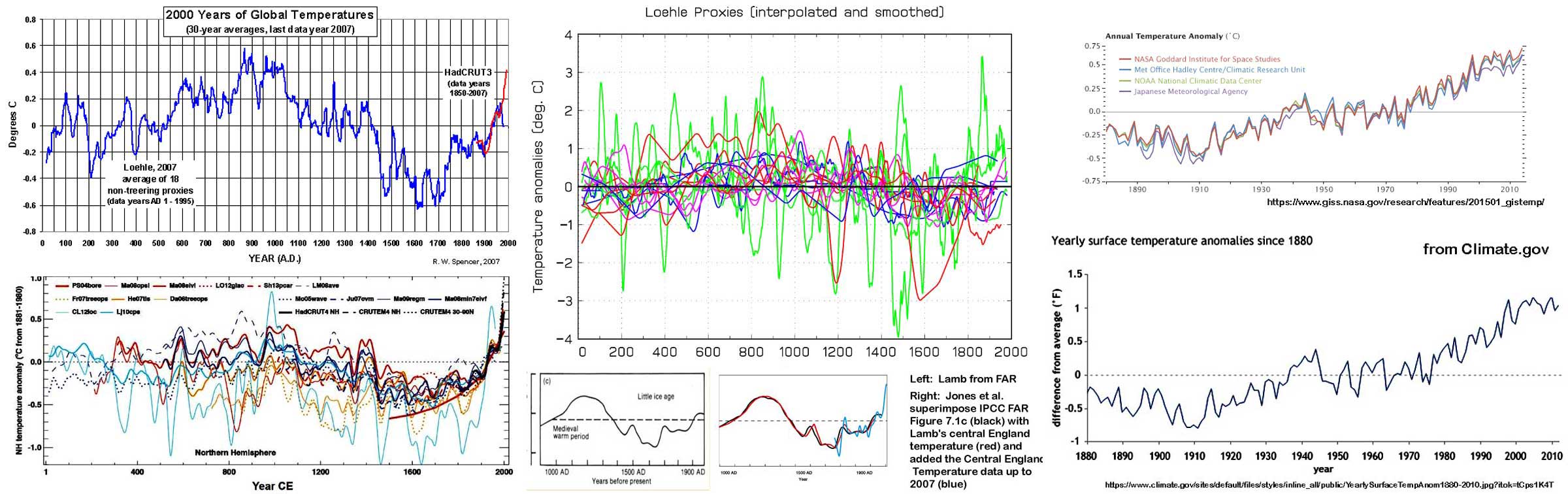
I am perfectly happy to accept that the “world” (the “global climate”) has warmed since the late 1800s. We know that the date of 1880/1890 is picked for the starting point of most of the contemporary consensus view plots — purportedly because it represents “the start of the modern industrial era”, this despite the fact that even the IPCC does not claim that “CO2 induced global warming” started at that date. Let’s take a closer look at Lamb and Lamb_modified_by_Jones:


We all know that Lamb was showing a stylized “schematic” view of Central England temperatures — and Jones 2007 re-does the analysis with very slightly different results, then overlays (in blue) the measured Central England through 2007. This graph contains the seed of my certainty that “global warming is happening” — which, in un-politicized language would be something like: “The Earth’s general climate has warmed since a bit before 1700 CE — i.e., for the last 300+ years.” Here’s Spencer 2007:

And if you prefer, here’s the NOAA version with comparisons of various reconstructions :

They all show cooling to approximately 1650 – 1700 and general warming since then.
From where does my skepticism arise then? Well, there is no more — general warming started about 1650-1700, maybe a little earlier, and has been ongoing. When warming doesn’t start is 1880/1890 — it starts a hundred and fifty to two hundred years earlier — earlier than the start of the increased CO2 output of the modern Industrial Era. This makes me very skeptical indeed of the claim that the industrial revolution and modern warming are intrinsically entwined.
And I think that it is a good thing that it has warmed since 1700. The Little Ice Age years, up thru the 16 and 17 hundreds, were hard times for farmers (and thus whole populations) in North America and Europe, as attested to by contemporary accounts of crop failures and hard winters.

To my knowledge, this point is not controversial or even contested. In the Consensus Worldview, it is simply over-looked and not mentioned. Truthfully, since the facts don’t match the narrative — the narrative that global warming was caused by the start of the Industrial Revolution and its subsequent CO2 emissions — this fact seems to have been down played or ignored.
What does the IPCC say? “Warming of the climate system is unequivocal.” — IPCC AR5 SPM 1.1
Well, I couldn’t agree more — moreover, it has been warming since about 1650-1700, two hundred years before the Industrial Revolution starts pouring out CO2.
What else does the IPCC say? “ … recent anthropogenic emissions of green-house gases are the highest in history.” — IPCC AR5 SPM 1
Again, I don’t disagree:

Without arguing about when “history” began, we can stipulate that the graph the European Geophysical Union gives us is an “accurate enough” picture of CO2 concentrations over the last thousand years. CO2 remains a shaky 275-290 ppm for 800 years and then begins to show a rise around 1850, finally breaking into new territory circa 1880-1890 — the start of the modern Industrial Era. The Wiki offers us the following, again confirming that CO2 does not begin to rise until 1890-1900, long after temperatures begin to rise.

It is simply a fact that atmospheric CO2 concentration has been rising since 1880-1890-1900 (close enough for my purpose today) and that it is now higher than it has been in a long time. Some think that this is a good thing, as it has brought about a resurgence in plant life on Earth’s surface and some think it is a bad thing.
Atmospheric CO2 has been rising — but is there doubt about this? — “ … recent anthropogenic emissions of green-house gases are the highest in history.” ?
While it is not easy to measure atmospheric CO2 concentrations, it has been being done for quite some time….and we have been able to guess about human greenhouse-gas emissions and their sources. [These are naturally abject guesses, but we needn’t argue with them on that account — they are our “best guesses”).
The IPCC’s AR5 includes this graphic:
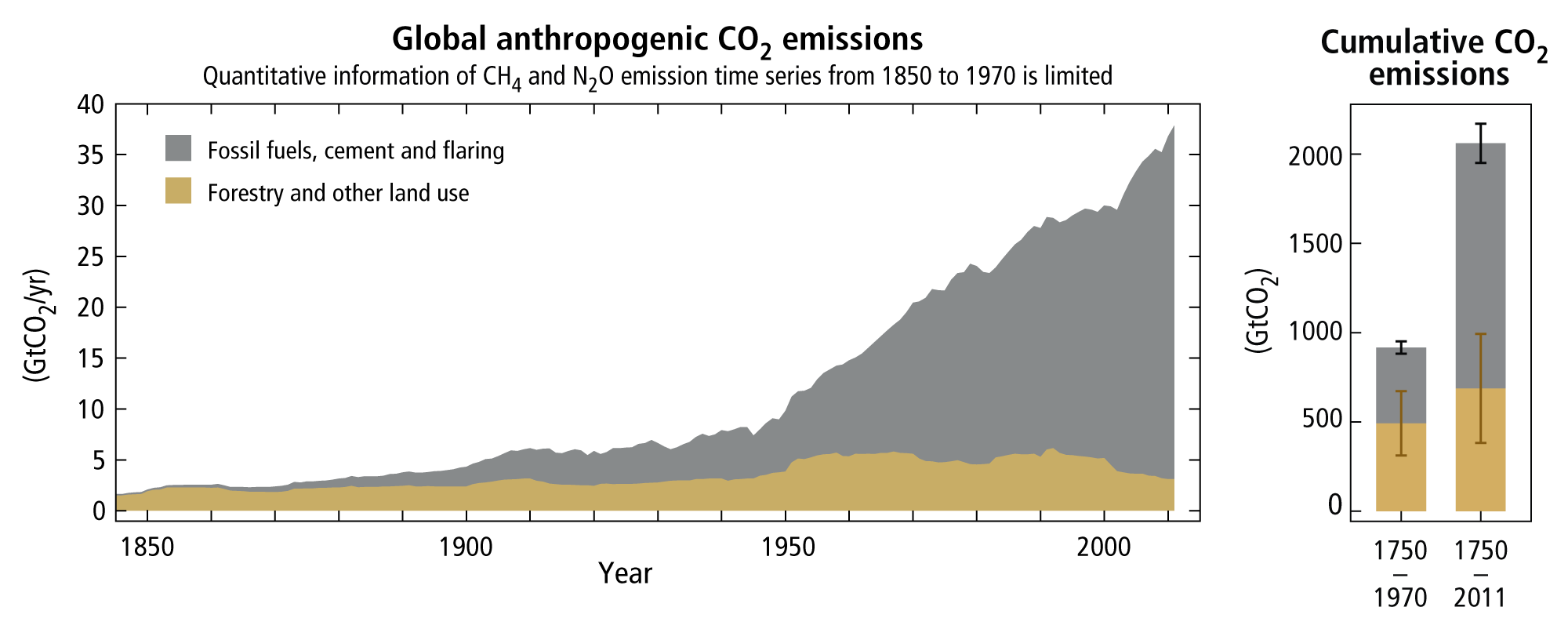

We see that recent emissions are highest, at least in this history, but notice that cumulatively up to 1970 (see the right hand inset bar graph), Forestry and other land use accounts for more than 50% of all CO2 emissions. This surprised even me — I was expecting a pretty big contribution from the clear-cutting and conversion into pasture and farmland of much of Europe and North America east of the Mississippi River — but I had no idea that Forestry and Land Use accounts for >50% all the way to 1970 –and that’s nineteen seventy, not eighteen seventy. By some proxies, global surface temperature had been rising for 300 years by 1970.
Keeping that fact in mind, let’s see what else the IPCC has to say about causes:
“Anthropogenic greenhouse gas emissions have increased since the pre-industrial era, driven largely by economic and population growth, and are now higher than ever. This has led to atmospheric concentrations of carbon dioxide, methane and nitrous oxide that are unprecedented in at least the last 800,000 years. Their effects, together with those of other anthropogenic drivers, have been detected throughout the climate system and are extremely likely to have been the dominant cause of the observed warming since the mid-20th century.”
The IPCC in their synthesis report for policy makers says that human emissions of greenhouse gases and “other anthropogenic drivers,” are “extremely likely to have been the dominant cause of the observed warming since the mid-20th century.”
Well, OK. This is where my Climate Skepticism begins to gain some traction. Dr. Judith Curry, president and founder of Climate Forecast Applications Network, recently offered the following graphic in an essay entitled “Fundamental disagreement about climate change”:

I would have used slightly different points and alternate wordings — but the essence would be the same.
The IPCC Consensus general position is shown on the left — CO2 (and other greenhouse gases) are the primary “forcing” of climate — with changes in CO2 causing changing climate (basically warming) — this warming amplified by feedbacks, like increased water vapor and clouds.
On the right is Dr. Curry’s general view — I share much the same viewpoint. I would have placed place more emphasis this:
Climate is Chaotic: It is composed of highly complex, globally coupled, spatio-temporal chaotic, resonant systems.
So far, I agree with all the facts, but don’t agree that recent CO2 (and other) emissions are “the dominant cause of the observed warming since the mid-20th century.” I agree neither with the attribution of CO2 as dominate or the effect size.
# # # # #
If you aren’t yet bored to tears, you can find out more on my reasons for that in Part 2, to be published in the next day or so.
# # # # #
Author’s Comment Policy:
I have tried to use examples, graphs, that would be generally acceptable to both sides of the Climate Divide, and to avoid controversial minor or fringe sources. I didn’t need to — I am happy with the data presented and that’s Why I Don’t Deny.
I suppose that many readers will disagree with my lack of denial or agree but have different reasons. That is how it should be in a new young field of science like Climate. Feel free to tell all in your comments. I may reply to rational, collegial remarks, questions and requests for clarification.
I am, however, too old to argue.
Address comments to “Kip…” if you expect a response.
# # # # #
The term “climate denier” is so idiotic and bumper-stickerish it can only be one thing…a political label.
The stratosphere is not cooling, and the tropical troposphere is not “trapping heat” as prophesied. End of story. Period. The enhanced greenhouse effect hypothesis is falsified.
Also, only the sun can warm the oceans to any measurable degree. There is no mathematical equation that can explain otherwise.
I’m a denier. Among other things I deny that the Earth is flat and that it is only a few thousand years old. Lots of other demonstrably false claims as well. CAGW is just one of them.
Jim ==> atta’ boy! A denier’s denier! Keep up the good work.
If I were asked, ““Why do you deny climate change?”, then
I might answer, “Your question is absurd?” Absurd questions do not have intelligent answers, so ask me a question that is not absurd, and maybe I can answer it.”
I sense that the question is really intended to be condemnation, disguised as an inquiry. I, therefore, deny the legitimacy of even asking such a question, because I suspect that its intent is NOT an inquiry at all, but bait to lure your censure founded on falsehoods.
I cannot answer such a question, and so I refuse to answer such a question, because the question is a lie. It harbors assumptions that are false. It assumes shared definitions of words or phrases that I do NOT share. It forces definitions onto terms to which I do NOT assign such definitions. It misuses words by omitting clarifying adjectives that give proper, intelligent context.
“Climate” refers to long-term patterns in weather.
“Change” refers to alterations in patterns.
“Climate Change”, then, refers to alterations in long-term patterns of weather. These sorts of CHANGES have always occurred. Nobody DENIES such things, and so, to ask ME, why I deny them is to ask a silly question, since I am one of the MANY (most) who NEVER has and never will “deny” that such changes DO exist and have ALWAYS existed.
So, why would anyone ask me the posed question? Do you truly believe that there are people who do not believe in long-term changes in weather? If no, then ask me what you REALLY mean. Use language correctly. Use clarifying adjectives, and do not assume that I understand how you might understand a particular word that has NEVER been the overriding understanding of this word’s meaning put forth in dictionaries.
What do YOU mean by the word, “climate”? Now ask me whether I agree with YOUR meaning. Once we agree on what YOU mean by “climate”, then we will be on better footing to have a conversation. Until then, according to the general understanding of what your words mean, the question posed is, again, utterly ABSURD.
Now let’s assume by “climate change”, you REALLY mean “human-caused climate change”. If YOU mean this, then YOU need to say this exactly this way, because “climate change” does NOT mean “human-caused climate change” automatically. You cannot just leave out an adjective from a universally understood phrase, and then use just part of what you mean disguised in a question intended as a condemnation to attract a response that allows you to bolster your own beliefs. This is NOT an inquiry. This is a set up for your own self gratification, and so my first response to someone seeking self gratification in such a manner is, “Go F yourself.” I would hope that this latter response adequately answers anyone who might ask me such a question.
Well, well, the CBC always finds the right guy to explain the right things…
https://www.cbc.ca/radio/thesundayedition/the-sunday-edition-august-19-2018-1.4784795/why-so-many-people-practice-denialism-1.4788057
“Climate change is on a lot of people’s minds during this summer of extreme heat and lethal wildfires across the Northern Hemisphere.
People see its devastating effects not as an abstract possibility in some hypothetical future, but unfolding in front of their own eyes. Scientists make ever more dire projections about the decades ahead if substantial reductions are not made to carbon emissions.
That paradox may be due, in part, to the large numbers of people who simply don’t believe that climate change is real in the first place.”
Straw man typical of CBC’s propaganda, this time from some sociologist Keith Kahn-Harris.
Meanwhile weather porn alarmist stance stuck the August 24, 2018 The National edition on hurricane Lane: http://www.cbc.ca/news/thenational/hurricane-lane-downgraded-canadians-still-stuck-in-hawaii-1.4798964
Check at starting at 3:05 in the video how CBC Meteorologist Johanna Wagstaffe will claim that the storm is, you guessed it, “unprecedented”…
Well at least since Iniki in September 1992, Iwa in 1982 etc…
https://en.wikipedia.org/wiki/List_of_Hawaii_hurricanes
I have a question for all those who dread the coming catastrophe: How does an interglacial period develop? Does it not continue to warm until it doesn’t?
Greg: See my comment re: interglacials.
“From where does my skepticism arise then? Well, there is no more — general warming started about 1650-1700, maybe a little earlier, and has been ongoing. When warming doesn’t start is 1880/1890 — it starts a hundred and fifty to two hundred years earlier — earlier than the start of the increased CO2 output of the modern Industrial Era. This makes me very skeptical indeed of the claim that the industrial revolution and modern warming are intrinsically entwined.”
I’d suggest the observational evidence is better than the proxy one, especially as there is large variation around that time in them and Loehle being the outlier coldest
The globe ….
And one for central England ( England didn’t start warming around 1650-1700).
Both show a warming from the late 1800’s, with an oscillating but flat trend before.
Besides didn’t we have an ongoing Little Ice Age between those 2 dates?
If the LIA had it’s coldest period 1650-1700 maybe it was a recovery from the depths of that merged into warming from the start of industrialisation.
“the narrative that global warming was caused by the start of the Industrial Revolution and its subsequent CO2 emissions — this fact seems to have been down played or ignored.”
No the “narrative” is that there was a LIA and there is modern warming.
It appears to me that you are adding one to the other from the deepest depths of the LIA (if one cares to accept Loelhe’s proxies in particular).
Anthony ==> I am puzzled by your comment. The first graph ONLY shows temperatures from 1850 so we can’t know about anything earlier. The second demonstrates my point quite nicely — warming from the beginning of the graph at 1650.

The easiest to see if the multi-sourced NOAA NCDC graph used in the essay:
I have tried to use data acceptable to all sides of the Climate Divide, so that there is no silly bickering about sources.
You may not agree with the NCDC, which is your privilege. But anytime someone insists on claiming that warming began at the beginning of the Industrial Era, they are simply misrepresenting the hard-won knowledge of climate science.
So, if one accepts what the data says — warming began at the end of the LIA (1650-1700), then one has a point to make about the Attribution Question.
Kip: Initially (20years ago), I had no reason to disagree with the prevailing science. It clearly had warmed and, up to that point, scientists enjoyed an honorable status built on several centuries of exceptional work. Bad science inexorably got weeded out in time. I didn’t immediately consider natural variability, although as a geologist and one who had studied paleoclimate in historical geology, I knew we had had ice ages (we didn’t call the whole ~3 million years an ice age at the time – 1950s) and, living on the floor of Lake Agassiz for the first third of my life (Winnipeg) and mapping some of its last ancient shorelines in northern Manitoba where the lake had emptied in a series of sudden episodes with time to re-establish new shorelines before it was gone (Lake Winnipeg and Lake Manitoba are vestiges that remain, although, with isostatic rebound continuing, who knows if they are permanent), I knew the climate of earth had been highly variable.
I discovered, as I began to protest the consensus view of a longtime stable earth climate pre-homo sapiens sapiens (except for the orbital stuff for long term events), that I knew stuff about climate that climate scientists appeared to be just learning. We had the knowledge of radiative physics for over a century, but the “compelling” evidence for a CO2 control knob, seemed to come from James Hansen’s thoughts on Venus’s atmosphere and the “runaway” warming that appeared to have taken hold on that planet’s surface. This was a decent conjecture. But when prominent scientists began to fight rearguard actions to deligitimize the reality of the Little Ice Age and the Medieval Warm Period – historical proof of natural variability of a magnitude that included everything we had seen to date, I began to realize that it wasn’t pure science we were dealing with. And when I began looking into the history of the whole thing and finding that a fellow Manitoban called Maurice Strong – a very smart high school drop out and a lifelong коммунист- was the creator of the Stockholm Conference, The Brazil Earth Summit, the UNFCC, Kyoto, and the IPCC, I began to understand the “rearguard action” and the increasingly bullying tactics of the consensus. Maurice who retired to Beijing and died there:
“…So, in order to save the planet, the group decides: Isn’t the only hope for the planet that the industrialized civilizations collapse? Isn’t it our responsibility to bring that about?”
CO2 (fossil fuels) is indeed the control knob, not for climate but for the people of the earth.
Gary P ==> Thanks for your thoughts.
The “Venus” thing is just plain bad science…..Venus is not hot because of CO2. It just isn’t so.
APOLOGIES ==> To all the readers who have left comments addressed to me….I have priority responsibilities at Church on Sundays that keep me busy until mid-afternoon.
Here now though, and will try to address your concerns starting with new comments (from this time) and oldest comments — burning the candle from both ends. — Kip
Kip
I’m not a churchgoer but respect those who are. I might need you someday. 🙂
An observation I have, however, if one can call it that, is that not too long ago nature sequestered enough of the atmosphere’s CO2 into what we now term fossil fuels. To such an extent that not too long ago I believe atmospheric CO2 dropped to 180 ppm. Dangerously low for the survival of the garden of Eden.
Shortly afterwards, humankind rocked up and discovered fire. Thereafter he discovered how to burn wood animal fats and oils, then dig up coal to burn and eventually drill for oil to burn.
Thanks to these discoveries man flourished, technology accelerated, and by complete coincidence, atmospheric CO2 increased and the planet began to green even in the face of supposed destruction because of man.
Whilst I’m not religious, I find this a ‘miraculous’ coincidence. Astonishing really.
I also happen to believe that when man becomes too big for his CO2 boots; populations do become too big, and life too difficult, there will be a natural adjustment. Possibly plague, pestilence, war etc. but we are far from that now.
I once asked a Geography teacher of mine in the early 70’s whether he believed in God. He said, only to the extent that he put man on the planet to see what would happen.
Hot ==> The rise of Mankind certainly is miraculous, no doubt about that.
Honestly, I don’t know what the best reply to such a question is. They are clearly not an intelligent well-informed person up for a rational debate.
Do your best, and maybe go to the gym more often beforehand, just in case.
When Asked “why do you deny climate change?” I’d reply “for the same reason you stopped beating your wife”.
History is important! Remember, the GW meme started in the the late 19th century with a back of the envelope calculation by Svante Arrhenius . It was way, way off through lack of information.
The idea bounced in and out of style until just prior to the establishment of the World Meteorological Organization in 1950. WMO primarily collected information and records for aviation, planning, and forecasting until the 1970’s. The United Nations Environment Program was founded by Maurice Strong, its first director, as a result of the United Nations Conference on the Human Environment (Stockholm Conference) in June 1972 and has overall responsibility for environmental problems among United Nations agencies but international talks on specialized issues, such as addressing climate change or combating desertification. The The World Meteorological Organization and UN Environment established the Intergovernmental Panel on Climate Change (IPCC) in 1988 specifically to address “human caused” environmental change.
These progenitors resulted in the over arching United Nations Framework Convention on Climate Change. Initially, an Intergovernmental Negotiating Committee (INC) produced the text of the Framework Convention during its meeting in New York from 30 April to 9 May 1992.
All of these organizations were founded and funded to study SOLELY human-caused changes to the climate. Carbon dioxide was seen as a key variable that could be used to instigate global action by forcing more developed countries to subsidize less developed countries to “battle climate change”. or to quote Christina Figueres(2015)
“This is the first time in the history of mankind that we are setting ourselves the task of intentionally, within a defined period of time, to change the economic development model that has been reigning for at least 150 years, since the Industrial Revolution,” to replace “capitalism” with a UN centrally controlled world economy.
Personally I have never denied that the climate is changing nor have have I denied it was warming. I could have made that statement in 1960. As I understand it the climate has been generally warming since the last glaciation, with cold hiccups along the way like the Little Ice Age. For a few years I even was willing to even consider that anthropogenic gas emissions might be playing a roll. However even before being trained as a scientists I have been a skeptic and as my wife says, “he must have data, good data.”
Can’t say what triggered my major skepticism about AGW. I did begin to dig into the whole issue back even before NASA Hansen’s testimony. Now I admit I am not a ‘climate’ scientist. I did begin to “ask questions” about the models, the data, etc, etc. Very few of the answers I received were satisfactory and some caused me to dig deeper. One of the biggest drivers of my skepticism was when I learned that major data sets were being manipulated in such a fashion as to “demonstrate” that the climate was supposedly warming faster than it was. Another was the fact that the original models barely included the influences of the world’s oceans, 75% of the earth’s surface. Then I began to read statements, especially of those associated with the UN, that caused me to question what the real motivation behind the gloom and doom, hyperbolic scenarios being sold to us. It became apparent that regardless of whether AGW was happening or not that the driving force behind what had clearly become an orthodoxy, pseudo- religion was something other than saving the planet.
The greenhouse effect on Earth is as old as the planet itself and is one of the causes of life in it. If the Earth were not able to retain certain gases around it, life as we know it would be impossible. Moreover, the very existence of the Earth’s atmosphere is linked to the greenhouse effect. So talking about the greenhouse effect or global warming is as old a subject as the planet we inhabit. The fundamental question is whether only the action of men will be able to modify the temperature in such a high amount that the hecatomb that some predict or if there are other factors outside the intervention of man will be caused. https://planckito.blogspot.com/2018/08/el-efecto-invernadero-y-el-cambio.html
Scientific evidence:
Past climate reconstructions
using climate proxies
show no evidence of
CO2 levels
leading temperature levels.
Predictions of the future:
Wild guessing
and unproven theories
by government bureaucrats
claim CO2 controls the temperature.
So, who are you going to believe?
(1)
Scientific studies of the past climate
(general findings, as a group of studies),
or
(2)
Wild guess computer games
played by government bureaucrats
whose jobs depend on a coming
climate “crisis”, and who not only
make wrong climate predictions,
but they also control
and frequently “adjust”
temperature data
to make their predictions
look better
(and yet they are still
awful predictions! ) ?
In 21 years of reading about climate science
I have never read or heard anyone
deny that the climate on our planet changes.
Name calling (“climate denier”)
is a tool of smarmy leftists
with not enough intelligence
(or ammunition) to debate
real climate science !
My climate change blog:
http://www.elOnionBloggle.Blogspot.com
For me, the below picture says it all. The is no “global warming”. According to the flawed radiation model of climate, CO2 should be having an equal impact on the globe …. I don’t see it, I see a warming arctic …. the place with the least coverage and most inaccurate measurements. How convenient.
The term climate “denial” is of course, first and foremost, odious in two ways: first by its implied linkage with genocide denials, and second by its equally offensive association with denial as a mental illness, such as being in “denial” of a traumatic event such as death of a loved one.
The term is also ambiguous, vague, confusing and imprecise. Do they mean denial that climate changes at all, or specifically that climate has warmed in the last century or so? Or does it mean denial of human agency in global warming?
Of these three, the first one – denial that climate changes at all, is pure projection and hypocrisy, since it is the warmist-alarmists themselves that take the deeply unscientific null hypothesis, strongly implied if not stated outright in all their narrative, that climate is normally static and that any change is unusual, alarming and must arise from some unusual external agency. Thus it is the warmist-alarmists who are the deniers of climate change in this most general sense.
The second variant – contesting whether last-century warming has happened, is the position only of a minority on the climate skeptic side. While disputing the politically doctored instrumental temperature record, few serious voices on the skeptics side argue no warming in the last century. To do so is to also deny the little ice age (LIA) – with no recent warming there is no LIA. Since the LIA is a major feature of climate skeptic narrative, then alledging this kind of denial is contradictory and confused if not deliberately inaccurate. Again it is the warmists themselves who deny natural fluctuations in climate such as the LIA, MWP and earlier excursions.
The third option is what Judith Curry with logical precision and economy of words describes as the issue of “attribution”. Yes the climate has warmed, but how much of it – if any – is human caused? For most academic climate skeptics this third variant is the true one – disagreement on attribution.
Therefore the use of the term denial / denier in the climate discourse is deeply offensive and also muddled, contradictory and unclear. Its use displays only a wish to either offend and vilify or to cloud and confuse the debate. Its use precludes and serious desire for any constructive scientific dialog.
Kip:
I just wanted to thank you for starting this discussion; the discussion is interesting and, for the most part, civil.
Also, a special thank you to Anthony Watts for sponsoring the discussion on his Web Site; discussions like this are what make this such a great site to visit.
RicDre ==> Anthony will one day be recognized as a Citizen Science Hero…..
Kip – very interesting. What you have demonstrated here is that correlation is shaky.
What has always bothered me is even if correlation were sound, it does not imply causation. I have just never seen anything that looks to me like argument for causation rather than just correlation. Have you ever encountered anything that argues (rather than merely assumes) causation?
John ==> Read historical posts at Dr. Curry’s blog on Attribution — the stickiest question in CliSci. Lots of information and opinions….
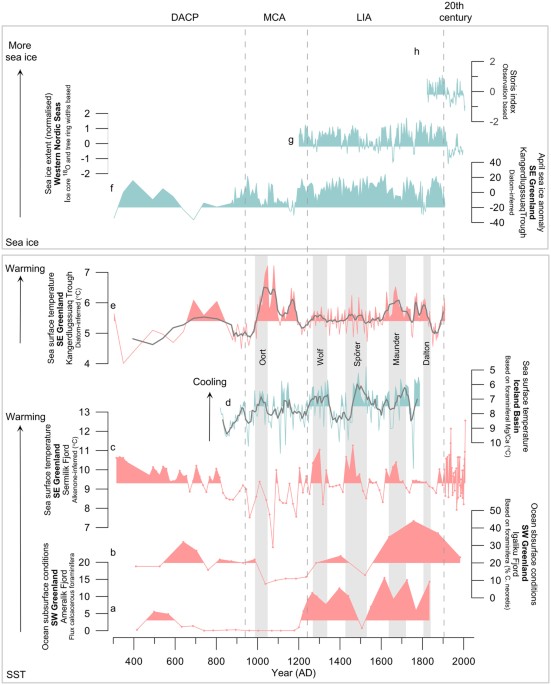
So how much of the big warm spike just after 1000 AD on the NOAA data is the AMO turning very warm during a solar minimum?
Kip: Have you ever considered that both sides in Judith Curry’s “climate control knob” vs “chaos” picture could be right? Of course, chaotic changes in climate could overwhelm the forced signal from rising CO2. They certainly do on the decadal time scale with ENSO. Even the IPCC admitted in the FAR that forced change at that time was comparable to natural variation due to unforced variability (chaos) and “naturally-forced” variability (solar and volcanic). On the other hand, CO2 does slow down radiative cooling to space, which must force to planet to warm on the average. If one has a large enough radiative forcing from rising CO2, climate forcing knob will dominate and chaos will average out – at SOME point and on SOME time scale. The dividing line between these positions depends on climate sensitivity.
Since the FAR, the IPCC has chosen to ignore climate change during the Holocene and assess the contributions of both CO2 forcing and chaos (unforced variability) with AOGCMs. These models don’t produce realistic unforced variability and they currently appear to exaggerate climate sensitivity. Even worst, the climate sensitivity of a model is a consequence of choices may in the ad hoc tuning of a model, a process that is not guaranteed to produce an optimum model.
Frank ==> Bluntly, “nobody knows”. The is what CliSci ought to be working on, “what is causing what?” rather than trying to “prove” the CO2 Control Knob hypothesis.
The state of the science today is: Could be this….could be that….could be both….could be neither.
Kip: Thanks for the reply. I respectfully disagree with: “Could be this….could be that …” That is just evading the issue.
The climate chaos perspective is obviously correct, because chaos produces ENSO and longer variations such as AMO. Today, even the IPCC’s dubious conclusion that at least 50% of current warming is man admits the possibility that the other half is chaos.
However, the Holocene offers no precedent for global changes of 4 K due to natural climate variability. That is close to the difference between glacial and inter-glacial. If AOGCMs are correct that ECS is 3 K/doubling or higher, the CO2 control knob perspective almost certainly will dominate the climate chaos perspective.
The debate WILL BE settled by climate sensitivity and total emissions. Since international cooperation is implausible, total emissions likely will be determined by the rate at which technology finds a replacement for coal.
You are certainly correct that we don’t know what climate sensitivity is. The IPCC (and Judith?) is lacking candor.
Frank ==> “The state of the science today is: Could be this….could be that….could be both….could be neither.”
Not my opinion, it is my opinion on what Climate Science really knows with certainty as to the causes of various climate phenomena over the long-term history.
Kip: Laboratory experiments have accurately measured the interactions between CO2 and thermal infrared radiation. The parameters obtained from those experiments accurately predict the spectra of OLR reaching space and DLR reaching the surface, and how DLR changes with the changing concentration of one GHG, water vapor and with temperature. These parameters predict that a doubling of CO2 will slow down the rate at which thermal infrared reaches space by about 3.7 W/m2. Conservation of energy demands that the planet will warm until its emission to space has risen 3.7 W/m2. IMO, COE and IR spectra are things we know with reasonable certainty.
ECS is equivalent to asking how much the earth must warm to emit another 3.7 W/m2 – after all of the climate chaos has average out. If the Earth were a simple gray body, it would emit an additional 3.3 W/m2/K and warm 1.2 K/doubling. Observations of seasonal change should that the Earth doesn’t behave like a simple gray; it emits about 2.1 W/m2/K of LWR due to positive feedbacks.
The long-term history of climate chaos during the Holocene has been recorded by ice-cores, ocean sediments and less definitive temperature proxies. This evidence shows that climate chaos does have a long-term average and therefore doesn’t drift like a random walk process. (If the drift from random walk process produced 1 K of warming during the previous century, then the expected drift would be 10 K during the last 100 centuries of the Holocene.)
I’ve found that most of the everyday people who are global warming advocates, have no idea what are the mainstream skeptic positions. They prefer to argue against things that almost nobody believes. I suppose that’s easier. Conversely, arguing that CAGW is a hoax, or a fraud, is not the most productive path. Even if it were to be a global wealth transfer scheme cooked up by the UN, it’s an unnecessarily high bar to set to try to prove it.
All that matters is that based on what we know today, radical and expensive actions to reduce carbon emissions are not warranted.
Steve O: In theory, radical and expensive actions to reduce CO2 emissions are warranted if the net present value of future damage due to climate change is higher than the cost of reducing emissions. Our ability to estimate future damage from climate change is limited and choosing the proper discount factor for NPV is challenging. Intuitively, poorer countries that expect their descendants to be much richer than they are will apply a lower discount rate and ivory tower academics who think we have already ruined the planet for future generations will use a high discount rate. A global consensus on CO2 reduction is unlikely.
Epilogue:
My heart-felt thanks to all who read this rather long essay (and will read Part 2 later today).
Quite a few (nearly 600) comments from all over the map — both physically and intellectually.
As a reminder, “feeding the trolls” can sometimes seem fun and entertaining, but it does not add to the conversation, much of it being trading insults and competing “talking points” of the Climate Wars.
I was surprised and pleased that there has been almost no push-back on my acceptance of various data facts on the climate issue — to me this shows that Climate Skepticism is maturing.
Thank you for reading.
# # # # #
I am in full and complete denial that even if everything the alarmists say is true, that higher taxes, windmills, and wealth transfers will solve the problem. In fact, wealth transfers to poor “vulnerable” countries would only make the global warming problem worse as their new spending would be guaranteed to increase carbon emissions. It’s not hard to imagine governments getting on board with something that justifies higher taxes.
Actions that result in the expenditure of resources need to be justified on the basis that the expected benefit should exceed the expected cost. There is nothing anywhere that justifies radical action.
There is this idea that if warming is caused by mankind and is dangerous that it should be abated. That fails the test of logic. If warming is dangerous AND IF we can do something worthwhile about it, then it should be abated whether or not mankind is the cause. Global warming mitigation strategies rely on the assumption that it is possible. Where is the evidence for that? And where is the evidence that the benefits exceed the costs? An editorial in the WSJ a long time ago estimated that the Kyoto accords would cost $10 Trillion dollars, and that the benefit would be that we reach the same levels of warming anyway, with a six year delay. Does that sound like the benefits justify the costs?
Maybe instead of blowing our wad trying to interrupt the global climate cycle, we should expend resources adapting to it.
“Why do you deny climate change?”
It has nothing to do with climate, nor even weather.
‘Climate change’ is orthodoxy. You reject their orthodoxy. That is primal sin.